e-ISSN: 2278-7461, p-ISSN: 2319-6491
Volume 5, Issue 5 [May 2016] PP: 49-54
Ultrasonic Destruction Of Yeast Cells In Water Dispersion
V. Starchevsky, N. Bernatska, I. Typilo
Department of general chemistry Lviv Polytechnic National University St. Bandera, 12, Lviv, Ukraine 79013
Abstract
: The influence of ultrasound on a decrease of the number of colonies of microorganisms and chemical oxygen demand has been investigated. Oxidation of organic compounds proceeds according to the first order reaction during sonication and destruction of microorganisms proceeds according to the pseudo-second order process. A mathematical model of ultrasonic degradation of yeast aggregate was proposed.Keywords: ultrasound, destruction of microorgnisms, yeast aggregate, kinetic of reaction, oxidation of organic compounds.
I.
I INTRODUCTION
Ultrasound is a very effective source of energy for degradation and dispergation of material which are widely used in technological processes for obtaining of paints, magnetic materials, metal particles etc [1, 2]. Its application in chemical and biological processes is limited by a rise of many different reactions under the high energy with a formation of great quantity of products [3, 4].
Ultrasound can be used for enhanced of sludge decomposition at biological wastewater treatment [5 – 7]. Sludge floccules have been broken at short sonication times with formation of small size particles stabilized in water [8]. An increase of quantity of microorganisms in a unite volume of dispersion leads to the intensification of methane elimination in anaerobic treatment of microorganisms in sludge [6, 8] or carbon dioxide in aerobic condition [9]. Therefore concentration of vitae microorganisms in water and soluble organic substances is increased at their treatment by ultrasound.
Sonication of well-dispersed microorganisms leads to their partial or full destruction [10, 11]. Reduction of bacteria E. coli concentrated in the caviting jet due to the cavitation generated till 1000 times was observed [10]. The concentration of Saccharomyces cerevisiae during ultrasonic treatment is decreased by the pseudo first order process [11]. The rate constant of microorganism’s inactivation as a function of the vibration amplitude was similar to that of hydrogen peroxide formation in the distilled water. The inactivation of microorganisms can be connected with their treatment by hydroperoxid radicals formed from water in the result of growth and collapse of microscopic bubbles under the cavitation conditions [2, 12].
Cytologic investigation of Saccharomyces cerevisiae treated by ultrasound [10] showed that main changes were observed inside of cells. Mechanical deformation and partial destruction of nuclea, vacuola structures are taken place in a short time of sonication. The cell walls are broken and the cell content is washed away at the second stage of the ultrasonic treatment. Further oxidation of organic substances is proceeded by the pseudo-first order reaction [9]. There is need to note that the rate constant of this reaction depends on the strength of bonds between hydrogen and carbon atoms in organic compounds or their redox potencial. The oxidation of methyl violet in aqueous solutions during ultrasonic treatment is proceeded according to the pseudo-first order. However the rate constant is decreased greatly when the initial concentration of substance is increased [12]. The destruction of metallophthalocyanines in the presence of CHCl3 and hydrogen peroxide during sonication is the
radical reaction [10]. Radicals •OH, Cl• and CH2Cl•2 are formed during the reaction of decomposition of
hydrogen peroxide.
The aim of our investigation was comparison of the mechanical influence of ultrasound on the destruction of Saccharomyces cerevisiae colonies in dispersion and products of their decomposition and also on the decrease of chemical oxygen demand of dispersion of microorganisms. The creation of ultrasound treatment model for the complex of microorganisms and glucose oxidation.
II.
EXPERIMENTAL PART
dispersion with distilled water. The obtained dispersion contained 1-8% of dry Saccharomyces cerevisiae. Chemical oxygen demand (COD) and the most probable number (MPN) of vitable microorganisms were investigated in each sample. COD was studied by standard method (EPA method 410.4). The MPN was determined by surface planting on the meat-peptone agar medium before and after treatment. Two plates were used for each dilution and incubated at 370C for 48 h. The influence of ultrasound was measured for 4 different concentrations of yeast cells at different treatment time and at 360C. Analysis of samples was described above. The microphotograph experiments were prepared by electronic transmission microscope PEM-100. Radius of yeast aggregates in dispersion was determined by sedimentation method.
III.
RESULT AND THEIR DISCUSSION
Investigations of the number of vitable microorganisms in unite volume of dispersion after dispergation of dry Saccharomyces cerevisiae during sonication have shown (Fig. 1), that their concentration were increased during first 30 minutes till maximum. Then their quantity were sharply decreased in comparison with untreated cells.
1 2 0,0E+00
2,0E+06 4,0E+06 6,0E+06 8,0E+06 1,0E+07 1,2E+07 1,4E+07 1,6E+07 1,8E+07 2,0E+07
0 10 20 30 40 50 60 70
t, min
М
P
N
Figure1. Dependence of the number of vitable Saccharomyces cerevisiae in the unite volume of dispersion on time during sonication (1) and without it (2). Initial concentration of yeast was 1,6 g/l.
It is a need to note that the part of microorganisms was viable in this condition. Investigation of aggregate size by sedimentation method showed (Fig. 2) that average radius of aggregates found by the sedimentation method was decreased during 30 min of sonication. This coincide with results of microphotograph experiments
.
3 12
0,00E+00 5,00E-05 1,00E-04 1,50E-04 2,00E-04 2,50E-04 3,00E-04 3,50E-04
0 5 10 15 20 25 30 35
t, min
Figure2. The change of the radius of the aggregate of yeast dispersion in time during sonication. Initial concentrations of yeast in aerobic condition were 1.6 (1), 4 (2) and in anaerobic condition (3)
Mechanism of destruction of agglomerates of microorganisms can be described taking into account that the ultrasound energy is spent on the formation of a new surface of contact with media when aggregate is broken. Volume of aggregate can be calculated according to equation:
V = 4πR3/3 (1)
where R is the radius of aggregate found by the sedimentation method. The number of aggregates in the unit volume of dispersion is equal to: N = c/(Vρ) (2)
where c is the initial concentration of Saccharomyces cerevisiae in dispersion (g/l), ρ is the density of swelling microorganisms.
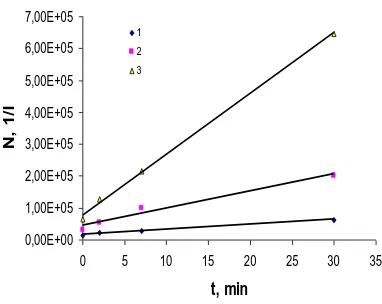
Fig. 3 shows that the number of aggregates of microorganisms in the unit volume of dispersion rises up practically linear in time till 30 min. It coincides with microbiological data (Fig. 1). The rate of new aggregate formation is increased when the initial concentration of Saccharomyces cerevisiae in dispersion is increased.
0,00E+00 1,00E+05 2,00E+05 3,00E+05 4,00E+05 5,00E+05 6,00E+05 7,00E+05
0 5 10 15 20 25 30 35 t, min
N
,
1
/l
1 2 3
Figure3. Dependence of the number of aggregates of Saccharomyces cerevisiae in the unit volume in time during ultrasonic irradiation. Initial concentrations of yeast were 1,6 (1), 4 (2) and 8 (3) g/l.
Taking into account that elimination of ultrasound energy is constant in time; the rate of formation of new surface of aggregate at its distraction is proportional to the surface area participating in the formation of bonds between particles in aggregate:
dSn/dt = − kSnN (3)
where k is the rate constant of new surface area formation;
Sn is the surface participating in bonds formation between particles in aggregate in unit volume of
dispersion.Equation (4) can be obtained by integration of equation (3): ln(Sn/Sn0) = − kt (4)
where Sn0 is initial surface participating in bonds formation between particles in aggregate in the unit
volume of initial dispersion.
Sn = N1S1 – NSa (5)
where N1 is the whole number of microorganisms in aggregate or simple bacteria;
S1 is the surface area of one simple bacteria;
Sa is outside surface area of cell aggregate.
Sa = 4πR 2
where N0 and R0 are the initial concentrations of aggregates in dispersion and their radius.
Fig. 4 shows that the experimental data or the concentration of aggregates of microorganisms and their radius lie on the straight lines in the coordinates of Eq.(7).
-2
-1,5
-1
-0,5
0
0
10
20
30
40
t, min
ln
(
1
-4p
NR
2 /(
N
1
S
1
)) 8 g/l
4 g/l
1,6 g/l
Figure4. Dependence of the number of Saccharomyces cerevisiae aggregates in the unit volume of dispersion in time in coordinates according to Eq. (7). Initial concentrations of yeast were 4(1), 1.6 (2) and 8 (3) g/l. The rate constants k (Table 1) for different initial concentration of cells in dispersion are close each to other. Correlation coefficient of the straight lines are higher than critical (0.878) for significance level (0.05)Therefore the mathematical model describes the process of decomposition of aggregates with new surface formation.
Table 1 Correlation coefficient and rate constants of dispersion of aggregates of microorganisms under ultrasonic treatment
c, g/l R ln(1 − 4π N0R 2
0/(N1S1) k, s
-1
8.0 0.988 0.47±0.05 0.029±0.002 4.0 0.961 0.63±0.07 0,030±0.004 1.6 0.987 0.60±0.05 0,026±0.004
Soluble organic compounds or cell walls are oxidized evidently during sonication in the first stage of the process.
Figure5. The change of COD of yeast dispersion in time during ultrasonic irradiation in anaerobic condition (1), in aerobic condition (2) and at the oxygen bubbling through dispersion (3). Initial concentration of yeast 1,6 g/l. Fig. 6 shows that experimental data of glucose oxidation during sonication proceeded according to the first order reaction. The rate constant of the process is equal to 0,988 that is higher than critical. An increase of oxygen concentration can lead to an increase of reaction rate according Eq. (7). Figure 6 shows that oxygen bubbling by dispersion increases to its concentration in media and the oxidation rate.
It is a need to note that the oxidation rate of glucose is higher than microorganisms’ dispersion at equal concentrations.
1
2
-0,012 -0,01 -0,008 -0,006 -0,004 -0,002 0
0 10 20 30 40 50 60 70
t, min
lg(
CO
D/
CO
D0
)
Figure6. Semilogariphmic dependence of COD of glucose solution in time during sonication. Initial concentration of glucose were 1.6 (1) and 160 g/l (2).
It can be connected with heterogenic media of yeast dispersion. Oxidation of microorganisms proceeds evidently on their surface because oxygen inside microorganisms is bounded with metal organic complex and it is low active in radical processes. Moreover oxygen concentration inside microorganisms is lower than outside of them.
The investigation of microorganisms oxidation during sonication showed that this process proceeded according to the pseudo second order reaction (Fig. 7).
1 2
3 4
0 0,0001 0,0002 0,0003 0,0004 0,0005 0,0006
0 10 20 30 40 50 60 70
t, min
(1
/C
O
D)
-(1
/C
O
D0
)
Figure7. Dependence of COD of yeast dispersion in time in coordinates of the second order process at oxygen bubbling (1, 2) and in aerobic condition (3, 4). Initial concentration of dry Saccharomyces cerevisiae were 1.6
(1, 3) and 8 g/l (2, 4).
Table 2 Correlation coefficient and rate constants of yeast dispersion under ultrasonic treatment in different condition
c, g/l conditions R k
1.6 anaerobic −
1.6 aerobic 0.981 6.767∙10-6
8 aerobic 0.994 8.670∙10-6
1.6 oxygen bubbling 0.999 3.954∙10-6 8 oxygen bubbling 0.998 4.057∙10-6
IV.
CONCLUSION
Ultrasonic technology is an effective method to enhance clusters of microorganisms decomposition and to increase of the concentration of vitable microorganisms in dispersion as well as the rate of biological processes. Mathematical model which describes decomposition of yeast aggregates with formation of single microorganisms or small cells aggregates during sonication is proposed. Oxidation of solved organic compounds during sonication proceeds according to the pseudo first order reaction and can be described by well known theory. Dispersion of microorganisms is heterogenic system and its oxidation proceeds according to pseudo second order reaction evidently only on the cell surface.
V.
ACKNOWLEDGMENTS
This work was supported by Lviv Polytechnic National University and Department of general chemistry
REFERENCES
[1] Goncharuk, V. Use of Ultrasound in Water Treatment. Journal of Water Chemistry and Technology. 2008. Vol. 30, № 3 (1). pp. 137–150.
[2] Chisti, Y. Sonobioreactors: using ultrasound for enhanced microbial productivity. Trends in Biotechnology. 2003. Vol. 21, №2. pp. 4–6.
[3] Nasseri, S. Determination of the ultrasonic effectiveness in advanced wastewater treatment. Environmental Health Science Engeneering. 2006. Vol. 3, Issue 2. pp. 109–116.
[4] Kalumuck,K. Remediation and disinfection of water using jet generated cavitation. Fifth International Symposium on Cavitation, 2003. pp. 5–12.
[5] Mason, T. New Evidence for the Inverse Dependence of Mechanical and Chemical Effects on the Frequency of Ultrasound. Ultrasonics Sonochemistry. 2011. Vol. 18. pp. 226–230.
[6] Jambrak, A. Effect of Ultrasound Treatment on Particle Size and Molecular Weight of Whey Protein. Journal of Food engineering. 2014. Vol. 121. pp. 15–23.
[7] Chemat, F. Appliction of Ultraound in Food Technology: Processing, Preservation and Extraction. Ultrasonics Sonochemistry. 2011. Vol. 18, Issue 4. pp. 813–835.
[8] Gao, S. Inactivation of Microorganisms by Low-frequency high-power Ulrtasound: A Simple model for the inactivation mechanism. Ultrasonics Sonochemistry. 2014. Vol. 21, Issue 1. pp. 454–460.
[9] Vasilyak, L. Ultrasound Application in Systems for the Disinfection of Water Surface Engineering and Applied Electrochemistry. 2010. Vol. 46, Issue 5. pp. 489–493.
[10] Madhu G. Cavitation Techniques for Wastewater Treatment: A Review The IUP Journal of Chemical Engineering. 2010. Vol. 11. Issue 3. pp. 58–79.
[11] Jomdecha C. The research of low-ultrasonic energy affects to yeast growthin fermentation process. 12th A-PCNDT 2006 – Asia-Pacific Conference on NDT. 2006., pp.6.