e-ISSN: 2278-067X, p-ISSN: 2278-800X, www.ijerd.com
Volume 11, Issue 12 (December 2015), PP.13-18
Comparative Performance Evaluation of Cool Season Vegetables
under Poly house Structure and in Open field
Bini Sam
1, S. Regeena
2 1Associate Professor (Agrl. Engg), Farming Systems Research Station, Kerala Agricultural University, Sadanandapuram, Kottarakkara
2Professor and Head, Farming Systems Research Station, Kerala Agricultural University,
Sadanandapuram, Kottarakkara
Abstract:- An investigation on evaluation of cool season vegetables such as cabbage and cauliflower with respect to vegetative and yield parameters was carried out under naturally ventilated poly house and in open field condition at Farming Systems Research Station, Sadanandapuram, Kottarakkara, Kerala, India. Highest yield was recorded in poly house structures than in open field for cabbage and cauliflower. The increase in yield was to the tune of 99.32% and 163.58% for cabbage and cauliflower respectively and shelf life better in poly house. Height of cabbage plant is higher in poly house structure than in open field. However, number of leaves per plant was same inpoly house structure and in open field condition. Higher height of plant and more number of leaves are observed in poly house structure than in open field for cauliflower. No pest and diseases incidence was observed in poly house structures for cabbage and cauliflower. However, grass hopper, cater pillar and snail affect these plants in open field. It was found that micro climatic parameters were varied between poly houses and outside. Photosynthetically active radiation inside the poly house was reduced by about 50% compared to the outside (i.e. open field) while air and soil temperatures were always remained higher. The relative humidity was less in poly house structure compared to outside the structure (5-8% increase in outside).Soil under poly house always maintained a 2-3ºC higher temperature as compared to the temperature at the outside soil at all growth stages of crop. Cultivation of cabbage in a poly house was found to be highly feasible as reflected in higher values of BCR (2.67) followed by cauliflower with B: C ratio 1.51.
Keywords:- cabbage; cauliflower; poly house structure; yield; micro climatic parameters; B: C ratio
I.
INTRODUCTION
In conventional agronomical practices, the crops are being grown / cultivated in the open field under natural conditions where the crops are more susceptible to sudden changes in climate i.e. temperature, humidity, light intensity, and other conditions such as pest and diseases due to which the quality, yield of a particular crop can get affected and may be decreased. Poly houses/ green houses are frames of inflated structure covered with a transparent material in which crops are grown under controlled environment conditions throughout the season irrespective of the natural conditions outside. This technology helps for off season production of vegetables. In Kerala this technology is being adopted by many of the farmers.
Protected cultivation is gaining importance in the recent past, owing to its perpetual demand throughout the year. Polyhouse production has already been proven as profitable and production under protection has attracted much attention in recent years [1].
Demonstration of low-cost polyhouse production technology will attract even the younger educated generation to adopt it as a rewarding enterprise. This will also help in adoption of the technology by more farmers and augment vegetable and cut flower production in the district. In this study, vegetable crops such as cabbage and cauliflower were tested under protected conditions inside the polyhouse and were compared with their performance under open conditions. Various microclimatic parameters and biometric observations and yield were recorded for performance evaluation.
II.
MATERIALS AND METHODS
Gable type poly house structures with double vent each having an area of 96 m2 (width of structure -6m and length of structure- 16m) with natural ventilation have been constructed at FSRS farm (Fig.1). Gable shaped ploy house structure oriented in north-south direction has facility to provide natural ventilation ( > 30% effective side ventilation and > 9% effective roof ventilation) is most suitable to Kerala conditions since it permits reduction of temperature and relative humidity and replacement of carbon dioxide deficiency.
quality of produce [3]. Natural ventilation system combined with fogging (only during peak hours) can provide a good degree of environmental control.
Green house monitor with sensors for measuring micro climatic parameters such as air temperature at different heights, relative humidity, soil temperature at different depths, leaf temperature, solar radiation and outside climatic parameters have been installed.
Fig.1: Naturally ventilated Gable type poly house structures
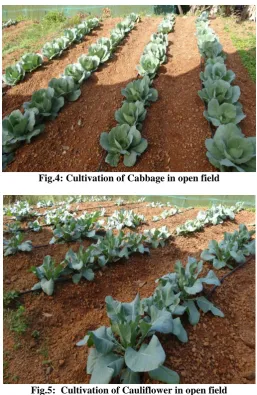
The experiment was laid out in poly house (Fig.2 & 3) and in open field condition (Fig.4 &5) for cabbage and cauliflower.
Fig.2: Cultivation of Cabbage in poly house structure
The selected variety of cabbage was F1hybrid NS43 (Namdari) and for cauliflower the variety was F1hybrid
NS60N (Namdari). Plant characteristics and micro climatic parameters are recorded. Two trials have been conducted. Fertilizers are applied as per Adhoc recommendation of KAU. Water soluble fertilizers are used.
Fig.4: Cultivation of Cabbage in open field
Fig.5: Cultivation of Cauliflower in open field
III.
RESULTS AND DISCUSSION
A. Performance Evaluation of cabbage
Table 1 shows the growth characters like plant height and number of leaves/plant in poly house structure and in open field condition.
Table 1: Growth characters of cabbage
Days after planting Plant height ( cm)
No. of leaves/ plant
Poly house
Open field Poly house Open field
15 DAP 5.5 4.5 4 4
30 DAP 9.5 9.0 7 7
45 DAP 14.5 12.0 12 10
60 DAP 23.5 20.5 16 16
The result reveals that theheight of cabbage plant is higher in poly house structure than in open field. However, number of leaves per plant was same inpoly house structure and in open field condition.
tune of 99.32% over open condition. Earlier flowering of the crops was observed in poly house structure and shelf life better in poly house.
Table 2: Yield Attributes of cabbage
Yield attributes Poly house Open field
Yield/cent ( Kg) 151.64 76.08
Yield/plant( Kg) 0.885 0.68
Duration for flowering 60-62days 62-65 days
Pest and diseases incidence was not observed in poly house structures for Cabbage in first trial. However, grass hopper and snail affect these plants in open field. In second trial, cater pillar affected some of the plants in poly house. However timely control measures were under taken to control the attack of these pests.
Beauveria 20 grams/litre was sprayed to control the attack of cater pillar. In the open field in second trial, the plants show the incidence of cater pillar and snails. Beauveria 20 grams/litre was sprayed to control the attack of cater pillar in open field.
B. Performance Evaluation of Cauliflower
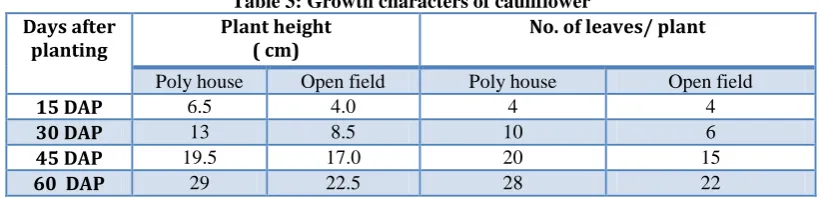
Higher height of plant and more number of leaves are observed in poly house structure than in open field (Table 3).
Table 3: Growth characters of cauliflower
Days after planting
Plant height ( cm)
No. of leaves/ plant
Poly house Open field Poly house Open field
15 DAP 6.5 4.0 4 4
30 DAP 13 8.5 10 6
45 DAP 19.5 17.0 20 15
60 DAP 29 22.5 28 22
Table 4 shows the yield attributes of cauliflower in poly house and in open field.
Table 4: Yield Attributes of cauliflower
Yield attributes Poly house Open field
Yield/cent ( Kg) 121.25 46
Yield/plant( Kg) 0.70 0.44
Duration for flowering
60-62days 62-65 days
Highest yield was recorded in poly house structures than in open field. The total yield / cent was 121.25 kg in poly house structure while it was 46 kg in open yield. The increase in yield was to the tune of 163.58% over open field. No pest and diseases incidence was observed in poly house. However, grass hopper and snail affect these plants in open field. The per plant yield of cauliflower was 0.70 kg and 0.44 kg in poly house and in open field respectively.
Earlier flowering of the crops was observed in poly house structure. Shelf life is better in poly house than open field.
C. Evaluation of microclimatic parameters
Fig.6: Variation of solar radiation in poly house and open field
Fig.7: Variation of soil temperature in poly house and open field
Fig.9: Variation of relative humidity in poly house and open field
D. Economics
The present study examined the economic viability of production of cabbage and cauliflower in poly house. The cost of cultivation of each crop such as cabbage and cauliflower assessed and the benefit cost ratio was calculated [2] . Two trials were conducted for each crop. The total cost of cultivation was divided as fixed cost and variable cost. Among the total cost of cultivation, the proportion of total fixed cost was highest (Rs. 139182) compared to total variable cost (Rs. 9632/-) of cabbage production under protected conditions. Similarly, the proportion of total fixed cost was (Rs. 139182) for cauliflower, while the variable cost was Rs. 9157/-. Among the variable costs, the labour cost was highest followed by expenditure on material cost.
Cultivation of cabbage in a polyhouse was found to be highly feasible as reflected in higher values of BCR (2.67) followed by cauliflower with B: C ratio 1.51.
IV.
CONCLUSION
Highest yield was recorded in poly house structures than in open field for cabbage and cauliflower. The increase in yield was to the tune of 99.32% and 163.58% for cabbage and cauliflower respectively. No pest and diseases incidence was observed in poly house structures for cabbage and cauliflower. Photosynthetically active radiation inside the poly house was reduced by about 50% compared to the outside (i.e. open field) while air and soil temperatures were always remained higher. The relative humidity was less in poly house structure compared to outside the structure (5-8% increase in outside).Soil under poly house always maintained a 2- 3ºC higher temperature as compared to the temperature at the outside soil at all growth stages of crop. Year round cultivation of vegetables even under the extreme climatic conditions is possible using these structures. However the performance of the crop was better in cool season. Better quality of produce, high yield and minimizing pesticides can be ensured. Efficient use of water and fertilizer can be achieved. Continuous monitoring of crops is needed inside the poly house.
REFERENCES
[1]. P Aruna and I P Sudagar, Evaluation of capsicum varieties under play house conditions, The Asian Journal of Horticulture, 2010, vol.4(2) , p.336-337
[2]. D S Sreedhara, M G Kerutagi, H Basavaraja, L B Kunnal and M T Dodamani,Economics of capsicum
production under protected conditions in Northern Karnataka, Karnataka J. Agric. Sci., 2013, vol. 26 (2), p. 217-219