Volume 12, Issue 10 (October 2016), PP.70-81
“Generation of A Learning Pathway for A Learning Material”
Juhi K Gor
1, Nidhi A Doriya
21Mtech Student of Computer Department, Gujarat University1 2
Mtech Student of Computer Department, Gujarat University2
Abstract
The Metadata for educational resources helps to understand the details of learning object used on a website. From the IEEE Learning Object Metadata there are various metadata which we can extract automatically. Still there are metadata like interactivity type, interactivity level and Learning Path for which automatic extraction is not identified. Our research will also focus on the automatic extraction of the learning path. Learning Path will help Students to know the pre study and post study topics and it will help teachers to explain the topic by going through sequence.
Keywords:- Web-based learning, Learning material, e-Learning, Learning path, Pre study topics, Pre learning topics, Post learning topics, Post study topics, Learning object, Learning Object Metadata
I.
INTRODUCTION
Learning path generation is our research area. One topic has many pre learning and post learning topics. That describes a Learning Path of that particular topic. We are generating learning path for topics. Metadata for educational resources helps to understand the details of learning object used on a website. Each student has different grasping power and has different choices for studying. Same way for teachers, it’s difficult to find best suitable material with respect to the students’ pre knowledge and interest. By going through learning path it will be easy to understand topics for students. And for teachers it will be easy to explain.
Learning Object
A learning object is "a collection of content items, practice items, and assessment items that are combined based on a single learning objective".
Learning objects go by many names, including content objects, chunks, educational objects, information objects, intelligent objects, and knowledge bits, knowledge objects, learning components, media objects, and reusable curriculum components, reusable information objects, and reusable learning objects, testable reusable units of cognition, training components, and units of learning.
Examples of Learning object
The best way to understand what a learning object is, and why they matter, is to look at examples. Following are some examples of learning objects:
Electronic calculators Animations
Tutorials Text entries Bibliographies Audio clips Video clips Quizzes Photographs Illustrations Diagrams Graphs and charts Maps
Assessments
Learning Object Metadata
Learning Object Metadata (LOM) is a metadata standard to describe educational resources. LOM is a data model, usually encoded in XML, used to describe a learning object and similar digital resources used to support learning. It is nothing but a description of a learning object.
Metadata standards
It is recommended that the learning objects should be associated with some common metadata standard. Some metadata standards are listed below:
IEEE LOM, http://ltsc.ieee.org/wg12/index.html DCMI, http://dublincore.org/
IMS, http://www.imsglobal.org/
SCORM, http://www.adlnet.gov/scorm/index.cfm CanCore, http://www.cancore.ca/
ADL, http://www.adlnet.org We are going to focus on IEEE LOM.
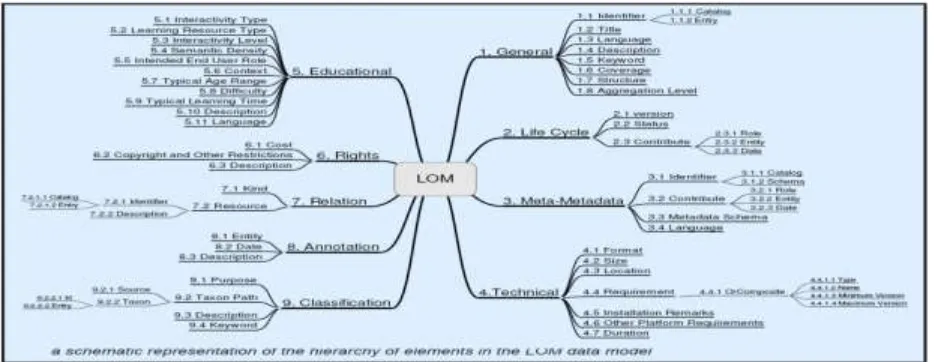
IEEE Schematic representation of the hierarchy of elements in the LOM data model
The LOM comprises a hierarchy of elements shown in figure. At the first level there are nine categories, each of which contains sub-elements; these sub-elements may be simple elements that hold data, or may themselves be aggregate elements, which contain further sub-elements. The semantics of an element are determined by its context: they are affected by the parent or container element in the hierarchy and by other elements in the same container.
Fig.1: IEEE Schematic representation of the hierarchy of elements in the LOM data model
Categories of metadata
There are nine categories of IEEE LOM. They are described below.
Table I: Categories of IEEE LOM
Metadata category Description of contents
1. General Descriptive information of the learning object as a whole, such as: identifier, title, language, description, keyword, coverage, structure, aggregation level.
2. Life-cycle Elements related to the creation or revision history of the learning object as well as information about those who have contributed to the development, creation, revision of the learning object. 3. Meta-metadata Information regarding the creation of the metadata record.
4. Technical The category consists of elements that describe the technical characteristics of the learning object such as the format, size, location and technical requirements.
5. Educational The educational category aggregates elements regarding pedagogical and educational information about the use of a learning object. Such elements include: Interactivity type, Learning resource type, Interactivity level, Semantic density, Audience or Intended end user role, Context, Typical age range, Difficulty, Typical learning time, Description, Language.
6. Rights The rights category includes information regarding the intellectual property rights and conditions of use of the learning object.
7. Relation The relation category presents information about the relationship of the described learning object with other objects.
8. Annotation The annotation category provides a comment regarding the use of learning objects.
9. Classification The classification category classifies the content of the learning object based on an appropriate classification system.
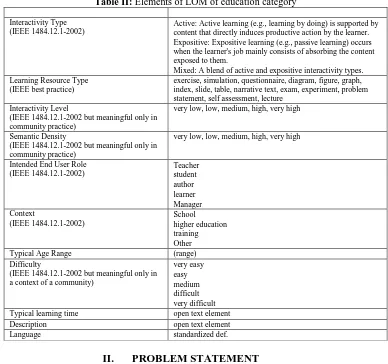
Elements of learning object metadata of education category
There are following elements of learning object metadata of education category.
Table II: Elements of LOM of education category
Element Description
Interactivity Type (IEEE 1484.12.1-2002)
Active: Active learning (e.g., learning by doing) is supported by content that directly induces productive action by the learner. Expositive: Expositive learning (e.g., passive learning) occurs
when the learner's job mainly consists of absorbing the content exposed to them.
Mixed: A blend of active and expositive interactivity types. Learning Resource Type
(IEEE best practice)
exercise, simulation, questionnaire, diagram, figure, graph, index, slide, table, narrative text, exam, experiment, problem statement, self assessment, lecture
Interactivity Level
(IEEE 1484.12.1-2002 but meaningful only in community practice)
very low, low, medium, high, very high
Semantic Density
(IEEE 1484.12.1-2002 but meaningful only in community practice)
very low, low, medium, high, very high
Intended End User Role (IEEE 1484.12.1-2002)
Teacher student author learner Manager Context
(IEEE 1484.12.1-2002)
School higher education training Other Typical Age Range (range) Difficulty
(IEEE 1484.12.1-2002 but meaningful only in a context of a community)
very easy easy medium difficult very difficult Typical learning time open text element Description open text element Language standardized def.
II.
PROBLEM STATEMENT
One Learning Material covers many topics and concepts. For e-learners, it will be difficult to understand particular topic without properly knowing its prerequisites topics. A Learning Path Way of a topic is needed by going through which learner can easily get solutions for their problems with clear understanding.
III.
PROPOSED MODEL
Learning pathway is described as the chosen route, taken by a learner through a range of (commonly) e-learning activities, which allows them to build knowledge progressively. With learning pathways, the control of choice moves away from the tutor to the learner. "The sequence of intermediate steps from preconceptions to target model form what Scott (1991) and Niedderer and Goldberg (1995) have called a learning pathway.
Learning Pathways will give a learner answers for many questions, which are described below.
When a Lerner studies a topic, they have particular purpose in mind, which means they need to narrow their
topic. How might they narrow that topic?
When a learner studies a topic, they need to research it and need to find sources which will give them great information. What sources could give them great information about that topic?
When a learner studies a topic, they use key words which are important for understanding that topic. What
Keywords they need to understand to talk about that topic in a smart way?
Proposed Model
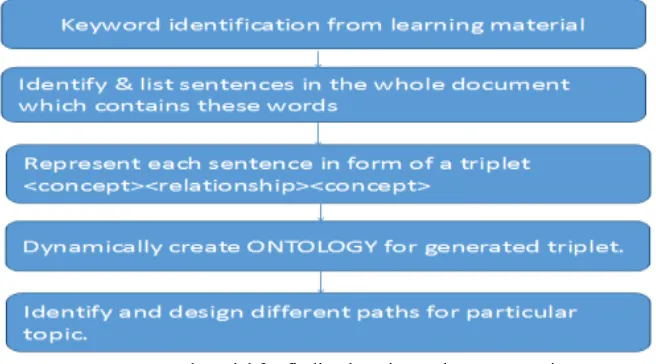
Fig.2 shows proposed model for generating learning pathway of a particular topic.
Fig.2: Proposed Model for finding learning pathway generation
Model Description
For generating Learning Path of a particular topic we are basically following three step processes. 1. Triplet Generation
2. Ontology creation. 3. Learning Path Generation
1. Triplet Generation
Step 1: Identify Keywords available in a document.
Step 2: List out sentences which contain two keywords in one sentence.
Step 3: We have List of Patterns Which helps us to know the relationship between keywords or we can say it as concepts.
Step 4: If we found sentence with two keywords connected with pattern available in our list of pattern. We will take it as a triplet of Concept1<Relationship>Concept2.
2. Ontology creation
Step 1: Create two classes “Keywords” and “Patterns”. Keyword class contains all the keywords extracted from document. And pattern class contains list of patterns.
Step 2: Create Object Property “Prerequisites” for Keyword class. Step 3: For a Generated Triplet create relationship between two concepts. For Example:
For Triplet: concept1<Prerequisite>concept2. Connection Link between concept1 and concept2 will be created.
Thus whole Onto graph for Document is created.
3. Learning path generation
Once we have Onto graph with us we can suggest learning paths to learners for the topic. Step 1: Learner will give topic for which they want learning path as an input.
Step 2: By going through all the connected links of that topic in an onto graph we are generating learning path for that topic.
IV.
EXPERIMENTS CONDUCTED
For a Learning path generation our first step is to generate ontology for a learning material.
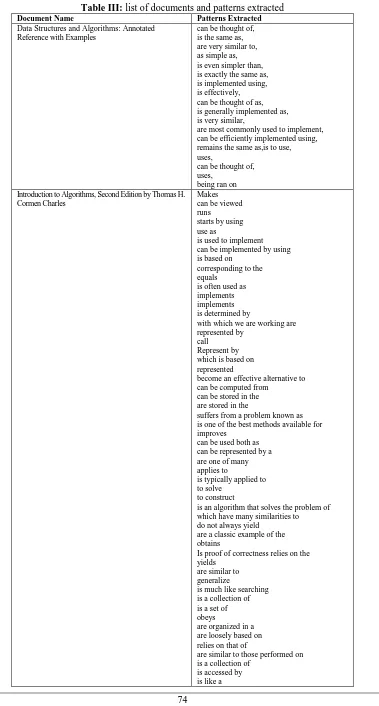
For that we have read different documents and extracted patterns which give us prerequisite for a topic. Using those patterns, we are generating triples of a concept i.e. concept1<prerequisite>concept2. Using that triplet we are generating onto graph for that material.
List of Documents and Patterns Extracted
Table III: list of documents and patterns extracted
Document Name Patterns Extracted
Data Structures and Algorithms: Annotated Reference with Examples
can be thought of, is the same as, are very similar to, as simple as, is even simpler than, is exactly the same as, is implemented using, is effectively, can be thought of as, is generally implemented as, is very similar,
are most commonly used to implement, can be efficiently implemented using, remains the same as,is to use, uses,
can be thought of, uses,
being ran on Introduction to Algorithms, Second Edition by Thomas H.
Cormen Charles
Makes can be viewed runs starts by using use as
is used to implement can be implemented by using is based on
corresponding to the equals
is often used as implements implements is determined by
with which we are working are represented by
call Represent by which is based on represented
become an effective alternative to can be computed from
can be stored in the are stored in the
suffers from a problem known as is one of the best methods available for improves
can be used both as can be represented by a are one of many applies to
is typically applied to to solve
to construct
is an algorithm that solves the problem of which have many similarities to do not always yield
are a classic example of the obtains
Is proof of correctness relies on the yields
are similar to generalize
is much like searching is a collection of is a set of obeys
are organized in a are loosely based on relies on that of
are similar to those performed on is a collection of
Data Structures to efficiently process, like,
supports, composed of, used to, similar to, is using, uses, Concurrent Data Structure by Mark Moir and Nir shavit
are among the, provides, are based on, represented as a, provides, implement, is a,
are linearizable versions of the,
V.
RESULT ANALYSIS
1. Triplet Generation Statement1: All arrays consist of contiguous memory locations.
Fig.3: Triplet generation for statement1
Statement2: Array is used for different verities of applications.
Fig.4: Triplet generation for statement2
Statement3 & Statement4: Array is used to store the data or values of same data type. Above array is used to store the integer numbers in an array.
Statement5-1: So in short character array can store character variables
Fig.6: Triplet generation for statement5-1
Statement5-2: while floating array stores only floating numbers.
Fig.7: Triplet generation for statement5-2
Statement6: Array can be used for Sorting Elements.
Fig.8: Triplet generation for statement6
Statement7: Array Can Perform Matrix Operation.
Statement8: Array can be used in CPU Scheduling.
Fig.10: Triplet generation for statement8
2. Dynamic creation of ontology classes and individuals:
Fig.11: Classes and individual of ontology
Ontology
Push stack has a prerequisite Stack
Stack has a prerequisite Array
Fig.13: Example2 of ontology
3. Generated Ontograph
Learning Material: Concurrent Data Structure by Mark Moir and Nirshavit
Fig.14: OntoGraph of Concurrent Data Structure by Mark Moir and Nirshavit
Learning Material: Data Structures and Algorithms: Annotated Reference with Examples
Learning Material: Introduction to Algorithms, Second Edition by Thomas H. CormenCharles
Fig.16: OntoGraph of Introduction to Algorithms, Second Edition by Thomas H. CormenCharles
Learning Material: Data Structures
4. Learning Pathway Generation Learning path of Array:
Fig.18: Generated Learning path for Array
Learning path of stack:
Fig.19: Generated Learning path for Stack Learning path of queue:
Learning path of liked list:
Fig.21: Generated Learning path for Liked list
VI.
CONCLUSION
In this research, we have created triplets. Using triplets, we have created onto graph. And using onto graph, we have generated learning path for a particular concept of a Learning material.
VII.
FUTURE SCOPE
In learning pathway generation, we have identified some patterns suitable for establishing prerequisite relationship between two topics. And we have analysed it with five documents. This can be done with some more and large documents and more patterns can be added in a patterns list. Furthermore, we have generated the possible learning path for a topic. That learning path can be personalised and using learners profile optimum path can be suggested to the learner.
REFERENCES
[1]. Hatzigaidas, Athanasios, et al. "Topic map existing tools: a brief review."ICTAMI 2004 (International Conference on Theory and Applications of Mathematics and Informatics). 2004.
[2]. Malafsky, Geoffrey P., and B. Newman. "Organizing Knowledge with Ontologies and Taxonomies." Fairfax: TechI LLC. Available at (2009).
[3]. Pirrone, Roberto, et al. "Learning path generation by domain ontology transformation." AI* IA 2005: Advances in Artificial Intelligence. Springer Berlin Heidelberg, 2005. 359-369.
[4]. Bloom, Benjamin Samuel. Taxonomy of educational objectives. Vol. 2. New York: Longmans, Green, 1964.
[5]. Velardi, Paola, Alessandro Cucchiarelli, and Michael Petit. "A taxonomy learning method and its application to characterize a scientific web community." IEEE Transactions on Knowledge and Data Engineering 19.2 (2007): 180-191.