Quality of Service Analysis on Wrp and
DSR Protocols in Mobile Ad-Hoc Network
A. Ponmalar
1, Geetha
21
Research Scholar, Department of Computer Science, Periyar Arts College, Cuddalore(dt), Tamilnadu, India
2Associate Professor, Department of Computer Science, Periyar Arts College, Cuddalore(dt), Tamilnadu, India
Abstract: In recent years’ mobile ad hoc networks became highly regarded and plenty of analysis is being done on totally different aspects of MANET. Mobile ad hoc Networks (MANET)-a system of mobile nodes (laptops, sensors, etc.) interfacing while not the help of centralized infrastructure (access points, bridges, etc.). There are totally different aspects that are taken for analysis like routing, synchronization, power consumption, information measure issues etc. This paper concentrates on routing techniques that is that the most difficult issue because of the dynamic topology of ad hoc networks. There are totally different methods projected for economical routing that claimed to produce improved performance. There are totally different routing protocols projected for MANETs that makes it quite troublesome to work out that protocol is appropriate for various network conditions. There are various different routing protocols and it is difficult to choose routing protocol for different situations as there is tradeoff between various protocols. This system provides a summary of routing protocols projected in literature and conjointly provides a comparison between WRP and DSR. The result of the protocols helps to analysis the performance of the routing protocols on MANET with TCP. Keywords: MANET, DSR, AODV, NS-2.
I. INTRODUCTION
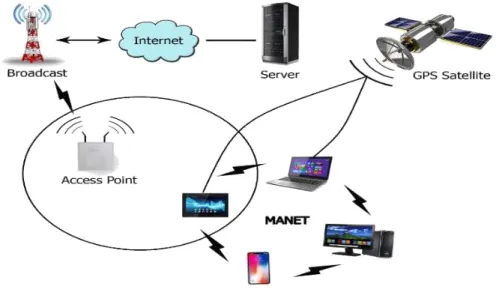
MANET stands for collection of mobile nodes [1] connected by wireless links. MANET is an ad-hoc network which doesn’t require any infrastructure support for carrying data packets between two nodes. Mobile hosts are communicating with each other without any central coordinator and it can dynamically change the location of the network at any time. Mobile ad-hoc networks are working in distributed environment. Examples of MANET’s are networks from building-to-building, vehicle-to-vehicle, ship-to-ship, etc.,
Figure 1. Manet Architecture
1.1 Challenges In Manet
In MANET, [2] there are many challenges are facing the network, Energy saving
o It gives only a limited amount energy saving facility available in MANET. Limited Bandwidth
o The bandwidth provided by a MANET is limited. Transmission Error
Security
o Security is the highly challenging issue in ad-hoc network, because of the open nature and the presence of wide security attacks.
II. REVIEW OF LITERARTURE
Vijaya, Amiya Kumar Rath, Bhagabat Puthal,Debahuti Mishra, Satapathy [5] QoS parameters are used to measure the efficiency of routing protocols in different situations. DSR protocols are dominated with the AODV and DSDV based on the throughput, packet delivery ratio performs well than DSDV and AODV.
Alok Kumar Jagadev, Binod Kumar Pattanayak, Ajit Kumar Nayak, Manojranjan Nayak [6] Wireless ad-hoc networks are communicating without any support of fixed infrastructure or any centralized administration. DSR is a reactive routing protocol and it has a unique advantage by virtue of source routing. QoS parameters are completely differing from application to application. The scenarios of QoS parameters are analyzed on the TCP and UDP. K.Geetha and N.Sreenath [9] The multimedia messages are sent through the mobile ad-hoc networks and the performance are measured through the quality of service parameter like Jitter, End-to-End Delay, Routing Overhead, Network Overhead and Throughput are compared in different routing protocols are DSDV, OLSR, AODV and FSR. S.Mahalakshmi and K.Geetha [3] SOADV is the extension of AODV and it is used for the security purpose. SCTP is the Stream Control Transmission Protocol, it is a transport protocol. SCTP is well performed in Ad-hoc Wireless Network. SAODV is behaved in well with SCTP than TCP.TCP provides high packet loss.
III. DESCRIPTION OF THE PROBLEM
Routing is one of most important concepts of MANET [3]. Routing is used to find out the route and select the best path between communicating nodes. Routing protocols specify a set of rules which helps to transfer data or packets from source to destination in a network [8]. Here we use the following protocols for the study.
WRP - Wireless Routing Protocol DSR - Dynamic Source Routing Protocol
3.1 Table-Driven Or Proactive Routing Protocol
Proactive protocol routing technique is defined as the routing technique where a route to the destination is available immediately [10]. It is also called as Table-driven routing protocol. Proactive routing protocols are the routes that are evaluated continuously within the network. It maintains and updates the information of routes at every node about the source and destination of the packet. It is useful for datagram traffic, tracks the substantial signal traffic and power consumption.
Table-driven protocols are not suitable for large networks as there are need to maintain the record. It also maintains different number of routing tables varying from protocol to protocol. The examples of proactive routing protocols are WRP, DSDV, CGSR, GSR, FSR, and OLSR.
3.1.1 Performance Of Wrp
WRP stands for Wireless Routing Protocol is one of the table-driven routing protocols. WRP is based on the Destination Sequence Distance Vector protocol, and it is used to maintain the set of routing tables and update procedures. In this protocol is completely maintained the up-to-date information about the wireless network. It is also known as the updated version of the DSDV protocol.
Figure 2. WRP ROUTING Table 1. WRP ROUTING TABLE
3.2 On-Demand Or Reactive Routing Protocol
Reactive protocol is more efficient than the proactive routing protocol [4]. It is otherwise called as on-demand routing protocol. Reactive protocol is finding the route between sources to destination whenever the communication is done. It includes two processes: Route discovery and Route maintenance. Route discovers process comes to an end with the detection of suitable route. Route maintenance maintains the continuity of route during the transfer. The examples of reactive protocol are AODV, DSR, ABR and TORA.
3.2.1 Performance Of Dsr
DSR means Dynamic Control Protocol, self-maintaining routing protocol used in mobile network. It helps to control the bandwidth, which doesn’t need to flood the network with table update messages periodically but extra work is not required. DSR is used to reduce the control overhead.
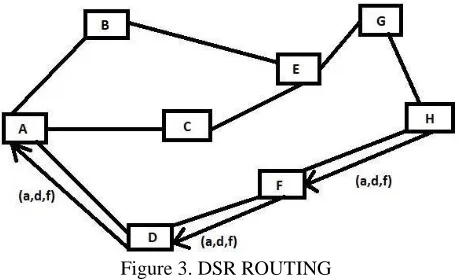
DSR consists of two basic concepts; Route discovery and Route maintenance. Route discovers process comes to an end with the detection of suitable route. Route maintenance maintains the continuity of route during the transfer. Route maintenance has two packets: Route error packet and Acknowledgement.
Figure 3. DSR ROUTING
IV. ANALYSIS OF WRP AND DSR WITH TCP PROTOCOL
Figure 4. Node initialization in MANET
PARAMETER VALUE
SIMULATOR NS-2 (VERSION 234)
CHANNEL TYPE CHANNEL/WIRELESS CHANNEL
RADIO-PROPAGATION MODEL PROPAGATION/TWO RAY ROUND WAVE
NETWORK INTERFACE TYPE PHY/WIRELESSPHY /TRANSPORT
MAC TYPE MAC /802.11
INTERFACE QUEUE TYPE QUEUE/DROP TAIL
LINK LAYER TYPE LL
ANTENNA ANTENNA/OMNI ANTENNA
MAXIMUM PACKET IN IFQ 60
AREA (M*M) 900 * 900
NUMBER OF MOBILE NODE 50
SOURCE TYPE TCP
SIMULATION TIME 350 SEC
ROUTING PROTOCOLS WRP, DSR
PARAMETER 06 PARAMETERS
NODE GAP 3.22 NM
Table 2. Simulation Environment
4.1 Simulation Methods
The Quality of Service is defined as the technology that manages data traffic to reduce the latency, jitter and packet loss on the network and ability to achieve the maximum bandwidth and deals with other network performance elements like error rate and uptime.
QOS also involves managing and controlling the network resources by setting the priorities for specific types of data (files, audio, and video) on the network. QOS is used to network traffic generated for video on demand, VoIP, IPTV, online gaming and video-conferencing.
The Quality of metric [17] are, Throughput
End-to-End Delay Packet Delivery Ratio Control Overhead Jitter
4.1.1 Throughput
Throughput is defined as [3] the number of packets is delivered source to destination within the particular processing time (seconds). The throughput can be represented as,
Throughput= Number of Bytes Received x 8 Kbps Time x 100
4.1.2. End-To-End Delay
End-to-End Delay [6] is defined as the difference between each packet to transmit from source to destination. Delay depends on the routing protocol, network speed, and packet size.
The delay can be represented as,
DELAY = Packet Received Time - Packet Send Time
4.1.3. Packet Delivery Ratio
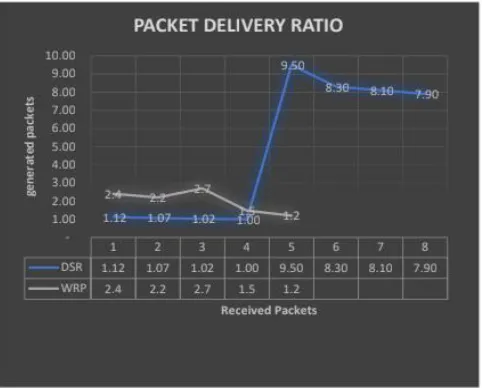
Packet Delivery Ratio is defined as the ratio of the number of packets send to the number of packets received. Packet Delivery Ratio=Received Packets/Generated packets * 100
4.1.4. Control Overhead
Control overhead is defined as the number of routing packets required for network communication. It is calculated using AWK script which processes the trace file and produces the routing result. The control overhead can be defined as,
Control overhead= Sum of routing packets/Sum of data packets
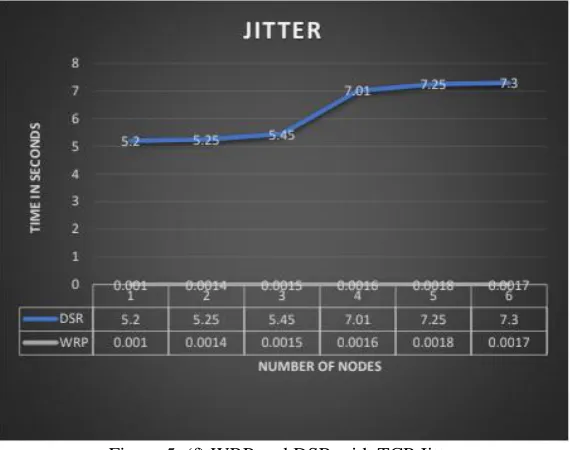
4.1.5. Jitter
Jitter is defined as the delay between the adjacent packets. The Jitter can be represented as, Jitter (i) = Delay (i+1) – Delay (i)
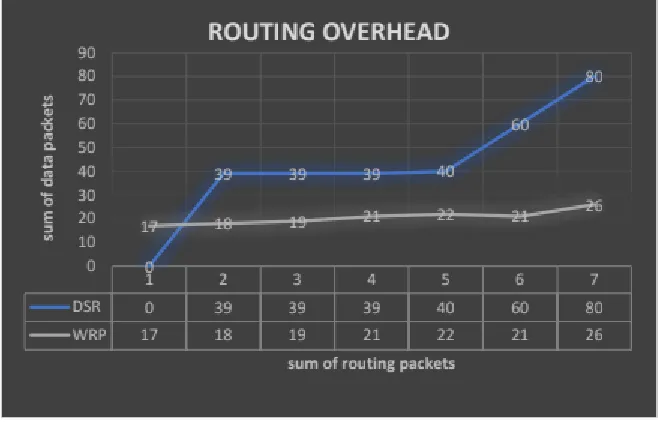
4.1.6. Routing Overhead
Routing Overhead is defined as the ratio of total packet size of control packets to the total packet size of data packets are transmitted to the destination.
Routing Overhead= sum of routing packets/ sum of data packets
4.2 Analysis
WRP and DSR performances are analyzed through the NS-2(Network Simulator -2) and produces the results in graph. In this analysis are based on the TCP protocols in MANET. Then the first protocol, WRP gives the average results in the performance of all the seven parameters. In the second routing protocol, DSR produces the maximum results in the performance of all the seven parameters. Finally, DSR is the efficient protocol compared to the other two protocols. From the analysis, it is understood that WRP is not performing well in MANET. It produces high packet loss and throughput. DSR produce high throughput, packet delivery ratio. From this analysis, DSR is well performing than the WRP protocols. But, WRP the overheads are minimum because it is used in the large amount of resources are needed.
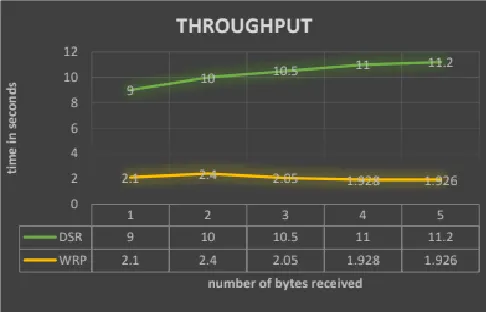
The following graph shows the data throughput from source to destination through WRP and DSR routing protocol. From taking an x-axis is number of bytes received and y-axis is time in seconds. WRP gives minimum throughput because it includes the delay, packet loss and DSR provides a maximum throughout and the third protocol provides the gives best results. Finally, DSR is well performing than other two protocols.
Figure 5. (b) WRP and DSR with TCP End-to-End Delay
The following graph shows the end to end delay from source to destination through two protocols namely, WRP and DSR [2]. While, taking an x-axis is packet received time and y-axis is packet send time. In the first protocol cause the maximum delay because data cannot send to the particular time period in the process. The second protocol is send the data packets to receiver within the particular time (seconds). So the DSR provides the efficient performance compared to first protocol.
Figure 5. (c) WRP and DSR with TCP Packet Delivery Ratio
Figure 5. (d) WRP and DSR with TCP Control Overhead
The following graph, compares the WRP, DSR and ZRP performance of the control overhead. From taking an x-axis is sum of routing packets and y-x-axis is sum of data packets. The number of packets is sends to the network communication by using the two protocols. Finally, in the control overhead DSR gives the efficient results due to the routing process it reduces the traffic control and the routing speed.
Figure 5. (e) WRP and DSR with TCP Routing Overhead
Figure 5. (f) WRP and DSR with TCP Jitter
The following graph, explains the comparison of WRP and DSR Jitter performance. From taking an x-axis is number of nodes and y-axis is time in seconds. DSR gives the better results in the jitter and it provides the positive range and the WRP protocol provides negative range.
V. CONCLUSION
In this analysis, it is tried to compare the QOS provided by Table-driven, On-demand routing protocol, specifically one of the protocol is chosen from each category as the WRP, DSR protocol. These three protocols are rarely chosen by the researchers. The QoS parameters are chosen in such a way that it reveals the user’s satisfaction in an explicit manner. Among the three protocols the behavior Dynamic Source Routing protocol is up to the user’s satisfaction in terms of the QoS parameters are chosen in the study. Dynamic source routing is used to reducing load into the flow data packets. It is specially designed for multi-hop wireless networks and saving resources. This study only provides an analysis with respect to the taken parameters in order to widely analyze the QoS. Thus, the analysis may be extended with various other parameters and the protocols may also be extended to include the explicit characteristics of the Table-driven, On-demand, protocols the other transport layer protocols may also be considered as this study restricts with TCP/IP protocol.
VI. REFERENCES
[1] Sadiya Mirza, Sana Zeba Bakshi, “Introduction To MANET”, International Research Journal Of Engineering and Technology(IRJET), ISSN: 2395-0056; vol. 05, issue: 1(2018). Available: http://www.irjet.net.
[2] Dr.S.S. Tiyagi, Aarti, “Study of MANET: Characteristics, Challenge, Application and Security Attacks”, International Journal of Advanced Research in Computer Science and Software Engineering, ISSN: 2277 128X; vol. 03, issue: 5(2013). Available:http://www.ijarcsse.com [3] S. Mahalakshmi, Dr. K. Geetha,”A Study on the Behaviour of SAODV with TCP and SCTP Protocols in Mobile adhoc
Networks”,”International Journal of Research in Advent technology”, Vol.6, No.8, August 2018.E- ISSN:2321-9637.Available online at www.ijrat.org
[4] C. Siva Ram Murthy and B.S.Manoj, “Ad-hoc Wireless Networks Architecture and Protocols”, Perason ed. India: Perason Education, 2004. [5] I. Vijaya, Amiya Kumar Rath, Bhagabat Puthal, Debahuti Mishra and S. Satapathy,”Performances Analysis of QoS Parameters of MANET
on Mobility and Energy Based Model with Different MANET Routing Protocols”,”Indian Journal of Science and Technology, Vol 9(37), DOI:10.17485/ijst/2016/v9i37/100468,October 2016.ISSN:0974-5645.
[6] Alok Kumar Jagadev, Binod Kumar Pattanayak, Ajitumar Nayak,Manoranjan Nayak,”Evaluation of QoS Parameters on TCP/IP in Wireless Adhoc Networks”,”Journal of Thearitical and Applied Information Technology”,15th October 2011. Vol.32 No. 1.ISSN:1992-8645.Available online at www.jatit.org.
[7] Priyanshu and Ashish Kumar Maurya,”Survey: Comparison Estimation of Various Routing Protocols in Mobile ad-Hoc Network”,”International Journal of Distributed and Parallel Systems (IJDPS) Vol.5,No.1/2/3,May 2014.
[8] K. Geetha, N. Sreenath,”A General Study on the Transfer of Multimedia Messages over Mobile adhoc Networks”,”International Journal of Coputer Apllication (0975-8887), Volume 81-No.9,November 2013.
[9] Harvaneet Kaur,”A Survey on Manet Routing Protocols”,International Journal of Advanced Research in
[10] Computer Science and Software Engineering”, Volume 5, Issue 1, January 2015, ISSN: 2277 128X. Available online at:www.ijarcsse.com. [11] Harshita Tuli, Dr. Sanjay Kumar,”Study of MANET Routing Protocols”,”Special Conference Issue: National Conference on Cloud