An Efficient Real Time Recharging Scheme for
WSN with Priority Packet Scheduling
1
Anjana P. S, 2 Dr. Gnana Sheela K
1, 2
Dept. Electronics and Communication Toc H Institute of Science and Technology
Ernakulam, India
Abstract - One of the fundamental problem faced by wireless sensor networks is its constrained lifetime due to scarce energy supply available during their operation. In this paper we are going to model an efficient real time wireless recharging for wireless sensor network along with Dynamic Multilevel Priority( DMP) packet scheduling. For that firstly a Real time recharging scheme is adopted. An NDN based Real time recharging scheme is one of the best real time recharging scheme which uses multiple mobile vehicles for recharging, and also provides more scalability and robustness. In this proposed work, an efficient real time wireless recharging protocol which is named as, ENHANCED NETWRAP (E-NETWRAP) is developed, by including DMP packet scheduling along with above mentioned NDN based real time recharging scheme. By adopting DMP packet scheduling scheme along with the Real time recharging framework further improves the network performance.
Keywords - Wireless Charging Technology, Real Time Recharging, NDN, NETWRAP, Sencars, DMP.
1. Introduction
Wireless sensor networks consist of spatially distributed sensor nodes to monitor physical or environmental conditions, such as temperature, sound, vibration, pressure and motion of pollutants, and to cooperatively pass their data through the network to a base station (BS), which actually act as a gateway. They have been widely employed in a broad range of applications related to environmental monitoring ,military, health care , national security and so on.Wireless sensor nodes are usually powered by small batteries and thus the scarce energy supply has constrained their lifetime. This has been a long lasting, fundamental problem faced by sensor networks. To resolve this problem, various approaches like energy conservation , ambient energy harvesting , incremental deployment, and battery replacement have been proposed.
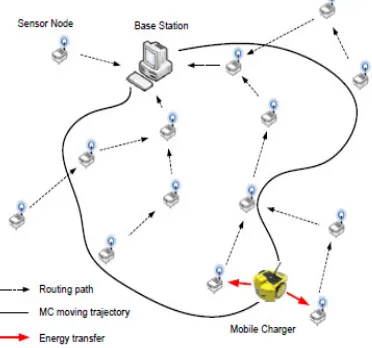
However, energy conservation schemes can only slow down energy consumption but not compensate energy depletion. Harvesting environmental energy, such as solar, wind and vibration , is subject to their availability which is often uncontrollable by people. The incremental deployment approach may not be environmentally friendly because deserted sensor nodes can pollute the environment. The battery or node replacement approach is applicable only for scenarios that sensor nodes are accessible by people or sophisticated robots that can locate and physically touch the sensor nodes. The newly emerging wireless charging technology provides a promising alternative to address the energy constraint problem in sensor networks. Comparing with sensor node or battery replacement approaches, it allows a mobile charger to transfer energy to sensor nodes wirelessly without requiring accurate localization of sensor nodes or strict alignment between the charger and sensor nodes. Figure 1 shows an example of wireless chargeable sensor network.
2. Background Information
In this proposed work for improving the recharging efficiency of WSN, the concept of Named Data Networking (NDN) is leveraged. By using the concept of Named Data Networking, energy monitoring and reporting protocols is developed. Also for handling concurrent emergency recharging situations, NDN based efficient algorithm is developed. And then in that NDN implemented WSN, priorities can be given to different packets based on their types i.e. real time packets or non real time packets. As a result the real time based recharging process get more prioritized. This scheme not only improves network scalability but also ensures the perpetual operation of networks.
2.1 Named Data Networking
Named Data Networking is a novel approach that has been recently introduced for internet. Usually, in a network the importance would lie on the end to end connectivity i.e., the connectivity established between the nodes. Most of the architectures that were proposed showed their importance on the connection establishment between the nodes .NDN focuses its importance on the data content rather than the connection between the nodes.
Communication in NDN is driven by the receiving end, i.e., the data consumer . A router remembers the interface from which the request comes in, and then forwards the interest packet by looking up the names in the Forwarding Information Base (FIB). To receive data, a consumer sends out an Interest packet, which carries the name that identifies the desired data. Once the Interest reaches a node that has the requested data, a Data packet is sent back, which carries both the name and the content of the data, together with the signature by the producer’s key. When multiple Interests are received for the same data, then the router stores the Interest in the Pending Interest Table (PIT). When Data packets arrives, the router finds matching in the PIT and caches the Data in the Content Store, the buffer memory of the router.
NDN Packet is a meaningful packet, independent of where it comes from or where it may be forwarded to, thus the router can cache it to satisfy potential future requests. This enables NDN various functionality without extra infrastructure, including content distribution (many users requesting the same data at different times),multicast (many users requesting the same data at the same time), mobility (users requesting from different) and the delay tolerant networking(users having
intermittent connectivity). NDN names are opaque and are not globally defined.
3. Enhanced NDN based Real Time Wireless
Recharging Protocol (E-NETWRAP)
Firstly a real time recharging scheme should be adopted for implementing the DMP packet scheduling [2]. And for that here we are considering NDN based Real Time Recharging scenario for WSN [1]. In this real time recharging scheme by adopting the concepts of Named Data Networking (NDN), energy monitoring and reporting protocols i.e. NETWRAP routing protocol is developed. In NETWRAP routing protocol sensor energy status information is efficiently delivered to vehicles in real-time by using the concepts and mechanisms of Named Data Networking. In NDN, data are addressed by the names of particular location instead of hosting node’s address or ID. The operation is based on two types of messages, Interest and Data, and the communication is initiated by the receiver.
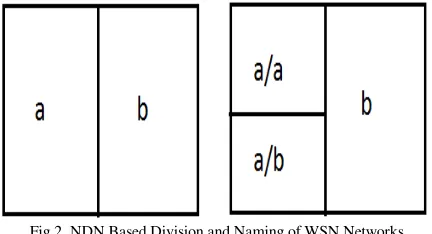
For implementing NDN concept in sensor network, firstly the network is divided in a hierarchical fashion and the energy information is aggregated bottom-up through different levels. NDN uses names instead of locations to address data, which is a natural match for aggregated energy information that belongs to an area instead of any particular node. Thus the aggregated energy information can be addressed by the area’s name. For instance, if we consider a rectangular area as WSN, then firstly it will be divided vertically to two areas ‘a’ and ‘b’. When ‘a’ is divided horizontally, the 2 new sub areas are named ‘a/a’ and ‘a/b’. Figure 2 shows an example of NDN based network partitioning and name assignment.
Fig.2. NDN Based Division and Naming of WSN Networks
The NDN implemented wireless sensor network consists of the following components:
1) SenCars and service station: SenCars query the
for energy information and recharge nodes based on the energy information collected. A service station is used for network management and maintenance.
2) Head nodes: A head is a sensor node delegated to
aggregate energy information from its subordinate area. When requested by a SenCar or by the head of its upper level, a head queries energy information from subordinate subareas at the lower level, aggregates such information and sends to the requester.
3) Proxy node: A proxy nodes aggregates emergencies
from sensor nodes and reports such information to the SenCar when queried. They collect emergency information from normal nodes just after normal recharging. That emergency normal node directly sends the message to the proxy nodes which are present in their respective cluster. Thus with help of proxy nodes emergency recharging occurs.
4) Normal node: A sensor node not selected as a head is a
normal node. It reports energy information to head nodes, or sends emergency request directly to its proxy node when its have critical energy level.
3.1 NETWRAP Protocol Functioning
First of all the network is hierarchically divided into different clusters. From each cluster a head node is selected ,which is having more energy compared to all other nodes. And a proxy node is also selected which is the highest level head node. Firstly sencars sends out energy interest message to all the head nodes. Upon receiving the energy interest message head node passes it to all its child nodes. And it is further passed down to the lowest level head node ,then to its child nodes too.
When the lowest level child node receives this energy interest message, it replies back by sending the energy data message which consists of node id and its remaining energy. Thus the head node receives the aggregated energy information of all its child node and bottom level child nodes too. Then the head node finds out the node having very less energy and passes the list to sencar, which contains the minimum energy node id,area name to the sencar. Sencar upon receiving the list moves towards that particular node and recharges it. Similarly for handling emergency recharging sencar sends out emergency interst message to the proxy node. The node having very critical amount of minimum energy sends it list directly to proxy node. Thus proxy node already has the list of those nodes which is to be emergency recharged. So it sends that list to sencar. Sencar by using NETWRAP
algorithm reaches out to the emergency node and recharges it. Figure 3 shows the Energy interest propagation and Energy status aggregation taking place in the wireless sensor network as part of NETWRAP protocol implementation.
Fig.3. Energy interest propagation and Energy status aggregation
3.2 E-NETWRAP Protocol Functioning
After implementing the NDN based real time recharging scheme in WSN, next step is to add priority scheduling for developing an efficient real time recharging protocol. By adding dynamic priority packet scheduling (DMP) along with the NETWRAP results in an efficient real time recharging framework. And thus an Enhanced Netwrap (E-Netwrap) can be developed. For implementing DMP packet scheduling into WSN, firstly the sensor nodes are virtually organized into a particular hierarchical structure. Here for the NDN implemented WSN we are organizing the nodes in a specific manner suitable to the recharging application. Thus the sensor nodes are arranged into four levels. Figure 5 shows the virtual four level hierarchical structure of sensor nodes.
Data packets that are sensed at a node are scheduled among a number of levels in the ready queue. Then, a number of data packets in each level of the ready queue are scheduled. Here three-level of queues is considered, that is, the maximum number of levels in the ready queue of a node is three: priority 1 (pr1), priority 2 (pr2), and priority 3 (pr3) queues. Data packets of nodes at different levels are processed using the Time-Division Multiplexing Access (TDMA) scheme. For instance, nodes that are located at the lowest level and the second lowest level can be allocated timeslots 1 and 2, respectively. Real-time data packets go to pr1, the highest priority queue, and are processed using FCFS. Non-real-time data packets that arrive from sensor nodes at lower levels go to pr2, the second highest priority queue. Finally, non-real time data packets that are sensed at a local node go to pr3, the lowest priority queue.
The priority of non-real-time data packets is assigned based on the sensed location (i.e., remote or local) and the size of the data. The data packets that are received by node x from the lower level nodes are given higher priority than the data packets sensed at the node x itself. However, if it is observed that the lower priority non-real time local data cannot be transmitted due to the continuous arrival of higher priority non-real-time remote data, they are preempted to allow low-priority data packets to be processed after a certain waiting period. Nevertheless, these tasks can be preempted by real-time emergency tasks. In case of two same priority data packets the smaller sized data packets are given the higher priority.
The highest-priority real-time/emergency tasks rarely occur. They are thus placed in the preemptive priority task queue (pr1 queue) and can preempt the currently running tasks. On the other hand, non real time packets that arrive from the sensor nodes at lower level are placed in the preemptable priority queue (pr2 queue). The processing of these data packets can be preempted by the highest priority real-time tasks and also after a certain time period if tasks at the lower priority pr3 queue do not get processed due to the continuous arrival of higher priority data packets. Real-time packets are usually processed in FCFS fashion. Each packet has an ID, which consists of two parts, namely level ID and node ID. When two equal priority packets arrive at the ready queue at the same time, the data packet which is generated at the lower level will have higher priority. This phenomenon reduces the end-to-end delay of the lower level tasks. For two tasks of the same level, smaller task (i.e., in terms of data size) will have higher priority.As an example just consider a head node of the WSN, which is organized in level 3. It
will give high priority to the real time based packet i.e. recharging based packets and also for the packets exchanged between sencars. Second highest priority is given to the packets transferred between its own level nodes i.e between other head nodes an proxy nodes. And the third priority is given to those packets exchanged between other normal nodes. Similarly in each nodes which are present in different hierarchical levels, the DMP packet scheduling occurs. And thus the real time base recharging process get more prioritized. Overall network performance improves as a result of minimum end to end delay and better packet delivery ratio as a result of implementation of dynamic multilevel priority packet scheduling in the real time based recharging process.Total energy consumption and overall residual energy of network also get slightly varied in a better way when compared to NETWRAP case. Figure 6 shows the DMP packet scheduling scheme implemented in NDN based WSN in terms of head node.
Fig.5. DMP Packet scheduling implemented in NDN based WSN
4. Network Simulation
like packet delivery ratio, end to end delay and total energy consumption of the nodes and overall residual energy of nodes in case of both NETWRAP and E-NETWRAP is plotted and compared using Graph. Various metrics used for the simulation purpose are given in the table below.
Table 1: Simulation Metrics
Protocols Used CASE 1: NETWRAP
CASE 2: E-NETWRAP
No of Nodes 46
Dimension of Topography 1500*600 m2
Traffic Type CBR
Channel Type Wireless Channel
Mac Protocol Omni Directional Antenna
Queue Length 50
Initial Energy 5J
A wireless sensor network of 46 node which is created for implementation of NETWRAP and E-NETWRAP cases. As per NDN concept, hierarchical network division occurs and thus 6 areas(clusters) are formed. From each area a head node is selected, thus total 6 head nodes(8,15,22,28,36,43) are assigned. Similarly 6 nodes(4,13,19,24,34,39) are assigned as proxy nodes. 0th node act as service staion. And there are 2 mobile nodes (44,45) which act as Sencars. Remaining all nodes are static nodes and act as normal nodes, and along with it one source node(5th node) and one destination node(40th node) is also there, between which data packet transfer takes place. And then a four level virtual hierarchical architecture is considered and DMP packet scheduling is included into the NETWRAP implemented network .And thus an Enhanced Netwrap (E-NETWRAP) protocol is developed.
4.1 Simulated Results
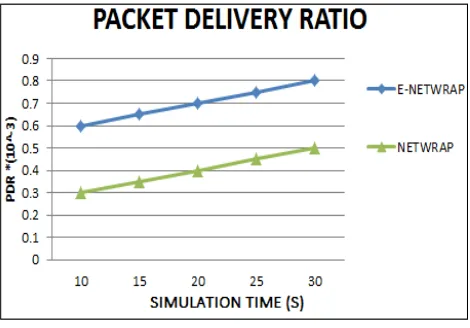
Various simulation metrics such as packet delivery ratio, end to end delay, total energy consumption and overall residual energy and its variation with simulation time in case of the NETWRAP and E-NETWRAP are compared and it is shown using graphs. Figure 6 shows the graph of packet delivery ratio versus simulation time.
Fig.6. Packet Delivery Ratio Vs Simulation time
From the graph, it is clear that packet delivery ratio is increasing, which shows that proper delivery of data packets is taking place between source and destination node. Better packet delivery ratio indicates better performance of protocol. From the graph it is clear that E-NETWRAP has more PDR value compared to NETWRAP case. Figure 7 shows the graph of End to End delay versus simulation time. As per the obtained graph initially end to end delay is high, it is because at the starting time of packet transfer between source and destination nodes energy depletion was occurring in some nodes. But after that proper recharging of those nodes takes place with higher priority with minimum latency,end to end delay gradually get decreased, which in turn indicates that proper communication without any delay is happening between source and destination nodes due to DMP packet scheduling. And thus in E-NETWRAP case End to End delay is less when compared to NETWRAP case.
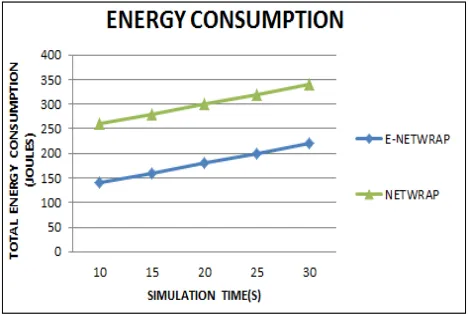
Figure 8 shows the graph of total energy consumption versus simulation time of both NETWRAP and E-NETWRAP cases. Energy consumption is another important parameter which is to be considered. From the graph it is clear that only little energy is consumed during the initial stages. But, as the simulation time is increased, and when more network activities are carried out naturally energy consumption increases.
Fig.8. Total Energy Consumption Vs Simulation Time
Figure 9 shows the graph in which the overall residual energy of network in case of NETWRAP and E-NETWRAP case is shown. Both protocols shows better residual energy values because of real time recharging. But from the graph it is clear that E-NETWRAP has a got a slight higher values compared to NETWRAP case because of higher priority assigned to real time recharging process.
Fig.9. Overall Residual Energy Vs Simulation Time
5. Conclusion
In this paper, an efficient NDN based real time wireless recharging model with DMP packet scheduling is developed. Use of NDN based real time recharging scheme enables coordination of multiple mobile vehicles to recharge sensor nodes. Employing multiple mobile vehicles provides more scalability and robustness. In this framework, a scalable and efficient communication protocol along with priority packet scheduling, called E-NETWRAP is developed, which provides more priority for real-time energy information gathering and delivery mechanism, and also for real time recharging of energy depleted nodes when compared to other non real time process . E-NETWRAP ensures minimum end to end data transmission for the highest priority data i.e. real time based recharging packets, while exhibiting acceptable fairness towards lowest priority data. This protocol can also adapt to unpredictable and dynamic network conditions and satisfies the needs for both normal and emergency recharging of nodes. Performance of the developed E-NETWRAP protocol is analyzed and it is compared with NETWRAP case by using graphs of various simulation metrics. Comparison results show that E-NETWRAP is having better network performance than the NETWRAP.
Acknowledgment
We would like to take this opportunity to express our gratitude and deepest regards to all those staffs, lab Instructors of Toc H Institute of Science and Technology, who helped us by giving exemplary guidance and support throughout this project work.
References
[1] Ji Li, Cong Wang, Fan Ye, and Yuanyuan Yang “NETWRAP: An NDN Based Real Time Wireless Recharging Framework for Wireless Sensor Networks,” IEEE Trans. Mobile Ad-Hoc and Sensor Systems,vol. 13, no. 6, pp. 1283-1287, June 2014. [2] Nidal Nasser, Lutful Karim, and Tarik Taleb,
“Dynamic Multilevel Priority Packet Scheduling Scheme for Wireless Sensor Network,” IEEE Trans.Wireless Communications, vol. 12, no. 4, April 2013.
[3] Wendi.R.Heinzelman, A. Chandrakasan, and H. Balakrishnan, “Energy-Efficient Communication Protocol for Wireless Microsensor Networks,” Proc. IEEE 33rd Hawaii Int’l Conf. System Sciences (HICSS), 2000.
Collection in Wireless Sensor Networks with Dynamic Deadlines,” Proc. 25th IEEE Int’l Real-Time Systems Symp. (RTSS), 2004.
[5] O. Younis and S. Fahmy, “Distributed Clustering in Ad-Hoc SensorNetworks: A Hybrid, Energy-Efficient Approach,” IEEE Trans.Mobile Computing, vol 3, no. 4, pp. 366-379, Oct. 2004.
[6] N. Bansal, A. Blum, S. Chawla, and A. Meyerson, “Approximation Algorithms for Deadline-TSP and Vehicle Routing with Time Windows,” Proc. 36th Ann. ACM Symp. Theory of Computing (STOC), 2004.
[7] A. Somasundara, D. Jea, and M. Srivastava, “Multiple Controlled Mobile Elements (Data Mules) for Data Collection in SensorNetworks,” Proc. First IEEE Int’l Conf. Distributed Computing in Sensor Systems (DCOSS), 2005.
[8] Tolga Bektas, “The Multiple Traveling Salesman Problem: AnOverview of Formulations and Solution Procedures,”Int’l J. Management Science, vol. 34, pp. 209-219, 2006.
[9] M. Ma and Y. Yang, “SenCar: An Energy-Efficient Data Gathering Mechanism for Large-Scale Multihop Sensor Networks,” IEEETrans. Parallel and Distributed Systems, vol. 18, no. 10, pp. 1476-1488, Oct. 2007.
[10] A. Kurs, A. Karalis, R. Moffatt, J.D. Joannopoulos, P. Fisher, and M. Soljacic, “Wireless Power Transfer via Strongly Coupled Magnetic Resonances,” Science, vol. 317, pp. 83-86, 2007.
[11] A. Karalis, J.D. Joannopoulos, and M. Soljacic, “Efficient Wireless Non-Radiative Mid-Range Energy Transfer,” Annals of Physics, vol. 323, no. 1, pp. 34-48, Jan. 2008.
[12] V. Jacobson, D. Smetters, J. Thornton, M. Plass, N. Briggs, and R.Braynard, “Networking Named Content,” Proc. ACM Fifth Int’lConf. Emerging Networking Experiments and Technologies (CoNEXT),2009.
[13] Y. Shi, L. Xie, T. Hou, and H. Sherali, “On Renewable Sensor Networks with Wireless Energy Transfer,” Proc. IEEE INFOCOM, 2011.
[14] Y. Yang M. Zhao and J. Li “Joint Mobile Energy Replenishment and Data Gathering in Wireless Rechargeable Sensor Networks,”Proc. IEEE 23rd Int’l Teletraffic Congress (ITC), 2011.
[15] S. He, J. Chen, F. Jiang, D Yau, G. Xing, and Y. Sun, “Energy Provisioning in Wireless Rechargeable Sensor Networks,” Proc. IEEEINFOCOM, 2011. [16] Z. Li, Y. Peng, W. Zhang, and D. Qiao, “J-RoC: A
Joint Routing and Charging Scheme to Prolong Sensor Network Lifetime,” Proc.19th IEEE Int’l Conf. Network Protocols (ICNP), 2011.
[17] Y. Shi, L. Xie, T. Hou, and H. Sherali, “On Renewable Sensor Networks with Wireless Energy Transfer,” Proc. IEEE INFOCOM, 2011.
Anjana P.S completed her B.Tech in Electronics and
Communication Engineering under Mahatma Gandhi
University,Kerala. Presently she is pursuing M.Tech in Electronics with specialization in Wireless Technology under Cochin University of Science and Technology (CUSAT), Kerala.