Evaluation of Some Solar Models with a New
Software Package
D.A. Adenugba
Department of Physics
The Federal University of Technology, Akure
P.M.B 704, Akure. Ondo State.
ABSTRACT
Everybody uses solar energy in one form or the other. It is a source of life to human beings, plants and animals. Indeed, sun is fuel of life. In this article, we briefly discuss the usefulness of solar energy and developed a computer software package, SolarSoft for the evaluation of Bowen and evaporative fraction models. With a decade data from four Meteorological sites in Nigeria, we estimated two solar laws of Wien and Stefan-Boltzmann. Besides, we evaluated local standard time meridian, local solar time, and time correction factor, Equation of time, as well as declination, elevation, maximum elevation for Northern and Southern hemispheres, Azimuth, Zenith and hour angles. A dynamic class library was developed for all the models, which other developers will find salutary in their works. SolarSoft functions to specifications. Photovoltaic system Engineers will benefit tremendously using our package to obtain not only elevation angle, but also its maximum values for photovoltaic system simulation. Virtually every Atmospheric Scientists will benefit from the use of SolarSoft as an efficient, flexible and accurate research tool.
General Terms
Software, SolarKeywords
Bowen ratio, Solar laws, SolarSoft, Solar time.
1.
INTRODUCTION
There is no human being who does not need sun, and who does not use sun. Sun is required throughout the whole world for one thing or the other. A mention could be made of the followings:
To dry washed cloth and warm the body, common use which is known to everybody. Photosynthesis, required by plant for its production, will be impossible without the sun, hence there won’t be plant and hunger for human beings. Solar radiation is responsible for all the physical and biological processes occurring close to the ground and/or in the atmosphere such as the driving force for the atmospheric circulation. Evaporation, transpiration, rock weathering and land forms development all depend on solar radiation.
Solar radiation is vital in environmental planning and development [5] and the varying temperature changes all over the globe is a function of solar radiation. Vast amount of Solar energy is released into space by the sun, but only a small fraction of about twenty millionth reaches the earth as the greater part is lost to space [5]. Solar data and information are required for planning solar energy utilization all over the world, especially in the third world countries where there is scarcity of solar data. Processed data is information; and since solar data are grossly insufficient, information dearth is better
imagined than said. In Nigeria, frantic efforts had been made in the past three decades to improve on the provision of solar data and energy. Currently, solar energy is utilized to power bole-holes, drives farm equipments and provides electricity in some homes. Ndukwe (1999) noted that copious insolation with daily time duration of approximately 12 hours existed in Okigwe (5040’N, 7010’E) town in Eastern part of Nigeria; and that there is noontime sunlight of approximately 8 hours. The highest monthly mean hourly insolation of 1011.85Wm-2 was obtained, indicating the suitability of Okigwe for solar energy project.
Our objectives in this paper are to develop a class library and a software package for Bowen ratio, local standard time meridian, local solar time, and time correction factor, evaporative fraction and Wien and Stefan-Boltzmann laws. To be estimated also are zenith angle together with declination, elevation and maximum elevation angles, equation of time, hour and azimuth angles. With SolarSoft, an application to be developed with Microsoft Visual Studio 2010, fourteen solar models could swiftly, efficiently and accurately be evaluated.
2. MODELS
2.1 Bowen Ratio and Evaporative Fraction
Bowen Ratio (BR) is used often in Meteorology and Hydrology, and is given by [14]BR = Qh / Qe (1)
Where Qh = Sensible heat, Qe = Latent heat. If BR > 1, most
of the surface available energy escapes to the atmosphere as Qh; and for BR < 1, Qe escapes to air dominates. As Qe tends
to zero, BR is unbounded thus the concept of evaporative fraction, EF has to be introduced. EF, which is related to BR is seen in eqn. (2), is a more appropriate choice of variable representing the relative contributions of the turbulent energy fluxes to the surface energy budget [14].
EF = Qe / (Qe + Qh) = 1 / (1 + BR) (2)
2.2 Solar Laws
Two significant laws in radiation studies are under Solar Laws menu of figure 1. The first one is Wien’s Displacement law which is useful in computing the wavelengths (λm) of
maximum emission from a blackbody, and is given by
λm = kT-1 (3)
k is a constant with numeric value of 2897; T is absolute temperature (K). Blackbody, we should not forget, absorbs all radiation impinging on it and emits the maximum energy at a particular temperature. The second context menu is the Stefan–Boltzmann law which gives flux of radiation (Eb) from
a blackbody and is expressed as
where σ, with numeric value of 0.814x10⁻¹¹
cal/cm2 min-1deg4, is Stefan–Boltzmann constant.
2.3 Solar Angles
The declination angle of the sun
, elevation angle
, azimuth angle, Za and hour angle, HRA are respectively expressed as [10].
B
Sin
0
23.45
(5)
81
365
360
B
d
(6) d is the number of days since the year started. Owing to the rotation of the earth around the sun and the tilt of the earth on its axis of rotation,
varies seasonally. It is zero at the equinoxes (March 22 and September 22), positive and negative during the northern hemisphere summer and northern hemisphere winter respectively.
Sin Sin Cos Cos CosHRA
1
Sin (7)
The angular height of the sun in the sky measured from the
horizontal(
), otherwise called altitude angle, is 0o and 90o at sunrise and when the sun is directly overhead at the Tropic of Cancer on summer solstice respectively. The maximumelevation angle at solar noon,
for Northern
N andSouthern
S hemispheres are given as
o
90
N (8)
o
S
90
(9)
is the site of interest latitude (%).With the knowledge of elevation angle
, zenith angle (Ze,angle between the sun and the vertical) could be evaluated using
-90
o
e
Z
(10)To define the apparent position of an object in the sky relative to a specific observation point, elevation and azimuth angles are employed. Azimuth angle (Za) is the compass bearing relative to true geographic north of a point on the horizon directly beneath an observed object [11]. It is the compass direction from which the sunlight is coming [10]; and it varies throughout the day, ranging between 0o-360o. The expression for the evaluation of Za is [8-13]
Cos
HRA
Cos
Sin
Cos
Cos
Sin
Cos
-1Za
(11)
Za, which is measured clockwise from the zero azimuth, is valid when HRA < 0 or LST < 12. However, when LST > 12 or HRA > 0, then the modified azimuth angle, Zam is expressed as
Za
0360
Zam
(12)The hour angle, HRA is related to local solar time, LST by
12
15
HRA
0LST
(13)It is negative in the morning, zero at solar noon and positive in the afternoon. It measures time after solar noon in terms of
one degree for ever four minutes or fifteen degrees per hour [8-13].
2.4 Solar Time
The equation of time (in minutes) is given by [10]
2B 7.53Cos
B 1.5Sin
B9.87Sin
EOT (14)
The local standard time Meridian is known to be
GMT
T
15
LSTM
(15)The difference of the local time (LT) from Greenwich Mean Time (GMT) is
LT
-GMT
T
GMT
(16)The local standard time Meridian, longitude and EOT are related to time correction factor, TCF by
EOT
4
TCF
LSTM
Longitude
(17) While local solar time, LST is a function of LT and TCF and is given by60
TCF
LT
LST
(18)3. CLASS LIBRARY
A class library, dvSolarCls was developed for the solar models in section 2. Table 1 contains the methods in dvSolarCls class. Flexibility of data supply is made possible by overloading our methods. The solar laws methods made use of EnumTempTypi enumerate class that has two members to indicate whether the supply temperature is in degree Celsius (oC) which has to be converted to Kelvin (K) by adding 273.15 to it; or already in Kelvin, ready for use. We should note that enumerate class generally limits the possible values to store in a variable thus preventing invalid values from being supplied for use. More so, it provides clarity in codes as meaningful names could be utilized for its members as we have done in our work [2-3, 6-7].
Some solar constants were separated and put in a module. This separation and meaningful names utilized make our code lucid apart from being available for use in other projects. Through the properties and methods, a client application converses with a server. Apart from the methods in Table 1, there are properties with which to expose our class. The dvInfo read only property, for instance, reports every action going on in dvSolarCls class library. The dvGetSolarRad read only property returns the single solar parameter computed. The result format type could be achieved through the write only property of dvSetFMT.
4. RESULTS AND DISCUSSION
The temperature for computing the solar laws are from four Meteorological locations in Nigeria, spanning a period of ten years. The stations, their coordinates and data periods are shown in Table 2. (FCT=Federal Capital Territory).
Table 2: Meteorology site for the work
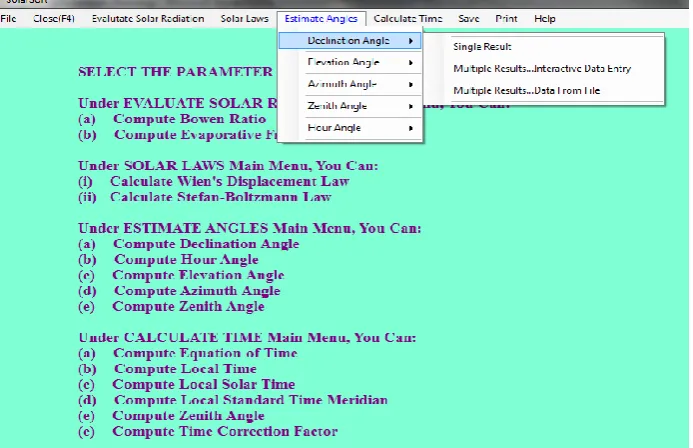
Figure 1 is the SolarSoft application user interface (UI) with well-informed menus, access and shortcut keys. The main menus have varying number of submenus. Figure 2 is the UI for obtaining the days, d since the year started that is used for calculating declination angle and equation of time models. It is a Windows forms control library developed for it, which support code reuse. The custom control uses intrinsic Microsoft MonthCalendar control (dvMthCalen) for visual date selection. The years from 1960-2015 were loaded into a combo box in the custom control constructor. The year selected is used to position the dvMthCalen control to the beginning of the selected year. From January 1 of the selected year, the user can then select the desired Month and day. When done, the Ok button is enabled; and upon clicking it, the full date is captured and displayed in a label for user to see. Then, the Ok button is disabled; the ending date combo box is enabled for year selection. The Ok button is enabled again when user selects ending date.
Upon valid date selection, the full date is displayed in another label below the first to the left as seen in figure 2, and the View Days button is enabled which permits the computed days to be shown or hidden by calling a dvHideShowViewButtn property. In addition, the close button is enabled which, when clicked, calls a function to calculate the difference between the two dates and returns number of days between them. This is achieved through DateDiff function that returns long value; but you should add 1 to the returned value for correct days to be obtained. More so, the first argument of DateDiff function should be correctly specified thus for day: DateInterval.Day. The DateInterval enumeration value represents the date (or time) interval between the two required dates.
Through dvGetDays read only property, the calculated days could be retrieved at the client side. Informed message could be inserted in the label to the left of Ok button via
dvReportInfo property.
Table 1: Methods in dvSolarCls Class
1. dvCalBowenRatio It calculates BR using the first two object arguments as inputs, and the result is returned in the last reference
object argument. The second overload has a reference Microsoft DataGridView (DGV) control as argument. The inputs (Qh, Qe) occupy the first two columns of the control and the dynamically inserted column holds the result. The input order is very significant here (as in other models): Qh is in column 1 and Qe is in column 2, any alteration will produce wrong result.
2. dvCalEvaporativeFractn It computes EF and returns the result in the last reference object argument. The inputs here are Qe and Qh.
The second overload accepts BR as input while the third overload has a reference DGV control as argument for Qe and Qh. The last method (dvCalEvaporativeFractn2) which functions as the third accepts only BR as argument and returns the result in the last column of the control.
3. dvWienDisLaw It calculates Wien displacement law, and there are three overloads for doing this. 4. dvStefanBolzmLaw It evaluates Stefan-Boltzmann law and has three overloads.
5. dvCalDeclinatnAng There are two methods for computing declination angle, δ. The first accepts a single argument being for number of days (d) since the year started and the output is the last reference argument. The second method holds input (d) only in a reference DGV control and returns the result in the last column. 6. dvCalElevtnAng It estimates elevation angle. The inputs in the DGV control are: δ, Φ, HRA, expected in that order for
correct result to be obtained.
7. dvCalMaxElevtnAng It computes maximum height of the sun in the sky at a certain time of the year (maximum elevation angle)
for Northern hemisphere and Southern hemisphere. The enumerate class dvEnumNHSN aids to indicate which hemisphere to calculate; the last member of the enumerate class computes both hemispheres, if specified.
8. dvCalAzimuthAng It computes azimuth angle; the input order is as in (6) with the addition of maximum elevation angle. 9. dvCalHourAng It evaluates hour angle; the input is LST.
10. dvCalEOT It calculates equation of time. The input (d) is identical to (5).
11. dvCalZenithAng It computes zenith angle. The first overload has elevation angle as input, while the second overload has inputs as (6). Using the three inputs, it calls (6) to compute elevation angle (without formatting, since the result is to be further used) which is used to find zenith angle. The third and fourth overloads respectively have reference DGV control with input for elevation angle, and then three inputs of (6) for the last overload. The result is returned in the last column of the DGV control which we inserted dynamically.
12. dvCalLSTM It computes local standard time meridian. The first overload accepts the difference of the local time (LT) from Greenwich Mean Time (GMT) as argument, computes result which is returned in the second reference argument. If the last argument is true, the result will be formatted, else unformatted. The other overload has GMT and LT as inputs as well as the other arguments as the first overload. The last overload has either the difference of the local time (LT) from Greenwich Mean Time (GMT) or GMT and LT as inputs and the result is returned in the same reference DGV control.
Figure 1: SolarSoft User Interface
Figure 2: Custom Control Designed for Gleaning Number of Days since Year Started
Figure 3: Plot of Flux against Temp for Abuja site Figure 4: Plot of Wavelength against Temp for Sokoto Site
26, 0.65
6.10E-01
6.15E-01
6.20E-01
6.25E-01
6.30E-01
6.35E-01
6.40E-01
6.45E-01
6.50E-01
6.55E-01
1 2 3 4 5 6 7 8 9
Ra
diation
Flu
x
Temperature (K)
Flux Vs Temperature
20.8, 0.6128.2, 0.67
5.60E-01
5.80E-01
6.00E-01
6.20E-01
6.40E-01
6.60E-01
6.80E-01
1 2 3 4 5 6 7 8 9
Wa
velength
(m)
Temperature (K)
Let it be noted that the events coded for dvMthCalen control are: DateChanged event where message is correctly displayed if there is any change to previous date selection; and DateSelected event where the selected date is captured for both starting and ending dates and that for the former is this:
MthDayYrDateStart = e.start
Where e is the DateRangeEventArg argument. The class-level declared DateTime object,MthDayYrDateStart,
returns the required date components which are concatenated and assigned to string class-level variable of StrNewDateStart thus:
StrNewDateStart = MthDayYrDateStart.Day.ToString & “/” & MthDayYrDateStart.Month.ToString &
“/” & MthDayYrDateStart.Year.ToString
This custom control was developed in anticipation for future use, besides it current application. For more discussions on Windows forms control library see [1-3, 6-7].
The results in Tables 3 and 4 for Maiduguri and Enugu sites (January) data were obtained for Stefan-Boltzmann (SB) and Wien displacement (WD) solar laws via the submenus of Solar laws main menu. The number of results shown is deliberately kept low, so as to be able to show more results. In actual fact, up to one hundred thousand inputs could be accepted, processed and outputted. The plots for Abuja and Sokoto are shown in figures 3-4 for SB and WD April temperature (Temp) data. Similar results and plots were obtained for all the months and all the stations.
Table 3: Maiduguri Site Stefan-Boltzmann law result
Temp SB
14.5 5.57E-01
14.0 5.53E-01
12.4 5.41E-01
11.9 5.37E-01
14.9 5.60E-01
10.9 5.30E-01
13.7 5.51E-01
13.9 5.53E-01
11.9 5.37E-01
Table 4: Enugu site Wien displacement law result
Temp Lamda
20.9 6.09E-01
21.4 6.13E-01
21.5 6.14E-01
21.9 6.17E-01
21.7 6.15E-01
20.9 6.09E-01
Table 5: Bowen ratio (BR) result
Qh Qe BR
100.0 20 5.00
20.0 5 4.00
60.0 30 2.00
10.0 2 5.00
500.0 20 25.00
Table 6: Evaporative fraction (EF) result
Qh Qe EF
20.0 5 0.20
60.0 30 0.33
40.0 300 0.88
100.0 20 0.17
Table 7: Elevation angle result DecAng Lat HRA ElevAng 3.0 12 -1.20 5.80E+01 -10.0 7 32.00 7.09E+01 -38.0 10 12.00 Dec<23.45 40.0 4 7.80 Dec>23.45 50.0 16 3.40 Dec>23.45 7.0 13 6.78 5.80E+01 15.5 28 - 21.00 6.23E+01 20.0 30 4.89 5.84E+01
Table 8: Zenith angle result when elevation angle is supplied
ElevationAngle ZenithAngle
10 8.00E+01
38 5.20E+01
40 5.00E+01
50 4.00E+01
70 2.00E+01
Table 9: Zenith angle result for declination angle, site latitude and hour angle inputs
DecAng Lat HRA ZenithAng
30.0 12.0 20.00 Dec>23.45
10.0 7.0 32.00 2.26E+01
3.8 10.0 12.00 3.11E+01
40.0 4.0 7.80 Dec>23.45
7.5 15.7 3.40 3.20E+01
-70.0 13.0 6.78 Dec<23.45
100.0 28.0 21.00 Dec>23.45
20.0 30.0 4.89 3.16E+01
Table 10: Azimuth angle (Za) result
DecAng Lat HRA MEvAng Za
3.8 12.0 20.00 40 2.22E+00
10.0 7.0 32.00 10 1.52E+00
8.2 100 12.00 15 1.65E+00
45.0 4.0 7.80 12 Dec>23.45
3.8 15.7 3.40 29 2.03E+00
Table 11: Maximum elevation angle result for Northern (NH) and Southern (SH) hemispheres
Lat(%) DecAng MaxElvAngNH MaxElvAngSH
1.1 24.9 Dec>23.45 Dec>23.45
1.2 -22.8 6.60E+01 1.14E+02
1.8 3.78 9.20E+01 8.80E+01
2.5 -5.67 8.18E+01 9.82E+01
8.5 10.00 9.15E+01 8.85E+01
11.0 12.00 9.10E+01 8.90E+01
12.0 -15.00 6.30E+01 1.17E+02
13.5 217.00 Dec>23.45 Dec>23.45
Table 12: Hour angle (HRA) result LST HRA
5 -105
18 90
23 165 49 555 55 645 60 720
Table 13: Declination angle (DecnAng) result
Days,d DecAng
5 -2.26E+01
23 -1.97E+01
30 -1.80E+01
40 -1.52E+01
50 -1.19E+01
60 -8.29E+00
Table 14: Equation of time (EOT) result
Days, d EOT
10 -7.51E+00
38 -1.44E+01
50 -1.44E+01
70 -1.07E+01
140 3.60E+00
Table 15: LSTM Result given TGMT
TGMT LSTM
10 1.50E+02
40 6.00E+02
50 7.50E+02
70 1.05E+03
100 1.50E+03
Table 16: LSTM result given GMT and LT
GMT LT LSTM
5 1 6.00E+01
9 7 3.00E+01
10 8 3.00E+01
15 10 7.50E+01
20 12 1.20E+02
Table 17: Time correction factor (TCF) result
GMT LT Long d TCF
10 7.0 32.00 10 44.489814
38 10.0 12.00 15 1622.6515
50 15.7 3.40 29 2031.2303
70 13.0 6.78 34 3378.9152
100 28.0 21.00 54 4222.0354
Table 18: Time correction factor (TCF) result using other inputs
LSTM Long EOT TCF
12 7 10 3.00E+01
11 8 7 1.90E+01
5 4 2 6.00E+00
1 9 3 -2.90E+01
12 30 38 -3.40E+01
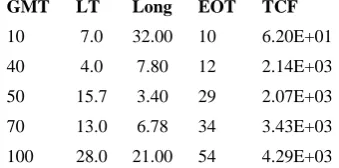
Table 19: Time correction factor (TCF) result using other inputs
GMT LT Long EOT TCF
10 7.0 32.00 10 6.20E+01
40 4.0 7.80 12 2.14E+03
50 15.7 3.40 29 2.07E+03
70 13.0 6.78 34 3.43E+03
100 28.0 21.00 54 4.29E+03
Sufficient information is provided in our package; figure 1 upon loading displays the information seen directly on the form. As expected the solar laws results vary according to the temperature (K) value, being highest for maximum temperature as figures 3-4 depicted. The variability of elevation angle result depends closely on its inputs. Since declination angle is a function of day of the year, and hour angle that of LST, elevation angle, which also depends on site latitude, varies from location to location as the arbitrary data employed in Table 7 reveals. Elevation angle variation has been noted to be very useful for accurate Photovoltaic (PV) system simulation [10].
4.1. Fine tuning codes
Besides inserting error trappings where we deem problem(s) could occur, we fully treated models limitations or conditions for validity. In computing azimuth angle, the conditions given in section 2 (eqns. 11-12) were built into our codes to account for solar period other than solar morning when HRA is positive (HRA > 0). Za cannot be negative or above 360o as its values could be between 0o and 360o. At sunrise Za = 0o
we subtracted 360 as required by the model. The value of declination angle is expected between -23.45o and 23.45o. This fact is taken care of in our codes as you can see in the results shown in Tables 7, 9-11. The effect is boldface for emphasis.
The dvCalMaxElevtnAng method is very handy for estimating maximum elevation angle which is also useful for PV system design. All possible inputs that could be used for evaluating LST, LSTM and maximum elevation angle were utilized. The time correction factor could be evaluated using different inputs as Tables 17-19 demonstrated. The inputs flexibility, as well as ease of computation with SolarSoft guarantees users’ comfort which modern software should provide. The results obtained were compared with previous works and found to be accurate [8-10].
5. CONCLUSION
An application for computing some solar radiation models has been developed. The application exposed the functionalities in dvSolarCls class library developed for all the fourteen models considered. SolarSoft package is accurate, besides being flexible, as comparison with other researchers’ works unveiled. Photovoltaic system Engineers will find our package indispensible in their work by mere pressing buttons and menus to obtain desired parameters for PV system design. Now that the flexibility and accuracy of SolarSoft has been established, there is need to apply it to more real data comprehensively. More so, more solar models should be included to further enhance the usefulness of the package. Animations to show the diurnal and seasonal effects of the solar parameters should be included in this accurate package, so as to further endear it to both Scientists and non-Scientists.
6. REFERENCES
[1] Craig Utley. 2001. A Programmer’s Guide to Visual Basic. NET. Sams Publishing.
[2] Dave Grundgeiger. 2002. Programming Visual Basic .NET. O’ Reilly and Associate, Inc.
[3] Evangelos Petroutsos. 2010. Mastering Microsoft Visual Basic 2010. Wiley Publishing Inc.
[4] Ndukwe, I.C. 1999. Solar Energy utilization in Nigeria in the 21st Century–A Case Study Of Okigwe Town. Nig. J. Phys. Vol.11, Pp. 73–76.
[5] Oyediran Ojo, Kayode Ojo and Feyi Oni. 2001. Fundamental of Physical and Dynamic Climatology. Sedec Publishers.
[6] Thearon and Bryan. 2010. Beginning Microsoft Visual Basic 2010. Wiley Publishing Inc.
[7] Tim Patrick. 2008. Programming Visual Basic 2008. O’ Reilly and Associate, Inc.
[8] ITACA website: www.itancanet.org
[9] Juergen Giesen's GeoAstro Applet Collection: www.jgiesen.de
[10] Bypass Diodes: www.PVEducation.org.2010.
[11] Midmarket CIO information, news and tips – SearchCIO: www.searchcio-midmarket.tectarget.com
[12] Sustainable By Design : www.susdesign.com