*Corresponding author:Pramita Waghambare
INTERNATIONAL JOURNAL OF CURRENT MEDICAL AND
PHARMACEUTICAL RESEARCH
ISSN: 2395-6429, Impact Factor: 4.656
Available Online at www.journalcmpr.com
Volume 5; Issue 12(A); December 2019; Page No. 4755-4759
DOI: http://dx.doi.org/10.24327/23956429.ijcmpr201912794
Research Article
CRITICAL VARIABLE PARAMETERS AFFECTING INDUSTRIALLY RELEVANT BOTTOM-UP
TECHNIQUES OF NANOCRYSTAL FORMULATION
Pramita Waghambare, Lalit J. Pawaskar, Prabha Singh and Pramila Chaubey
Dr. Bhanuben Nanavati College of pharmacy, Mithibai Campus, Vile parle(W), Mumbai, India 400057
ARTICLE INFO ABSTRACT
The solubility dependent bioavailability problem has become a major hurdle in drug development processes. Drug nanocrystals have been widely accepted by the pharmaceutical industry to improve the bioavailability of poorly water-soluble drugs. Poorly water soluble drugs show many problems in formulating a dosage form. Micronization does not sufficiently to enhance bioavailability and so next step is nanocrystalization i.e. drug nanocrystals having size of 1-1000 nm whose main application is to enhance the saturation of solubility, rate of dissolution and bioavailability of poorly soluble or poorly permeable drugs. Pure drug nano crystals, generated by “bottom up” or “top down” technologies, facilitate a significant improvement on dissolution behavior of poorly soluble drugs due to their enormous surface area, which in turn lead to substantial improvement in oral bioavaibility. In this review article we are focusing on Bottom-up techniques due to its simplicity and more applicability towards industrial use. The final product from this process is a suspension of drug nanocrystals in a liquid stabilized by a surfactant or polymer so called nan-suspension and after solidification of nano-suspension, nano-crystals can be formulated. The main objective behind this review articles was to provide bottom-up techniques for the preparation of nano-crystals with various critical parameters which affects the process, the final particle size and stability of nanocrystal.
Copyright © 2019 Pramita Waghambare et al. This is an open access article distributed under the Creative Commons Attribution License, which permits
unrestricted use, distribution, and reproduction in any medium, provided the original work is properly cited.
INTRODUCTION
Most of the APIs are identified through combinatorial screening program are poorly soluble in water. Enhanced solubility and dissolution, improved bioavailability and absorption, elimination of food effects, safe dose escalation, enhanced safety, efficacy and tolerability profiles are the inherited advantages of nanoparticles due to their size and surface features. Low bioavaibility of poorly soluble drug becomes obstacle for oral drug delivery system and to solve these problems, many approaches had been developed like solubilization by surfactants, complex formation, micronization of drugs and among those micronization method was more effective approach in which drug particle size ranges between 1 to 10 µm. Micronization leads to increased surface area and consequently leads to increased dissolution velocity up to certain extent this approach was helpful for increasing the surface area and thus dissolution velocity but it was not sufficient to overcome the bioavailability problems of very poorly soluble drugs. Micronization results in increase surface area of the particle which will ultimately going to enhance the dissolution rate but saturation solubility does not increases, thus bioavailability get affected. To overcome limitations of micronization, nanocrystal approach can be used. Drug nanocrystals (NCs) are the nanoparticles which offer an additional advantage of 100% drug loading since they are
encapsulating-carrier free nanoparticles. The formulation simplicity and production scaling flexibility along with their intrinsic small particle size and large surface area make NCs stand a way unique not just among the pharmaceuticals but also among other nanoparticles. The consequent next step was to move from micronization to nanonization. Nanocrystals was more efficient approach to increase drug solubility and dissolution velocity.1
Nanocrystal are the crystals having size less than 1 µm. Smaller the particle size more will be the surface area which will enhance the solubility and bioavaibility of poorly soluble drug i.e. BCS class II or class IV, ultimately loading dose in the nanocrystals will reduced and patient compliance will increased. Nanocrystals leads to increase in dissolution rate and rapid absorption.
For preparation of the drug nanocrystal, first the nanosuspension is prepared and then it is converted into the nanocrystal. Conversion of liquid nanosuspensions into the solid dosage forms, such as capsules, tablets, granules and pellets, can help to avoid the potential physical instabilities (Ostwald ripening and agglomeration) and chemical instabilites (e.g. oxidation and hydrolysis). Also improve the commercialization of the product and allow better handling.4 There are two methods for solidification of the nanosuspension into the nanocrystal. There are two types of drying Article History:
Received 15th September, 2019 Received in revised form 7th October, 2019
Accepted 13th November, 2019 Published online 28th December, 2019
Key words:
technologies for solidifying the nanosuspensions to get the nanocrystals. First method is drying of the nanosuspension to a nanocrystal powder using oven drying, lyophilisation or spray drying, and then further formulation of the powder proceed to different dosage form such as capsules or tablets. The second method of solidification, includes pelletization or granulation, this method is the combination of shaping and drying processes together. The nanosuspension is used as layering dispersion on solid powder in a fluidized bed process or in a binder solution along with binder in the granulation processes.4 Water or any other dispersion media is removed during the drying process from the nanocrystals suspensions by sublimation or evaporation and the motions of the stabilizer chains around the nanocrystals are decreased because of the possible partial crystallization or dehydration. The steric repulsion supplied by the stabilizer ceases and then the polymer chains adsorbed on the particles can entangle each other, which hinder particle separation and prompts particle aggregation. In addition, the contact points among nanocrystals are increased with water removal. In the drying process mechanical stresses (such as crystallization of ice, the stress of freezing and dehydration) and additional thermal stresses occurs, further nanocrystals are subject to reversible agglomeration or irreversible aggregation/fusion. The agglomeration/aggregation can compromise the advantages of nanocrystals based on the large surface area, e.g. decreased dissolution rate, the lag time in the beginning of the dissolution, and unpredictable variations in bioavailability.5 Therefore, re-dispersibility of dried nanopowders in the dissolution medium with a short time (a few minutes) is an important standard to evaluate the drying step. The parameters of the drying procedure, the properties of drug compounds, the choice of dispersed matrix and stabilizer can affect the nanocrystal re-dispersibility. In freeze drying process, fast freezing and low API concentration are beneficial for re-dispersibility.6 In spray drying process, high gas flow rate and feed temperature lead to formation of donut shaped particles.7 Spray drying at high inlet temperature causes powders with higher lag time as well as lower dissolution rates.5 Eerdenbrugh et al.8 showed that regardless of the drying methods or other properties of drug compounds, such as molecular weight, melting point, solubility and density, the hydrophobicity of drug surface, which in general corresponds to log P values (partition coefficient) of the drug, is a key parameter for nanocrystal redispersibility. More hydrophobic compounds resulted in harder–to–disintegrate agglomeration. Chaubal et al.5 showed that using a charged surfactant as a stabilizer and sugar as excipient can effectively prevent irreversible aggregation compared to non-charged polymeric surfactants and sugars. Excipients are usually added during the freeze drying process to protect the product from freezing stress (cryoprotectant) or drying stress (lyoprotectant).9 The commonly used excipients include water-soluble sugars such as mannitol10, sucrose11, trehalose12, 13 and water-insoluble microcrystalline cellulose (MCC) as a matrix-former to protect the nanocrystals from aggregation14. The results showed that the reconstituted nanocrystals dried with excipients had smaller mean particle size than the ones dried without added lyoprotectant. The preferable amount of cryoprotectant used is about 2%-25%, based on the total weight of the nanoparticulate suspension.15 Sometimes dried powders without any excipients exhibit good re-dispersibility since stabilizers used in nanocrystal production act lyo/cryprotectant in a certain extent.
Bottom-Up Technique
Nanoprecipitation
There are two crucial steps included in the bottom-up process which grows nanocrystals from solution, these are nucleation and consequent crystal growth. Nucleation is very important to achieve uniform and small nanocrystal. In some cases nucleation rate may increase, which results in the increased number of nuclei formed from the supersaturated solution, leading to decreased supersaturation. If a large number of nuclei are produced in the nucleation stage, it results in a narrow particle size distribution.17 Therefore, it is essential to promote homogeneous and rapid nucleation in the bottom-up process. Nucleation can be triggered by either mixing with removal of solvent or antisolvent.17,18 The mixing of drug solution and anti-solvent can be done with use of any conventional mixing equipment, i.e. by using overhead mechanical stirrer or magnetic stirring.19
To promote the higher nucleation, sonication with the help of probe sonicator or bath sonicator can be used to provide cavitation effects, which is called as sonoprecipitation20,21. Some highly efficient mixing equipments can also be used to prepare nanocrystals, which includes static mixer,22 confined impinging jet reactor23–27 and multiple inlet vortex mixer28 these instruments can be used for intense micro-mixing between the two fluids which can be fulfilled in some milliseconds only.29-30 A homogeneous solution with high supersaturation can be achieved for the onset of nucleation, which favours small nanocrystals having narrow size distribution. Freeze drying and spray-drying are common methods to remove solvent. Recently, controlled crystallization during freeze-drying techniques31 and spray-freezing into liquid32–35 also has been developed to prepare nanocrystals by removal of solvent. Supercritical fluid (SCF) can be used to prepare nanocrystals by taking advantage of the unique physical properties of SCF, with solubilisation like liquid and diffusivity like gas. In addition, SCF can be removed very quickly and efficiently at low temperature without excessive drying and nanocrystals can be easily precipitated. Supercritical carbon dioxide (SCO2) is the most favoured SCF
due to the mild critical point (310C and 73.8bar) and low environmental impact. Depending on the solubility of a compound in SCO2, nanocrystal preparation can be achieved
by rapid expansion of SCO2 from drug solution,36 or by
precipitation using SCO2 as the antisolvent.37–39
Critical Variable Parameters Affecting Nanoprecipitation
Effect of the drug concentration
Optimum drug concentration is required to get the desired smaller particle or nanocrystal size. Concentration above the optimum level results in generation of lager particle size. Higher drug concentration is responsible for higher super saturation which results in a higher rate of nucleation and thereby smaller size particles are obtained but, at the same time, the growth of nuclei is also increased due to the higher super saturation. Second, due to increase in the drug concentration, viscosity gets increases, which will hinder the diffusion between anti solvent and solvent, which leads to slower nucleation rates, non-uniform super saturation and increased particle agglomeration, and hence, larger size nanocrystals are obtained.40-42
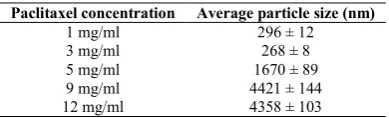
Ying Lu et al have developed paclitaxel nanocrystal of size less than 300nm in that process different trial batches have been taken with different concentrations of paclitaxel in the solvent which is shown in the table (Table 1) along with the average particle size, In the optimization process he found that 3 mg/ml paclitaxel in ethanol is the optimum concentration required to meet the minimum requirements. By using the drug concentrations above this level results in increase in the particle size. This increase in the particle size had been observed as the drug concentration in solvent increased which was due to the higher level of supersaturation which reduces the diffusion rate of crystal nuclei between solvent and antisolvent and increases the particle growth. So the data generated due to these trial batches as shown in the table 1 supports the above statement43.
Table 1 effect of paclitaxel concentration on average particle size of nanocrystal43
Paclitaxel concentration Average particle size (nm)
1 mg/ml 296 ± 12
3 mg/ml 268 ± 8
5 mg/ml 1670 ± 89
9 mg/ml 4421 ± 144
12 mg/ml 4358 ± 103
Solvent to Anti-solvent ratio
The relative ratio of anti-solvent to solvent have major effect on the particle size property of nanosuspension or nanocrystal. Particle size gets decreases with an increasing ratio of antisolvent. Increased ratio of antisolvent to solvent, results in higher or increased degree of super saturation which increases the rate of nucleation and results in a decreased particle size. Once the nuclei are formed, particle growth occurs which is partially hindered at higher anti-solvent volumes as the diffusion distance for the growing species increases and the process becomes diffusion limited.40-42,44
Ying Lu et al., have developed paclitaxel nanocrystal formulation of size less than 300nm in that process different trial batches have been taken with different solvent to antisolvent ratio as shown in the (table 2) with the average particle size obtained. An antisolvent to solvent ratio of 20:1 was found to be necessary in case of paclitaxel to get nanocrystals that met the requirements. Below this ratio the nanocrystal size got increased significantly. The explanation for that was given by Ying Lu et al that at a same drug content in the formulation, the degree of supersaturation got increased when there was increased ratio of antisolvent to solvent. A higher degree of supersaturation results in a greater nucleation
rate, which causes smaller particle size. In case of low antisolvent to solvent ratios, the rate of nucleation was higher but the effect is demolished due to the increase in the growth due to higher solvent phase ratio, and the kinetics favour overall particle growth. Above the ratio of 20:1 of antisolvent-to-solvent, there was no further decrease in nanocrystal size was seen. This was most likely due to the equilibrium between nucleation and growth processes.43
Table 2 effect of solvent to Anti-solvent ratio on average particle size (nm)43
Antisolvent–solvent ratio Average particle size (nm)
40:1 291 ± 10
20:1 287 ± 8
10:1 518 ± 19
5:1 746 ± 25
Stabilizer
It is the key challenge in the nanoprecipitation process is to retain the nano size of the particles in nanosuspension. In Ostwald ripening phenomenon, it is stated that, smaller particles are more soluble than large ones that’s why material transfer occurs from the fines or smaller particle size to the coarse or larger size particles, coarse particles grow and fine particles redissolve. Moreover during the antisolvent precipitation, surface Gibbs free energy of the newly formed nanoparticles gets increased and due to which the particle undergoes aggregation to reduce Gibbs free energy which compromises with the advantage of higher saturation solubility and bioavailability, and faster rate of dissolution.44-46
Stabilizers gets adsorbed on the surface of the newly formed particles which prevents the Ostwald’s ripening and agglomeration of nanocrystals in the nanosuspension and gives a physically stable formulation by providing ionic or steric barrier. The amount and type of stabilizer has a major effect on in vivo behaviour of nano suspension and physical stability. Steric and/or electrostatic techniques are the common approaches for stabilization of nanosuspension. In electrostatic stabilization, ionic surfactants (such as sodium lauryl sulfate (SLS) and soya lecithin gets adsorbed on the particle surface of nanoparticles and this electrostatic repulsion and surface charge prevents the aggregation of Nano sized particles. Steric stabilization can be achieved by adsorbing polymers (for example hydroxyl propyl b cyclodextrin (HP-b-CD), hydroxyl propyl methyl cellulose (HPMC) and D-a-tocopherol polyethylene glycol 400 succinate (TPGS)) or nonionic surfactants (for example Poloxamer 188) on the surfaces of drug nanoparticles to give a dynamically rough surface to prevent coalescence by repulsive entropic forces.44-46
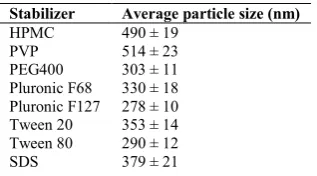
Ying Lu et al have developed paclitaxel nanocrystal formulation with the aim of formulating the nanocrystal of size less than 300nm in that process different batches have been taken with different stabilizers which resulted in different size of nanocrystals as shown in the table 3. Ying Lu et al tried 8 different stabilizers including HPMC, PVP, PEG400, Pluronic F68, Pluronic F127, Tween 20, Tween 80, and SDS with the same concentration and he had observed a lot of variation in the average particle size as shown in the table 3.47
Table 3 Effect of different stabilizers at same concentration on average particle size (mm)47
Stabilizer Average particle size (nm)
HPMC 490 ± 19
PVP 514 ± 23
PEG400 303 ± 11
Pluronic F68 330 ± 18
Pluronic F127 278 ± 10
Tween 20 353 ± 14
Tween 80 290 ± 12
SDS 379 ± 21
Effect of the stirring speed
Stirring speed is the important critical parameter which usually affects the particle size. Increase in the stirring speed of solution results in decreased particle size, which may be due to higher intensity of micro mixing. High micro mixing causes increased mass transfer between the multiphase and rate of diffusion and thus high homogenous super saturation in less time is achieved which causes rapid nucleation and resulting into generation of smaller particles size. Also the growth of the particle is also reduced at high stirring speed. Thus smaller and narrow particle size distribution is achieved at higher stirring speed.40
Zhengxi Zhu et al have formulated Polyelectrolyte Stabilized b-Carotene Nanoparticles via Flash Nanoprecipitation, during formulation development he has taken trial batches at different stirring speed and from these studies he has concluded that as the stirring speed gets increases the particle size gets decreases up to a certain speed of stirring which is called as critical stirring speed but increase in the speed above the critical do not causes to further decreases in the particle size, and particle size remains same.47
CONCLUSION
The formulation of poorly soluble drugs is a challenging problem which can be solved by nanocrystal or nanosuspension formulation. Nanosuspension formulation is most of the times not stable due to Ostwald ripening or agglomeration. These stability problems can be solved by conversion of nanosuspension formulation into nanocrystal formulation by oven/tray drying, spray drying or lyophilisation. The drug NCs being unique nanoformulation options with notable advantages, the researches encompassing scalable formulations/methods for the production of drug NCs open a new vista and pave a new platform for the design of these nanopharmaceuticals. In the present article, so many critical variable parameters affecting nanocrystal formulation by bottom-up process are mentioned. By controlling these critical variable formulation parameters, desired size of nanocrystals can be formulated with less variation per batch with highest robustness.
References
1. Thakkar H, Patel B, Thakkar S. A review on techniques for oral bioavailability enhancement of drugs. Int. J Pharm Sci Rev Res 2010;4:203-23.
2. Zhang L, Webster TJ. Nanotechnology and Nanomaterials Promises for Improved Tissue Regeneration. Nano Today 2009;4:66-80.
3. Chan VS. Nanomedicine: an unresolved Regulatory issue. Regular Toxicol pharmacol 2006;46:218-24. 4. Gao L, Liu G, Ma J, Wang X, Zhou L, Li X et al.
Application of drug nanocrystal technologies on oral drug delivery of poorly soluble drugs. Pharm Res 2013;30:307-24.
5. Chaubal MV, Popescu C. Conversion of nanosuspensions into dry powders by spray drying: A case study. Pharm Res 2008;25:2302-8.
6. Lee J, Cheng Y. Critical freezing rate in freeze drying nanocrystal dispersions. J Control Release 2006;111:185-92.
7. Iskandar F, Gradon L, Okuyama K. Control of the morphology of nanostructured particles prepared by the spray drying of a nanoparticle sol. J Colloid Interface Sci 2003;265:296-303.
8. Van EB, Froyen L, Van HJ, Martens JA, Augustijns P, Van den MG. Drying of crystalline drug nanosuspensions-the importance of surface hydrophobicity on dissolution behavior upon redispersion. Eur J Pharm Sci 2008;35:127-35.
9. Abdelwahed W, Degobert G, Stainmesse S, Fessi H. Freeze-drying of nanoparticles: formulation, process and storage considerations. Adv Drug Deliv Rev 2006;58:1688-713.
10. Gao L, Zhang D, Chen M, Zheng T, Wang S. Preparation and characterization of an oridonin nanosuspension for solubility and dissolution velocity enhancement. Drug Dev Ind Pharm 2007;33:1332-9. 11. Van EB, Froyen L, Martens JA, Blaton N, Augustijns P,
Brewster M et al. Characterization of physico-chemical properties and pharmaceutical performance of sucrose co-freeze-dried solid nanoparticulate powders of the anti-HIV agent loviride prepared by media milling. Int J Pharm 2007;338:198-206.
12. Teeranachaideekul V, Junyaprasert VB, Souto EB, Müller RH. Development of ascorbyl palmitate nanocrystals applying the nanosuspension technology. Int J Pharm 2008;354:227-34.
13. Konan YN, Gurny R, Allémann E. Preparation and characterization of sterile and freeze-dried sub-200 nm nanoparticles. Int J Pharm 2002;233:239-52.
14. Van EB, Vercruysse S, Martens JA, Vermant J, Froyen L, Van HJ et al. Microcrystalline cellulose, a useful alternative for sucrose as a matrix former during freeze-drying of drug nanosuspensions - a case study with itraconazole. Eur J Pharm Biopharm 2008;70:590-6. 15. Gary GL, Christopher PP, Kenneth CC. Method to
reduce particle size growth during lyophilization. US Patent US5302401A, 1994.
16. Yi Lu, Ye Li, Wei Wu. Injected nanocrystals for targeted drug delivery. Acta Pharmaceutica Sinica B 2015;6:106–13.
systems: strategies, technologies, and applications, 1st ed. New York: John Wiley & Sons, Inc; 2013. p. 181– 206.
18. de Waard H, Frijlink HW, Hinrichs WL. Bottom-up preparation techniques for nanocrystals of lipophilic drugs. Pharm Res 2011;28:1220-3.
19. Xia D, Gan Y, Cui F. Application of precipitation methods for the production of water-insoluble drug nanocrystals: production techniques and stability of nanocrystals. Curr Pharm Des 2014;20:408-35.
20. 20.] Dalvi SV, Yadav MD. Effect of ultrasound and stabilizers on nucleation kinetics of curcumin during liquid antisolvent precipitation. Ultrason Sonochem 2015;24:114-22.
21. Dalvi SV, Dave RN. Analysis of nucleation kinetics of poorly water-soluble drugs in presence of ultrasound and hydroxypropyl methyl cellulose during antisolvent precipitation. Int J Pharm 2010;387:172-9.
22. D'Addio SM, Prud'homme RK. Controlling drug nanoparticle formation by rapid precipitation. Adv Drug Deliv Rev 2011;63:417-26.
23. Dong Y, Ng WK, Shen S, Kim S, Tan RB. Controlled antisolvent precipitation of spironolactone nanoparticles by impingement mixing. Int J Pharm 2011;410:175-9. 24. Beck C, Dalvi SV, Dave RN. Controlled liquid
antisolvent precipitation using a rapid mixing device. Chem Eng Sci 2010;65:5669–75.
25. Siddiqui SW, Unwin PJ, Xu Z, Kresta SM. The effect of stabilizer addition and sonication on nanoparticle agglomeration nina confined impinging jet reactor. Colloid Surf A 2009;350:38–50.
26. Chiou H, Chan HK, Prud'homme RK, Raper JA. Evaluation on the use of confined liquid impinging jets for the synthesis of nanodrug particles. Drug Dev Ind Pharm 2008;34:59–64.
27. Liu Y, CC, LiuY, Prud'homme RK, Fox RO. Mixing in a multi inlet vortex mixer (MIVM) for flash nano-precipitation. Chem Eng Sci 2008;63:2829–42.
28. Han J, Zhu Z, Qian H, Wohl AR, Beaman CJ, Hoye TR, et al. A simple confined impingement jets mixer for flash nanoprecipitation. J Pharm Sci 2012;101:4018–23. 29. 30.] Lince F, Bolognesi S, Marchisio DL, StellaB, Dosio F, Barresi AA et al. Preparation of poly (MePEGCA-co-HDCA) nanoparticles with confined impinging jets reactor: experimental and modelling study. J Pharm Sci 2011;100:2391–405.
30. de Waard H, Hinrichs WL, Frijlink HW. A novel bottom-up process to produce drug nanocrystals: controlled crystallization during freeze drying. J Control Release 2008;128:179–83.
31. Hu J, Rogers TL, Brown J, Young T, Johnston KP, Williams RO 3rd. Improvement of dissolution rates of poorly water soluble APIs using novel spray freezing into liquid technology. Pharm Res 2002;19:1278–84. 32. Rogers TL, Nelsen AC, Hu J, Brown JN, Sarkari M,
Young TJ et al. A novel particle engineering technology to enhance dissolution of poorly water soluble drugs: spray freezing into liquid. Eur J Pharm Biopharm 2002;54:271–80.
33. Rogers TL, Hu J, Yu Z, Johnston KP, Williams RO 3rd. A novel particle engineering technology: spray-freezing into liquid. Int J Pharm 2002;242:93–100.
34. Hu J, Johnston KP, Williams RO 3rd. Spray freezing into liquid (SFL) particle engineering technology to enhance dissolution of poorly water soluble drugs: organic solvent versus organic/aqueous co-solvent systems. Eur J Pharm Sci 2003;20:295–303.
35. Tuerk M. Manufacture of submicron drug particles with enhanced dissolution behaviour by rapid expansion processes. J Supercrit Fluid 2009;47:537–45.
36. Reverchon E, De MarcoI, Torino E. Nanoparticles production by supercritical antisolvent precipitation: a general interpretation. J Supercrit Fluid 2007;43:126– 38.
37. Kim MS, Jin SJ, Kim JS, Park HJ, Song HS, Neubert RH et al. Preparation, characterization and in vivo evaluation of amorphous atorvastatin calcium nanoparticles using supercritical antisolvent (SAS) process. Eur J Pharm Biopharm 2008;69:454–65. 38. Zhao X, Zu Y, Li Q, Wang M, Zu B, Zhang X et al.
Preparation and characterizationof camptothecin powder micronized by a supercritical antisolvent (SAS) process. J Supercrit Fluid 2010;51:412–9.
39. Sinha B, Müller RH, Möschwitzer JP. Bottom-up approaches for preparing drug nanocrystals: Formulations and factors affecting particle size. Int J Pharm 2013;453:126-41.
40. 4Kakran M, Sahoo NG, Li L, Judeh Z, Wang Y, Chong K, Loh L. Fabrication of drug nanoparticles by evaporative precipitation of nanosuspension. Int J Pharm 2010;383:285-92.
41. Joye IJ, Mc Clements DJ. Production of nanoparticles by anti-solvent precipitation for use in food systems. Trends in Food Science & Technology 2013;34:109-23. 42. Ying Lu, Zhao-hui W, Tonglei L, Helen MN, Kinam P,
Michael S. Development and evaluation of transferrin-stabilized paclitaxel nanocrystal formulation. J Control Release 2014;176:76–85.
43. Yadav D, Kumar N. Nanonization of curcumin by antisolvent precipitation: process development, characterization, freeze drying and stability performance. Int J Pharm 2014;477:564-77.
44. Aditya NP, Yang H, Kim S, Ko S. Fabrication of amorphous curcumin nanosuspensions using beta-lactoglobulin to enhance solubility, stability, and bioavailability. Colloids Surf B Biointerfaces 2015;127:114-21.
45. Hong C, Dang Y, Lin G, Yao Y, Li G, Ji G et al. Effects of stabilizing agents on the development of myricetin nanosuspension and its characterization: an in vitro and in vivo evaluation. Int J Pharm 2014;477:251-60. 46. Zhengxi Z, Katrin MG, Shlomo M, Yeshayashu T,
Christopher W. Macosko. Polyelectrolyte Stabilized Drug Nanoparticles via Flash Nanoprecipitation: A Model Study with b-Carotene. journal of pharmaceutical sciences 2009;99:4295-306.