Abstract—A double-deck tunnel is an advanced tunnel
construction technology that has been applied under various conditions around the world. This type of tunnel consists of multi-deck roads in a single tunnel, and each deck can be a complex formation of roads for vehicles or waterways, thus offering the advantage of maximizing national infrastructures and diversifying the functions of a tunnel. In this paper, the characteristics and durability of various types of cement-based grouts that can be applied in the construction and reinforcement of double-deck tunnels were investigated. Types of grouting materials were divided into cement grout, which has quick setting properties, and mortar grout, which has high strength properties. Looking at the cement grouts, the quick setting property was excellent when sodium silicate was used as a set accelerating agent, but multiple cracks were found due to changes in volume and a reduction in strength was observed over the longer term. When a mineral-based set accelerating agent (calcium aluminate) was used, excellent durability was shown, including an increase in strength, and there were no significant changes in volume and cracks over the long term. Changes in strength and volume in mortar grouts were proportional to the water-cement ratio, and the results of chemical resistance and volume change measurement showed that the high strength-type had the best durability performance.
Index Terms—Double-deck tunnel, grouting, reinforcement,
durability.
I. INTRODUCTION
Grouting is defined as injecting a grout material with special properties using gravity or pumps, or filling a gap in the connecting parts of structures for integration to improve the characteristics of a target to meet certain objectives [1]. Grouting can be divided into cement, asphalt, or polymer-based materials according to the injection material used, and can also be divided into water cut-off grouting and reinforcement grouting depending on the purpose of construction. Initially, most civil constructions employed cement-based grouting utilizing cement, water, and clay for grouting materials. However, with the invention of chemical grouting in 1919, the variety of grouting has increased further. The chemical grouting method has seen highly limited application in Korea, as it has been applied to curtain grouting for mountain tunnels or dams. But grouting has been adopted in earnest in civil construction projects, including the
Manuscript received May 10, 2017; revised July 12, 2017. This research was supported by a grant (14SCIP-B088624-01) from Construction Technology Research Program funded by Ministry of Land, Infrastructure and Transport of Korean government.
H. S. Heo is with R&D Center the Jntinc Co. Ltd., 18284 Korea (e-mail: [email protected])
B. J. Lee is with the Civil Engineering Department, University of Daejeon, Daejeon, 34520 Korea (e-mail: [email protected]).
Seoul Subway, since the 1970s.
Today, grouting is widely used in construction projects not only in Korea’s five major metropolitan cities, including Daegu, Incheon, Gwangju, and Daejeon, but also in large-scale buildings, expressways, airports, high-speed railway, soft ground improvement, and harbor construction. The use of grouting has become indispensable in construction, and this trend is expected to continue.
In this study, the durability characteristics of milk type grout for waterproofing and reinforcement of surrounding grounds during excavation of double-deck tunnel, and mortar type grout for reinforcement of slabs inside double-deck tunnels, were investigated based on mix conditions.
Studies have been conducted on milk type grouting in Korea with the aim of increasing ground strength using sodium silicate, suggesting studies in Korea on chemical grouting were also launched in earnest [2]. The durability of the grouting method using sodium silicate, one of the main materials in milk type grouting that provides a quick setting property, can be acquired from the effect of cohesion between soil and sodium silicate grout[3]. However, the durability is degraded when the groundwater flow rate increases and causes severe dilution and loss of chemical grouts, thereby reducing cohesion and increasing the elution of chemical grout. Thus, a study [4] reported that when a method that used sodium silicate was applied to hydraulic grounds, not only shortening the cementation time but also increasing the concentration, the injection rate and injection speed of chemical grouts were important factors to increase the efficiency of the method. In contrast, a method that employed a mineral-based set accelerating agent used hydration reaction of cements and secondary reaction of a mineral-based set accelerating agent (Ettringite reaction) to produce a quick-setting structure due to hydrate generation. Furthermore, a grout hardened by hydrate [5] was claimed, in that it had fast initial hardening and excellent long-term durability due to a strong bond.
Mortar type grouts were divided into general type, self leveling (SL) type, and high-strength type, and their durability was investigated. No studies have been conducted on the reinforcement of double-deck slabs in double-deck tunnels in Korea, since no cases are found in the installation and operation of double-deck tunnels in Korea. Thus, the present study investigated various types of mortars used in Korea as well as their characteristics. The general type consisted of cement, silica, and functional admixture, which was selected as the most widely used in building and civil sites. The SL type is a high flow mortar constructed over a slab of buildings and factories. It contains a variety of admixtures inside mortars, and has excellent characteristics in terms of crack resistance, bond property, and initial
Study on Durability of Grouting Materials for
Reinforcement in a Double-Deck Tunnel
strength development. In contrast, the high-strength type is used in conditions where the water-cement ratio is very low. Since it employs admixtures such as silica fume to develop high strength, its durability is generally excellent.
The present study was a foundational study on the development of grouting material for the efficient reinforcement of double-deck slab pouring. It involved experiments on compressive strength, changes in length, and chemical resistance with regard to milk type and mortar type grouts for the purpose of repair and reinforcement of slab structures as well as surrounding grounds during double-deck tunneling, and their durability was analyzed and evaluated.
II. MATERIALS AND DESIGN OF COMPOSITION RATIO
A. Milk Type Grout
Sodium silicate and mineral-based grouts were selected to compare the performance of milk type grouts, and a standard composition ratio recommended by material suppliers was applied to compare their characteristics. The composition ratio was based on two solutions, and gelation and hardening are progressed via mixing the two solutions to reveal water-stop and reinforcement performance within the ground. A separate mixer was used to mix the two solutions inside a mixer device to be used in a site, and then the mixture was transported through a separated pump, and passed through a special mixing device prior to grouting followed by being injected to the ground. The gelation condition was as follows: for sodium silicate-based grouts, glassy calcium silicate was generated and gelated via the reaction between silica and calcium hydroxide, which was a cement hydrate, and for mineral-based grouts, ettringite, which was a needle-shaped crystal, was generated and gelated by calcium hydroxide, which was a cement hydrate, calcium aluminate, and plaster. These have a separated gel structure but their purpose is the same as water-stop and reinforcement of ground.
Tables I and II present the mix conditions for each type. TABLE I: MIX CONDITION OF SODIUM SILICATE-BASED GROUTS
Solution A Solution B
Sodium silicate Water Cement Bentonite Water
250 250 200 20 430
TABLE II: MIX CONDITION OF MINERAL-BASED GROUTS
Type W/C Solution A
Solution B
Water Cement Accelerator Water Setter
Ordinary Portland Cement
(OPC)
40% 555 1,262 126
70% 666 952
100% 740 740 90 10
130% 702 561 56 90 10
160% 734 474 47
Micro Cement (M/C)
40% 555 1,262 126
70% 666 952
100% 740 740
130% 702 561 56 90 10
160% 734 474 47 90 10
1)
Setting preparation: Acrylate-based polymer thickener
B. Mortar Type Grout
For mortar type grout, the water-mortar ratio was changed to ensure the optimum properties, and the durability of each material was investigated. Each of the materials was based on one-solution type, and mixed in a single mixer and transported by a pump, thereby being injected into a site where reinforcement was needed. Types and composition ratios of mortar type grouts are presented in Table III.
TABLE III: MIX CONDITION OF HIGH-STRENGTH TYPE GROUTS
Mix condition Unit weight
Sample nameW/M(%)1) S/B(%)2)
cement additive sand water
General type
12 355 160 60 78 120
15 355 160 60 78 150
18 355 160 60 78 180
SL type
12 75 240 330 430 120
15 75 240 330 430 150
18 75 240 330 430 180
High-strength type
12 96 230 280 490 120
15 96 230 280 490 150
18 96 230 280 490 180
1)W/M(%): water-mortar ratio 2)S/B(%): sand-binder ratio
III. EVALUATION OF DURABILITY
A. Fabrication of Specimens
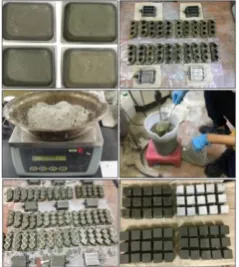
The sample fabrication was conducted after preparing components in accordance with the mix ratios in Tables 1– 3, which were then mixed using a dedicated mixer as shown in Fig. 1 followed by being injected into a mold before standard curing. Tests on compressive strength, changes in length, and chemical resistance were then conducted to evaluate the durability of each sample.
Fig. 1. Fabrication of specimens.
B. Test of Durability Performance
1) Compressive strength
Compressive strength was measured using the “testing method for compressive strength of hydraulic cement mortar” in KS F 5105. To produce the specimens, a 50×50×50mm mold was used, and three specimens for each age were fabricated. Strength was measured after curing for 1, 3, 7, 28, 56, and 91 days for milk type and mortar types.
2) Change in length
in a temperature of 23℃±3℃ and 60%±5% of humidity was used, and the change in length was measured using Vernier calipers.
3) Chemical resistance
For the chemical resistance test, square-shaped specimens of 50×50×50mm were fabricated as per the regulation in ASTM C 267 and immersed sufficiently in an aqueous solution of 5% sulfuric acid. Then, changes in outer appearance and mass were measured in the condition under 20℃ and 60% relative humidity. Prior to the measurement, the specimens were naturally dried for 24 hours and peeled off the corrosive area.
IV. TEST RESULT
A. Milk Type Grout 1) Compressive strength
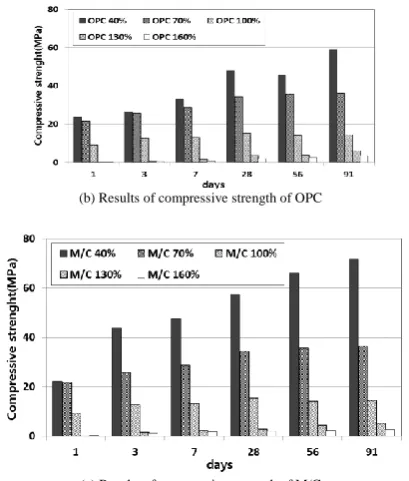
The test results according to the mix conditions showed that in all conditions (sodium silicate, ordinary Portland cement (OPC), and micro cement (M / C)), compressive strength tended to decrease as the W/C ratio increased as shown in Fig. 2. In silicate-based specimens, strength was gradually increased according to ages, but this increase in strength was smaller than other compared specimens.
For OPC and M/C, an excellent level of strength was revealed in M/C when W/C ratio was 40%. On the other hand, a relatively high strength was developed in OPC when W/C ratio was 70% and 100%. For milk type, a very high strength was developed in OPC and M/C when W/C ratio was less than 70%, making it appropriate as a high-strength grout.
2) Change in length
The test results revealed that all samples showed a high contraction rate at early age, and then a pattern of constant converging was observed as the contraction rate decreased over time, as shown in Fig. 3 and Fig. 4. In particular, silicate-based specimens showed a high contraction rate overall at initial and long ages compared to that of OPC and M/C. For OPC and M/C, the contraction rate was not increased significantly, but a similar contraction rate was shown under all conditions even if W/C ratio was increased, thereby revealing highly stable durability compared to silicate-based specimens.
(a) Mean compressive strength of silicate, OPC, and M/C
(b) Results of compressive strength of OPC
(c) Results of compressive strength of M/C
Fig. 2. Test result on compressive strength of milk type specimens.
(a) Silicate and OPC
(b) M/C
Fig. 3. Test result on changes in length of milk type specimens
1day 30days 1day 30days (b) OPC 40% (c) OPC 70%
1day 30days 1day 30days (d) OPC 100% (e) OPC 130%
1day 30days 1day 30days (f) OPC 160% (g) MC 40%
1day 30days 1day 30days (h) MC 70% (i) MC 100%
1day 30days 1day 30days (j) MC 130% (k) MC 160%
Fig. 4. Changes in length of milk type specimens.
3) Chemical resistance
The chemical resistance test was conducted by immersing specimens in a test solution of 5% sulfuric acid for 31 days, and measuring the change in their mass every three days. During the test process, the aqueous solution was replaced every week to maintain the concentration of sulfuric acid in the aqueous solution as constant. The test result showed that a significant reduction in mass was found in the silicate-based specimens from the early stage, while a reduction in mass was revealed in a relatively stable tendency on OPC and M/C as time passed, as shown in Fig. 5 and Fig. 6.
Conclusively, milk type (OPC and M/C) specimens had much less loss of mass at the final day than silicate-based specimens, which verifies their higher chemical resistance.
(a) Silicate and OPC
(b) M/C
Fig. 5. Result of test on chemical resistance of milk type specimens.
(a) 7days
(b) 14days
(c) 21days
(d) 28days
Fig. 6. Chemical resistance of milk type specimens.
B. Mortar Type Grout 1) Compressive strength
upon W/M 12%, which was highly strong. This was gradually increased over time, up to 105 MPa at day 91. The increase in strength for the general type was large at early ages (day 1 to day 3), but this increase in strength was reduced as W/M ratio and age were increased. All of the general type, SL type, and high-strength type showed the strongest strength at W/M 12%.
2) Change in length
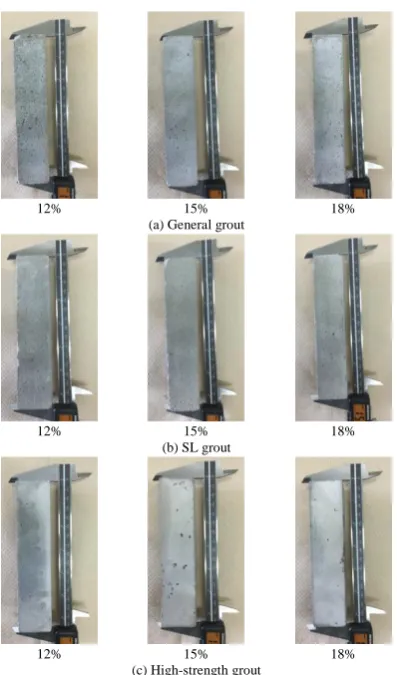
Changes in length by age were measured by comparing the lengths of the initial specimens, which are shown in Fig. 8 and Fig. 9. The high-strength type exhibited some contraction at early stage at W/M 18%, but no change in contraction was revealed after day 10. For the mortar type, minimal contraction was measured only at early stage under all conditions. Afterward, the rate of contraction was converged constantly over time.
3) Chemical resistance
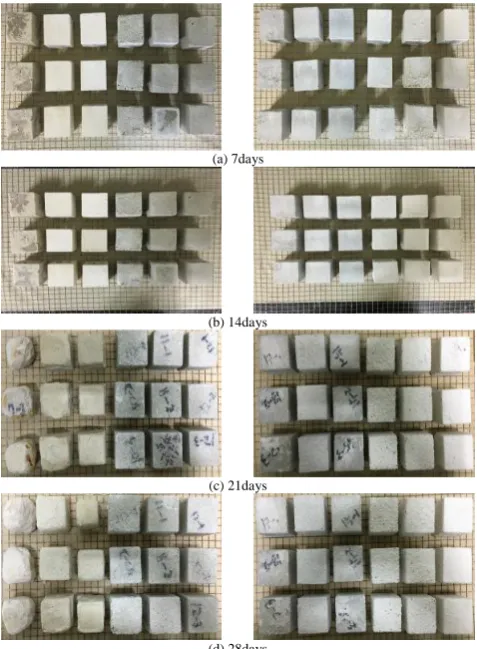
The test on chemical resistance of mortar type was conducted under the same conditions as the milk type type, and test results are shown in Fig. 10 and Fig. 11. For the mortar type, a minimal reduction in mass was revealed in all ages, and a significantly lower reduction in mass was exhibited even after 45 days in immersion compared to that of milk type. The present test results verified that the mortar type had superior chemical resistance compared to the milk type.
Fig. 7. Result of compressive strength measurement of high-strength grouts.
(a) General grout.
(b) SL grout.
(c) High-strength grout.
Fig. 8. Result of test on changes in length of mortar type specimens.
12% 15% 18% (a) General grout
12% 15% 18% (b) SL grout
12% 15% 18% (c) High-strength grout
Fig. 9. Changes in length of mortar type specimens.
(a) General grout.
(c) High-strength grout
Fig. 10. Result of test on chemical resistance of mortar type specimens.
(a) 7days
(b) 14days
(c) 21days
(d) 28days
Fig. 11. Chemical resistance of mortar type specimens.
V. CONCLUSION
The present study analyzed the characteristics of milk and mortar type grouts to develop grouting materials for the purpose of reinforcement of the double-deck tunnel, and compressive strength, changes in length, and chemical resistance were evaluated to determine their durability. The result of durability test of a milk type grout showed that the mineral-based composition had superior strength to the silicate-based composition in terms of compressive strength, while for OPC and M/C, higher strength was measured at W/C 40% and 70% than others. For this reason, they were found to be suitable for use as high-strength grouts under W/C 70%. In the test on changes in length, silicate-based specimens showed the largest reduction rate in all conditions, and mineral-based specimens had a slight reduction initially regardless of the W/C ratio, but changes in length were converged constantly over time, and no changes were shown later. The results of the chemical resistance test showed that
the silicate-based specimens had a significant reduction in mass compared to other types while the mass of the mineral-based specimens tended to decrease gradually as immersion days have increased. Thus, the present test results verified that the mineral-based specimens had superior chemical resistance in contrast with silicates.
The results of the test on the durability of mortar type grouts showed that the strongest strength was revealed in high strength type at W/M 12%, and for the general type, the increase in strength was large in early ages but this trend of increasing strength gradually decreased as W/M ratio and age increased. In all types, the largest strength for each dimension was revealed at W/M 12%: general, SL, and high-strength. The results of the length change showed that the mortar type exhibited a similar change in length to that of milk type. In particular, relatively high contraction was observed at early ages with W/M 18% in high-strength type, but no more contraction was found afterward as age increased. The results of the chemical resistance test showed that the mortar type did not have a reduction in mass at early and later stages, and a lower reduction in mass was observed compared to that of the milk type even with more than 45 immersion days. Thus, the present test results verified that the mortar type grouts had superior chemical resistance.
ACKNOWLEDGEMENT
This research was supported by a grant (14SCIP-B088624-01) from Construction Technology Research Program funded by Ministry of Land, Infrastructure and Transport of Korean government.
REFERENCES
[1] H. S. Heo "An experimental study on the mixing properties of thixotropic grou,"M.Sdissertation, Dept. Civil and Environment Eng, Dankook Univ., Seongnam, Korea, 2001.
[2] H. S. Heo, B. J. Lee, and S. L. Lee "The physico-chemical characteristics of the high strength grout consist of materials," in Proc. Korea Society of Civil Engineerings Conf., 2015, pp.135-136 [3] S. Li, R. Liu, Q. Zhang, and X. Zhang, “Protection against water or
mud inrush in tunnels by grouting: A review," Journal of Rock Mechanics and Geotechnical Engineering, vol. 8, no. 5, 2016, pp.753-766.
[4] S. J. Kim, K. S. Cha, and H. S. Heo "Development of Cement Milk Grout for Gravel and Riprap Cut-off," Korean Geotechnical Society Conf., 2014, pp.1108-1109.
[5] B. S. Chun, J. Y. Lee, and K. M. Kim, "Strength characteristic of solidified cement grout on curing solution and environmental effects," in Proc. Korean Geotechnical Society Conf., 2003, p. 689696
Heo Hyungseok acquired his master’s degree with a
thesis titled "Study on Characteristics of Plastic Grout" from the Department of Civil Engineering, Dankook University. He is now working for JNTINC as a leader in construction Material team after long years working in research center. His interesting area is new materials for buildings, ground foundations and pavement.