Development of Cylinder Type Sago
Rasping Machine Using Pointed Teeth
Darma
*1, Budi Santoso**
2, Reniana
*3*Agricultural and Biosystem Engineering Department, Faculty of Agricultural Technology, University of Papua, Manokwari 98314, Indonesia
**Agricultural Processing Technology Department, Faculty of Agricultural Technology, University of Papua, Manokwari 98314, Indonesia
1 [email protected], 2 [email protected], 3 [email protected]
Abstract— Traditional method of sago starch extraction was a time and labor intensive process. The most laborious stage is pith disintegration which is done by using hammer-like tools called pounder. The total time required to process one whole trunk of sago palm traditionally is 41 hours on average or six days of work. However, the use of rasping machine to disintegrate the pith is saving time and energy. The objective of this study was to develop a cylinder type sago rasping machine in order to improve its performance. In the experiment, three rotation speed of rasping cylinder (1500 rpm, 2250 rpm, 3000 rpm) and three levels of cylinder’s teeth density (2.2 cm × 4 cm, 2.2 cm × 3 cm, and 2.2 × 2 cm) were examined. The rasping performance test was carried out by measuring rasping capacity, starch percentage, and starch yield. Three replications were considered for each treatment. A one way ANOVA by SPSS Statistics (Version 23) was used for analysing the data. The experimental results showed that the combination of cylinder rotation speed and teeth density significantly affected rasping capacity and starch yield, but did not affect the starch percentage. The highest rasping capacity (1009 kg/hour) and the highest starch yield (476 kg) was achieved under experimental condition at teeth density 2.2 cm x 4 cm with cylinder rotation speed of 2250 rpm. Meanwhile, the highest starch percentage (50.517 %) was obtained at experimental condition at teeth density 2.2 cm x 4 cm with cylinder rotation speed of 3000 rpm. Therefore, the optimum condition to achieve highest rasping performance was teeth density 2.2 cm x 4 cm with cylinder rotation speed of 2250 rpm. In conclusion, the developed cylinder type sago rasping machine works properly and has higher performance compared with previously prototype.
Index Term-- sago rasping machine, cylinder type, rotation speed, rasping capacity, teeth density
I. INTRODUCTION
Papua and West Papua Province, the most eastern part of Indonesia (formerly known as Irian Jaya Province) has vast areas of sago forests with high yield potential. Approximately 1.471.232 hectares, mostly natural sago forest was existed in this area but unfortunately, sago starch production and utilization in this area is very low [1]. Joong [2] predict that the sago starch potential in Papua is around 5,000,000 tons of dry starch per year, but current realization of production is only about 350,000 tons per year. Meanwhile, according to Matanubun and Maturbong [1], the sago starch production potential in Papua is about 12,035,555 tons/year but it utilization is estimated at less than 5 % of existing potency.
This means that more than 95 % of the sago starch resources have not been utilized and are simply abandoned in the field, whereas simultaneously the needs for sago starch are continuously increasing from year to year due to the increase of both food and feed industries. Up to recent time, there has been no significant development in sago starch production in Papua [3], [4]. In contrast, the sago industry in Malaysia (in the State of Sarawak) is well established and has become one of the important industries contributing to export revenue [5], [6].
Sago palm (Metroxylon sp.) plays an important role in social and cultural aspects in Papua [3], [4]. Sago starch has long been an important source of nutrition in this area. It is consumed as a staple food, and can also be processed to produce several traditional foods in small scale. Sago starch is not only used as a staple food, but also can be used for traditional cakes, in the food and drink industries, as a raw material for agroindustry, as well as in biopesticides, bio-ethanols, bio-degradable plastics, cosmetics, and in the pharmaceutical industry [7]. Sago pith residue can be used for mushroom and seedling media. The nutrient content of sago starch is almost the same as rice, corn, cassava, and sweet potato [8].
being carried out by introducing mechanical equipment. Therefore, sago farmers are changing the traditional processing to mechanical processing for sago starch production.
Rasping is the most frequently useful method to disintegrate or to break down the cellular structure of sago pith for mechanical processing. Sago palms produce starch inside pith cells. The starch can not be washed out unless the cells are ruptured in some way. To a large extent, the efficiency of extraction of the starch depends on the proportion of starch cells that are ruptured. The amount of starch obtained depends on fineness degree of rasped pith and the efficiency of starch washed out from the rasped pulp. The more finely the pith is rasped, the more starch can be extracted in the subsequent rinsing process. However, the rinsing process becomes more complicated in separating the starch from other constituent (sago waste) [11], [12]. In previous study, a prototype of cylinder type sago rasping machine was developed. Functionally, it worked properly but it still has some limitations which is needs to be improved further in order to achieve a higher level of performance. This mechanical rasping machine consists of a rotating cylinder made of 0.5 cm thick stainless steel that is covered with pointed end teeth on its circumference surface enclosed in a housing made of stainless steel sheet. The objective of this study is to develop the design of cylinder type sago rasping machine in order to increase its performance. The research’s focus is to investigate the effect of cylinder rotation speed and cylinder’s teeth density on rasping performance.
II. MATERIALS AND METHODS
A. Overall Structure of the Sago Rasping Machine
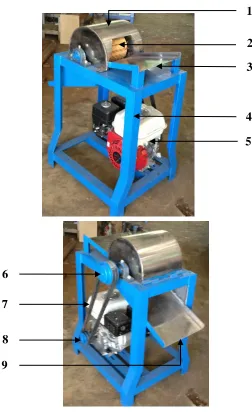
The sago rasping machine consists of several main components, they are: (1) A rotating rasper cylinder covered with pointed teeth on its circumference surface enclosed in a housing made of stainless steel plate. The cylinder was made of stainless steel sheet which is 16.8 cm in diameter and 22 cm in length. The cylinder shaft is an important component, which transmits the required power to the rasper cylinder to break down the sago pith into pieces. The cylinder shaft of 25.2 mm diameter was employed. The cylinder shaft fixed to the cylinder was mounted on ball bearings (UCP 205-16j) to obtain low-friction rotation. The length of the shaft was extended on one side of the cylinder so as to attach a pulley by means of which power was transmitted to the cylinder, (2) An 4-stroke gasoline engine (6.5 hp, maximum shaft rotation 3600 rpm) is used as power driver. The engine was attached to the main frame in such a way that the power could be easily transmitted to the cylinder, (3) Power is transmitted by the components of pulley and V-belt. Two A-section V-belts was used to transmit the power directly from the engine to the rasper cylinder, (4) Main frame was made of mild steel equal angle (L-shape) having a cross-section of 50×50×5mm. The frame was welded to provide rigidity to the unit and support to other parts of the machine which were also mounted on the frame. In addition, it is equipped with cylinder’s cover and input feeding component (input hopper) both made of
stainless steel sheet with 2 mm in thickness. The assembly of input feeding hopper is mounted at a slope of 20 degrees. It is also equipped with an output hopper to facilitate the rasped sago pith (repos) into collecting bag. The overall structure of developed sago rasping machine is shown in Figure 1.
Note: (1) Cylinder’s cover, (2) Rasping cylinder, (3) Input hopper, (4) Main frame, (5) Gasoline engine, (6) Cylinder’s pulley/driven, (7) V-belt, (8)
Engine’s pulley/driver, (9) Output hopper.
Fig. 1. Overall structure of cylinder type sago rasping machine constructed in this experiment
B. Experimental Conditions
Although there are many ways to break down the cellular structure of sago pith, in practice almost all small-scale processing of sago uses raspers machine. Functional component or process system of this sago rasping is a rotating cylinder covered by pointed teeth made of stainless steel rod. The function of the cylinder was to disintegrate or to break down sago pith into small particles, so that starch in the pith can be freed in subsequent steps.
6
7
8
9
1
2
3
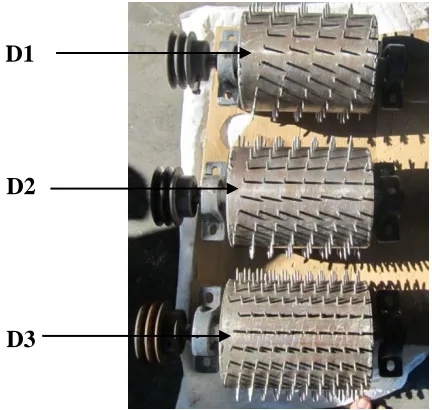
The parameters studied for rasping performance are cylinder rotation speed and teeth density on the cylinder circumference surface. Cylinder rotation speed consists of three levels that are 1500 rpm, 2250 rpm, and 3000 rpm. Adjusting cylinder rotation speed is done by changing the ratio of driver pulley (pulley on motor’s shaft) to driven pulley (pulley on cylinder’s shaft). Therefore, there are three different ratios of driver to driven pulleys that are used in this experiment, each corresponding to the intended rotation speed. The ratios of driver pulley to the driven pulley were 3 inch: 6 inch, 3 inch: 4 inch and 3 inch: 3 inch. The engine rotation speed was set at 3000 rpm. The Cylinder’s teeth were made of stainless steel rod (SS 201) which is 4 mm in diameter and 20 mm in length. On the cylinder surface, holes were made using electric drill, and then the teeth were firmly embedded in the cylinder. In addition, to prevent the teeth from falling away, the teeth were welded on the cylinder surface. There were 3 cylinders each with different teeth densities i.e. teeth density 1 (D1) was set at 2.2 cm × 4 cm apart, density 2 (D2) was 2.2 cm × 3 cm, and density 3 (D3) was 2.2 cm × 2 cm (Figs. 2 and 3). Each cylinder was subjected to three different rotation speeds, as had mentioned previously. In addition, the existing prototype (EP) was also tested, therefore there were ten experimental conditions for testing.
Note:Teeth density 1 (D1): the distance between adjacent teeth was 4 cm and between the teeth axes was 2.2 cm, teeth density 2 (D2): the distance between adjacent teeth was 3 cm and between the teeth axes was 2.2 cm, teeth density 3 (D3): the distance between adjacent teeth was 2 cm and between the teeth
axes was 2.2 cm.
Fig. 2. the three rasper cylinder with different teeth density used for testing in the experiment
Fig. 3. the rasper cylinder was assembled on the frame and ready for testing
C. Rasping Performance Test Procedure
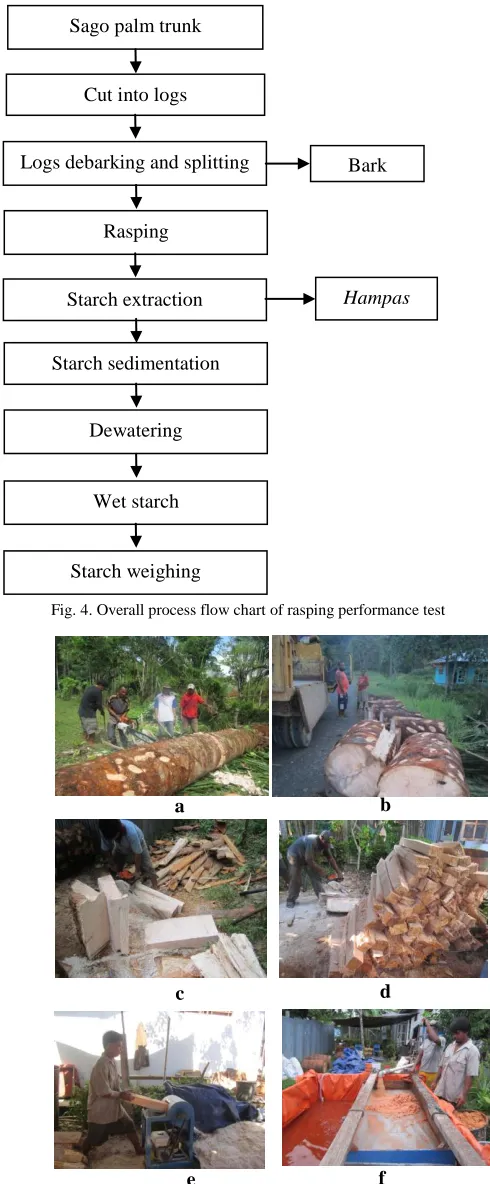
The performance of each experimental condition in term of rasping capacity, starch percentage and starch yield were measured and evaluated. In the experiment, testing for each condition was repeated three times and the data were recorded. The performance tests of the experimental units were conducted based on completely randomized design (CRD). A one-way ANOVA by SPSS Statistics(Version 23) was used for analyzing the data to determine the effect of independent variables (experimental conditions) on the dependent variables (rasping performance). A comparison between pairs of treatment means was made by determining the least significant difference (LSD) at 5% significance. The following procedure was adopted to test the performance of the developed cylindrical type sago rasping machine (Figs. 4).
(1) Rasping capacity: The sago palm trees (Metroxylon sago) which are ready for harvest were felled using a chain saw. The felled sago palm trunk is then cut into shorter logs about 100 cm in length to facilitate transportation to the laboratory (Fig.5). The first stage in the extraction of starch is to separate the bark from the log. Once the bark is removed, the pith is split into pieces suitable for the rasping process (Fig.5). The pieces are then fed manually onto the feeding hopper and pushed gently to rotating cylinder. The piecesare fed onto rasper end-on direction. The rasped pith called repos
[6], [11], [13], is then collected and weighed. Rasping capacity is defined according to equation (1):
t
w
R
RC
(1)
Where
R
C is rasping capacity (kg/h);w
R is weight of raspedpith/repos (kg);
t
is time required (hour).(2)Starch percentage: The rasped pith (repos) then was processed further using a stirrer rotary blade sago starch
D1
D2
extractor [4] to extract the starch. After pith disintegration, which aims to break down cellular structure and to rupture the cell walls, fiber and starch existed in the repos have not separated yet. The purpose of the extraction process is to separate the maximum amount of starch from the repos. The separation of the starch granules which exist in the cells, so far can only be removed by a washing process using water. Starch separation mechanism is that firstly repos is suspended in water and then stirred rigorously to release the starch. The suspended starch or starch slurry is then separated from the
repos using a screen.
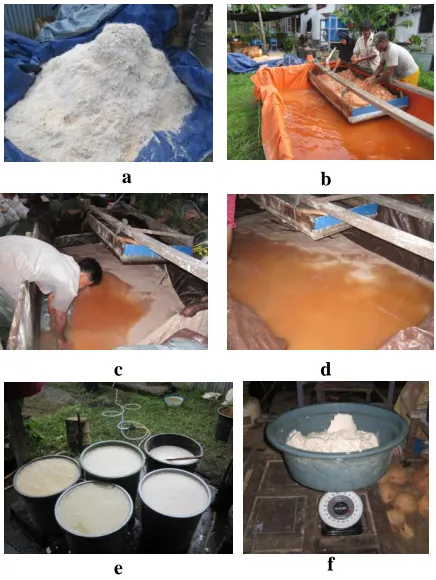
The starch extraction starts by feeding the rasped pith (repos) manually into the extractor. As much as 90 kg of repos was fed into the extractor in each procedure. A lot of water was also being added and constantly supplied into the extractor while the extraction process is taking place to facilitate starch extraction. The stirrer rotary blade rotated at a fixed speed (150 rpm). While the stirring process is taking place, starch granules are forced to pass through the pores of screener into the outer surface they then flowed to the sedimentation tank through pipe. This process was stopped when all starch had been washed out (no more starch in the repos), which was indicated by the slurry draining out from the extractor becoming clear. The resulting starch suspension in the collecting tank was left for sedimentation to allow starch particle to precipitate in the bottom of tank. Meanwhile, sago pith waste (hampas) which is retained in the extractor was discarded out at the extractor gate. After 2 hours, supernatant water was drained out and the fresh or wet starch was taken and weighed (Fig. 6).
The starch percentages (wet basis) are obtained using equation (2):
100
%
R S
w
w
SP
(2)Where SP is starch percentage (%);
w
Sis weight of starch (kg),WR is weight of repos (kg)
(3)Starch yield: Starch yield is amount of starch that was resulted. It depends on rasping capacity and starch percentage, and it is obtained using equation (3):
SY
R
C
SP
(3)Where SY is starch yield (kg), RC is rasping capacity (kg of repos/hour), SP is starch percentage (%)
Fig. 4. Overall process flow chart of rasping performance test
Fig. 5. Rasping performance test procedures: (a) Ready harvested sago trunk was felled down, (b) The trunk is then cut into logs, (c) Debarking and splitting the log (d) Pieces of sago log called batten was ready to be rasped, (e)
Sago log pieces is being rasping, (f) Rasped sago log/sago pith called repos
was then processed further to get the starch (starch extraction). Sago palm trunk
Cut into logs
Logs debarking and splitting Bark
Rasping
Starch extraction Hampas
Starch sedimentation
Dewatering
Wet starch
Starch weighing
a b
c d
bc
f
d
de ef
c
a
b
a
a
0 200 400 600 800 1000 1200
1000 1500 2000 2500 3000 3500
R
as
p
in
g
cap
ac
it
y
(k
g/
h
ou
r)
Cylinder rotation speed (rpm) Density 1 (D1) Density 2 (D2) Density 3 (d3) Existing Prototype (EP)
Fig. 6. The process of sago starch extraction: (a) Rasped pith, (b) Starch suspention in the sedimentation tank, (c) After 2 hours starch was settled on the bottom of the tank, supernatant water was drained (d) Fresh starch ready to
be taken out (e) Fresh/wet starch resulted (f) Weighing of wet starch.
III. RESULTS AND DISCUSSION
A. Rasping capacity
The result of variance analysis showed that combination of cylinder rotation speed and teeth density (independent variables) had highly significant effect on rasping capacity. The rasping capacity for the three teeth density as well as existing prototype at three rotation speeds is shown in Fig. 7.
Fig. 7. Relationship between cylinder rotation speed and rasping capacity
Fig. 7 shows that rasping capacity for all cylinder’s teeth density increased as cylinder rotation speed was increased
from 1500 rpm to 2250 rpm and then decreased. Rasping capacity of teeth density 1 (D1) and teeth density 3 (D3) increased rapidly as cylinder rotation speed was increased from 1500 rpm to 2250 rpm, then it decreased rapidly when the cylinder rotation speed was further increased from 2250 rpm to 3000 rpm. Meanwhile, rasping capacity for teeth density 2 (D2), increased slightly then followed by sharply decreased. This was because rasping process occurs rapidly when the cylinder rotation speed increased. In this condition, the frequency of rasping process of each tooth was increased. As the cylinder rotation speed was exceed of 2250 rpm, the rasping capacity decreases due to the decrease of torque on rasping cylinder. Consequently, the feeding speed of sago pith on rasping cylinder should be reduced in order to maintain the cylinder rotation speed at constant level. Theoretically, the torque of a rotating cylinder was inversely proportional to its rotating speed [14]. In order to maintain uniform cylinder rotation speed, the speed of feeding pith onto rasping cylinder must be reduced because pressing the pith too forcefully reduces the rasping machine efficiency significantly [11].On the other hand, when the power source is large enough to surpass the cutting resistance of the sago pith, increasing rotational speed of the cylinder continuously increases the rasping capacity. These results consistent with previously study [3]. These results were also consistent with those of Darma [15] in which a disc type of sago rasping machine was tested at three different rotation speeds (700 rpm, 1400 rpm and 2800 rpm), and Darma [16] where the same type of sago rasping machine was tested at three different rotation speeds (1750 rpm, 2100 rpm, and 2625 rpm). The latter experiment used almost the same size of cylinder made of hard wood but was serrated by blunt end teeth and powered by using 5.5 HP gasoline engine.
From Fig. 7 it is also shown that higher teeth density has lower rasping capacity. It means that lower teeth density rasps more effectively compared with the higher density. This behaviour is most likely related to the rasping torque requirement where the higher teeth density needs higher torque requirement and vice versa [4]. When the rasping torque requirement was lower, the feeding speed of sago pith onto rasping cylinder was higher and as a result was increased of rasping capacity. On the other hand, when the rasping torque requirement was high, the feeding speed of sago pith onto rasping cylinder was reduced and consequently, the rasping capacity was reduced. The highest rasping capacity for cylinder teeth density 1, density 2, and density 3 are 1009 kg/h, 960 kg/h, and 730/h kg per hour respectively. These results are higher compared with previously study [4], [16], [17]. Overall, the highest rasping capacity (1009 kg/h) was teeth density 1 at cylinder rotation speed of 2250 rpm which is significantly different with all others. Meanwhile, the lowest one (534 kg/h) was found at the existing prototype which was not statistically different from teeth density 3 at cylinder rotation speed of 1500 rpm and 3000 rpm.
a b
c d
0 10 20 30 40 50
1000 1500 2000 2500 3000 3500
S
tar
ch
p
er
ce
n
tage
(
%)
Cylinder rotation speed (rpm) Density 1 (D1) Density 2 (D2) Density 3 (D3) Existing prototype (EP)
b
d
c c
c
b
a
b
a a
0 50 100 150 200 250 300 350 400 450 500
1000 1500 2000 2500 3000 3500
S
tar
ch
yi
el
d
(
k
g)
Cylinder rotation speed (rpm) Density 1 (D1)
Density 2 (D2) Density 3 (D3) Existing prototype (EP)
B. Starch percentage
Experimental conditions (combinations of cylinder rotation speed and teeth density) did not affect the starch percentage at the 5% level. The results indicated that the starch percentage levels with all teeth density and with the three cylinder rotation speeds were not significantly different. The starch percentage varied from 43 % to 48 % for all testing conditions. Fig.8. shows the relationship between starch percentage and cylinder rotation speed of the three different cylinder’s teeth densities.
Fig. 8. Relationship between starch percentage and cylinder rotation speed
Fig.8. shows that the starch percentage for all teeth density nearly constant as cylinder rotation speed was increased from 1500 rpm to 2250 rpm, and then slightly increase when the cylinder rotation speed was further increased from 2250 rpm to 3000 rpm. The highest starch percentage (48 %) was obtained at teeth density 3 (D3) with cylinder rotation speed of 3000 rpm. This indicates that more cellular structure of sago pith had been broken down at the condition, consequently more cells wall have been ruptured therefore more starch can be extracted in subsequent extraction process. The sago pith is made of enormous numbers of cells contains starch inside. Unless a cell is ruptured in some way, the starch cannot be washed out. Therefore the efficiency of extraction of the starch depends on a large extend on the proportion of starch cells that are ruptured [11]. Rasping causes rupture of cell walls and release of starch. The smaller the size of rasped pith (repos), more cell walls is ruptured thus more starch can be obtained [11], [12].
Starch percentage resulted in this experiment (43 % – 48 %) are higher than the previously study [3]. [4], [15],[16], [17]. This is also much higher compared with that of Hermanto et al. [18], Irawan [19], Payung [20], Ratnaningsih et al. [21]. The higher starch percentage obtained in this experiment was due to the high starch content of sago pith that has been processed. The amount of starch that is obtained depends greatly on the sophistication of the methods employed and starch content in the pith of sago palm. Flach [22] reported that starch content of sago is around 10 % to 25 %. Meanwhile, according to Haryanto dan Pangloli [23], starch content in the sago pith is around 15 % to 25 %. Cecil [11] and Cecil et al. [13] also reported almost the same values (23% to 27%). Darma et al. [24] reported that starch content of sago in
Papua province varies from 12.43% to 39.89 %. Singhal et al. [25] reported that starch content of the pith obtained from ready harvested sago palm varies from 18.8 % and 38.8% (fresh weight). Yunus [26] also found nearly the same value (35.45 %). The different results of starch percentage among researchers indicate that not only the methods employed but also varieties of sago affect starch percentage.
C. Starch yield
Starch yield depend on both rasping capacity and starch percentage. The results indicated that experimental conditions significantly affected starch yield. The average starch yield of three teeth density at three different cylinder rotation speeds is shown in Fig. 9.
Fig. 9. Relationship between starch yield and cylinder rotation speed
starch yields of respectively 116.25 kg, 158.84 kg and 118.65 kg.
IV. CONCLUSIONS
The developed sago rasping machine resulted in this study
has higher performance compared to the existing prototype. Overall, all experimental conditions that have been tested were work properly. However, the rasping performance was varied according to teeth density and cylinder rotation speed. Rasping capacity and starch yield for all teeth density increased as rasping cylinder rotation speed was increased from 1500 rpm to 2250 rpm, then it decreased when cylinder rotation speed was further increased from 2250 rpm to 3000 rpm. Meanwhile, starch percentage initially almost constant as rasping cylinder rotation speed was increased from 1500 rpm to 2250 rpm and then it slightly increase as rasping cylinder rotation speed was increased further from 2250 rpm to 3000 rpm.The highest rasping capacity (1009 kg/hour) and starch
yield (473 kg) was obtained at the condition of teeth density 1 (D1) at cylinder rotation speed of 2250 rpm. Therefore, the optimum condition to get highest rasping performance was teeth density 1 (D1) rotating at 2250 rpm.ACKNOWLEDGMENT
The authors are grateful to the financial support by Ministry
of Research and Technology of the Republic of Indonesia (Insinas Identity Number: RT-2014-324).REFERENCES
[1] H. Matanubun, and L. Maturbongs, ―Sago Palm Potential, Biodiversity and Sociocultural Consideration for Industrial Sago Development in Papua, Indonesia,‖ in Proc. 8th Int.Sago
Symposium: Sago Palm Development and Utilization, Jayapura, Indonesia, August. 4-6,2006, pp. 41-54.
[2] F. S. Jong, ‖ An Urgent Need to Expedite The Commercialization of the Sago Industries,‖ in Proc. 8th Int.Sago Symposium, Sago
Palm Development and Utilization,Jayapura, Indonesia, August. 4-6, 2006, pp.25-34.
[3] Darma, X. L. Wang and K. Kito, ―Development of Cylinder Type Sago Rasper for Improving Rasping Performance‖. International Agricultural Engineering Journal (IAEJ), 23(3), pp. 31-40, 2014. [4] Darma, X. L. Wang and K. Kito, ―Development of Sago Starch
Extractor with Stirrer Rotary Blade for Improving Extraction Performance,‖ International Journal of Engineering and Technology (IJET), 6(5), pp. 2472-2481, 2014.
[5] S. M. M. Kamal, S. N. Mahmud, S. A. Hussain, and F. R.Ahmadun, ―Improvement on sago flour processing,‖
International Journal of Engineering and Technology, 4(1), pp. 8-14, 2007.
[6] A. A. Karim, Pei-Lang Tie, D.M.A. Manan, and I.S.M. Zaidul, ―Starch from the Sago (Metroxylon sagu) Palm Tree-properties, Prospect, and Challenges as a new Industries Source for Food and Other Uses. Comprehensive Reviews in Food Science and Food Safety,‖ Institute of Food Technology, 7 (3), pp. 215-228, 2008. [7] M. H.Bintoro, ―Progress of Sago Rresearch in Indonesia,‖ in Proc.
10th Int.Sago Symposium, Sago for food security, Bio-energy, and
Industry From Research to Market,Bogor, Indonesia, Oct. 29-31, 2011 pp.16-34.
[8] H. M. H. B. Djofrie, ‖Sago as a locally specific food and its prospect in agribusiness,‖ In Proc. National Symp. of Utilization of Locally spesific Food of Papua, Jayapura, Indonesia, 2004, pp. 11-14.
[9] P. Rajyalaksmi, ‖Caryota Palm Sago, a Potential yet Underutilized Natural Resource for Modern Starch Industry,‖ Natural Product Radiance, vol.3(3), pp. 144-149. 2004.
[10] Darma and P. Istalaksana, ‖Traditional processing of sago in Papua Province,‖ in Proc. 10th Int.Sago Symposium, Sago for food security, Bio-energy, and Industry From Research to Market,
Bogor, Indonesia, Oct. 29-31, 2011, pp.115-116.
[11] J. E. Cecil, Small-,Medium-and Large-Scale Starch Processing, FAO Agricultural Services Bulletin 98, Rome, 1992.
[12] F. J. Colon, and G. J. Annokke, 1984. Survey of some processing route of sago in Proc. of the expert consultation of the sago palm and palm produc, Jakarta, Indonesia, Jan. 16-21, 1984, pp. 1-17. [13] J. E. Cecil, G. Lau, H. Heng, and C.K. Ku, The Sago Starch
Industry: a Technical Profile Based on Preliminary Study Made in Serawak, Tropical Product Institute, London, 1982.
[14] L. O. Roth, F. R. Crow, and G. A. W. Mahoney, An Introduction to Agricultural Engineering. Avi Pub. Co. Inc. Westport-Connecticut, 1982.
[15] Darma, ‖Design and Performance Test of Disc Type sago Rasper‖.
Agricultural Engineering Journal, 2(2), pp.40-50, 2005. [16] Darma, ‖Prototype of Cylinder Type Sago Rasper Powered by
5.5 hp Gasoline Engine.‖ Agrotek Journal, 1(6), pp.49-56. 2009. [17] Darma. ‖Variant-1 of Cylinder Type Sago Rasper Powered by 5.5
hp Gasoline Engine.‖ Agrotek Journal 2(3),pp.82-90. 2010. [18] Hermanto, Ansharullah, A. Nuwiyah, and Muhidin, ―Different
Technique of Rasping and Its Affect on increasing Starch Percentage and Sago Starch Quality‖, Agriplus; Scientific Journal
21(1)pp. 30-35, 2011.
[19] P. Irawan, ―Design and Technical Test of Cylinder Type Sago Rasper‖, Thesis, Department of Agricultural Engineering, Bogor Agricultural University, Bogor, 2009.
[20] P. Payung, ―Design and Performance Test of Disc Type Sago Rasper (Metroxylon sp).‖ Agrotek Journal 1(4), pp. 32-37, 2009. [21] H. Ratnaningsih, Setyanto, and D. Sumangat. ―Modification of
Rasper’s Teeth and Cost Analysis of Cylinder Type Sago Rasper‖.
Indonesia Agency for Agricultural and Development (IAARD), Bogor, 2009.
[22] M. Flach, Sago Palm (Metroxylon sagu Rottb), International Plant Genetic Resources Institute (IBPGR), Rome, 1997.
[23] B. Haryanto and P. Pangloli, Potency and Utilization of Sago Palm. Kanisius, Jokyakarta, 1992.
[24] Darma, P. Istalaksana, Z. L. Sarungallo, ‖Starch Content and production Potency of Natural Sago Palm (Metroxylon Sagu Rottb)‖, Agrotek Journal 2(2), pp.7-14, 2010.
[25] R.S. Singhal, J. F. Kennedy, S. M. Gopalakrishnan, A. Kaczmarek, C. J. Knill and P. F. Akmar, ―Industrial Production-processing, and Utilization of Sago palm-derived Products,‖ Science Direct Carbohydrate Polymers, vol.72, pp. 1-20, 2008.