S H O R T R E P O R T
Open Access
Validation of the Korean version of the
avoidance endurance behavior
questionnaire in patients with chronic pain
Jeongwi An
1, Young Hoon Kim
2and Sungkun Cho
1*Abstract
Background:The avoidance-endurance model suggests both fear-avoidance responses and endurance-related
responses could affect the chronicity of pain. Proper pain intervention requires measuring fear-avoidance responses and endurance-related responses but no Korean language questionnaire has yet been made to measure them. The purpose of this study was to evaluate the validity and reliability of the Korean version of the Avoidance-Endurance Behavior Questionnaire (K-AEQ-Behavior) by adapting the behavioral responses of Avoidance-Endurance
Questionnaire into Korean language.
Methods:The K-AEQ-Behavior was forward and backward translated based on the standards for instrument
translation. A total of 136 outpatients with chronic pain of a duration exceeding 3 months were recruited from a pain center at a university hospital in Seoul, Korea. Two weeks later, the K-AEQ-Behavior was re-administered to 36 patients for test-retest reliability. Exploratory factor analysis was performed using principle axis factoring. The internal consistency, test-retest reliability, and concurrent validity of the K-AEQ-Behavior were measured by Cronbach’s⍺, intraclass correlation coefficient, and Pearson correlation coefficient, respectively.
Results:Although the four-factor structure (23 items) was derived in the original study, the two-factor structure of avoidance behavior and endurance behavior (21 items) was derived in the exploratory factor analysis of the Korean version in this study. Other results indicated that K-AEQ-Behavior has good internal consistency, test-retest reliability and concurrent validity.
Conclusion:This study suggests that the K-AEQ-Behavior is a reliable and valid instrument for assessing avoidance behavior and endurance behavior in patients with chronic pain.
Keywords:Avoidance behavior, Endurance behavior, Chronic pain, Validation
Background
The fear-avoidance model suggests that fear-avoidance re-sponse (FAR) plays an important role in the development of chronic pain [1]. According to the model, people even avoid behaviors that can help them recover from pain due to fear of pain, resulting in a vicious cycle of continuing and deepening pain. However, some studies have suggested different pathways via which endurance-related responses (ER) also affect development of chronic pain [2, 3]. Specifically, continuing physical
activity despite severe pain increases pain by physical overload. The avoidance-endurance model (AEM) suggests that both FAR and ER should be considered in the chronicity of pain [4, 5].
The primary measure of FAR and ER is the Avoidance-Endurance Questionnaire (AEQ) consisting of cognitive, emotional, and behavior responses [6]. Studies on AEQ confirmed that all responses were divided into FAR and ER and have good internal consistencies [6, 7]. Both FAR and ER have several subscales: for example, in behavior response, FAR consists of avoidance of social ac-tivities scale (ASAS) and avoidance of physical acac-tivities scale (APAS) and ER consists of humor/distraction scale (HDS) and pain persistence scale (PPS). The FAR scales
* Correspondence:[email protected]
1Department of Psychology, Chungnam National University, 99 Daehak-ro,
Yuseong-gu, Daejeon, Republic of Korea
Full list of author information is available at the end of the article
showed positive correlation, but the ER scales negative correlation, with pain-related variables such as depression, disability, and pain-related beliefs.
Proper pain intervention requires measuring FAR and ER but no Korean language questionnaire has yet been made to measure them. Although the original question-naire consists of cognitive, emotional, and behavioral responses, this study adapts only behavior response to pain because it directly affects the chronicity of pain, as compared to cognitive and emotional responses [1–3]. Therefore, this study aimed to test the validity and reli-ability of a Korean version of the Avoidance-Endurance Behavior Questionnaire (K-AEQ-Behavior). As evidence for concurrent validity, we set two hypotheses with refe-rence to prior studies [6, 7]. First, FAR scales have moderate-to-large positive correlation with pain cata-strophizing, anxiety, depression and pain intensity and moderate negative correlation with mental and physical functioning. Second, ER scales have low-to-moderate negative correlation with pain catastrophizing, anxiety and depression and low-to-moderate positive correlation with mental and physical functioning and pain intensity.
Methods
Participants
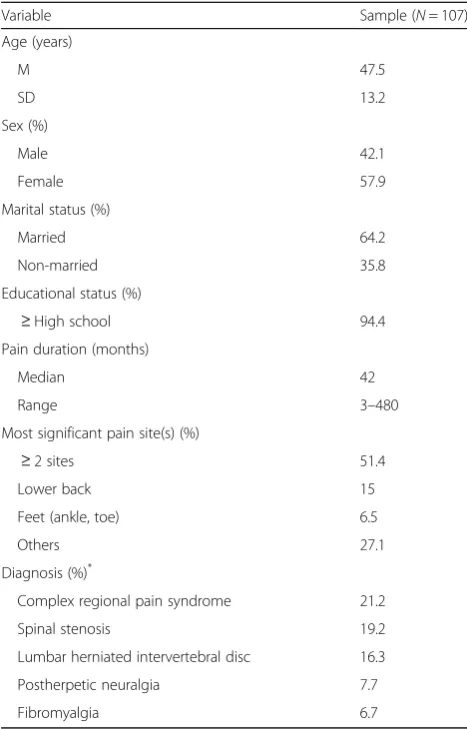
A total of 136 outpatients were recruited from a pain center at a university hospital in Seoul, Korea. The inclusion cri-teria were patients with chronic pain of duration exceeding 3 months. Participants whose K-AEQ-Behavior was completed less than 70% were excluded from the analysis, and the final sample was 107 patients. To assess the test-retest reliability of the K-AEQ-Behavior, 36 participants completed the K-AEQ-Behavior two weeks later. Demo-graphic characteristics of the participants are presented in Table1. The institutional review board approved the study protocol and all participants were given informed consent before participating.
Translation
The K-AEQ-Behavior was translated and reverse translated based on standards for instrument translation [8, 9]. A Korean-speaking clinical psychologist and professional translator who majored in English translated the behavior parts of AEQ into Korean. Then two English-Korean bilingual professional translators, one majored in psychology and another in English, back-translated it. One of the original authors gave feedback on the integrated back-translated version and it was revised accordingly.
Measures
The types of behavior responses for pain were assessed by the K-AEQ-Behavior in both mild and severe pain. Only behavior responses for severe pain were used in the analysis. Six variables were used to test concurrent
validity. Pain intensity was assessed by an 11-point Numeric Rating Scale [10], anxiety and depression by the Hospital Anxiety and Depression Scale (HADS) [11], pain catastrophizing by the Pain Catastrophizing Scale (PCS) [12], and physical and mental functioning by the Short Form-12 (SF-12) [13]. Korean versions of these measures showed good reliability and validity [14–16].
Data analyses
For the analyses, SPSS 24.0 and AMOS 24.0 were used. Confirmatory factor analysis was conducted to confirm the adequacy of the original AEQ-Behavior factor struc-ture (ASAS, APAS, HDS, PPS) and showed low model fit: comparative fit index (CFI) = .86, root-mean-square error of approximation (RMSEA) = .10, and non-normed fit index (NNFI) = .84. The same process was conducted with the Spanish version of the AEQ-Behavior factor structure (avoidance of social and physical activities scale, pain persistence/distraction scale, ignoring pain
Table 1Demographic characteristics of the sample
Variable Sample (N= 107) Age (years)
M 47.5
SD 13.2
Sex (%)
Male 42.1
Female 57.9
Marital status (%)
Married 64.2 Non-married 35.8 Educational status (%)
≥High school 94.4 Pain duration (months)
Median 42
Range 3–480 Most significant pain site(s) (%)
≥2 sites 51.4 Lower back 15 Feet (ankle, toe) 6.5
Others 27.1
Diagnosis (%)*
Complex regional pain syndrome 21.2 Spinal stenosis 19.2 Lumbar herniated intervertebral disc 16.3 Postherpetic neuralgia 7.7 Fibromyalgia 6.7
Note:*
scale, humor scale) and also showed low model fit: CFI = .86, RMSEA = .12, and NNFI = .83. Therefore, exploratory factor analysis (EFA) was performed using principle axis factoring with direct oblique. To determine the number of factors suitable for analysis, eigenvalues, plot scree test and parallel analysis were considered. Internal consistency and test-retest reliability were measured by Cronbach’s ⍺ and intra-class correlation coefficient(ICC). In order to verify the concurrent validity of the K-AEQ-Behavior, Pearson correlation coefficient between the scales was
per-formed. As evaluation criterion, r< .30 was considered
as low correlation, .30 <r< .70 as medium correlation,
and r> .70 as high correlation [17].
Results
Factor structure
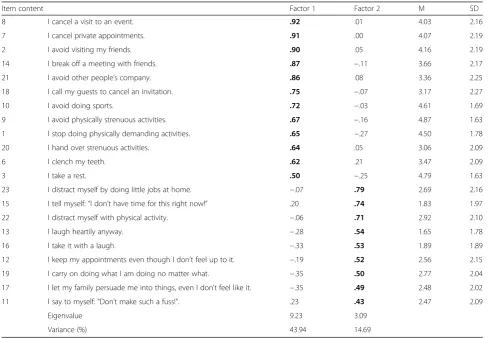
In EFA, the Kaiser-Meyer-Olkin (KMO) measure of sampling adequacy (.89) and Bartlett’s test of Sphericity (χ2 = 1691.29; p< .001) showed that the items were ap-propriate for EFA. Two factors were extracted conside-ring eigenvalues, plot scree test and parallel analysis. On the second principle axis factoring forced to two-factor solution, items 4 and 5 showed loadings less than .40 in
both factors and so were excluded. The final K-AEQ-Behavior was determined as 2 factors with 21 items (Table2). The 2-factor model accounted for 54.5% of the total variance. One factor included all the FAR items and one ER item of the original AEQ-Behavior, and the other factors included all but three items of the original AEQ-Behavior’s ER items. Thus, these factors were named as avoidance behavior (AB) and endurance behavior (EB).
Reliability
The internal consistencies for AB and EB were Cronbach’s
⍺= .94 and .85, respectively; test-retest reliability, ICC = .83
and .50 respectively; the standard error of measurement, 7.46 and 8.91, respectively; the minimal detectable change (MDC), 20.67 and 24.70, respectively; and the limits of
agree-ment,−15.77 to 28.54 and−28.77 to 18.85, respectively.
Concurrent validity
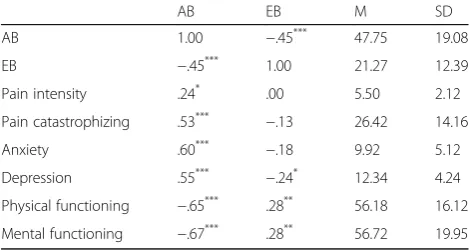
Descriptive statistics of the pain outcome variables and their correlations are presented in Table 3. AB showed low-to-moderate positive correlation with pain intensity, anxiety, depression, and pain catastrophizing, but
Table 2Factor loading and descriptive statistics for subscale of K-AEQ-Behavior (N = 107)
Item content Factor 1 Factor 2 M SD 8 I cancel a visit to an event. .92 .01 4.03 2.16 7 I cancel private appointments. .91 .00 4.07 2.19 2 I avoid visiting my friends. .90 .05 4.16 2.19 14 I break off a meeting with friends. .87 −.11 3.66 2.17 21 I avoid other people’s company. .86 .08 3.36 2.25 18 I call my guests to cancel an invitation. .75 −.07 3.17 2.27 10 I avoid doing sports. .72 −.03 4.61 1.69 9 I avoid physically strenuous activities. .67 −.16 4.87 1.63 1 I stop doing physically demanding activities. .65 −.27 4.50 1.78 20 I hand over strenuous activities. .64 .05 3.06 2.09 6 I clench my teeth. .62 .21 3.47 2.09 3 I take a rest. .50 −.25 4.79 1.63 23 I distract myself by doing little jobs at home. −.07 .79 2.69 2.16 15 I tell myself:“I don’t have time for this right now!” .20 .74 1.83 1.97 22 I distract myself with physical activity. −.06 .71 2.92 2.10 13 I laugh heartily anyway. −.28 .54 1.65 1.78 16 I take it with a laugh. −.33 .53 1.89 1.89 12 I keep my appointments even though I don’t feel up to it. −.19 .52 2.56 2.15 19 I carry on doing what I am doing no matter what. −.35 .50 2.77 2.04 17 I let my family persuade me into things, even I don’t feel like it. −.35 .49 2.48 2.02 11 I say to myself:“Don’t make such a fuss!”. .23 .43 2.47 2.09
Eigenvalue 9.23 3.09
Variance (%) 43.94 14.69
moderate negative correlation with physical and mental functioning, whereas EB showed low negative correl-ation with depression, but low positive correlcorrel-ation with physical functioning and mental functioning.
Discussion
The K-AEQ-Behavior appears to be an appropriate measure of behavior responses to pain. The K-AEQ-Behavior showed a two-factor model consisting of AB and EB. AB and EB items correspond to the FAR and ER items of the original questionnaire, respectively, but item 6 (I clench my teeth), which was tied to ER in the original study [6], was tied to AB in this study. It could be due to cultural difference: when Korean people have pain, the expression “I clench my teeth” means to be tolerated rather than to do something despite having pain in Korea [18]. In the original study, FAR consists of ASAS and APAS and ER consist of HDS and PPS [6]. However, there were no subscales in both AB and EB in the present study.
The internal consistency of AB and EB and the test-retest reliability of AB were good (ICC = .83). However, EB showed relatively low test-retest reliability (ICC = .50), possibly due to the low EB score of the study sample at first examination. According to AEM, a high level of FAR or ER is relatively time stable [5]. In this study, patients showed high AB scores and low EB scores (AB = 47.52, EB = 21.96), which may have affected the test-retest reliability. Therefore, it should not be sim-ply determined that the test-retest reliability of ER is low. The MDC scores for AB and EB were 20.67 and 24.70, respectively, at the 95% confidence level. Changes beyond these scores would not be considered as measurement error.
As expected, AB and EB correlated with pain outcome variables in opposite directions. Variables that show positive correlation with AB have negative correlation with EB and vice versa. These results are consistent with two previous studies [6, 7]. However, correlations
between EB and pain intensity, pain catastrophizing and anxiety were not significant, which was attributed to the sample characteristics. The sample was recruited from a pain center in a university hospital where patients with severe pain such as complex regional pain syndrome and fibromyalgia visit. Severe pain renders EB performance almost impossible in spite of pain as AEM suggested [19, 20]. Further research is needed to identify how AB and EB correlate with pain outcome variables in various pain intensity groups.
This study had some limitations. First, since the samples were recruited in a pain center of a university hospital, the study findings may not be generalizable to all pain patients. Second, only behavior responses for severe pain were used in this study because we aimed to predict pain outcomes such as pain intensity and disability. Further studies need to investigate the short-term negative or posi-tive effects of AB and EB on cogniposi-tive function or emotion when patients experience mild pain. Third, this study can-not identify the pathway that AB and EB lead to intensified pain as AEM suggests, because a cross-sectional design was used. Despite these limitations, this study was the first to validate a measure that discriminates the behavior of pain patients by AB and EB. The study results are expected to contribute to different interventions based on behavioral re-sponses seen by patients.
Conclusion
The results suggest that the Korean version AEQ-Behavior is a reliable and valid instrument for assessing avoidance behavior and endurance behavior in patients with chronic pain. Considering that the behavior responses to pain affect pain, the K-AEQ-Behavior is expected to provide useful in-formation if used in pain intervention. On the other hand, for generalization to pain patients, additional studies will be needed with a larger sample size and patients with a range of pain intensities.
Abbreviations
AB:Avoidance Behavior; AEM: Endurance Model; AEQ: Avoidance-Endurance Questionnaire; APAS: Avoidance of Physical Activities Scale; ASAS: Avoidance of Social Activities Scale; CFI: Comparative Fit Index; EB: Endurance Behavior; EFA: Exploratory Factor Analysis; ER: Endurance-related Responses; FAR: Fear-Avoidance Response;; HADS: Hospital Anxiety and Depression Scale; HDS: Humor/Distraction Scale; ICC: Intraclass Correlation Coefficient; K-AEQ-Behavior: Korean version of the Avoidance-Endurance Behavior Questionnaire; KMO: Kaiser-Meyer-Olkin; MDC: Minimal Detectable Change; NNFI: Non-Normed Fit Index; PCS: Pain Catastrophizing Scale; PPS: Pain Persistence Scale; RMSEA: Root-Mean-Square Error of Approximation; SF-12: Short Form-12
Funding
This work was supported by the National Research Foundation of Korea Grant funded by the Korean Government (NRF-2017S1A5A8020406).
Availability of data and materials
The datasets used and/or analyzed during the current study are available from the corresponding author on reasonable request.
Table 3Correlations between the K-AEQ-Behavior subscale and
outcome variables
AB EB M SD AB 1.00 −.45*** 47.75 19.08
EB −.45*** 1.00 21.27 12.39
Pain intensity .24* .00 5.50 2.12
Pain catastrophizing .53*** −.13 26.42 14.16
Anxiety .60*** −.18 9.92 5.12
Depression .55*** −.24* 12.34 4.24
Physical functioning −.65*** .28** 56.18 16.12
Mental functioning −.67*** .28** 56.72 19.95
Note:ABavoidance behavior;EBendurance behavior.*
p< .05, **
Authors’contributions
All the authors have made contributions to conception of this study. AJ and SC participated in the analysis and interpretation of data and writing of the manuscript. YHK helped with collecting data and technical support. All authors have read and approved the final manuscript.
Ethics approval and consent to participate
The Catholic Medical Center-Institutional Review Board approved the study protocol and all participants were given informed consent before participating.
Consent for publication
Not applicable.
Competing interests
The authors declare that they have no competing interests.
Publisher’s Note
Springer Nature remains neutral with regard to jurisdictional claims in published maps and institutional affiliations.
Author details 1
Department of Psychology, Chungnam National University, 99 Daehak-ro, Yuseong-gu, Daejeon, Republic of Korea.2Department of Anesthesiology and
Pain Medicine, Seoul St. Mary’s Hospital, College of Medicine, The Catholic University of Korea, 222, Banpo-daero, Seocho-gu, Seoul, Republic of Korea.
Received: 22 July 2018 Accepted: 6 September 2018
References
1. Vlaeyen JW, Linton SJ. Fear-avoidance and its consequences in chronic musculoskeletal pain: a state of the art. Pain. 2000;85(3):317–32. 2. Hasenbring MI, Plaas H, Fischbein B, Willburger R. The relationship
between activity and pain in patients 6 months after lumbar disc surgery: do pain-related coping modes act as moderator variables? Eur J Pain. 2006;10(8):701–9.
3. Bousema EJ, Verbunt JA, Seelen HA, Vlaeyen JW, Knottnerus JA. Disuse and physical deconditioning in the first year after the onset of back pain. Pain. 2007;130(3):279–86.
4. Hasenbring MI. Attentional control of pain and the process of chronification. In: Sandkühler J, Bromm B, Gebhart GF, editors. Prog Brain Res, vol. 129. New York: Elsevier Science B.V; 2000. p. 525–34.
5. Hasenbring MI, Verbunt JA. Fear-avoidance and endurance-related responses to pain: new models of behavior and their consequences for clinical practice. Clin J Pain. 2010;26(9):747–53.
6. Hasenbring MI, Hallner D, Rusu AC. Fear-avoidance-and endurance-related responses to pain: development and validation of the avoidance-endurance questionnaire (AEQ). Eur J Pain. 2009;13(6):620–8.
7. Ruiz-Párraga GT, López-Martínez AE, Rusu AC, Hasenbring MI. Spanish version of the avoidance-endurance questionnaire: factor structure and psychometric properties. Span J Psychol. 2015;18:e88.
8. Sousa VD, Rojjanasrirat W. Translation, adaptation and validation of instruments or scales for use in cross-cultural health care research: a clear and user-friendly guideline. J Eval Clin Pract. 2011;17(2):268–74. 9. Guillemin F, Bombardier C, Beaton D. Cross-cultural adaptation of
health-related quality of life measures: literature review and proposed guidelines. J Clin Epidemiol. 1993;46(12):1417–32.
10. Jensen MP, Karoly P. Self-report scales and procedures for assessing pain in adults. In: Turk DC, Melzack R, editors. Handbook of pain assessment. New York: Guilford; 1992. p. 15–34.
11. Zigmond AS, Snaith RP. The hospital anxiety and depression scale. Acta Psychiatr Scand. 1983;67(6):361–70.
12. Sullivan MJ, Bishop SR, Pivik J. The pain catastrophizing scale: development and validation. Psychol Assess. 1995;7(4):524–32.
13. Ware JE Jr, Kosinski M, Keller SD. A 12-item short-form health survey: construction of scales and preliminary tests of reliability and validity. Med Care. 1996;34(3):220–33.
14. Min KJ, Oh SM, Park DB. A study on the standardization of the hospital anxiety and depression scale for Koreans : a comparison of Normal,
depressed and anxious groups. J Korean Neuropsychiatr Assoc. 1999;38(2): 289–96.
15. Kho SB, Chang SJ, Kang MG, Cha BS, Park JK. Reliability and validity on measurement instrument for health status assessment in occupational workers. J Prev Med Public Health. 1997;30(2):251–66.
16. Cho S, Kim HY, Lee JH. Validation of the Korean version of the pain catastrophizing scale in patients with chronic non-cancer pain. Qual Life Res. 2013;22(7):1767–72.
17. Kirkwood B, Sterne J. Essential medical statistics. 2nd ed. Oxford: Blackwell Science; 2003.
18. National Institute of Korean Language. The standard korean dictionary. 1st ed. Seoul: Dusandonga; 1999.
19. Borchers A, Gershwin M. Complex regional pain syndrome: a comprehensive and critical review. Autoimmun Rev. 2014;13(3):242–65. 20. Gaston-Johansson F, Gustafsson M, Felldin R, Sanne H. A comparative study