R E S E A R C H A R T I C L E
Open Access
Diagnostic utility of
BRAF
V600E
mutation testing in
thyroid nodules in elderly patients
Anna Guerra
1, Vincenzo Di Crescenzo
1, Alfredo Garzi
1, Mariapia Cinelli
2, Chiara Carlomagno
3, Stefano Pepe
1,
Pio Zeppa
1, Massimo Tonacchera
4, Mario Vitale
1*From
26th National Congress of the Italian Society of Geriatric Surgery
Naples, Italy. 19-22 June 2013
Abstract
Background:Thyroid cancer is a rare disease characterized by the subtle appearance of a nodule. Fine-needle cytology (FNC) is the first diagnostic procedure used to distinguish a benign from a malignant nodule. However, FNC yields inconclusive results in about 20% of cases.BRAFV600Emutation is the most frequent genetic alteration in papillary thyroid carcinoma (PTC); its high prevalence makes this oncogene a useful marker to refine inconclusive FNC results. However, the prevalence of theBRAFV600Emutation depends on detection methods, geographical factors, and age. The aim of this study is to determine the prevalence ofBRAFV600Emutation and its utility as a diagnostic tool in elderly subjects.
Methods:FNC from 92 PTC patients were subjected to the analysis ofBRAFmutation by pyrosequencing and direct sequencing; age-dependent prevalence was also determined.
Results:BRAFmutation analysis was successful in all FNC specimens.BRAFV600Ewas documented in 62 (67.4%) and in 58 (63.0%) PTCs by pyrosequencing and direct sequencing, respectively.BRAFV600Eprevalence did not correlate with patient’s age at diagnosis. Twenty out of 32 PTCs (62.5%) were correctly diagnosed byBRAFmutation analysis in inconclusive FNC results.
Conclusions:Detection ofBRAFV600Ein cytology specimens by pyrosequencing is a useful diagnostic adjunctive tool in the evaluation of thyroid nodules also in elderly subjects.
Introduction
Living in an oxygenated environment has required the evolution of effective cellular strategies to detect and detoxify metabolites of molecular oxygen known as reactive oxygen species. Reactive oxygen species (ROS) are highly reactive molecules that consist of a number of diverse chemical species including superoxide anion (O2-), hydroxyl radical (·OH), and hydrogen peroxide (H2O2) [1]. Oxidative stress is an important aspect of cancer, diabetes, neurodegenerative, cardiovascular and other diseases, and elevated ROS has been implicated in the mechanism of senescence and aging [2,3]. Oxidant overproduction occurs in response to several stressors, including chemicals, drugs, pollutants, high-caloric diets
and exercise [4]. The prevalence of palpable thyroid nodules in iodinesufficient regions ranges between 1% -9% in adults [5]. It is lower in young people and increases progressively with age. However, the preva-lence of nodular goiter markedly increases when ultraso-nography is used. About 75% of individuals over the age of 80 years have nodules on ultrasound examination. The majority of thyroid nodules are benign and the inci-dence of thyroid cancer is low, accounting for about 5% of nodules [6,7], although it has increased over the last decades. The increase of incidence is not equally attrib-uted to all types of thyroid cancer. Papillary thyroid car-cinoma (PTC) is the most frequent thyroid cancer, accounting for approximately 85 - 90% of all thyroid cancers, whereas follicular thyroid carcinoma accounts for about 10% or less, and poorly differentiated and undifferentiated or anaplastic carcinomas are very rare
* Correspondence: [email protected]
1Department of Medicine and Surgery, University of Salerno, Salerno, Italy
Full list of author information is available at the end of the article
(approximately 1 - 2%) [8]. The risk of thyroid cancer is higher in women and people with low iodine intake, high body mass index and radiation exposure [9-11]. Hashimoto’s Thyroiditis (HT) is a frequent thyroid dis-order whose prevalence increases with age. PTC is believed to be more frequent in patients with concurrent HT. RETrearrangements (RET/PTC) andBRAF point mutations are genetic alterations occurring in PTC, pro-posed as tumor markers to refine inconclusive FNC results. The identification of changes in the expression of other molecular biomarkers, such as Ca2+ -transport-ing proteins, which have been proposed as an alternative means for tumor diagnosis [12-19], is still missing. BRAFV600E is the most frequent mutation in PTC and,
unlike RET/PTC, it has never been detected in benign thyroid nodules. Its utility as a diagnostic marker depends upon its prevalence, which varies on the basis of detection methods and geographical factors. While RETrearrangements are induced by thyroid exposure to ionizing radiations, noBRAFmutation inducing factors have been identified so far. The higher prevalence of age-related thyroid diseases, such as HT or longer expo-sure to endocrine disrupters and thyroid toxic agents, may affect the prevalence ofBRAFmutations in elderly subjects as well as the sensitivity of BRAFV600E as a tumor marker. The clinical appearance of thyroid cancer is that of a nodules, some time representing a challen-ging diagnostic dilemma with thyroid or unusual extra-thyroidal masses [20,21]. Until serological biomarkers are available, FNC is the primary diagnostic tool offering the highest values of sensitivity and specificity [22-27]. Nonetheless, inconclusive results may occur and the application of molecular techniques to FNC has dramati-cally increased its sensitivity [25,28-31], including in the case of HT with diffuse or nodular enlargement [26]. These advantages are enhanced in the case of benign nodules, which does not require surgical treatment, and even more in the elderly, where surgery is generally more burdensome, complex and expensive than in younger patients [32,33]. Hence, the aims of the present study are to determine the utility ofBRAFV600Emutation detection as a diagnostic tool to refine inconclusive FNC results in elderly subjects and whether its sensitivity is age-related.
Material and methods
Patients and clinicopathological data collection
A total of 92 patients with PTC were enrolled in the study after giving their consent and with the approval from the institutional review board. Clinicopathological data included: age at diagnosis, gender, tumor size, and TNM staging. Tumor volume was calculated according to the formula of the ellipsoid model: volume (mL) = width × length × thickness ×□/6. After surgical resection, tissues were fixed in formalin, embedded in paraffin wax, and
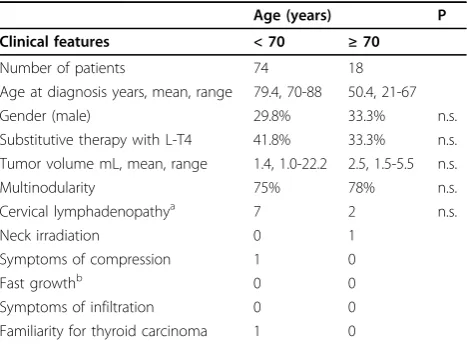
stained with haematoxylin and eosin for microscopy stu-dies. Standard criteria were employed to classify tumors and their variants [34]. FNC was performed and classified according to the British Thyroid Association [35] as described elsewhere [36,37]. As far as the concomitant lymphoid infiltrate concerns, its polyclonal, inflammatory nature was assessed in selected cases by flow cytometry (FC) and related data were interpreted accordingly [38-41] in this specific clinical and anatomical setting. Clinico-pathological data are reported in Table 1.
DNA extraction from cytology samples
Cytology samples were obtained using a syringe with a 22-gauge needle passed three to four times. Material from the needle was used to prepare a smear for cytol-ogy, then the needle was washed out with 5 ml of nor-mal saline into a collection tube, and centrifuged. The pellet was resuspended into TRI Reagent buffer (Sigma) and stored at -20 °C for DNA extraction.
Detection of the BRAF mutation
Direct sequencing was performed by BigDye Terminator method. DNA was amplified by polymerase chain reaction (PCR) with specific primers, as described previously [42]. Pyrosequencing was performed as described in detail else-where [42,43]. Briefly, DNA was amplified by PCR, pro-cessed to obtain single-stranded DNA, hybridized to sequencing primers, and sequencing-by-synthesis reaction of the complementary strand was automatically performed on a PSQ 96MA instrument (Biotage, Uppsala, Sweden). The cut-off was set at 5%, corresponding to the mean per-centage of normal tissues plus 2 SD.
Statistics
Results were analyzed by the chi-square of independence test or the t-test with Prism (Version 3.00 for Windows;
Table 1 Pre-surgical clinicopathological features of PTC patients with concurrent HT.
Age (years) P
Clinical features < 70 ≥70
Number of patients 74 18 Age at diagnosis years, mean, range 79.4, 70-88 50.4, 21-67 Gender (male) 29.8% 33.3% n.s. Substitutive therapy with L-T4 41.8% 33.3% n.s. Tumor volume mL, mean, range 1.4, 1.0-22.2 2.5, 1.5-5.5 n.s. Multinodularity 75% 78% n.s. Cervical lymphadenopathya 7 2 n.s. Neck irradiation 0 1
Symptoms of compression 1 0 Fast growthb 0 0 Symptoms of infiltration 0 0 Familiarity for thyroid carcinoma 1 0
a
, detected by ultrasonography;b
GraphPad Software, San Diego, CA, USA). The level of significance was set atP< 0.05.
Results
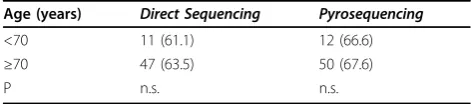
A total of 92 PTC patients entered the study. Patients were divided into 2 groups: < 70 years old (No. = 74) and ≥70 years old (No. = 18). The mean age of the 2 groups was 79.4 and 50.4, respectively. Cervical lympha-denopathy was documented by ultrasonography in 9 subjects; neck irradiation, symptoms of compression and familiarity for thyroid carcinoma were documented in 1 patient, respectively (Table 1).BRAFmutational analy-sis was successful in all cytology specimens.BRAFV600E was documented in 62 patients (67.4%) and in 58 (63.0%) patients by pyrosequencing and direct sequen-cing, respectively (Table 2). The prevalence of BRAFV600E mutation in the 2 age groups was similar
(67.6 vs. 66.6 by pyrosequencing in < 70 years vs.≥70 years, respectively). The mean age of PTC patients (BRAFV600E positive or negative) was similar (54.4 and 54.3 respectively, P= 0.461). Twenty-four (26.1%) FNCs yielded inconclusive results (Table 3), 10.9% and 13.4% were THY3 and THY4, respectively.BRAFV600E muta-tion was documented in 16 inconclusive FNC results (66.6%). No significant difference in sensitivity was documented between young and elderly patients.
Discussion
The clinical utility of molecular testing for inconclusive FNC results was demonstrated by a number of studies in the last decade. Among the genetic alterations known in thyroid cancer,BRAFV600E is the most useful to this purpose, because of its high sensitivity and its absolute specificity. However, its sensitivity depends on the detection method and on its prevalence. cDNA sequen-cing is the gold standard for the detection of genetic mutations. However, the sensitivity of these methods is reduced by the diluting effect of the wild type gene car-ried by tumor cells and non-tumor cells in the specimen [23]. This is particularly relevant when other thyroid diseases are present. Thyroid autoimmunity, and HT in particular, are frequent in the general female population and even more frequent in the elderly. These diseases are characterized by an abundant lymphoplasmacytic infiltrate of the thyroid and in the late stages by fibrous
atrophy. Hence, the sensitivity of molecular tests applied to thyroid cytology specimens was hypothesized to be reduced in elderly subjects [44]. Another possible factor affecting the sensitivity ofBRAFV600Ediagnostic tests is the prevalence of this oncogene in a specific cohort. Besides the detection methods, racial or geographical factors are the major determining factors ofBRAFV600E prevalence. This oncogene is much more frequent in the Korean population than in any other, being detected in about 90% of PTCs. Its high prevalence can be the result of a particular genetic imprinting or the effect of food or environmental factors. Iodine diet content and goitrogen factors, the exposure to ionizing radiations, endocrine disrupters and thyroid toxic agents can be relevant in the development of thyroid cancer. A low iodine diet has been associated with a higher prevalence of thyroid cancer, with a higher papillary/follicular thyroid ratio [45]. Also, the exposure to ionizing radiations is a risk factor for the development of thyroid cancer. The genetic rearrangement of the proto-oncogene RET gen-erates chimeric proteins (RET/PTC) with demonstrated carcinogenetic properties. RET rearrangements, and RET/PTC3in particular, are induced by the exposure to ionizing radiations, so that their prevalence is increased in the exposed populations [46,47]. Time of exposition to interfering agents is crucial for carcinogenesis, so that the risk of thyroid cancer development is age-dependent. Studies on population of different geographic areas showed the reduction ofRET/PTCin thyroid tumors in older subjects [48,49]. AlthoughBRAFV600E has been extensively investigated, evidence on the etiology of this oncogene is lacking. Study results indicate that the preva-lence ofBRAFV600Edoes not change in elderly subjects and that it can be used as a PTC marker in inconclusive FNC results. The sensitivity of the Big Dye terminator method is low since it is based on an automated or sub-jective evaluation of a chromatogram. For this reason, mutations detected in less than 20% of PCR products yield ambiguous or false negative results [50]. Accord-ingly, BRAFV600Edetection in this study was higher by pyrosequencing analysis than by direct sequencing, and PTC was correctly diagnosed in 66.6% of FNC inconclu-sive results by means of this method.
Table 2 Prevalence ofBRAFV600Emutation in 92 PTCs.
Age (years) Direct Sequencing Pyrosequencing
<70 11 (61.1) 12 (66.6)
≥70 47 (63.5) 50 (67.6)
P n.s. n.s.
Number of positive samples (and percentages). n.s., not significant
Table 3 FNC results and detection ofBRAFV600Emutation by pyrosequencing.
FNC Age, > 70 years Age,≥70 years
TYH total BRAFV600E total BRAFV600E
3 8 6 (75.0) 2 1 (50.0) 4 11 7 (63.6) 3 2 (66.6) 5 55 37 (67.2) 13 9 (69.2)
Number of positive samples (and percentages).
Conclusions
The prevalence of BRAFV600E mutation in PTCs of elderly subjects is similar to that of younger subjects. The detection ofBRAFV600E mutation in cytology speci-mens by pyrosequencing is a useful diagnostic adjunc-tive tool in the evaluation of thyroid nodules also in elderly subjects.
Competing interests
The authors declare that they have no competing interests.
Authors’contributions
MV: conception and design, interpretation of data. AG, PZ, VDS, AG, MCP, CC, SP, MT: acquisition of data, drafting the manuscript. PZ, MV: critical revision, given final approval of the version to be published.
Authors’information
AG = Resident in Clinical Pathology at University of Salerno. VDC = Aggregate Professor of Thoracic Surgery at University of Salerno. AG = Aggregate Professor of Pediatric Surgery at University of Salerno. MC = Aggregate Professor of Anatomy, University of Naples“Federico II”. CC = Aggregate Professor of Oncology, University of Naples“Federico II”. SP = Associate Professor of Oncology, University of Salerno. PZ = Associate Professor of Pathology at University of Salerno. MT = Associate Professor of Endocrinology at University of Pisa. MV = Associate Professor of Endocrinology at University of Salerno.
Declarations
Publication charges for this article were covered by research funds of the project Bando Faro 2011 - Finanziamenti per l’Avvio di Ricerche Originali, cofounded by the Compagnia di San Paolo and by the Polo per le Scienze e le Tecnologie per la Vita of the University Federico II in Naples. This article has been published as part ofBMC SurgeryVolume 13 Supplement 2, 2013: Proceedings from the 26th National Congress of the Italian Society of Geriatric Surgery. The full contents of the supplement are available online at http://www.biomedcentral.com/bmcsurg/supplements/13/S2
Authors’details
1Department of Medicine and Surgery, University of Salerno, Salerno, Italy. 2
Department of Public Health, University of Naples“Federico II”, Naples, Italy.
3Department of Clinical Medicine and Surgery, University of Naples“Federico
II”, Naples, Italy.4Department of Endocrinology, Research Center of
Excellence AmbiSEN, University of Pisa, Pisa, Italy.
Published: 8 October 2013
References
1. Cui H, Kong Y, Zhang H:Oxidative stress, mitochondrial dysfunction, and aging.Journal of signal transduction2012,2012:646354.
2. Testa D, Guerra G, Marcuccio G, Landolfo PG, Motta G:Oxidative stress in chronic otitis media with effusion.Acta oto-laryngologica2012,
132(8):834-837.
3. Cattaneo F, Iaccio A, Guerra G, Montagnani S, Ammendola R: NADPH-oxidase-dependent reactive oxygen species mediate EGFR transactivation by FPRL1 in WKYMVm-stimulated human lung cancer cells.Free radical biology & medicine2011,51(6):1126-1136.
4. Conti V, Russomanno G, Corbi G, Guerra G, Grasso C, Filippelli W, Paribello V, Ferrara N, Filippelli A:Aerobic training workload affects human endothelial cells redox homeostasis.Medicine and science in sports and exercise2013,45(4):644-653.
5. Tonacchera M, Pinchera A, Vitti P:Assessment of nodular goitre.Best Pract Res Clin Endocrinol Metab2010,24(1):51-61.
6. Kang HW, No JH, Chung JH, Min YK, Lee MS, Lee MK, Yang JH, Kim KW:
Prevalence, clinical and ultrasonographic characteristics of thyroid incidentalomas.Thyroid2004,14(1):29-33.
7. Hodgson NC, Button J, Solorzano CC:Thyroid cancer: is the incidence still increasing?Ann Surg Oncol2004,11(12):1093-1097.
8. Sherman SI:Thyroid carcinoma.Lancet2003,361(9356):501-511.
9. Belfiore A, La Rosa GL, La Porta GA, Giuffrida D, Milazzo G, Lupo L, Regalbuto C, Vigneri R:Cancer risk in patients with cold thyroid nodules: relevance of iodine intake, sex, age, and multinodularity.Am J Med1992,
93(4):363-369.
10. Dal Maso L, La Vecchia C, Franceschi S, Preston-Martin S, Ron E, Levi F, Mack W, Mark SD, McTiernan A, Kolonel L,et al:A pooled analysis of thyroid cancer studies. V. Anthropometric factors.Cancer Causes Control
2000,11(2):137-144.
11. Baverstock K, Egloff B, Pinchera A, Ruchti C, Williams D:Thyroid cancer after Chernobyl.Nature1992,359(6390):21-22.
12. Dragoni S, Laforenza U, Bonetti E, Lodola F, Bottino C, Berra-Romani R, Carlo Bongio G, Cinelli MP, Guerra G, Pedrazzoli P,et al:Vascular endothelial growth factor stimulates endothelial colony forming cells proliferation and tubulogenesis by inducing oscillations in intracellular Ca2+ concentration.Stem Cells2011,29(11):1898-1907.
13. Lodola F, Laforenza U, Bonetti E, Lim D, Dragoni S, Bottino C, Ong HL, Guerra G, Ganini C, Massa M,et al:Store-operated Ca2+ entry is remodelled and controls in vitro angiogenesis in endothelial progenitor cells isolated from tumoral patients.PLoS One2012,7(9):e42541. 14. Moccia F, Bonetti E, Dragoni S, Fontana J, Lodola F, Berra Romani R,
Laforenza U, Rosti V, Tanzi F:Hematopoietic progenitor and stem cells circulate by surfing on intracellular Ca2+ waves: A novel target for cell-based therapy and anti-cancer treatment?Curr Signal Transd T2012,
7(7):161-176.
15. Moccia F, Dragoni S, Lodola F, Bonetti E, Bottino C, Guerra G, Laforenza U, Rosti V, Tanzi F:Store-dependent Ca(2+) entry in endothelial progenitor cells as a perspective tool to enhance cell-based therapy and adverse tumour vascularization.Curr Med Chem2012,19(34):5802-5818.
16. Dragoni S, Laforenza U, Bonetti E, Lodola F, Bottino C, Guerra G, Borghesi A, Stronati M, Rosti V, Tanzi F, Moccia F:Canonical Transient Receptor Potential 3 channel triggers VEGF-induced intracellular ca2+ oscillations in endothelial progenitor cells isolated from umbilical cord blood.Stem Cells and Development2013,22(19):2561-2580.
17. Monteith GR, McAndrew D, Faddy HM, Roberts-Thomson SJ:Calcium and cancer: targeting Ca2+ transport.Nat Rev Cancer2007,7(7):519-530. 18. Sanchez-Hernandez Y, Laforenza U, Bonetti E, Fontana J, Dragoni S,
Russo M, Avelino-Cruz JE, Schinelli S, Testa D, Guerra G,et al: Store-operated Ca(2+) entry is expressed in human endothelial progenitor cells.Stem Cells Dev2010,19(12):1967-1981.
19. Roderick HL, Cook SJ:Ca2+ signalling checkpoints in cancer: remodelling Ca2+ for cancer cell proliferation and survival.Nat Rev Cancer2008,
8(5):361-375.
20. Soscia A, Guerra G, Cinelli MP, Testa D, Galli V, Macchi V, De Caro R:
Parapharyngeal ectopic thyroid: the possible persistence of the lateral thyroid anlage. Clinical case report.Surg Radiol Anat2004,26(4):338-343. 21. Cooper DS, Doherty GM, Haugen BR, Kloos RT, Lee SL, Mandel SJ,
Mazzaferri EL, McIver B, Pacini F, Schlumberger M,et al:Revised American Thyroid Association management guidelines for patients with thyroid nodules and differentiated thyroid cancer.Thyroid2009,19(11):1167-1214. 22. Guerra A, Marotta V, Deandrea M, Motta M, Limone PP, Caleo A, Zeppa P,
Esposito S, Fulciniti F, Vitale M:BRAF (V600E) associates with cytoplasmatic localization of p27kip1 and higher cytokeratin 19 expression in papillary thyroid carcinoma.Endocrine2013,44(1):165-171. 23. Vitale M:Intratumor BRAF(V600E) Heterogeneity and Kinase Inhibitors in
the Treatment of Thyroid Cancer: A Call for Participation.Thyroid2013,
23(4):517-519.
24. Vitale M:SEREX: a promising approach for identification of thyroid cancer serological biomarkers.Clin Endocrinol (Oxf)2013,79(1):12-13. 25. Kim MI, Alexander EK:Diagnostic use of molecular markers in the
evaluation of thyroid nodules.Endocr Pract2012,18(5):796-802. 26. Zeppa P, Cozzolino I, Peluso AL, Troncone G, Lucariello A, Picardi M,
Carella C, Pane F, Vetrani A, Palombini L:Cytologic, flow cytometry, and molecular assessment of lymphoid infiltrate in fine-needle cytology samples of Hashimoto thyroiditis.Cancer2009,117(3):174-184. 27. Bellevicine C, Cozzolino I, Malapelle U, Zeppa P, Troncone G:Cytological
and molecular features of papillary thyroid carcinoma with prominent hobnail features: a case report.Acta Cytol2012,56(5):560-564. 28. Alexander EK, Kennedy GC, Baloch ZW, Cibas ES, Chudova D, Diggans J,
Friedman L, Kloos RT, LiVolsi VA, Mandel SJ,et al:Preoperative diagnosis of benign thyroid nodules with indeterminate cytology.N Engl J Med2010,
29. Hodak SP, Rosenthal DS:Information for clinicians: commercially available molecular diagnosis testing in the evaluation of thyroid nodule fine-needle aspiration specimens.Thyroid2013,23(2):131-134.
30. Santini M, Fiorello A, Zeppa P, Vicidomini G, Di Crescenzo VG, Laperuta P:
Role of diffusing capacity in predicting complications after lung resection for cancer.Thorac Cardiovasc Surg2007,55(6):391-394. 31. Zeppa P, Varone V, Cozzolino I, Salvatore D, Vetrani A, Palombini L:Fine
needle cytology and flow cytometry of ectopic cervical thymoma: a case report.Acta Cytol2010,54(5 Suppl):998-1002.
32. Gervasi R, Orlando G, Lerose MA, Amato B, Docimo G, Zeppa P, Puzziello A:
Thyroid surgery in geriatric patients: a literature review.BMC Surg2012,
12(Suppl 1):S16.
33. Passler C, Avanessian R, Kaczirek K, Prager G, Scheuba C, Niederle B:Thyroid surgery in the geriatric patient.Arch Surg2002,137(11):1243-1248. 34. Rosai J, Carcangiu ML, De Lellis RA:Tumors of the thyroid gland.InAtlas
of tumor pathology, third series, fascicle 5.Washington DC: Armed Forces Institute of Pathology;Rosai J SL 1992:49-62.
35. British Thyroid Association, Royal College of Physicians: Fine needle aspiration cytology (FNAC). Guidelines for the Management of Thyroid Cancer 2nd edition Royal College of PhysiciansLondon: Perros P.; 2007, 9-10. 36. Zeppa P, Barra E, Napolitano V, Cozzolino I, Troncone G, Picardi M, De
Renzo A, Mainenti PP, Vetrani A, Palombini L:Impact of endoscopic ultrasound-guided fine needle aspiration (EUS-FNA) in lymph nodal and mediastinal lesions: a multicenter experience.Diagn Cytopathol2011,
39(10):723-729.
37. D’Antonio A, Baldi C, Memoli D, Caleo A, Rosamilio R, Zeppa P:Fine needle aspiration biopsy of intraparotid spindle cell lipoma: a case report.Diagn Cytopathol2013,41(2):171-173.
38. Cozzolino I, Vigliar E, Sosa Fernandez LV, Selleri C, Pepe S, Vitale M, Triggiani M, Zeppa P:Non lymphomatous clonal B-Cell populations in enlarged lymph nodes in acquired immunodeficiency syndrome.Infez Med2012,20(Suppl 2):35-42.
39. Cozzolino I, Nappa S, Picardi M, De Renzo A, Troncone G, Palombini L, Zeppa P:Clonal B-cell population in a reactive lymph node in acquired immunodeficiency syndrome.Diagn Cytopathol2009,37(12):910-914. 40. Cipullo C, Amato B, Vigliar E, Di Crescenzo V, Zeppa P:Lymph node fine
needle cytology in the diagnosis of infectious diseases and reactive unspecific processes.Infez Med2012,20(Suppl 3):30-33.
41. Stanzione B, Cozzolino I, Arpino G, Vigliar E, Virginia SF, Zeppa P:Multiple metachronus proliferative fasciitis occurring in different anatomic regions: a case report and review of the literature.Pathol Res Pract2012,
208(2):126-130.
42. Guerra A, Sapio MR, Marotta V, Campanile E, Rossi S, Forno I, Fugazzola L, Budillon A, Moccia T, Fenzi G,et al:The Primary Occurrence of BRAFV600E Is a Rare Clonal Event in Papillary Thyroid Carcinoma.J Clin Endocrinol Metab2012,97(2):517-524.
43. Guerra A, Fugazzola L, Marotta V, Cirillo M, Rossi S, Cirello V, Forno I, Moccia T, Budillon A, Vitale M:A high percentage of BRAFV600E alleles in papillary thyroid carcinoma predicts a poorer outcome.J Clin Endocrinol Metab2012,97(7):2333-2340.
44. Marotta V, Guerra A, Zatelli MC, Uberti ED, Stasi VD, Faggiano A, Colao A, Vitale M:BRAF mutation positive papillary thyroid carcinoma is less advanced when Hashimoto’s thyroiditis lymphocytic infiltration is present.Clin Endocrinol (Oxf)2013.
45. Feldt-Rasmussen U:Iodine and cancer.Thyroid2001,11(5):483-486. 46. Sapio MR, Guerra A, Marotta V, Campanile E, Formisano R, Deandrea M,
Motta M, Limone PP, Fenzi G, Rossi G,et al:High growth rate of benign thyroid nodules bearing RET/PTC rearrangements.J Clin Endocrinol Metab
2011,96(6):E916-919.
47. Marotta V, Guerra A, Sapio MR, Vitale M:RET/PTC rearrangement in benign and malignant thyroid diseases: a clinical standpoint.Eur J Endocrinol
2011,165(4):499-507.
48. Nakazawa T, Kondo T, Kobayashi Y, Takamura N, Murata S, Kameyama K, Muramatsu A, Ito K, Kobayashi M, Katoh R:RET gene rearrangements (RET/ PTC1 and RET/PTC3) in papillary thyroid carcinomas from an iodine-rich country (Japan).Cancer2005,104(5):943-951.
49. Elisei R, Romei C, Vorontsova T, Cosci B, Veremeychik V, Kuchinskaya E, Basolo F, Demidchik EP, Miccoli P, Pinchera A,et al:RET/PTC rearrangements in thyroid nodules: studies in irradiated and not irradiated, malignant and benign thyroid lesions in children and adults. J Clin Endocrinol Metab2001,86(7):3211-3216.
50. Sapio MR, Posca D, Troncone G, Pettinato G, Palombini L, Rossi G, Fenzi G, Vitale M:Detection of BRAF mutation in thyroid papillary carcinomas by mutant allele-specific PCR amplification (MASA).Eur J Endocrinol2006,
154(2):341-348.
doi:10.1186/1471-2482-13-S2-S37
Cite this article as:Guerraet al.:Diagnostic utility ofBRAFV600Emutation testing in thyroid nodules in elderly patients.BMC Surgery2013 13(Suppl 2):S37.
Submit your next manuscript to BioMed Central and take full advantage of:
• Convenient online submission
• Thorough peer review
• No space constraints or color figure charges
• Immediate publication on acceptance
• Inclusion in PubMed, CAS, Scopus and Google Scholar
• Research which is freely available for redistribution