R E S E A R C H A R T I C L E
Open Access
Basic geriatric assessment does not predict
in-hospital mortality after PEG placement
Christine Smoliner
1,2, Dorothee Volkert
2, Anke Wittrich
3, Cornel C Sieber
2,4and Rainer Wirth
1,2*Abstract
Background:Percutaneous endoscopic gastrostomy (PEG) is an established procedure for long-term nutrition. However, studies have underlined the importance of proper patient selection as mortality has been shown to be relatively high in acute illness and certain patient groups, amongst others geriatric patients. Objective of the study was to gather information about geriatric patients receiving PEG and to identify risk factors associated with in-hospital mortality after PEG placement.
Methods:All patients from the GEMIDAS database undergoing percutaneous endoscopic gastrostomy in acute geriatric wards from 2006 to 2010 were included in a retrospective database analysis. Data on age, gender, main diagnosis leading to hospital admission, death in hospital, care level, and legal incapacitation were extracted from the main database of the Geriatric Minimum Data Set. Self-care capacity was assessed by the Barthel index, and cognitive status was rated with the Mini Mental State Examination or subjectively judged by the clinician.
Descriptive statistics and group comparisons were chosen according to data distribution and scale of measurement, logistic regression analysis was performed to examine influence of various factors on hospital mortality.
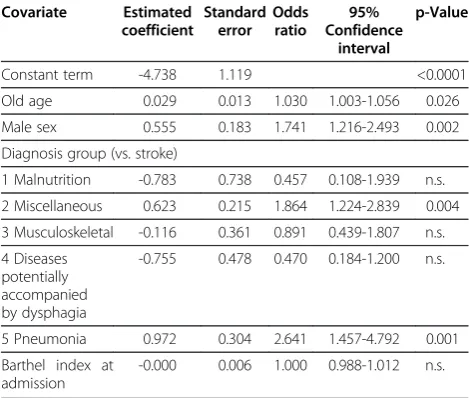
Results:A total of 1232 patients (60.4% women) with a median age of 82 years (range 60 to 99 years) were included. The mean Barthel index at admission was 9.5 ± 14.0 points. Assessment of cognitive status was available in about half of the patients (n = 664), with 20% being mildly impaired and almost 70% being moderately to severely impaired. Stroke was the most common main diagnosis (55.2%). In-hospital mortality was 12.8%. In a logistic regression analysis, old age (odds ratio (OR) 1.030, 95% confidence interval (CI) 1.003-1.056), male sex (OR 1.741, 95% CI 1.216-2.493), and pneumonia (OR 2.641, 95% CI 1.457-4.792) or the diagnosis group
‘miscellaneous disease’(OR 1.864, 95% CI 1.224-2.839) were identified as statistical risk factors for in–hospital death. Cognitive status did not have an influence on mortality (OR 0.447, CI 95% 0.248-1.650).
Conclusion:In a nationwide geriatric database, no component of the basic geriatric assessment emerged as a significant risk factor for mortality after PEG placement, emphasizing individual decision-making.
Keywords:Percutaneous endoscopic gastrostomy (PEG), Mortality, Geriatric assessment
Background
Percutaneous endoscopic gastrostomy (PEG) is a com-mon, safe and relatively economic procedure for long-term nutrition. However, some studies have underlined the importance of proper patient selection because mor-tality has been shown to be relatively high in acute illness and certain patient groups, amongst others geriatric
patients. The 1-month mortality rates range from 6.5 to 23.9%, and 1-year mortality rates of more than 50% have been reported [1-4]. A recent British study observed that of those patients dying within 1-month after feeding tube placement, 40% died within the first week after the pro-cedure [5]. The authors assumed that this mortality was most probably related to the acute disease and under-lying co-morbidities and not to the procedure itself. Im-proper patient selection was held responsible for futile insertions and high morbidity [3,5-7]. This conclusion is supported by Janes et al., who reported a steeply increas-ing number of PEG placements in the last decade, * Correspondence:[email protected]
1
Department of Internal Medicine and Geriatrics, St.-Marien-Hospital Borken, Am Boltenhof 7, 46325 Borken, Germany
2
Institute for Biomedicine of Aging (IBA), Friedrich-Alexander-Universität Erlangen-Nürnberg, Nürnberg, Germany
Full list of author information is available at the end of the article
resulting in higher mortality rates despite improved placement techniques and pointing towards a more lib-eral indication [8].
A variety of studies have tried to identify patient groups that may not benefit from PEG placement by analyzing differences in short-term mortality. Patient characteristics that have been shown to be associated with worse outcomes after feeding tube placement are: high age, increased number of comorbidities, hypoalbu-minemia, elevated inflammatory markers and a low body mass index [3,9-13]. Most data on risk factors imply that disease severity may be responsible for high short term mortality. If this is true, one could expect functional lim-itations reflecting increased disease severity to indicate risk for PEG placement. Few studies have investigated the prognostic value of functional status to estimate the risk of poor outcome in geriatric patients with PEG placement [14,15].
The aim of the present study was to identify risk fac-tors associated with in-hospital mortality in a large population of geriatric patients undergoing percutaneous endoscopic gastrostomy and to evaluate whether compo-nents of geriatric assessment could be useful for guiding decisions about PEG placement.
Methods
Study design and data collection
This observational study retrospectively analyzed data from the GEMIDAS project, a Geriatric Minimum Data Set, which serves as an instrument for voluntary quality assurance in acute and rehabilitative geriatric hospital units in Germany. The database includes information on age, gender, main and secondary diagnosis accord-ing to International Classification of Diseases (ICD) 10, length of stay, and the results of the basic geriat-ric assessment at hospital admission and discharge. Since 2004, operative and endoscopic procedures have been documented according to the German diagnostic related groups (G-DRG) [16], which allows the identi-fication of patients with specific procedures, such as PEG placement.
The total number of patients included in the GEMI-DAS database during the observation period between 2006 and 2010 was 199,454 from 68 hospitals all over Germany. Inpatients from 68 acute geriatric hospital units who had PEG-placement performed during the ob-servation period were identified for this study. We received an anonymized data set of 1281 patients, which represented 0.64% of the GEMIDAS population. Forty-nine patients had to be excluded from the analysis due to double entry or incomplete data regarding gender, age, main diagnosis, length of stay, or mortality.
The following variables were extracted from the main database: age, gender, main diagnosis according to
ICD-10, length of stay, place that person was discharged to or death in hospital, care level and legal incapacitation, Barthel index, and cognitive status. The main diagnoses captured by ICD-10 codes were pooled for diagnosis groups. In the G-DRG, the main diagnosis is based on the reason leading to hospital admission. In Germany, a care level is allocated to a person in need of care; de-pending on the severity, a level from 1 to 3 is assigned. Care level 1 is attributed to a person who needs care in some areas, adding up to a minimum of 90 minutes per day. Care level 3 is attributed to persons who are com-pletely unable to care for themselves and given up to 5 hours of care. In our population, several patients did not have a care level upon admission despite a low Barthel index, which reflects the acute situation of the geriatric patient, who could have been completely inde-pendent before admission to the hospital. The ability to perform basic activities of daily living (ADL) was assessed by the Barthel index at admission and dis-charge, with a range from 0 to 100 points in which 0 points represented complete care dependency [17]. The ability to walk was extracted from the corresponding component of the Barthel index and included patients who were able to walk with amateur help, a walking frame, or were completely independent. Cognitive status was rated with the Mini Mental State Examination (MMSE) [18]. A score of 0 to 19 points was considered to represent moderate or severe cognitive impairment, 20 to 25 indicated mild or questionable cognitive impair-ment, and more than 25 points indicated normal cogni-tive status [19]. If the MMSE score was not available, as was the case in several patients e.g. due to severe sick-ness, aphasia after stroke, etc. cognitive status was evalu-ated by the attending physician. On the basis of the subjective clinical judgment patients were categorized into three groups: no cognitive impairment, slight or questionable cognitive impairment, and moderate to se-vere cognitive impairment. As this was a retrospective database analysis with an anonymized dataset, an ethics approval was not necessary.
Statistical analysis
Results
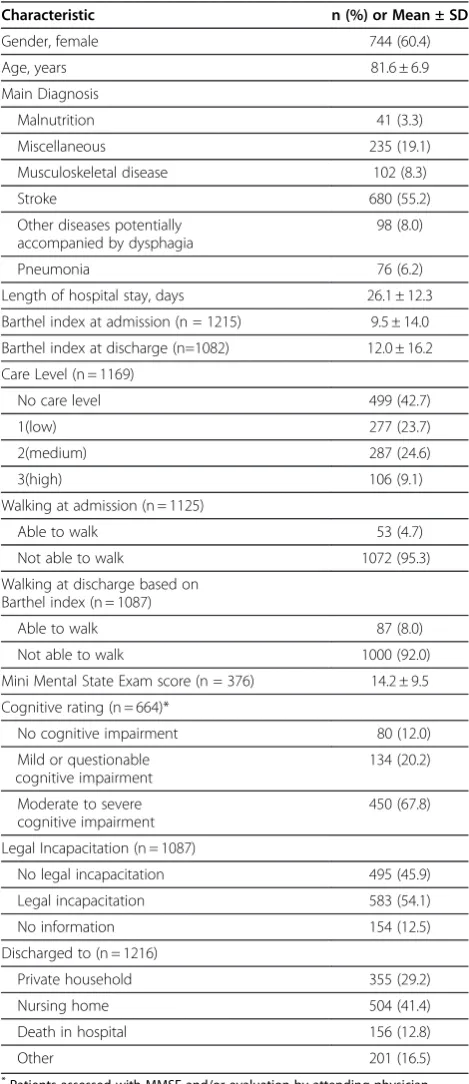
A total of 1232 patients with a median age of 82 (range 60-99) years were included in the analysis. The patients’ baseline characteristics are shown in Table 1. Approxi-mately two-thirds of the patients were women. Even
though more than 40% of the patients did not have a care level at admission, Barthel index values at admis-sion and discharge were very low, which shows how severely sick included patients were. Only 4.7% of the patients were able to walk at admission. Information on cognition was available for 664 patients (376 patients assessed with MMSE, 288 patients assessed by the attending doctor), of which 20.2% showed signs of minor cognitive impairment and 67.8% were moderately to se-verely impaired.
Stroke was the most common diagnosis leading to hospital admission in these patients, affecting more than half of the study population. The second largest group was 'miscellaneous', which included cancer, epilepsy, heart failure and infection, as well as other diseases such as those of the skin and the gastrointestinal tract. The diagnosis group ‘malnutrition’ included synonyms for reduced nutritional status, including protein-energy malnutrition, cachexia, and dehydration. Diseases other than stroke that are potentially accompanied by dyspha-gia were put in one group including Parkinson’s disease, dementia (26 patients, 2.1% of the study population), dysphagia of unknown cause and motoneuron disease. The diagnosis group pneumonia also included aspiration pneumonia (2,8%). Musculoskeletal diseases included fractures, osteoporosis with fractures, musculoskeletal disorders with surgery, osteoarthritis, and abnormalities of gait and mobility.
A total of 156 patients (12.8%) died over the course of their hospital stay, with a median survival of 20 days (range 1-81 days, interquartile 13 - 28) in those patients. In a group comparison of patients who survived and those who died in the hospital, patients with pneumonia or a miscellaneous diagnosis had significantly higher mortality rates that patients from other diagnosis groups. Interestingly, significantly more men than women died. Cognitive status at hospital admission was not signifi-cantly different in patients who survived and those who died (Table 2).
In a regression analysis, risk factors for in-hospital mor-tality were old age, male sex, and the diagnosis groups mis-cellaneous or pneumonia (Table 3). Because cognitive status was available in only about half of the patients, we calculated a separate logistic regression model that included age, gender, main diagnosis, Barthel index, and cognitive status. In this model, the cognitive rating did not have an influence (odds ratio (OR) 0.447, 95% confidence interval (CI) 0.248-1.650). Age was not a significant risk factor any-more, whereas gender and diagnosis groups miscellaneous and pneumonia remained significant in the model. Inter-estingly, even though male sex was a risk factor for increased mortality in the regression analysis, women were significantly older (79.5 ± 7.1 vs. 83.1 ± 6.5 years; p = 0.016), and the Barthel index values were significantly lower Table 1 Baseline characteristics of study participants
(n = 1232)
Characteristic n (%) or Mean ± SD
Gender, female 744 (60.4)
Age, years 81.6 ± 6.9
Main Diagnosis
Malnutrition 41 (3.3)
Miscellaneous 235 (19.1)
Musculoskeletal disease 102 (8.3)
Stroke 680 (55.2)
Other diseases potentially accompanied by dysphagia
98 (8.0)
Pneumonia 76 (6.2)
Length of hospital stay, days 26.1 ± 12.3
Barthel index at admission (n = 1215) 9.5 ± 14.0
Barthel index at discharge (n=1082) 12.0 ± 16.2
Care Level (n = 1169)
No care level 499 (42.7)
1(low) 277 (23.7)
2(medium) 287 (24.6)
3(high) 106 (9.1)
Walking at admission (n = 1125)
Able to walk 53 (4.7)
Not able to walk 1072 (95.3)
Walking at discharge based on Barthel index (n = 1087)
Able to walk 87 (8.0)
Not able to walk 1000 (92.0)
Mini Mental State Exam score (n = 376) 14.2 ± 9.5
Cognitive rating (n = 664)*
No cognitive impairment 80 (12.0)
Mild or questionable cognitive impairment
134 (20.2)
Moderate to severe cognitive impairment
450 (67.8)
Legal Incapacitation (n = 1087)
No legal incapacitation 495 (45.9)
Legal incapacitation 583 (54.1)
No information 154 (12.5)
Discharged to (n = 1216)
Private household 355 (29.2)
Nursing home 504 (41.4)
Death in hospital 156 (12.8)
Other 201 (16.5)
*
(10.5 ± 15.3 vs. 8.9 ± 13.0; p = 0.011) and legal incapacitation was more prevalent (49.7% vs. 57.0%; p = 0.018) among women, indicating that women were more dependent over-all (data not shown). Diagnosis groups did not differ be-tween men and women.
Discussion
The present study found that old age, male gender and certain diagnoses were associated with higher in-hospital mortality after PEG placement in a geriatric population. The data shows no influence of the functional compo-nents of a basic geriatric assessment on mortality.
Hospital mortality in the described patient population was 12.8%, which is within the range of mortality rates observed in other studies of PEG-placement in geriatric patients [8,10].
Our finding that old age is predictive of decreased sur-vival is supported by several studies in elderly patients conducted with different time frames for follow-up ran-ging from 1 to 36 months [1,3,11,20]. However, the increased risk was very small in our study; thus, age per se should have no impact on clinical decision mak-ing regardmak-ing whether a feedmak-ing tube should be placed or not.
The increased risk for in-hospital mortality observed in men is noteworthy and has been shown in other stud-ies of the elderly [1,4,9,21]. Women in our population were generally more dependent, but diagnosis groups did not seem to differ between sexes. One possible ex-planation could be a more generous prescription of feed-ing tubes for men because they were significantly younger and had a higher functional status and lower care level, which possibly made them seem more prom-ising as candidates with benefit from PEG placement. Even though we did not detect any gender differences in regards to the main diagnosis, men could have been sicker overall. Also, men comprised 40% of the present study population, but they account for 30% of the gen-eral GEMIDAS (years 2002 to 2008) population, sup-porting the previously mentioned hypothesis of a more generous prescription in men. We think this should not lead to any impact on decision-making, but it is an inter-esting finding prompting further research.
While patients in the pneumonia and miscellaneous groups had a statistically increased risk for in-hospital mortality it remains important to carefully evaluate indi-cation and timing for PEG placement in every patient. Taking into account the prognosis and usefulness of the intervention in acutely ill patients have to be underlined. This is supported by studies that found patients with acute illness to be at a high risk of serious adverse events after PEG insertion [6,7]. Abuksis et al. suggested for in-stance the use of a nasogastric feeding tube during the first 30 days and then deciding on PEG insertion [6].
PEG placement in patients with a very low Barthel index and high cognitive impairment as is often the case in patients with advanced dementia is not supported by the literature; whether patients profit in terms of survival and improved nutritional or functional status or quality of life is questionable [10,22]. In our analysis, the Barthel index was not predictive of in-hospital mortality. How-ever, the mean Barthel index value was extremely low, which could be the reason for not being able to detect an influence. The index values of patients in this study were similar to those of patients receiving PEG in an earlier study using GEMIDAS data (9.5 ± 13.0 vs. 8.2 ± 14.6), whereas the mean Barthel index value of the general GEMIDAS population is significantly higher (44.6 ± 26.8) [23]. Other studies investigating PEG placement in geriatric
Table 2 Characteristics of survivors and patients who died in hospital
Survived hospital stay
Death in hospital
p-Value n = 1076 n = 156
Men 409 (33.2) 79 (6.4) 0.003
Women 667 (54.1) 77 (6.2)
Age, years 81.5 ± 6.8 82.3 ± 7.9 n.s.
Diagnosis Groups <0.0001
Malnutrition 38 (3.1) 3 (0.2)
Miscellaneous 192 (15.4) 44 (3.6)
Musculoskeletal disease 92 (7.5) 10 (0.8)
Stroke 605 (49.1) 75 (6.1)
Other diseases potentially accompanied by dysphagia
93 (7.5) 5 (0.4)
Pneumonia 57 (4.6) 19 (1.5)
Length of stay, days 26.6 ± 11.9 22.9 ± 13.9 0.001
Barthel index at admission
9.5 ± 13.9 9.8 ± 14.3 n.s.
No care level 440 (37.6) 59 (5.0) n.s.
Care level 1 244 (20.9) 33 (2.8)
Care level 2 245 (21.0) 42 (3.6)
Care level 3 94 (8.0) 12 (1.0)
Able to walk at admission
49 (4.4) 4 (0.4) n.s.
Not able to walk at admission
928 (82.5) 144 (13.4)
No cognitive impairment
74 (6.0) 6 (0.5) n.s.
Mild or questionable cognitive impairment
122 (9.9) 12 (1.0)
Moderate or severe cognitive impairment
395 (32.1) 55 (4.5)
No legal incapacitation 427 (39.6) 68 (6.3) n.s.
Legal incapacitation 512 (47.5) 71 (6.6)
patients found very low functional status in patients receiv-ing PEG feedreceiv-ing [14,15]. In our study, impaired functional status was not associated with increased in-hospital mortal-ity. Thus, not functional status per se, but diagnosis and general prognosis should support the decision-making process.
Several studies and meta-analyses have emerged that question the practice of feeding tube placement in patients with dementia [22,24] Mitchell et al. for in-stance observed nursing home residents with advanced dementia and found that 40.7% of residents underwent burdensome interventions including aggressive nutrition therapy in the last 3 months of life [25]. Sanders et al. on the other hand compared the 30-day mortality after PEG placement in patients with dementia to other pa-tient subgroups and found a significantly higher mortal-ity in cognitively impaired patients (54% mortalmortal-ity vs. 28% mortality entire cohort, p <0,0001) [26]. In our study we were not able to find an influence of cognitive status on short-term survival in regards to hospital mor-tality. However, this conclusion is of limited value as cognitive status has only been available in approximately half of the patients and the origin of cognitive dysfunc-tion (dementia, delirium, or other) could not be traced back. Taken together, our data indicate that cognitive impairment as a functional measure does not increase the risk of short-term mortality after PEG insertion.
The limitations of this study are the retrospective na-ture of the database analysis and the lack of information concerning several known risk factors such as for ex-ample secondary diagnoses, inflammatory markers, etc. that have been found to be significant predictors of decreased survival in patients with PEG placement [27].
Mini Mental Status Examination is used for cognition screening in the GEMIDAS-database. It has to be men-tioned that the test is limited in differentiating between mild to no dysfunction of cognitive status and is of lim-ited use in inpatients with dysphasia. It remains to dis-cuss whether another instrument for more precise cognition screening should be used in the future.
Certainly it has to be mentioned that advanced direc-tives play a certain role in patient selection, this however, could not be displayed by our study.
Conclusion
Recent studies have reported high rates of early mortal-ity after PEG placement in geriatric patients. In these particular cases, PEG placement might be regarded as futile or possibly introducing additional morbidity, evok-ing the question of whether early mortality and by this futile insertions can be partly predicted by certain pa-tient characteristics or the geriatric assessment. In this context no component of the basic geriatric assessment emerged as a significant risk factor for short-term mor-tality after percutaneous endoscopic gastrostomy.
Competing interests
There is no competing interest. This work has not received any financial support.
Authors’contributions
CS and RW performed data analysis, data interpretation and writing of the manuscript. AW performed data extraction from the GEMIDAS-database, DV, CCS and AW critically reviewed and edited the manuscript. All authors read and approved the final manuscript.
Author details 1
Department of Internal Medicine and Geriatrics, St.-Marien-Hospital Borken, Am Boltenhof 7, 46325 Borken, Germany.2Institute for Biomedicine of Aging (IBA), Friedrich-Alexander-Universität Erlangen-Nürnberg, Nürnberg, Germany. 3Bundesverband Geriatrie e.V, Reinickendorfer Str. 61, 13347 Berlin, Germany. 4
Department of Internal Medicine II, Nürnberg Hospital, Prof.-Ernst-Nathan-Str. 1, 90419 Nürnberg, Germany.
Received: 5 December 2011 Accepted: 31 August 2012 Published: 6 September 2012
References
1. Grant MD, Rudberg MA, Brody JA:Gastrostomy Placement and Mortality Among Hospitalized Medicare Beneficiaries.JAMA1998, 279(24):1973–1976.
2. Figueiredo F, da Costa M, Pelosi A, Martins R, Machado L, Francioni E: Predicting outcomes and complications of percutaneous endoscopic gastrostomy.Endoscopy2007,39(04):333,338.
3. Chong V, Vu C:Percutaneous endoscopic gastrostomy outcomes: can patient profiles predict mortality and weaning?Singapore Med J2006, 47(5):383.
4. Rimon E, Kagansky N, Levy S:Percutaneous endoscopic gastrostomy; evidence of different prognosis in various patient subgroups.Age Ageing 2005,34(4):353–357.
5. Johnston SD, Tham TCK, Mason M:Death after PEG: results of the National Confidential Enquiry into Patient Outcome and Death. Gastrointest Endosc2008,68(2):223–227.
6. Abuksis G, Mor M, Segal N, Shemesh I, Plout S, Sulkes J, Fraser GM, Niv Y: Percutaneous endoscopic gastrostomy: high mortality rates in hospitalized patients.Am J Gastroenterol2000,95(1):128–132.
Table 3 Binary logistic regression analysis with In-hospital mortality as the dependent variable Covariate Estimated
coefficient
Standard error
Odds ratio
95% Confidence
interval
p-Value
Constant term -4.738 1.119 <0.0001
Old age 0.029 0.013 1.030 1.003-1.056 0.026
Male sex 0.555 0.183 1.741 1.216-2.493 0.002
Diagnosis group (vs. stroke)
1 Malnutrition -0.783 0.738 0.457 0.108-1.939 n.s.
2 Miscellaneous 0.623 0.215 1.864 1.224-2.839 0.004
3 Musculoskeletal -0.116 0.361 0.891 0.439-1.807 n.s.
4 Diseases potentially accompanied by dysphagia
-0.755 0.478 0.470 0.184-1.200 n.s.
5 Pneumonia 0.972 0.304 2.641 1.457-4.792 0.001
Barthel index at admission
-0.000 0.006 1.000 0.988-1.012 n.s.
7. Longcroft-Wheaton G, Marden P, Colleypriest B, Gavin D, Taylor G,
Farrant M:Understanding why patients die after gastrostomy tube insertion: a retrospective analysis of mortality.J Parenter Enter Nutr2009,
33(4):375–379.
8. Janes S, Price C, Khan S:Percutaneous endoscopic gastrostomy: 30-day mortality trends and risk factors.J Postgrad Med2005,51(1):23–28. 9. Higaki F, Yokota O, Ohishi M:Factors predictive of survival after
percutaneous endoscopic gastrostomy in the elderly: is dementia really a risk factor?Am J Gastroenterol2008,103(4):1011–1016.
10. Mitchell S, Tetroe J:Survival after percutaneous endoscopic gastrostomy placement in older persons.J Gerontol A Biol Sci Med Sci2000, 55(12):M735–M739.
11. Shah P, Sen S, Perluter L, Feller A:Survival after percutaneous endoscopic gastrostomy: the role of dementia.J Nutr Health Aging2005,9(4):255–259. 12. Donini LM, Savina C, Ricciardi LM, Coletti C, Paolini M, Scavone L,
Felice MRD, Laviano A, Fanelli FR, Cannella C:Predicting the outcome of artificial nutrition by clinical and functional indices.Nutrition
2009,25(1):11–19.
13. Blomberg J, Lagergren P, Martin L, Mattsson F, Lagergren J:Albumin and C-reactive protein levels predict short-term mortality after percutaneous endoscopic gastrostomy in a prospective cohort study.Gastrointest Endosc2011,73(1):29–36.
14. Callahan C, Haag KW M, Tierney W, Buchanan N, Stump T, Nisi R:Outcomes of percutaneous endoscopic gastrostomy among older adults in a community setting.J Am Geriatr Soc2000,48(9):1048–1054.
15. Rudberg MA, Egleston B, Grant M, Brody J:Effectiveness of feeding tubes in nursing home residents with swallowing disorders.JPEN2000, 24(2):97–102.
16. German Institute of Medical Documentation and Information:ICD-10-GM. Deutscher Ärzte-Verlag Köln; 2009.
17. Mahoney F, Barthel D:Functional evaluation: The Barthel Index.Md State Med J1965,14:61–65.
18. Cockrell J, Folstein M:Mini-Mental State Examination (MMSE). Psychopharmacol Bull1988,24(4):689–692.
19. German Societies for Neurology and Psychiatry and Psychotherapy, German guidelines for dementia, 2009.
20. Rabeneck L, Wray N, Petersen N:Long-term outcomes of patients receiving percutaneous endoscopic gastrostomy tubes.J Gen Intern Med 1996,11(5):287–293.
21. Taylor C, Larson D, Ballard D, Bergstrom L, Silverstein M, Zinsmeister A, DiMagno E:Predictors of outcome after percutaneous endoscopic gastrostomy: a community-based study.Mayo Clin Proc1992, 67(11):1042–1049.
22. Sampson E, Candy B, Jones L:Enteral tube feeding for older people with advanced dementia.Cochrane Database Syst Rev2009,15(2).
23. Wirth R, Volkert D, Bauer J, Schulz R, Borchelt M, Fleischhauer C, Steinhagen-Thiessen E, Sieber C:PEG tube placement in German geriatric wards - a retrospective data-base analysis.Z Gerontol Geriat2007, 40:21–30.
24. Freeman C, Ricevuto A, DeLegge MH:Enteral nutrition in patients with dementia and stroke.Curr Opin Gastroenterol2010,26(2):156–159. 25. Mitchell SL, Teno JM, Kiely DK, Shaffer ML, Jones RN, Prigerson HG, Volicer L,
Givens JL, Hamel MB:The Clinical Course of Advanced Dementia.N Engl J Med2009,361(16):1529–1538.
26. Sanders DS, Carter MJ, D'Silva J, James G, Bolton RP, Bardhan KD:Survival analysis in percutaneous endoscopic gastrostomy feeding: a worse outcome in patients with dementia.Am J Gastroenterol2000, 95(6):1472–1475.
27. Kobayashi K, Cooper GS, Chak A, Sivak MV, Wong RCK:A prospective evaluation of outcome in patients referred for PEG placement. Gastrointest Endosc2002,55(4):500–506.
doi:10.1186/1471-2318-12-52
Cite this article as:Smolineret al.:Basic geriatric assessment does not predict in-hospital mortality after PEG placement.BMC Geriatrics2012
12:52.
Submit your next manuscript to BioMed Central and take full advantage of:
• Convenient online submission
• Thorough peer review
• No space constraints or color figure charges
• Immediate publication on acceptance
• Inclusion in PubMed, CAS, Scopus and Google Scholar
• Research which is freely available for redistribution