Dynamic Message Transmission Scheduling
Using Can Protocol
Israa M. Al Saadi
Abstract: The reliability, safety and deadlines guarantee of data transmission are key features of advanced real time communication systems. Recently, many studies demonstrated the efficiency of Controller Area Network(CAN) protocol, one of the most common Real Time Communication (RTC) protocols which has received wide attention from network architecture developers. This paper illustrates the mechanism of CAN protocol in the term of real-time message transmission scheduling in order to guarantee that the transmitted messages will not exceed their deadlines. The analyzed method of dynamic message transmission scheduling is based on message priority which was recently proposed by many authors to support the idea of in time message transmission.
Keywords: Real Time Communication; Real-time Message Transmission Protocols; CAN Protocol; Message Transmission Scheduling. ————————————————————
I.
I
NTRODUCTIONOver the recent years, the necessity of adopting a communication policy that can satisfy the real-time message transmission requirements such as reliability, safety and deadlines guarantee has been significantly increasing due to the fast progression of real-time system applications. RTC can be defined as communication system that depends mainly on the time as a determinative factor of system performance accuracy when the system provides the communication services among the interconnected users over a communication environment. In the past, the use of real-time system applications was concentrated on the industrial applications such as process control systems ,chemical plant control systems and industrial automation systems[1]. Nowadays, the collaboration among new communication technologies such as Voice-over-IP (VoIP)telephony, Instant Messaging(IM),video conferencing and many other applications have made the RTC applications widespread [2,3]. The taxonomy of RTC is basically divided into two categories, Hard Real Time (HRT) and Soft Real Time (SRT) depending on the level of messages transmission deadlines guarantee[4]. In HRT applications, the system behavior must be organized and capable to meet the deadlines of the transmitted messages and communicates with unpredictable changes during the system operation. However, the disability in these systems of in time messages transmission leads to system failure as well as the overall system performance will be undependable[5]. Such systems conduct communication protocols when implement data communication infrastructure, these protocols have the ability of instantaneous transmission of different packets such as text, voice and video. The transmitted packets cross over a communication environment to the destination side in a given time[6]. Controller Area Network(CAN) is one of the most common RTC protocols which has received wide attention from network architecture developers due to its high level of efficiency and flexibility of in time message transmission. CAN protocol has been adopted by various applications of real-time systems in order to achieve the quality of services which is provided by the new generations of RTC technologies[7,8].This paper illustrates the efficient mechanism of CAN protocol for message transmission scheduling based on message priority by using dynamic message transmission method as a technique in order to implement real-time messages transmission quarantees.The rest of this paper is organized as follows:
Section II introduces an overview of CAN protocol.Section III summarizes related work on CAN protocol.Section IV presents general idea of CAN protocol message transmission mechanism.Section V explains CAN bus message information delay.Section VI analyses CAN frame delay.Section VII defines problem definition.Section VIII applies the dynamic scheduling algorithm.Section IX discusses the obtained results.Finally,Section X concludes this work and suggests future work in this area.
II.
CAN
P
ROTOCOLO
VERVIEWThe CAN bus is defined by the International Standards Organization ISO11898 as a digital field control devices connection bus which is capable of effective supporting the serial communication of the real time as well as distributed systems[9]. In the late of 1970s,International Standards Organization (ISO) produced a standard model, Open Systems Interconnection (OSI) which has been adopted as a standard by most of network architecture designers specially in the stage of data communications implementation. The performance mechanism of CAN protocol is built to operate in the Medium Access Control (MAC) layer which is a sublayer of the Data link layer(DLL) in the network architecture[10]. Fig.1 shows the basic design of OSI model and the main functions of MAC layer. CAN protocol has been commonly used in the concept of connecting devices in the systems that require high level of reliability, reality and flexibility of system performance such as industrial control systems, data acquisition and network sensors[9]. CAN bus is a broadcast bus .In another meaning, each node is capable of hearing messages transmissions of all other nodes. The CAN bus nodes will share the transmitted message as well as selecting the network traffic. The CAN bus is a wired technology. The physical connection of CAN bus nodes is based on wired network[11]. CAN protocol is ideal for complicated real-time systems due to its developed platform that is established with advanced attributes for example, high level of data security,error detection, priority based Medium Access Control (MAC) and short message length[5]. There are many advantages of using CAN protocol such as:
• Mature standard
159 advantage, adaptability, robustness in error detection and
its predictable characteristic when the worst-case timing delay occurs during data transmission[11,13].
• Excellent error Detection
CAN protocol can be considered as robust protocol in hardware support for error detection due to its automatic error handling mechanism which is based on an efficient cyclic redundancy checking and messages retransmission. Therefore, CAN protocol has been conducted by many of critical and controlling applications such as, active-steering and heavy industrial machines controlling[11,13].
• Fault confinement
Message Transmission performance can be threatened by any fault node. However, since the CAN protocol allows all the bus nodes to share the network bandwidth, CAN protocol uses its developed features to prevent that node from damage on the whole system[11].
III.
R
ELATEDW
ORKThe investigation of CAN message transmission analysis has been started in the last decade of nineteenth century[14]. In 1990, Lehoczky proposed the theory of a busy period and proved that if a process is constrained by a given time which is greater than its period, belong to as arbitrary deadlines , then it is an important to check whether the worst-case response time can be determined by the response times of all the process steps during a busy period[15].
In 1991,Harbour et al. showed that there is a necessity to find powerful solution to fix the worst-case response time when the deadlines of a task are less than or equal to periods
Figure1 ISO/OSI Model Layers[10]
and the priorities are various during the process execution[15]. In 1994, Tindell provided a fixed priority scheduling as an efficient method based on CAN protocol. The adapted method calculated the maximum queuing delay and the worst-case response time of each node on the network. Tindell concluded that the proposed method is an ideal priority policy to be conducted to have a high real time performance[16]. In 1996,George et al. introduced inclusive scheduling analysis depend on the previous results. The comprehensive studying focused on non-pre-emptive fixed priority scheduling of single processor systems. In 1999,both of Wang and Saksena worked on pre-emption thresholds to analyse the CAN scheduling[15]. However the work of the last two authors(Wang and Saksena,1999) was modified by Regehr in 2002[15]. In 2006, Bril argued about the result which was given by Burns(1994), the work showed that the scheduling analysis may lead to worst-case response time[15]. In 2007, Davis investigated and corrected the shortcomings that are given by Tindell et al. The discovered shortcomings showed the probability of missing the messages their deadlines guarantees[16]. In 2011, the research which was introduced by Davis et al. who proposed a message scheduling analysis using FIFO transmission queues.
IV.
CAN
M
ESSAGET
RANSMISSIONM
ECHANISM―CAN is an asynchronous multi-master serial data bus that uses Carrier Sense Multiple Access/Collision Resolution (CSMA/CR) to determine access‖[15]. The first designed of CAN was made with the capability to operate with speed up to 1 Mbit/s[15].CAN protocol is communication protocol based on message priority[6]. This protocol applies a dynamic message scheduling as an efficient method to adjust the network-deduced delay while allocate the message identifier. However, the traditional message scheduling methods use a static technique when allocate the message identifier which is in most cases leads to infinite delay time of low messages priority[6]. Therefore, CAN protocol dynamic message scheduling can be considered as an intelligent method to guarantee the fair allocation of the network bandwidth resources among the CAN bus nodes[6]. In another meaning, the CAN protocol manages the message transmission process by asking the bus nodes to wait before start sending the data until the bus will be idle (Carrier Sence). When the interval of no activity occurs in the bus, the opportunity of sending data will be distributed equally among the interconnected nodes (Multiple Access). When two or more interconnected nodes in the network try to synchronously send the data, in this case the node that carries the message which has the lowest numeric frame identifier will be given the priority of sending its message(Collision Resolution)[10,15]. CAN scheduling analysis of real-time applications can be assumed as follows :
2. The possibility of sending the highest message priority at first in the bus arbitration of the CAN network when one node has more than one message is prepared to be sent[14].
However, these assumptions impose limitations on CAN protocol behavior as well as the overall CAN network performance. Consequently, an argument among CAN protocol behavior analysers led to few disadvantages about CAN protocol ability of in time message transmission. For instance, restricted bandwidth and lack of full support for reliable group communications[12].The security issue puts another limitation on CAN bus when it applies a mechanism which allows CAN bus nodes to share the transmitted messages[8]. ―No protocol is perfect‖[12].Even though the contrasted behaviour of CAN network, this does not mean that CAN protocol lost its ability to create an efficient and reliable message transmission system if the network architecture designers take in account the carefulness when establish the design and implementation of CAN protocol[17].
V.
CAN
B
USM
ESSAGEI
NFORMATIOND
ELAYCAN bus classifies message information delay into four categories frame delay, software delay, CAN controller delay and media access delay[18]. Frame delay is caused by message serialization transmission, more explanation about frame delay can be found in section V. The time that is used by the application process to realize message transceiver and data pretreatment is called Software delay. The combination between the taken time by CAN controller when realize the message information string/parallel or parallel/string and bus transceiver delay cause the CAN controller delay[18]. The last category of CAN bus message information delay is Media access delay which is caused by the time when the message control on the bus resource[18].
VI.
F
RAMED
ELAYA
NALYSISFrame delay, is one of the CAN bus message information delay. It serializes the message transmission delay which is the main part of the entire message delay .The frame length and baud rate determine the frame delay[18].Delay time can be calculated by this equation :
Delay time = Frame length / Baud rate [18]
Both of frame type, frame format and padding bit determine the frame length while the bus length determine the message transmission rate.The CAN bus message transfer is divided into four types of frames,data frame, remote frame , overload frame and error frame[18]. Fig.2 shows the layouts of standard format of data frame. In the CAN bus , each data frame has an unique identifier. Data frame is divided into two frame formats: standard frame and expand frame[18]. The standard format has frame length with 11 bits while the expand format comes with 29 bits length. The frame length is determinative by two factors: data field length and identifier length[18]. The message identifier has two functions. First, it operates as message priority determinative. In another word, the message identifier decides which of the transmitted message among the bus will be the first transmitted one or the next and so on. Second, the message identifier operates as a filter to eliminate the un important message in the receiver side. Therefore it will reduce the load on the receiver host[15]. In the industrial fields , these systems apply the CAN bus, must have a powerful control system of network bandwidth, information delay and process cycle parameters. These systems should be capable to find the transfer parameters of the bus to decide which is the best among them. In the case of low baud rate , it causes the limitation of bus space. In the other hand , the high baud rate will cause the limitation in the bus length and reduce the resistance to noise intervention. At the end , the selected baud rate parameter in the bus will not be changed. Therefore , the baud rate parameter in the delay factors is deterministic[18].
VII.
P
ROBLEMD
EFINITIONEvery node in the CAN bus has the right to send the carried data by that node. when two or more nodes send data at the same time , the node with the high priority will win the opportunity of the bus control to send its data. As a result, the node with the low priority will be in a waiting mode until obtains another opportunity to be involved inside the bus nodes competition. However, when the data conflict occurs which is caused by the high load of the network
Figure2 Standard Format of Data Frame[15]
activity, in this case, the data which are carried by the low priority node will cause data transmission delay with long waiting mode . Therefore, the network ability to transmit the data in the given time will be missed[18].
VIII.
D
YNAMICS
CHEDULINGA
LGORITHM161 Avoidance the low priority without bus control
Guarantee the real-time constraints during the network data transmission
When there is no conflict in the bus, each node starts sending its data depending on the initial priority. However, when all the nodes try to send the data synchronously, the data conflict will be the dominant on the network action. In this case, the competition among the interconnected nodes to send their data will be limited on the nodes with high priority. In order to avoid the low performance of the network, the nodes with low priorities need an increasing on their priority values to have new probability of the next bus competition[18]. Therefore, there is a necessity of adopting a method that makes the data transmission process takes place in an organized way. As a result, meeting the real-time requirements will be guaranteed and the network behavior will be better. But, there is another probability that may leads to data conflict or network system failure[18]. When two or more nodes in the network have the same priority values, using a powerful algorithm to ensure the absence of this problem will be the best choice to make the data transmission in the bus occurs in an efficient way.―Taking Mold Increase‖ method, is a good solution to avoid the problem of priorities equality[18]. The description of this method is as follows: K is the number of the bus nodes, P is the number of priority digits which can be articulated as the largest amount of 2P-1 (the greatest node of K). Each node of K starts with initial value equal to (2P-1)-H ,when H is limited between [0,K-1][18]. When the probability between the node starts , the new priority of each node can be calculated by this equation: New priority = Original priority – K [18]. Basically, when the algorithm executes the increasing step, each node with its new priority value must be greater than 0 as a condition to win the bus arbitration. However, when the new priority value of any node is less than 0 ,this means that there is no ability to change the priority value[18]. Table1 demonstrates an example of the dynamic scheduling algorithm computations.
TABLE1 SITE DYNAMIC PRIORITY UPGRADE [18]
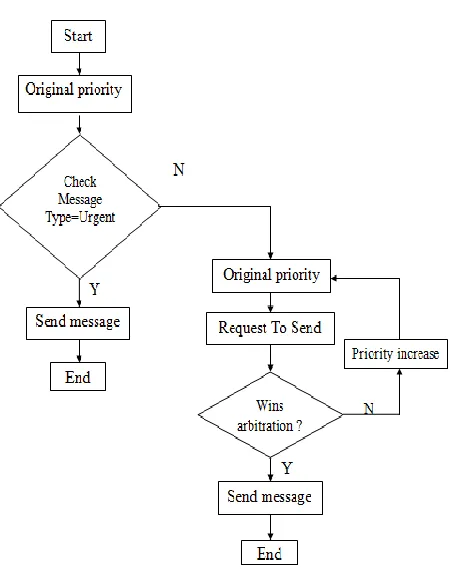
As shown in table1, there are six competitive nodes on CAN bus try to send their data, Each node has an initial priority. The algorithm uses its mathematical steps to increase the node priority value at the competition failure side. Therefore, it will show that there are not two nodes have the same priority values[18]. The flowchart in Fig.3 shows the sequential steps of priority algorithm procedure.
Figure 3 Priority algorithm procedure[18]
When the algorithm starts checking the priority of the competitive nodes , it can take a modulus to increase the low priority node which failed to obtain an opportunity in the data transmission process of the CAN bus in order to decrease the number of low priority nodes failure[18]. However, the mechanism of this algorithm has several shortcomings that are discussed in the discussion section.
IX.
R
ESULTSD
ISCUSSIONoperations[8]. Consequently, there is no guarantee in this algorithm that the network bandwidth resources will be fairly allocated among the interconnected nodes which means that the overall network behavior will be unacceptable. The author of this paper proposed a modification on the ―Taking Mold Increase‖ algorithm. The proposed algorithm by the author suggests that there is a critical message carried by one of the CAN bus nodes. The node which carries the critical message will not be included in the bus priority arbitration even if its priority less than other nodes. Fig.4 shows the proposed modification on the original flowchart to check the message importance.
Figure 4 Modified (Proposed)Priority algorithm procedure
X.
C
ONCLUSION ANDF
UTUREW
ORKThrough the investigation of several analysis researches on CAN protocol message transmission scheduling mechanism, the gained knowledge emphasis the high performance of this protocol to be an accurate and reliable messages transmission scheduling protocol under RTC constraints. This paper showed the implementation of CAN protocol message transmission scheduling based on message priority by using dynamic scheduling algorithm. The possibility of increasing low priority nodes has been discussed. The challenges which are associated with using ―Taking Mold Increase‖ algorithm are specified.In addition, this paper indicated the negative impact on the network bandwidth resources and the overall system performance when the message transmission guarantees are broken as well as message deadlines are missed. Future work on this area will be presented by using a software that can proves the proposed modification by the author on the origin algorithm.Therefore, the author strongly recommend that Controller Area Network, Real-time Message Transmission
scheduling are hot topics to be focused by many network systems developers.
ACKNOWLEDGMENTS
The author would like to thank all the academic staff for their diligent efforts in teaching this module and all anonymous reviewers for their motivation, support and comments during the completion of this research.
R
EFERENCES[1]. R. Mall, Real-Time Systems: Theory and Practice. Prentice Hall, 2009.
[2]. S. Klein, N. Vehring and M. Kramer, "Introducing Real Time Communication: Frames, modes & rules," Proceedings of the 23rd Bled eConference on eTrust: Implications for the Individual, Enterprise and Society, pp. 20-23, 2010.
[3]. I. Lazar, "Integrating telephony, IM, video and mobility with presence," Business Communications Review, vol. 36, pp. 28, 2006.
[4]. R. Moraes, F. Vasques and P. Portugal, "Survey of Real-Time Communication in CSMA-Based Networks," Network Protocols and Algorithms, vol. 2, pp. 158-183, 2010.
[5]. Ni Xiaodong and Zhang Yanjun, "Determining message delivery delay of controller area networks," in TENCON '02. Proceedings. 2002 IEEE Region 10 Conference on Computers, Communications, Control and Power Engineering, 2002, pp. 767-771 vol.2.
[6]. Wu Qinmu, Liu Jiangning and Li Yesong, "A study on message scheduling method based on delay time constraint," in Mechatronics and Automation (ICMA), 2010 International Conference On, 2010, pp. 783-787.
[7]. C. H. Hauser, T. Manivannan and D. E. Bakken, "Evaluating multicast message authentication protocols for use in wide area power grid data delivery services," in System Science (HICSS), 2012 45th Hawaii International Conference On, 2012, pp. 2151-2158.
[8]. S. Mirshokraie, M. Sabeghi, M. Naghibzadeh and K. Bertels, "Performance evaluation of real-time message delivery in RDM algorithm," in Networking and Services, 2007. ICNS. Third International Conference On, 2007, pp. 74-74.
[9]. Xiaohong Ren, Chenghua Fu, Tianwen Wang and Shuxiang Jia, "CAN bus network design based on bluetooth technology," in Electrical and Control Engineering (ICECE), 2010 International Conference On, 2010, pp. 560-564.
163 [11]. L. G. Bushnell, "Networks and control," IEEE
Control Syst. Mag., vol. 21, pp. 22-23, 2001.
[12]. M. Short and M. J. Pont, "Fault-Tolerant Time-Triggered Communication Using CAN," Industrial Informatics, IEEE Transactions On, vol. 3, pp. 131-142, 2007.
[13]. P. Axer, M. Sebastian and R. Ernst, "Probabilistic response time bound for CAN messages with arbitrary deadlines," in Design, Automation & Test in Europe Conference & Exhibition (DATE), 2012, 2012, pp. 1114-1117.
[14]. D. A. Khan, R. I. Davis and N. Navet, "Schedulability analysis of CAN with non-abortable transmission requests," in Emerging Technologies & Factory Automation (ETFA), 2011 IEEE 16th Conference On, 2011, pp. 1-8.
[15]. R. Davis, A. Burns, R. Bril and J. Lukkien, "Controller Area Network (CAN) schedulability analysis: Refuted, revisited and revised," Real-Time Syst., vol. 35, pp. 239-272, 04/01, 2007.
[16]. R. I. Davis, S. Kollmann, V. Pollex and F. Slomka, "Controller area network (CAN) schedulability analysis with FIFO queues," in Real-Time Systems (ECRTS), 2011 23rd Euromicro Conference On, 2011, pp. 45-56.
[17]. M. Short, I. Sheikh, S. Aley and I. Rizvi, "Bandwidth-efficient burst error tolerance in TDMA-based CAN networks," in Emerging Technologies & Factory Automation (ETFA), 2011 IEEE 16th Conference On, 2011, pp. 1-8.
![Figure 3 Priority algorithm procedure[18]](https://thumb-us.123doks.com/thumbv2/123dok_us/9113719.1445827/4.612.43.281.521.716/figure-priority-algorithm-procedure.webp)