The Effect Of Human Resources Management
Practices On Employee Performance
Hamzah Mohammad A. Al_Qudah, Dr. Abdullah Osman, HamzahEdris M. Al_Qudah
Abstract: This paper aimed to examine the effect of HRM practices towards employee performance in Malaysian Skills Institute (MSI). It investigated the factors that affecton recruitment and selection, compensation toward employee performance in MSI. The study population, which consisted of employees in the MSI, comprised 40 respondents. To achieve the study objectives, the researcher developed and distributed a questionnaire, and collected and analyzed the data using SPSS. An overall analysis was performed based on the descriptive statistics and correlation analysis. The results indicated that recruitment and selection and compensation significantly correlated with the employee performance in MSI. The paper provided recommendations for improving recruitment and selection and compensation in MSI.
Keywords: Recruitment and Selection, Compensation, Employee Performance,
————————————————————
1.0 Introduction
Recently, MSI faces an increasing burden among the lecturers due to insufficient number of the administrative staff, where many instructors and lecturers complain from the additional administrative works. Many committees involving instructors were recruited in ad hoc manner that led to several weaknesses in MSI administration due to the lack of enough administration skills with the instructors. Obviously, this could exhaust the instructors while undertaking their job, specially, with lack of cooperation among the instructors themselves in carrying out their duties due to the lack of stimulus from the top officers. Thus, reduce the performance of the instructors in their main jobs. The importance of this study being looked at one of the topics of modern management is relatively a HRM practices and the factors affecting it, as it is new concept to the developing countries, which include Malaysia, so it is subjected to the study of the field gives more importance especially in light of the circumstances and variables technological and economic. The multi-policy, witnessed by the Malaysian public sector, which require the adoption of the concept of HRM practices from the perspective of application to keep up with the rapid environmental changes.
2.0 Literature Review
2.1 Employee Performance
Employee performance is one of the most factors that affect on the performance of the organization. The successful organization understands the importance of HR as a critical factor directly affects and contributes on the performance[2].The success of any organization depend on its employees behavior and their decision, although there are many other factors contribute in that success, such as the organization size, the environment in what it operate and its activities. Often, human resource management practices are employed to evaluate the performance of the employee in the organization, and in modern era and highly competitive climate between the organizations, the tendency to improve employee performance is by improving the HRM practices[5]; [3]. The employee‘s performance is use of knowledge, skills, experiences and abilities, to perform the assigned mission required by their managers efficient and effectively [9]. The importance of the employees performance can be in form of several points such as 1) help to considering the cost of the resources used [17], 2) a measure of the quantity and quality of work done[17], 3) help to survive and excel between the firms [13], 4) help to assess and attain of established performance goals [4], and finally, 5) increase the efficiency of the employee performance helps to make the right decisions [4]. Kaplan [22] explained the main methods of evaluating employee performance based on: 1) employee attributes which confirm characteristics or qualities important to the firm, 2) employee behaviors which are widely used for evaluating or defining employee behaviors necessary to complete a job successfully, and, 3) employee achievements which show the extent to which specific objectives or aims have been met, exceeded, or not met.
2.2 Recruitment and Selection
Recruitment is the process to fully fill the offered work positions in sufficient number and qualities of the applicants, as well as to meet the expectations and requirements of the organization [24].Recruitment is using the analysis of the job in order to select and identify the needs and requirements of the organization, and it's related to the adopted strategy by the organization through human resource management planning [15]. Organization chooses carefully the policy of recruitment due to what is reflecting from the general strategy of the organization[20].There are _____________________________
Hamzah Mohammad A. Al_Qudah, School of
Business Innovation & Technopreneurship,
University Malaysia Perlis,
Email: [email protected]
Dr. Abdullah Osman, School of Business Innovation
& Technopreneurship, University Malaysia Perlis, Email: [email protected]
HamzahEdris M. Al_Qudah, School of Business
Innovation & Technopreneurship, University
Malaysia Perlis,
130 many factors that affect on the recruitment process and can
be divided to internal and external factors. The restrictions that imposed by the government and the labor market limit the improvement process of recruitment policies and it considered as the main external factors. Organization's policy and the vision of the organization can be considered as an indicator to the efforts of the recruitment and it‘s an example of the internal factors [20]. As a professional HR manager, it is vital to have the competency and ability to select appropriate employees and place them in suitable work positions [16]. Selection is an important element in HR functions, because the employee‘s selection has close relationship and connection with the organization's development. Selection is collecting the information about the applicants to decide who is fit and should be employed each work position[24].
2.3 The Effect of Recruitment and Selection on Employee Performance
Recruitment and selection are integrated factors that affect the performance of the employee. Recruit and select appropriate employee for suitable position of work have close relationships and connections with the organization's development. Many studies have found positive relationship between recruitment and selection and employee performance.Huselid[11] stressed that by adopting best practices in recruitment and selection, it allow the good quality of skill in the organization. He also stressed on importance of training as complement of selection practices through which the organizational culture and employee behavior can be aligned to produce positive results. Tessema and Soeters[26]―the extent of HR practices affect performance at the employee level in Eritrea‖. Since performance is a multi-faceted and complicated concept, HRM outcomes were used as mediating factors between HR practices and employee performance and the result was positively with the relationship between recruitment and selection and performance at the employee level.Alnaqabi[1] identified HR practices and other factors such as job satisfaction, organizational commitments and leadership practice that affect employee performance in UAE with emphasis on public organizations. Alnaqabi[1] showed the positive impact of recruitment and selection toward the performance of the employee. A related study by Smith and Lynch [25], showed that recruitment and selection is the first step in employee evaluation process. This is linked with identify, attract and select the appropriate applicant to meet the requirements of the jobs in the organization. This process is important to make sure about the outcomes of the recruitment and selection process in the organization. Qureshi and Ramay[21] stated that HRM practices are positively and significant linked with the performance of the employee and training and selection is the most factor affecting on the employee performance between all the others practices. Based on the previous mentioned studies it can be safely assumed that employee performance is positively affected by recruitment and selection.
2.4 Compensation
Compensation is the bonuses submitted to the employee due to their services. Compensation process can be divided to direct financial compensation and indirect compensation
whether it financial or nonfinancial [19]. Compensation is a strategic policy in the organization, where it can affect on the employer's possibility to attract new applicants, gain employee's loyalty and ensure the maximum level of performance to meet the organization goal and objective from the employee [19]. Compensation systems in the organization offer to the employees as to increase employee motivation [18], performance and productivity. Hence, most of the organizations concerned on establishing and maintaining the optimal compensation systems. According to expectancy theory [27], once pay is linked with performance of group or individual, employees are more likely to increase their efforts in working hard to increase the performance of individual and the organization which related to increase and improve the overall organization's performance. Based on expectancy theory [27], it can be expected that, if the company provides compensations and rewards desired by the employee in question, the employee is more likely to perform so that the employee can be rewarded. ―Choosing an appropriate compensation mechanism is probably the core problem of human resource managers, and represents the heart of personnel economics‖ [9].Caruth and Handlogten[7] stated that: ―Employees are motivated when there are financial rewards directly tied to their performance‖. Leonard and Jonathan[14] stated that when the organization adopts long-term plan of incentives, it will get and increase more in ROE than the organization that didn't do.
2.5 The Effect of Compensation on Employee Performance
linked with practices of innovative work such as ‗flexible job design, cooperation of employees as a team to solve the faced problems, develop workers skills by put them under training programs and employment security‘ [12]. Study by Huselid [11] showed that there is statistically significant relationship between compensations and employee and corporate financial performance. Also the study by Teseema and Soeters [26] confirmed with significant positive relationship between practices of compensation and performance of employees.
3.0 Research Question
How Human Resource Management practices affects Employee Performance?
3.1 Research Hypotheses
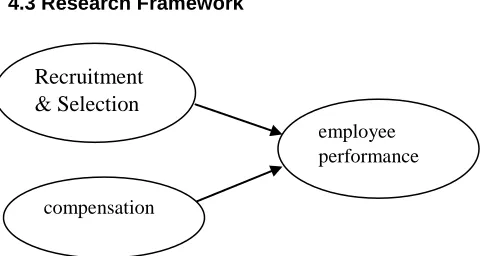
H1: There is a positive effectofrecruitment and selection on employee performance in MSI.
H2: There is a positive effectofcompensation onemployee performance in MSI.
4.0 Methodology
4.1 Sampling
This research study finds out the effect of HRM practices on employee performance. Simple random sampling has been applied to guarantee that specific groups within a population are adequately represented in the sample and the efficiency is improved by gaining greater control on the composition of the sample.
4.2 Data Collection and Analysis
Sample of this study is lecturers and administrators in MSI. Selected sample size is 60 and 56 returned out of total distributed questionnaires. Response rate is 93%. Questionnaires of Sekaran[2003] are selected for data collection because already available data is not sufficient for analysis; with the amendment of dependent variable from perceived organizational performance to employees‘ performance in organization this questionnaire is used.Since this study found effect between human resource management practices and employee‘s performance, Pearson correlation and descriptive statistics are used for analyzing data numerically.
4.3 Research Framework
Figure 1: Research Framework
4.4 Results of the Study
This study adopted a five-point Likert scale to answer the items in the questionnaire, with 5 denoting ―always‖ and 1 denoting ―never.‖ Mean scores less than 2.33 were considered weak, mean scores between 2.76 and 3.94 were considered moderate, and mean scores of more than 3.67 were considered high. And Cronbach Alpha‘s valuesare more than 0.60.
Table 1:Descriptive statistics and reliability
Se r. Item
Mean score
Stand ard deviat ions
Cronb ach’s Alpha Recruitment and
Selection .826
1
Job description is clearly spelt out for academic and administrative staff which improves on their performance.
3.55 1.127 .759
2
The number of academic and administrative staff and their distribution per course is directly related to their level of performance.
3.61 1.155 .776
3
Recruitment of academic and administrative staff has been satisfactorily done in MSI
3.59 1.005 .816
4
In MSI, academic and administrative staff is normally interviewed before joining service.
3.91 .940 .870
5
Only academic and administrative staff who meets the selection criteria is appointed.
3.57 1.142 .763
6
Selection procedure is done objectively by matching job description and person specification against what is offered.
3.61 1.155 .776
Compensation .792
7
Job performance is crucial factor that help to determine the compensation of employees.
3.64 .943 .703
8
MSI rewards the employees to ensure retains them.
3.89 .947 .771
9
In MSI, the employee‘s compensation is directly related to their performance.
3.55 1.127 .789
10
The compensation which is offered impacts the employee`s high performance.
3.61 1.155 .805
11
The compensation focuses on the employees from all the levels of MSI.
3.64 .943 .703
12
In MSI the compensation decision is related to the competences and abilities of employee.
3.82 1.011 .780
Item serial 4 obtained the highest mean score (3.91) for the first variable, recruitment and selection (see Table 1). This result suggested that the recruitment and selection
employee performance
compensation
132 processes within MSI are well established, and HR staff
members are well versed in the rules and procedures, and have experience and competence in the employee recruitment and selection process. And item serial 8 obtained the highest mean score (3.89) for the second variable, compensation.
Table 2: correlation analysis
Variables
Employee performanc e
Recruitment & Selection
Compen sation
Employee
performance 1 . 946 . 951
Recruitment &
Selection . 946 1 . 881
Compensation . 951 . 881 1
As shown in correlation results the highest correlation value is Compensation (r= .951; p<.05), and smaller correlation value is Recruitment & Selection(r=.946;p<.05). The results indicates that all the variables have positive relationship and statistically significant at (p<.05).
Table 3:Regression Analysis
Variables Beta Sig.
Recruitment &
Selection .484 .000
Compensation .525 .000
R Square .957 Durbin Watson 1.809 Sig. F 0.000
Table 3 depicted the multiple regression coefficients (β) of the two independent variables to the employee performance, as dependent variable. All variables in HRM practices are significant where p < 0.05. In terms of beta values, the highest beta coefficient was discovered for Compensation, where (Beta = .525). This indicated that Compensation variable made the strongest contribution to explain the dependent variable (employee performance). The lowest beta value indicated that recruitment and selection with (Beta = .484).
4.5 Hypotheses Testing
To test the hypotheses, a simple regression and correlation analysis were performed on HRM practices and employee performance.
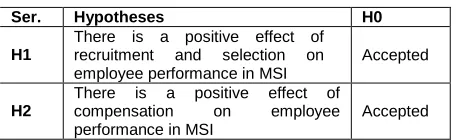
H1: There is a positive effect of recruitment and selection on employee performance in MSI
The effect of recruitment and selection were tested against employee performance by using Pearson correlation and regression analysis. The results indicate that there is a positive relationship between the two variables as shown in table 2 (r= .946; p<.05) indicating that the relationship between the variables is significant with moderate correlation. Also, the regression analysis results shown in table 3 (β = 0.484, p<.05) indicates a positive statistically significant relationship between recruitment and selection process and employee performance. Thus H1 is accepted.
H2: There is a positive effect of compensation on employee performance in MSI.
The effect of Compensation was tested against employee performance by using Pearson correlation and regression analysis. The results indicate that there is a positive relationship between the two variables as shown in table 2 (r= .951; p<.05) indicating that the relationship between the variables is significant with moderate correlation. Also, the regression analysis results shown in table 3 (β = 0.525, p<.05) indicates a positive statistically significant relationship between Compensation process and employee performance. Thus H2 is accepted.
Table 4. Results of Hypotheses
Ser. Hypotheses H0
H1
There is a positive effect of recruitment and selection on employee performance in MSI
Accepted
H2
There is a positive effect of compensation on employee performance in MSI
Accepted
The results of the testing hypotheses indicated that the independent variables significantly correlated with the dependent variable. The correlation results confirmed a significant association between independent variables and the dependent variable. The analysis suggested the lack of multicollinearity in this study because of the correlation coefficient was less than 0.80. Recruitment and selection have positive effect with employee performance. Based on this finding, this study was also supported by Smith and Lynch [25] andAlnaqabi [1].Compensation has positive effect with employee performance. Based on this finding, this study was also supported by Shahzad et al [23 andTeseema and Soeters[26].
5.0 Recommendation
References
[ 1] Alnaqbi, W., (2011), ―The Relationship between Human Resource Practices & Employee Retention in Public Organizations: An Exploratory Study Conducted in the UAE‖, Edith Cowan University.
[ 2] AL-Qudah, M. K. M., Osman, A., Ab Halim, M. S., & Al-Shatanawi, H. A., (2014). The Effect of Human Resources Planning and Training and Development on Organizational Performance in the Government Sector in Jordan, International Journal of Academic Research in Business and Social Sciences, Vol. 4, No. 4.
[ 3] Bowra, Z., Sharif B., Saeed A., & Niazi, M. (2012). Impact of human resource practices on employee perceived performance in banking sector of Pakistan. African Journal of Business Management, 6(1), 323-332.
[ 4] Boysen, C., Demery, A., & Shake, S. (1999). Achieving Organizational excellence through the performance measurement system: Consortium benchmarking study-best practice report. Houston, TX: American Productivity Center.
[ 5] Caliskan, N. E. (2010). The impact of strategic
human resourcemanagement on
organizational performance. Journal Naval Science Engineering, 6(2): 100-116.
[ 6] Cardon, M and Stevens, C. (2004) Managing human resources in small organizations: What do we know; Human Resource Management Review. 14 , p. 295−323.
[ 7] Caruth, D.L., &Handlogten, G.D. (2001). Managing compensation (and understanding it to): A handbook for perplexed. Westport, CT: Green Wood Publishing Group.
[ 8] Collins, C. J., & Clark, K. D. (2003). Strategic Human Resources Practices and Top Management Team Social Networks: An Examination of the Role of HR Practices in Creating Organizational Competitive Advantage. Academy of Management Journal, 46(6), 740-752.
[ 9] DuBrin, A.J. (2006). Fundamentals of Organizational Behavior (4th editions). US: South-Western College Pub.
[ 10] Frye, M. B. (2004). Equity‐based compensation for employees: firm performance and determinants. Journal of Financial Research, 27(1), 31-54.
[ 11] Huselid, M. A. (1995). The impact of human resource management practices on turnover, productivity and corporate financial
performance. Academy of Management Journal, 38(3), 635-672.
[ 12] Ichniowski, Casey, Kathryn Shaw, and Giovanna Prennushi (1997) ―The Effects of Human Resource Management Practices on Productivity: A Study of Steel Finishing Lines,‖ American Economic Review, vol. 87, pp. 291-313.
[ 13] Lee, K., & Carter, S. (2011). Global marketing management. Strategic Direction, 27(1).
[ 14] Leonard,& Jonathan S. (1990). Executive pay and firm performance. Industrial and Labor Relations Review 43, 13S-29S.
[ 15] Macky, K., and Johnson, G. (2004). Managing Human Resources in New Zealand. (2nd Ed.), McGraw-Hill, Auckland.
[ 16] Marques, J. (2007). HR in all its glory. Human Resource Management International Digest, 15(5), 3 – 6.
[ 17] Mathis, H. & Jackson, L. (2004). Human Resource Management, Singapore‖. Thomson Asia Pte .Ltd.
[ 18] Milgrom, P., Roberts, J. (1992), ―Economics, organization and management‖, London: Prentice-Hall International.
[ 19] Mondy, K. (2011). Cardiovascular risks of antiretroviral therapies. International Journal of Human Resource, 58, 141-155.
[ 20] Nel, P., Werner, A., Haasbroek, G., Poisat, P., Sono, T. & Schultz, H. (2008). Human Resources Management. 7th Edition. Cape Town: Oxford Southern Africa.
[ 21] Qureshi M. T., & Ramay I. M. (2006), Impact of Human Resource Management Practices on Organizational Performance in Pakistan, Muhammad Ali Jinnah University, Islamabad.
[ 22] Robert. D. Kaplan (2003). Warrior Politics: Why Leadership Demands a Pagan Ethos. Vintage. ISBN 0-375-72627-6
[ 23] Shahzad, K., Bashir, S., & Ramay, M. I. (2008). Impact of HR practices on perceived performance of university teachers in Pakistan. International review of business research papers, 4(2), 302-315.
134 [ 25] Smith, R., and Lynch, D., (2010). Rethinking
Teacher Education: Teacher education in the Knowledge Age. AACLM Press, Sydney.
[ 26] Tessema, M. and Soeters, J. (2006). Challenges and prospects of HRM in developing countries: testing the HRM-performance link in Eritrean civil service, International Journal of Human Resource Management, 17(1), 86-105.
[ 27] Vroom, V. H. (1964). Work and motivation. San Francisco, CA: Jossey-Bass.