3248
Securing Biometric Data With Multiple Share
Creation And Light Weight Visual Cryptography
Technique
G.Elavarasi, Dr.M.Vanitha
Abstract: Presently, Visual cryptography (VC) concepts become more familiar and are employed for data encryption which in the form of v isual details like images. Since the biometric templates archived in a database comprises of images, VC can be effectively applied for template encryption from attacks. The approach of steganography is employed in integration to the VC for further security in biometric data. The biome tric details like face image is split into multiple shares and saved in individual database so that the secret image can be attained only when all the shares are available. In this paper, an efficient share creation (SC) with light weight cryptography (LWC) named SC-LWC is presented to attain effective secret image sharing with maximum confidentiality. Under the procedure of SC, a particular criterion for random matrices and XOR operation is carried out for generating ‗n‘ transparency. Once every share is piled in a joint way, the secrecy of the image can be exposed. Many shares are employed for transferring the secret image utilizing the encryption and decryption procedure using LWC. The presented SC-LWC model is validated using a set of three biometric images namely fingerprints, iris and face. The results are assessed under diverse aspects and the superiority of the applied model is verified over the compared methods.
Index Terms: Biometric; Share Creation; Light Weight Cryptography; Visual Cryptography; Security Mechanism
—————————— ——————————
1
I
NTRODUCTIONBiometrics is a technique that helps in the creation a personal identification for a person by means of external or natural mannerism like fingerprint, face, iris, voice and gait [1]. It is an authentication mechanism that is performed with the use of collecting information form unrefined biometric information from required object (face images), obtain a group of features from data (Eigen-coefficient), then the gathered data is compared with already stored formats present in the database. Hence, this comparison is helpful for identifying the concern subject. Each template for a person is stored while enrolling the subjects that are often saved along with raw data. By performing the above operations, there is a requirement of increasing security for the templates that are stored in database. This biometric authentication mechanism comprises of the following process namely capturing, extracting and enrolment. Thus, processed data which is obtained from raw biometric, it is in the form of mathematical values or equation relations. The mathematical details that are saved in a storage media for upcoming comparison in the authentication process [1]. The primary goal of this biometric system is to utilize the biometric image that is useful for the restriction of unwanted access for secured information by combining Visual cryptography (VC) and steganography. VC describes the process of encrypting the secret image into multiple shares with the help of two matrices. The traditional (k, n) threshold VC will encode a secret image to 𝑛 random like images in such a way that different 𝑘 shares are visually decrypted to secret via stack process.
XOR-based VC is used for resolving the arrangement issues and managing the images that consist of poor dimension. Secondly, Visual Secret Sharing (VSS), which depends upon(𝑘 − 𝑛) threshold model. This technique work as follows,
𝑛 share with any 𝑘 else several reunited shares, for retrieving the actual image by superimposing the shares which avoids difficulty in operations [2]. The (k, n) Threshold VC scheme are identified in the research, where the size of originated shared and new image has similar image that differentiates from alternate VC schemes, k is the threshold value [3]. Some of the VC applications are watermarking, classical access structures, copyright protection and visual authentication. A k-out-of-n method of VC, a secret binary image is encoded in a cryptographic way to shared images of arbitrary binary patterns [4]. VC or VSS defines a confidential sharing method for images where the decryption takes place by overlaying the stacked shares by human visual process [5]. A 2 out – of –2 VCS produces, 2 share images based on raw picture from shares within the user end, requires a superimposing process for produced shares to retain the actual image [6]. While augmentation of restores quality image, VCS-XOR regularly provides many merits on pixel designing as well as opposite qualities compared to VCS-OR. Without any malfunction the deciphering models are intruded as several intricate and promising when deciphering a maximum value of shares, the XOR based VCS is introduced itself as the common realistic with respect to (2; 𝑛) case [7]. Final decision of new methods for retaining dishonesty at bay is the approval of many secret images, so that every capable subset would express the relevant secret image, after leaving the alternate secret image unknown to the prospective hawkers [8]. This research introduces new k out of n secret image sharing model. The presented (k, n) VC model, splits the pixel into n shares and spread to users. Every k or n shares are overlay; in such case secret image appears for the user. Tso et al. [9] was awarded for presenting the innovative system like benevolent medical image sharing model by the use of arbitrary lattices. Arbitrary matrices are used for manufacturing two dissimilar shares. A neighborly model is superimposed on shares, so that the users can manage it and get remind of it in an easy way. It is
______________________________
• Elavarasi.G is a Ph.D Research Scholar in Department of Computer Applications, Alagappa University, Karaikudi, India.
E-mail: [email protected]
• Dr.M.Vanitha is an Assistant Professor in Department of Computer Applications, Alagappa University,Karaikudi, India. .
3249 applicable for pointing the impossible task of obtaining the
data on corresponding façade shares. [10] proposed Genetic Algorithm (GA) on the basis of symmetric key cryptosystem to encode and decode. The fundamental content and client details are not in a sorted order, so that it is distorted to content matrix as well as network independently. Additive matrix is generated by incorporating the content matrix and key network. Linear substitution abilities are linked with additive matrix for creating the transitional one. In such case, the GA abilities are connected to transitional cipher for delivering resultant cipher content. It is achieved by utilizing symmetric key substitution principle for assuring secrecy in system, which is connected and actualized with the help of genetic abilities for furnishing including security. The authors in [12] recommended the cryptography is an important to ensure the information as significant security in extending the appearance of online exchanging management. This paper includes GA, which is deployed for establishing a key with the assistance of pseudo irregular value generator. The presented symmetric key determination is employed for combining image, so that it has extreme security for symmetric key encryption. Consequently, efficiency of this pattern is extended along the operational time and complexity was accomplished to attack the message. [13] The Proposed algorithm describes the pixel position is shuffled based on random matrix with traditional VSS procedure. It is very useful to enhance the image security by encrypting original images. The Color VSS method is also exists for digital images. The rest of the portions are formulated as follows. Section 2 elaborates the SC-LWC algorithm. Section 3 validates it and Section 4 concludes it.
2.
The proposed SC-LWC algorithm
The presented VS technique is utilized to send a secret image to the receivers secretly. On the original image, the pixel values (Pv) is removed and individually generate the
red-green-blue (RGB) pixel matrices. The presented technique is used to generate the share of the pixel values. The removed pixel value is used to generate many shares (share_1, share_2 ... share n). They are generated for securing the image communication and manages the details of the image secretly, and the image share is separated to blocks. The block of every share is encrypted with used the LWC technique and the encrypted images are decrypted by LWC technique. Next the encryption methods are concerned for the image and we obtain the encrypted image as result. Behind the encryption technique, the encrypted images are decrypted with used the reverse procedure of the encryption. Each and every number of secret-shared images are stacked jointly and it exposes the secrets. Later than the decryption procedure, at last, the resultant images are assessed with respect to peak signal to noise ratio (PSNR) and mean square error (MSE).
2.1. Secret image
The pixel values of the secret image is removed and obtain as RGB pixel values and this value is individually specified as the matrices Rp, Gp and Bp and their size is similar as the size of
the original image (M * N). The image values of actual pixels
are given as 𝑃𝑖𝑥𝑒𝑙 =
∑ 𝑅 + 𝐺 + 𝐵 (1)
Where ‗Pixel‘ indicates the entire value of Rp, Gp and Bp. (M *
N) are the size of the actual image size and the color is particular as red, green and blue. Each pixel from the secret
images are coded to many sub pixels in every share image in the form of matrix for establishing the colors of the pixels.
2.2. Share Creation Model
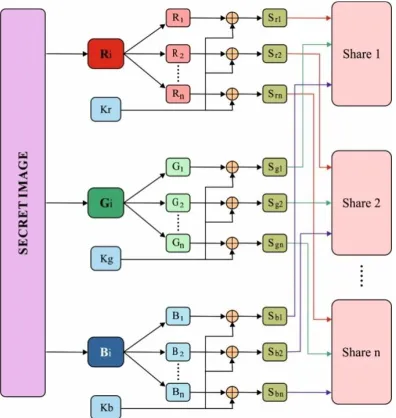
Every actual pixel of the secret image will appear in 𝑛 modified versions known as shares. Every individual share holds a group of sub-pixels of the RGB image. By improved radius of internet transmission, VC are used for contributing the confidential image through extreme privacy above unprotected public channels. The entire presented system is explained in Fig. 1. The presented (e, n) VC system that the secret image appreciable with or extra contributors by assembling with their simplicities with respect to overhead projector. It is changed to 2 various gray scale images dependent on its color component(R , G , B ). Initially, different arbitrary matrix (dependent on R , G , B values) is created and this matrix is employed to generate the number of shares (𝑠ℎ𝑎𝑟𝑒1, 𝑠ℎ𝑎𝑟𝑒2 ⋯ 𝑠ℎ𝑎𝑟𝑒 𝑛). The secret image size and matrix is same. In SC method, particular new state for arbitrary matrix and then XOR function is achieved [14]. At last, encryption quality testing and visual analysis is used for estimating the action of presented method.
Fig. 1. Process involved in SC model
SC Scheme
Step 1: Secret image signifiesP . Here, P denotes the image
metrics of secret image, where h =height, w =width.
Step 2: Removes the pixel value of every color elements from secret image.
P ∑ 𝑅 + 𝐺 + 𝐵 (2)
Step 3: Here, a 2 ≤ e ≤ n, where n and e indicates actual and reformed share count.
Step 4: Create n-1 different arbitrary matrix of size h w for separate color elements. Assume dealer desires four shares and create three distinct arbitrary matrices namely
A , A , A , A , A , A , A , A , A for the color elements of
R , G , B .
3250
R < *A , A , A +, G < {A , A , A }, B
< *A , A , A + (3)
For instance, if R( , )= 150 for red element, it creates three
arbitrary numbers like 40, 100 and 10.
Step 6: Coordinate the matrices from previous step in an increasing order.
R < A < A < A
G < A < A < A (4) B < A < A < A
For instance, 0 < 10 < 40 < 100
Step 7: Generate 4 fundamental matrixes for separate color
elements as
D , D , D , D , D , D , D , D , D , D , D , D under subsequent forms:
D A
D A − A D A − A D R − A
D A
D A − A
D A − A
D G −A
D A
D A − A D A − A
D B −A
For instance, D = 10, D = 40‐ 10 = 30, D = 100‐ 40 = 60 and D = 150‐ 100 = 50.
Step 8: Currently create E, E , E key matrices for separate color elements.
Step 9: XOR function is achieved among basic and key matrices.
Step 10: At last, every RGB color element is joined to make shares.
Share_1 (Share_1_ , Share1 G, Share1 B) Share_2 (Share_2_ , Share2 G, Share2 B) Share_3 (Share_3_ , Share3 G, Share3 B) Share_4 (Share_4_ , Share4 G, Share4 B)
Shares Reconstruction Model
Step 1: Removes the pixel value of each share together using color elements.
Step 2: XOR function is executed among key and share matrices for separating color elements to recover basic matrix.
Step 3: Share matrix is recreated under the subsequent form. Condition 1: If 𝑛 = 4 and k = 3 shares is recreated.
P = D D D (or) D D D (or) D D D (or)
D D D (5)
Condition 2: If 𝑛 = 4 then k = 2 shares are recreated.
P = D D (or) D D (or) D D (or) D D (or)
D + D (or) D + D (6)
These forms are replicated for other 2-pixel values of the and color elements.
Step 4: Every elementary matrix joined along with to recover the secret image color elements separately,
D = D D D D
D = D D D D (7) D = D D D D
At last recover the secret image(P ),
P ∑ 𝐷 + 𝐷 + 𝐷 (8)
2.3. Block Creation
The share is prepared for the parts of the image at several locales. The secret contribution plans encryption of a secret image to 𝑛 unimportant images. It could not release some information on the early image except every share is obtained. Proposes will be attained from the single secret image. By the time of encryption, initially it is needed to determine value of 𝑛
to be created. The client will provide some values of 𝑛. Earlier to distinguishing the shares, the necessary network is primarily developed dependent upon the share count. The random keys are created focus about the block size of the secret image.
Usually, the block sizes are
4 * 4 or 8 *8.
2.4. Lightweight cryptography (LWC)
The essential method present in the LWC techniques are shown in Fig. 2. In this study, rectangle techniques are used to attain securities that are described under [15].
Fig. 2. Process involved in LWC
Share
1
−R = D
r1⊕ E
rShare
2
−R = D
r2⊕ E
rShare
3
−R = D
r3⊕ E
rShare
4
−R = D
r4⊕ E
rShare
1
−G = D
g1⊕ E
gShare
2
−G = D
g2⊕ E
gShare
3
−G = D
g3⊕ E
gShare
4
−G = D
g4⊕ E
gShare
1
−B = D
b1⊕ E
bShare
2
−B = D
b2⊕ E
bShare
3
−B = D
b3⊕ E
bShare
4
−B = D
b4⊕ E
bDr1= Share 1−R ⊕ Er
Dr2= Share 2−R ⊕ Er
Dr3= Share 3−R ⊕ Er
Dr4= Share 4−R ⊕ Er
Dg1= Share 1−G ⊕ Eg
Dg2= Share 2−G ⊕ Eg
Dg3= Share 3−G ⊕ Eg
Dg4= Share 4−G ⊕ Eg
Db1= Share 1−B ⊕ Eb
Db2= Share 2−B ⊕ Eb
Db3= Share 3−B ⊕ Eb
3251
Cipher State and the Sub key State
A 64-bit plain text, or a 64-bit middle product, or 64-bit cipher texts are together known as a cipher state. It is signified as a 4 × 16 rectangular range of bits signifying the basis of the cipher name RECTANGLE. Let 𝑋 = 𝑥 || · · · ||𝑥||𝑥 refer to a
cipher state, the early 16 bits 𝑥 || · · · ||𝑥 ||𝑥is arranged in row 0, the following 16 bits 𝑥 || · · · ||𝑥 ||𝑥 is supported in
row 1, etc., as offered in Eq. (9) and (10).
The 64-bit sub keys are uniformly treated as a 4 16
rectangular array.
The Round Transformation
RECTANGLES are a 25 round SP network cipher. Each individual round includes 25 rounds that utilizes 3 levels such as Add Round key, Sub Column, and Shift Row. By finishing the last round, Add Round Keys are also found.
Add Round key: Includes a bitwise XOR of the around sub key to the midway condition.
Sub Column: Similar function of S-boxes to 4 bits in the identical column. The methods of Sub Columns are given in Eq. (11). The input of an S-box are
𝑜𝑙(𝑒) = 𝑙 , 𝑒 ||𝑙 , 𝑒 ||𝑙 , 𝑒 ||𝑙 , 𝑒for 0 ≤ j ≤ 15, and the results are ( 𝑜𝑙(𝑒)) = 𝑚 , 𝑒 ||𝑚 , 𝑒||𝑚, 𝑒 ||𝑚 , 𝑒
The S-box using the RECTANGLE is a 4-bit to 4-bit S-box
∶ 𝐹42 → 𝐹42.
Shift Row: In each row, a left turn takes place on
individual offsets. Row 0, 1, 2 and 3 is left turned above 0, 1, 12 and 13 bits correspondingly.
3. Experimental Validation
The performance of the presented SC-LWC model is tested against three kinds of biometric image dataset namely fingerprint, iris and face.
Table 1 Visualization analysis of fingerprint images
Table 1 shows the visualization of the results attained on the input fingerprint images with various shares and aggregated
share image.
Table 2 Visualization analysis of iris images
Table 2 shows the visualization of the results attained on the input iris images with various shares and aggregated share image.
𝑥
15
⋯ 𝑥2
𝑥
1
𝑥
0
𝑥
31
⋯ 𝑥18
𝑥
17
𝑥
16
𝑥
47
𝑥
63
⋯
⋯
𝑥
34
𝑥
50
𝑥
33
𝑥
49
𝑥
32
𝑥
48
(9)
𝑙
0,15
⋯ 𝑙
0,2
𝑙
0,1
𝑙
0,0
𝑙
1,15
⋯ 𝑙
1,2
𝑙
1,1
𝑙
1,0
𝑙
2,15
𝑙
3,15
⋯
⋯
𝑙
2,2
𝑙
3,2
𝑙
2,1
𝑙
3,1
𝑙
2,0
𝑙
3,0
(10)
𝑙
0,15𝑙
1,15𝑙
2,15𝑙
3,15⋯
𝑙
0,2𝑙
1,2𝑙
2,2𝑙
3,2𝑙
0,1𝑙
1,1𝑙
2,1𝑙
3,1𝑙
0,0𝑙
1,0𝑙
2,0𝑙
3,0↓ ⋯ ↓ ↓ ↓
𝑚
0,0𝑚
1,0𝑚
2,0𝑚
3,0⋯
𝑚
0,0𝑚
1,0𝑚
2,0𝑚
3,0𝑚
0,0𝑚
1,0𝑚
2,0𝑚
3,0𝑚
0,0𝑚
1,0𝑚
2,0𝑚
3,0(11)
Input Image Share 1 Share 2 Share 3
Share 4 Stacked any 2 Share
Stacked any 3 Share
Final Decrypted Image
Input Image Share 1 Share 2 Share 3
Share 4 Stacked any 2 Share
Stacked any 3 Share
3252 Table 3 Visualization analysis of face images
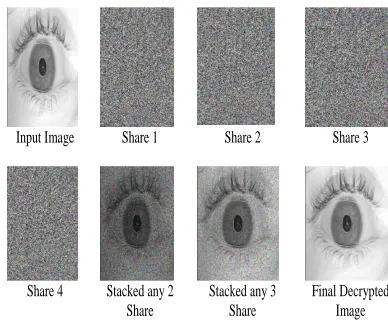
table 3 shows the visualization of the results attained on the input face images with various shares and aggregated share image. For assessing the quality of the stacked images from the secret images applied, a comprehensive examination is done by means of PSNR and MSE. Table 4 shows the outcome of the presented SC-LWC model on the applied diverse set of biometric images in terms of MSE and PSNR.
Table 4 Image quality analysis in terms of MSE and PSNR
Category Image Name MSE PSNR
Fingerprint Images
Image 1 2.183 44.74
Image 2 2.495 44.16
Iris Images Image 3 1.394 46.69
Face Images
Image 4 1.459 46.49
Image 5 2.494 44.16
Fig. 3. Image quality analysis in terms of MSE
Following to that, on the applied image 4, the presented SC-LWC model attains a minimum MSE of 1.459 and maximum PSNR of 46.49. Besides, on the applied image 5, the presented SC-LWC model attains a minimum MSE of 2.494 and maximum PSNR of 44.16
.
Fig. 4. Image quality analysis in terms of PSNR
To further highlight the efficacy of the presented model, an analysis is made in terms of Number of Pixels Changing Rate (NPCR), Unified Average Changing Intensity (UACI). Table 5 provides the values obtained in terms of NPCR and UACI.
Table 5 Results analysis in terms of NPCR AND UACI
Category Image Name NPCR (%) UACI (%)
Fingerprint Images
Image 1 98.56 31.39
Image 2 99.34 32.49
Iris Images Image 3 98.88 31.47
Face Images
Image 4 98.23 31.23
Image 5 99.57 32.67
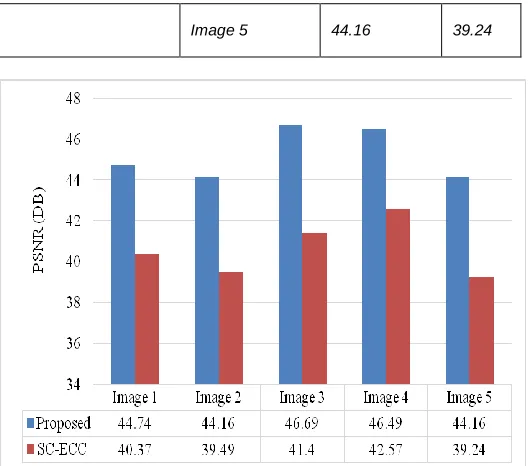
Finally, a comparative analysis between the presented SC-LWC models with the existing SC-ECC model [19] takes place in Table 6 and Fig. 5.
Table 6 Performance Comparison of various Methods with proposed in terms of Accuracy
Category Image Name Proposed SC-ECC
Fingerprint Images
Image 1 44.74 40.37
Image 2 44.16 39.49
Iris Images Image 3 46.69 41.40
Face Images Image 4 46.49 42.57
Input Image Share 1 Share 2 Share 3
Share 4 Stacked any 2
Share
Stacked any 3 Share
3253
Image 5 44.16 39.24
Fig. 5. Comparative results analysis in terms of accuracy
By looking into the tables and figures, it is demonstrated that the projected SC-LWC technique offers maximum performance over the compared techniques.
4. Conclusion
This paper has devised a novel SC-LWC model to transmit the images in a secure manner. The SC-LWC is presented to attain effective secret image sharing with maximum confidentiality. Under the procedure of SC, a particular criterion for random matrices and XOR operations are carried out for generating ‗n‘ transparency. Many shares are employed for transferring the secret image utilizing the encryption and decryption procedure using LWC. The presented VS technique is utilized for sending a secret image to the receivers. The performance of the presented SC-LWC model is tested against three kinds of biometric image dataset namely fingerprint, iris and face. The results are assessed under diverse aspects and the superiority of the applied model is verified over the compared methods. By looking into the comprehensive experimental outcome, it is demonstrated that the projected SC-LWC model offers maximum performance over the compared methods. As a part of future scope, it can be extended to videos.
Acknowledgment
This research work has been supported by RUSA PHASE 2.0, Alagappa University, Karaikudi.
References
[1]
Jain, A., Flynn, P., Ross, A.: Handbook of
Biometrics. Springer, New York (2007)
[2]
A Nag, S Biswas, D Sarkar, PP Sarkar,
―Secret Image Sharing Scheme Based on
Boolean
Operation.
Cybernetics
and
Information Technologies‖, 2014;14:98-113.
[3]
Ram Krishna Jha and Abhijit Mustafi, ―Boolean
XOR
Based
(k,
n)
Threshold
Visual
Cryptography
for
Grayscale
Images‖,
International Journal of Computer Science and
Informatics ISSN: 2231
–5292, Volume-2,
Issue-3, 2012.
[4]
Savita Patil1, Jyoti Rao, ―Extended Visual
Cryptography for Color Shares using Random
Number Generators‖, International Journal of
Advanced
Research
in
Computer
and
Communication Engineering 2012:1.
[5]
Xiaotian Wu
and Wei Sun, ―Improved tagged
visual cryptography by random grids‖, Signal
Processing, Vol.97, pp.64-82, 2014.
[6]
Vinita Sharma et al, ―kǦn Secrete Sharing
Scheme of Visual Cryptography Using2X2
Blocks Replacement‖, International Journal of
Science,
Engineering
and
Technology,
10.2348 /ijset06150553
[7]
Carlo Blundoa, Alfredo De Santis, and
MoniNaor, ―Visual cryptography for grey level
images‖, Journal of Information Processing
Letters Vol.75, pp.255–259, 2000.
[8]
S. Tsai, T.H. Chen, G. Horng, ―A cheating
prevention
scheme
for
binary
visual
cryptography
with
homogeneous
secret
images‖, Pattern Recognition 2007; 40:2356–
2366
[9]
H.-K. Tso, T.-M. Lo and W.-K. Chen, Friendly
medical image sharing scheme, J. Inf. Hiding
Multimed. Signal Process. 5(3) (2014) 367–
378.
[10]
K. Sindhuja and S. Pramela Devi, A
symmetric key encryption technique using
genetic algorithm, J. Comput. Sci. Inf.
Technol. 5(1) (2014) 414–416.
[11]
L. N. Pandey and N. Shukla, Visual
cryptography schemes using compressed
random shares, J. Adv. Res. Comput. Sci.
Manage. Stud. 1(4) (2013) 62–66.
[12]
A. Soni and S. Agrawal, Using genetic
algorithm for symmetric key generation in
image encryption, J. Adv. Res. Comput. Eng.
Technol. 1(10) (2012) 137–140.
[13]
Elavarasi.G and Vanitha.M, ―
A Novel
Method for Securing Medical Images using
Visual Secret Sharing Scheme‖, International
Journal of Engineering and Technology, ISSN:
2319-8613, Volume 9 No 5, 2017.
[14]
Shankar, K. and Eswaran, P., 2016,
January. A new k out of n secret image
sharing scheme in visual cryptography.
In 2016 10th International Conference on
Intelligent Systems and Control (ISCO) (pp.
1-6). IEEE.
[15]
Yalla, P. and Kaps, J.P., 2009,
3254