1796
Classification Of Malware Detection Using
Machine Learning Algorithms: A Survey
P HarshaLatha, R Mohanasundaram
Abstract: Malware is the one which frequently growing day by day and becomes major threats to the Internet Security. The are several methods for classifying of new malware from the existing signatures or code. The traditional approaches are not much effective to compete the new arriving malware samples. More antivirus softwares provides defense mechanism against malwares but still zero-day attack is not achieved. To enhance in mechanisms machine learning algorithms are used and provide good experimental results accordingly. While the traditional signature approaches are also failed to compete the new malwares. In this paper, we define malware and types of malware as an overview, as well we define the new mechanism of using machine learning algorithms how effective and efficient in classification of malware detection and we presented the existing works related to malware detection classification using machine learning algorithms and it is discussed about main important challenges that are facing in malware detection classification.
Index Terms: Malware, Malware Analysis, Static Analysis, Dynamic Analysis, Classification, Machine learning, Data mining Techniques, Malicious Code. —————————— ——————————
1
INTRODUCTION
Malware word defines from Malicious Software. Malware is a malicious code that affects the user system or computer and intently harms the computer by an attacker. Malware is variant forms which are a virus, Trojan, backdoor, rootkits, ransomware, worm, botnet, spyware, adware, keyloggers, etc., and there is a wide range of their families are existing and massively growing on the internet daily. According to the survey [1] conducted by AV-Test Institute, it registers that everyday 350,000 new malicious code and potentially unwanted applications. Each malicious one is classified with respect to their behavior and saved accordingly by this institute and gives the malware statistics in 2018 is 847.34m malicious code is found and recorded and registered. Some of the malware attacks in history are Melissa was a macro embedded with a word file. When the user opens it the macro will execute and resend the virus to the first 50 people in the user's address book. It was designed by David L. Smith in 1999. Likewise, several malware attacks in history namely, My Doom worm in 2004, Stuxnet in 2010, wannacry in 2017. In this paper, we presented the literature work of previously existing works of malware detection classification using machine learning algorithms. Section 2 covers about malware analysis and types of malware analysis. Section 3 is all about literature of malware detection classification using machine learning algorithms. Section 4 is discussion section and followed by Section 5 for conclusion.
2
MALWARE
ANALYSIS
The analyzing behavior, functionality, and impact of malware samples on a user system defined as malware analysis. The analyzing of malware samples variants in different ways which are signature-based, behavior-based and memory-based malware analysis.
2.1 Types of Malware Analysis
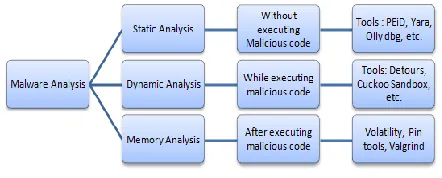
There are basically three types of Malware Analysis in general which are Static Malware Analysis, Dynamic Malware Analysis, and Memory Malware Analysis briefly in Fig. 1.
2.3 Static Malware Analysis
The process of detecting or examining the malicious code without executing it is defined as static malware analysis. It is a signature-based malware analysis. In static malware analysis, static features such as Metadata strings, code, and import libraries are extracted and used in the feature selection or feature extraction phase in the machine learning classification. Most probably the input file type of static malware analysis is should be of the type exe, DLL, documents, Assembly code, byte code, etc., from these file types static features are extracted as output. The tools used for static malware analysis are PEiD, ssdeep, pafish, Yara, strings, IDA Pro [2], OllyDbg [3], LordPE [4], OllyDump[5], etc.,
2.4 Dynamic Malware Analysis
The process of detecting the behavior and functionality of malicious code while executing it is defined as a Malware Analysis. Dynamic features are system calls, file activities, process activities, and network activities. The dynamic malware analysis tools are used to extract the dynamic features of malicious code, tools are CWSandbox [6], Anubis[7], comodo automated analysis, ThreatTrack etc. The monitoring tools for dynamic malware analysis are Process Explorer [12], Process Monitor [13], Capture-BAT [14] (for registry monitoring and file system monitoring), RegShot[15] (for detecting System change), Wireshark [16] (for network monitoring), Process Hacker replace [17] etc.
2.5 Memory Malware Analysis
The process of examining the malicious code after executing it is defined as memory malware analysis. The features for memory analysis are shared libraries, running processes, hooking detection, network connections, rootkit connection, hidden artifacts, code injection, etc. The tools for memory analysis are volatility, pin tools, Valgrind, etc.
————————————————
• P HarshaLatha, Research Scholar, School of Computer Science and Engineering, Vellore Institute of Technology, Vellore, Tamilnadu, India. E-mail: [email protected]
1797 Fig. 1. Types of Malware Analysis
3
MALWARE
DETECTION
CLASSIFICATION
USING
MACHINE
LEARNING
ALGORITHMS
Various Machine learning techniques are used for malware classification such as Support Vector Machine, Decision Tree, Naive Bayes, Random Forest, etc., and machine learning clustering techniques are used for clustering malware samples. The existing literature is discussed below about machine learning approaches for malware analysis. Gupta et al. 2018 [18] proposed architecture for malware detection. In this architecture, first prepares the dataset which contains 0.2 million of files in which has 0.05 million clean files and 0.15 million malware samples these are collected from different resources like VXheaven, Nothink, VirusShare, etc. After the collection of malware samples, automated malware analysis is performed on the collected dataset by using cuckoo sandbox which contains a series of python scripts to determine the behavior of malware during their execution. The results are in the format of JavaScript Object Notation (JSON). The static and dynamic features are extracted from the json reports using python in Apache Spark. After the feature extraction, the classification models are applied to it with 10-fold cross-validation. The classification models are applied to the dataset and evaluate the performance using the parameters True Positive Rate (TPR), False Positive Rate (FPR), Precision, False Negative Rate (FNR) and Accuracy. The experimental results show Naïve Bayes(NB), Support Vector Machine (SVM), and Random Forest (RF) gives 89.13 %, SVM gives 94.03% and Random Forest gives 98.88% of accuracy. Random Forest gives the best accuracy with minimum FPR and FNR. Cho et al. 2016 [19] propose a framework that performs preprocessing the data and classification (Malware Similarity). In the preprocessing step, the malware samples are reduced the amount in which it is categorized into malware families which is relevant to one another. In the classification process, behavior monitor, sequence refining, sequence alignment, and similarity calculation are to be addressed. 150 malware samples are used in 10 different malware variant families and the classification is repeated by 5 times and the experimental result gives 87% of high accuracy. Burnap et al. 2018 [20] present the novel approach in classification which uses self-organizing maps are used to distinguish between the malicious and benign files and it reduces the overfitting process when samples are training. Dataset is collected from VirusTotal API. In this architecture, multiple classifiers are used for classification and tested in different circumstances. Classifier models used in this approach are Random Forest, BayesNet, MLP, and Support Vector Machine. First, all the malware samples are tested under 10 fold cross-validation and the classifier results will give the best result by Random Forest with 98% accuracy and the same Random Forest
1798
(unwanted signatures). Both remote analysis and local analysis of malware detection techniques are used in their framework. A file is checked whether it is malicious or benign with help of signatures. In the remote analysis, various antivirus software’s is used to analyzing malicious executables and API. In the local analysis, Anti-virtual machine, anti-debugger, URL analysis, string analysis, and packing analysis are used. Ronen et al. 2018 [26] provide a standard benchmark dataset that was announced by Microsoft Malware Classification Challenge which is cited by several malware researchers, and it is serving in the Kaggle competition. The dataset consists of 9 different malware families with 0.5 terabytes of huge data having more than 20,000 malware samples in byte code cited by nearly 50 research papers. Ye et al. 2017 [27] presented a survey on malware detection using data mining techniques which is focused on intelligent malware detection approaches. They illustrate two stages which are feature extraction and classification/clustering as important stages in malware analysis and detection. They presented the research works from 2011 to 2016 and issues and challenges in the malware detection using data mining approaches. Wang et al. 2017 [28] introduce the implementation and design of sandbox, feature extractor, and the classifier. There are mainly three stages in their work which are collector, extractor, and classifier. Collector contains static analysis program and dynamic execution with the module PinFWSandbox which records the dynamic information and log file information and it passed to the extractor stage. Extractor performs both static feature extraction, dynamic instruction feature extraction and system called feature extraction. Finally, the classifier performs the action of combining all the classifier models such as single model classifier result, system call classifier result, dynamic immediate classifier result and dynamic opcode classifier result to give the better result of the f1 score which gives nearly close to 96%. Pai et al. 2017 [29] present malware classification using clustering algorithms. Static features are extracted from the opcode sequences and with their scores. These static features are used for malware classification using the clustering algorithms K-means, Expectation-Maximization, and Hidden Markov Models. Among the clustering algorithms, Expectation-Maximization gives better results of accuracy. This is the different approach for malware classification which includes machine learning clustering algorithms. Gupta et al. 2016 [30] present a framework using windows API call sequences. Five malware classes are classified which are Worm, Trojan-Downloader, Trojan-Spy, Trojan-Dropper and Backdoor among 2000 malware samples using API call sequence and fuzzy hashing based classification. Liu et al. [31] provide an approach to evaluate and classify unknown malware instances to cluster with respect to their families. To classify the malware instances shared nearest neighbor clustering algorithm. The experimental result gives 98.9% accuracy for known malware instances and 86.7% of unknown malware is correctly classified of new malware instances. Makandar et al. 2017 [32] give an overview of malware analysis and detection techniques with different types of malware families. Different methods or techniques are used to detect and analyze malware, one method is to visualize malware in the form of an image, grayscale image, etc. Different existing works related to visualization of malware families are given an overview of their work. Nari et al. 2013 [33] propose the automated malware classification based on
1799
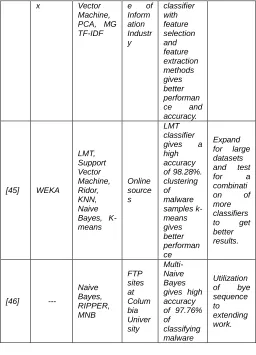
of malware using behavior logs. Using the sandbox environment, Qemu for emulation and Wine for simulation for extracting features from behavior logs of malware samples. The four classifiers Naive Bayes, Random Forest, J48 and SMO applied to the extracted features to get better performance. Random forest classifier gives high accuracy of 96.2%.Lin et al. 2015 [44] proposed an approach for malware classification using effective features of data using feature selection and feature extraction methods. Feature selection is performed on the dataset using the MG TF –IDF method precisely selected features of subsets of the dataset. These précised features are examined under the feature extraction method PCA which gives accurate results by reducing the dimensions of the dataset. Support Vector Machine classifier is applied to the extracted features to get high accuracy and better performance. Dhammi et al. 2015 [45] propose an approach to classify malware samples and clustering them. The data is collected from the cuckoo sandbox environment and the data pre-processing is performed using different classifiers in the WEKA tool. Among the five classifiers of machine learning, LMT classifier gives a better accuracy performance of 98.3%. The classified malware samples are clustered using k-means clustering algorithm and give better results. Schultz et al. 2001 [46] were first introduced the method of detecting unknown malicious samples using data mining approaches. Static features are extracted from the PE Executables using LibBFD. The three data mining classifiers Naive Bayes, RIPPER, and Multi-Classifier System are applied to the extracted features. The Multi-Naive Bayes Strings gives a high average accuracy of 97.76%.The following Table 1 gives the existing literature in detailed as to what tools are used for their work, what machine learning algorithm used, what are internet sources for dataset collection, what are the parameter they considered to meet their goals and what are the future works they suggested are listed in the Table 1.
TABLE1
SURVEYED PAPERS EXISTING LITERATURE WORK
Pape r Tools Used Algorithms used Datas et Sourc es
Results Future Work [18] Apache Spark, MLlib, Cuckoo Sandbo x, Oracle VM VirtualB ox Naive Bayes, Random Forest, Support Vector Machine VX Heave n, Nothin k, VirusS hare. Among the three classifiers Naive Bayes, Support Vector Machine, and Random Forest, the Random Forest gives the best accuracy Supervise d Dimensio nality Reduction in a large data set of malware samples. [19] Cuckoo Sandbo x Sequence alignment VX Heave n The average accuracy of all malware families is 87% and overall execution
The pair wise sequence alignment algorithm will improve the performan
time is reduced from 91% to 99% ce proposed system for malware samples classificati on and execution time. [20] Cuckoo Sandbo x Random Forest, BN, MLP, Support Vector Machine, Self Organizing Feature Map Virus total API. Performan ce increased by 7.24% to 25.68% when compared to the previous model
Increasing the sample size and granularit y of data for other models will perform better?
[21] VOS
viewer
Bibliom etric analysis
We b of scienc e North America producing more research articles when compared to all other continents.
Findin g the past 10 years of articles and analyze them with the keywords of “Malware Analysis”, “Malware detection” , “algorithm ”, ”security” etc., which are important in research related to malware.
[24] ---
KNN, Random Forest CTU-13, Stratos phere IPS project Performan ce is increased. 95.5% of high accuracy achieved. Identifying the network behavioral changes in malware samples.
[28] PinFWS andbox
The static immediate feature, system call feature, dynamic immediate feature, dynamic opcode Vxhea ven.or g, malwr. com, virusc an.org The merged model increases the percentag e to 96%
It can apply the sequence feature or function sequence feature to get better results.
[29] --- Clustering algorithms Collect ed from Malicia websit e Expectatio n-Maximizati on techniques give a high accuracy of classificati on using
1800 clustering
algorithms .
apply for extracted dynamic features.
[30] ssdeep
Windows API call sequence and fuzzy hashing. VxVaul t, http:// www.v xvault. net, Vx heave n, http:// www.v xheav en.org Vir usSign , http:// www.vi russig n.com Vir usTota l. https:// www.vi rustota l.com Five malware classes are successful ly classified using windows API call sequence and fuzzy hashing based classificati on. Text pattern matching technique s are used to classify the malware
[31] ---
Shared nearest neighbour (SNN). Kingso ft, ESET NOD3 2, and Anubis .
Gives 98.9% accuracy of known malware and 86.7% of accuracy for unknown malware. ---
[33] WEKA J48, C4.5
Comm unicati on Resea rch Center Canad a (CRC). Compariso n between different antivirus programs gives better accuracy results ----
[34] ----
Decision tree, nearest centroid, perceptron , Stochastic gradient, Multilayer Percep tron, Random Forest Malim g datase t. Random Forest gives better accuracy results. ---
[35] WEKA
MLP, DT, IB1, Random Forest
Univer sity of Califor nia
Random Forest gives high accuracy results of 99.58%
----
[36] WEKA
Random Forest, IB1, DT, Support CA’s (Comp uter Associ Random forest gives better ---- Vector Machine ates) VETZo o accuracy and improves performan ce by 9% accuracy.
[38] Neural network
Feedforwa rd back propagatio n neural network (ANN). Mahen hur Datas et The feedforwar d backpropa gation neural network gives 96.35% of accuracy in experimen tal results. Dimensio nality reduction of the feature vector.
[39] ---
Support Vector Machine, cross-validation, leave-one-out, random sampling N6 platfor m from Resea rch and Acade mic Comp uter Netwo rk (N ASK) Support Vector Machine random sampling gives better accuracy results of 94.98%
Classificat ion of a large dataset [40] Text editors and Binary editors KNN GIST image feature s Using KNN 98% accuracy is obtained. Clustering of malware samples using image-based features.
[41] WEKA Ada Boost, IB1, Random Forest, Support Vector Machine, DT, Naive Bayes CA’s VET zoo Overall classificati on accuracy is 97%. ----
[42] WEKA
Support Vector Machine, NN, J48, Naive Bayes, PCA VX Heave n The combinatio n of feature selection techniques and Support Vector Machine classifier gives 97% of accuracy.
n-gram rule from SNORT signature for better accuracy using machine learning. [43] CWSan dbox, Qemu (emulati on) and Wine (simulati on) Naive Bayes, Random Forest, SMO, J48 VX Heave n Random Forest gives high accuracy of 96.2%
1801
x Vector
Machine, PCA, MG TF-IDF
e of Inform ation Industr y
classifier with feature selection and feature extraction methods gives better performan ce and accuracy.
[45] WEKA
LMT, Support Vector Machine, Ridor, KNN, Naive Bayes, K-means
Online source s
LMT classifier gives a high accuracy of 98.28%. clustering of malware samples k-means gives better performan ce
Expand for large datasets and test for a combinati on of more classifiers to get better results.
[46] ---
Naive Bayes, RIPPER, MNB
FTP sites at Colum bia Univer sity
Multi-Naive Bayes gives high accuracy of 97.76% of classifying malware
Utilization of bye sequence to extending work.
4
DISCUSSION
Previous existing literature works of malware detection prove that successfully classification is done with the help of machine learning techniques but still there are some issues have not resolved. Zero-day attacks are the one which the day having no new malware will rise in future. It is the main aim of all the malware researchers. Basing on the survey [1] by AV-Test still, millions of new malware are rising day-by-day. Some issues and challenges of malware detection are still there and not yet resolved. One issue is to real verification or manual verification of classification results becomes harder when it comes to reality. Another issue is to improve the advancement of techniques for more active learning. The more recent advancements are expecting from the fields of machine learning, ensemble learning, deep learning and more. The most advanced techniques are needed to achieve Zero-day Attacks. Dealing with large datasets is also one of the issues. These advanced techniques are needed in dimensionality reduction.
5
CONCLUSION
This paper presents the survey about existing literature on malware analysis using different machine learning algorithms. Table 1 defines the different literature of existing works with what are the tools used in their work, what are the machine learning algorithms they used in their work, from what sources dataset is collected, what are parameters they consider to reach their goal and the corresponding experimental results and what are the future works are proposed all are listed in the table form. In the discussion, it clearly identifies that machine
learning algorithms are very useful for the classification and clustering of malware samples for small datasets and for large volumes of data.
6
REFERENCES
[1] AV-TEST (2018, November 28). The Independent IT-Security Institute, Malware Statistics [Online]. Available:
https://www.av-test.org/en/statistics/malware/
[2] IDAPro. (2018, November 28). [Online]. Available:
https://www.hex-rays.com/products/ida/support/download_freeware.shtml
[3] OllyDbg. (2018, November 28). [Online]. Available:
http://www.ollydbg.de/
[4] LordPE. (2018, November 28). [Online]. Available:
http://www.woodmann.com/collaborative/tools/index.php/Lor dPE
[5] OllyDump. (2018, November 28). [Online]. Available:
http://www.woodmann.com/collaborative/tools/index.php/Olly Dump
[6] Willems, C., Holz, T. and Freiling, F. (2007) Toward Automated Dynamic Malware Analysis Using Cwsandbox. IEEE Security & Privacy, 5, 32-39. http://dx.doi.org/10.1109/MSP.2007.45
[7] Anubis. (2018, November 28). [Online]. Available:
http://anubis.iseclab.org/
[8] Bayer, U., Kruegel, C. and Kirda, E. (2006) TTAnalyze: A Tool for Analyzing Malware. Proceedings of the 15th European Institute for Computer Antivirus Research Annual Conference.
[9] Norman Sandbox. (2018, November 28). [Online]. Available:
http://sandbox.norman.no
[10] Dinaburg, A., Royal, P., Sharif, M. and Lee, W. (2008) Ether: Malware Analysis via Hardware Virtualization Extensions. Proceedings of the 15th ACM Conference on Computer and Communications Security, CCS’08, Alexandria, 27-31 October 2008, 51-62.
[11] ThreatExpert. (2018, November 28). [Online]. Available:
http://www.threatexpert.com/submit.aspx
[12] Process Explorer. (2014). [Online]. Available:
http://technet.microsoft.com/en-us/sysinternals/bb896653.aspx
[13] Process Monitor. (2014). [Online]. Available:
http://technet.microsoft.com/en-us/sysinternals/bb896645.aspx
[14]Capture BAT. (2018, November 28). [Online]. Available:
https://www.honeynet.org/node/315
[15]Regshot. (2018, November 28). [Online]. Available:
http://sourceforge.net/projects/regshot/
[16]Wireshark. (2018, November 28). [Online]. Available:
http://www.wireshark.org/
[17] Process Hacker replace. (2018, November 28). [Online]. Available: http://processhacker.sourceforge.net/
[18]Gupta, D., & Rani, R. (2018). Big Data Framework for Zero-Day Malware Detection. Cybernetics and Systems, 49(2), 103-121.
[19]Cho, I. K., Kim, T. G., Shim, Y. J., Ryu, M., & Im, E. G. (2016). Malware Analysis and Classification Using Sequence Alignments. Intelligent Automation & Soft Computing, 22(3), 371-377.
399-1802
410.
[21]Ab Razak, M. F., Anuar, N. B., Salleh, R., & Firdaus, A. (2016). The rise of ―malware‖: Bibliometric analysis of malware study. Journal of Network and Computer Applications, 75, 58-76.
[22]Ray, A., & Nath, A. (2016). Introduction to Malware and Malware Analysis: A brief overview. International Journal, 4(10).
[23]Ucci, D., Aniello, L., & Baldoni, R. (2017). Survey on the usage of machine learning techniques for malware analysis. arXiv preprint arXiv:1710.08189.
[24]AlAhmadi, B. A., & Martinovic, I. (2018, May). MalClassifier: Malware family classification using network flow sequence behaviour. In APWG Symposium on Electronic Crime Research (eCrime), 2018 (pp. 1-13). IEEE.
[25]Khan, M. H., & Khan, I. R. (2017). Malware Detection and Analysis. International Journal of Advanced Research in Computer Science, 8(5).
[26]Ronen, R., Radu, M., Feuerstein, C., Yom-Tov, E., & Ahmadi, M. (2018). Microsoft Malware Classification Challenge. arXiv preprint arXiv:1802.10135.
[27]Ye, Y., Li, T., Adjeroh, D., & Iyengar, S. S. (2017). A survey on malware detection using data mining techniques. ACM Computing Surveys (CSUR), 50(3), 41.
[28]Wang, C., Ding, J., Guo, T., & Cui, B. (2017, November). A Malware Detection Method Based on Sandbox, Binary Instrumentation and Multidimensional Feature Extraction. In International Conference on Broadband and Wireless Computing, Communication and Applications (pp. 427-438). Springer, Cham.
[29]Pai, S., Di Troia, F., Visaggio, C. A., Austin, T. H., & Stamp, M. (2017). Clustering for malware classification. Journal of Computer Virology and Hacking Techniques, 13(2), 95-107. [30]Gupta, S., Sharma, H., & Kaur, S. (2016, December).
Malware Characterization Using Windows API Call Sequences. In International Conference on Security, Privacy, and Applied Cryptography Engineering (pp. 271-280). Springer, Cham.
[31]Liu, L., Wang, B. S., Yu, B., & Zhong, Q. X. (2017). Automatic malware classification and new malware detection using machine learning. Frontiers of Information Technology & Electronic Engineering, 18(9), 1336-1347.
[32]Makandar, A., & Patrot, A. (2015). Overview of malware analysis and detection. In IJCA proceedings on national conference on knowledge, innovation in technology and engineering, NCKITE (Vol. 1, pp. 35-40).
[33]Nari, S., & Ghorbani, A. A. (2013, January). Automated malware classification based on network behavior. In 2013 International Conference on Computing, Networking and Communications (ICNC) (pp. 642-647). IEEE.
[34]Kosmidis, K., & Kalloniatis, C. (2017, September). Machine Learning and Images for Malware Detection and Classification. In Proceedings of the 21st Pan-Hellenic Conference on Informatics (p. 5). ACM.
[35]Gandotra, E., Bansal, D., & Sofat, S. (2014, September). Integrated framework for classification of malwares. In Proceedings of the 7th International Conference on Security of Information and Networks (p. 417). ACM. [36]Islam, R., Tian, R., Batten, L. M., & Versteeg, S. (2013).
Classification of malware based on integrated static and dynamic features. Journal of Network and Computer Applications, 36(2), 646-656.
[37]Gandotra, E., Bansal, D., & Sofat, S. (2014). Malware
analysis and classification: A survey. Journal of Information Security, 5(02), 56.
[38]Makandar, A., & Patrot, A. (2015, December). Malware analysis and classification using Artificial Neural Network. In Trends in Automation, Communications and Computing Technology (I-TACT-15), 2015 International Conference on (pp. 1-6). IEEE.
[39]Kruczkowski, M., & Szynkiewicz, E. N. (2014, August). Support vector machine for malware analysis and classification. In Proceedings of the 2014 IEEE/WIC/ACM International Joint Conferences on Web Intelligence (WI) and Intelligent Agent Technologies (IAT)-Volume 02 (pp. 415-420). IEEE Computer Society.
[40]Nataraj, L., Karthikeyan, S., Jacob, G., & Manjunath, B. S. (2011, July). Malware images: visualization and automatic classification. In Proceedings of the 8th international symposium on visualization for cyber security (p. 4). ACM. [41]Tian, R., Batten, L., Islam, R., & Versteeg, S. (2009,
October). An automated classification system based on the strings of trojan and virus families. In Malicious and Unwanted Software (MALWARE), 2009 4th International Conference on (pp. 23-30). IEEE.
[42]Khammas, B. M., Monemi, A., Bassi, J. S., Ismail, I., Nor, S. M., & Marsono, M. N. (2015). Feature selection and machine learning classification for malware detection. Jurnal Teknologi, 77(1).
[43]Devesa, J., Santos, I., Cantero, X., Penya, Y. K., & Bringas, P. G. (2010). Automatic Behaviour-based Analysis and Classification System for Malware Detection. ICEIS (2), 2, 395-399.
[44]Lin, C. T., Wang, N. J., Xiao, H., & Eckert, C. (2015). Feature Selection and Extraction for Malware Classification. J. Inf. Sci. Eng., 31(3), 965-992.
[45]Dhammi, A., & Singh, M. (2015, August). Behavior analysis of malware using machine learning. In Contemporary Computing (IC3), 2015 Eighth International Conference on (pp. 481-486). IEEE.