Thesis by
Christina Luisa Vizcarra
In Partial Fulfillment of the Requirements for the Degree of
Doctor of Philosophy
California Institute of Technology Pasadena, California
2008
Acknowledgements
It has been a privilege to be at Caltech for the last six years. I thank my advisor, Steve Mayo, for providing a great work environment and for allowing me to learn so many new techniques. Even if it was not in the interest of getting research done quickly, the opportunity to participate in both computational and experimental projects certainly furthered my education. I am grateful to the members of my committee, Doug Rees, Frances Arnold, and Jim Heath for advice throughout this process. I am also grateful to the funding sources that provided support for my graduate work: the Rosen fellowship from Caltech and the National Science Foundation’s graduate research fellowship.
I have had the opportunity to work with a great group of collaborators. Ned Wingreen, Chen Zeng, and Naigong Zhang were thoughtful and always responsive. My time working with Mike Chen and Chris Snow in the Arnold lab was a lot of fun. I received a great deal of help from Emil Alexov and Barry Honig at the start of my projects.
I am particularly grateful to past educators who have helped me get to this point: Dave Benson, Estela Gavosto, and Ward Thompson at the University of Kansas, and Cole Ogdon at Shawnee Mission East High School.
Abstract
Computational protein design seeks to identify amino acid sequences that will fold into a specified three-dimensional structure. Extending this technique from identification of sequences that retain a native structure to the design of sequences that will carry out a function has been a significant challenge. Modeling the energetics of catalysis and binding requires considerations that may not be necessary for the design of folded, stable proteins. I have investigated models for protein electrostatics with the goal of improving current methods for the design of functional molecules. The work in this thesis is focused on the Poisson-Boltzmann model, a dielectric continuum model that describes the effect of solvent polarization on the electrostatic potential in a protein. I found that this model is amenable to design calculations, as judged by its ability to be decomposed into terms that are used in sequence selection.
TABLE OF CONTENTS
Acknowledgements Abstract
Table of Contents Figures and Tables Abbreviations iii v vi vii ix Chapters Chapter 1 Chapter 2 Chapter 3 Chapter 4 Chapter 5 Chapter 6 Chapter 7 Appendix Appendix A Appendix B Appendix C Introduction
Electrostatics in computational protein design
One- and two-body decomposable Poisson-Boltzmann methods for protein design calculations
An improved pairwise decomposable finite-difference
Poisson-Boltzmann method for computational protein design Experimental and computational characterization of the Poisson-Boltzmann model in the ORBIT energy function The plasticity of surface residues on engrailed homeodomain Computationally designed libraries of fluorescent proteins evaluated by preservation and diversity of function
Double mutant cycle analysis of an ion pair on the surface of protein G
Evaluation of the Generalized Born model for computational protein design
Designed combinatorial libraries of cytochrome p450
FIGURES AND TABLES
Figure 1-1. Computational protein design Table 3-1. Accuracy of the electrostatic models
Table 3-2. Cross-validation of α, the scaling parameter for two-body sidechain desolvation
Table 3-3. Cross-validation of distance-dependent dielectrics for limited pair two-body sidechain/sidechain screened Coulombic interactions
Figure 3-1. Free energy cycles used to calculate exact versus one-body backbone desolvation energies
Figure 3-2. Free energy cycles used to calculate sidechain desolvation energies and sidechain/backbone screened Coulombic
Figure 3-3. Free energy cycles used to calculate exact versus two-body sidechain/sidechain screened Coulombic energies
Figure 3-4. Accuracy of the one-body method Figure 3-5. Accuracy of the two-body method Figure 3-6. Sensitivity of error in two-body energies
Figure 3-7. Energy predicted using the sum of the FDPB energies and ORBIT van der Waals energy versus the experimentally determined stability of each homeodomain variant
Figure 3-8. Protein design protocol, including one and two-body FDPB calculations
Table 4-1. Accuracy of the electrostatic models Table 4-2. Parameter sensitivity of the G3 model
Table 4-3. Comparison of FDPB, LK, and DDD models Table 4-4. LK parameters derived from FDPB energies Table 4-5. Accuracy of generic method for varied parameters Table 4-6. Total error optimization
Figure 4-1. Illustration of exact, no generic sidechain (G0), and generic sidechain (G3) calculations
Figure 4-2. Accuracy of one-body G0 and G3 FDPB methods Figure 4-3. Accuracy of two-body G0 and G3 FDPB methods
Figure 4-4. Sensitivity of the G3 FDPB method to generic sidechain parameters Figure 4-5. Accuracy of the G3 model versus the LK solvent exclusion model Figure 4-6. Accuracy of the G3 model versus the DDD model
Figure 4-7. The total error associated with varying generic sidechain parameters Table 5-1. Change in hydrogen-bond energy
Figure 5-1. The ENH test case Figure 5-2. The PB model in ORBIT
Figure 5-3. Experimental data for the ENH variants
Figure 5-4. CD data for the ENH variants designed using 1996 rotamer library Figure 5-5. Test of hydrogen-bonding geometries
Figure 5-6. Results of the hydrogen-bond test
Figure 5-7. Desolvation penalty leads to loss of hydrogen-bonding geometries Figure 6-1. Designed ENH variants
Figure 6-2. Electrostatic potential surface and calculated interaction energies for ENH variants
Figure 6-3. CD data for ENH variants
Figure 6-4. Analytical ultracentrifugation of HT_ENH
Figure 6-5. Effect of ionic strength on thermostability of NSC and HT_ENH Table 7-1. Library designs
Table 7-2. Analysis of mutations
Figure 7-1. Structure of GFP-S65T and spectra of variants Figure 7-2. Preservation of function
Figure 7-3. Diversity of function
Figure 7-4. Preservation and diversity of function
Figure 7-5. Mutational analysis of GFP-S65T variants from DBISORBIT library Figure 7-6. The DBIS algorithm
Figure 7-7. Vector map and BsaXI site
Table A-1. Thermodynamic data for GB1 variants Figure A-1. The Lys4–Glu15 salt bridge in GB1 Figure A-2. CD data for GB1 variants
Table B-1. Pairwise decomposability of solvation models Table B-2. Accuracy of analytical methods compared to DelPhi
Figure B-1. One and two-body approximation for sidechain and backbone desolvation
Figure B-2. Two-body decompositions for screened Coulombic energy
Figure B-3. Accuracy of analytical methods for calculating desolvation energy Figure B-4. Accuracy of analytical methods for calculating screened Coulombic
energy
Figure B-5. The importance of Born radii Table C-1. Designed BM3 libraries Table C-2. BM3 library screening
Table C-3. Sequences of the variants with DME activity. Figure C-1. The BM3 structure
Figure C-2. Properties of the designed libraries
ABBREVIATIONS
AA amino acid
AUC analytical ultracentrifugation
BM-3 cytochrome p450 from Bacillus megaterium (accession # P14779)
C consensus
CD circular dichroism
CFA Coulomb field approximation
CPK color scheme based on Corey, Pauling, and Kultun models
DBIS diversity benefit applied to interacting sets DDD distance-dependent dielectric
DEE dead-end elimination
DME dimethyl ether
DNA deoxyribonucleic acid
DTT dithiothreitol
E. coli Escherichia coli
ENH engrailed homeodomain
epPCR error-prone PCR
FASTER fast and accurate sidechain topology and energy refinement
FDPB finite-difference Poisson-Boltzmann
G0 no generic sidechains
G3 three-sphere generic sidechain
GB1 B1 domain of Protein G
GB generalized Born
GBSA generalized Born/surface area
GB-PDA generalized Born with pairwise descreening approximation
GFP green fluorescent protein
GMEC global minimum energy conformation
HPLC high performance liquid chromatography
IPTG isopropyl -D-1-thiogalactopyranoside
LK Lazaridis-Karplus (solvent exclusion model)
MC Monte Carlo
MSA multiple sequence alignment
NSC negatively supercharged ENH variant
Ni-NTA nickel-nitrilotriacetic
ORBIT optimization of rotamers by iterative techniques
PB Poisson-Boltzmann
PDB protein data bank
PCR polymerase chain reaction
PNK polynucleotide kinase
RMSD root mean squared difference
SE site entropy
SCMF self-consistent mean field
TFA trifluoroacetic acid
VDW van der Waals
Chapter 1
The central goal of computational protein design is to identify amino acid
sequences that will fold into a given three-dimensional structure.1,2 This is accomplished
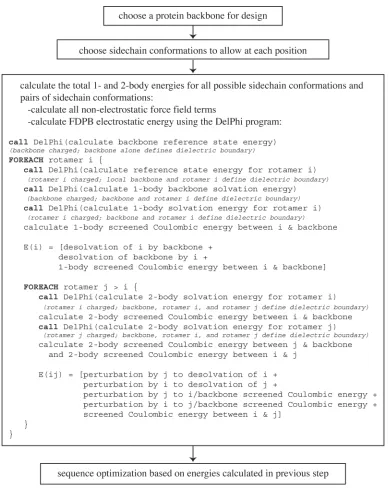
using the scheme shown in Figure 1-1. The design process starts with the selection of a
three-dimensional protein structure. Residues to be designed are selected: this might
include all of the residues in the protein or just a subset as shown in Figure 1-1. The
conformational flexibility of the candidate amino acid sidechains at each position are
modeled using discrete conformations, referred to as rotamers.3 The energy of each
rotamer is calculated using an energy function that is primarily based on molecular
mechanics force fields.4,5 Energies are stored for each rotamer’s interaction with the rest
of the protein and for the interaction between all pair of rotamers. This energy table and
specialized search algorithms are used to search the multidimensional sequence/energy
landscape to find the optimal rotameric sequence.6 A number of variations have been
made on the general computational protein design scheme in Figure 1-1.
Recently, the goal of protein design has expanded from retention of a target fold
to include the design of novel function.7–10 This is accomplished by modeling the
structure in a functionally relevant state and designing an amino acid sequence that will
favor that conformational or chemical state. The design of functional molecules has
presented a formidable challenge for the field of computational protein design.
Specifically, binding and catalysis have been refractory to de novo design. We do not
have clear answers for why these are such difficult targets, but one can look at the many
assumptions in the process outlined in Figure 1-1 to compile a list of what factors might
hinder the design of function:
1. Crude approximation of energies
2. Fixed protein backbone and other limitations on conformational sampling
3. Lack of consideration of multiple states
4. Poor models for the relevant chemical states.
The central goal of my graduate work was to address the first issue. To this end we
investigated models for polar interactions, an energetic contribution expected to be
crucial for catalysis and binding. The residues involved in catalysis are overwhelmingly
polar.11,12 Similarly, the residues found in protein-protein interfaces more closely
resemble the composition of protein surfaces rather than protein cores.13 Therefore, both
of these processes will require accurate modeling of the balance between favorable
electrostatic interactions and the energetic cost of desolvating polar groups. I pursued my
thesis work with the idea that improved modeling of electrostatic interactions will
accelerate the design of functional molecules.
Chapter 2 of this thesis outlines in detail the many methods that have been used
by protein designers to account for electrostatic interactions. All of the models reported
thus far are constrained by the enormous computational demands of the protein design
thesis, more than 10 possible rotameric sequences are possible. A one second
calculation to model the energies of electrostatic interactions in each sequence
conformation would lead to a total calculation time of
1576242655205550000000000000000000000000000000000000000 years. Because of
this challenge, all energies are calculated in a “residue pairwise” scheme in which the
energy only reflects the interaction energy between two rotamers (“two-body”) or
between a rotamer and the rest of the protein that is not being designed (“one-body”).
Search algorithms can then use this table of one-body (Ei) and two-body (Eij) energies to
calculate sequence energies as needed
.
The computational benefit of using a residue pairwise calculation comes at the cost of
accurate modeling of the energies since our most complete theories of protein energetics
have “many-body” terms.
Chapters 3 and 4 describe work on formulating a Poisson-Boltzmann (PB) model
that can be implemented in current protein design protocols. The PB model is a
continuum solvation model in which the dielectric environment and the charge
distribution of the protein determine the electrostatic potential at each atom in the protein.
Since the potential is dependent on the dielectric environment, which is itself dependent
on the position of all atoms in the protein, the PB is a many-body energy model. We
address the issue of whether the one- and two-body energy terms used to guide sequence
selection would be meaningful if derived from the PB model. It was found that the one-
standard many-body PB model, indicating that the PB model is potentially useful for
protein design methods. In Chapter 3, the initial pairwise formulation is introduced, and
in Chapter 4, improvements to this formulation plus comparison with additional models
are presented. I also investigated the Generalized Born (GB) model as an alternative to
the computationally expensive PB model. In Appendix B, I show that the accuracy of the
GB model, judged as the ability to reproduce PB energies, is similar to models that are
currently used in ORBIT. I identify features of the GB model that might lead to its
insensitivity to the microenvironments that are sampled in a protein design calculation.
The promising computational results from Chapters 3 and 4 lead me to implement
the residue pairwise PB model into ORBIT and assess the validity of this model in
experimental tests. In Chapter 5, data is presented for these efforts and for computational
characterization of the PB model’s treatment of hydrogen-bonded sidechains. I used the
design of the surface residues in Drosphilia melanogaster engrailed homeodomain
(ENH) as an experimental test case. Using the PB model from Chapter 4 did not lead to
the design of a stabilized variant of ENH. In attempting to make a comparison between
the PB-designed sequences and those designed with other energy functions, I found
unexpected behavior in this test case. This behavior highlights the fact that design
calculations are highly sensitive to factors that might be unrelated to the energy function.
In this chapter, I also investigate the problem of reconciling the incomplete description of
hydrogen-bonding inherent in continuum solvation, an issue that extends beyond protein
design calculations and must be addressed for enzyme design. In a computational
the rotamers chosen by the PB model do not necessarily conform to the geometric
description of hydrogen bonds used currently in the ORBIT force field.
During the experimental characterization discussed in Chapter 5, I made a series
of ENH variants to dissect the relationship between rotamer library and energy function.
One of these variants, designed using the standard ORBIT force field and sequence
biasing, had a melting temperature around 95°C. Chapter 6 discusses characterization of
this variant and also a “supercharged” variant. These two molecules represent extremes
of surface plasticity for the ENH fold: one has highly optimal surface electrostatic
properties while the other has a high degree of repulsion between its surface residues. I
also investigated the role of surface electrostatics in WT protein G. In Appendix A, data
is presented for an ion pair on the beta-sheet surface protein G. This ion pair was found
to have a favorable free energy of interaction, but removing it caused a negligible change
in the protein’s thermodynamic stability.
An alternative or complementary approach to addressing the shortcomings listed
at the beginning of this chapter is to take a higher throughput strategy in tackling difficult
design targets. Where possible, medium to high throughput screening could be used to
characterize many computationally designed molecules. The challenge is turning the
information from the design calculation into combinatorial libraries of sequences that can
be synthesized in the laboratory. Chapter 7 discusses the evaluation of a number of
different library design strategies by their ability to create libraries that (1) retain function
in the largest number of library members and (2) perturb the function of the WT parent.
Using green fluorescent protein as a test case, we defined the retention of function as
bound on the number of folded sequences in the library. Diversity of function was
defined by shifts in the emission peak position. Our experiments showed that
structure-based design methods perform well by both metrics: retention and diversity of function.
In Appendix C, data is presented for the design of combinatorial libraries focused on the
substrate-binding pocket of cytochrome p450 BM3 from Bacillus megaterium. The
p450 libraries were screened in the laboratory and shown to have a high number of folded
variants.
The sum of the work in this thesis is the development and evaluation of
computational tools that can be used in the design of functional molecules. The current
outlook for designing enzymes and binding proteins is positive. Recently, much progress
has been made in the field of ligand placement in active sites14,15 and impressive strides
have been made in designing enzymes de novo.9,10 There is also progress in the field
protein-protein interaction design.16,17 With improved modeling strategies and hybrid
engineering methods, the technological benefits of protein-based devices and catalysts
References
1. Dahiyat, B. I. & Mayo, S. L. (1996). Protein design automation. Protein Sci. 5, 895–903.
2. Dahiyat, B. I. & Mayo, S. L. (1997). De novo protein design: Fully automated sequence selection. Science278, 82–87.
3. Dunbrack, R. L., Jr. (2002). Rotamer libraries in the 21st century. Curr. Opin. Struct. Biol.12, 431–440.
4. Gordon, D. B., Marshall, S. A. & Mayo, S. L. (1999). Energy functions for protein design. Curr. Opin. Struct. Biol.9, 509–513.
5. Mendes, J., Guerois, R. & Serrano, L. (2002). Energy estimation in protein design. Curr. Opin. Struct. Biol.12, 441–446.
6. Voigt, C. A., Gordon, D. B. & Mayo, S. L. (2000). Trading accuracy for speed: A quantitative comparison of search algorithms in protein sequence design. J. Mol. Biol.299, 789–803.
7. Bolon, D. N. & Mayo, S. L. (2001). Enzyme–like proteins by computational design. Proc. Natl. Acad. Sci. U. S. A.98, 14274–14279.
8. Looger, L. L., Dwyer, M. A., Smith, J. J. & Hellinga, H. W. (2003). Computational design of receptor and sensor proteins with novel functions.
Nature423, 185–190.
9. Jiang, L., Althoff, E. A., Clemente, F. R., Doyle, L., Rothlisberger, D., Zanghellini, A., Gallaher, J. L., Betker, J. L., Tanaka, F., Barbas, C. F., 3rd, Hilvert, D., Houk, K. N., Stoddard, B. L. & Baker, D. (2008). De novo computational design of retro–aldol enzymes. Science319, 1387–1391.
10. Rothlisberger, D., Khersonsky, O., Wollacott, A. M., Jiang, L., Dechancie, J., Betker, J., Gallaher, J. L., Althoff, E. A., Zanghellini, A., Dym, O., Albeck, S., Houk, K. N., Tawfik, D. S. & Baker, D. (2008). Kemp elimination catalysts by computational enzyme design. Nature453, 190–195.
11. Bartlett, G. J., Porter, C. T., Borkakoti, N. & Thornton, J. M. (2002). Analysis of catalytic residues in enzyme active sites. J. Mol. Biol.324, 105–121.
12. Gutteridge, A. & Thornton, J. M. (2005). Understanding nature's catalytic toolkit.
Trends Biochem. Sci.30, 622–629.
14. Lassila, J. K., Privett, H. K., Allen, B. D. & Mayo, S. L. (2006). Combinatorial methods for small–molecule placement in computational enzyme design. Proc. Natl. Acad. Sci. U. S. A.103, 16710–16715.
15. Zanghellini, A., Jiang, L., Wollacott, A. M., Cheng, G., Meiler, J., Althoff, E. A., Rothlisberger, D. & Baker, D. (2006). New algorithms and an in silico benchmark for computational enzyme design. Protein Sci.15, 2785–2794.
16. Huang, P. S., Love, J. J. & Mayo, S. L. (2005). Adaptation of a fast Fourier transform–based docking algorithm for protein design. J. Comput. Chem. 26, 1222–1232.
Chapter 2
Electrostatics in computational protein design
The text of this chapter is adapted from a published review article that was co-authored with Professor Stephen L. Mayo
Abstract
Catalytic activity and protein-protein recognition have proven to be significant challenges for computational protein design. Electrostatic interactions are crucial for these and other
protein functions, and therefore accurate modeling of electrostatics is necessary for successfully advancing protein design into the realm of protein function. This review
Introduction: the electrostatics challenge
Computational protein design seeks to design the amino acid sequence of a protein in a manner that preserves the target three-dimensional fold.1,2 The compatibility
of an amino acid sequence with the target fold is determined by an energy function. Standard components of protein design energy functions are van der Waals, solvation,
electrostatics, hydrogen bonding, and various statistical terms that approximate entropy and other forces that are not modeled explicitly.3,4 The balance between these energetic terms has generally been trained on experimental stability data1,5 or on the ability to
recover wild-type amino acid composition.6,7
Recently, the goals of many computational protein design projects have shifted
from preserving the folded structure to designing function. Electrostatic interactions play important functional roles in many biomolecular systems. In enzymes, surface electrostatic potential can channel substrates to the active site,8 where the electrostatic
environment plays a key role in stabilizing the transition state.9 Because enzymes are such efficient catalysts, the de novo design of enzymatic activity has many technological
applications.10 Protein-protein interfaces contain a proportion of polar and charged residues similar to that on the protein surface,11 and therefore their design requires a careful balancing of polar desolvation energy and electrostatic interactions.12–14 The
control of protein recognition is an important goal for protein designers, as this will allow for the manipulation of biochemical networks15 in ways that may shed light on signal
much debate.17 It has been suggested that electrostatic interactions may play a role in fold specificity instead of stability.18 Since electrostatics may have a relatively small net contribution to the free energy of folding in most mesophilic proteins, one can design
well-folded, stable proteins by focusing on producing well-packed, hydrophobic cores and using only a very crude or damped model for electrostatic interactions.19 Indeed force
fields with an orientation-dependent hydrogen bonding potential and a small or non-existent Coulombic term have yielded stable, well-folded proteins.20–22 However, it stands to reason that a physical model that accurately captures the electrostatic forces that
allow a protein to fold should be adaptable to the challenges imposed by the desire to design protein function.
Marshall et al.23 showed that for the surface of an all alpha-helical protein, current electrostatic models used in computational protein design did not accurately capture the electrostatic effects of helix dipole and N-capping interactions. Restricting the amino
acid identities at N-cap positions to those that have high N-capping propensities and restricting the charge of amino acids at the N-terminal and C-terminal regions of the helix
allowed for the design of a sequence that was stabilized by 3 kcal mol-1 over an unbiased design. Similarly, it has been shown that polar amino acids are found in the cores of natural proteins.24,25 Bolon et al.26 designed a stabilized variant of thioredoxin by
imposing empirical hydrogen-bonding rules that would compensate for the cost of polar desolvation. In order to make protein design force fields more general, it is desirable to
In the simplest estimate, the number of sequences considered for even a small, 50-amino-acid protein is astronomically large (~ 1065 sequences). Most successful computational protein design algorithms approach this combinatorial problem by using
computationally tractable pairwise decomposable energy functions that score the arrangement of at most two sidechain conformations at a time. The limitation to pairwise
decomposable energy functions has led to the development of efficient sequence optimization algorithms27 but has precluded certain energy models that do not lend themselves to pairwise expressions. Because proteins are surrounded by water, which is
highly polarizable, any accurate description of protein electrostatics is a function of the solvent environment, making the electrostatic energy a many-body term. It is therefore
necessary to reconcile the limitations of the pairwise approximation with the need for an accurate description of electrostatics. Furthermore, modeling of water explicitly is currently intractable for the number of conformational energies that must be calculated
for protein design. Therefore continuum or empirical models have been used in most protein design force fields to address electrostatic interactions as well as polar
desolvation. It has been pointed out by Jaramillo and Wodak28 that protein design may be a stringent test of continuum models because design requires that an energy function distinguish between many micro-environments inside the protein.
In the past decade, great effort has gone into updating the electrostatics and polar solvation portions of molecular mechanics force fields. In this review, we focus on the
both of these terms are functions of the dielectric environment, continuum models generally propose one consistent treatment for solvation and electrostatics. We therefore consider the modeling of polar and charged residue desolvation as part of the
electrostatics challenge. Previous reviews of computational protein design have covered general methodology,29–31 energy functions,3,4 protein-protein interactions,32 metal
centers,33–35 and catalysis.10 In addition, continuum models for electrostatics and solvation have been reviewed extensively.36–38
Working models
Poisson-Boltzmann The Poisson-Boltzmann (PB) equation is considered the standard for accuracy within the limitations of the continuum description. In PB calculations the solute is described as a low dielectric cavity embedded in a high dielectric solvent, and the induced polarization in the solvent is used to calculate the electrostatic potential at all
points in the protein. Analytical solutions to the PB equation exist only for simple solute geometries such as spheres or cylinders. Numerical methods must be employed for
complex shapes like that defined by a protein molecular surface.8 Although the PB model is not readily pairwise decomposable by side chain, Marshall et al.39 recently proposed a two-body formulation using the finite difference PB solver DelPhi. In the
two-body approach, a reduced representation of the protein is used and perturbations to the dielectric boundary are considered explicitly for each sidechain conformation.
used by Georgescu et al. for pKa calculations and may be useful in reducing the complexity of protein design calculations.
Modified Tanford-Kirkwood The original Tanford-Kirkwood model 41 treated proteins as spheres, allowing for an analytical solution to the PB equation.42 Because advances in
structural biology have shown the spherical representation to be a dubious approximation for many proteins, Havranek and Harbury43 developed the modified Tanford Kirkwood (MTK) method in which the charge distribution of the protein is mapped from the exact
protein geometry onto a sphere. They also use a shell charge representation and an image charge solution to calculate the electrostatic free energy associated with a protein
conformation. This model, along with a negative design scheme, was used to create a series of coiled coil systems that specifically formed homo- or hetero-dimers.44
Generalized Born The Generalized Born (GB) model maps each charge in the protein to the center of a sphere with a radius that reflects the burial of the charge in the protein.
From this Born radius, the electrostatic potential can be calculated at each charge in the protein.45 GB implementations are distinguished by the method in which Born radii are computed. The GB model has enjoyed wide use in MD simulations, but it has been
shown that the ability of the GB model to reproduce more accurate PB calculations varies widely between implementations.46 It has also been shown that many commonly used
have adapted the GBSA method49 for use in protein design. They overcome the pairwise decomposability problem by calculating Born radii using spheres to approximate sidechains of unknown identity.
Empirical Models Instead of attempting to calculate the screening of electrostatic interactions using Born radii or solvent polarization charges, a distance dependent dielectric model (DDD) has been used to damp all Coulombic interactions regardless of
environment. The simplest DDD models use a dielectric constant of εr, which means that
electrostatic interactions have an r-2 dependence as opposed to r-1. This formulation has
served to minimize the contribution of electrostatics to the force field3 and is computationally efficient. More sophisticated formulations of the DDD model have also been proposed.50,51 Wisz and Hellinga52 improved the DDD model by parameterizing
dielectric constants and solvation parameters for different regions of the protein. The 24 derived parameters were optimized to reproduce hundreds of experimental pKa values.
Their model includes terms for solvation as well as electrostatic interactions and is extremely computationally efficient.
Surface-area-based solvation models have been used in many structure-based
energy calculations, including the ORBIT protein design force field.5,53,54 Although these functions have been successful at modeling non-polar solvation, the basis for using
The Lazardis and Karplus (LK) semi-empirical model measures the desolvation of one atom by another as the product of the volume of the desolvating atom and a solvation free energy density around the desolvated atom. Therefore solute atoms within
the first solvation sphere of a particular atom have a larger desolvating effect than atoms further away. The LK model is computationally efficient and can be applied to both
polar and nonpolar solvation. The physical assumption that makes the LK model so simple is that atomic desolvation terms are additive. The LK model was re-parameterized by Baker and coworkers and used in the design of a novel fold.56 The
implementation of the LK model into protein design force fields only includes a solvation energy term separate from electrostatic interaction energy. A reported method for using
the LK strategy of summing over atomic desolvation terms to approximate effective dielectric constants for electrostatic interactions may also be applicable to protein design energy functions.50
Looking ahead
Implementing more sophisticated electrostatic models into highly parameterized protein design force fields brings to the forefront the issue of balancing electrostatics with other protein design force field terms. It has been shown that implementing a series of
theoretically improved polar solvation models in a balanced protein design force field does not necessarily lead to improved decoy discrimination.28 Kuhlman and Baker6 have
Force field balancing will be futile without considering certain important aspects of protein thermodynamics. Improved models for entropy will be necessary to correctly model salt bridges on the surface of proteins, which may be energetically neutral despite
their favorable electrostatic energy. The use of an empirical hydrogen bonding potential57,58 has been a key component in many successful designs. Continuum models
do not capture the covalent character and resulting orientation dependence of hydrogen bonds. As such, an energy function that not only models electrostatics properly but also recognizes favorable hydrogen bonding geometry will be necessary. Morozov et al.51
reported a balance between hydrogen bonding and a DDD model that discriminated native states from decoys more successfully than either term alone. Currently, energy
terms are modeled within the limitation imposed by fixed protein backbone design. This may have a particular impact on electrostatics: if in reality a protein has significant conformational heterogeneity, then the energy of a static salt bridge may not be
meaningful.
The combinatorial explosion of protein design has made computationally
demanding energy models intractable. If more detailed electrostatic models are to be implemented, there needs to be an effort to develop numerical methods that take advantage of the near redundancy of calculating millions of pairwise rotameric energies.
Update: May 2008
Since this review article was published in late 2005, several advances have been made in the field of enzyme design. Baker and coworkers have reported the design of
enzymes that catalyze the kemp elimination and retro-aldol reactions.59,60 These enzymes were designed using a protocol in which contacts to a transition state analog are
optimized by quantum mechanical calculations. The resulting constellation of catalytic sidechains is then matched with compatible backbone structures, followed by rounds of sequence design around the active site and continuous minimization of the structure. The
most active of the designed retro-aldol enzymes use a bound water molecule in the active site. The authors point to the failure of catalytic motifs that use a polar amino acid in the
same capacity as evidence for the difficulty in balancing desolvation and polar interactions in catalytic networks.
In addition to the progress in enzyme design, several new methods for modeling
polar solvation in protein design energy functions have been reported. McCammon and coworkers developed a method called CIRSE that uses a set of basis functions based on
distance-dependent dielectric and solvent exclusion models with parameters trained to reproduce PB/SA calculations.61 The CIRSE model has been adapted for protein docking and design.62 Simonson and coworkers have reported a residue pairwise GB model that
extends the traditional atom-based Born radii formulation to “residue Born radii” that reflect the burial of each residue.63 We have reported an update to our two-body PB
solvation models have yet to be experimentally validated (see Chapter 5 of this thesis). Together with the advances of Baker and coworkers for identifying scaffolds for novel active sites, more accurate modeling of electrostatics should accelerate the pace of
computational enzyme design.
Acknowledgements
This work was funded by Howard Hughes Medical Institute, the Ralph M. Parsons
Foundation, the Defense Advanced Research Projects Agency, the Institute for Collaborative Biotechnologies (grant DAAD19-03-D-0004 from the U.S. Army Research
References
1. Dahiyat, B. I. & Mayo, S. L. (1996). Protein design automation. Protein Sci. 5, 895–903.
2. Dahiyat, B. I. & Mayo, S. L. (1997). De novo protein design: Fully automated sequence selection. Science 278, 82–87.
3. Gordon, D. B., Marshall, S. A. & Mayo, S. L. (1999). Energy functions for protein design. Curr. Opin. Struct. Biol. 9, 509–513.
4. Mendes, J., Guerois, R. & Serrano, L. (2002). Energy estimation in protein design. Curr. Opin. Struct. Biol. 12, 441–446.
5. Street, A. G. & Mayo, S. L. (1998). Pairwise calculation of protein solvent– accessible surface areas. Fold. Des. 3, 253–258.
6. Kuhlman, B. & Baker, D. (2000). Native protein sequences are close to optimal for their structures. Proc. Natl. Acad. Sci. U. S. A. 97, 10383–10388.
7. Raha, K., Wollacott, A. M., Italia, M. J. & Desjarlais, J. R. (2000). Prediction of amino acid sequence from structure. Protein Sci. 9, 1106–1119.
8. Honig, B. & Nicholls, A. (1995). Classical electrostatics in biology and chemistry. Science 268, 1144–1149.
9. Warshel, A. (1998). Electrostatic origin of the catalytic power of enzymes and the role of preorganized active sites. J. Biol. Chem. 273, 27035–27038.
10. Bolon, D. N., Voigt, C. A. & Mayo, S. L. (2002). De novo design of biocatalysts. Curr. Opin. Chem. Biol. 6, 125–129.
11. Lo Conte, L., Chothia, C. & Janin, J. (1999). The atomic structure of protein-protein recognition sites. J. Mol. Biol. 285, 2177–2198.
12. Sheinerman, F. B., Norel, R. & Honig, B. (2000). Electrostatic aspects of protein-protein interactions. Curr. Opin. Struct. Biol. 10, 153–159.
13. Lee, L. P. & Tidor, B. (2001). Barstar is electrostatically optimized for tight binding to barnase. Nat. Struct. Biol. 8, 73–76.
14. Sheinerman, F. B. & Honig, B. (2002). On the role of electrostatic interactions in the design of protein-protein interfaces. J. Mol. Biol. 318, 161–177.
16. Shoichet, B. K., Baase, W. A., Kuroki, R. & Matthews, B. W. (1995). A Relationship between Protein Stability and Protein Function. Proc. Natl. Acad. Sci. U. S. A. 92, 452–456.
17. Hendsch, Z. S. & Tidor, B. (1994). Do Salt Bridges Stabilize Proteins — a Continuum Electrostatic Analysis. Protein Sci. 3, 211–226.
18. Lumb, K. J. & Kim, P. S. (1995). A Buried Polar Interaction Imparts Structural Uniqueness in a Designed Heterodimeric Coiled–Coil. Biochem. 34, 8642–8648. 19. Lazar, G. A. & Handel, T. M. (1998). Hydrophobic core packing and protein
design. Curr. Opin. Chem. Biol. 2, 675–679.
20. Malakauskas, S. M. & Mayo, S. L. (1998). Design, structure and stability of a hyperthermophilic protein variant. Nat. Struct. Biol. 5, 470–475.
21. Marshall, S. A. & Mayo, S. L. (2001). Achieving stability and conformational specificity in designed proteins via binary patterning. J. Mol. Biol. 305, 619–631. 22. Korkegian, A., Black, M. E., Baker, D. & Stoddard, B. L. (2005). Computational
thermostabilization of an enzyme. Science 308, 857–860.
23. Marshall, S. A., Morgan, C. S. & Mayo, S. L. (2002). Electrostatics significantly affect the stability of designed homeodomain variants. J. Mol. Biol. 316, 189–199. 24. McDonald, I. K. & Thornton, J. M. (1994). Satisfying Hydrogen–Bonding
Potential in Proteins. J. Mol. Biol. 238, 777–793.
25. Bolon, D. N. & Mayo, S. L. (2001). Polar residues in the protein core of Escherichia coli thioredoxin are important for fold specificity. Biochem. 40, 10047–10053.
26. Bolon, D. N., Marcus, J. S., Ross, S. A. & Mayo, S. L. (2003). Prudent modeling of core polar residues in computational protein design. J. Mol. Biol. 329, 611– 622.
27. Desjarlais, J. R. & Clarke, N. D. (1998). Computer search algorithms in protein modification and design. Curr. Opin. Struct. Biol. 8, 471–475.
28. Jaramillo, A. & Wodak, S. J. (2005). Computational protein design is a challenge for implicit solvation models. Biophys. J. 88, 156–171.
29. Pokala, N. & Handel, T. M. (2001). Review: Protein design — where we were, where we are, where we're going. J. Struct. Biol. 134, 269–281.
31. Park, S., Xi, Y. & Saven, J. G. (2004). Advances in computational protein design. Curr. Opin. Struct. Biol. 14, 487–494.
32. Kortemme, T. & Baker, D. (2004). Computational design of protein–protein interactions. Curr. Opin. Chem. Biol. 8, 91–97.
33. Hellinga, H. W. (1996). Metalloprotein design. Curr. Opin. Biotech. 7, 437–441. 34. Hellinga, H. W. (1998). The construction of metal centers in proteins by rational
design. Fold. Des. 3, R1–R8.
35. Benson, D. E., Wisz, M. S. & Hellinga, H. W. (1998). The development of new biotechnologies using metalloprotein design. Curr. Opin. Biotech. 9, 370–376. 36. Warshel, A. & Papazyan, A. (1998). Electrostatic effects in macromolecules:
fundamental concepts and practical modeling. Curr. Opin. Struct. Biol. 8, 211– 217.
37. Orozco, M. & Luque, F. J. (2000). Theoretical Methods for the Description of the Solvent Effect in Biomolecular Systems. Chem. Rev. 100, 4187–4225.
38. Simonson, T. (2001). Macromolecular electrostatics: continuum models and their growing pains. Curr. Opin. Struct. Biol. 11, 243–252.
39. Marshall, S. A., Vizcarra, C. L. & Mayo, S. L. (2005). One- and two-body decomposable Poisson-Boltzmann methods for protein design calculations. Protein Sci. 14, 1293–1304.
40. Georgescu, R. E., Alexov, E. G. & Gunner, M. R. (2002). Combining conformational flexibility and continuum electrostatics for calculating pK(a)s in proteins. Biophys. J. 83, 1731–1748.
41. Tanford, C. & Kirkwood, J. G. (1957). Theory of Protein Titration Curves .1. General Equations for Impenettrable Spheres. J. Am. Chem. Soc. 79, 5333–5339. 42. Kirkwood, J. G. (1934). Theory of Solutions of Molecules Containing Widely
Separated Charges with Special Application to Zwitterions. J. Chem. Phys. 2, 351–361.
43. Havranek, J. J. & Harbury, P. B. (1999). Tanford–Kirkwood electrostatics for protein modeling. Proc. Natl. Acad. Sci. U. S. A. 96, 11145–11150.
44. Havranek, J. J. & Harbury, P. B. (2003). Automated design of specificity in molecular recognition. Nat. Struct. Biol. 10, 45–52.
46. Feig, M., Onufriev, A., Lee, M. S., Im, W., Case, D. A. & Brooks, C. L. (2004). Performance comparison of generalized born and Poisson methods in the calculation of electrostatic solvation energies for protein structures. J. Comput. Chem. 25, 265–284.
47. Zhu, J., Alexov, E. & Honig, B. (2005). Comparative study of generalized Born models: Born radii and peptide folding. J. Phys. Chem. B 109, 3008–3022.
48. Pokala, N. & Handel, T. M. (2004). Energy functions for protein design I: efficient and accurate continuum electrostatics and solvation. Protein Sci. 13, 925–936.
49. Dominy, B. N. & Brooks, C. L. (1999). Development of a generalized born model parametrization for proteins and nucleic acids. J. Phys. Chem. B 103, 3765–3773. 50. Mallik, B., Masunov, A. & Lazaridis, T. (2002). Distance and exposure dependent
effective dielectric function. J. Comput. Chem. 23, 1090–1099.
51. Morozov, A. V., Kortemme, T. & Baker, D. (2003). Evaluation of models of electrostatic interactions in proteins. J. Phys. Chem. B 107, 2075–2090.
52. Wisz, M. S. & Hellinga, H. W. (2003). An empirical model for electrostatic interactions in proteins incorporating multiple geometry-dependent dielectric constants. Proteins 51, 360–377.
53. Eisenberg, D. & Mclachlan, A. D. (1986). Solvation Energy in Protein Folding and Binding. Nature 319, 199–203.
54. Zhang, N. G., Zeng, C. & Wingreen, N. S. (2004). Fast accurate evaluation of protein solvent exposure. Proteins 57, 565–576.
55. Lazaridis, T. & Karplus, M. (1999). Effective energy function for proteins in solution. Proteins 35, 133–152.
56. Kuhlman, B., Dantas, G., Ireton, G. C., Varani, G., Stoddard, B. L. & Baker, D. (2003). Design of a novel globular protein fold with atomic-level accuracy. Science 302, 1364–1368.
57. Dahiyat, B. I., Gordon, D. B. & Mayo, S. L. (1997). Automated design of the surface positions of protein helices. Protein Sci. 6, 1333–1337.
58. Kortemme, T., Morozov, A. V. & Baker, D. (2003). An orientation–dependent hydrogen bonding potential improves prediction of specificity and structure for proteins and protein–protein complexes. J. Mol. Biol. 326, 1239–1259.
D., Houk, K. N., Stoddard, B. L. & Baker, D. (2008). De novo computational design of retro–aldol enzymes. Science 319, 1387–1391.
60. Rothlisberger, D., Khersonsky, O., Wollacott, A. M., Jiang, L., Dechancie, J., Betker, J., Gallaher, J. L., Althoff, E. A., Zanghellini, A., Dym, O., Albeck, S., Houk, K. N., Tawfik, D. S. & Baker, D. (2008). Kemp elimination catalysts by computational enzyme design. Nature 453, 190–195.
61. Cerutti, D. S., Ten Eyck, L. F. & McCammon, J. A. (2005). Rapid estimation of solvation energy for simulations of protein–protein association. J. Chem. Theor. Comp. 1, 143–152.
62. Cerutti, D. S., Jain, T. & McCammon, J. A. (2006). CIRSE: A solvation energy estimator compatible with flexible protein docking and design applications. Protein Sci. 15, 1579–1596.
63. Archontis, G. & Simonson, T. (2005). A residue-pairwise generalized born scheme suitable for protein design calculations. J. Phys. Chem. B 109, 22667– 22673.
Chapter 3
One- and two-body decomposable Poisson-Boltzmann methods
for protein design calculations
The text of this chapter is adapted from a published manuscript that was co-authored
with Shannon A. Marshall and Professor Stephen L. Mayo
Abstract
Successfully modeling electrostatic interactions is one of the key factors required for the computational design of proteins with desired physical, chemical, and biological properties. In this paper, we present formulations of the finite difference Poisson-Boltzmann (FDPB) model that are pairwise decomposable by sidechain. These methods use reduced representations of the protein structure based on the backbone and one or two sidechains in order to approximate the dielectric environment in and around the protein. For the desolvation of polar sidechains, the two-body model has a 0.64 kcal mol-1
Introduction
Electrostatic interactions are often critical determinants of protein structure and function. In an earlier protein design study, an overly simplistic electrostatic model was found to incorporate destabilizing electrostatic interactions into the designed proteins.1 Energies calculated using the finite difference Poisson-Boltzmann (FDPB) model,2–4
a more sophisticated model for describing the electrostatic potential in proteins, correlated more strongly with experimentally determined stability. However, FDPB calculations, as normally performed, are computationally too costly for most protein design calculations.
Computational protein design algorithms5–8
have relied on simple, often empirical methods to model electrostatic interactions between charged and polar protein groups and the desolvation of polar and charged sidechains. For example, the ORBIT (Optimization of Rotamers by Iterative Techniques) protein design force field uses Coulomb’s law with a distance-dependent dielectric and an explicit hydrogen bond term to describe interactions between polar and charged groups and either a penalty for the burial of polar hydrogens or a penalty for the burial of polar surface area.5,9
Havranek and Harbury have developed a modified Tanford-Kirkwood model to describe electrostatic interactions and applied it to the design of homodimeric and heterodimeric coiled coils.10,11
Baker and coworkers have used a volume-based solvent exclusion model to describe the desolvation of polar groups,12
along with a distance-dependent dielectric model, in the successful design of a novel protein fold.13
Hellinga and coworkers have empirically derived a large number of dielectric constants and interaction parameters to describe polar desolvation as well as charge-charge and charge-polar interactions between protein groups.14
Pokala and Handel have developed a method for calculating Born radii in the context of protein design calculations.15
Here, we describe a method for modeling electrostatic interactions in protein design calculations using a limited number of FDPB calculations performed with simplified surface representations. Typically, FDPB calculations require atomic coordinates for the protein backbone and all sidechains in order to define the spatial regions that correspond to the low dielectric protein and high dielectric solvent. In protein design calculations, each possible rotameric sequence (a rotamer is a low energy amino acid sidechain conformation), will have a unique structure and require an independent FDPB calculation. Because the combinatorial complexity of design calculations is often astronomically large, it is not tractable to perform an independent calculation for each possible structure. Instead, we determine the electrostatic energy for each sidechain or pair of sidechains by performing FPDB calculations using simplified structures that include only the backbone and one or two sidechains. The total energy is then obtained by summing the contribution of each sidechain and sidechain pair.
Like the other electrostatic models that have been used for design, the simplified surface approach possesses the computational efficiency required for combinatorially complex protein design calculations. The method is two-body decomposable (meaning that each energy term depends on the identity and conformation of at most two amino acid sidechains) and therefore compatible with deterministic search algorithms such as Dead End Elimination (DEE)16–18
number of free parameters. It explicitly captures the impact of sequence changes on the structure of the protein surface, which defines the boundary between the low dielectric protein and the high dielectric solvent. Finally, it efficiently produces energies that correlate well with standard FDPB methods, providing the accuracy demanded by protein design problems.
Strategies for incorporating FDPB methods into protein design calculations
In this study, we have used the FDPB solver from the computer program DelPhi4 to calculate electrostatic energies for 24 proteins selected from a group of 500 high resolution protein X-ray structures compiled by Richardson and coworkers. The results of these "exact" FDPB calculations were compared to the results of a tractable number of FDPB calculations performed using simplified surface representations that require knowledge of the identity and conformation of no more than two amino acid sidechains at a time in order to assess the accuracy of the simplified surface approximation.
sidechain is defined as the difference between the electrostatic solvation energy of the sidechain in the context of the folded protein versus the electrostatic solvation energy of the sidechain and local backbone alone, where the local backbone is defined by the atoms: CA(i-1), C(i-1), O(i-1), N(i), H(i), CA(i), C(i), O(i), N(i+1), H(i+1), and CA(i+1).
Electrostatic interactions between polar protein groups and the solvent also act to screen Coulombic interactions within a protein. The screening energy is generally opposite in sign and weaker in magnitude than the Coulombic energy for a given interaction. The procedures used to calculate sidechain/backbone and sidechain/sidechain screening energies are shown in Figures 3-2A and 3-3A, respectively. In all cases, the screening energies and Coulombic energies are added to yield "screened Coulombic energies", and the screened Coulombic energies predicted by the different electrostatic models are then compared. As solvation energies are strongly anti-correlated with Coulombic energies, comparison of screened Coulombic energies but not screening energies alone is appropriate for the validation of approximate electrostatic models.19
For compatibility with the ORBIT protein design procedure, we have calculated backbone desolvation energies, sidechain desolvation energies, sidechain/backbone interaction energies, and sidechain/sidechain interaction energies separately. The total electrostatic energy of each rotameric state of a protein is then the sum of the backbone desolvation energy (ΔGbb
desolv), the desolvation energy of each sidechain i (ΔGi
desolv), the
screened Coulombic interaction between each sidechain i and the backbone (ΔGi/bb
screenedCoul), and the screened Coulombic interaction between each pair of sidechains i
and j (ΔGi/j
When calculating the “exact” FDPB energies, each of the above terms is calculated using all of the protein atoms to define the low dielectric protein region versus the high dielectric solvent region.
One-body FDPB decomposition
Several physical properties of proteins can be calculated using information derived from the protein surface. While protein surfaces cannot be perfectly represented using pairwise decomposable methods, earlier protein design studies have demonstrated that pairwise or sequence independent approximations can yield satisfactory results for hydrophobic solvation and binary patterning, respectively.20,21
Similarly, it may be possible to obtain accurate estimates of the FDPB energies obtained using all the atomic coordinates to define the surface from FDPB energies obtained using simplified models for the protein surface that require knowledge of only one or two sidechain conformations at a time.
and the backbone) and the isolated backbone, as shown in Figure 3-1B. The total backbone desolvation energy for each protein is approximated as the sum of the one-body backbone desolvation energies of each of its sidechains. As is shown in Figure 3-2B, one-body sidechain desolvation energies are calculated as the difference in solvation energy between the one-body folded state (which includes only the sidechain of interest and the backbone) and the unfolded state (which includes sidechain i and the local backbone). The one-body sidechain/backbone screened Coulombic energy of each sidechain is calculated using the model in Figure 3-2C.
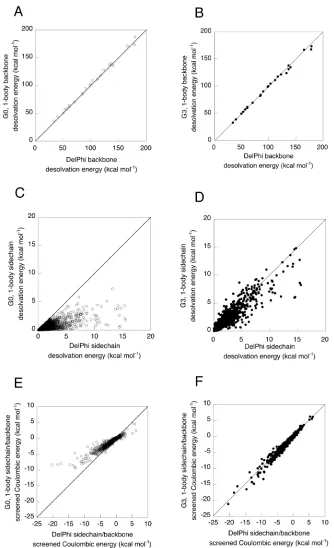
To test the accuracy of the one-body decomposition, we calculated the backbone desolvation energies, sidechain desolvation energies, and sidechain/backbone screened Coulombic energies for the set of 24 proteins. Backbone desolvation energies can be calculated reasonably well by summing the desolvation induced by the presence of each sidechain, as shown in Figure 3-4A. Using the one-body decomposition, the backbone desolvation energy resulting from each sidechain can be considered as a component of the sidechain/backbone energy of the sidechain in design calculations. The extent to which backbone desolvation energy depends on protein sequence and sidechain conformations is not yet fully understood. Avbelj, Baldwin, and coworkers, however, have reported the importance of backbone desolvation in determining amino acid secondary structure propensities. 22–24
excessively solvated folded state. Deviations between the one-body and exact FDPB results are especially pronounced for large magnitude desolvation and screened Coulombic energies, which tend to occur in environments with a low effective dielectric.
Two-body FDPB decomposition
More accurate energies can be obtained using two-body methods (i.e., methods including two sidechain rotamers), in which the total sidechain desolvation or sidechain/backbone screened Coulombic energy for each sidechain i is defined as the sum of its one-body energy and the two-body perturbation energies for each other sidechain j. As shown in Figures 3-2B and 3-2C, the perturbation energy of each other sidechain is defined as the difference between the two-body energy, which is calculated using the backbone and two sidechains to define the dielectric boundary, and the one-body energy calculated previously.
Incorporating the effects of other sidechains using the two-body perturbation method allows accurate calculation of electrostatic energies, as shown in Table 3-1 and Figures 3-5A and 3-5B. Five outlier points, representing five different amino acid types from four structures, were observed to have large errors in their two-body sidechain desolvation energies, as shown in Figure 3-5A. These outliers likely arise from grid placement artifacts, a source of error in FDPB calculations that has been described previously.2
Accurate two-body desolvation energies can be obtained for these five points by slightly altering the position of the molecule relative to the grid (data not shown).
was minimized by linearly scaling the two-body perturbation energy. The set of 24 structures was divided into two sets of 12 structures, and a scaling parameter, α, was derived by a linear least-squares fit for each set (with the five outlier points removed). The robustness of the scaling parameter was tested by cross-validation, as shown in Table 3-2, and sensitivity analysis, as shown in Figure 3-6A. The error in the two-body sidechain desolvation is reasonably insensitive to α around the optimal α value, and both sets have similar dependence on α, suggesting that this scaling parameter should be used
in routine calculations.
In the one-body FDPB method, we calculated sidechain and backbone desolvation energies and sidechain/backbone screening energies, but not sidechain/sidechain screening energies. Simply multiplying the one-body potential generated by sidechain i by the partial atomic charges of sidechain j is not very accurate (data not shown), especially for charged atoms located at or beyond the dielectric boundary defined by sidechain i and the protein backbone. Sidechain/sidechain screened Coulombic energies were calculated using a two-body decomposable method that uses only the backbone and two sidechains of interest to define the dielectric boundary, as shown in Figure 3-3B. Although the two-body model systematically over-screens the Coulombic interactions, the accuracy obtained using a two-body FDPB decomposition is quite good, as shown in Table 3-1 and Figure 3-5C. The two-body approximation is probably less accurate for certain large interaction energies due to increased sensitivity to the shape of the dielectric boundary in regions of large electrostatic potential.
sidechain is negligible. The small fraction of two-body perturbations that contribute significantly to the desolvation or sidechain/backbone energies involve pairs of residues that are close in space. Furthermore, sidechain/sidechain interaction energies for residues that are not close in space are typically small in magnitude and may be approximated using a simpler electrostatic model. We performed additional calculations in which two-body perturbations were calculated only for pairs that separated by less than 6 Å or 4 Å. As shown in Table 3-1, we observe a slight decrease in accuracy as the distance cutoff is decreased from infinity to 6 Å to 4 Å. This arises from an increased underestimation of the sidechain desolvation energies and sidechain/backbone screened Coulombic energies, as well as increased inaccuracy in defining the dielectric environment, as fewer pairs are included.
When calculating screened Coulombic energies, the interaction of sidechain pairs separated by more than a distance cutoff of 6 Å or 4 Å was approximated by a distance-dependent Coulombic model and the two-body FDPB model was applied only to pairs that are close in space. The two sets of protein structures used for the α parameterization were used to derive the optimal distance dependent dielectric values for pairs separated by distances greater than the cutoff. The dielectrics derived for each set are similar, and the errors in the two-body approximation with the cutoffs are comparable to the error in the full two-body calculation including all pairs, as shown in Table 3-3. The sensitivity of the error and correlation with the exact FDPB energies to the dielectric value is shown in Figures 3-6B and 3-6C.
often large. For instance, the reported surface design calculation for engrailed homeodomain considers 15,000,000 rotamer pairs.1
The FDPB calculation for this number of pairs would require approximately three weeks of CPU time on a cluster of 128 IBM PowerPC 970 processors running at 1.6 GHz. The time required to complete the two-body calculation can be reduced to less than one day of CPU time by applying a distance cutoff of 4.0 Å.
It has been shown that, for a series of designed homeodomain variants, there is a correlation between experimental stability and exact FDPB electrostatic energies plus ORBIT van der Waals energies.1
In order to assess the predictive power of the two-body method presented here, we have compared the two-body FDPB energies to these experimental results. For each variant, the sum of all two-body sidechain/backbone and sidechain/sidechain screened Coulombic energies and the sum of all two-body sidechain desolvation energies were added to the ORBIT van der Waals energies. As shown in Figure 3-7, the two-body FDPB energies are able to predict, with accuracy close to that of the exact FDPB calculations, trends in experimental stabilities of six of the seven variants tested, including the wild-type protein and NC3-Ncap, the most stable variant.
Additional considerations
will be a greater source of error than the limitations of the underlying FDPB model. To maximize computational efficiency, most protein design methods use a fixed backbone, discrete sidechain rotamers, and a very simple model of the unfolded state. As a result, certain errors in electrostatic energies can be observed in design calculations. For example, the energetic benefit of surface salt bridges is overestimated if the entropic cost of locking flexible sidechains into a single conformation is not considered. Similarly, the folded state stability conferred by interactions that are populated in the unfolded state, such as i, i±2 sidechain/backbone interactions, is overestimated if the unfolded state is modeled as the sidechain and local backbone only.
Based on a single study of electrostatics in designed proteins,1
either exact or two-body FDPB energies (with large magnitude sidechain-sidechain interactions truncated) are sufficiently accurate to provide a reasonable correlation with experimentally determined stability, as shown in Figure 3-7. Additional experimental studies will be required to assess the performance of the two-body decomposable model in the design of proteins with specific catalytic or binding properties. In cases where accurate modeling of electrostatics is especially critical, more sophisticated structural models, such as the flexible rotamer model25
and explicit modeling of alternate backbone conformations,13
Conclusions
Accurate electrostatic models, including the FDPB model, require knowledge of the full tertiary structure of the protein. As a result, these models cannot be applied directly to protein design calculations, which often consider over 1050
possible protein structures. While it is not possible to explicitly calculate electrostatic energies in each structural environment, it is also not prudent to neglect changes in the shape of a protein’s surface that result from modifying the protein sequence.
We have found that it is possible to obtain accurate electrostatic energies using simplified surface models that depend on the identity and conformation of the protein backbone and only one or two sidechains at a time. The success of the two-body FDPB method suggests that it is critical to define the surface accurately in the immediate vicinity of the partial charges that are "generating" and "feeling" the electrostatic potential in each calculation. The results also suggest that it is important to account for desolvation and screening due to other nearby sidechains, but that the effects of each other sidechain are fairly independent and can be captured pairwise. Finally, we have found that the effects of sequence-dependent variation in the dielectric boundary can be neglected if the perturbations are reasonably far removed from the partial charges that are "generating" or "feeling" the electrostatic potential in a given calculation.
typically sample a large number of backbone conformations or relative molecular orientations. Since each backbone conformation would require an independent set of one- or two-body FDPB calculations, the computational demands of folding and docking calculations would be far greater than those for design.