THE COPYING OF BRONZE COINS OF CLAUPIUS 1 IN ROMAN BRITAIN
submitted for the Degree of Ph.D.
by
Robert Frederick Ernest Kenyon
Institute of Archaeology
University College London
contemporary imitations of Roman coins pose particular problems for both numismatists and archaeoloqists, not least of which is differentiating orthodox coins from copies. In making a study of contemporary imitations of bronze coins of Claudius I (~D41-54) found in Britain, the problem of recognition and identification of 'Claudian copies' was tackled by inspection of a large corpus of comparative material and data. Studying the material first-hand was crucial: the depth of knowledge gained by handling and recording both orthodox and imitative coins could not have been achieved by a purely literary study. The empirical approach of this aspect of the research was followed by a similar 'hands-on', experimental investig-ation into the manufacture of these coins. Analysis of results of experiments in manufacturing technique provides explanations for certain characteristic aspects of the appearance of Claudian copies.
A corpus of Claudian copies found in Britain was created by photographing and recording details of coins held in museum and other collections throughout the southern half of Britain and by an extensive literary search through archaeological and numismatic journals. The data was assembled initially in three formats: a database of
photo-graphic catalogue of coins which is representative of
Claudian bronze coins found in Britain. Findings based on
the scrutiny and manipulation of the data are given in chapters dealing with the distribution of finds, and the supply and circulation of Claud ian copies in Roman
Britain. These findinqs are complemented by the results
of a die-study of the photographic collection and of available comparative material.
TABLE OF CONTENTS
Part i
Frontispiece . . . 1
Ti tlepage . . . 2
Abstract . . . 3
List of contents . . . 5
List of Tables . . . 13
List of Figures . . . 16
List of Map Figures ••••••••••••••••••••••••••••• 23 Acknowledgements . . . • • . . . . • . . . • • . . . • . • . • • . • 25
CHAPTER 1: INTRODUCTION ••••••.••••.•••••••••••• 28 CHAPTER 2: 2.1 2.2 THE COINAGE COPIED . . . 39
2.3 2.4 2.4 1 2.4:2 2.4:3 2.4:4 2.4:5 2.4:6 2.4:1 2.5 Introduction ••••••••••••••••••••• 39 First aes issues from the mint of Rome
...
. . . 40The coins . . . . . . 41
The identification of irregular Claudian aes . . . 51
Appearance ••••••••••••••••••••••• 54 Legends and lettering •••••••••••• 57 Shape of flan •••••••••••••••••••• 59 Metal . . . 59
Weight . . . 62
Size . . . 64
Die-Axis . . . 64
CHAPTER 3: CLASSIFICATION OF IRREGULAR CLAUDIAN
!lES • • • • • • • • • • • • • • • • • • • • • • • • • • • • • • • • • 72
3.1 Introduction . . . • . . . 72
3.2 Criteria used to grade Claudian ae s . . • • • • . . . • . . . • . • . • • • . • • 73
3.3 Claudian •• s database . . . 82
" 3.3:1 Provenance and Accession Number .•. 87 3.3:2 Coin-types . . . 88
3.3:3 Grade . . . 89
3 • 3 : 4 Size ( mm ) . . . 90
3.3:5 Die-Axis . . . 90
3.3:6 Weight (g) . . . 90
3.3:7 Condition . . . 90
3.3:8 Obverse and reverse irregularities • . . . • . . . 91
3.4 Analysis of weights and sizes of irregular Claudian .es found in Britain as defined by their grades of imitation . . . 92
3.5 Summary . . . 114
CHAPTER 4: MANUFACTURE AND METROLOGY OF CLAUDIAN ~ES • • • • • • • • • • • • • • • • • • • • • • • • • • • • • • • •• 115 4.1 Introduction . . . 115
4.2 Experiments in engraving dies for Claudian aes . . . • . • . . . • . . . . 116
4.3 Experiments in producing blanks for striking . . . 119
4.3:1 Copper sheet . . . • . . . • . . . . 120
4.3:3 Casting blanks in open clay
moulds . . . 121 4.3:4 Casting blanks in open sand
mOll Ids . . . 122 4.3:5 Casting blanks in two-part sand
moulds . . . 123 4.4 Experiments in striking bronze
coins . . . 126 4.4:1 Preparation of blanks •.•.•.•••.•. 127 4.4:2 Striking coins . . . . • . • • . . . • • . . . . 127 4.5 Experiments to produce a 'plated'
as . . . 130 4.6 Cast irregular Claudian aes •••••. 130 4.7 Metrology of irregular Claudian
·aes . . . 131
4.8 Summary and conclusions . • . • . . . 140
CHAPTER 5: DISTRIBUTION OF CLAUDIAN ~ES COIN-FINDS I N BR I TAl N . . . . . . . . . . . . . . • • . . . . . . • .•. 143 5.1 Survey of finds . . . . • . . . • . . . 143 5.2 Graphical presentation of data . . . . 146 5.3 Claudian aes coin-finds in tribal
5.3b:1 The territory of the Durotriges ... 169 5.3b:2 The territory of the Dobunni ..•.. 172 5.3b:3 The territory of the Corieltauvi .. 175 5.3b:4 The territory of the Iceni . . . 178 5.3c Cunliffe's 'outer Zone' ...•••.• 181 5.3c:1 The territory of the Dumnonii ••••• 181 5.3c:2 The territory of the Silures .•••. 184 5.3c:3 The territory of the Demetae ••••• 186 5.3c:4 The territory of the Ordovices •••• 187 5.3c:5 The territory of the Deceangli ..• 188 5.3c:6 the territory of the Cornovli ••.• 189 5.3c:7 The territory of the Brigantes ...• 191 5.3c:8 The territory of the Parisi •...•• 194 5.4 Patterns of Distribution ••••••.•• 196 5.5 Summary and conclusions ..••.•.... 204
CHAPTER 6: 6.1
A SUMMARY OF DIE-LINKS . . . 208 Introduction . . . 208 6.2 The material studied •••••••.••••• 209 6.3 Die-study method . . • . . . • 213 6.4 Problems and difficulties associated
with making a die-study ...••••. 217 6.5 Die-related groups .•••••.••.•••••• 221 6.5:1 Die- and style-related group A
6.5:2 Die- and style-related group B
6.5:3 Die- and style-related group C 6.5:4 Die- and style-related group D 6.5:5 Die- and style-related group E 6.5:6 Die- and style-related group F
6.5:8 Die- and style-related group H •.. 235 6.5:9 Die- and style-related group I ••. 236 6.5:10 Die- and style-related group J ••• 238 6.5:11 Die- and style-related group K ••• 238 6.5:12 Die- and style-related group L ••• 238 6.5:13 Die- and style-related group H .•. 239 6.5:14 Die- and style-related group N .•. 241 6.5:15 Die- and style-related group 0 . . . 241 6.5:16 Die- and style-related group P ..• 242 6.5:17 Die- and style-related group Q ..• 243 6.5:18 Die- and style-related group R ... 247 6.5:19 Die- and style-related qroup S .•. 247 6.5:20 Die- and style-related group T ... 248 6.5:21 Coins die-related to published coins
"and groups . . . 251
6.5:21a Pangbourne, Berks. -
Conde-sur-Aisne, France Group •••...•.•••••• 251 6.5:21b Maidstone, Kent - Conde-sur-Aisne,
France Group . . . • . . . • • . . 251 6.5:21c London - Giard's
Graveur D,
(Giard,1970, plates 9-10) . . . 252 6.5:21d Sutherland, (1935), plate 1, nos.
4&5 • • • • • • . • • . • • . • • • • . . . • . • • • • • • 252 6.5:21e Boon, (1988), plate 3, no.37 .•••. 253 6.5:21£ Hammerson, (1978), plate 21, nos.
2, 4 & 10 . . . 253 6.5:21g Hammerson, (1978), plate 22, nos.
22, 25 & 26 . . . 254 6.5:21i Hammerson, (1978), plate 23, nos.
32 & 33 . . . 254 6.6 Summary and conclusions . . . . • . . • . . 254
CHAPTER 7: THE SUPPLY OF IRREGULAR CLAUDIAN RES IN BR I TAl N .. . . • . . . • • . • . . • • . •• 2 57 7.1 Introduction ...•••.•••.•••• 257 7.2 Supply of irregular Claudian aes in
Britain . . . 258 7.2:1 Distribution of irregular Claudian
aes by size and weight . . . 258 7.2:2 Distribution of irregular Claudian
aes by grades of imitation . . . 26Z 7.2:3 Distribution of irregular Claudian
aes by denomination ..•.••..•..•.. 285 7.2:4 Distribution of Claudian aes
coin-types in Britain and in the northern and western imperial provinces . . . . 297 7.2:5 Hybrids, double-strikes, brockages
and overstrikes . . . 304 7.3 Summary • . . . 312
CHAPTER 8: CIRCULATION AND USE OF IRREGULAR CLAUDIAN AES . . . 316 8.1 I ntroduct ion . . . • . . . • • • . 316 8.2 Irregular Claudian aes in
6.4 Native British and Roman coins in
circulation • . . . • . . . • . . . • . 324
6.5 Circulation of countermarked aes in Claudio-Neronian Roman Britain . . . . 329
8.5:1 Countermarks composed of the name of an emperor - TIBCL~VIMP, TI.C.~, Tl~V, NC~PR . . . 332
8.5:2 Countermarks not referring to an emperor by name - IMP, PRO, PROB, BON, QV~, DVP, ~S . . . 336
8.6 Plated Claudian aes, test-cuts and punchmarks . . . • . . . . • • . . . . • • • • 346
8.7 Buckled Claudian aes and pierced Claudian aes . . . 350
8.8 'Deposition of irregular Claudian aes . . . 354
8.8:1 Hoards, groups and accumulations containing aes of Claudius ••••••• 355 8.8:2 Burial offerings . . . • . . • . • 362
. 8. 9 Summa r y . . . . 3 6 5 CHAPTER 9: CONCLUSIONS AND SUMMARY . . . • 367
BIBLIOGRAPHY . . . 388
KEY TO PLATES . . . 401
Part ii
TABLE OF CONTENTS . . . 536
APPENDICES
1 CATALOGUE OF CLAUDIAN COINS IN BRITAIN .... 537
2 CATALOGUE OF CLAUDIAN ~£S IN THE COLLECTIONS OF MUSEUMS AND ARCHAEOLOGICAL BODIES RECORDED BY THE AUTHOR . . . 791
3 STATISTICAL ANALYSIS OF APPENDIX ONE . . . 916
4 METALLOGRAPHIC ANALYSIS OF EXPERIMENTAL
CLAUDIAN COPPER COINS, by J P Northover ... 991
5 CATALOGUE OF PRE-CLAUDIAN COINS FOUND IN
BRITAIN . . . 1001
6 STATISTICAL ANALYSIS OF APPENDIX FIVE .•.•. 1069
7 CATALOGUE AND STATISTICAL ANALYSIS OF PUB-LISHED CLAUDIAN ~ES FOUND IN ITALY AND THE ROMAN PROVINCES OF Hispania, Gallia, Ger.ania,
(and some unpublished Claudian aes), Raetia,
Norica. and Pannonia . . . . • . • . . . . • • • . . • . . • . • 1084
LIST OF TABLES
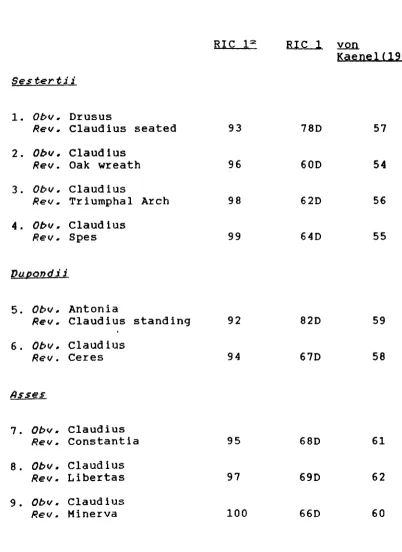
2.1 Concordance of major references for Claudian
aes which were primary models for irregular
issues . . . 43
3.1 Percentages of provenanced Claudian aes
classified by gradeS of imitation . . . 81
5.1 Proforma used to collect data of Claudian
aes from museums and archaeological
societies . . . 145
5.2 Known and possible pre-Flavian Roman forts
and fortresses where at least five Claudian aes have been found . . . 199
5.3 Sites not identified as having had
pre-Flavian military occupation where five or
more Claudian aes have been found . . . 200
7.1 Geographical distribution of irregular
Claudian aes by module . . . 276
7.2 Geographical distribution of ratios of
modules of irregular Claudian aes . . . 279
7.3 Geographical distribution of irregular
Claudian aes by grade of imitation . . . 283
7.4 Concentrations of Claudian asses in Britain.288
7.5 Concentrations of Claud ian d~pondjj in
Britain . . . 290
7.6 Concentrations of Claudian sestertjj in
Britain .•.••.••...•..••••.••••••••••••. 292
7.7 Finds and concentrations of Claudian
7.8 Distribution of Claudian aes in the northern and western imperial provinces and Italy •.. 299 7.9 Comparison of quadrantes in the northern and
western imperial provinces and Italy .•••• 301 7.10 Comparison of second-issue Claudian aes
found in the northern and western imperial
provinces and Italy . . . • . . . 301 7.11 Comparison of Claudian sestertii found in the
northern and western imperial provinces and Italy . . • . . . 302 7.12 Double-struck irregular Claudian aes found
in Britain . . . 307 7.13 Brockages of Claudian aes found in Britain .307 7.14 Hybrid irregular Claud ian aes found in
Britain . . . 308 7.15 Overstruck irregular Claudian aes found in
Britain . . . 311 8.1 Small group found at Swanton Morley,
Nor folk . . . 317 8.2 Provenanced aes of Augustus-Claudius found
in Br i tain . . . 322 8.3 Republican aes found in Britain . . . • . . . 325 8.4 Halved early imperial and Claudian aes found
in Britain . . . 325 8.5 British sites producing both Claudian aes
8.8 Plated Claudian and pre-Claudian aes found
in Britain . . . 347 8.9 Claudian and pre-Claudian aes with test-cuts
and punchmarks found in Britain •••••••••.. 349 8.10 Pierced Claudian aes found in Britain ...•. 351 8.11 Buckled Claudian aes found in Britain •.••• 353 8.12 Hoards of coins terminating with aes of
Claudius 1 . . . 356 8.13 Hoards of coins including Claudian aes
term-inating with coins of Nero . . . • . • . 357 8.14 Hoards of coins including Claudian aes
term-inating with coins of Vespasian . . . 357 8.15 Hoards of coins including Claudian aes
term-inating with coins of the second centuryAD .. 358 8.16 Hoards of coins including Claudian aes
deposited at an indeterminate period in the first-second century AD • • • • • • • • • • • • • • • • • • • 359 8.17 Hoards of coins including Claudian aes
term-inating coins of the third century AD ••••• 359
LIST OF FIGURES
2.1 Weights of irregular Claudian asses in good condition or better in the Ashmolean Museum, Oxford . . . 65 2.2 Weights of irregular Claudian d~pondii in
good condition or better in the Ashmolean
Museum, Oxford . • • . . . • • . . . • • • • . • • . . • . . . 65
2.3 Weights of irregular Claudian sestertii in good condition or better in the Ashmolean
Museum, Oxford .•.••.••••...•.••.••••..••.. 66 2.4 Sizes of irregular Claudian asses in good
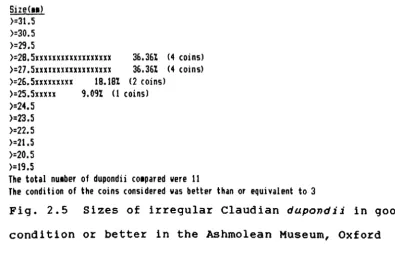
condition or better in the Ashmolean Museum, Oxford . . . 66 2.5 Sizes of irregular Claudian d~pondjj in good
condition ~r better in the Ashmolean Museum, Oxford . . . 67 2.6 Sizes of irregular Claudian sestertii in good
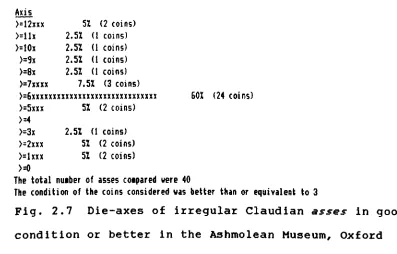
condition or better in the Ashmolean Museum, Oxford . . . 67 2.7 Die-axes of irregular Claud ian asses in good
condition or better in the Ashmolean Museum, Oxford . . . 68 2.8 Die-axes of irregular Claudian d~pondii in
good condition or better in the Ashmolean
Museum, Oxford . . • . . . • . • . • ~ ...•.•.• . 68 2.9 Die-axes of irregular Claudian sestertji in
good condition or better in the Ashmolean
denominations . . . • • . . . . • • . . . • • . . . • . • . • . • . . . 94
3.2 Distribution of provenanced Claudian aes
coin-types . . . 94
3.3 Weights of provenanced Claudian sestertii .. 95
3.4 Sizes of provenanced Claudian sestertii . . . 95
3.5 Weights of provenanced Claudian dupondii •.• 96
3.6 Sizes of provenanced Claudian dupondii ..•. 96
3.7 Weights of provenanced Claudian asses . . . . 97
3.8 3.9
Sizes of provenanced Claudian asses •••••• 97
Weights of grade A provenanced Claudian
sestertj J' • • • • • • • • • • • • • • • • • • • • • • • • • • • • • • • • • • 98 3.10 Sizes of grade A provenanced Claudian
sestertjj . . . 98 3.11 Weights of grade B provenanced Claudian
sestertj i tI • • • • • • • • • • • • • • • • • • • • • • • • • • • • • • • • • • 99
3.12 Sizes of grade B provenanced Claudian
sestertj i . . . 99 3.13 Weights of grade A provenanced Claudian
du.pondjj • • • • • • • • • • • • • . . . • • • • • • • • • • . • . • • • • • • 100
3.14 Sizes of grade A provenanced Claudian
du.pondjj • • • • • • • • . • • . • . • • • • • . • • • . • • • . . • • . • • 100
3.15 Weights of grade B provenanced Claudian
du.po»dij • . . • • . • • . . . • . . • . • . . . . • . . . • • . . • 101 3.16 Sizes of grade B provenanced Claudian
du.pOTJdjj •••••••••••••••••••••••• a·_ • • • • • • • • 101
3.17 Weights of grade C provenanced Claudian
du.pondjj . . • • • • . . • • . • . • . . . • . . . • • • • • • • • • • 102
3.19 Weights of grade A provenanced Claudian
as.<ies . . . 103 3.20 Sizes of grade A provenanced Claudian
asses . . . 103 3.21 Weights of grade B provenanced Claudian
as.<i€S . . . • • . . . • . • 104 3.22 Sizes of grade B provenanced Claudian
asses . . . 104
3.23 Weights of grade C provenanced Claudian
ass€s . . . 105
3.24 Sizes of grade C provenanced Claudian
asses . . . 105
3.25 Scatter-diagram of weights and sizes of
provenanced grade A s€stertjj •••••.••.••.. 106 3.26 Scatter-diagram of weights and sizes of
provenanced grade B sestertjj ..•••••••••.. 106 3.27 Scatter-diagram of weights and sizes of
provenanced grade A do.pondjj . . . • . . . . 107 3.28 Scatter-diagram of weights and sizes of
provenanced grade B do.pondjj . . . • . . . 107 3.29 Scatter-diagram of weights and sizes of
provenanced grade C do.pondjj . . . 108 3.30 Scatter-diagram of weights and sizes of
provenanced grade A asses . . . 108 3.31 Scatter-diagram of weights and sizes of
provenanced grade Basses . . . 109 3.32 Scatter-diagram of weights and sizes of
provenanced Claud ian aS$(::~s . . . 110 3.34 Scatter-diagram of weights and sizes of
provenanced Claudian dupondii . . . 110 3.35 Scatter-diagram of weights and sizes of
provenanced Claudian sestertii . . . 111
3.36 Comparison of weights of grade A, Band C
dupondii . . . • . . . 112 3.37 Comparison of sizes of grade A, Band C
dupondii . . . • 112 3.38 Comparison of weights of grade A, Band C
asses . . . 113 3.39 Comparison of sizes of grade A, Band C
asses . . . 113 4.1 scatter-diagram of weights and sizes of
Claud ian asses from 1971-82 excavations at
Colchester, Essex . . . 133 4.2 Scatter-diagram of weights and sizes of
provenanced Claudian asses . . . 133 4.3 Scatter-diagram of weights and sizes of
Claudian dapondii from 1971-82 excavations
at Colchester, Essex . . . 134 4.4 Scatter-diagram of weights and sizes of
provenanced Claudian dapondii ..•.•••.••••. 134 4.5 Scatter-diagram of weights and sizes of
provenanced Claudian asses with revised
cluster groups . . . 136 7.1 Scatter-diagram of weights and sizes of
7.2 Scatter-diagram of weights and sizes of
asses in very poor condition and better found in the 'Core Zone' . . . 261
7.3 Scatter-diagram of sizes and weights of
asses in good condition and better found
in the territory of the Cantiaci . . • . • . • . . . 262
7.4 Scatter-diagram of weights and sizes of
asses in very poor condition and better found in the territory of the Cantiaci . . . 262
7.5 Scatter-diagram of weights and sizes of
asses in good condition and better found
in the territory of the Atrebates . . . 263
7.6 Scatter-diagram of weights and sizes of
asses in very poor condition and better found in the territory of the Atrebates . . . 263
7.7 Scatter-diagram of weights and sizes of
asses in good condition and better found
in the territory of the Catuvellauni •••••• 264
7.8 Scatter-diagram of weights and sizes of
asses in very poor condition and better found in the territory of the Catuvellauni • . . . 264
7.9 Scatter-diagram of weights and sizes of
asses in good condition and better found
in the territory of the Trinovantes . . . 265 7.10 Scatter-diagram of weights and sizes of
in the 'Peripheral Zone' . . . 266 7.12 Scatter-diagram of weights and sizes of
asses in very poor condition and better found in the 'Peripheral Zone' . . . 266 7.13 Scatter-diagram of weights and sizes of
asses in good condition and better found
in the territory of the Durotriges . . . 267 7.14 Scatter-diagram of weights and sizes of
asses in very poor condition and better found in the territory of the Durotriges . . . 267 7.15 Scatter-diagram of weights and sizes of
asses in good condition and better found
in the territory of the Dobunni . . . . • . . . 268 7.16 Scatter-diagram of weights and sizes of
asses in very poor condition and better found in the territory of the Dobunni . . . 268 7.17 Scatter-diagram of weights and sizes of
asses in good condition and better found
in the territory of the Corieltauvi . . . 269 7.18 Scatter-diagram of weights and sizes of
asses in very poor condition and better found in the territory of the Corieltauvi . . . • . . 269 7.19 Scatter-diagram of weights and sizes of
asses in good condition and better found
in the terr i tory of the Iceni • . . . 270 7.20 Scatter-diagram of weights and sizes of
asses in good condition and better found
in the 'Outer Zone' . . . 271 7.22 scatter-diagram of weights and sizes of
asses in very poor condition and better found in the 'Outer Zone' . . . 271 7.23 Scatter-diagram of weights and sizes of
asses in good condition and better found
in the territory of the Dumnonii . . . 272 7.24 Scatter-diagram of weights and sizes of
asses in very poor condition and better found in the territory of the Dumnonii . . . 272 7.25 Scatter-diagram of weights and sizes of
asses in good condition and better found
in the territory of the Cornovii . . . 273 7.26 Scatter-diagram of weights and sizes of
asses in very poor condition and better found in the territory of the Cornovii • . . . 273
7.27 Scatter-diagram of weights and sizes of asses in good condition and better found
in the territory of the Silures . . . 274 7.28 Scatter-diagram of weights and sizes of
asses in very poor condition and better found in the territory of the Silures . . . 274 7.29 Scatter-diagram of weights and sizes of
asses in good condition and better found in the southern territory of the Brigantes . . . 275 7.30 Scatter-diagram of weights and sizes of
LIST OF MAP FIGURES
5.1 Distribution of provenanced Claudian aes
in counties of England & Wales . . . 149
5.2 Tribal groups of Britain in the aftermath of the Roman Conquest, RD 43, arranged in 'zones'
(after Cunliffe, (1981» . . . 153 5.3 Distribution of bronze coins of Claudius 1
in the territory of the Cantiaci . . . 156 5.4 Distribution of bronze coins of Claudius 1
in the territory of the Atrebates . . . 159 5.5 Distribution of bronze coins of Claudius 1
in the territory of the Catuvellauni . . . 162 5.6 Distribution of bronze coins of Claudius 1
in the territory of the Trinovantes . . . 166 5.7 Distribution of bronze coins of Claudius 1
in the territory of the Durotriges . . . 170 5.8 Distribution of bronze coins of Claudius 1
in the territory of the Dobunni . . . 173 5.9 Distribution of bronze coins of Claudius 1
in the territory of the Corieltauvi . . . 176 5.10 Distribution of bronze coins of Claudius 1
in the territory of the Iceni . . . 179 5.11 Distribution of bronze coins of Claudius 1
in the territory of the Dumnonii . . . 182 5.12 Distribution of bronze coins of Claudius 1
in the territory of the Cornovii . . . 190 5.14 Distribution of bronze coins of Claudius 1
in the territory of the Brigantes . . . 193 5.15 Distribution of bronze coins of Claudius 1
in the territory of the Parisi • . . . • . . . 195 6.lA-D Distribution of die/style-related groups
A-D . . . • . . • . . • . . . • . • . • . • . . 226
6.lE-H Distributi~n of die/style-related groups E-H . . . 233 6.lI-L Distribution of die/style-related groups
I-L . . . 237 6.lM-P Distribution of die/style-related groups
M-P . . . • . . . • • . . . 240
6.lQ-T Distribution of die/style-related groups
Q-T . . . . : . . . • . . . 246
7.31 The geographical distribution of Claudian
asses in Britain . . . 287
7.32 The geographical distribution of Claudian
dupondii in Britain . . . • . . . • . . 289 7.33 The geographical distribution of Claudian
sestertii in Britain . . . • . . . • 291 7.34 The geographical distribution of Claudian
ACKNOWLEDGEMENTS
This research project has benefit ed directly and indir-ectly from the assistance, encouragement and criticism of many people. A study of coins inevitably involves the assistance of many curators of collections. For this study many curators and collectors kindly and promptly supplied information when requested, and were most helpful when visited: their names, too numerous to give here, are recorded in the introductory pages to Appendix One. My indebtedness to them will become apparent in the following chapters and appendices, but I alone remain responsible
for the conclusions drawn from this information. I am also indebted to specialist colleagues and friends who gave their knowledge and help freely and willingly: for their translation work, Jim and Sue MacDonagh, Marcelle Greenwood, Martin Lightbown, Kathy Wicksteed, Peter Darlow and Andrew Burnett; for tutoring me to write computer
programs for this study, Alan Maddison, Jill Bowen and Chris Shaw; for assistance with experiments in
coin-making, my father Robert J Kenyon, Ted Wright, Mike Groom, Bob Hodgson, and Doug Bowen, Head of Technology, Horndean School, Hants. for permission to use the school's foundry equipment.
Authority for their grant which partly paid the fees for my registration as a postgraduate student at the Institute of Archaeology, University College London. I am espe-cially indebted to Lynn Lee, Principal of st Vincent
College, Gosport, Hants. for providing me with periods of study-leave at crucial times in the development of this thesis without which its completion would have been further delayed.
Many individuals have given me much encouragement, and I am grateful to them all, but I would like to record my gratitude to particular individuals whose enthusiasm and interest spurred me onward: Daphne Nash, formerly of the Ashmolean Museum, Oxford, for her early encouragement of my interest in 'Claudian copies'; Cathy King, also of the Ashmolean Museum; George Boon, formerly of the National Museum of Wales, Oxford; Nina and Philip Crummy, of Colchester Archaeological Trust; John Davies; and Hans-Marcus von Kaenel.
Three individuals who more than anyone have encouraged me, sustained me in my moments of doubt, and given me
this project: his encouragement and constructive criticism have been of much value to me. Valued though their
1. INTRODUCTION
'Claudian copies' is the title commonly used today to describe coins which are the subject of this study; the title was first given by Humphrey Sutherland in his important and seminal work of nearly sixty years ago (Sutherland, (1935». A fuller, but less succinct, des-cription would be 'coins made in imitation of bronze
issues of Claudius I struck at the mint of Rome'. Before Sutherland provided us with his neutral, apt term,
pedoratative phraseology alluding to their inartistic appearance was used readily to describe these coins. It
is possible that what began as an accurate, descriptive phrase became instrumental, through repeated use in archaeological and numismatic reports, in effecting a
prescribed notion of the origin, function and behaviour of this coinage. It may be useful therefore, at the outset of this study, briefly to trace the development of terms used to describe the appearance of this derivative
currency, so that we may investigate the above proposition.
(Archaeologia, vol.29, (1842), p.418) became, twelve years later, the 'barbarous work' evident in similar coins found in the River Thames at London (Roach Smith, (1854), p.92). From that publication until Sutherland's almost eighty years later (Sutherland, (1935», with very few excep-tions, 'barbarous' was the adjective used in British numismatic and archaeological reports to describe imita-tive Claudian aes. The English Channel was not to prove a barrier to the spread in the use of this description: we find Cohen recording similar coins 'de fabrique barbare' in his influential catalogue of Roman coins (Cohen,
(1895), p.257, note 1). Mattingly's reference to 'purely barbarous specimens' of imitative Claudian aes in his important catalogue (BMCRE, (1923), p.el) ensured the continued, and widespread, use of the phrase. Within a decade, 'barbarous imitations' were to become 'barbarian
imitations' (NC (1931), pp.313-14); it is the overt nature of the latter phraseology which highlights a subtle, but significant, shift in interpretation of the origin of these coins.
Initially, the word 'barbarous' was used to describe the 'non-Roman' appearance of imitative Claudian aesi
subsequently, a shift in emphasis from non-Roman to the virtually synonymous 'coarse and crude' is evident in the literature; but ultimately, a transition in interpretation from crude object to the product of an 'uncivilised'
of use and meaning of 'barbarous' may be matched by a corresponding shift in the interpretation of evidence for their origin. Lysons, early in the nineteenth century, was convinced by the artless production of the imitative
Claudian asses that they were manufactured by 'the soldiers in Britain' (Archaeologia, vol.17, (1817),
pp.122-23). In the second half of the nineteenth century, 'ignorant artists' 'in Britain' began to be identifed as the originators of 'very barbarous' coins, such as those found at Latton, Glos. (NC, (1864), p.216). According to Cohen, the perpetrators of Claudian copies found in France and Britain were simply 'les Bretons' (Cohen, (1895),
p.257, note 1). A contrary opinion expressed, early in this century, by Ritterling, favoured Gallic communities as manufacturers of 'barbarische' aes found at miltary stations on the German Ij.es (Rltterling, (1904) and
jde •• , (1913». This argument was supported by Hill, who deduced that 'barbarous or semi-barbarous' Claudian aes in the 'Southants' hoard (NC, (1911), pp.42-56), and others of the same kind found in Britain, may be judged by their limited occurrence and geographical distribution to be 'as a general rule, importations' from Gaul. It was Mattingly who took a broader view and firmly embraced all
found at Lincoln, Lincs. were 'very possibly of local
make' (Ne, (1931), pp.313-14): clearly, to his mind, those imitations found in Britain were struck there; similarly for finds in Gaul, Germany and Spain. In numismatic and archaeological literature, published in Europe before the Second World War, and to a more limited extent after it, the origin of this ubiquitous, derivative coinage was prescribed by the terminology used to describe it. Clearly, it was considered to be inartistic and
unsophisticated and therefore the product of uncivilised (un-Roman) people.
In 1935, Sutherland took up the challenge of investigating the origin of imitative Claudian aes found in Britain
(sutherland, (1935». He found that while some,
undoubtedly, were imports from Gaul, the majority were struck in Britain at both military and civil centres. He postulated that 'Claudian copies' struck at military camps in Britain were an 'official' or 'semi-official' means of supplementing the military paychests - a measure necessi-tated by failure of the mint of Rome to supply sufficient
•• s
for troops stationed there. These 'military copies',in turn, were employed as models for local issues struck at civil centres. The accuracy of the imitations varied as might be expected of any operation which involved the handiwork of a large number of people. Sutherland
characteristics, which would classify imitations by their approximation, or otherwise, to Claudian aes of the mint of Rome. It was Sutherland's view that Claudian imita-tions could be differentiated, and their source (military or civil) identified by their grade of imitation: the more accurate copies (grade 1) may be attributed to a military origin; whereas, the more crudely accomplished specimens
(Grades 11, III and IV) may derive from civil centres. The reasoning behind this attribution is based on the inference that the more artless copies could only be the handiwork of non-Romans.
The imperial authorisation, or at least tolerance, of minting-centres in Britain striking imitative Claudian aes, implicit in Sutherland's model, was dismissed by
Crawford (Crawford, (1970», who countered that all imita-tions were the work of profiteers. This view was
supported by Boon a few years later who, comparing
Claudian copies with the spurious illicit halfpence emplo-yed in 18th century Britain, regarded Claudian imitations
'in general as mere counterfeits' (Boon, (1974), p.106): a view repeated recently in his revised version of that
publication (Boon~ (1988». This view was not universally held: most continental authorities followed Giard's lead
in arguing for officially sanctioned military minting-centres (Giard (1970), but not all agreed with his view that the emperor, or his representative, licensed certain
the counterblasts noted above, Sutherland's choice of words in his subsequent publications indicates a clear shift of opinion on the subject of who was responsible for striking these coins: 'official or semi-official' sources
(Sutherland, (1935); jdem (1947» became 'semi-official or unofficial supplementation by others' (Sutherland,
(1976),p.72), and finally, in his last words on the subject, 'non-official augmentation of aes monetary sup-ply' (Sutherland, (1984), p.115).
In Sutherland's 5e~jnal publication of 1935, twenty per cent of Claudian aes found in Britain were estimated to be
imitations. After examining the wealth of coins found at Colchester, Essex (Sutherland, (1947», Sutherland found that 'between one-half and two-thirds' of the Claudian aes found there were imitations. Scholars' opinions of the proportion of copies to orthodox Claudian aes in Britain have fluctuated, but the trend, following Sutherland, has been to recognise more imitations among the coins
available for inspection. The attempt to broadly date a British site by the percentage of Claudian copies found there (Hammerson, (1978» was ill-founded, based as it was on comparative material which was not entirely reliable: authors of many (early) coin reports, referred to therein, mistakenly identified irregular Claud ian aes as orthodox
at the sites quoted (ibid, pp.588-89), a mean of 42%
irregular: 58% regular Claudian coins can be calculated); the unreliability of the data is recognised by the author in his second report on coin-finds from the same site (Hammerson, (1989), p.420). Recent estimates of the percentage of imitative Claudian
aes
at sites across Britain have generally been in excess of ninetyper cent
(cf., Boon, (1949), and Boon, (1982) for sites in the
west; Hammerson, (1978), Brown, (1986) and Kenyon (1987a) for south-eastern sites). This tendency to identify a high percentage of imitative coins is almost certainly as a result of a greater familiarity with both orthodox and
irregular Claud ian
aes,
brought about by the increased publication of photographs of Claudianaes
as both British site-finds (Sutherland, (1947» and exemplars (Boon,(1974); idem. (1988». Publication of important work by scholars on the continent has added greatly to our
knowledge of irregular coinage, as well as providing us with a wider resource of illustrated comparative material
(cf., Giard, (1968), ide •• , (1970), idem", (1975) for
Gaul; Campo, (1974), and Pereira & Bost, (1974) for Spain and Portugal; and von Kaenel, (1984) for the River Tiber finds). The paucity of illustrated material from Lower and Upper Germany may be noted here and lamented.
Before Sutherland's significant publication of 1935, the period of striking irregular Claudian aes, where it had been considered, was judged to be contemporary with the prototypes - 'the reign of Claudius and possibly the early years of Nero' (BMCRE, (1923), p.el). Sutherland, how-ever, inferred from the incidence of Claud ian copies in second and third century hoards that ' i t may be necessary to account for a proportion of the more barbarous examples by the hypothesis that they are of an unexpected lateness of manufacture' (Sutherland, (1935), p.26). This view failed to win support, and almost a quarter of a century later, was justifiably demolished by Kent, citing the evidence of site-finds (Kent. (1959), p.62). Some
authorities sought to be more precise in dating irregular aes and suggested that the striking of the second issue of
aes from the mint of Rome in ~D49 brought an end on the continent, in ~Dc.50, to the wide-spread manufacture of
imitative Claudian aes (Todd, (1966), p.149, note 2; Giard, (1970». This date was arrived at following
Kraay's argument for the late dating of the second issue of Claudian aes (Kraay, (1962»; recent work on Claudian coins struck at the mint of Rome now convincingly dates the second issue of aes from Rome to ~D 42 (von Kaenel,
(1986». It is clear therefore that the second issue of aes from Rome failed to have a limiting effect on the
sites in Britain (Boon, (1982» demonstrates their contin-ued coining beyond the reign of Claudius. The argument for the cessation of Claudian imitations with the issue of new Neronian aes, in ~Dc.64, from the newly opened mint of L~gd~n~m (Lyons, France), however, is much more convincing
(Boon, (1974), p.106). Evidence of coin-finds from the Flavian forts in Wales has been shown elsewhere to support this view (Boon, (1988), pp.123 & 163, note 130).
From the above survey, it is clear that our knowledge of imitations of Claudian aes is derived exclusively from the sources of numismatics and archaeology, the intellectual traditions of which have been largely based on classicism. Valuable though their contribution is, these disciplines have inevitably imposed a classical bias on the interpre-tation of this derivative coinage. It is intended there-fore to examine a large body of evidence, to question the validity of any such classically-biased interpretations previously held, and to offer explanation which hopefully will avoid the imposition of modern values upon an alien culture and its artifacts.
It was clear at the outset that this study demanded an empirical approach; its basis had to be an intimate
used to produce Claudian copies.
To assemble a corpus of material for study, data and photographs of both orthodox and imitative Claudian aes were collected from three main sources: primarily, from first-hand experience of recording coins in museum and other collections throughout Britain; secondly, from a comprehensive literature search; and thirdly, from an extensive postal survey of collections and finds recorded by museums and archaeological groups in Britain. Compara-tive data was collected from the continent employing the last two sources, although the last source was employed only for finds made in the Low Countries.
To gain a fuller understanding and appreciation of the appearance of these coins, practical experiments in die-engraving, casting of blanks and striking of coins were carried out. The processes employed were basic; progress, from ignorance to an understanding, was made by following the well-practiced method of trial and error. The results of some of these experiments were afterward subjected to metallographic analysis, at Oxford University, in attempt to further our knowledge of irregular coin-production techniques.
might include extraneous elements: certain aspects might be exaggerated, while others minimised. Because of the complex and confusing nature of the subject, it was decided that problems would be tackled in simple and direct ways: only simple mathematical calculations would be employed - complicated extrapolations would be avoided; wherever relevant, information would be presented
visually; lines of investigation would be channelled through direct means.
In the following chapters, I will set out to investigate and analyse the material assembled and produced for study by attempting to answer these simple, direct questions: in Chapters Two and Three, Uhat are Claadian copies?; in
Chapter Four, Hou uere they made?; in Chapters Five, Six and Seven, Uhere are they foand? and Hhere Here they made?; and in Chapter Eight, HOH Here they ased? In the concluding Chapter Nine, my aim is to draw together the
interpretations and deductions arrived at in this study, and, using that evidence, to attempt to answer the
2. THE COINAGE COPIED
2.1 Introduction
The aes coinage of Claudius 1 began at Rome in the year of his accession, AD 41. In addition, an exceptional comme-morative issue was almost certainly struck at the imperial mint of L~gd~n~m (Lyons, France), which had not issued aes since the reign of Tiberius and had been recently closed. The latter, a heavy q~adrans (or a light semis), c.
3.85g., has a reverse design depicting the Altar of Rom. et A~g~st~s at L~gd~"u.. which was dedicated, in the
presence of Augustus, on 1 August 10 BC, the day of Claudius' birth at Lu.gd~"~m.
The first issue of aes denominations at Rome was followed by a second, which can be identified by obverse legends ending with the title prater) P(atriae), assumed by
Claudius in January,
AD
42. This second issue consisted of the same coin-types as the first issue and in addition three new coin-types were struck to further promoteClaudius'S dynasty: an as commemorating his brother
Germanicusi a d~po"di~s in honour of the consecration of his grandmother Livia and the deified emperor Augustus; and a commemorative sestertj~s for Germanicus' illustrious wife, Agrippina the Elder.
To detail the development of this argument would take us beyond the scope of our subject, which deals with contem-porary imitations of only the sestertii, d~pondjj and asses of the first issue of Claudius, and must therefore
be resisted here. Suffice to say, Sutherland has recently presented an argument for the first issue of aes being struck between
RD
41-50, and the secondRD
50-54 (RIC 12,(1984), pp. 116-19); von Kaenel presents an alternative argument which limits the first issue to
RD
41-42, and the secondRD
42-43 (von Kaenel, (1986». The latterargument, supported as it is by die study, is more
convincing. The date of the commemorative q~adrans struck
at L~gd~n~m is also subject to consideration, though it is
generally agreed that it was struck before
RD
46 (cf. von Kaenel, (1986), pp. 195-6; Giard, (1988), pp. 26-7, and sutherland, (1987), pp.77-8).2.2 First aes issue from the mint of Rome
The aes coinage of Claudius is distinguished by the number and variety of types. The eleven aes types struck at Rome
for his first main issue were chosen to communicate values which Claudius sought to promote through his election: confidence, security and courage. Some types commemorate his lineage: two sestertjj commemorating his father, Nero Drusus, and a dapondias, his mother, Antonia. Some
for his inauguration, another with the reverse-type Spes
~ugusta for the birth of his son and heir, later to be named Britannicus, and the dupondius with reverse-type Ceres ~ugusta for his empress (see BHCRE, vol 1, (1923), p. clvi). others proclaim his intention to provide wise and resolute leadership in both civil and mi~tary matters: asses with the reverse-types of Constantiae, Ljbertas and
Minerva extol virtues not evident during the reign of his
predecessor, Gaius; the two quadrans types refer to measurement and corn-supply, matters essential to trade and the well-being of the popul~Roman~.
2.3 The coins
Familiarity with the first aes issue of Claudius is a prerequisite for determining which coins are products of the mint of Rome and which are not. The coins, with the exception of the quadrantes which are not imitated, are therefore described in detail below and each coin-type is illustrated by a photograph (plate 1). The reference
numbers, for each coin-type, used throughout this work are sutherland's revised edition of volume one of the series Roman Imperial Coinage (RIC 12, (1984». Concordance with other references is given in Table 2.1.
The obverse (obv~) and reverse (r~vM) of typical examples of the coin-types are described below. In all cases, legends read from left to right. The lettering and
accurately and uniformly formed ~e.9., the even
proportions of the upward strokes of the letter A with a balanced cross bar unifying the whole), and that benefit from se.rifs, thus creating the effect of an even
distribution of the weight of the legend, are firm
indicators of orthodox mintage. Legends that are evenly-spaced and punctuated with stops are other positive
indicators of orthodox mintage.
The ranges of mean-weights given below are taken from coins in the study by von Kaenel, referred to above; they are used in preference to those given by Sutherland, in RIC 12
, because of the former's access to a wide range of
material in good condition in Italy and across Europe. Mean-sizes are taken from my measurements of orthodox material in the collection of the Ashmolean Museum, Oxford. Die-axes are virtually always 180 degrees.
The word 'portrait' is used frequently in the following descriptions in the sense that the image depicted is a rendering which intends to inform the observer of some-thing of the characteristics of the person portrayed.
RIC 12 RIC 1 Y.QIl.
Kaenel(1986) Sestertjj
1- Obv. Orusus
Rev. Claudius seated 93 780 57
2. Obv. ClaudIus
Rev. Oak wreath 96 600 54
3. Obv. Claudius
Rev. Triumphal Arch 98 620 56
4 . Obv. Claudius
Rev. Spes 99 640 55
Du.pondjj
5. Obv. Antonia
Rev. Claudius standing 92 820 59
6 . Obv. Claudius
Rev. Ceres 94 670 58
Bss~s
7. Obv. Claudius
Rev. Constantia 95 680 61
8. Obv. Claudius
Rev. Libertas 97 690 62
9 . Obv. Claudius
Rev. Minerva 100 660 60
Claud ian aes struck at the mint of Rome are typically well-struck coins displaying complete dies on
appropriately sized round flans.
Sestertii
1. RIC 93, orichalcum, 27.17 - 28.04g., c. 3Smm. (pl.l, A)
Obv. NERO CLAUDIUS DRUSUS GERMANICUS IMP(.rator)
The above legend around a bare-headed portrait of Nero Claudius Drusus, in profile facing left. The large
portrait of Drusus is well-proportioned with a broad head and neck, wavy hair, a firm chin, and pronounced neck musculature. The point of the neck touches the
circumference of the reverse design and functions as the point at which the legend starts and finishes.
Rev. TI(berius) CLAVDIUS CAESAR AUG(ustus) P(ontifex)
M(aximus) TR(ibunicia) P(otestate) IMP(erator)
A three-quarters view of Claudius seated, facing left, on a curule chair, amid sundry weapons, armour and trophies. Claudius is wearing a toga and is bare headed. He holds a branch in his outstretched right hand. It is worth noting that the legend CAESAR invariably occupies the space
between the tip of the branch and Claudius' head. S(enatus) C(onsaltc
exergue.
2. RIC 96, orichalcu.m, 28.11 - 28.59g., 34 - 35mm., (pl.I, B)
Obv. TI(berius) CLRVDIVS CRESRR RVG(u.stus) P(ontifex)
M(aximus) TR(ibunicia) P(otestate) IMP(erator)
The above legend around a laureate portrait of Claudius, in profIle facing right. The bust of Claudius is smaller than that of Nero Claudius Drusus, noted above. The
features are generally more angular and less bold: the chin is 'weaker', receding to a thInner, but still
muscular, neck with a prominent 'Adam's apple'. The long neck of Claudius is a distinguIshing feature of his
portrait bust. The point of the neck touches the circum-ference of the obverse design and marks the position where the legend ends and occasionally begins. The starting position of the legend is below the neck of Claudius, but it is not always at the point of the neck. (It is perhaps relevant to note, here, that we should not assume legends were always engraved from first letter to last, or even from last to first if we are thinking of the mirror-image design. It is possible, and it could have proved to have been a useful planning-out device, to begin wIth a central word and then to work outward in each direction altern-ately. In this case, the central word would be CRESRR, which invariably follows the line of Claudius' head from his brow to the top of his cranium. Eleven letters
letters (T I CLIWDIVS .. ) do not always and a gap is occasionally evident beneath Claudius' bust where due allowance has not been given to the marginally broader
letters necessary.)
Rev. EX S(enatus) C(onsalto ) OB CIVES SERV~TOS The above legend in four lines encircled by an oak wreath symbolising the Co~ona Civic., used to mark Claudius' accession. The untied ends of the wreath invariably touch.
3. RIC 98, orichalca., 26.39 -28.35g., 34 - 35mm., (pl.l,
C)
Obv. As for obverse of RIC 96 above.
Rev. HERO CL~VDIVS DRVSVS GERM~H(icas) IMP(erato~) The above legend encircling a front view of a triumphal arch, surmounted by a statue of a horseman facing right with trophies of war to the left and right of him. The profile of the equestrian statue captures the act of the horse rearing triumphantly as the horseman throws his
spear downwards. S(enatus.> and C(onsa.lto, > in the field to the left and right of the arch.
4. RIC 99, orichalcl11lJ, 27.9 - 28.26g., 34 - 36mm., (pl.1, D)
Obv. As for obverse of RIC 96 above.
Rev. SPES ~VGVSTA
figure of Spes. The three-quarters' view of Spes shows her advancing left with her outstretched right hand raised and holding a flowering bud, and her left hand raising her skirt. The folds of the drapery on the figure of Spes are shown in detail. The width of the material is exaggerated by the drapery cascading over her shoulder and by the
raised skirt; the general effect is to give Spes a broad and rather squat appearance. The legend SPES does not extend beyond the deity's outstretched hand. The legend S(enatas) C(onsalto
>
occurs in the exergue below the surface Spes is walking on. It is interesting to note there are two main variations of punctuation to the legend S C used on this reverse-type: a single punctuation stop may be positioned between the letters or two stops may be employed, one before the letter S and another after C. Von Kaenel has identified the latter as distinguishing feature of his 'Stempelgruppe B', and the former of his'Stempelgruppe C' (von Kaenel, (1986), p.192 and plates 22-24).
Dupondii
5. RIC 92, oricnalca., 13.31 - 15.76g., 28.5 - 30mm., pl.l, E
Obv. ANTONIA AUGUSTA
features of Claudius' mother are portrayed as soft and smooth, in contrast to Claudius' own angularity. However, like Claudius' portrait bust, Antonia is depicted with a long neck.
Rev. TI(beri~s) CL~VDIVS C~ES~R ~VG(~st~s) P(ontifex)
M(axi.~s) TR(ib~nicia) P(otestate) IMP(erator)
The above legend encircles the veiled and togate standing figure of Claudius, whose head is facing left. He holds a simp~l~m in his extended right hand and his left is rested across his middle. The legend S(enat~s) C(onsaltat~.) is placed in the field and divided by the figure of Claudius. Claudius stands on a ground-line drawn between the start and end of the encircling legend.
6. RIC 94, orichalcam, 15.47 - 15.65g., c.28mm., (pl.!, F)
Obv. TI(beri~s) CL~VDIVS C~ES~R ~VG(~st~s) P(ontifex) M(axi.as) TR(ib~njcia) P(otestate) IMP(erator)
The legend encircling bare-headed Claudius, who is seen in profile facing left. He is characterised by features
noted for RIC 96, above, i.e., wavy hair, a receding chin, a prominent 'Adam's apple', a long and muscular neck with the point of his neck touching the beaded circumference of the obverse design. The legend invariably begins and ends at the point of the emperor's neck, with the title C~ES~R
Rev. CERES
~VGVSTAThe legend is divided by the seated figure of Ceres, with
CERES
to the left of the figure andAVG
VST~ to the right. The veiled and draped figure of Ceres is seated, facing left, on a decorated and ornamental throne. She holds a long torch in her lap and in her extended right hand she holds two ears of corn. Her feet rest on a small cushion or footstool. In the exergue, below the floor on which Ceres' ornamental throne rests, is the legendS(enatas)
C(onsaltQ
.>. These features recall some of those of Spes sestertjj, described above. There are othersimilar-ities: for example, the legend
CERES
does not generally extend beyond the two ears of corn held by the goddess in her extended right hand, and the punctuation variations noted for the sestertjj may be seen on this type also.~sses
7. RIC 95, copper, 10.61 - Il.37g., 29 - 31mm., (pl.l, G)
Obv.
As for RIC 94 above.Rev.
CONST~NTI~EAVGVSTI
The legend does not encircle, but it does enframe, the standing figure of Constantia, whose body is facing front and head is turned to the left. The legend
CONSTANTlAE
does not extend beyond the head and feet of the goddess,and ~VGVSTl fits in the space between the top and bottom
on a long spear. The spear is made with a series of punched dots rather than an engraved line. Though not clear in all dies, the spear head is pointing to the
groundline (see von Kaenel, (1986), plate 33, no. 1675 for a very clear example). Her right hand is raised with
finger extended toward her face. The ample folds of
drapery in her tunic and cloak are detailed and are given breadth. This broad treatment of the drapery gives the design of the reverse die a balance of composition which it would lack if the drapery was dealt with in a more constrained way. The legend S(enatu.s) C(onsu.ltQ
>
is rendered large and is positioned in the field on either side of the deity. S(enatu.s) is at the elbow of the figure and C(consu.ltatu.~> in line with it.8. RIC 97, copper, 10.11 - 11.05g., 28 - 29mm., (pl.l, H) Obv. As for RIC 94, above.
Rev. LIBERTAS AUGVSTA
The legend enframes the draped, standing figure of Libertas.
LIBERTAS
begins at the deity's feet andthe field on each side of the standing figure,
C(onsu.ltatu.m) is below her outstretched hand and S(enatas)
is level with it.
9. RIC 100, copper, 10.8 - 10.89g., 28 - 29mm., (pl.1, I)
Obv.
As for RIC 94, above.Rev. --. The helmeted and draped figure of Minerva is depicted striding to the right holding a spear aloft in her right hand and with a shield on her left arm. The drapery of her dress is flowing behind her on the upper part of her body, and pressed close to her legs on the lower part. The effect is of the goddess moving swiftly and purposefully forward. The legend S( enatlJ.s.)
C(onsu.lto ) is in the field on each side of the striding figure: S(enata's.) is placed behind her and C(onsu.lto· ) in front of her, below her shield. This legend is larger than that found on the two asses above.
2.4 The identification of irregular Claudian aes
Irregular Claud ian aes have obverse and reverse designs based on those from the mint of Rome described above. The high standard of die-engraving skill evident in some
irregular.
The above descriptions can only serve as guides to
recognising and identifying orthodox Claud ian aes coins of
the mint of Rome. Experience of handling and inspecting a
large number of specie is an essential requirement for
gaining a knowledge of the coins and developing a 'feel' for the differences between regular and irregular coins. The coin-trays of the British Museum, London and the Ashmolean Museum, Oxford hold sufficiently large enough numbers of both regular and irregular Claud ian aes to give the interested student some experience of handling both types of material and of comparing prototypes with their
imitations. Further knowledge of Rome-minted coins can be
gained from critical inspection of photographs of
specimens from a variety of continental published sources, particularly the major opus of H-M von Kaenel (von Kaenel,
(1986».
Familiarity with both regular and irregular Claudian aes
was gained, for this study, through first-hand experience of handling over three thousand coins in over forty
museums and private collections throughout England and Wales and cataloguing details of sizes, weights, legends and die-axes, etc.. To avoid a narrow view, data from a wide geographical area was collected rather than, for example, from just a sample of museums in the south of
cover an area from Norfolk to Devon, from Kent to South Glamorgan and from Hampshire to Lincolnshire. Information about coins outside this wide area has been gained by
inspecting coins loaned to the author by museums and
individuals (Shropshire and South Humberside respectively) and by the provision of photographs and details of weight, etc. (Merseyside and North Yorkshire). The corpus of data collected represents all parts of England south of the rivers Trent and Severn, and beyond into south Wales, Merseyside, Nottinghamshire and North Yorkshire (Appendix 2) •
At each of the museums and archaeological units visited, coins in a 'readable' condition, i.e., not too corroded or too heavily worn, were photographed (plates 18-97). In addition, prints of the security photographs of Claudian aes in the British Museum were used as a visual reference.
In total, the photographs form a corpus of almost two thousand Claudian aes, comprising of over one thousand, four hundred and forty British provenanced Claudian aes, and over five hundred unprovenanced aes. Of the latter, the majority are found in the trays of the major museums
in Britain. This body of material, together with
published photographs of provenanced Claud ian aes, form a large assemblage which may be considered as being compre-hensively representative of Claudian aes found in Britain.
knowledge of, and familiarity with handling, regular Claudian coins as has been stressed above. Visual and metrological features of Claud ian aes struck at the mint of Rome have been dealt with in detail above. It is perhaps relevant at this stage to consider features that separate irregular from orthodox coins.
2.4:1 Appearance
Irregular Claudian aes are the products of dies engraved with images derived, at first- or second-hand, from those on the first issue of Claudian aes from the mint of Rome
(~D 41-42). The skill and quality of die-engraving varies from excellent to poor, and all stages between. Coins struck from these dies vary from those easily confused with regular Claudian aes to those with obverse and
reverse images so crudely wrought that they bear little or no resemblance to the original models.
~es which differ markedly from the models they seek to imitate may be readily identified as irregular coins. They are, however, not always easily recognised as