180
A Secure Encryption through Gray Codes and
BigIntegers for IoT Devices
Hirendra Singh Sengar, Dr. D.N.Goswami, Dr. Anshu Chaturvedi
Abstract—Cryptography is essential because it allows protection of data securely so that unauthorized person cannot have access to it which ensures the protection of corporate secrets. In this paper, Binary code conversions based cryptography technique has been developed which provides security through binary codes like gray codes. Furthermore, security has been enhanced by the utility of prime numbers and BigInteger values. The designed technique protects the alphanumeric data against various cryptanalytical attacks. Proposed work includes symmetric key technique. The benefit of using symmetric key algorithm is faster execution time as compare to asymmetric key algorithm. It also work on stream ciphers those are faster when compared to block ciphers. Performance and security analysis when compared to other schemes shows that the proposed scheme is more powerful, efficient and secure than other related schemes.
Index Terms— BigIntegers, Cryptanalysis, Cryptanalytical attacks, Encryption, Gray codes, Prime numbers, Randomization
————————————————————
1 I
NTRODUCTIONThe internet of things (IoT) is an ecosystem of connected physical devices and objects that are accessible though the internet. It is a giant network of connected digital machines, embedded devices, things and objects. IoT devices are constrained devices such as sensors and smart devices; these have limited memory capacity and limited battery power. The programs run on these devices must be very efficient and less time consuming so that devices may save battery power. While exploiting vulnerabilities in IoTs, brute force attack is very common and compromises the security of the device. Brute forcing is the act of guessing out every possible username and password combination until a successful one is found. Hence, it‟s important that IoTs are always secured by these attacks. Encryption process ensures the security and privacy of the data stored on IoT devices. Encryption guarantees data confidentiality, integrity and authenticity. Various encryption algorithms were proposed by researchers time to time but these have some limitations associated with them like they employed many time-consuming operations which make its speed down. The bit shifting operations, circular shift operations, XOR operations and many other operations were used in encryption and decryption process of existing proposals which makes both of these processes slower. At present time, IoT devices need cryptographic algorithms for security which provides more security and don‟t run out of battery power. Cryptanalysis is a way to measure the level of security in IoT environment. Cryptanalysis is the art of breaking cryptographic algorithms using analytical reasoning, pattern locating, guessing and statistical analysis [1]. There are many types of cryptanalytical attacks on alphanumeric data like brute force attack, chosen cipher text attack, known cipher text attack, chosen plain text attack, known plain text attack. A cipher text only attack is one
of the cryptanalytical attacks where attacker does not have any part of plain text message. He only has the set of cipher text messages. He might know the language used during encryption and analysis the frequency distribution of some characters. Based on these activities, he might able to guess the plain text message. In known plain text attack, attacker not only having the cipher text but also has plain text. He discovers the key after performing some analysis on cipher text, plaintext pairs. In chosen plain text attack, attacker chooses some pieces of plain text and compares it with cipher text to obtain the key while in chosen cipher text attack, attacker chooses some different cipher texts[2]. Various encryption schemes have been proposed by researchers. Recently developed, Saurabh Chandra‟s scheme [3] found vulnerable to these attacks during cryptanalysis process. For providing higher security, the encryption schemes must be free from these attacks. Data travelled among various devices in IoT environment which must be immune to these attacks. Cryptanalysis of our proposed work shows that our proposed scheme is free from these attacks and achieves various security goals.
In cryptographic algorithm, number of bits contained by the key defines its key size. Key size ensures the strength of the key. Key with the smaller sizes are found in existing schemes which is vulnerable to various known attacks but all primitives types are unable to store large key values. Big integers are the only way to store a large key sized value. Proposed work employed the power of BigIntegers to enhance the security. As it is known that the RSA and elliptic curve asymmetric algorithms are based on prime numbers. These numbers have interesting properties that make them well suited to cryptography. A prime number is a number that has no factors other than one and itself. That means, to get a prime, two smaller whole numbers cannot be multiplied. Two large primes can be multiplied to get an even larger composite, but other people will have a hard time factoring that composite back into the original two primes. In digital electronics, the digital data can be represented, stored and transmitted as group of binary bits. This group is also called as binary codes. There are many types of binary codes weighted codes, non weighted codes, binary coded decimal, alphanumeric codes. BCD is a weighted code. It is known as 8421 code. It is used for representing decimal numbers. In
————————————————
Hirendra Singh Sengar is currently pursuing PhD degree program in Computer Science in Jiwaji University, India, PH-8839913112. E-mail: [email protected]
D. N. Goswami is currently working as professor in SOS in Computer Science and Application department in Jiwaji University, India, PH-9406586343. E-mail:[email protected]
Anshu Chaturvedi is currently working as associate professor in CSE & IT department in M.I.T.S college, India, PH-8839551661. E-mail:
181
weighted codes, each successive digit from right to left represents weights equal to some specified value and to get the equivalent decimal number system we sum the products of these weights by the corresponding binary digit. Excess 3 is a non weighted code. For converting decimal number in excess 3 codes we add three to each decimal digit before converting it into equivalent binary. In gray codes as one advance from one number to next only one bit is changed. Not only change in one bit takes place every time decimal number is also incremented by one from 0 through 9 but even for the change from 9 to 0 also has only one bit in change. One code can be changed into another by conversion process. The power of prime numbers was used with gray codes & BigIntegers and an innovative idea implemented in proposed work to enhance the level of security. Our paper is organized as follows: section2 describes the related work done in the same field. Then in section3, security analysis of the existing work has been done. In section 4, our proposed work has been presented in simulated environment. Furthermore, in section 5, cryptanalysis and performance analysis of the proposed work has been done. Finally, in section 6 we provided conclusion of our research work.
2
B
ACKGROUND ANDR
ELATEDW
ORKSourabh Chandra et al. [3] proposed content based algorithm that performs some logical operations like binary addition and circular bit shifting on binary data. For generating the secured cipher text, they performed encryption process two times. Folding method was used for generating the secret key. Laiphrakpam et al. [4] cryptanalysed and proposed the improved version of the scheme developed by Mrinal et al. [5]. Ammar et al. [6] suryed the security of the main IoT frameworks, a total of 8 frameworks are considered. They clarified the proposed architecture. They highlighted on the security measures of each framework. Boruchinkin et al. [7] proposed a cryptographic device which provides a secure transmission of data. It alerts the user if the crypto headset at the opposite end of the link is not trusted. Muhammed J. et al. [8] developed the innovative function works on the random based operations. The explicit mapping knowledge which correlates the random number with key and plaintext were used in their proposed work. Ajay kushwaha et al. [9] developed the encryption algorithm working on the concept of selection of significant data from the whole message. They applied the blowfish algorithm as encryption algorithm to encrypt the subset of data. They reduced the encryption time overhead and enhanced the performance. Rizky riyaldhi [10] proposed some techniques to improve the performance of AES algorithm. Modifications have been done in S.Box.They also reduced the shifting operations for efficiency. Vania Beatrice Liwandouw et al. [11] studied and analyzed several cryptographic applications running on android platforms, to provide recommendations for users to select the best cryptographic application that can be used on IM. Andrey Starikovskiy [12] studied the performance evaluation of various encryption algorithms based on key size and analyzed that key generation, encoding and decoding time increases with the size of the key. Furthermore they proposed for the protection of text messages.Dalila Slimani et al. [13] proposed
182
RSA algorithm and a strong key is used to provide better security.
3
S
ECURITYA
NALYSIS OFE
XISTINGP
ROPOSALSThe strength of key decides the level of security. Encryption schemes with the small sized keys are generally vulnerable to different guessing attacks. In sourabh chandra et al. [4] method, random number has been given as input to folding method for generating the encryption key. Let any user give the random number 724. The key is calculated as below- Round 1: 7+2+4=13
Round 2: 1+3=4 Encryption key: 4
After doing the cryptanalysis it is found that the value of generated key each time lies between 1 and 9 digits so the key can be easily guessed by attacker in only nine rounds which shows the existing proposal is vulnerable to brute force attack. Once the attacker has the decryption key, he is able to find the number of spaces between strings in cipher text message. Once he finds the spaces in the message, he can easily determine the lengths of all word of the same message. Sourabh chandra et al. [4] performed two subtraction operations in the decryption process. In first subtraction operation they subtracted all ASCII values by the decryption key and later they subtracted newly ASCII values by the length of words. The whole decryption process with the character table [4] shown in the table1.The above cryptanalysis shows that both the decryption key and length of all words have been determined by the attacker, thus he easily generates corresponding ascii values of plain text after performing only two subtraction operations. The whole plain text message can be easily determined after converting the ASCII values to their corresponding character values.
3.1 Ciphertext only Attack (Brute Force Attack)
In this analysis the key „k‟ consisting of 1 decimal number only, where this number can be represented in form of 4 binary bits. Hence, the length of the key is 4 bits and size of the key space is 24=16 keys. If the time required for the
determination of plaintext for one value of the key in the key space is taken as 1 ms = 10-3 s, then the time required for
obtaining the plaintext by considering all the possible keys in the key space is given as follows which is very short time to break the cipher.
(16 X 10-3) / (24 * 60 * 60) = 1.85185185 e-7 days
3.2 Known Plaintext Attack
A known plain text attack always allows a brute force attack on a cipher- simply try all keys, decrypt the ciphertext and see if matches the plaintext. In existing proposal the cipher text is transferred in the same order as it was generated. Each letter in the ciphertext has the association with each other in the plaintext which makes this method vulnerable to known plaintext attack. We have taken a pair of plaintext for our cryptanalysis process as follows. After performing the ciphertext only attack on the ciphertext “Qnnuu” we got the plaintext “Hello” which matches to the plaintext given in the pair hence the method is vulnerable to known plain text
attack.
(plaintext, ciphertext) = (“Hello”,”Qnnuu”)
4
P
ROPOSED
S
CHEME
4.1 Encryption Process
Encryption is a process that encodes a message so that only intended recipient can read it. An encryption algorithm is used for scrambling the information. Sender inputs the plain text and a prime no to the encryption algorithm. Encryption technique automatically generates encryption key value by using random number generator. The whole plain text is then stored into an array and converted to cipher text after performing some binary code conversions and also performing some arithmetic operations as multiplication of decimal values with key and prime number. The resultant values stored into BigIntegers and then sent to receiver side as cipher text value.
4.2 Decryption Process
Decryption is the process of converting unreadable cipher text to readable information. Receiver gets the cipher text as BigInteger values and further inputs the key and prime no to the decryption algorithm. Decryption process then converts the cipher text into plain text after performing some arithmetic operations like division of BigInteger values with key and prime no and doing some binary code conversions like decimal to binary, binary to gray code, binary to UNICODE. For papers accepted for publication, it is essential that the electronic version of the manuscript and artwork match the hardcopy exactly! The quality and accuracy of the content of the electronic material submitted is crucial since the content is not recreated, but rather converted into the final published version.
4.3 Pseudo Code for Algorithms
Algorithm1- Algorithm for encryption process Input: plain text, prime no
Output: cipher text BEGIN
Store plain text message in an array Input the prime no
Perform key generation using randomization process FOR each character value in an array
Calculate Unicode value of character Perform Unicode to binary conversion Perform binary to gray conversion
TABLE1
183
Perform gray to decimal conversion Multiply decimal value with prime no Multiply resultant number with key Store number in BigIntegers
END FOR
Send Cipher text to receiver END
Algorithm2- Algorithm for decryption process Input: cipher text, prime no, key
Output: plain text BEGIN
Store cipher text message in BigIntegers array Input the prime no
FOR each char value in array Divide the number by key
Divide the resultant number by prime no. Perform decimal to binary conversion Perform binary to Unicode conversion Convert Unicode to equivalent character Store char value in array of characters END FOR
Receive the plain text. END
4.4 Results
The implementation of proposed work was done using Eclipse mars and JAVA 8 on Lenovo G570 with the system configuration of Intel core i3 processor and 2 GB RAM using 128 bit key length. Every run of application generates a different key. BigInteger was used for storing key value. The simulation of text encryption and decryption is shown in fig 1.
Fig. 1 Output of encryption and decryption
5
P
ERFORMANCE
A
NALYSIS
In cryptography, randomness must be supplied in the plain text message to remove the structure of the plaintext message. Higher randomness decreases the correlation between messages. Entropy is a measure of how unpredictable, something is, so high entropy in keys increases security. In Sourabh Chandra‟s scheme, they used one digit as an encryption key so the calculated entropy of the encryption key in their technique is log2(1)=0 while in the proposed technique,
key having 32 digits so the calculated entropy is log2(32)=5.
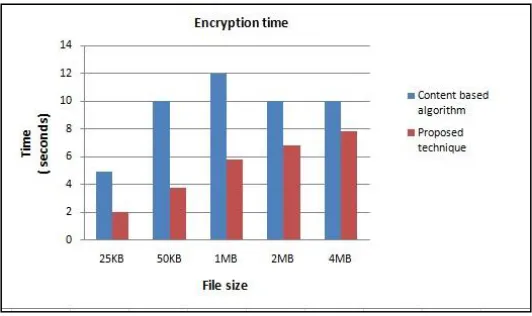
The entropy of the proposed technique is higher than the Sourabh Chandra‟s technique which makes proposed technique more powerful and secure than Sourabh Chandra‟s scheme. In Sourabh Chandra‟s scheme, circular shift operations and other time-consuming operations were used. These operations make encryption process slower. Fig 2, 3 shows the time taken by the encryption and decryption process over the file sizes. It is shown that the proposed algorithm takes less time to encrypt the text as well as to decrypt the text. Fig 4 shows total time which depicts how the proposed algorithm is more efficient than Sourabh Chandra‟s scheme.
5.1 Time Complexity and Cryptanalysis
The proposed technique provides two level of security. The attacker would not be able to decrypt the message until he has both the prime no and the key at the same time. Guessing the prime number does not ensures breaking of security because the length of the key is 128 bits and size of the key space is 2128= 3.40282367e38 keys. If the one value of key takes the time
as 1 ms = 10-3 s in the key space to determine the plaintext.
Then all the possible keys used to determine the plain text will take the following time
(3.40282367e38 X 10-3) / (24 * 60 * 60) = 3.40282367e30 days
This proves that the technique is secured against brute force attack (guessing attack). In proposed technique, each time a new key is generated through randomization process so different-different cipher text generated every time for the same plaintext. Randomization decreases the correlation between plaintext and cipher text and increases the confusion which makes technique secure against various cryptanalytical attacks like known cipher text attack, known plain text attack, chosen cipher text, chosen plain text attack etc.
184
Fig.3 Decryption Time Vs File Size
Fig.4 Total Time Vs File Size
6
C
ONCLUSIONS
After reviewing Sourabh Chandra‟s scheme and carrying out the security analysis, many attacks have been presented in different circumstances. The aim of our proposed work is to enhance the security through big integers with prime numbers and to provide immunity against attacks. Our proposed work also focused on digital code conversions and randomization process. Results shows that our proposed technique takes less time to encrypt and decrypt of alphanumeric data which makes it more efficient over Sourabh Chandra‟s scheme. Cryptanalysis process shows that our proposed technique is also robust against various cryptanalytical attacks. Our proposed technique is more secure and less time engrossing. Proposed technique used UNICODE standards so the message written in any language can also be encrypted by this. It is thus concluded that the proposed cryptosystem guarantees the confidentiality of messages and provide better performance.
7
R
EFRENCES
[1] Patel, P., Patel, R. & Patel, N 2015, „Integrated ECC and
Blowfish for Smartphone Security‟, Procedia Computer Science, ELSEVIER, pp.210-216.
[2] https://www.expertsexchange.com/articles/12460/Cr
yptanalysis-and-Attacks.html
[3] Chandra, S., Mandal, B., Alam, Sk. & Bhattacharyya, S
2015, „Content based double encryption algorithm
using symmetric key cryptography‟, Procedia Computer Science, ELSEVIER, pp.1228-1234.
[4] Laiphrakpam, D. & Khumanthem M 2016,
„Cryptanalysis of symmetric key image encryption using chaotic Rossler system‟, Optik, vol 7, issue 11, pp. 200-209.
[5] Mandal K.M., Kar M., Singh K.S. & Varnwal K.V. 2014,
„Symmetric key image encryption using chaotic Rossler system‟, Security and Communication Networks, vol 7, pp. 2145–2152.
[6] Ammar, M. & Rusello G 2018, „Internet of Things: A
survey on the security of IoT frameworks‟, Journal of information security and applications, ELSEVIER, pp. 8-27.
[7] Boruchinkin, A., Tolstaya, A & Zhgilev A 2018,
„Cryptographic Wireless Communication Device‟, Proc. 8th Annual International Conference on Biologically Inspired Cognitive Architectures (BICA), pp. 110-115.
[8] J., M., Al-Muhammed & Zitar, R 2017, „k-Lookback
random-based text encryption technique‟, Journal of King Saud University – Computer and Information Sciences, vol 31, pp. 92-104.
[9] Kushwaha, A., Sharma, H. & Ambhaikar, A 2016, „A
Novel Selective Encryption Method for Securing Text over Mobile Ad hoc Network‟, Proc. 7th International Conference on Communication, Computing and Virtualization, 2016, 79, pp. 16-23.
[10] Riyaldhi, R., Rojali & Kurniawan, A 2017,
„Improvement of Advanced Encryption Standard Algorithm with Shift Row and S.BOX modification mapping in mix column‟, Proc. International Conference on Computer Science and Computation al Intelligence(ICCSCI), pp. 401-407.
[11] Liwandouw, V. & Wowor, A 2017, „The Existence Of
Cryptography: A Study On Instant Messaging‟, Proc. 4th Information Systems International Conference (ISICO), pp. 721-727.
[12] Starikovskiy, A., Zhgilev, A. & Shevchenko, N 2018,
„Text Messages Protection System‟, Proc. 8th Annual International Conference on Biologically Inspired Cognitive Architectures (BICA), 2018, pp. 457-466.
[13] Sliming, D. & Melaka, F 2018, „Encryption of speech
signal with multiple secret keys‟, Proc. International Conference Natural Language and Speech Processing (ICNLSP), pp. 79-88.
[14] Nathanael, D., Faisal & Soriano, D 2018, „Text
Encryption in Android Chat Applications using elliptical Curve Cryptography (ECC)‟, Proc. 3rd International Conference on Computer Science and Computational Intelligence, pp. 283-291.
[15] Thangarajan, S. & Bhaaskaran, V 2018, „High Speed and
Low Power Implementation of AES for Wireless Sensor Networks‟, Proc. 8th International Conference on Advances in Computing and Communication (ICACC), pp. 736-743.
[16] Hraoui, S., Gmira, F., Abbou, M., Oulidi A. & Jarjar A
185
International Conference on Intelligent Computing in Data Sciences (ICDS), pp. 399-408.
[17] Rizk. R. & Alkady, Y 2015, „Two-phase hybrid
cryptography algorithm for wirelesssensor networks‟, Journal of Electrical Systems and Information Technology, vol 2, pp. 296–313.
[18] Mishra M. & Mankar V 2015, „Text encryption
algorithms based on Pseudo Random Number Generator‟, International Journal of Computer Applications, vol 111, pp. 1-6.
[19] Tiwari R. & Sinhal A 2016, „Block Based text data
partition with RC4 encryption for text data security‟, International Journal of Advanced Computer Research, vol 6, pp. 107-113.
[20] Kumari S 2017, „A research paper on cryptography
encryption and compression techniques‟, International journal of engineering and computer science, vol 6, pp. 20915-20919.
[21] Vijayan A., Gobinath T. & Saravanakarthikeyan M.
2016, „International journal of engineering research and applications‟, ASCII value based encryption system (AVB), vol 6, pp. 08-11.
[22] Elhoseny M., Yuan X., El Minir. H. & Riad A 2016, „An
energy efficient encryption method for secure dynamic WSN‟, Security and communication networks, vol 9, pp. 2024-2031
[23] Ahmad M. & Tipathi M 2018, „Development of