681
An Adaptive Scheme In Under Water Sensor
Network With Eavarp-Clique
K.S.SENTHILKUMAR , DR.K.PRABAVATHYAbstract: Communication establishment in deep oceanographic environment is attained by Under Water Sensor Network (UWSN). Underwater atmosphere is admitted with varied conditions that might corrupt the communication system. The transmission is achieved effectively via acoustic channel. Deep water current and changeability of nodes raise the link failure that may leads to delay and failure in transmission. Unlike terrestrial network, UWSN needs potential network that ensures high privacy features. In this paper, Energy-Aware and Void Avoidable Routing Protocol (EAVARP) is developed with CLIQUE and it is an adaptive scheme that ensures the needs of UWSN. Mischievous node recognition is attained through neighbourhood node and the process is clique. The approach implements the message passing technique and instigated using monitor node. Vote is passed on to the monitor by the suspected malevolent node. Whereas, the activity of vote transmission is attained by monitor node. Test results states that the EAVARP-CLIQUE scheme has shown the best result evens the channel are unreliable. Privacy and data transmission precision is achieved by the proposed approach.
Index Terms: acoustic channel, clique, sensor node, malicious node, security, under water, cluster.
—————————— ——————————
1
INTRODUCTION
One of the key technology to achieve persuasive computing and maintenance aquatic applications is done by UWSN [1, 2, 3]. Aquatic based applications are developed with the assist of UWSN. Resources and other factors in the ocean is observed, explored and followed with aquatic applications. Aquatic resource observation and exploration is done through the premise called Submarine Observation System (SOS) which is a significant technology of UWSN [4,5]. SOS faces high energy usage, low band width and delay which are the most considerable factors in designing a protocol and its topology. The protocol for UWSN must be scalable and robust to handle all the aspects of ocean [6]. All the sonobuoys in the deep sea are instilled with similar virtual node identification that enables anycast routing. The terrestrial routing protocols are modified to meet the challenges of underwater [7]. Design paradigm of UWSN deals with high delay, error rate and low bandwidth. Acoustic signals have huge latency and error-rate over radio signal which is constrict in nature. UWSN uses the acoustic channel for exchanging the data and speed ranges in m/s. Protocol design has shown their impact on latency, propagation, high error and the bandwidth ranges at 20kbps [8,9]. Terrestrial network is not sufficient to meet the UWSN and it doesn’t support geo-routing, synchronization of time and also location based services. Movement pattern of the node as well as the context of three dimensions poses vibrant and dynamic topology that result in the designing constraints of UWSN algorithms [10]. Famous application of marine geosciences is Autonomous Underwater Vehicle (AUV). Propeller and control surfaces are at the stern that has a streamlined body [11, 12, 14]. Another artefact of UWSN is glider that incorporates the technology to make the movements [15]. In UWSN, strategy of routing is initiated at the sink which lies in the surface region of water and the senor nodes are placed at several layers of the ocean. The nodes nearer to the sink exchange the data frequently and scenario is called as hot zone [16, 17]. Latency, excess load at nodes and limited energy are the problems raised due to hot zone. Huge load at the node is due to the incident called flooding. Node failure is caused by the factors of ocean and nature of water which tends to the transmission failure and minimises the Packet Delivery Ratio (PDR) [18]. Intent of this paper is to attain accuracy in detection and security in transmission.
Algorithm for Detection in a CLIique (ADCLI) is used in achieving the goals. The malicious node recognization is achieved with the proposed EAVARP [19] based ADCLI approach and PDR value is obtained with higher rate. Higher security is ensured in the ADCLI method. The rest of the paper is organized as Section II gives the literature review of UWSN, Section III explains the proliferation of acoustic channel, Section IV shows the mischievous activity detection, section V shows the analysis of simulation, section VI concludes the paper and references are at the reference section.
2
LITERATURE
REVIEW
Hu, T., & Fei, Y. [20] designed an adaptive and energy efficient routing scheme that supports Delay/Distribution Tolerant Networks (DTNs). UWSN need effective approach to handle the issues of under water. Development of this method was done using Q-learning and machine learning. Q-learning was a strengthening algorithm which identifies the cost or gain via reward function. The simulation results show that the algorithms show better result in terms of latency, PDR and utilization of energy. Al-Bzoor, M., Zhu, Y., et al [21] addressed the issues of UWSN and devise considerations of the protocols. Strong movable nodes and minimum energy supplied nodes are the foremost things in UWSN need to be intended in protocol design. The proposed approach by author had the ability to handle the scenarios such as dense and sparse networks. The proposed method was static and the routing was established o the fly. Based on the finite values nodes in the network adjust themselves to transmit along its path with minimal energy utilization and in shortest path. Simulation displays low energy consumption and high PDR. Hu, T., & Fei, Y. [22] proposed a Multi-level Routing Protocol
for Acoustic –Optical Hybrid Underwater Wireless Sensor
had shown proficient outcome than the other UWSN algorithms. Yu, H., Yao, N., et al [23] proposed an Adaptive hop-by-hop vector based forwarding routing protocol (AHH-VBF). In this method, based on the transmission process radius of the pipeline was changed. The data forwarding was also done as hop-by-hop sequence. AHH-VBF shown the best in the sparse environment and it used the virtual pipeline. In AHH-VBF repeated as well as the duplicate packet generation was removed in the dense space and reliability of the transmission is assured in the sparse space. Thus, AHH-VBF outperforms other algorithms. Javaid, N., Shah, M., et al [24] introduced Efficient and Balanced Energy Consumption Technique (EBET) and Enhanced EBET (EEBET). EBET avoid the direct data transfer to the long distance which improved the routing and energy saving process. EEBET is developed to face the drawbacks of EBET namely threshold assigning issue. EEBET uses the depth based threshold. Life of the network was enriched with the proposed approaches. Radii of the network and the nodes count was taken for the simulation. The proposed approach shows the best result.
3 PROLIFERATION
OF
ACOUSTIC
CHANNEL
Oceanographic environment may influence the definite aspects of networks such as utilization of energy, traffic and the proliferation of acoustic signal across the environment. Data transmission in the underwater is described using the propagation model of thorp [25]. Attenuation of the acoustic channel with the distance of dt is signified as,
where value for k is 1.5 and represents the location of the spreading area and is a coefficient for absorption that is
measured in dB/km. F as KHz and denoted as, Under water atmosphere is entirely different from terrestrial it faces numerous factors and noise is one among them that is represented as,
Where are different
kinds of noise that are occurred in the environment of ocean. NLt(ft) is by the turbulence effect, NLs(ft) is due to the
movement of shipping, NLw(ft) and NLth(ft) are due to heat and
thermal impacts of wave. Signal Noise Ratio (SNR) for the recipient is represented as,
where p(ft) power of the sender and DT is the detection
threshold. Correlation among temperature, salinity (SY) and depth are denoted as,
4 MISCHIEVOUS
ACTIVITY
DETECTION
USING
CLIQUE
SCHEME
The CLIQUE Algorithm
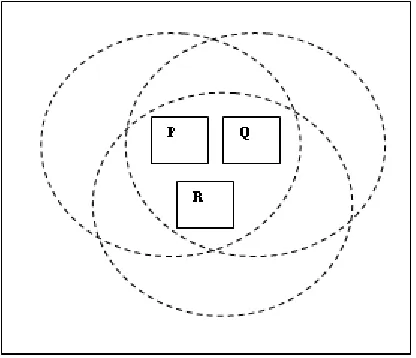
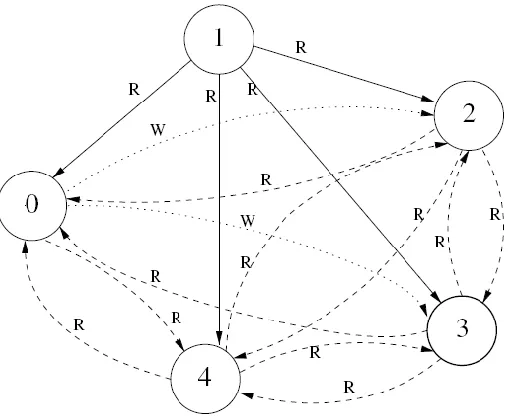
The main intent of ADCLI algorithm is to recognize presence of the malicious node in the same signal range. The Figure 1 illustrates the node representation. Occurrence of node in a same signal range is clique and shows edge among the nodes. A set of nodes and edge representation is established in the Figure 2.
Figure 1. Mobile nodes in a single range
Figure 2. Nodes with connected edge
683
Where m=1 and n=5.in the example node 0 is the malicious and monitor node is 1 which transmits the message to all the nodes. Corresponding response is relayed back to the node and the malicious node alone transmits the wrong message. Following figure shows the transmission of message among the node and the relay message to the corresponding node.
Figure 3. Transmission of message among the nodes
ADCLI (Algorithm for Detection in a Clique) Algorithm
ADCLI algorithm is used in identifying the malicious nodes among a set of nodes such that every couple of nodes in the set is lies within the similar acoustic range of each other.
Case 1: Initial node transmits the message which is used for discovery and it is done by the monitor node.
Case 2: Node is checked for any malicious content and if not then forwards the RIGHT message. If a node is found to be malicious, then the following cases are done
Case (a): Broadcast of message is not accomplished to a few or all of the n-2 nodes.
Case (b): Broadcast the altered message to a few or every of the n-2 nodes.
Case 3 : After the accomplishment of case 2, the node at the monitor state propagate a MAL-VOTE-REQ message as a demand to the other n-1 nodes to propagate votes about nodes (vote is a information about the malicious node), which they infers as malicious.
Case 4: The n-1 node propagates information to the monitor node regarding the suspected nodes. Nodes shows malicious activity is suspected nodes and it transmits the WRONG message to the monitor node to be monitored. Vote is sent by the suspected node to the monitor node.
Case 5: The node acts as a monitor node calculates the votes to estimate the node as malicious. Detection of malicious activity is carried by this process.
5 SIMULATION
ANALYSIS
The most popularly used simulation tool for network simulation is NS2. Once the simulation program is compiled, automatically trace and nam files are generated through the program. Further, these files are incorporated in defining the movement pattern of the nodes and environment is tracked entirely [26, 27]. In this section, EAVAR-CLIQUE is tested using the activity of the network and evaluated using four varied performance metrics such as death rate, energy consumption, end to end delay and PDR. Parameters involved in the simulation are represented using table 1.
TABLE 1.Simulation Parameters
Death Rate
In order to accomplish every individual transmission, node needs energy which is already instilled using battery or by any other external source. In every transmission node loses the energy and at certain level of transmission energy of the node exhausted. This made the idle situation in the node and the node is signified as dead node. The estimation of death rate is the divergence among the residual energy of the node and energy of the whole network. Death rate is also amplified due to the factors like irregular energy exploitation, latency and other network issues. Optimized energy convention and network preservation reduces the death rate.
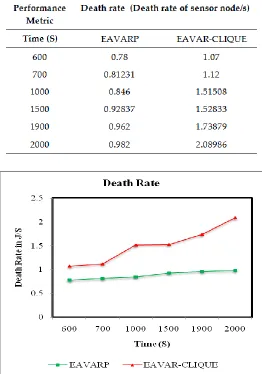
TABLE 2.THE DEATH RATE OF SENSOR NODES
Figure 4. Comparison of Death rate for EAVARP and
EAVAR-CLIQUE and the death rate is increased in EAVARP when the simulation time initiated. EAVAR-CLIQUE outperforms the
EAVARP.
Figure 5. X graph for EAVAR-CLIQUE
Packet Delivery Ratio (PDR)
PDR is a accomplishment rate of broadcasted data and it is used in handling the good organization of the network. At the time of data propagation sender pass on the data to the recipient node and it may subjective to numerous factors which causes the propagation failure. The data successfully reaches the recipient among the influencing factors is approximated with total population of the node is PDR.
where Rp - Received Packets by sink node and Sp - Sent Packets by sensor nodes.
Table 3. Packet Delivery Ratio of sensor nodes
Figure 6. Comparison of PDR for EAVARP and
EAVAR-CLIQUE and the PDR is increased in EAVARP when the simulation time initiated. EAVAR-CLIQUE outperforms the
685
Figure 7. X graph for EAVAR-CLIQUE
Average End to End Delay
Time taken to propagate the data among the sender and all the receiver node to reach the recipient is termed as delay time. The entire time Ti of sensor node transmitting the data to
sink node is approximated by the sum of the transmission delay, the propagation delay and the additional delay.
where - delay, - length of the data packet, i - the layer of a sensor node that sends a data packet, B - Bandwidth of channel, - distance from layer i to layer i – 1, - Speed of sound is (≈1500m/s) and - additional delay.
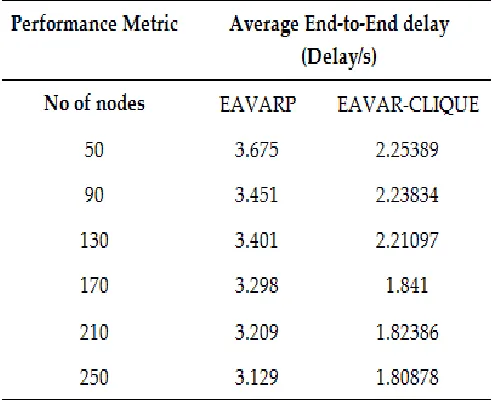
Table 4.End to End delay of sensor nodes
Figure 8. Comparison of end to end delay for EAVARP and
EAVAR-CLIQUE and the end to end delay is decreased in EAVARP when the simulation time initiated. EAVAR-CLIQUE
outperforms the EAVARP.
Figure 9. X graph for EAVAR-CLIQUE
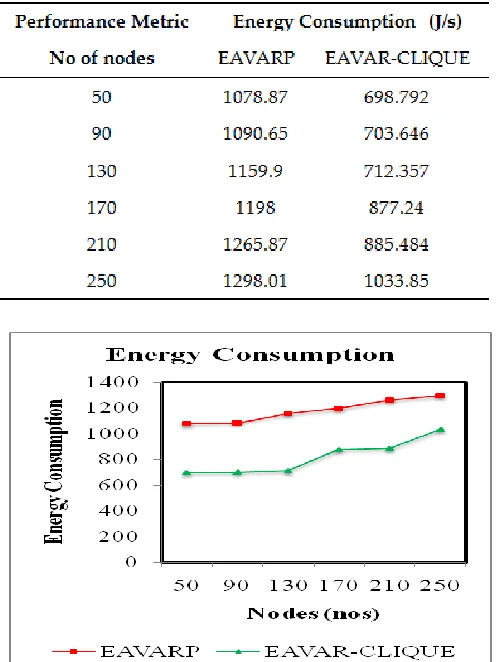
Energy Consumption
In order to complete every individual broadcast of data, node needs energy which is already instilled using external source. Energy is utilized by the whole network and maintaining the routing table causes the energy consumption. The energy needed to maintain the routing table is far least than the energy needed to transmit the packet. Data propagation among the node, energy is loosed at certain rate and at certain level energy of the node get exhausted.
Table 5. Energy Consumption of sensor nodes
Figure 10. Comparison of Energy Consumption for EAVARP
and EAVAR-CLIQUE and Energy Consumption is decreased in EAVARP when the simulation time initiated.
EAVAR-CLIQUE outperforms the EAVARP.
Figure 11. X graph for EAVAR-NCA
6
CONCLUSION
In this paper proposed an algorithm called EAVAR-CLIQUE and it is a collaborative effort from the set of nodes which identifies the malicious node by voting procedure. On the basis of message, the suspected node is identified. Suspected node transmits the data to monitor node the process of identification is initiated. The node receives the least vote is suspected to be a malicious node. The detection of mischievous node is obtained with highest accuracy. From the
algorithm security features are assured in data transmission. Delay in transmission is encountered in this algorithm which is improved in the future.
7
REFERENCES
[1] J.S. Bridle, ―Probabilistic Interpretation of Feedforward Classification Network Outputs, with Relationships to Statistical Pattern Recognition,‖ Neurocomputing— Algorithms, Architectures and Applications, F. Fogelman-Soulie and J. Herault, eds., NATO ASI Series F68, Berlin: Springer-Verlag, pp. 227-236, 1989. (Book style with paper title and editor)
[2] W.-K. Chen, Linear Networks and Systems. Belmont, Calif.: Wadsworth, pp. 123-135, 1993. (Book style) [3] H. Poor, ―A Hypertext History of Multiuser
Dimensions,‖ MUD History, http://www.ccs.neu.edu/home/pb/mud-history.html. 1986. (URL link *include year)
[4] K. Elissa, ―An Overview of Decision Theory," unpublished. (Unplublished manuscript)
[5] R. Nicole, "The Last Word on Decision Theory," J. Computer Vision, submitted for publication. (Pending publication)
[6] C. J. Kaufman, Rocky Mountain Research Laboratories, Boulder, Colo., personal communication, 1992. (Personal communication) [7] D.S. Coming and O.G. Staadt, "Velocity-Aligned
Discrete Oriented Polytopes for Dynamic Collision Detection," IEEE Trans. Visualization and Computer Graphics, vol. 14, no. 1, pp. 1-12, Jan/Feb 2008, doi:10.1109/TVCG.2007.70405. (IEEE Transactions ) [8] S.P. Bingulac, ―On the Compatibility of Adaptive
Controllers,‖ Proc. Fourth Ann. Allerton Conf. Circuits and Systems Theory, pp. 8-16, 1994. (Conference proceedings)
[9] H. Goto, Y. Hasegawa, and M. Tanaka, ―Efficient Scheduling Focusing on the Duality of MPL Representation,‖ Proc. IEEE Symp. Computational Intelligence in Scheduling (SCIS ’07), pp. 57-64, Apr. 2007, doi:10.1109/SCIS.2007.367670. (Conference proceedings)
[10]J. Williams, ―Narrow-Band Analyzer,‖ PhD dissertation, Dept. of Electrical Eng., Harvard Univ., Cambridge, Mass., 1993. (Thesis or dissertation)
[11]E.E. Reber, R.L. Michell, and C.J. Carter, ―Oxygen Absorption in the Earth’s Atmosphere,‖ Technical Report TR-0200 (420-46)-3, Aerospace Corp., Los Angeles, Calif., Nov. 1988. (Technical report with report number)
[12]L. Hubert and P. Arabie, ―Comparing Partitions,‖ J. Classification, vol. 2, no. 4, pp. 193-218, Apr. 1985. (Journal or magazine citation)
[13]R.J. Vidmar, ―On the Use of Atmospheric Plasmas as Electromagnetic Reflectors,‖ IEEE Trans. Plasma Science, vol. 21, no. 3, pp. 876-880, available at http://www.halcyon.com/pub/journals/21ps03-vidmar, Aug. 1992. (URL for Transaction, journal, or magzine) [14]J.M.P. Martinez, R.B. Llavori, M.J.A. Cabo, and T.B.