Licensed under Creative Common Page 594
http://ijecm.co.uk/
ISSN 2348 0386
MANAGEMENT COMMITMENT AND ACCOUNTING
INFORMATION SYSTEM
Arlis Dewi Kuraesin
Doctoral Students of Science Accountancy Department, Faculty of Economics and Business,
Padjadjaran University, Bandung, Indonesia & Lecturer of STIE Muhammadiyah Jakarta,
Jl. Minangkabau No.60, Jakarta Selatan, DKI Jakarta, Indonesia
Abstract
This article aims to determine management commitment part of the accounting information
system. Accounting Information System is to collect, record, store, and process data to produce
information in decision making. The success of accounting information systems through: (1) the
planting of pride (pride), trust (faith), and respect to the user with good acting and direction
(idealized influence). (2) increase user confidence in the use of accounting information systems
to articulate an appealing vision and describes a high-level expectations and optimism user the
ability to use accounting information system - inspirational motivation. (3) providing training and
advice (mentor) to their followers and provide support individually by listening, paying attention
to the needs of users of accounting information system - individualized consideration Therefore
top management does not lose focus managerial, to provide role models and play an active role
in the implementation of decisions and fully engaged in the process of working with real action.
Keywords: Commitment Management, Accounting Information Systems
INTRODUCTION
Accounting information according to Warren et al, (2012:3) provided by accounting through
processes or phases that begins from the determination of the required information, then
designing a system of accounting information in accordance with the needs of users, recording
economic data into the accounting information system, and concludes to provide accounting
Licensed under Creative Common Page 595 the input data , store data , provide information on users and controls all the processes (Azhar
Susanto, 2008:11) .Quality accounting information is used to assist the users of information
useful in making decisions (decisions usefulness) (Gellinas, 2012:19; Shipper and Vincent,
2003: 98). Quality information will enhance understanding of the quality of management in view
of the changes that occur both inside and outside the organization that can quickly and
accurately respond to changes arising (Azhar Susanto, 2008:11).
Quality of accounting information which can provide benefits in the form of an
opportunity to do things faster, more correctly (effective) and cheaper (efficient) (Azhar Susanto,
2008:12). Accounting information quality can lead to decisions taken by the user is not qualified
so can result in losses (Huang et al., 1999). The wrong decision can in turn lead to additional
costs, adding a longer time, lower the reputation of the organization, causing difficulty in
identifying opportunities, as well as lost opportunities (Baltzan, 2012:209). The information
produced by the accounting information system is not just the financial statements, but all the
information that support increased productivity, efficiency and control (Azhar Susanto, 2008:11).
In practice, masih` many problems occurred in accounting information systems that are
not relevant to non-business entities such as accounting information system applied to SOEs
still bad proved inaccurate recording and reporting process is not in accordance with the former
SOE SOE Minister Metri (Dahlan Iskan, 2012). Obviously the conditions relating to the problems
in the quality of input data and the application of accounting information systems above require
attention from management in the organization, management must demonstrate its commitment
in the determination of the data inputted into the accounting information system, because
without the commitment of management, there is no data input quality (Hubley, 2001; Adelman,
2009), which is needed to produce quality information (Kimbal et al., 2008). Management
commitment is needed in determining the scope of data quality clear because not all data need
to be connected to the accounting information system (Vodapaali: 2009).
Furthermore, Cooper (2006) states that management commitment is essential so that
the top management and other resources can receive feedback well, and achieve the expected
goals of the organization. Similarly, according to Kimball et al. (2008: 18) should participate in
the implementation of management information systems in order to feel they have and find
common ground. Confirmed by Deming (1982) that the top management is responsible for 94%
of the quality problems existing information systems both in small and large business
organizations, both public and private sectors (Njie et al., 2008). Management commitment is a
commitment in the long term that refers to the objectives, forms of cooperation and
responsibility for implementation of a project (Kontio et al, 1998), and it is necessary for the
Licensed under Creative Common Page 596 systems not only effort that requires financially a certain time, but must continue to go on
(Rainer and Hall, 2003). The implementation of an information system expensive project (Dyba,
2005) that requires a lot of investment of resources, namely time, money and effort (Ashfaq,
2007). Lack of leadership involvement in the process is likely to face a crisis will be greater
continuity (Dyba, 2005).
With the information system is the best and the most dynamic project team though will
not automatically reach the goal if top management does not participate actively (Dias, 2004).
The absence of confidence and strong support from top management to perform, execute a
predetermined policy objectives cannot be achieved without the active participation of the
management will not get the results of a successful information system development (Schwalbe
2006; Ashfaq, 2007). Management failure caused by human factors will give a negative impact,
namely the involvement and interaction of brain-ware to information systems such as the
incompatibility of cultures new work, the policy use of information systems, as well as the
limitations of expertise, here humans contribute significantly to optimizing the use of information
systems (Lamb and Kling, 2003). Human (brain ware) is an important component of information
systems as users and developers of information systems and information systems as well as
components of the organization (Azhar Susanto, 2008:59). Both user, operator, systems
analysts, and programmers are the ones who are.
Management Commitment
Management commitment is a leadership style where the top and middle management
participate together in the creation of employment goals, determine the level of authority, and
clarify the performance commitment (Chalk, 2008: 3). The manager approves the specific
results to be achieved through dialogue (Chalk, 2008: 3). Management responsibility here can
be described in three stages, namely the responsibility to direct, approve and responsibility to
measure (Chalk, 2008: 3). According to Chalk (2008:3) definition of management commitment is
"Management commitment is a style of leadership where both the manager and the subordinate
Participate jointly in the establishment of work objectives, define authority levels, and clarify the
performance commitments. Management commitment is an endorsement to define, defend and
support the main activities from the beginning to the end of a development project (Englund and
Bucero, 2006:8).
Definition of support is an active role during the lifecycle of a project. Types of activities
to be undertaken by the project sponsor may be different but there are some things all the
sponsors have in common, including the obligation, dedication and accomplishments, in other
Licensed under Creative Common Page 597 understanding of management commitment "Commitment management is a sponsorship to
define, defend, and support major activities from the start to the end of a development project.
We Consider sponsorship is an active role during the project life cycle. Obviously the types of
activities to be done by the project sponsor may be different. But there are some things all
sponsors have in common, including obligation, devotion and achievement - in other words,
commitment"
While the description of the commitment of top management according to Liker and
Hoseus (2008:192) Commitment could be defined as dedication of oneself for a field goal or a
relation. Real commitment requires something that psychologists call internal motivation; i.e. an
individual is pushed to the goal internally. Commitment by Liker and Hoseus (2008:192) as
dedicated themselves to a cause or relationship. Real commitment requires internal motivation,
that individuals are encouraged for internal purposes. One should satisfy themselves through
work and get energy without making the manager gave them a gift for a special behavior (Liker
and Hoseus, 2008:192).
The sense of commitment in terms of management information system development can
be formulated by pulling a red thread management commitment by Chalk (2008: 3) as well as
by Englund and Bucero (2006:8). Where regard management commitment to the development
of the information system is the participation of top management and middle management in the
formulation of the purpose of development of information systems and clarify the performance
commitments in documentation work plan for accountability in an effort to direct, approve,
measure, support from start to.
Information Systems
The information system is a man-made system which generally consists of a series of integrated
components and component -based computer users was established to collect, store and
manage data and generate output information to the user (Gelinas et al., 2012:14). The
information system according to Gelinas et al., (2012:14); an Information system is a man made
system that Generally consists of an integrated set of computer -based components and manual
components established to collect, store and manage the data and to provide output information
to users.
In line with the opinion of Gelinas (2012:14), O'Brien and Maracas (2009:4) mentions the notion
of information systems in more detail as follows: "Information System can be any organized
combination of people, hardware, software, communications networks, the data resources and
policies and procedures that stores, retrives, transforms and disseminates information in an
Licensed under Creative Common Page 598 using a variety of physical devices (hardware), information processing instructions and
procedures (software), communications channels (networks), and the stored data (data
resources) "Similarly, according to Bentley and Whitten (2007: 15) in explaining the following
information systems; "Information systems in Organizations capture and manage the data to
produce useful information that supports an organization and its employee, customers,
suppliers, and partners. Information systems an arrangement of people, data, processes and
information technology that Interact to collect, process, store, and provide as output the
information needed to support an organization.
Azhar Susanto (2008:52) provide an understanding of information systems as follows :
The information system is a collection of sub-systems both physical and non physical are
interconnected with one another and work together in harmony to achieve one goal of process
data into information. From the notions above it can be concluded that the information system is
a collection of two or more sub- systems or components of physical or non-physical nature that
interact and work together in harmony (integration) to process the data in order to achieve the
goal of generating useful information for decision makers (users).
Accounting Information System
Definition of Accounting Information Systems according to Romney and Steinbart (2006 : 6) is
as follows : An accounting information system is a system that collects, records, stores, and
processes the data to produce information for decision makers. Accounting information system
is a system that collects, records and processes the data to generate information for
decision-makers (Romney and Steinbart, 2006: 6). Meanwhile, according to Bodnar and Hopwood
(2004:3) definition of Accounting Information Systems are as follows, Accounting Information
System is a collection of resources, such as human and equipment designed to alter financial
data and other data into information.
Such information is communicated to decision makers. Then further Azhar Susanto
(2008:72) gives a definition of Accounting Information Systems ( AIS ) as follows : Accounting
Information Systems can be defined as a collection (integration) of sub-systems / components
both physical and non physical are interconnected and cooperate with each other in harmony to
process transaction data related to financial problems into financial information.
According Bagranoff et al., (2010:8) understanding Accountancy information system is
as follows: An accounting information system is a collection of the data and processing
procedures that creates the needed information for its users. AIS as a set of components that
Licensed under Creative Common Page 599 Accounting information system as data collection and processing procedures that create
information needed for its users. Accounting information system as a set of components that
collects accounting data; store it for future use and processes for end users (Bagranoff et al.,
2010:8).
Based on the theories put forward, it can be concluded that the accounting information
system is a collection of sub-systems or components of both physical and non physical are
interconnected in harmony to process financial data into financial information.
Accounting Information System Components
Accounting information system has a component that consists of hardware, software , brain
ware, procedures, databases, and network communication technology ( Romney , 2006;
O'Brien , 2005; and Azhar Susanto, 2004;).
Hardware
O'Brien and Steinbart (2009:30) state that the hardware is all the physical devices and materials
used in the process of information. In particular this includes not only machines such as
computers and other equipment, but also all the media data. Media data is a tangible object to
the data recorded, may be sheets of paper on magnetic or optical disks. Similarly, according to
Jogiyanto (2005:4) giving understanding of the hardware as follows; "Hardware is hardware in a
computer system that is physically visible and can be touched".
According to Azhar Susanto (2010 : 15 ) the hardware is the physical equipment used to
collect, enter, process, store and retrieve the data processing in the form of information.
Hardware component information system includes a system unit, consisting of Processor,
Memory, Bus, Cache , Driver card ; an input device (input device) and the output device ( output
device) ( Azhar Susanto , 2010: 15-92 and Baltzan (2012 : A1 ) :
Software
Baltzan (2011:A1) says that there are two main categories of information technology
(information technology) hardware and software. Software is a collection of hardware executes
instructions on the production of specific tasks. O'Brien and Steinbart (2009: 31) states that the
software is composed of all the information collection process instructions. The general concept
of software does not only consist of a collection of programs called the operating instructions,
which a landing and controlling computer hardware, but also a set of instructions that we call the
information process procedures needed people. The resources consist of software resources of
Licensed under Creative Common Page 600 According to Azhar Susanto (2010:15) is a collection of software programs that are used to run
the computer. The program is a series of computer commands systematically arranged.
Software includes operating systems, interpreters, and compiler. Operating system (operating
system), serves to control the relationship between the components installed in the computer
system. Interpreter and compiler, is software that acts as an interpreter language understood by
humans into the language that computers understand. Interpreter and compiler is a package.
Interpreter translates the computer program per command so that the command used when
creating the program. Compiler translates once so used when the program is finished or tested
(single file) (Azhar Susanto (2010:15-20) and Baltzan (2012:A12-A13)
Brainware
Brainware is an important part of the component of Accounting Information Systems. Brainware
is a resource that is involved in making accounting information systems, data collection and
processing, distribution and utilization of information (Azhar Susanto, 2008: 75). Brainware
grouping according to Bentley and Whitten, 2007: 45 and Azhar Susanto,(2008: 75 ) is as
follows :
a) Owner Information Systems (systems owners)
Sponsor is on the development of accounting information systems within an organization.
System owner is responsible for the resources including human resources and costs required in
the development of accounting information systems. Additionally system owners responsible for
the availability of time to be used for development and is responsible for the maintenance of
information systems. System owners acting as the determinant in establishing whether or not
received information systems in organizations.
b) User Information Systems (systems users)
Users of information systems are those that use accounting information system has been
developed (end user). User information systems (systems users) determining the organizational
problems to be solved, the opportunity should be taken, need to be met, and the constraints of
business (business process) to be included in the accounting information system.
c) The designer of Information Systems (systems designers)
The system designer translates user requests and provides technical solutions on the
constraints faced in the client organization. The activities are to design (design) file, database,
Licensed under Creative Common Page 601 must also be able to integrate technical solutions for work or everyday user activities. System
designers are grouped into groups of managers are supervisors, managers and executives are
using SIA as a source of information in the decision-making process as well as systems
analysts, that is, those who analyze and design information systems accounting.
d) Information System Builder (systems builders)
Builders build the information system components of information systems based on the
specifications of the system designers. The group that entered into the system builder is
- The communication experts, to analyze communication in SIA, identifying shortcomings,
designing or revising.
- Administrator data base, ensure the database is used in accordance with user needs.
- Programmer, create a program appropriate referral systems analyst
- Operator, operates the application of Accounting Information Systems
- Librarian, storing and securing documents and backup software.
Then brainware the resources associated with those (people) who are involved in the
implementation of information systems.
Procedure
Understanding the procedure according to Azhar Susanto (2008:263) is a series of activities of
the activities carried out repeatedly in the same way based on certain rules for running an
information system. The procedure will eventually become guide organizations in deciding what
activities to do to perform its functions. This procedure cannot be programmed, while
procedures that can be programmed to be turned into software. Important procedures of the
organization so that everything can be done uniformly. Given adequate procedures it can to
control the activities of the organization.
Database
Bentley and Whitten (2011:518) explain that a database is a collection of interrelated files. The
key word is interrelated. A database is not merely a collection of files. The records in each file
must allow for relationships to the records in other files. According to Bentley and Whitten
(2011:518) the database is a collection of files that are interrelated. The key word is interrelated.
The database is not just a collection of files; records in each file must be associated with data in
another file.
Licensed under Creative Common Page 602 restrictive definition of a database is that a database is the collection of the Data under the
control of database management system software. According to McLeod and Schell (2007:124)
is a collection of database files. The general definition of a database is a collection of all
computer - based data company. More specific definition is a set of data that is under the
control of database management system software. Scott (2001:349) gives a definition of the
following databases, a database is a computer file system that uses a way of organizing a
particular file, intended to accelerate the renewal of each record, and updating simultaneously
on record related, as well as to simplify and accelerate access to all record through the
application program, as well as fast access to stored data should be used together to read to
the preparation of routine or special report or investigation. While the database according to
Azhar Susanto (2004:205) is a collection of related data and logically arranged. Data are
numbers, letters or anything that can be used as input in the process to produce the information.
The database is said to be good if it has the function of data recovery, integrated, have a data
security system , multi- access, has a system of authorization data, and has a data processing
system either on-line or off-line.
Communication Network Technology
Telecommunications system is a collection of hardware and software that is compatible
arranged to communicate information to another location. According Baltzan (2012:B1), the
telecommunications system allows data transmission over public or private networks. Network
communication system is made by connecting two or more devices and set a standard
methodology that can communicate. Then O'Brien and Steinbart (2009:32) explain that: The
concept of network resources emphasizes that communications technologies and networks are
fundamental components of all resource information systems. Network resources are include
communications media, and network infrastructure.
Characteristics of quality information system according DeLone and McLean (1992) are
ease to use, system flexibility and ease of learning. Wixom and Todd (2005) characterize the
quality of the information system are reliability, flexibility, integration, accessibility and timelines.
Further, characteristics of the quality of the information system according to Horan and
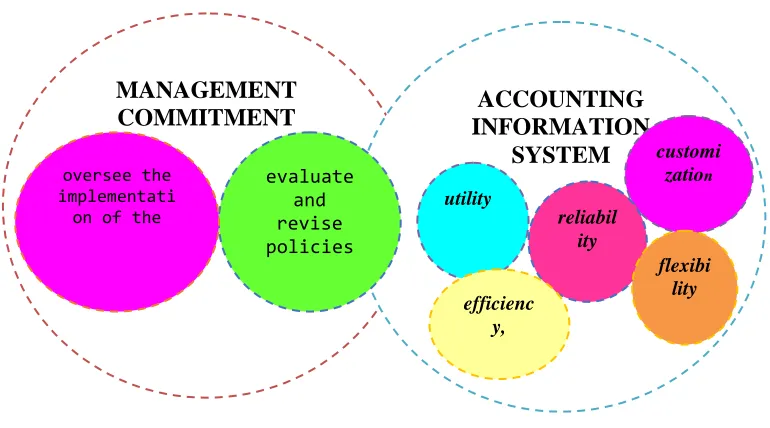
Abhichandani (2006) are a utility, reliability, efficiency, customization, and flexibility. Sedera et
al. (2004) measured the quality system with Ease of use, Ease of learning, user requirements,
system features, System Accuracy, Flexibility, Sophistication, Integration and Customization.
The quality of accounting information systems can be accessed through the performance of the
Transaction Processing System (TPS), the criteria of the cycle of transaction processing,
Licensed under Creative Common Page 603 systems. Where these points into a dimension of quality of accounting information systems in
this study.
Influence Commitment to Quality Management Accounting Information Systems
Factors that are key to the success of accounting information system the main thing is the
support and continuing commitment of the leadership of the organization (Siakas and
Georgiadou, 2002), because the accounting information systems is not an activity that is
one-stop shopping (Vodapaali, 2009) but it is a process improvement continuously (Ashfaq, 2007),
during the life cycle of information systems, as there are a series of decisions that must be
taken when implementing and perfecting information system (Dias, 2004). Cooper (2006) state
that management commitment is important in the implementation of accounting information
systems, so that the top management and other resources can receive feedback well, and
achieve the expected goals of the organization. Similarly, according to Kimball et al. (2008: 18)
in the implementation of accounting information systems, top management should participate in
its implementation in order to feel they have and find common ground in its implementation. So
that without the active participation of management will not get the results of a successful
information system development (Schwalbe, 2006; Ashfaq, 2007).
Commitment of top management is very important, without the commitment of the top
management of many projects the implementation of information systems will fail because top
management is a major supporter in the implementation of information systems in terms of
guaranteeing the availability of adequate resources that fund, human resources and visibility of
information systems implementation ( Schwalbe 2006:66).
According Liker and Hoseus (2008:192) states that the commitment of top management
as the dedication of self to a destination in a way to motivate members of the organization to
achieve these objectives. Top management must play an active role during the life cycle of
information systems (Englund and Bucero, 2006:8). So it can be said that the commitment of
the top management in the development of information systems is a top management
participation in the development and maintenance of the information system responsible for
directing effort, agreeing, measuring, and supporting the development and maintenance of
information systems as a form of active participation of top management and middle
management. Efforts are made through a way of ensuring the availability of resources needed
for the development and maintenance of accounting information system, appoint the
management representative to coordinate activities in the maintenance (Data Quality Protocol,
Licensed under Creative Common Page 604 and repairs, reviewing the development of the management team and consultants (Cooper,
2006:2).
The theories mentioned above is supported by the results of research and Yetton
Sharma (2003 ), Sabherwal et al. (2006), Vodapalli (2009) , Koronios et al. , (2008) and Kerr
(2004 ). Sharma and Yetton (2003) give a conclusion on research, management commitment
(management support) to be one of the critical factors in the successful implementation of
accounting information systems. There is a strong relationship between management
commitments through management support to the successful implementation of accounting
information systems Similarly Sabherwal et al., (2006) which gives conclusions on the results of
his research that there is a relationship which represents the success of an information system
that is top- management support for information systems. Vodapalli (2009) shows also the
results of empirical research that an important factor in the implementation of accounting
information systems are methodologies and management project, a vision and a clear plan,
management commitment and sponsorship, as well as data management and data quality.
Koronios et al., (2008) presents the results of his research that there is a critical factor in
the successful implementation of information systems, namely management commitment. In line
with the results of previous studies that the management's commitment to contribute to the
successful implementation of accounting information systems. Importance of management
commitment to the implementation of an organization's information system is confirmed Kerr
(2004), which suggests the implementation of the Information System requires proactive
management of the organization, namely the commitment of top management.
Based on the theories as a concept in the study mentioned above and some of the
results of recent research that supports this theory and based on this premise can be said that
the commitment of top management affect the quality of accounting information systems.
According to O'Brien and Steinbart (2009:32) the concept of network resources
emphasizes that communications technology and networks are fundamental components of all
information system resources. Network resources included are communications media, and
network infrastructure. Accounting information systems relying on telecommunications such as
data processing online (online processing). Network communication technology is necessary if
companies require higher data accuracy, faster data communication, data transfer distance
away and a lot of user data. Communication that occurs between multiple parties that
communicate should be facilitated by the infrastructure of the telecommunications network
(Azhar Susanto, 2010: 94-108).
Data transmission using a system called the electronic transmission of data
Licensed under Creative Common Page 605
MANAGEMENT
COMMITMENT
are connected to one another. To communicate data from one place to another three elements
of the system that should be available are the source of the data (source), the transmission
medium (transmission medium) that carries data transmitted from the data source to the
receiver element (receiver). If one of the elements does not exist, then the communication will
not be performed (Jogiyanto, 2005:304).
Figure 1: Framework Mind
CONCLUSION
Management commitment influences the accounting information system. If the accounting
information system is not committed, the management does not work optimally and will
influence the decisions of top management because during this time the management is not
committed to the maximum in conducting a review of the accounting information system
maintenance activities. Top management should be responsible for developing a long-term
strategic view on a change in the organization, which is responsible for managing the change
and pay full attention on issues of human and organization and how information systems can
affect the way in which the work is organized. This indicates that the internal control system that
controls the organization as an accounting information system, should be running as it should
be. Commitment of top management is the most important criteria for the assessment of the
success or failure of implementation of accounting information systems, because by having a
strong commitment of the top management will be easy to overcome the deficiencies in the
implementation of the accounting information system.
ACCOUNTING
INFORMATION
SYSTEM
evaluate and revise policies
customi zation
utility
reliabil ity
oversee the implementati
on of the
flexibi lity efficienc
Licensed under Creative Common Page 606
REFERENCES
Azhar Susanto . 2008. Accounting Information Systems : Developing Risk Control Structure . First Edition: Lingga Jaya
Azhar Susanto . 2010. Management Information Systems : An Pendekat Structured Risk Development . First Edition : Lingga Jaya.
Adelman, Sid. 2009. Data quality, Understanding Mangement Commitment. EIM Instituted Azhar Susanto. 2008. Sistem Informasi Akuntansi: Struktur Pengendalian Risiko Pengembangan. Edisi Perdana: Lingga Jaya
Baltzan, Paige. 2012. Business Driven Information Systems. Third Edition. New York: McGraw Hill. International Edition.
Bagranoff, Nancy A. et al. 2010. Core Concepts of Accounting Information Systems, John Wiley&Sons, Inc. 111 River Street, Hoboken, NJ 07030-5774. USA. Eleventh Edition
Bentley, Lonnie D., Whitten, Jeffrey L. 2007. Systems Analysis and Design for the Global Enterprise.
Seventh Edition. New York: McGraw Hill. International Edition
Bodnar, George, H., and Hopwood, William, S. 2004. Accounting Information Systems, Ninth Edition.
Upper Saddle River, New Jersey 07458: Pearson Education Inc
Cooper, Dominic. 2006. The Impacts Management Commitment on Employee Behaviour A Field Study,
Kindom of Bahrain : American Society of Safety Engineers, Middle East Chapter, Proffesional Development Conference and Exhibition. March 18-22 2006
Cooper, Donald., Schindler, Pamela. 2003. Business Research Method. Eighth Edition.McGraw-Hill/Irwin Education (Asia). International Edition.
Chalk, N. David. 2008. Management by Commitment. AuthorHouse. 2008. ISBN:978-1-4343-9464-4 (sc.). 1663 Liberty Drive, suite 200, Bloomington, IN 47403. Indiana.USA
Dahlan Iskan, 2012. FITRA: Telkom Berpotensi Jadi BUMN Terkorup Potensi penyimpangan anggaran yang merugikan negara oleh PT Telkom mencapai Rp12 miliar dan US$130,26
juta.http://www.hukumonline.com/berita/baca/lt5003e488e2307/fitra--telkom-berpotensi-jadi-bumn-terkorup Senin, 16 Juli 2012
Dias, Ajantha. 2004. Management Team Commitment is Key for Successful Automation in Customs Adminsitration. World Customs Journal Volume 3, Number1. www. worldcustomsjournal. org.
Englund, L. Randall, and Bucero, Alfonso. 2006. Project Sponsorship: Achieving Management Commitment for Project success. John Wiley & sons. Inc., 989 Market Street, San Fransisco, CA 94103-1741 Melalui < www.josseybass.com>
Enrique Claver, et al. 2008. The Performance of Information Systems Through organizational Culture
Eppler, M. J. 2003. Managing Information Quality: Increasing the Value of Information in Knowledge-Intensive Products and Processes: Springer Huang, K. T., et al. 1999. Quality information and knowledge. Upper Saddle River New Jersey 07458:: Prentice Hall PTR. Warren S. Carl et al. 2012. Accounting.
South-Western, Cengage Learning, 24th ed.
Englund, L. Randall, and Bucero, Alfonso. 2006. Project Sponsorship: Achieving Management Commitment for Project success. John Wiley & sons. Inc., 989 Market Street, San Fransisco, CA 94103-1741 Melalui < www.josseybass.com>
Gellinas, Ulrich., and Dull, B. Richard. 2012. Accounting Information System. Ninth Edition. South Western Cengage Learning. 5191 Natorp Boulevard Mason, USA.
Licensed under Creative Common Page 607 Hubley Jennifer. 2001. Data quality: The foundation for business intelligence. Melalui<www.executionmih.com/business-intelligence/performance-information-data-quality.php> 11 Jul 2001
Jogiyanto. 2005. Pengenalan Komputer, Dasar Ilmu Komputer, Pemrograman, Sistem Informasi dan Intelegensi Buatan. Edisi 5. Yogyakarta: Penerbit Andi.
Kerr, Karolyn. 2008. The Development of a Data Quality Framework and Strategy for the New Zealand Ministry of Health Department of Information Systems and Operations Management, University of Auckland, Private Bag 92 019, Auckland, New Zealand [email protected]
Kimball, Ralph et al. 2008, The Data warehouse Lifecycle Toolkit" (2nd ed.)
Koronios, Andy,. et al. 2008. Towards a Critical Success Factor Framework for Implementing Business Intelligence Systems: A Delphi Study in Engineering Asset Management Organizations, Research and practical Issues of Enterprise Information Systems II, IFIP International for Information Processing, 2008, volume 255/2008, 1353-1367,DOI: 10.1007/978-0-387-76312-5_64.
Kontio, Jyrki. And Pitkanen, Olli. 1998. Towards Better Software Projects and Contracts: Commitment Spesifications in Software Development Projects. International Conference on Software Engineering. April 1998 Kyoto Japan. Melalui <http://wwwseg.cs.hut.fi/>
Lamb, R. Dan Kling, R. 2003. Reconceptualizing Users as Social Actors in Information Research.MIS Quarterly, volume 27, No.2, June 2003 9pp 197-236)
Liker, J.K. and Hoseus, M. 2008. Michael and the Center for Quality People and Organization Toyota Culture: The Heart and Soul of Toyota Way. McGraw-Hill. New York.
Vodapalli, Naveen K. 2009. Critical Success Factors of BI Implementation, 20 Report-New.pdf?file _id=871821, IT University of Copenhagen, 2009-11-02
McLeod, Raymond and Schell, George P. 2008. Management Information Systems, Tenth Edition, Upper Saddle River New Jersey 07458: Pearson/Prentice Hall
McLeod Raymond Jr. 2007. Sistem Informasi Manajemen. Edisi Ketujuh. Versi Bahasa Indonesia. Jakarta:PT.Prenhallindo
Mitchell, F. Reid, G., and Smith J. 2000. Information system development in the small firm: the use of management accounting. CIMA Publishing
Njie, L. Thaddeus and Fon, T. Linus. 2008. Top Management Commitment and Empowerment of Employees in TQM Implementation. University College of Boras School of Engineering SE-501 90. Bada.hb.se/bitstream
O’Brien, James A., and Marakas, George M. 2009. Management Information Systems. Ninth Edition.New York: McGraw-Hill/Irwin.
Ovaska, Paivi. 2009. A Case Study of Systems Development in Custom IS Organizational Culture Information Development. 2009. 405-416, DOI:10.1007/978-0-387-68772-8_3. Melalui <www.springerlink.com/index/ n29.pdf>
Rainer, R. Kelly and Cegielski Casey G. 2011. Introduction to Information Systems: Enabling and Transforming Business, 3rd ed. John Wiley & Sons Inc. USA
Romney, Marshall, and Steinbart, Paul. 2006. Accounting Information Systems, Tenth Edition. Upper Saddle River, New Jersey, 07458 : Pearson Education, Inc
Sabherwal, Rajiv, and Anand, Jeyaraj, Charles Chowa. 2006. Information System Success: Individual and Organizational Determinants, citeseerx.ist.psu.edu, April 2006
Sedera et al. 2004. A Factor and Structural Equation Analysis of the Enterprise systems Success Measurement Model. Proceedings of the Tenth Americas Conference on Information Systems, August 2004, New York
Licensed under Creative Common Page 608 Schwalbe, Kathy. 2006. Introduction to Project Management. Course Technology Thomson Learning. Inc. Cengage Learning, Inc. ISBN -13: 978-1-4188-3559-0. Boston, Massachussetts, USA. www.thomsonrights.com.
Scott, George. 2001. Principles of Management Information System, Mc Graw-Hill,Inc Wang, R. Y. and Strong, D. M. 1996. 'Beyond Accuracy: What Data Quality Means to Data Consumers', Journal of Management Information Systems, vol. 12, no. 4, pp. 5-34.
Sharma, Rajeev, and Yetton, Philip. 2003. The Contingent Effects of Management Support and Task Interdependence on Successful Information Systems Implementation MIS Quarterly research Vol.27 No.4, p 533-555, December 2003