Licensed under Creative Common Page 1173
http://ijecm.co.uk/
ISSN 2348 0386
EFFECT OF INTERNAL CONTROL SYSTEM ON
PROCUREMENT PROCEDURES IN CONSTITUENCY
DEVELOPMENT FUNDED PROJECTS
A CASE OF NYANDARUA COUNTY, KENYA
P. M. Kamau
School of Human Resource Development
Jomo Kenyatta University of Agriculture and Technology, Kenya [email protected]
G. Rotich.
School of Human Resource Development
Jomo Kenyatta University of Agriculture and Technology, Kenya [email protected]
Abstract
Many public procurement activities are posited to be riddled with neglect, lack of coordination
and direction, lack of open competition, lack of transparency, corruption, and incompetent
procurement staff. In light of the foregoing, the study sought to determine the effect of internal
control system on procurement procedures in CDF projects. The study specifically examined the
effect of accountability and transparency on procurement procedures. The study was conducted
in Nyandarua County, Kenya. A cross-sectional survey method were employed. A total of 60
CDFC members constituted the target population, where a census was carried out. A structured
questionnaire was used to collect primary data. Accountability and transparency in CDF projects
were found to be crucial in influencing the projects’ procurement procedures. The study
concluded that, accountability and transparency in CDF projects is crucial in influencing the
projects’ procurement procedures. The study recommends that watchdog organizations and
relevant boards or civic organizations should demand for transparency and accountability in
CDF projects’ procurement and implementation.
Licensed under Creative Common Page 1174
INTRODUCTION
Internal control is argued to be a complex process with regard to both the public and private sectors, realized by the management and employees of an organization, and established for the definition of risks and for obtaining reasonable certainty. The purpose of the internal control is said to be the fact that it supports an organization in complying with the relevant laws and regulations; meeting its accounting or reporting obligations; and the achievement of its strategic goals, which include the protection of the resources of the entity from losses, improper use and damages. According to the Organization for Economic Co-operation and Development (OECD, 2011), the public sector needs to uphold integrity, transparency and accountability. It is, moreover, asserted that calls for government transparency and accountability have been on the rise due to the financial and economic crisis.
Ombaka (2009) points out that procurement is not simply an act of buying; rather it encompasses a complex range of operational, business, information technology, safety and risk management, and legal systems, which are structured to address an organization’s needs. Procurement determines, accredits and monitors appropriate supply sources, evaluates suppliers’ performance, chooses a buying strategy, monitors delivery, assesses outcomes, and evaluates new products and/or services in the market. According to Baily et al. (2005), a procurement fundamental rule states that it is paramount to think in terms of ownership. This is noted to include not only the purchasing price, but also time and resources that are to be expended in pursuit of ownership. It is further asserted that understanding the steps involved with procurement enables the determination of the real cost involved with procuring any good or service. Many public procurement activities are posited to be riddled with neglect, lack of coordination and direction, lack of open competition and transparency, corruption, and incompetent procurement staff. It is further alleged that inflexible and bureaucratic procurement systems are largely to blame for unacceptable contract delays, increased costs, potential for manipulation of contract awards and lack of fair competition.
Licensed under Creative Common Page 1175
procurement outlines the items that are required in order for a ministry or authority to perform its duties. Such include fuel stationery, vehicle parts, road maintenance, and security.
The Constituency Development Fund (CDF) Act was passed into law in 2003 by the Kenya’s National Assembly according to the Institute of Economic Affairs (IEA, 2006). In principle, the Act compels the Cabinet Secretary for Finance to allocate not less than 2.5 per cent of revenue collected by the National Government each financial year. The same Act establishes both the National Constituencies Development Fund Management Committee (NCDFMC) and the Constituency Development Committees (CDCs) to manage the fund at national and constituency levels respectively. It is noted that the CDF Act provides for management structures to be put in place to oversee the implementation of CDF projects and more importantly to ensure prudent utilization of the funds. One of these structures is the Constituency Development Fund Committee (CDFC) which is outline in Section 27 of the Article. CDFC has a maximum of 15 members and initially used to be chaired by the local member of the National Assembly. The committee selects and prioritizes projects, meet to prioritize projects, and monitors implementation of projects in the constituency. In light of the aforementioned facts, it was important to establish the effect of internal control system on procurement procedures in CDF projects.
Statement of the Problem
The establishment of the CDF was aimed to enhance socio-economic development in constituencies across Kenya. There have been several benefits that have accrued from the CDF ever since it was introduced in year 2003. It is noted that there are procurement regulations in place relative to CDF projects. These include open tendering and payment of procured services by cheques. Yet, as alleged by IEA (2006) though the purpose of procurement procedures is to promote fairness and non-discrimination in the provision of services, the regulations are evidently violated. More so, accounting for the funds is currently difficult because there is no mechanism of tracking the amount released to the project committees.
Licensed under Creative Common Page 1176
and infrastructure. The victims of the abuse of these funds are, therefore, the local people at constituency level and the country at large. The foregoing thus necessitates the current study.
Research Objective
To establish the effect of accountability and transparency on procurement procedures in CDF projects
Research Question
What is the effect of accountability and transparency on procurement procedures in CDF projects?
THEORETICAL REVIEW
The study reviews theories relative to internal control systems and procurement procedures.
Theory of Procurement Contracts
It is evident that the procurement problem has generated substantial attention in the recent past. Bajari and Tadelis (2001) asserted that the primary focus of literature touching on procurement problem has been on the public sector procurement. It is argued that public sector procurement is of huge importance to the economy of any given country. According to Laffont and Tirole (1993), modern economic theories of procurement employ mechanism design to structure the procurement problem as one of ex ante asymmetric information coupled with moral hazard. In light of the foregoing, the seller is argued to possess information regarding production costs that the buyer does not have. The buyer is said to screen the seller by offering a list of contracts from which the seller selects a particular contract, a situation that end up revealing the buyer’s private information. In this case, the seller has an upper hand in terms of requisite information.
Licensed under Creative Common Page 1177
In context of CDF projects, the contractual agreement is between the CDFCs in charge of various developmental projects, and the entities contracted to execute the projects. The CDFCs always have an upper hand. Indeed in a number of cases, the contracted entities are obliged to go an extra mile in abetting with some CFDCs’ members in order to be awarded the contracts. The procurement procedures in CDF projects adopt either fixed price or cost-plus contracts.
Agency Theory
Agency relationship is asserted to be a contract under which one or more persons (principals) engage another person (the agent) to perform some service on their behalf which involves delegating some decision-making authority to the agent (Anderson & Marcie, 1996). It is posited that when carrying out the tasks within the principal-agent relationship, the agent must choose actions that have consequences for both the principal and the agent. Furthermore, it is said that due to the fact that the aforementioned outcomes can be either positive or negative for each of the actors, the chosen action of the agent affects the welfare of both (Aylesworth, 2003). In context of CDF projects, the taxpayers through the government are the principals whereas the CDFCs are the agents. The taxpayers expect the CDFCs to choose and/or prioritize projects that are of great benefit to them. The agency theory, according to Aylesworth (2003), is argued that it can enable all the stakeholders in public procurement to better understand their role in utilizing procurement decisions. In the event that the CDFCs follow inappropriate or corrupt procurement procedures, they are bound to elicit the wrath of the taxpayers who can demand for their removal and consequential prosecution.
It is noted that the principal-agent relationship usually arises from the belief that the agent possesses the requisite skills and abilities in abundance and/or have time to perform the desired activities (Dixit, 2002). In line with this assertion, the CDFCs are expected to encompass diversity in terms of geographical representation, gender, age, marginalization, and professionalism. It is, however, argued to be inevitable that there are several challenges for the principal in governing the relationship with the agent. This is normally occasioned by the challenge of choosing an appropriate agent. In the case of CDF projects, the taxpayers (constituents) have minimal say, if any, regarding the composition of the CDFCs. This, in many, cases is alleged to be a preserve of the sitting member of the National Assembly. As such, they are compromised regarding their performance be it in prioritizing projects beneficial to the community or the procurement procedures of requisite materials and/or services.
Licensed under Creative Common Page 1178
to as moral hazard and often results from asymmetric information (Aylesworth, 2003). Many CDFCs are alleged to take the advantage of constituents by awarding CDF project tenders to their cronies and with disregard of the procurement procedures as stipulated in the PPDA. This is to the detriment of the constituents who ultimately fail to enjoy the intended project benefits.
EMPIRICAL STUDIES
This section reviews studies hitherto conducted touching on internal control systems and procurement procedures in general; and in particular studies that address accountability and transparency that have hitherto been undertaken. The review takes a global perspective and then narrows down to regional perspective before ultimately zeroing on the local perspective.
Accountability and Transparency
Segal and Summers (2002) studied how to enhance transparency in pharmaceuticals in Latin America and the Caribbean region. They argued that accountability is a government’s obligation to demonstrate effectiveness in undertaking the goals and producing the types of services that the public wants and needs. Accountability, they observe, comprises of three vital dimensions, that is, measurement of goals and results, justification of results obtained to monitors (internal or external), and punishment or sanctions for poor performance of corrupt behaviour. The scholars suggest pertinent strategies than could help to enhance accountability. These strategies include among others, information systems to measure how inputs are employed to produce outputs, watchdog organizations, relevant boards or civic organizations that demand explanation of results, performance incentives to reward good performance, and sanctions for poor performance. It is worth noting that when there is no accountability, a window of corruption is opened (Brinkerhoff, 2004).
The integrity and transparency of a public procurement system is said to rely on a number of control mechanisms which include an effective control and audit system, an efficient appeals mechanism, a comprehensive information sharing system that enables civil society and other stakeholders to conduct social audit, and effective ethics and anti-corruption measures (PPOA, 2007). Namusonge (2007) avers that a public audit is considered effective if and when it accomplishes the intended results of fostering good governance and effective accountability in the management of public resources. It is, moreover, posited that an appropriate regulatory system is required in order to enhance transparency and non-discriminatory in the application of public resources.
Licensed under Creative Common Page 1179
be one of the most vital beacons of modern national procurement systems (Barret, 2000). In their study, Vian and Collins (2006) posited that a district health planning and reporting system was employed in South Africa with a view of enhancing management control and also in order to hold government agents accountable for their decisions. The system brought together the financial and service data helped officials to explore the genesis for performance differences, which include probable corruption.
Transparent management is averred to be closely related to accountability, yet Kenya has done little to ensure that this type of management is upheld. It is reasoned that relative to transparency, active disclosure of information entailing decision making and measures of performance can lead to improved public deliberation, reinforce accountability and inform citizen choice. It is further asserted that transparency enables the documentation and dissemination of information on both the scope and consequences of corruption. This information, it is advised, can aid in building support for anti-corruption programmes and target enforcement efforts (Ngugi & Mugo, 2011). According to the two scholars, accountability of public procurement officials is probably the most fundamental aspect of upholding integrity in public procurement. This is ascertained by the argument that accountability of public procurement officials not only is it vital form a public law perspective, but it also have economic consequences. Accountability components (measurement of goals and results, justification of results obtained to monitors, and punishment or sanctions for poor performance of corrupt behaviour) according to the Ngugi and Mugo’s study findings were found to affect procurement process of supplies in the public sector to a great extent. .
When studying efficiency and efficacy of CDF in Kenya, Kimenyi (2005) opined that public audits are a crucial link in the chain of accountability because they reinforce accountability, both upwards to elected or appointed members who provide resources and outwards to the consumers and beneficiaries, taxpayers and the wider community in general. The rationale of public procurement audits according to TISA (2009) is to ascertain that public funds are utilized for their intended purpose, and with a view of maximizing value received by the public purchaser. This ensures that proper and accountable systems are not only in place but also adhered to.
Procurement Procedures
Licensed under Creative Common Page 1180
while in Uganda it accounts for a whopping 70 per cent of public spending. Yet, procurement is argued by Trionfetti (2000) to be increasingly vulnerable to internal control challenges. The findings of Mamiro’s (2010) study indicated that one of the major setbacks in public procurement is poor procurement planning and management of the procurement procedures. Kakwezi and Nyeko (2010), in their study, observed that the procurement departments of public organizations in Uganda are faced with the problem of inadequate information regarding the procurement procedure. As such, those organizations are unable to determine their efficiency and effectiveness. This argued to result from failure to establish clear procurement procedures and performance standards.
Integration of Information and Communications Technology (ICT) in procurement procedures is very important. This assertion is reinforced by the results of a study by Ngugi and Mugo (2011) where it was established that ICT adoption affected procurement process at Kenya government ministries to a great extent. Incorporating ICT was found to enhance the process of effective tendering through advertising, sourcing reviews, pre-qualification, potential for cost savings and greater awareness for new development. The adoption of ICT was argued by the two scholars to capacitate the aforementioned ministries to provide excellent service to their suppliers in an effective and transparent manner. Their study inferred that operating procedures afore-explained affected the procurement process at Kenya government ministries to a very great extent.
The PPDA (2005) stipulates the procurement methods to be applied, advertising rules and time frames, the content of tender documents and technical specifications, tender evaluation and award criteria, procedures for submission, receipt and opening of tenders, and the complaints system structure and sequence. It is further pointed out in a critical appraisal of CDF Act in Kenya by Ongoya (2005) that regulations as established by PPDA lay the basis upon which there is creation of separation of powers between institutions that manage public procurement and those checking compliance with procurement procedures. Kimenyi (2005) study findings further indicate that the CDF Act 2007 play a fundamental role in auditing of procurement activities of various CDF projects in Kenya. The findings of Achuora et al. (2011) concurred with those of Manasseh (2007) that public procurement regulation is one of the most important factors in carrying out effective public procurement audit.
Licensed under Creative Common Page 1181
as aforestated, pushes out genuine entrepreneurs and professionals, undermines standards and wealth creation prospects for constituencies. It was revealed that ghost companies were being awarded CDF project tenders through flouting of procurement procedures whereby they seized the opportunity to inflate prices of goods and services. Cases of Mwatate and Nakuru town constituencies were put into perspective. In the former, the CDFC treasures doubled as a contractor while in the latter it was alleged that Project Management Committees (PMCs) were allowed to provide labour and materials such as timber and ballast which resulted in conflict of interest.
Conceptual Framework
Figure 1: Conceptual Framework
According to Camp (2001), a conceptual framework refers to as structure of what has been learnt to best explain the natural progression of a phenomenon that is being studied. The conceptual framework illustrates the interaction of independent and dependent variables. The independent variable as shown in Figure 1 is accountability and transparency. On the other hand, the dependent variable is represented by the procurement procedures.
METHODOLOGY Research Design
A research design simply outlines the suitable approaches to be employed to solve the research problem in line with the time frame and cost budget. The design creates the foundation of the entire research work (Rajasekar et al., 2006). In the context of the current study, descriptive research design was used. This according to Kothari (2008) is due to the fact that this design attempts to answer the “what?” questions which is in line with the general research question in the current study. The aforementioned question is essentially derived from the general objective
Independent Variable
Dependent Variable
Procurement
Procedures
Accountability and Transparency
Watchdog organizations/civil
society
Effective appeal bodies
Licensed under Creative Common Page 1182
and it reads: what is the effect of internal control system on procurement procedures in CDF projects? In addition, the study employed a cross-sectional survey of CDFC members across the five constituencies in Nyandarua County. A survey method is recommended when the researcher is dealing with quantitative data and when the study is being conducted at a given point in time. The current study is consistent with the aforementioned conditions.
Target Population
A population is an aggregate of subjects or members who have a number of characteristics in common (Polit & Hungler, 1999). The population constituted all the 3480 CDFC members across the 47 Counties in Kenya. The target population, on the other hand, refers to the population to which the study findings were to be generalized. The target population of this study comprised of all CDFC members within Nyandarua County. There are a total of 60 CDFC members in the County (12 from each of the 5 constituencies).
Census Design
Given that the target population is relatively small (less than 100) and with the object of enhancing accuracy and generalizability of study findings, a census method was employed. This implies that all members of the target population participated in the study. It is further ascertained that the census method not only does it eliminate the sampling error, but it also get rid of the sampling bias.
Research Instrument
The study exclusively employed a structured questionnaire to collect the requisite data from the respondents. The questionnaire comprised of two major sections. The first section entailed demographic data of the respondents while the second captured independent and dependent variables (control environment, control activities, monitoring, accountability and transparency, and procurement procedures). The second section sought to obtain responses on a five-point Likert scale. A questionnaire was deemed appropriate since, according to Mugenda and Mugenda (2009), it was able to capture data from many respondents who have significant literacy levels. This instrument is also appropriate when the researcher intends to collect quantitative data as it was the case with the current study.
Pilot Study
Licensed under Creative Common Page 1183
CDFC members randomly selected across the five constituencies of Nyandarua County. The object of the pilot study was to identify the sources of measurement error that would be most detrimental to useful score interpretation. This was achieved by determining both the reliability and validity of the instrument. Reliability estimates evaluate the stability of measures and internal consistency of the research instrument. On the other hand, validity is the extent to which the interpretations of the study findings are warranted. The study employed the Cronbach alpha (α) to test for reliability. Cronbach alpha is the most widely used method for estimating the internal consistency reliability according to DeVellis (2006). The instrument was deemed reliable after the factors associated to each of the aforementioned variables attained α ≥ 0.7 threshold. Accountability and transparency returned α = 0.706 while procurement procedures returned α = 0.761. The researcher sought to determine the content validity of the instrument by seeking the expert opinion of the University supervisors. This was justified by the fact that this type of validity is not statistically measurable (Kimberlin & Winterstein, 2008). This pilot test was followed by refinement of the instrument by focusing on minimizing the errors identified (Crocker & Algina, 1986).
Data Processing and Analysis
The collected questionnaires were first thoroughly perused to ensure that only the appropriately filled ones were considered for data analysis. The data collected was input into the computer to be processed and analyzed using the Statistical Package for Social Sciences (SPSS) tool. Data was analyzed using both descriptive and inferential statistics. Demographic data was limited to descriptive analysis where the frequencies and percentages were the statistical measurements. On the other hand, the data pertinent to study variables underwent both descriptive and inferential analysis. Descriptive analysis entailed both measures of central tendencies (mean) and measures of variability (standard deviation) while inferential analysis was in form of Pearson’s correlation. This type of analysis was due to the fact that the data collected relative to all the study variables was on a Likert scale (Ary, Jacobs & Sorenson, 2010). The inferential analysis (Pearson’s correlation) was guided by 0.05 degree of precision (significance level).
ANALYSIS AND FINDINGS Descriptive Findings
Licensed under Creative Common Page 1184
Descriptive Findings and Discussions for Accountability and Transparency
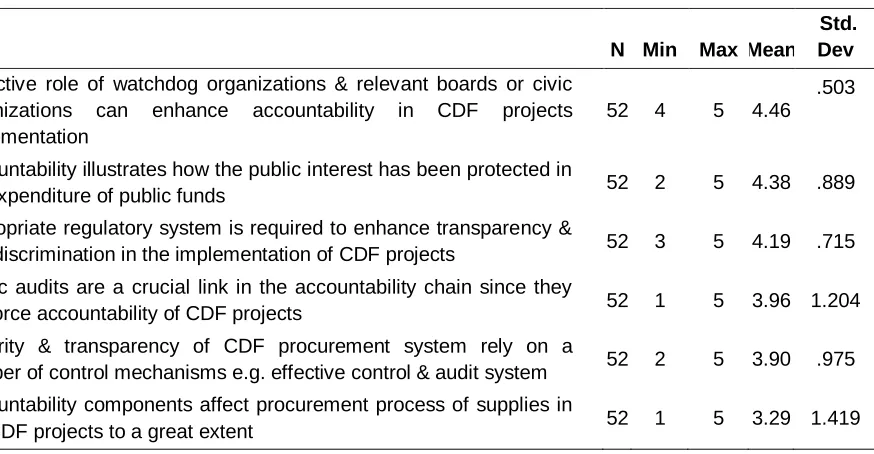
Moreover, the views of the CDFC members regarding accountability and transparency in CDF projects were sought. The results of the analysis of their opinions are as shown in Table 1.
Table 1: Descriptive Findings for Accountability and Transparency
N Min Max Mean Std.
Dev
Objective role of watchdog organizations & relevant boards or civic organizations can enhance accountability in CDF projects implementation
52 4 5 4.46 .503
Accountability illustrates how the public interest has been protected in
the expenditure of public funds 52 2 5 4.38 .889
Appropriate regulatory system is required to enhance transparency &
non-discrimination in the implementation of CDF projects 52 3 5 4.19 .715
Public audits are a crucial link in the accountability chain since they
reinforce accountability of CDF projects 52 1 5 3.96 1.204
Integrity & transparency of CDF procurement system rely on a
number of control mechanisms e.g. effective control & audit system 52 2 5 3.90 .975
Accountability components affect procurement process of supplies in
the CDF projects to a great extent 52 1 5 3.29 1.419
The CDFC members concurred (mean ≈ 4.00) that, objective role of watchdog organizations and relevant boards or civic organizations can enhance accountability in CDF projects implementation; accountability illustrates how the public interest has been protected in the expenditure of public funds; appropriate regulatory system is required to enhance transparency and non-discrimination in the implementation of CDF projects; public audits are a crucial link in the accountability chain since they reinforce accountability of CDF projects; and also that, integrity and transparency of CDF procurement system rely on a number of control mechanisms such as effective control and audit system. They, nonetheless, differed (mean = 3.29; std dev = 1.419) on whether or not accountability components affect procurement process of supplies in the CDF projects to a great extent.
Descriptive Findings and Discussions for Procurement Procedures
Licensed under Creative Common Page 1185
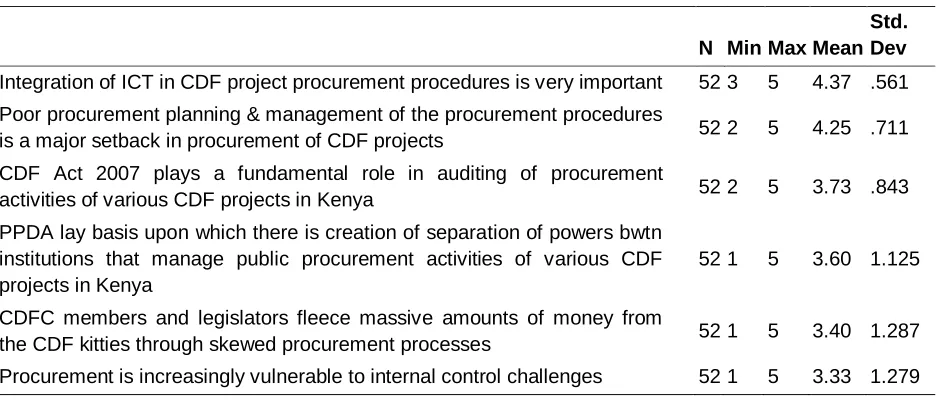
Table 2: Descriptive Findings for Procurement Procedures
N Min Max Mean Std. Dev
Integration of ICT in CDF project procurement procedures is very important 52 3 5 4.37 .561
Poor procurement planning & management of the procurement procedures
is a major setback in procurement of CDF projects 52 2 5 4.25 .711
CDF Act 2007 plays a fundamental role in auditing of procurement
activities of various CDF projects in Kenya 52 2 5 3.73 .843
PPDA lay basis upon which there is creation of separation of powers bwtn institutions that manage public procurement activities of various CDF projects in Kenya
52 1 5 3.60 1.125
CDFC members and legislators fleece massive amounts of money from
the CDF kitties through skewed procurement processes 52 1 5 3.40 1.287
Procurement is increasingly vulnerable to internal control challenges 52 1 5 3.33 1.279
It was noted that, respondents agreed that, integration of ICT in CDF project procurement procedures is very important; poor procurement planning and management of the procurement procedures is a major setback in procurement of CDF projects; CDF Act 2007 plays a fundamental role in auditing of procurement activities of various CDF projects in Kenya; and also that, PPDA lay basis upon which there is creation of separation of powers between institutions that manage public procurement activities of various CDF projects in Kenya. The aforementioned propositions returned means tending towards 4.00 (agree). On the other hand, respondents were unsure (mean ≈ 3.00; std > 1.000) whether or not CDFC members and legislators fleece massive amounts of money from the CDF kitties through skewed procurement processes; and if or not procurement is increasingly vulnerable to internal control challenges.
Inferential Findings
This section presents the inferential findings and discussions. Given that, the data collected was on a Likert scale, Pearson’s correlational analysis was employed in order to enable the drawing of inferences pertinent to the study objectives. This was realized by correlating the composite scores of accountability and transparency and the composite scores of the procurement procedures.
Effect of Accountability and Transparency on Procurement Procedures
Licensed under Creative Common Page 1186
Table 3: Correlation between Accountability and Transparency, and Procurement Procedures Procurement Procedures
Accountability & Transparency Pearson Correlation .482**
Sig. (2-tailed) .000
N 52
**. Correlation is significant at the 0.01 level (2-tailed).
Accountability and transparency were established to relate positively and moderately (ρ = 0.482; p < 0.01) with procurement procedures. The relationship between the two variables was also statistically significant at 0.01 level of significance. The findings implied that, accountability and transparency in CDF projects was crucial in influencing the projects’ procurement procedures.
SUMMARY AND DISCUSSIONS
The CDFC members agreed that, objective role of watchdog organizations and relevant boards or civic organizations can enhance accountability in CDF projects implementation; accountability illustrates how the public interest has been protected in the expenditure of public funds; appropriate regulatory system is required to enhance transparency and non-discrimination in the implementation of CDF projects; public audits are a crucial link in the accountability chain since they reinforce accountability of CDF projects; and also that, integrity and transparency of CDF procurement system rely on a number of control mechanisms such as effective control and audit system. However, they on whether or not accountability components affect procurement process of supplies in the CDF projects to a great extent. Accountability and transparency in CDF projects were found to be crucial in influencing the projects’ procurement procedures. The foregoing concurred with Brinkerhoff’s (2004) findings.
Licensed under Creative Common Page 1187
CONCLUSIONS AND RECOMMENDATIONS
It was inferred that, watchdog organizations and relevant boards or civic organizations can play a fundamental role to enhance accountability in CDF projects implementation. More so, it was conclude that, public audits are a crucial link in the accountability chain since they reinforce accountability of CDF projects. Lastly, the study concluded that, accountability and transparency in CDF projects is crucial in influencing the projects’ procurement procedures.
It is important for watchdog organizations and relevant boards or civic organizations to demand transparency and accountability in CDF projects procurement and implementation. The composition of the CDF committees should be all-inclusive. This implies that gender, age brackets and professionalism of the committee members should be factored in. An inclusive committee is likely to be accountable and transparent.
LIMITATIONS
The researcher encountered a number of bottlenecks when conducting the research. Traversing the five constituencies of Nyandarua County was a herculean task. To overcome the challenge, the researcher made a point of accessing the CDFC chairpersons through whom he administered the questionnaires to the other CDFC members. The other limitation was the instrument used to collect data. The instrument comprised close-ended questions which limited the way respondents gave their opinions regarding the issues touching on the study themes. In light of the foregoing, the researcher ensured that, the instrument captured only the most relevant and objective questions. He also ensured that, the questions were in tandem with the study objectives.
REFERENCES
Achuora, J., Arasa, R. & Ochriri, G. (2011). Precursors to effectiveness of public procurement audits for Constituency Development Funds (CDF) in Kenya. European Scientific Journal, 8(25), 198 – 214.
Anderson, R., & Macie, K. E. (1996). Understanding the differences in group purchasing. NAPM InfoEdge, 2 (4).
Aylesworth, M. M. (2003, May 18 - 23). Purchasing Consortia in the Public Sector Models and Methods for Success.” Paper presented at the 88th
Annual International Supply Management Conference, Nashville, Tennessee.
Baily, P., Farmer, D., Jessop D., & Jones D. (2005). Purchasing Principles and Management. U.K.: Pearson Education Limited.
Barrett, P. (2000). Balancing accountability and efficiency in a more competitive public sector environment. Australian Journal of Public Administration, 59(3), 58-71.
Licensed under Creative Common Page 1188 Crocker, I. & Algina, J. (1986). Introduction to Classical and Modern Test Theory. Orlando: Harcourt Brace Jovanovich.
DeVellis, R.F. (2006). Classical test theory. Med Care, 16, 50 – 59.
Dixit, A. (2002). Incentives and organizations in the public sector: An interpretative review. Journal of Human Resources, 37 (4), 696-727.
IEA. (2006).Kenyans’ Verdict: A Citizens Report Card on the Constituencies Development Fund (CDF). Nairobi: Institute of Economic Affairs.
ISA. (2009). Gross Illegalities in Constituency Development Fund need urgent Redress. CDF status report. Nairobi: Institute for Social Accountability.
Joshi, A. (2011). Review of Impact and Effectiveness of Transparency and Accountability Initiatives: Annex 1 Service Delivery. Paper prepared for the Transparency and Initiative Workshop.
Kimberlin, C.L., & Winterstein, A.G. (2008). Research fundamentals. Am J Health-Syst Pharm, 65.
Kothari, C.R. (2008). Research Methodology: Methods and Techniques. New Delhi, India: New Age International Publishers.
Mamiro, R. G. (2010). Value for Money, The Limping Pillar in Public Procurement. Tanzania Procurement Journal , 4 -5.
Mugenda, F., & Mugenda, O. (2009). The research methods. Nairobi: Acts Press.
Namusonge, G.S. (2005). Monitoring and Evaluation of Micro and Small Enterprises policies. Nairobi: KIPPRA.
Ngugi, J.K. & Mugo, H.W. (2011). Internal factors affecting procurement process of supplies in the public sector: A survey of Kenya Government Ministries.
Nyaguthii, E. & Oyugi, L.A. (2013). Influence of community participation on successful implementation of Constituency Development Fund Projects in Kenya: Case of Mwea Constituency. International Journal of Education and Research, 1(8), 1 – 16.
OECD. (2011). Internal control and internal audit: Ensuring public sector integrity and accountability. A report by OECD Internal Audit and the OECD Public Governance and Territorial Development Directorate. Paris, France.
Okungu, J, (2008), The beauty and shame of Kenya's Constituency Development Fund. Retrieved on June 10, 2014 from: http:/www.afroarticles.com/article
Ombaka E. (2009). Management of medicines procurement in Developing countries. Retrieved on June 8, 2014 from: http//health-care-procurement.com/content/pdf/1689-2231-6-8.pdf>
Ongoya, Z.E.&Lumalla, E. (2005) A critical appraisal of Constituency Development Fund Act. Concept paper by Ongoya, Z.E. &Lumalla, E. November 2005, Nairobi.
Segal and Summers 2002). Improving transparency in pharmaceutical systems: strengthening critical decision points against corruption. Washington, DC: World Bank, Human Development Network, Latin American and Caribbean Region.
TISA. (2009) The CDF Status Report December 2009. Report by the Institute for Social Accountability, Nairobi.
Trionfetti, F. (2000). Discriminatory public procurement and international trade. World Economy, 23(1), 57-76.
Vian, M., and Collins, S. (2006). Paying for ‘free’ health care: the conundrum of informal payments in