IN THE FRAMEWORK CONVENTION ON CLIMATE CHANGE AND THE SECOND SULPHUR PROTOCOL;
AN EMPIRICAL AND INSTITUTIONAL ANALYSIS
Michael A. Ridley
A thesis submitted for the degree of Doctor of Philosophy
University of London
Department of Economics University College London
All rights reserved
INFORMATION TO ALL USERS
The quality of this reproduction is dependent upon the quality of the copy submitted.
In the unlikely event that the author did not send a complete manuscript and there are missing pages, these will be noted. Also, if material had to be removed,
a note will indicate the deletion.
uest.
ProQuest 10105754
Published by ProQuest LLC(2016). Copyright of the Dissertation is held by the Author.
All rights reserved.
This work is protected against unauthorized copying under Title 17, United States Code. Microform Edition © ProQuest LLC.
ProQuest LLC
789 East Eisenhower Parkway P.O. Box 1346
John (* Jack’) Edward Ridley
This thesis studies joint implementation in the Framework Convention on Climate Change and the Second Sulphur Protocol. Joint implementation may allow countries or firms to undertake emission reduction abroad where it is less expensive, in lieu o f more expensive emission reduction at home, potentially bringing large cost savings.
Chapter 2 defines and describes a workable joint inq)lementation system, fi’om the current legal definition o f joint implementation, current practice and current discussions o f joint implementation. Joint inçlementation is further defined by comparison with other trading
mechanisms. This section compares allowance trading with emission reduction credit trading. It argues that allowance trading and emission inventory analysis go together, whilst emission reduction credit trading goes hand in hand with project by project analysis. Chapter 2 investigates how FCCC and SSP trading may evolve and sets out political objections to joint implementation.
Chapter 3 analyses data on twenty AIJ (activities implemented jointly) projects, fifteen fi*om the United States Initiative on Joint Implementation pilot phase. The present value (1997) cost o f carbon emission reduction in $/tC for each o f these projects is calculated. Carbon emission reduction achieved in the future is discounted. Carbon damage ratios are introduced to take into account the varying level of damage caused over time by a set amount of carbon in the atmosphere. Regression analysis is conducted to explain variations in cost by location and by emission reduction method. Chapter 3’s emission reduction costs are higher than in many other studies; and they suggest a different hierarchy o f project carbon emission reduction costs. Adjustments to the data to reflect costs that would prevail in a true carbon market are suggested.
also considered.
Chapter 5 turns to joint inq)lementation in the context of a non uniformly dispersed pollutant, sulphur dioxide, Wiere the problem is one of third party effects. Chapter 5 uses an integrated assessment model to investigate two issues. Recalculating exchange rates is assumed to be expensive. At the same time, the more frequent recalculation of exchange rates brings greater damage reduction per DM spent on emission reduction. Chapter 5 calculates the optimal number o f times for European carbon exchange rates to be recalculated, given the above trade off. Chapter 5 also reveals that different countries will have different views about the number o f times that exchange rates are recalculated.
Chapter 5 also looks at emission reduction agreements and emission trading when Eastern European states are involved and when they are not involved. The benefits of multilateral trading compared to bilateral are expounded.
Lists of Tables 8
List of Diagrams 10
List of Maps 11
List of Abbreviations 13
List of Addresses 15
Acknowledgements 17
Special Note 20
CHAPTER 1: INTRODUCTION AND MOTIVATION
1.1 Introduction and Motivation 21
CHAPTER 2: JOINT IMPLEMENTATION UNDER THE
FRAMEWORK CONVENTION ON CLIMATE
CHANGE AND THE SECOND SULPHUR PROTOCOL
2.1 Introduction 25
2.2 What is Joint Implementation? 27
2.2.1 Defining Joint Implementation 27
2.2.2 Joint Implementation and Other Trading Mechanisms 28
2.2.3 Benefits of Joint Implementation 31
2.2.4 Joint Inq)lementation and the Global Environment Facility 36
2.2.5 Joint Implementation and the Private Sector 36
2.3 Joint Implementation in International Law 37
2.3.1 The Framework Convention on Climate Change (FCCC) 37
2.3.2 The Second Sulphur Protocol (SSP) 40
2.3.3 Comparing Joint Inqjlementation in the FCCC and the SSP 43
2.4.1 AIJ, JI and TPs 47 2.4.2 Allowance Trading versus Emission Reduction Credit Trading 49
2.4.3 Project by Project Analysis 53
2.4.4 Inventory Analysis 54
2.4.5 Additionality 55
2.4.6 Cheating 58
2.5 Problems 61
2.6 Conclusions 65
Appendix 2 A: Agreement Reached at FCCC COP 1 in Berlin, 20 March 66 - 7 April 1995
CHAPTER 3: THE COST OF CARBON IN A CARBON PERMIT
MARKET
3.1 Introduction 68
3.2 The FCCC Pilot Phase 70
3.3 Carbon Damage Costs 73
3.4 The Data 76
3.5 Methodology 83
3.5.1 Overview 83
3.5.2 Carbon Damage Ratios 85
3.5.3 Discounting 88
3.5.4 Equivalent Damage 91
3.6 Results 92
3.7 Sensitivity Analysis 98
3.7.1 Overview 98
3.7.2 Carbon Damage Ratios 98
3.7.3 Discounting 101
3.8 Rusagas 116
3.9 Conclusions 117
Appendix 3 A: Information on JI Projects 118
Appendix 3 B: USIJI Costs and Carbon Emission ReductionData 142
CHAPTER 4: THE CARBON HIERARCHY REVISITED
4.1 Chapter 3’s Results 157
4.1.1 Introduction 157
4.1.2 How Representative is the Chapter 3’s Sample? 160
4.1.3 Are Chapter 3 ’s Results at Odds with Other Studies’ Results? 161
4.2 Support for Chapter 3’s Results 166
4.2.1 Existing Studies 166
4.2.2 Venezuelan Costs 168
4.3 The Carbon Hierarchy 174
4.3.1 Overview 174
4.3.2 Energy Efficiency 176
4.3.3 Carbon Sequestration 181
4.3.4 Fuel Switching 183
4.4 Will Prices Fall as Trading Begins? 185
4.5 Wider Costs of Emission Reduction 186
4.6 Joint Implementation as Foreign Policy 188
4.7 Conclusions 190
Appendix 4 A: More Information on Venezuelan Emissions 191
Appendix 4 B : Average Energy Prices in Some Latin American Countries 191 During 1992
DISPERSED
5.1 Introduction 199
5.2 Trading With a Non Uniformly Dispersed Pollutant 200
5.3 Modelling European Sulphur Emission Reduction Trading 201
5.3.1 Framework 201
5.3.2 Data 206
5.3.3 Simulating Emission Reduction Runs with AS AM 208
5.3.4 The Base Run 209
5.3.5 Weighted Trading Runs 210
5.3.6 ASAM, RAINS and CASM Con^ared 214
5.4 How Often Should Exchange Rates Be Recalculated? 215
5.4.1 Introduction and Previous Results 215
5.4.2 Methodology and Results 216
5.4.3 Conclusions and Discussion 219
5.5 Emission Reduction W ith and Without Eastern European 222
Participation
5.5.1 Introduction and Previous Results 222
5.5.2 Methodology and Results 222
5.6 Discussion 229
Appendix 5 A: Results from Section 5.4 233
Appendix 5 B: Results from Section 5.5 235
CHAPTER 6: LOSSES FROM SEQUENTIAL TRADING
6.1 Introduction 236
6.2 Sequential Trading 237
CHAPTER 7; SUMMARY, CONCLUSIONS AND FURTHER RESEARCH
7.1 Summary 247
7.2 Conclusions 249
1J5 Further Research 252
Units 255
CHAPTER 2 Table 2.1: Table 2.2: Table 2.3: Table 2.4: Table 2.5:
Conqjaring Joint Implementation with other Trading Mechanisms Emission Reductions Agreed under the Second Sulphur Protocol Five International Agreements Allowing Trading
Definitions o f AU, JI and TPs
When Inventory Analysis o f Emission Reduction is Possible
CHAPTERS Table 3.1: Table 3.2: Table 3.3: Table 3.4: Table 3.5: Table 3.6: Table 3.7: Table 3.8: Table 3.9: Table 3.10: Table 3.11: Table 3.12: Table 3.13: Table 3.14: Table 3.15: Table 3.16: Table 3.17:
Different Valuations o f Damage fi-om a Tonne o f Carbon, in $/tC List of Joint Implementation Projects
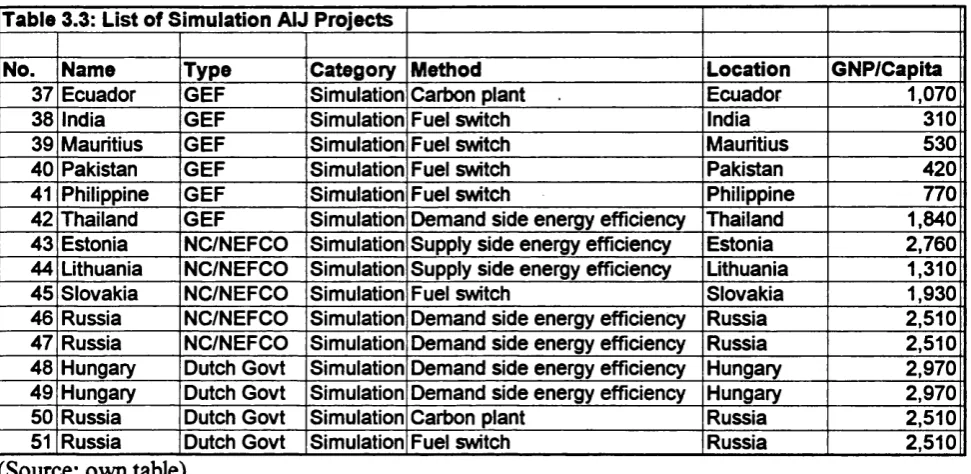
List o f Simulation AIJ Projects
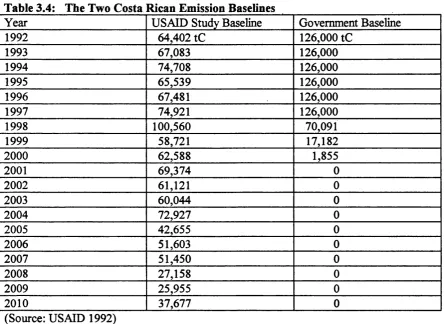
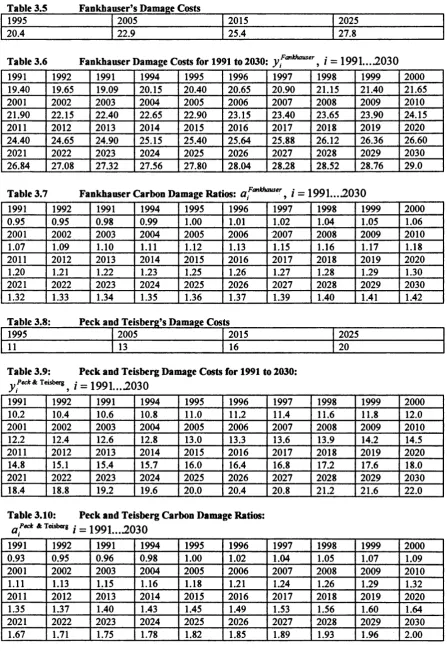
The Two Costa Rican Emission Baselines Fankhauser’s Damage Costs
Fankhauser’s Damage Costs for 1991 to 2030
Fankhauser’s Carbon Damage Ratios for 1991 to 2030 Peck and Teisberg’s Damage Costs
Peck and Teisberg’s Damage Costs for 1991 to 2030
Peck and Teisberg’s Carbon Damage Ratios for 1991 to 2030 Discounted Fankhauser Carbon Damage Ratios
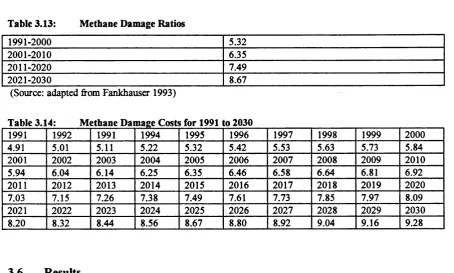
Discounted Peck and Teisberg Carbon Damage Ratios Methane Damage Ratios
Methane Damage Costs for 1991 to 2030 Results
Project Costs Using Different Carbon Damage Ratios (When r=0.03)
Table 3.19:
Table 3.20:
Table 3.21:
Carbon Sequestration Costs When Carbon Stored is Released into the Atmosphere in 2030
Suggested Alterations to Achieve 100% Additionality for Forestry Projects
Suggested Alterations to Achieve 100% Additionality for Non Forestry Projects CHAPTER 4 Table 4.1: Table 4.2: Table 4.3: Table 4.4: Table 4.5:
Emission Reduction Costs: Currents Predictions, Actual Costs, Possible Costs in a Carbon Market
Cost of Emission Reduction from Mintzer et al (1994)
Annual Venezuelan CO2 and CH4 Emissions in Absolute Terms and Carbon Equivalent Quantities
Venezuelan Results
Energy Efficiency Opportunities By Sector
CHAPTERS Table 5.1: Table 5.2: Table 5.3: Table 5.4: Table 5.5: Table 5.6 Table 5.7 Table 5.8
Grids in Exceedence in Five Emission Trade Runs Net Emissions in Five Emission Trade Runs AE/ AG in Five Emission Trade Runs
Emission Reduction Required of Three Countries under Three Different Reweighting Runs
The Twelve States Undertaking Emission Reduction in Runs 6 and 7 and Thirty Two States Undertaking Emission Reduction in Runs 1 Through 5
Grids in Exceedence in Four Emission Reduction Runs Emissions in Four Emission Reduction Runs
Table 5.9: Table 5.10:
Table 5.11:
Table 5.12:
Table 5.13: Table 5.14: Table 5.15: Table 5.16: Table 5.17:
The Single Weighting Run
Run with Weightings Set at the Beginning with Reweightings After Every 2.5 Billion DM of Expenditure
Run with Weightings Set at the Beginning with Reweightings After Every 5 Billion DM of Expenditure
Run with Weightings Set at the Beginning with Reweightings After Every 10 Billion DM of E3q>enditure
dG/dC for Five Trade Runs dE/dC for Five Trade Runs
dE/dC.dC/dG for Five Trade Runs
Base run 12 - Baserun Involving Twelve Countries
Weight EU 12 - Single Weighting Run Involving Twelve Countries
CHAPTER 6 Table 6.1:
Table 6.2:
Probability Distribution of Pairings when Lower Buyer Enters First and One Pairs with the First Person One Meets
LIST OF DIAGRAMS
CHAPTER 2 Diagram 2.1: Diagram 2.2:
Showing Gains from Joint Implementation
Showing the Emission Reduction Lost by the )^%hdrawal of
Emission Reduction Plans and Exaggeration of Emission Reduction
CHAPTER 3 Diagrams.1: Diagram 3.2:
Carbon Ratios
Carbon Damage Ratios Discounted Back to 1997 at 3%
CHAPTER 4
Diagram 4.1: Emission Reduction Costs in Venezuela and Costa Rica
CHAPTERS Diagram 5.1:
Diagram 5.2:
Grids in Exceedence for Five Runs with Different Reweighting
Frequencies ^
LIST OF MAPS
CHAPTER 5
Map 5.1: Target Load for Sulphur: 60% Gap Closure Between 1990 and 5% Critical Load
Map 5.2: Exceedence of 5% Critical Load for Sulphur in 1990
Map 5.3: Exceedence of 5% Critical Load for Su^hur at 5Ba DM/yr.; Weighted Trade Run of 12 Western European States
Map 5.4: Exceedence of 5% Critical Load for Sulphur at 5B a DM/yr.; Base run of 12 Western European States
Map 5.5: Exceedence of 5% Critical Load for Sulphur at 5B a DM/yr.; Weighted Trade Run of All States
LIST OF ABBREVIATIONS
AES Applied Energy Systems
AIJ Activities implemented jointly
ASAM Abatement Strategy Assessment Model
CAA Clean Air Act
CAAA Clean Air Act Amendments
CASM Co-ordinated Abatement Strategy Model
CCE Co-ordinating Centre on EfiFects at RIVM, the Netherlands CEMs Continuous Emissions Monitoring System
CFCs Chloroflorocarbons
CFLs Compact fluorescent light bulbs
CSERGE Centre for Social and Economic Research on the Environment COP-1 (First meeting of the) Council of the Parties
EBRD European Bank for Reconstruction and Development EMEP European Monitoring and Evaluation Programme ERC Emission Reduction Credit
EPA (US) Environmental Protection Agency FACE Forests Absorbing Carbon Dioxide Emissions FCCC Framework Convention on Climate Change
FF French Franc
F JIN Foundation Joint Implementation Netherlands
GDP Gross Domestic Product
GEF Global Environment Facility
GWP Global Warming Potential
lADB Inter American Development Bank
ICPR International Commission for the Protection of the Rhine DBA International Energy Authority
IPCC Intergovernmental Panel on Climate Change
JI Joint implementation
MdPA Mines des Potasse d’Alsace
NAAQS North American Air Quality Standards
NAPAP National Acid Precipitation Assessment Programme
NAS National Academy of Sciences
NEFCO Nordic Environment Finance Corporation
NC Nordic Council
NEP New England Power
NMVOC Non Methane Volatile Organic Conpound)
OECD Organisation for Economic Co-operation and Development OTA OfiBce of T echnology Assessment
RAINS Regional Acidification Information and Simulation SCAQMD South Coast Air Quality Management District SEI Stockholm Environmental Institute
SSP Second Sulphur Protocol
TPs Tradable Permits
UNCED United Nations Commission for Environment and Development UNECE United Nations Economic Commission for Europe
UNEP United Nations Environment Programme
USAID United States Agency for International Development USCSP United States Country Studies Programme
LIST OF ADDRESSES
Edison Electric Institute
701 Pennsylvania Avenue NW, Washington DC 20004-2696 tel. 202 508 5711
E7 Network of Expertise for the Global Environment E7 Secretariat
1010 St. Catherine Street West 6th Floor, P.O. Box 6162
Montréal, Québec, Canada H3C 4SL
Face Foundation
Utrechtseweg 310, PO Box 575, NL-6800, Arnhem, the Netherlands
Foundation, Joint Implementation Network Zemike Science Partk Centre 2
9747 AN Groningen, the Netherlands, tel 31 50 5745717
Global Environment Facility Secretariat
1818 H Street NW, Washington DC 20433, USA
USIJI Secretariat:
Located at: Mailing address:
Forrestal Building USIJI (PO-6)
1000 Independence Avenue SW Room GP 196
Room GP 196 1000 Independence Avenue SW
World Business Council for Sustainable Development
c/o Mr. Jim Leslie, TransAlta Corporation, 902,, 110 12th Avenue SW, Box 1900, Calgary, Alberta, TP2 2MI, CANADA
ACKNOWLEDGEMENTS
Deciding at the age of twenty four that I wished to undertake doctoral research in economics, when possessing an undergraduate degree in Political Science and a Master’s degree in Politics of the World Economy, meant that I had my work cut out. Achieving the PhD thus involved great effort getting to the starting point as well as completing. For helping me to get to the starting point I thank Jonathan Wadsworth, Amos Witztum, Michael Hodges (all, when I encountered them, at LSE) and Bob Evenson, Jorge Portillo and Jason Shogrun (all Yale), those at the LSE summer school in economics, which I attended annually from 1991 to 1994 and my Yale International and Development Economics MA classmates of 1992-1993.
David Pearce has created a centre of excellence in environmental and resource economics through his research over the last thirty years. I am grateful to him for making this available to me when I arrived at UCL in 1993. David has helped me with his learning, patience, kindness and fortitude. He allowed me to seek out my own subjects; yet many o f the questions he raised o f my work were the ones I later came to find the most fescinating. He has supervised my work with great care, thoroughness and imagination. He has demanded great precision in my texts. He also passed very good material on to me at opportune times. I am very grateful to him for all his support.
I am proud of winning one of the few three year research scholarships awarded annually by the ESRC. I am grateful to the ESRC for this and for funds they gave me to undertake three field trips: to the Groningen International Conference on Joint Implementation in the Netherlands in June 1995, to the USA and Venezuela in January-February 1996 and to Denmark and the Netherlands in February 1996. I am grateful to the UCL Graduate School for funds to attend the United Nations First Council of the Parties to the FCCC meeting in Berlin in March and April 1995 and the Royal Institute of International Affairs ‘Controlling Carbon and Sulphur’ December 1996 Conference in London. I thank Eva Luber for giving me accommodation in Berlin. I am grateful to my parents for financial support and advice in the crucial ‘post ESRC’ period.
Chapter 2 benefited fi"om a conversation with Kenneth Richards. I am grateful to the United States Initiative on Joint Inq)lementation (USIJI) Secretariat in Washington DC and to Forests Absorbing Carbon Dioxide Emissions (FACE) in Arnhem for granting me access to data that I analyse in chapter 3. The USIJI secretariat granted me ofiBce space for two days and representatives of USIJI and FACE discussed joint implementation and individual projects with me in detail. Alan Randall, Tia Nelson and Randy Curtis at the (US) Nature Conservancy discussed the Rio Bravo and Biodiversifix carbon sequestration projects with me. Ted Vinson and Tatyana Kolchugina of Oregon State University discussed Rusagas and Rusafor with me. Sandra Brown, Roger Dower, Charles Feinstein and Wytze van der Gaast discussed ideas and information with me. The Danish Environmental Agency in Copenhagen gave me information on Nordic Council ‘simulation joint implementation projects’. Sarah Ridley and John Zelenik helped me with data acquisition in the United States, as well as making and receiving many late night transatlantic ‘phone calls. I thank Sam Fankhauser for giving me comments on a draft of chapter 3 and for answering a subsequent query on this chapter.
Peraza for putting me up in Venezuela. I thank Ken Gwilliam at the World Bank for his views on the Venezuelan transport situation.
I am extremely grateful to Rachel Warren at Imperial College Centre for Environmental Technology for her assistance on my work for chapter 5. She assisted me greatly in conducting runs on the ASAM model. Her precise language in describing ASAM’s current structure was extremely helpful and our debates about what would and would not be possible on ASAM were extremely interesting.
At UCL I would like to thank Richard Blundell, Wendy Carlin, Maria lacovou, Fahmida Khatun, Arundhati Kunte, Tim Kuypers, Maite Martinez-Granado, Roger Salmon, Steve Smith and Anne Usher for their support and positive attitudes. I would like to thank Valika Foundoulakis for reading a draft of the thesis. In the wider University of London community I would like to thank Marieli Garcia de la Torre, Paula Manzini, Tony Ridley and Jane Ridley.
SPECIAL NOTE
Chapter 3 of this thesis analyses joint implementation projects data collected on field trips to the head offices of FACE (Forests Absorbing Carbon Dioxide Emissions) in Arnhem and the USIJI (United States Initiative on Joint Implementation) Secretariat in Washington DC. Information on USIJI projects has also been obtained fi’om USIJI project managers.
The USIJI secretariat granted me access to the project documents for all fifteen first and second USIJI projects. This information was made available to me on the grounds that, when discussing projects’ emission reduction costs, projects are not identified by name but only by their type (e.g. 'fuel switching’) and by the country in which they take place. To uphold this agreement whilst at the same time making public information obtained via other channels or already made public by the USIJI, the following arrangement has been made. Data on the USIJI projects obtained outside of my agreement with the USIJI secretariat is presented in appendix 3 A, where projects are referred to by name. Cost and carbon emission reduction data obtained fi’om the USIJI secretariat and covered by my agreement with them are presented in appendix 3 B. Projects are referred to by letter, not by name in appendix 3 B.
Examiners of this thesis have been handed a sheet putting projects names to the project letters used in appendix 3 B. Without this information no concrete link can be made between the two sets of information. Readers seeking this information may write to the author at the following address:
M. Ridley Esq. c/o 77 Church Road Richmond
CHAPTER 1: INTRODUCTION, MOTIVATION AND OVERVIEW
1.1 Introduction and Motivation
Lemer stated in 1972 that
‘An economic transaction is a solved political problem. Economics has gained the title the queen of the social sciences by choosing solved political problems as its domain’ (1972, p. 259; italics in original).
Lemer’s first point was correct; when people engage in commodity exchange, the exchange is uncontested and non political. Because an economic transaction is a solved political problem, when a market operates we are not in the realm o f politics, the world of influence, persuasion and bureaucracy, but the more fiictionless realm o f economics.
Lemer was aware that for economic exchange to be possible, property rights need to be established and a jurisdiction within which trading is condoned created and maintained. A political consensus needs to be reached that trading a particular commodity form is acceptable. To transfer an allocation problem once and for all fi’om the realm of politics to that of economics, to transform it fi*om a political problem to an economic transaction, a once and for all decision condoning the trade and its effect needs to be taken. ^
However, Lemer was wrong in arguing that economists restrict themselves to expounding on existing market exchanges and established markets; many strive for or contribute to the transformation Lemer describes. In the same year that Lemer wrote the above, Montgomery published the first mathematical treatment of tradable permits, updating a concept originally presented in 1968 by Dales (Montgomery 1972, Dales 1968a,b). Economists and regulators in the intervening twenty five years have striven to widen the domain of the market into the environmental field (Hahn and Hester 1989b, Kete 1992,
^ Lemer stated ‘With or without a fight, there is a settlement or compromise in which the rights are defined....What I want particularly to stress is that the solution is essentially the transformation of the
Klaassen 1995, Pearce 1993, Tietenberg 1985). Many have argued that the realm of economic ownership and exchange should be widened, that pollution rights be established and provision made for exchange o f these newly defined commodities. Several economists have also identified instances when trading will produce less gains than those envisaged by Montgomery (Atkinson and Tietenberg 1991, Hanley et al 1995) while others have reported fewer than the anticipated trades (Dudek and Palmisano 1988).
This thesis examines joint implementation of carbon dioxide and sulphur dioxide emission reduction. In the carbon context, joint implementation could lead to the global trading of carbon dioxide emission permits. Joint implementation in the sulphur context could lead to a European sulphur dioxide trading scheme. Neither scheme has been unequivocally condoned. Under the auspices of the Framework Convention on Climate Change, a decision was taken at the First Council of the Parties in Berlin to sanction a joint implementation pilot phase that generates no credits (i.e. to sanction ‘activities implemented jointly’ or AIJ projects). With regards to the Second Sulphur Protocol, although the trading of national emission reduction obligations technically is allowed, no trades have taken place.
Either o f the above mentioned systems can cross this Rubicon of approval, if the economic gains o f trade are shown to be substantial, if third party effects are also shown to be limited or politically acceptable, and if the economic gains are shared out in a reasonable manner. Joint implementation in the FCCC and the SSP is a feiscinating case study on the crystallisation of a theoretical concept into a working system. The eirçirical and institutional elements of this thesis test political and legal objections to joint implementation and survey the possibility of setting up a successful trading system.
This thesis is ‘an empirical and institutional analysis of joint implementation’ and involves both an empirical analysis of carbon emission reduction data (chapters 3 and 4) and two modelling exercises that inform the institutional arrangement for SSP trading (chapters 5 and 6). Chapters 3 and 4 use a data set acquired on a visit in January 1996 to the USIJI Secretariat (an organisation run jointly by the US Department of Energy and the USEPA) and energy data acquired from a field trip in February 1996 to Venezuela. These chapters investigate the cost of carbon dioxide emission reduction and carbon sequestration and its variation by emission reduction method and by location. This analysis supports novel views on the absolute and relative costs of different emission reduction methods.
The problem faced by trading in the SSP context is that of getting trades to take place, given the potential third party effects that trading can have when the pollutant is non uniformly dispersed pollutant. Chapter 5 uses an integrated assessment model to model European emission reduction agreements and trades of emission reduction obligations between European countries. Given the current moribund state of the SSP joint implementation mechanism, multilateral trading rather than the currently envisaged bilateral trading is recommended. Chapter 6 examines how early sub-optimal trades reduce net benefits in sequential trading compared to multilateral trading.
A good deal of this thesis deals with Institutional matters, because effective institutions need to be constructed If exchange, unhindered by vetoes to trades, is to take place. There is little point in promoting trading in a general sense, but preventing individual trades from proceeding: yet this is the current situation with regards SSP trades.
CHAPTER 2: JOINT IMPLEMENTATION UNDER THE FRAMEWORK CONVENTION ON CLIMATE CHANGE AND THE
SECOND SULPHUR PROTOCOL
2.1 Introduction
The Framework Convention on Climate Change (FCCC) and the Second Sulphur Protocol (SSP)* are both emission reduction agreements that allow countries jointly to implement emission reduction projects or policies. Joint in^lementation involves changing the location at which emission reduction is undertaken. Countries or companies are allowed to undertake emission reduction abroad or in other companies’ jurisdictions, where emission reduction is less expensive, rather than at home, where it is more expensive: low cost emission reduction is undertaken instead of high cost emission reduction. In another sense the gain comes from putting off high cost emission reduction that would have been undertaken today until later, and by undertaking in its place low cost emission reduction brought forward from the future.
Joint implementation under the FCCC, if accompanied by a decision of the developed countries to reduce emissions, could allow for a massive transfer of funds and technology to the developing world, in return for a flow of emission reduction credits in the opposite direction. Joint implementation could give the developed world access to the low cost emission reduction opportunities in the developing world, while the developing world would in its turn receive technology as well as secondary air pollution benefits. An economic saving would be made from each trade which could be divided between the two parties.
Section 2.2.1 o f this chapter defines joint implementation. The benefits of joint implementation are set out in section 2.2.3. The nature and practice of joint implementation is further defined in sections 2.2.2, 2.2.4 and 2.2.5 where joint
implementation is compared to other types of trades, to tradable permits and the Global Environment Facility respectively. Section 2.3 sets out the legislation enabling SSP and FCCC joint implementation trades.
Two different types of trading systems would be possible under the FCCC: an emission reduction credit trading system and an allowance trading system. Under an emission reduction credit system, credits can only be sanctioned and then traded, after it has been proved that a project has achieved ‘additional’ emission reduction; project by project analysis of emission reduction is required. Under an allowance trading scheme, permits are granted to a country independently of that country achieving emission reduction. Emissions are monitored by inventory analysis and not in project by project feishion. Section 2.4 sets out the two systems and their respective problems.
Section 2.5 addresses political and international relations problems of joint implementation. Political problems stem fi*om the feet that, as low cost emission reduction opportunities are situated in the developing world, there is a need for north-south co operation if gains fi*om trade are to be achieved.
2.2 What is Joint Implementation?
2.2.1 Defining Joint Implementation
Joint implementation sees a country or a firm (the donor) paying for, (or participating in), an emission reduction or carbon sequestration project or policy in another country or firm’s plant (the host), instead o f reducing emissions or undertaking carbon sequestration at home. The donor supplies technology, policy advice or money to the host. In return, the donor receives emission reduction credits equal to (or less than) the amount of the emission reduction achieved. Joint implementation thus involves the transfer of an activity or policy across a boundary or jurisdiction; a country or firm undertakes, pays for or achieves emission reduction in another country or within another firm’s plant. The two trading entities need only to be in different jurisdictions and not in different countries.
The action undertaken abroad must involve reducing or sequestering the same pollutant which would have been acted against in the host country, if joint implementation had not occurred. Paying for SO* emission reduction abroad instead of for CO2 emission
reduction at home is not joint implementation. In other words, whatever pollutant was acted against abroad must have been able to be acted against at home. Thus a western country paying to preserve biological diversity in a tropical country does not constitute joint implementation because the same biological diversity could not have been preserved
in the western donor; this simply would be paying to preserve biological diversity.
Although the same pollutant must be acted against abroad as would have been acted against at home, the same action need not be undertaken. For example, paying for carbon sequestration (forest conservation or enhancement) abroad instead o f reducing CO2
emissions at home would constitute joint in^lementation, because, although different actions are undertaken, the same pollutant is acted against.
Collaboration could be on a project or a policy. The party paying for the environmental improvement is called the donor, while the receiving party is called the host. Donors receive credits equal to (or less than) the amount o f emission reduction achieved in host countries. These credits count against an emission reduction target feced by the donor. In terms of the Edgeworth Box, trading involves moving from an initial agreement point closer to the contract curve, closer to achieving the same net emission reduction at the least cost.
Recently it has been argued that joint implementation might be interpreted more widely to involve not only flexibility in the location of emission reduction but also flexibility in the timing of emission reduction. By this interpretation, the project undertaken in lieu of emission reduction at home could be delayed for a period. Allowing flexibility on timing introduces a problem of intertenqx)ral hotspots and leads one to ask if emission reduction will ever be undertaken. At the same time the extra flexibility would allow the cost of emission reduction to fell further. There is no natural association between this concept and joint inplementatioiL This extra intertenporal flexibility is not modelled or considered here.
It is important to distinguish between the benefit of an international emission reduction agreement and the benefit o f a joint implementation trade. The international emission agreement entails a net fall in emissions. If the joint implementation trade is a one for one trade, where net emissions stay constant, the gain from the trade is lower cost emission reduction. The situation is more complex with a non one for one trade. The impact of a non one for one trade is lower cost emission reduction plus a change in net emissions.
2.2.2 Joint Implementation and Other Trading Mechanisms
American firm pays for an emission reduction project in Mexico and receives emission reduction credits in return.
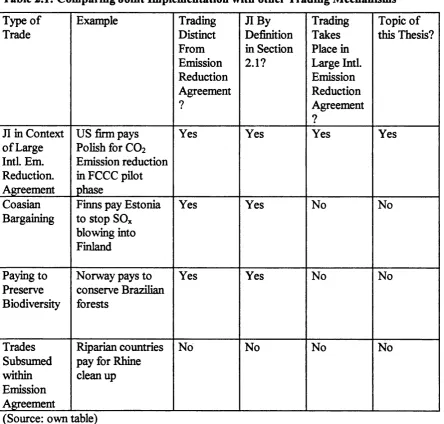
Now suppose Finland were to pay Estonia to stop its sulphur dioxide emissions fiowing into Finland (as envisaged by Tahvonen et al 1993). According to the definition of joint implementation given in section 2.2.1 above, this could constitute a joint implementation deal. However, as this trade does not take place in the context o f an international agreement involving many countries, it is not studied here. The spontaneous deal between neighbouring states (the Finland-Estonia deal) is a Coasian bargain where the polluted party pays the polluter to reduce its emissions. The rationale of this deal is not to secure lower cost emission reduction than is possible at home, but to stop depositions felling onto Finnish territory. A practical difference is that in a large international agreement an emission reduction permit is exchanged, whereas no permit is exchanged in the Finland- Estonia deal.
Consider now a deal where the Norwegian government pays for biodiversity preservation in Brazil. This is not a joint implementation deal because the Norwegians could not have preserved the same type of biodiversity at home, had they not preserved biodiversity abroad in Brazil. Furthermore, this deal between Norway and Brazil does not take place in the context of a large international emission reduction agreement.
These four agreements are set out in table 2.1 below. The second row project is a joint implementation deal undertaken in the context of a large international emission reduction agreement. This is the type of deal studied in this thesis. The third row project is a Coasian bargain, a trade that does not take place in the context of a large international emission reduction agreement. The fourth row project sees Norway paying for biodiversity in Brazil. The fifth row project is an agreement where trading has been subsumed within the emission reduction agreement process.
Table 2.1: Comparing Joint Implementation with other Trading Mechanisms
Type of Trade Example Trading Distinct From Emission Reduction Agreement ? JI By Definition in Section 2.1? Trading Takes Place in Large Intl. Emission Reduction Agreement ? Topic of this Thesis?
JI in Context of Large Intl. Em. Reduction. Agreement
US firm pays Polish for CO2
Emission reduction in FCCC pilot phase
Yes Yes Yes Yes
Coasian Bargaining
Finns pay Estonia to stop SOx blowing into Finland
Yes Yes No No
Paying to Preserve Biodiversity
Norway pays to conserve Brazilian forests
Yes Yes No No
Trades Subsumed within Emission Agreement Riparian countries pay for Rhine clean up
No No No No
Only those trades that are joint implementation trades as defined in section 2.2.1 above and that also take place within large international emission reduction agreements are studied in this thesis. Only those trades that enter a ‘yes’ in columns four and five are studies in this thesis: only row two meets these requirements.
2.2.3 Benefits of Joint Implementation
The gains fi"om a joint implementation trade must be distinguished fi*om the gains of an emission reduction agreement. In a one for one joint inq)lementation deal, there is no net emissions change and the gain is purely to achieve a set level of emission reduction at a lower cost. One way to depict the gain fi’om trade is in diagram 2.1 below. Two countries’ marginal abatement cost curves are depicted. The marginal abatement cost curve of party B is inverted and runs in the opposite direction o f party A’s marginal abatement cost curve.
Diagram 2.1: Showing Gains from Joint Implementation
Cost A Cost B
W X p Y
A’s emission reduction: High
Low
Low
B’s emission reduction: High
A and B together are to undertake emission reduction of the size W to Y. A is to undertake emission reduction Y to X, and B is to undertake emission reduction W to X. Diagram 2.1 shows that a more efficient arrangement is for A to pay B to undertake the additional emission reduction X to P instead of A undertaking P to X, After this trade, the same overall level of emission reduction W to Y is still undertaken. The gain from the trade is the cost saving L, that is the saving that A makes from not having to undertake emission reduction P to X, minus the cost of B having to undertake emission reduction X to P.
Consider now a numerical example. Suppose party A emits 100 units o f a pollutant and that B emits 50 units. Under an emission reduction agreement, A has agreed to reduce emissions to 80 units and B to 40 units. Under a joint implementation trade, A and B can end up with any level of emissions, so long as the total emissions are no greater than 120. Suppose that the two parties agree that A will reduce emissions to 90 units and B to 30 units. The gain from trade is the difference in cost between reducing B’s emissions from 40 to 30 units and reducing A’s emissions from 90 to 80 units. The cost of B reducing from 40 to 30 units is less than what A receives for not reducing from 90 to 80 units: this feet is the reason that the trade can take place.
How the gains from trade are divided up depends in part on market conditions. In an open market of joint implementation deals a market solution will prevail; the elasticities of supply and demand will determine whether the donor or host gets the larger share of the benefit. If we see a monopolist facing a monopsonist, the problem is similar to that of two people dividing a cake. Here, each person’s impatience plays the major role in determining the division of spoils (Rubinstein 1982). Barrett argues that the most efficient scheme is one where the host country receives only the net incremental cost of the project, because if hosts receive more than this, fewer than the optimal number of trades will take place (1993a). However, this would leave no incentive for countries to host deals! It is most likely that bargaining between buyer and seller would take place which would leave final prices somewhere between the net and the gross incremental cost of the project.
We have considered the gain from trade in a static sense above. Seen in a dynamic context, joint implementation allows low cost emission project Y to be undertaken today, with high cost project X deferred into the future. If project X is eventually undertaken, the gain joint implementation comes from undertaking project Y ahead of project X, instead of X before Y. The gain is the benefit of undertaking the expensive project later rather than sooner, minus the loss from undertaking the inexpensive project sooner rather than later.
The magnitude of the cost saving depends on the difference between X and Y, the length of time between the dates at which Y and X are undertaken and the magnitude o f the discount rate: the higher the discount rate the greater the gain from joint inqilementation. If the discount rate is zero and both the higher and lower cost steps have to be undertaken, there is no gain from joint inq)lementation (Mason and Swanson, p. 31).
A second gain could be achieved if emission reduction costs fell over time due to ^ improved technology, improved policy and improved management. Allowing an expensive project rather than an inexpensive one to be put off into the future means that a
greater gain from the fall in costs over time (through technological development) is achieved.
The lower cost of emission reduction that joint implementation may bring could be exploited in two ways. Either a set amount of emission reduction could be achieved at a lower cost, or more emission reduction could be achieved. More emission reduction could be achieved in two ways. Nations who previously had not been party to an emission reduction agreement could opt into that agreement (so reducing free riding); alternatively, countries that are already party to the agreement could reduce their emissions even further. Which avenue would achieve greater net emission reduction depends on the trade off between the strength of a protocol and the number of countries that sign it: a protocol with large emission reduction targets but few signatories may or may not achieve more net emission reduction than a protocol with smaller individual emission reductions but more signatories.
When joint implementation involves a uniformly dispersed pollutant and the trade is one for one, the benefit of a trade is solely that of achieving a set emission reduction at a lower cost. Where the pollutant is non uniformly dispersed, as with sulphur, there is a cost saving and an environmental impact which may be positive or negative, or by chance neutral. The environmental impact in the latter instance is hard to avoid since, for a non uniformly dispersed pollutant the location of emissions or emission reduction has an impact on damage and joint implementation involves changing the location of emission reduction! Attempts can be made to minimise or neutralise the environmental impact of! joint implementation trades, but they are unlikely to be wholly successful (see chapter 5). I
may be interested in a sulphur joint implementation deal to reduce depositions falling onto ^ \ y : ' , its land. Firms, however, will not be interested in achieving localised emission reduction^
unless they own large tracts of land. M ^
\
V V
What scope there is for trading and for gains from trade depends upon how perfect in \ economic terms the initial agreement itself was. There are potential gains from trade only J when the initial agreement has not placed parties on the contract curve in the Edgeworth \ Box. Being on the contract curve for the FCCC where the pollutant is uniformly
- 1 dispersed means that all countries’ marginal abatement costs would be the same as one | • another’s: making the agreement a least cost solution. In the optimal solution, all
countries’ marginal abatement costs are equal and the total marginal abatement cost for all countries is equal to the total marginal abatement benefit. A least cost solution is a necessary but not sufficient condition for being the optimal solution.
The SSP and the FCCC are not least cost solutions, so gains from trade are possible. The potential for gains is probably greater under the FCCC, however, because initially the SSP was an attempt at optimisation - although this was an unsuccessful^ attempt. The fact that joint implementation was written into the SSP shows that the parties negotiating the agreement realised it would not be a least cost solution. Parties felt that information used in the models may be inaccurate. Indeed differences in the solutions provided by the models show they could not aU be right! The parties also felt that some states might not accept the touted cost minimal solution, given the emission reduction they would have to achieve as part of this solution (Klaassen et al, 1994, p. 305).
Even if an international agreement for uniformly dispersed pollutants does not leave countries with similar marginal abatement costs (not on the contract curve), and even if trading is allowed, trading will not take place if emission targets are set too high or too low. If emission targets are so high that they do not constrain emissions, countries will not need to reduce emissions and so will not need to trade in order to reduce the cost of emission reduction. If emission targets are set at zero and noybmissions are allowed, then
/
/ . f,\
no countries will have any spare allowances to trade. Between the two extremes o f non binding targets and complete elimination of emissions, a trading system will be able to bring gains. Transaction costs associated with trading will reduce the possible gains from trade.
2.2.4 Joint Implementation and the Global Environment Facility
Both joint implementation and the GEF are financial mechanisms providing funds for emission reduction. However, there are several distinctions between these mechanisms. The first distinction is that, where joint inqjlementation deals are one for one, joint implementation does not reduce net emissions but only the cost of emission reduction, whereas the GEF aims to pay funds to increase the greenhouse gas emission reduction achieved by projects funded by other bodies. Secondly, a joint inplementation scheme could award credits for any emission reduction achieved by any project. By contrast, whilst the GEF is in part interested in supplying top up fuels to projects to secure extra emission reduction, it is also interested in promoting technologies that may not yet be commercial but which will deliver low cost, low CO2 power in the future. For exanple, the GEF has balked at paying for the cessation of gas
flaring in Venezuela because the project is only not profitable because of the artificially low price of petrol there (see chapter 4). The GEF believes that supporting such projects would not help develop new technologies. The final difference between joint inçlementation and the GEF is that the latter is a finite pot of money, whereas the amount of money flowing into joint inplementation deals is limited only by the number of trades that could occur.
2.2.5 Joint Implementation and the Private Sector
reduce emissions over the years ahead. This has happened in the Dutch energy sector, where energy firms have been set individual targets (Klaassen 1995, p. 321). Another method would be for governments to impose national carbon taxes. Each tax would be of a severity calculated to ensure that companies collectively reduce overall emissions by the amount of the government’s emission reduction target. A further method would be for a country to introduce a national tradable permit system. The government would distribute permits and either withdraw a certain number fi*om circulation each year or specify that the permits’ values fell by a certain percentage each year. Firms wishing their emission level to fell by less than the rate set by the government, or to rise in real terms, would buy permits.
2.3 Joint Implementation in International Law
2.3.1 The Framework Convention on Climate Change (FCCC)
The Framework Convention on Climate Change (FCCC), accepted at the UNCED ‘Earth Summit’ in Rio de Janeiro in June 1992, has as its primary objective:
‘stabilisation of greenhouse gas concentrations in the atmosphere at a level that would prevent dangerous anthropogenic interference with the climate system’ (Article 2).
The Convention does not specify what these concentrations should be, only that they be kept at a level that is not dangerous. This approach acknowledges that currently there is no scientific certainty about what is a dangerous level; the Convention is designed to allow countries to weaken or strengthen the treaty in response to scientific developments (Richards, 1995). The Convention is a first step o f an evolutionary process that lays the groundwork for increasingly specific agreements and commitments over time.
commitments to stabilise their emissions by certain dates. Non annex one countries are countries that were not required to set targets.
The Framework Convention on Climate Change makes four references to joint implementation or joint action. The first is Article 3, paragraph 2, part of the principles section of the convention. This specifies that
‘Efforts to address climate change may be carried put co-operatively by interested Parties’.
The strongest endorsement of the joint implementation concept comes in Article 4, paragraph 2 (a). This section, which applies only to annex one countries, reads:
‘Each of these Parties shall adopt national policies [this includes policies and measures adopted by regional economic integration organisations] and take corresponding measures on the mitigation of climate change, by limiting its anthropogenic emissions of greenhouse gases and protecting and enhancing its greenhouse gas sinks and reservoirs....These Parties may implement such policies and measures jointly with other Parties [italics added] and may assist other Parties in contributing to the achievement of the objective of the Convention and, in particular, that of this subparagraph’.
This section allows joint in^lementation deals to involve emission control and carbon sequestration.
Article 4, paragraph 2 (b) makes a tangential reference to joint implementation. It speaks about the need o f countries to prepare national communications about the measures they will be undertaking,
‘with the aim of returning individually or jointly [italics added] to their 1990 level o f these anthropogenic emissions’.
Finally, the Convention’s only direct reference to joint implementation. Article 4, paragraph 2 (d) requires the Conference of the Parties to,
This part of the Convention made plain that joint implementation is imprecisely defined in the Convention itself and that agreement would be required among the Parties before joint in^lementation could be put into practice. It says that decisions on joint implementation should be delayed until the First Conference of the Parties (COP 1), subsequently held in Berlin between 20 March and 7 April 1995.
COP 1 decided to condone a joint inq)lementation pilot phase, but to p l^ e many restrictions on pilot phase deals (UN, 1995). According to COP 1 activities implemented jointly had to,
‘be compatible with and supportive of national environmental and development priorities and strategies’,
while Governments of countries in which projects take place have to be approached for their,
‘acceptance, approval or endorsement’, of the activity.
Great store was placed on trying to ensure that these projects are additional to other investments or activities that would be taking place in any case. Activities implemented jointly should bring about climate change benefits that,
‘would not have occurred in the absence of such activities’. In addition,
‘the financing of activities implemented jointly shall be additional to the financial obligations of Annex II Parties [Annex II countries are all Annex I countries minus the economies in transition] within the fi*amework of the financial mechanism [the GEF] as well as to current official development assistance flows’.
developing world as aid or via the GEF: this concept is described here as ‘fund additionality’. Joint implementation may attract funds that previously would have gone to ' the developing world as aid because joint implementation projects would (except in a pilot phase) be rewarded with credits, whereas money given to the GEF or to aid programmes receives no credits. This problem could be solved by awarding credits for funds given to the GEF or to aid programmes. However, given that this is unlikely, fund additionality is expected to pose a problem.
COP 1 set no date at which the pilot phase would end and at which joint implementation proper would begin. COP 1 also decided that no credits would be given for projects undertaken in the pilot phase. These decisions slowed the advance of joint implementation. But caution about the idea was inevitable given the lack of proper control and monitoring measures, and wider political concerns (see section 2.5 of this chapter). At the same time, the Berlin conference did not throw out joint implementation. A surprisingly large numbers of countries spoke in fevour of further examination of joint implementation and for this reason the pilot phase was set in train and sanctioned. (The full Berlin agreement UN 1995, p. 2 is included as an annex to this chapter).
2.3.2 The Second Sulphur Protocol (SSP)
In the late 1960s the Swedish scientist Svante Oden publicised the increasing acidity of Swedish lakes and rivers and highlighted the increasing acidity of European precipitation (Cowling, 1982; Klaassen, 1995, pp. 207). He found that acidification in Sweden was largely due to sulphur emissions originating in the United Kingdom and Central Europe.
adopted as the body overseeing collaboration on transboundary air pollution (Hordijk et al, 1990).
The Convention on Long Range Transport of Airborne Pollutants (CLRTAP), which came into force in March 1983 after being ratified by twenty four parties, laid down general principles for international co-operation on air pollution abatement and set up an institutional fi*amework to bring together research and policy. Being a Convention and not a Protocol, countries did not agree specific emission targets under CLRTAP.
In March 1984, ten countries agreed to reduce sulphur dioxide emissions by 30%; the 30% figure was based on a German report that fiue-gas desulphurisation could reduce emissions by this amount. This ‘30% club’ formed the basis of the First Sulphur Protocol; this opened for signatures in Helsinki in 1985 and was signed by twenty countries: Austrià, Belarus, Belgium, Bulgaria, Canada, Czech and Slovak Federal Republic, Denmark, Finland, France, Germany, Hungary, Italy, Liechtenstein, Luxembourg, the Netherlands, Norway, Sweden, Switzerland and the Soviet Union. Parties to the Protocol agreed to reduce their annual sulphur emissions by at least 30% from their 1980 levels by 1993 (Wüster, 1992). The large emission reduction achieved by non signatories over this period led Ausubel and Victor (1992) to argue that the Protocol was not effective at gaining emission reduction beyond what countries would have done on their own anyway.
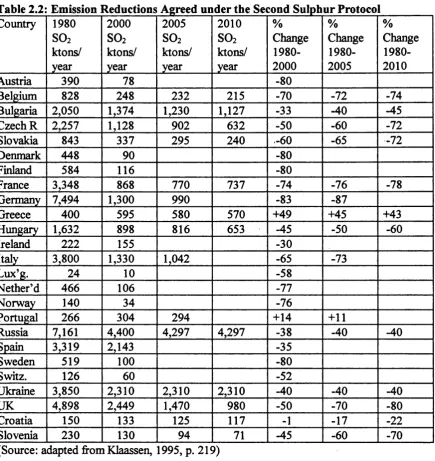
Negotiations over the Second Sulphur Protocol started in 1991 and were concluded in June 1994 when the Protocol was signed by twenty six parties (including the EU) in Oslo. Table 2.2 gives the targets agreed by all twenty five Protocol signatories.
Table 2.2; Emission Reductions Agreed under the Second Sulphur Protoco Country 1980 SO2 ktons/ year 2000 SO2 ktons/ year 2005 SO2 ktons/ year 2010 SO2 ktons/ year % Change 1980-2000 % Change 1980-2005 % Change 1980-2010
Austria 390 78 -80
Belgium 828 248 232 215 -70 -72 -74
Bulgaria 2,050 1,374 1,230 1,127 -33 -40 -45
Czech R 2,257 1,128 902 632 -50 -60 -72
Slovakia 843 337 295 240 -60 -65 -72
Denmark 448 90 -80
Finland 584 116 -80
France 3,348 868 770 737 -74 -76 -78
Germany 7,494 1,300 990 -83 -87
Greece 400 595 580 570 +49 +45 +43
Hungary 1,632 898 816 653 -45 -50 -60
Ireland 222 155 -30
Italy 3,800 1,330 1,042 -65 -73
Lux’g. 24 10 -58
Nether’d 466 106 -77
Norway 140 34 -76
Portugal 266 304 294 +14 +11
Russia 7,161 4,400 4,297 4,297 -38 -40 -40
Spain 3,319 2,143 -35
Sweden 519 100 -80
Switz. 126 60 -52
Ukraine 3,850 2,310 2,310 2,310 -40 -40 -40
UK 4,898 2,449 1,470 980 -50 -70 -80
Croatia 150 133 125 117 -1 -17 -22
Slovenia 230 130 94 71 -45 -60 -70
(Source: adapted from Klaassen, 1995, p. 219)
emission trading in Oslo in May 1991, joint implementation of emission reduction commitments has been considered for inclusion within the Second Sulphur Protocol. When the Second Sulphur Protocol was signed in June 1994 in Oslo, joint implementation was enabled under Article 2, paragraph 7 o f the Protocol, which states that;
may jointly [italics added] implement the obligations set out in Annex IP (UNECE 1994a, p. 6).
Possible rules to govern joint implementation trading were discussed in the Task Force on Economic Aspects of Abatement Strategies, which reported to the Working Group on Strategies. This working group was to propose a set of rules to be accepted by the Executive Body. Three years of discussion at the Task Force level led to a proposal presented to the Working Group in March 1995, without specific results, let alone the acceptance of specific proposals (UNECE 1994b). Further rules were proposed by a small group hosted by Norway in 1995. These rules also have not been accepted.
2.3.3 Comparing Joint Implementation in the FCCC and the SSP
There are significant differences between the FCCC and the SSP agreements and between the types of trading that each permits. The FCCC is a global agreement while the SSP is European (including parts of the FSU). The pollutants targeted under the FCCC are uniformly dispersed pollutants, whilst those legislated for by the SSP are non-uniformly dispersed. FCCC trades can be undertaken by firms or by countries, while SSP trades are undertaken by countries only.
Because carbon dioxide is a uniformly dispersed pollutant, trades under the FCCC are expected to be ‘one for one trades’, though technically they need not be. A ‘one for one’ trade sees net emissions remaining constant: the same amount of emission increase is undertaken at one location as emission reduction is undertaken at another. SSP trades are expected to be ‘non one for one’ exchange rate trades. A ‘non one for one’ trade sees net emissions changing; different levels of emission reduction and increase take place.
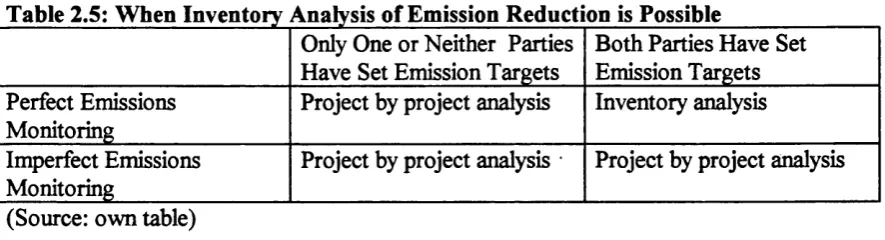
implementation deals makes it particularly difficult to discover how much emission reduction is achieved by projects when they are. This problem does not exist in the context of the Second Sulphur Protocol, because all signatories to the SSP have agreed to emission targets. This distinction between the two agreements means that FCCC trading is described as ‘open’ but sulphur trading as ‘closed’.
In a more fimdamental sense the key problems feeing joint implementation for the FCCC and the SSP differ. For FCCC the feet that not all countries have set themselves emission reduction targets means that baselines have to be constructed and project by project analysis of the emission reduction achieved undertaken. For sulphur trading the problem is that sulphur is a non uniformly dispersed pollutant and that changing the location of emission reduction can lead to blackspots.
The FCCC and the SSP can be expected to evolve in different ways. FCCC trading will change as more and more countries establish emission reduction targets. The ‘ultimate’ FCCC regime would see all countries having set themselves emission targets and undertaking trades. Evolution in the SSP context will revolve around the trade off between economic efficiency and protecting third parties. No final regime is obvious in the SSP context.
2.3.4 O ther Trading Systems
Many other international and national emission reduction agreements include provision for joint inplementation or tradable permits. The Montreal Protocol for the Protection of
year: this figure is about 5% of the 415,000 tons of CFCs produced in Europe in 1986 (when companies were awarded their credits under the Protocol) and 10-15% of the amount produced in 1991 (Klaassen, 1995).
The US Environmental Protection Agency’s emissions trading policy is the oldest national marketable permit system (see Dwyer 1992, Foster and Hahn 1995, Hahn and Hester 1989 Klaassen 1995, pp. 146-157 and Tietenberg 1985). This emission trading programme operates nation-wide within the US and covers sulphur oxides. It was originally intended to provide greater flexibility to firms in meeting the requirements of the Clean Air Act. Firms can engage in four types of trading: ofifeets, netting, bubbles and banking. All forms of trading between the mid 1970s and the mid 1980s saved between $1 and $13 billion (Klaassen 1995, p. 150).
In November 1990 the United States’ Clean Air Act Amendments (CAAA) became law (see Kete 1992, Klaassen 1995 pp. 162-175 and Rico 1995). The acid rain programme set a 10 million ton (US tons) per year reduction in sulphur dioxide emissions fi’om the 1980 level and a 2 million ton per year reduction in nitrogen oxides emissions. An emission trading scheme was integral to the agreement; the trading programme had the potential to reduce the cost of meeting the EPA’s air quality targets by $9.3 - $13.4 billion compared with command and control (ICF, 1992).
An emission reduction credit system operates in the South Coast Air Quality Management District (SCAQMD) in California, a district which includes the Los Angeles Basin. Regulators in this region have made trading difficult by granting few credits for emission reduction achieved by companies. The higher the regulator sets the standard of technology that firms must possess, the harder it is for firms to go beyond this standard and achieve additional emission reduction worthy o f credits; regulators assume that the emission reduction should have been undertaken anyway.. As a consequence, most credits sold in the SCAQMD market have come fi*om firms that closed down.
Parallels can also be drawn between non attainment areas in the SCAQMD and countries with emission targets (annex one countries) under the FCCC: most US sulphur trading is conducted by companies in non attainment areas; carbon trading is interesting to companies whose governments have set emission reduction targets.
Table 2.3 below summarises information on the five agreements discussed above. The second column tells us whether the pollutant traded is uniformly or non uniformly dispersed. The third column makes a distinction between international and national trading schemes. Column four states whether the trading agents are countries or firms.
Table 2,3: Five International Agreements Allowing Trading
Agreement Unif./Non Unif.
Dispersed Pollutant
International or National?
Trading Agents?
FCCC Uniform International
(Global)
Firms/ Countries
SSP Uniform International
(Europe)
Countries
Montreal Protocol Uniform International
(Global)
Firms
CAA Trading Non uniform National
(US)
Firms
CAAA Trading Non uniform National
(US)
Firms
AU intranational trading in table 2.3 is done by companies, but countries do not monopolise international trading: firms undertake international CFC production trading under the Montreal Protocol and firms may be able to trade under the FCCC. The two intra-national trading systems listed above are based in the United States. But intranational permit trading does take place in other countries: power plant quota trading takes place in Denmark, sector covenants occur in the Netherlands and ofifeets take place in Germany (Klaassen, 1995, pp. 175-184). Hungary, the Netherlands, Poland and the United Kingdom (London Economics, 1992) (Klaassen, 1995, p.320) are looking at intranational SO2 trading. (For other reviews of trading systems see Klaassen 1995,
chapter 6 and Hahn and Hester 1989).
The relationship between old and new power plants under the CAAA can be compared with that between developed and developing countries under the FCCC. New power plants in the US fece high SO* marginal abatement cost under the CAAA, because by investing in up to date technology they have already reduced their emissions. Older plants fece lower abatement costs. Under the FCCC, developed nations fece high marginal abatement costs whUe developing nations fece lower costs. The diSerence between the two situations is that under the CAAA those with lower marginal abatement costs (the older plants) must undertake the bulk of the emission reduction, whereas under the FCCC those feeing higher costs (the developed nations) must act. We can conclude that if joint implementation can bring savings under the CAAA then savings certainly would be expected under FCCC trading.
2.4 Forms of FCCC Trading
2.4.1 AIJ, JI and TPs
credits. AIJ allows countries to work together on emission reduction projects, but allows no creation of credits and no sale nor trading of credits (Yamin, 1995).
1
Joint implementation (JI) and tradable permits ve no legal definitions. However, they are real and distinct concepts. Joint inÿleméntation is defined here as a situation where countries or firms can collaborate on emission reduction, where emission reduction credits are generated by these projects, but where the permits cannot be sold to third parties. A tradable permit system is one where credits are created and can be sold on to third parties. These three definitions are set out in table 2.4 below.
Table 2.4: Definitions of AIJ, JI and TPs
Crediting Emission Reduction Allowed?
Selling on of Credits Allowed?
AIJ No No
JI Yes No
TPs Yes Yes
(Source: own table)
In the first article on tradable pollution permits. Dales remarks that when an asset can only be held by a few people but not by many, an explicit price system cannot develop. Dales is concerned that, even if rights are granted for ‘ownership’ o f pollution, irrational restrictions will be placed on the trading o f such rights (1968a, p. 179). Put in our context, his concern is that a joint inq)lementation system may be sanctioned but not a full tradable permit system.