ISSN (e): 2250-3021, ISSN (p): 2278-8719
Vol. 09, Issue 3 (March. 2019), ||S (III) || PP 11-17
Score-Based Max-Min Budget Constraint Workflow Scheduling
Algorithm for Cloud System
Makhan Singh
Department of Computer Science & Engineering, UIET, Panjab University, Chandigarh. India
Corresponding Author: Makhan Singh
Abstract:
Cloud computing is the paradigm that uses central remote servers and internet to host the data and perform distributed computing for large-scale applications. This is the latest concept emerging in Cloud computing for service provisioning in distributed system. The research community groups are keen to explore the merits and demerits of scientific application execution which involves workflow. In Cloud computing the scheduling of workflow is the prominent issue that maps and allows inter-dependent tasks to be executed on the distributed resources. Workflow scheduling allocates those resources to tasks which totally satisfy the quality of service (QoS) constraint that are defined by the Cloud users. In present scenario the workflow scheduling approaches are focusing on execution cost and time related QoS parameters only for allocating virtual machines to workflow applications. Sometimes virtual machines (VM) are not reliable at datacentres which results in the failure if workflow application that are scheduled on these. These resources frequently results into failure when workflow applications are scheduled on this VMs. Failure of workflow application is another key concern. This situation cannot be tolerated as workflow application of users may contain sensitive data. Hence proper scheduling can improve performance of the system. In this paper a score based Max-Min budget constraint workflow scheduling algorithms has been designed and simulated. This algorithm reduces the execution time and failure rate of workflow applications within user specified budget.Keywords:
Workflow Scheduling, Score, Virtual Machine, Budget Constraint, Cloudlet. --- --- Date of Submission: 06-03-2019 Date of acceptance: 25-03-2019 ------I.
INTRODUCTION
Cloud Computing is the paradigm that uses the central severs and internet to host the data and resources. This is the latest concept emerging in Cloud computing for service provisioning in distributed system. Cloud Computing facilitate software applications, platform, and hardware infrastructures as a service. Data and software packages are hosted on servers.
Workflow scheduling is one of the major issues in workflow management especially in Cloud and Grid workflow systems. It is a process that maps and manages the execution of workflow tasks on different distributed resources. It allocates required resources to suitable workflow tasks such that complete execution can be completed to satisfy constraints defined by the users. Proper scheduling can improve the performance of the system. However, in general, the mapping of tasks on the distributed resources is NP-hard problem. For such problems, no known algorithms are able to generate the optimal solution within polynomial time. Even then the workflow scheduling problem can be solved by using exhaustive search. In this case problem solving complexity is very high. In Grid Computing decisions about scheduling the tasks is taken in the shortest time possible, because number of individuals demand for resources, and time slots needed by one user could be taken by another user at any moment (Yu, J. et al., 2007). This equally applies to Cloud Computing environments.
Workflow scheduling is the problem of mapping of each task on suitable resources while satisfying the constraints imposed by the user. Proper workflow scheduling can have significant impact on the performance of the workflow management system.
II.
RELATED WORK
reduce the cost of execution along with satisfy the user objective function deadline. This algorithm partial critical path is recursively schedule. (Abrishami, S. et al., 2013) presents the workflow scheduling algorithms first one is called IaaS Cloud Partial Critical Paths (IC-PCP) which is one phase algorithm, and second one is called IaaS Cloud Partial Critical Paths with Deadline Distribution (IC-PCPD2).These algorithms consider the main features like on demand resource providing and pay per use model of the current commercial Clouds. (Yu, J. et al., 2008) proposed a genetic approach based workflow scheduling algorithm which considering two QoS constraints Budget and Deadline. Proposed genetic algorithm schedule the workflow application either to minimize the Makespan while meeting user imposed deadline constraints or minimize the execution cost while meeting user imposed budget constraints. The performance of proposed genetic algorithm is compared with the existing genetic algorithms. This algorithm mainly consider heterogeneous environment and provide the solution for deadline and budget optimization problem. (Jayadivya et al., 2012) proposed a workflow scheduling algorithm which provides fault Tolerance. Fault tolerance is achieved by using resubmission and replication of tasks. The resubmission and replication of tasks depends upon the metric which is achieved by resubmission factor and replication factor. Priority of tasks is defined on the basis of the criticality of the task which is calculated by using parameters resubmission impact factor, earliest deadline. (Bittencourt et al., 2011) proposed scheduling algorithm for Hybrid Cloud which optimizes the cost of resources. This algorithm chooses which resources should be leased from the public cloud and aggregated to the private cloud to provide enough processing power to execute a workflow within a given execution time. Design algorithm can reduce costs while achieving the specified desired execution time. (Van den Bossche et al., 2010) consider the problem of outsourced tasks at the time of heavy load from an internal data center to a cloud provider. The main objectives this algorithm to increase the utilization of the internal data center and to minimize the cost of running the outsourced tasks in the cloud while satisfy the required QoS constraints. They consider this optimization problem in a multi-provider hybrid cloud setting with deadline-constrained and preemptible but non-provider-migratable workloads that are characterized by memory, CPU and data transmission requirements.
III.
SCORE BASED MAX-MIN WORKFLOW SCHEDULING ALGORITHM
The proposed scheduling algorithm is based on the concept of score. In proposed scheduling algorithm Virtual machine (VM) score is defined on the basis of capability of the machine. In which each hardware component of the machine receives an individual score and final score of the machine is determined by lowest sub score of the component. Final score represents minimum performance of the machine, which is based on the capabilities of different parts of the machine including processing power, storage space and RAM. Similarly workflow tasks score is defined on the basis of number of instructions in workflow tasks. Score based algorithms looking for machines whose final score is equal to or more than the tasks score and execute the tasks on those machines within user specified budget. In proposed work score based Max-Min budget constrained workflow scheduling algorithm has been designed. Then performances of this algorithm has been compared with basic Max-Min budget constrained workflow scheduling algorithm with respect to their execution time, execution cost and failure rate.
Max-Min Scheduling Algorithm (Sidhu, A. K., et al., 2013) it starts with set of unassigned workflow tasks. Then all unassigned tasks are scheduled on those available resources which will execute them in maximum time (Kaur R, et al., 2013) This procedure is followed until all the workflow tasks are assigned to the machines. Here Max-Min scheduling algorithm has been designed with budget constraint i.e. tasks are executed within user specified budget. Score concept has also been introduced and only those machines are selected for scheduling which satisfy minimum task score. Then performance of score based Max-Min scheduling algorithm has been compared with basic Max-Min scheduling algorithm with respect to their execution time, execution cost and failure rate.
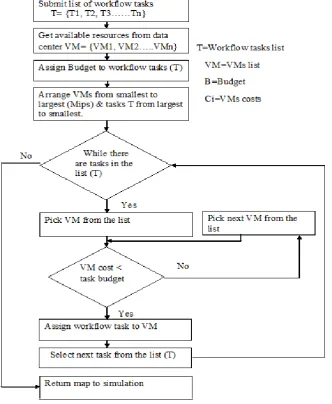
Algorithm BASIC_MAX-MIN (T, VM, B , 𝐂𝐢)
// T is Work Flow Tasks List, VM is Virtual Machines List, B is Budget, Ci is Virtual Machine Costs. Step1:-Submit list of workflow tasks T :={𝑇1, 𝑇2, … , 𝑇𝑛}.
Step2:- Get available resources from data center VM :={ 𝑉𝑀1, 𝑉𝑀2, … , 𝑉𝑀𝑛}. Step3:- Assign Budget B to workflow tasks T.
Step4:- Arrange the VMs in ascending order and Ts in descending order. Step5:- Repeat while T!= NULL
{
Step 5.1:- Pick VM from list. Step 5.2:- Pick next VM from list. Step 5.3:- If (VM Cost < Budget Cost)
{
Step 5.3.2:- Select next task from list and Goto Step 5. }
Else
Step 5.3.1:- Goto Step 5.2. }
Step 6:- Return map to simulation.
The figure 1 shows the flow diagram of Basic Max-Min Budget Constrained Workflow Scheduling Algorithm.
Figure 1: Basic Max-Min Budget Constrained Workflow Scheduling
Step by step description of score based Max-Min budget constrained workflow scheduling algorithm is presented below:
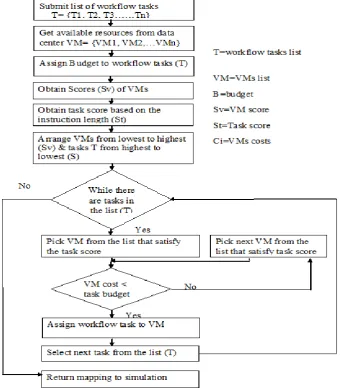
Algorithm SCORE_BASED_MAX-MIN (T, VM, B , 𝐂𝐢 , 𝑺𝒗, 𝑺𝒕)
// T is Work Flow Tasks List, VM is Virtual Machines List, B is Budget, Ci is Virtual Machine Cost, Sv is VM Score, 𝑺𝒕 is Task Score.
Step1:-Submit list of workflow tasks T :={ 𝑇1, 𝑇2, … , 𝑇𝑛}.
Step2:- Get available resources from data center VM :={ 𝑉𝑀1, 𝑉𝑀2, … , 𝑉𝑀𝑛}. Step3:- Assign Budget B to workflow tasks T.
Step 4:- Obtain Scores of VMs (Sv).
Step 5:- Obtain task scores (𝑺𝒕) based on instruction length
Step7:- Repeat while T!= NULL {
Step 7.1:- Pick VM from list that satisfy the task score. Step 7.2:- Pick next VM from list that satisfy the task score. Step 7.3:- If (VM Cost < Task Budget)
{
Step 7.3.1:- Assign workflow task to VM.
Step 7.3.2:- Select next task from list and Goto Step 7. }
Else
Step 7.3.1:- Goto Step 7.2. }
Step 8:- Return map to simulation.
The figure 2 shows the Flow Diagram of Score Based Max-Min Budget Constrained workflow Scheduling Algorithm
Figure 2: Score based Max-Min Budget Constrained Workflow Scheduling Algorithm
IV.
RESULTS AND PERFORMANCE ANALYSIS
Table 1: Parameters of Cloud Simulator
Type Parameter Value
Datacenter
Number of Datacenter 1
Number of Hosts 4
Type of Manager Time-Shared
Virtual Machine(VM)
Total Number of VMs 30
MIPS of PE(processing element) 1000-21000 Number of PEs per VM 1
VM Memory(RAM) 256-2048 MB
Storage Space 1-21 GB
Score 1-10
Cloudlet
Number of Workflow Application 1
Number of Cloudlets(Tasks) 5-25
In the experimental results performance of score based Max-Min budget constrained workflow scheduling algorithm has been compared with basic Max-Min budget constrained workflow scheduling algorithm with respect to their execution time, execution cost and failure rate.
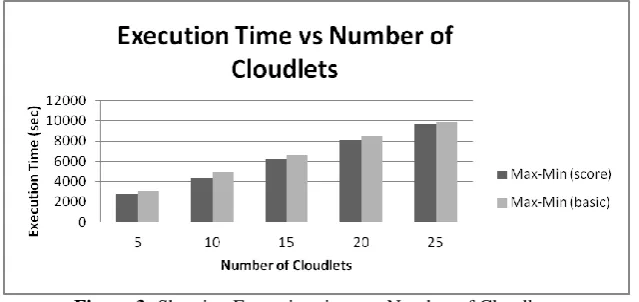
The test case in Table 2 shows the effect on execution time of Max-Min budget constrained workflow scheduling algorithm by varying the number of cloudlets when it is implemented with score and without score concept. Here cloudlet refers to workflow application tasks.
Table 2: Showing Execution Time and Number of Cloudlets Max-Min Budget Constrained Workflow Scheduling Algorithm
Number of Cloudlets Execution Time
Max-Min (score) Max-Min(basic)
5 2800 3006
10 4386 4960
15 6248 6625
20 8072 8536
25 9728 9945
Simulation results shown in Figure 3 indicate that score based Max-Min budget constrained workflow scheduling algorithm exhibit less execution time for the workflow application as compared to basic Max-Min budget constrained workflow scheduling algorithm.
Figure 3: Showing Execution time vs. Number of Cloudlets
Table 3: Showing Execution Cost and User Budget Max-Min Budget Constrained Workflow Scheduling Algorithm
User Budget Execution Cost
Max-Min (score) Max-Min(basic)
3000 2250 2015
6000 4970 4568
9000 8008 7590
12000 10645 9834
15000 13645 12800
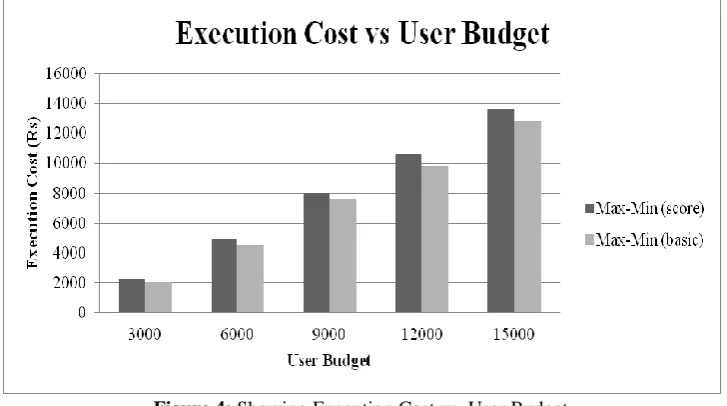
The results obtained in Figure 4 indicate that the score based Max-Min budget constraint workflow scheduling algorithm although incur more cost compared to basic Max-Min but still execute the workflow application within user specified budget.
Figure 4: Showing Execution Cost vs. User Budget
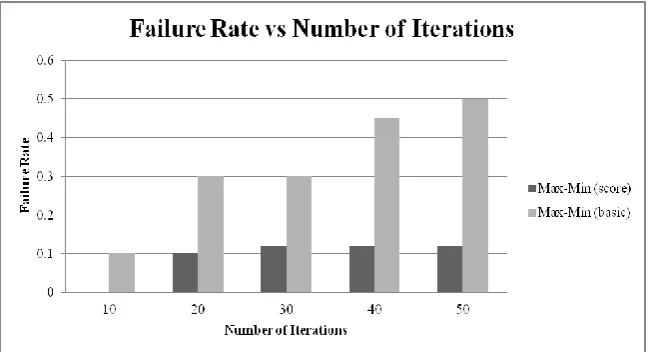
This test case in Table 4 shows the effect on failure rate of Max-Min budget constrained workflow scheduling algorithm by varying the number of iterations when it is implemented with score and without score concept. Here cloudlet refers to workflow application tasks.
Table 4: Showing Failure Rate and Number of Iterations Max-Min Budget Constrained Workflow Scheduling Algorithm
Number of Iterations Failure Rate
Max-Min (score) Max-Min(basic)
10 0 0.1
20 0.1 0.3
30 0.12 0.3
40 0.12 0.45
50 0.12 0.5
International organization of Scientific Research
17 | Page
Figure 5: Showing Failure Rate vs. Number of IterationsV.
CONCLUSION
In this research work, we have proposed score based Max-Min budget constrained workflow scheduling
algorithm. This algorithm schedule the workflow application within user specified budget constrained. The performance of score based Max-Min budget constrained workflow scheduling algorithm have been compared with basic Max-Min budget constrained workflow scheduling algorithm on the basis of following parameters i.e. execution time, execution cost, failure rate. Simulations results show that Score based Max-Min budget constrained workflow scheduling algorithm is more efficient than basic Max-Min budget constrained workflow scheduling algorithm. Score based workflow scheduling algorithm not only reduce the execution time of workflow application but also reduce the failure rate of workflow applications within user specified budget constraint.REFERENCES
[1]. Abrishami, S., & Naghibzadeh, M. (2012). Deadline-constrained workflow scheduling in software as a service cloud. Scientia Iranica, 19(3), 680-689.
[2]. Abrishami, S., Naghibzadeh, M., & Epema, D. H. (2013). Deadline-constrained workflow scheduling algorithms for infrastructure as a service clouds. Future Generation Computer Systems, 29(1), 158-169. [3]. Bala, A., & Chana, I. (2011, November). A survey of various workflow scheduling algorithms in cloud
environment. In 2nd National Conference on Information and Communication Technology (NCICT), 26-30).
[4]. Bittencourt, L. F., & Madeira, E. R. M. (2011). HCOC: a cost optimization algorithm for workflow scheduling in hybrid clouds. Journal of Internet Services and Applications, 2(3), 207-227.
[5]. Buyya, R., Ranjan, R., & Calheiros, R. N. (2009, June). Modeling and simulation of scalable Cloud computing environments and the CloudSim toolkit: Challenges and opportunities. In 2009 international conference on high performance computing & simulation, 1-11.
[6]. Jayadivya, S. K., Nirmala, J. S., & Bhanu, M. S. S. (2012). Fault tolerant workflow scheduling based on replication and resubmission of tasks in Cloud Computing. International Journal on Computer Science and Engineering, 4(6), 996.
[7]. Kaur, R., & Luthra, P. (2013). Load balancing in cloud computing. Int. J. of Network Security, 1-11. [8]. Sidhu, A. K., & Kinger, S. (2013). Analysis of load balancing techniques in cloud computing.
International Journal of computers & technology, 4(2), 737-741.
[9]. Van den Bossche, R., Vanmechelen, K., & Broeckhove, J. (2010, July). Cost-optimal scheduling in hybrid iaas clouds for deadline constrained workloads. In 2010 IEEE 3rd international conference on cloud computing, 228-235.
[10].
Yu, J., Buyya, R., & Ramamohanarao, K. (2008). Workflow scheduling algorithms for grid computing. In Metaheuristics for scheduling in distributed computing environments, Springer, Berlin, Heidelberg, 173-214[11]. Yu, J., Buyya, R., (2007). Workflow Schdeduling Algorithms for Grid Computing, Technical Report, GRIDS-TR-2007-10, Grid Computing and Distributed Systems Laboratory, The University of Melbourne, Australia.