www.pharmascholars.com
50
Original Article
CODEN: IJPNL6
Stability and sterility of single dose infusion vial of acetaminophen for
multiple dosing
Azfar Athar Ishaqui
1,*, Syed Baqir Shyum Naqvi
1, Iyad Naeem Muhammad
2, Sheikh Abdul
Khaliq
1, Syed Hameez Jawed
2, Adnan Iqbal
2.
1
Hamdard University, Faculty of Pharmacy, Department of Pharmaceutics, Karachi 74600,
Pakistan
2
Department of Pharmaceutics, Faculty of Pharmacy and Pharmaceutical Sciences, University of
Karachi, Karachi 75270, Pakistan
*Corresponding author e-mail:
[email protected]
Received on: 05-11-2016; Revised on: 02-12-2016; Accepted on: 25-12-2016
ABSTRACT
Single dose vials are considered to be used for single dose and single patient only. Many infection outbreaks reported previously by using single dose vials for multiple dosing were mainly due to improper handling by health care workers. However, under certain circumstances it is permissible to use single dose vial for multiple dosing. In present study, sterility and stability of 50 acetaminophen single dose vials were analyzed for 24 hours by withdrawing samples at different time intervals after the initial first spiking of vial by using basic aseptic techniques. The sterility was examined by inoculating samples on thioglycolate broth, nutrient agar and Sabouraud’s Dextrose agar but none of the samples found contaminated. The stability was evaluated by UV-visible spectrophotometric method. One way analysis (P-value=0.152) reject the null hypothesis and did not reveal any significant differences among samples at different time intervals. The study concludes the use of the SDV for multidosing provided the prevention of contamination in the system.
Key words: Single dose vials, Sterility, Stability, Multidosing, Acetaminophen
INTRODUCTION
Single dose infusion vials are those parenteral solution vials which can be used only once and for patient only. Single dose vials (SDV) do not contain preservative due to which it is recommended by manufacturers that these vials should not be stored even if the dose in the vial was left behind as these can become the source of infection when used inappropriate. Usually, multidose infusion vials are considered as those sterile preparations which contain more than one dose and can be saved for later [1]. Some studies also define multidose vials (MDV) as those vials which contain antibacterial “preservative” due to which these vials can be saved and have the potential to be reused again if manufacturer recommendation are followed properly [2]. stetler et
al. reported that preservatives present in multidose vials of different vaccines proven to be ineffective in providing stability against bacterial contamination as one of the strain of streptococcus was found to be remain active at 4C for around 15 days [3]. several studies proved that multidose vials medications such as insulin and heparin remains stable and sterile for long period without any safety issue. Tarr et al. reported that the insulin medication vials was remain stable and sterile for around 28 days both at room temperature and refrigerator without any change in potency of medication [4]. the inability of preservative included in MDV to maintain the sterility of vial may lead the patients suffered to bacterial, viral or fungal infections [5-7]. United States Pharmacopeia (USP) chapter 797 states that MDV containing sterile preparations should be
International Journal of Pharmacy
www.pharmascholars.com
51
discarded within 28 days after the first needlepuncture or first opening unless specified different by the manufacturer [8]. Since 2007, around 19 outbreaks of infections were reported to involve blood borne pathogen or bacterial infections [9]. These infection outbreaks were mainly caused due to unsafe injection practices which include poor aseptic practices such as not using the disinfectant to clean the septum of MDV while using, use of syringes for more than one time or not using personal protective equipment while using vials [10-12]. However, in case of drug shortages these SDV can be used for multiple patients by repackaging the contents of medication vial at the time of first opening. This repackaging should be performed by trained and qualified healthcare personnel in ISO class 5 air quality [13, 14].
Many intravenous infusions SDV are available in a packaging of dose usually required for healthy adult patient which is generally enough for more than one doses if the patient is pediatric. Also, in cases of renal impairment or hepatic impairment the dose of vial is more than enough for one dose which causes left over medication in SDV. For example, most of the brands the intravenous infusion SDV of acetaminophen comes in packaging of 1000mg/100ml. the usual dose of acetaminophen used for fever or analgesia is 15mg/kg per dose for patients with normal hepatic function [15, 16].
At least 6 complete doses can be drawn from one SDV of acetaminophen for patients weigh ≤ 10kg. While for patients weigh ≤ 20kg and ≤ 30kg, at least 3 and 2 complete doses can draw from one SDV respectively. But according to the almost all the manufacturer recommendation these acetaminophen infusion SDV should be used for single dose only and left over medication should not be stored for later doses because of lack of preservative which can affect the medication stability and sterility. In this study, we have evaluated the sterility and stability of medication content of Acetaminophen ready-to-use single dose intravenous infusion vial for 24 hour after first pricking/opening to check the possibility of using these vials for multiple dosing either for same patient or different patients.
METHODOLOGY
Clinical Setup
The study was conducted in a pediatric ward of tertiary care hospital from April, 2016 to July, 2016. The compliance rate of hand hygiene in the ward was found to be around 94% in the last quarter report.
Study Protocol
The ready-to-use acetaminophen single dose intravenous infusion vials of strength 1000mg/100ml were brought from the hospital pharmacy had been used in this study. The vials were placed at the patient bed site.
Sampling and Storage
The first sample was drawn just after opening the rubber cover cap of infusion vial by inserting a 10ml sterile syringe. The infusion vial was again placed at a patient bed site to have a full exposure of surrounding environment. After the first sample, four more samples were drawn from the same vial at 4th, 8th, 12th and 24th hour after the first opening by using a new sterile syringe. All the samples were drawn by trained nursing staff by using aseptic techniques. New pair of sterile gloves was used every time and rubber cover cap was cleaned by new alcohol swab each time before drawing a sample.
All the sample syringes were stored in a separate plastic zip lock bags. All the samples were evaluated for sterility of stability. Sterility testing was done in microbiology lab by inoculating the aliquot of sample on media for any bacterial or fungal contamination.
Analysis Method
Microbial Evaluation: Bacterial contamination was assessed by inoculating the sample on nutrient agar and Thioglycolate Broth (Merck, Darmstadt, Germany) for 24 hours. Fungal contamination was tested by inoculating the sample Sabouraud Dextrose Agar (Merck, Darmstadt, Germany) for seven days. The NCCLS protocol was followed for evaluation under aspetic conditions [17]. For stability testing, the samples were analyzed by using double beam Ultra-violet visible spectrophotometer (Spectronic Genesys-2).
Assay: Acetaminophen standard was obtained from a
www.pharmascholars.com
52
RESULTS
A total of 50 Acetaminophen SDV vials were evaluated for sterility and stability for 24 hours after first use so that it can be for multiple dosing. A total of 250 samples were evaluated for sterility and stability. All the samples were inoculated on nutrient agar and thioglycolate broth for 24 hours in order to examine the presence of bacterial and anaerobic contamination. None of the sample showed any microbial growth which rule out any contamination of bacterial and anerobic contamination. It is to be noted that most of the infections reported previously by the use of SDV for multiple dosing were infections caused by various bacterial organisms [19-22]. For the presence of fungal contamination, an aliquot of all 250 samples were also inoculated on sabouraud’s Dextrose agar. All the samples were found negative for any growth caused by fungal contamination, which reflected that no vial contracted any fungal contamination when SDV was left behind for 24 hour at bed site of patient after initial pricking /insertion of needle.
The chemical stability of samples drawn at different intervals were examined by Ultra Violet- visible spectrophotometry. A value of upper and lower limit was set at 105% and 95% respectively. The chemical stability of vial medication was considered as stable if the values of all the samples of one vial lie between this limit. the maximum and minimum values of percentage drug content at the time of first sample i.e first pricking/insertion was found to be 102.77% And 97.11% while the maximum and minimum values of samples drawn at 24th hour was measured as 101.33 % and 96.39%. the maximum difference in % drug content was found to be 1.44% in 24 hours while the minimum decrease in % drug content was 0.11% in one SDV. For all the vials tested, a mean difference of 0.6% (± 0.2) in drug content was observed in the duration of 24 hours.
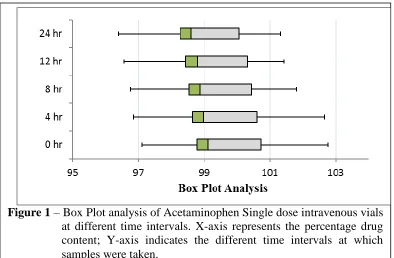
In figure 1, box plot representation of % drug content at different time intervals was shown. This can be clearly seen that none of the box plot shows symmetrical distribution of data values any time interval. All the box plots appears to be positively skewed which indicates the higher values have more variations as compare to lower values. The highest and lowest range of the values was found of 4th hour (5.795) and 12th hour (4.869) respectively, represented by the difference between the upper and lower whisker. On comparing the 0th hour samples boxplot with 24th hour boxplot, the mean and median values of % drug content decreases 0.62% and 0.54% respectively. The most variable data was found to be
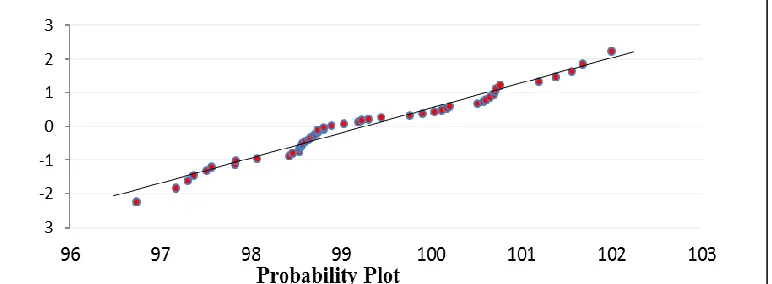
of 0th hour samples as represented by highest Intra Quartile Range while sample values of 24th hour samples showed the lowest IQR showing the least variability and most consistency among the data values. A strong linear pattern was found among the data values of samples taken at different time intervals as shown in Figure 2. Although some minor deviations were found but no significant outliers were identified in the data representation of probability plot (figure 2) and also supported by run chart (figure 3). The center line in Run chart (figure 3) represents the median of all subgroups at 99.8%. no special-cause variation was observed, as the p-values of clustering and oscillation was found more than 0.05(figure 3).
One way ANOVA was used to statistically analyze the differences in the mean of % drug content at different time intervals. No statistically significant differences were found among the samples at different time intervals as the p-value (0.152) was found greater than the level of significance i.e 0.05, which states that the sample values obtained at different interval of time gave enough evidence to accept the null hypothesis. On analyzing the data till 12th hour interval, the p-value (0.44) was also found to be greater than level of significance (0.05) and even greater than the p-value of data values till 24th hour.
DISCUSSION
On May 2, 2012, the Center of Disease Control (CDC) restated its 2007 position regarding the use of SDVs that under certain conditions, however, such as during limited drug availability, it is permissible for health care facilities to repackage SDVs into smaller doses, each intended for a single patient use. Repackaging is allowable if performed by qualified health care personnel under specific conditions according to standards in USP General Chapter 797, Pharmaceutical Compounding–Sterile Preparations, as well as the manufacturer’s recommendations pertaining to safe storage of that medication outside of its original container [8, 23].
www.pharmascholars.com
53
should not be stored at fridge temperature and leftover medications should not be store for further doses because of the lack of preservatives. Kemal et al studied the sterility of Becaziumab SDV, in which samples from one vial were drawn in different syringes at the same time and stored for 10 days. Some samples were also drawn directly from the vial and left over medication was stored and samples were drawn on next days from them. No sample was found to be contaminated which stated that SDV of bevacizumab can be stored and use for multiple dose of different patients [24].
Kwiatkowski et al. (2012) reported that acetaminophen drug content remained stable for 84 hours when samples from vials were drawn and then stored in propylene syringes [25]. Similar results were also reported by Kambia et al. (2006) when acetaminophen in combination with ketoprofen was
stored at room temperature and around 90% of original concentration was retained for 48 hours [26].
CONCLUSION
In present study, the storage and reuse of acetaminophen infusion vials by using aseptic techniques of handling vials does not seem to result in microbial contamination as all tested vials were found to be negative for microbial growth at different time intervals for 24 hours which means that acetaminophen SDV can be used for multiple dosing as the chemical stability and sterility remains very intact and within the acceptable limits. These acetaminophen SDV can used by drawing all doses at time of first pricking and saved it in sterile syringes for next 24 hours, which can lower the risk of handling associated chances of contamination.
www.pharmascholars.com
54
Run Chart Analysis
Figure 3 – Run Chart Analysis of % Drug content of Acetaminophen infusion
vials; Blue Colored Circles represent median value of % drug content
of acetaminophen infusion vials over 24 hours.
Figure 2
– Probability Plot presentation. X-axis represents the percentage
drug content; Y-axis indicates the ordered response values
REFERENCES
1. Mattner F, Gastmeier P. American journal of infection control 2004;32(1):12-16. 2. Dade J, Wilcox M, Kay L. The Lancet 2000;356(9242):1684-1685.
3. Stetler HC, Garbe PL, Dwyer DM, Facklam RR, Orenstein WA, West GR, Dudley KJ, Bloch AB. Pediatrics 1985;75(2):299-303.
4. Tarr B, Campbell R, Workman T. American Journal of Health-System Pharmacy 1991;48(12):2631-2634. 5. Nakashima AK, Highsmith A, Martone WJ. Journal of clinical microbiology 1987;25(6):1019-1021. 6. Moro ML, Maffei C, Manso E, Morace G, Polonelli L, Biavasco F. Infection Control & Hospital
Epidemiology 1990;11(01):27-35.
7. Melnyk PS, Shevchuk YM, Conly JM, Richardson CJ. Annals of Pharmacotherapy 1993;27(3):274-278. 8. Pharmacopeia U. USP< 797> Guidebook to Pharmaceutical Compounding-Sterile Preparations. Paper
www.pharmascholars.com
55
10. Tait AR, Tuttle DB. Anesthesia & Analgesia 1995;80(4):764-769.11. Taxis K, Wirtz V, Barber N. Journal of Hospital Infection 2004;56(1):79-81.
12. Calop J, Bosson J, Croize J, Laurent P. Journal of Hospital Infection 2000;46(2):161-162.
13. Centers for Disease Control and Prevention. "Protect patients against preventable harm from improper use of single–dose/single–use vials." (2012):01-06.
14. Alert SE. Preventing infection from the misuse of vials. The Joint Commission 2014(52):01-06 15. Peterson RG, Rumack BH. Pediatrics 1978;62(5s):877-879.
16. Kraemer FW, Rose JB. Anesthesiology clinics 2009;27(2):241-268.
17. Reller LB, Weinstein M, Jorgensen JH, Ferraro MJ. Clinical infectious diseases 2009;49(11):1749-1755. 18. Behera S, Ghanty S, Ahmad F, Santra S, Banerjee S. Journal of Analytical & Bioanalytical Techniques
2012;3(6): 4945-4953.
19. Bennett SN, McNeil MM, Bland LA. New England Journal of Medicine 1995;333(3):147-154.
20. Sheth NK, Post GT, Wisniewski TR, Uttech BV. Journal of Clinical Microbiology 1983;17(2):377-379. 21. Mattner F, Gastmeier P. American journal of infection control 2004;32(1):12-16.
22. Grohskopf LA, Roth VR, Feikin DR. New England Journal of Medicine 2001;344(20):1491-1497. 23. Alter MJ, Ahtone J, Maynard JE. Annals of Internal Medicine 1983;99(3):330-333.
24. Örnek K, Karahan ZC, Ergin A, Tekeli A, Tekeli O. Annals of Pharmacotherapy 2008;42(10):1425-1428. 25. Kwiatkowski JL, Johnson CE, Wagner DS. American Journal of Health-System Pharmacy
2012;69(22):1999-2001.
26. Kambia NK, Luyckx M, Dine T, Dupin-Spriet T, Gressier B, Brunet C. The European Journal of Hospital Pharmacy Science Volume 2006;12(4):81-84.