International Journal of Pharmaceutical and Phytopharmacological Research
379
ISSN (Online) 2249 – 6084
ISSN (Print) 2250 – 1029
Int.J.Pharm.Phytopharmacol.Res.
2012, 1(6): 379-384
(Research Article)
Design and Optimization of Tramadol HCL immediate release tablets as per scale Up and Post
Approval Changes (SUPAC) Level II
Jaikishan Khatri*, Mugdha Karde, Savita Yadav, Dr. S.S. Bhalerao
Department of Pharmaceutics, Dr. L. H. Hiranandani College of Pharmacy, C.H.M. Campus, Opposite Ulhasnagar Railway Station, Ulhasnagar -421003, Maharashtra, India.
Received on: 11/06/2012 Accepted on: 24/06/2012
ABSTRACT
The Filing of a New Drug Application (NDA), Abbreviated New Drug Application (ANDA) and Abbreviated Antibiotic Drug Application (AADA) is only the beginning for a drug to get into the market. The SUPAC Level changes are due to change in site, change in excipient levels, changes in batch size and equipment changes. The objective of this experiment was to make a robust, stable formulation which would withstand the SUPAC changes. An immediate release tablet formulation was made in order to carry out the proposed changes in excipient levels. A prototype formula of the immediate release tablet was prepared which was then subjected to SUPAC Level 2 changes – Binder ± 1 % (B1and B2), Disintegrant ± 2 % (D1and D2), and Lubricant ± 0.5 %
(L1and L2). These were observed for changes in physical parameters and the dissolution was also carried out. It was inferred
through the observations, that L1variant with less lubricant showed sticking and picking and the L2 variant showed slower
dissolution profile. Thus, knowing the effect of change of excipient beforehand can lead to savings in raw material cost, labour cost and avoidance of unnecessary batches.
Key Words:Tramadol HCl, SUPAC, ANDA, Immediate release, Tablets
INTRODUCTION
The oral route of administration has so far received the maximum attention with respect to research on physiological and drug constraints as well as design and testing of products 1. Oral ingestion has been the most convenient and commonly used route of drug administration because of its flexibility and dosage form design 2. Tramadol hydrochloride is a centrally acting opioid analgesic structurally related to codeine and morphine used in the treatment of moderate to severe pain in diverse conditions. Combined with low dependence/abuse potential, it has proven to be of significant advantage over other agents, especially in the elderly 3. Tramadol hydrochloride has been proved to be effective in both experimental and clinical pain without causing serious cardiovascular or respiratory side effects 4. Tramadol hydrochloride is freely soluble in water 5.Tramadol Hydrochloride is marketed as a racemic mixture. The (+) enantiomer is approximately four times more potent than (-) enantiomer in terms of µ opioid receptor affinity and 5 –HT uptake, whereas the (-) enantiomer is responsible for noradrenaline reuptake effects 6
. The half-life of the drug is about 5.5 hours and the usual oral dosage regimen is 50 to 100 mg every 4 to 6 hours with a maximum dosage of 400 mg/day 7. SUPAC stands for Scale Up Post Approval. The key to scaling up a tableting process is to consider it during the entire development
process. From the inception of a development project, the formulation scientist must consider scale-up. There are three guidelines by the US FDA for SUPAC; Immediate Release Solid Oral Dosage Forms, Modified Release Dosage Forms and Non Sterile Dosage forms. There is also an addendum for equipment change by US FDA. The guideline for Immediate Release Solid Oral Dosage Forms focuses on the change during the post approval period, to the components or composition; the site of manufacture; the scale-up/scale-down of manufacture; and/or the manufacturing (process and equipment) of an immediate release oral formulation. These changes are based at three levels with Level 1 changes are those that are unlikely to have any detectable impact on formulation quality and performance. Level 2 changes are those that could have a significant impact on formulation quality and performance. Level 3 changes are those that are likely to have a significant impact on formulation quality and performance. These level changes are briefly explained in Table 1.
MATERIALS AND METHOD Materials
Tramadol Hydrochloride, Microcrystalline cellulose (Avicel PH 102) and Magnesium stearate were obtained as gift samples from Rubicon Research Pvt. Ltd. Copovidone (Kollidon VA 64) and Crospovidone (Kollidon Cl) were obtained as gift sample from BASF. Sodium starch glycolate (Primojel) and Croscarmellose sodium (Primellose) were obtained as gift samples from DMV Fonterra. Colloidal silicon dioxide (Aerosil 200 Pharma) was obtained as a gift sample from Degussa.
Analytical Method Verification
A standard stock solution of 100 ug/mL of Tramadol HCl was scanned between 200 to 400 nm to determine the λmax in UV Spectrophotometer (Shimadzu 1800). The λmax was found to be 271 nm
Specificity
The specificity was checked by dissolving 400 mg of placebo in 900 mL of 0.1 N HCl and sonicated for 30 minutes. The solution was then filtered using Whatmann Filter paper and the UV absorbance was taken at λmax of 271 nm.
Linearity
Appropriate aliquots were withdrawn from the standard stock solution into different volumetric flasks and diluted with 0.1 N HCl so as to prepare the solutions of 10, 20, 40, 60, 80 and 100 ug/mL. The absorbances of these solutions were taken at λmax of 271 nm using 0.1 N HCl as blank.
Formulation Development of Tramadol HCl Tablets
The formulation of Tramadol HCl immediate release tablets involved the process of direct compression. Tramadol HCl and Microcrystalline cellulose were co-sifted through mesh 40. Kollidon VA 64 and Superdisintegrant (Sodium starch glycolate, Croscarmellose sodium and Crospovidone in the batches mentioned below) were sifted through mesh 40. The above excipients were then mixed in a polybag for 15 minutes. Colloidal silicon dioxide (Aerosil 200 Pharma) and Magnesium stearate were passed through sieve 40. The tablets were then prepared using 9 mm punches on a compression machine (Cadmach single punch, India)
Batches for Superdisintegrant Selection
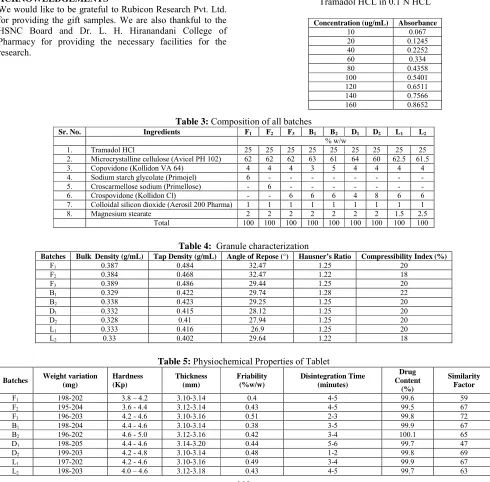
Three batches employing three different superdisintegants: Sodium starch glycolate (Primojel), Croscarmellose sodium (Primellose) and Crospovidone (Kollidon Cl) at 6 %w/w representing F1, F2and F3 were formulated as depicted in Table 3.
Components and Composition changes as per SUPAC Level II
The components and composition changes were carried out varying the superdisintegrant concentration with D1at 4 % Crospovidone (Kollidon Cl) and D2 at 8 % Crospovidone (Kollidon Cl). The binder concentration was varied using Copovidone (Kollidon VA 64) at 3 % represented by B1and 5 % Crospovidone (Kollidon Cl) represented by B2at The lubricant concentration was varied using Magnesium Stearate at 1.5 % represented by L1 and 2.5 % Magnesium stearate represented by L2. All these variations were carried out around the F2batch which contained 6 % Crospovidone (Kollidon Cl), 4 % Copovidone (Kollidon VA 64) and 2 %
Magnesium Stearate The formula for each of these variants is depicted in Table 3.
Evaluation of Granules
Bulk Density
The bulk density 8,9 of a powder is the ratio of mass of an untapped powder sample and its volume including the contribution of the interparticulate void volume. Hence, the bulk density depends on both the density of powder particles and the spatial arrangement of particles in the powder bed. Bulk Density was determined by pouring the blend in a 10 mL measuring cylinder and recording the weight (W) and volume (Vb). Bulk Density is calculated as follows:
Bulk Density = W/Vb
Tap Density
Tap Density 10 is measured by tapping the blend in a 10 mL measuring cylinder till a constant level is reached. The weight (W) and the tap volume (Vt) reached is determined. In this case, a total of 100 taps were given and it was calculated using the following formula:
Tap Density = W/Vt
Angle of Repose
Angle of repose 11,12 was determined using funnel method. The blend was poured through a funnel and the cone height (h) was measured. The radius of the heap (r) was measured and angle of repose was calculated.
Tan = h/r
Hausner’s Ratio
Hausner’s Ratio 13, 14 is an ease of index of powder flow. It is calculated by using the following formula:
Hausner’s Ratio = Tapped Density/ Bulk Density
Compressibility Index
Based on the bulk density and the tapped density, the percentage of compressibility 15 of the sample was calculated by using the following formula
% Compressibility = (Tapped Density – Bulk Density)/ Tapped Density X 100
Evaluation of Tablets
Weight Variation
Twenty tablets were selected randomly and the average weight was determined. The individual tablet was weighed and was compared to the average weight16.
Thickness
Ten tablets were evaluated for thickness using vernier caliper (Aerospace).
Hardness
tablets. Hardness for ten tablets was tested using Monsanto Hardness tester.
Friability
Friability 17was determined taking tablets equivalent to a weight of approximately 6.5 g. Tablets samples were weighed accurately and placed in friabilator (Roche friabilator). After the given specification (4 min at 25 rpm), loose dust was removed from the tablets. Finally tablets were weighed. The loss in weight indicates the ability of the tablets to withstand this type of wear. The tablets were then dusted and reweighed. It was calculated using the following equation:
% Friability = (Initial weight – Final Weight)/ Initial Weight X 100
Disintegration Time
The disintegration time was checked by placing six tablets in the Disintegration Apparatus (DBK Instruments) maintaining the temperature at 37± 2° C.
Content Uniformity
Ten tablets from each batch were powdered. The powdered sample equivalent to 100 mg of drug was transferred to a volumetric flask. 100 mL of 0.1 N HCl was added, mixed and filtered. 1 mL of filtrate was diluted to 10 mL with 0.1N HCl and analyzed against blank by UV spectrophotometer at 271nm. (UV 1800, Shimadzu)
In vitro Dissolution
The in vitro dissolution of all the bathes was carried out in USP 0.1 N HCl as the dissolution medium using USP Type I apparatus (TDT -08L, Electrolab) apparatus at 100 rpm as per the OGD media. The temperature was maintained at 37 ± 0.5 °C. The time points for dissolution were 5 minutes, 10 minutes, 15 minutes, 20 minutes, 30 minutes and 45 minutes. The absorbance of the samples at different time intervals were carried out using UV visible spectrophotometer (UV 1800, Shimadzu) at λ max of 271 nm.
Similarity Factor
Similarity factor is a "logarithmic reciprocal square root transformation of one plus the mean squared (the average sum of squares) differences of drug percent dissolved between the test and the reference products"
The equation of similarity factor proposed by Moore and Flanner is given in Eqn. 1:
f2= 50 + log {[1+ (1/n) ∑t=1* n Wt (Rt-Tt)2]-0.5*100} ………..(1)
where n is the number of time points, Rtand Ttare the cumulative percentage dissolved at each of the selected time points of the reference and test product respectively, Wt (an optional weight factor) is applied to the value or values that are deemed more important than the others.
RESULTS AND DISCUSSION
Analytical Method Verification
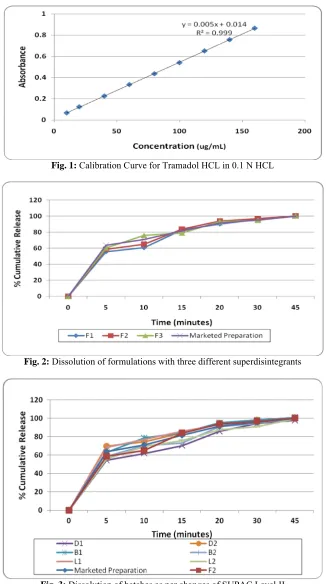
No interference of placebo was found at λmax of Tramadol Hcl.Hence, the UV method used for estimation of tramadol in formuation is specific. The results of the linearity of Tramadol HCl are summarised in Table-2.The calibration
curve of % concentrations of Tramadol hydrochloride
versus respective absorbances was ploted (Fig.1).The representative linear equation was y = 0.005x+0.014, where x is concentration and y is the absorbance. The correlation coefficient was 0.999, indicating good linearity in the concentration range of 10 - 100 ug/mL.
Formulation Development of Tramadol HCl Tablets
The study was designed to evaluate the immediate release tablets and carry out the optimization as per SUPAC Level II. All the batches were evaluated for flow properties. The angle of repose for all the batches was found to be between 26.9 °to 34.7° indicating good flow. A Hausner’s Ratio between 1.22 to 1.28 and Compressibility index between 18% - 22% indicated good flow. Thus, the formulation showed the required flow properties for direct compression. The values for angle of repose, Hausner’s Ratio and Compressibility Index of individual batches is represented in Table 4. All the batches were evaluated for physical parameters such as weight variation, thickness, hardness, friability and disintegration time. The tablets with different formulations were found to be between the weight range of 195 to 205 mg. A hardness value of tablets for all the batches was maintained between 3.6 to 4.6 Kp. The thickness of tablets was found to be between 3.10 to 3.18 mm. All the batches satisfied the friability requirement as the % friability values of tablets were less than 1 %. Disintegration time for D1batch was found to be more as compared to other batches. All the other batches showed the disintegration time below 5 minutes. The Drug content in the tablets was found to be highly uniform and within the range of 99.5 to 100.1 %. The weight variation, hardness, thickness, friability and content uniformity values are represented in Table 5.
Out of the in vitro dissolution results of the three batches with three different superdisintegrants; the batch with Kollidon Cl showed a more matching dissolution profile with the marketed preparation as represented in Fig. 2. Thus, the further optimization as per the SUPAC Level was carried out using Kollidon Cl as the superdisintegrant. For the formulation D1 with less superdisintegrant, it was observed that a slower release profile was obtained as compared to the marketed preparation which was not acceptable. The formulation D2with more superdisintegrant, a faster release profile was obtained which was comparable to the marketed preparation. Both B1with less binder and B2 with more binder showed a comparable release profile with respect to the marketed preparation. The batch L1with less lubricant showed a comparable release profile with the marketed preparation with some sticking and picking. The batch L2with more lubricant showed a slower release profile but was comparable to marketed preparation. Probably, in case of L2, as Magnesium stearate is hydrophobic; its higher amount slowed the dissolution profile slightly. The dissolution profile of these formulations is represented in Fig. 3.
The best formulation showing the closest release profile F2. In case of similarity factor as per equation 1, Wt was taken as one, since all the dissolution points were treated equally. Generally f2 values greater than 50 (50-100) ensure
had a similarity factor of more than 50 ensuring a similar profile with the marketed preparation.
CONCLUSION
A robust formulation of Tramadol HCl immediate release tablets which could withstand SUPAC Level 2 changes was successfully prepared. These scale up changes were performed from 100 tablets to 1000 Tablets and only one of the batch D1failed. All the other batches could withstand the changes. Thus, every formulation made should undergo the SUPAC changes at the initial development stage. These changes carried out at an early stage would give the formulator the confidence to carry out these changes on larger batch sizes. This would result in less manpower consumption and fewer batches thus reducing the overall cost, if the formulator is able to predict the outcome of these changes beforehand.
ACKNOWLEDGEMENTS
We would like to be grateful to Rubicon Research Pvt. Ltd. for providing the gift samples. We are also thankful to the HSNC Board and Dr. L. H. Hiranandani College of Pharmacy for providing the necessary facilities for the research.
Table 1:Scale Up Post Approval Changes
SUPAC
Changes LEVEL 1 LEVEL 2 LEVEL 3
Components and Composition
Deletion or partial deletion of excipient; % w/w excipient changes at low levels
Change in technical grade of excipient; % w/w excipient changes at higher levels
Change in excipient for Class IV drugs
Site Change Within a single facility Adjacent blocks At a different campus
Batch size change
Factor of 10 times the pilot batch size
Beyond the factor of 10 times the
pilot batch size
-Manufacturing Change
Another equipment with same working principle
Another equipment with different working principle
-Process Change Within the validation range Outside thevalidation range Change of process
Table 2:Absorbance of different concentrations of
Tramadol HCL in 0.1 N HCL
Concentration (ug/mL) Absorbance
10 0.067
20 0.1245
40 0.2252
60 0.334
80 0.4358
100 0.5401
120 0.6511
140 0.7566
160 0.8652
Table 3:Composition of all batches
Sr. No. Ingredients F1 F2 F3 B1 B2 D1 D2 L1 L2 % w/w
1. Tramadol HCl 25 25 25 25 25 25 25 25 25
2. Microcrystalline cellulose (Avicel PH 102) 62 62 62 63 61 64 60 62.5 61.5
3. Copovidone (Kollidon VA 64) 4 4 4 3 5 4 4 4 4
4. Sodium starch glycolate (Primojel) 6 - - -
-5. Croscarmellose sodium (Primellose) - 6 - - -
-6. Crospovidone (Kollidon Cl) - - 6 6 6 4 8 6 6
7. Colloidal silicon dioxide (Aerosil 200 Pharma) 1 1 1 1 1 1 1 1 1
8. Magnesium stearate 2 2 2 2 2 2 2 1.5 2.5
Total 100 100 100 100 100 100 100 100 100
Table 4: Granule characterization
Batches Bulk Density (g/mL) Tap Density (g/mL) Angle of Repose (°) Hausner’s Ratio Compressibility Index (%)
F1 0.387 0.484 32.47 1.25 20
F2 0.384 0.468 32.47 1.22 18
F3 0.389 0.486 29.44 1.25 20
B1 0.329 0.422 29.74 1.28 22
B2 0.338 0.423 29.25 1.25 20
D1 0.332 0.415 28.12 1.25 20
D2 0.328 0.41 27.94 1.25 20
L1 0.333 0.416 26.9 1.25 20
L2 0.33 0.402 29.64 1.22 18
Table 5:Physiochemical Properties of Tablet
Batches Weight variation (mg)
Hardness (Kp)
Thickness (mm)
Friability (%w/w)
Disintegration Time (minutes)
Drug Content
(%)
Similarity Factor
F1 198-202 3.8 – 4.2 3.10-3.14 0.4 4-5 99.6 59
F2 195-204 3.6 - 4.4 3.12-3.14 0.43 4-5 99.5 67
F3 196-203 4.2 - 4.6 3.10-3.16 0.51 2-3 99.8 72
B1 198-204 4.4 - 4.6 3.10-3.14 0.38 3-5 99.9 67
B2 196-202 4.6 - 5.0 3.12-3.16 0.42 3-4 100.1 65
D1 198-205 4.4 - 4.6 3.14-3.20 0.44 5-6 99.7 47
D2 199-203 4.2 - 4.8 3.10-3.14 0.48 1-2 99.8 69
L1 197-202 4.2 - 4.6 3.10-3.16 0.49 3-4 99.9 67
Fig. 1:Calibration Curve for Tramadol HCL in 0.1 N HCL
Fig. 2:Dissolution of formulations with three different superdisintegrants
Fig. 3:Dissolution of batches as per changes of SUPAC Level II
REFERENCES
1) Robinson JR and Lee VH. Controlled Drug Delivery Systems. 2ndedition New York: Marcel Dekker inc, 2005.
2) Kumar P, Singh S e. al. “Development And Biopharmaceutical Evaluation Of Extended Release Formulation Of Tramadol Hydrochloride Based On Osmotic Technology”, Acta Pharm, 2009, 59 (1):15–30.
3) Raval SB, Prajapati R., et al. “Formulation And Evaluation Of Tramadol Hydrochloride Mouth Dissolving Tablet”, Journal of Global Pharma Technology, 2010; 2(11):17-22. 4) Lehmann KA. “Tramadol In Acute Pain”, Drugs, 1997; 53
(2):25-33.
6) Singh I, Kumar P, et al. “Formulation And Development Of Matrix Tablets Of Tramadol Using Katira Gum As A Release Modifier”, Yakugaku Zasshi Journal of the Pharmaceutical Society of Japan, 2010, 130 (9) : 1225-1231.
7) Scott LJ, Perry CM, “Tramadol: A Review Of Its Use In Perioperative Pain”, Drugs, 2000, 60 :139-176.
8) ICH Guideline, Q4B Evaluation and Recommendation of Pharmacopoeial Texts for Use in the ICH Regions On Bulk Density and Tapped Density of Powders General Chapter, Q4 B Annexure 13, Version 1 dated June 9, 2010.
9) Kumar R, Patil S et. al. “Formulation Evaluation of Mouth Dissolving Tablets of Fenofibrate Using Sublimation Technique”, International Journal of ChemTech Research, 2009, 1 (4):840-850.
10) Modasiya MK, Lala I, “Design and Characterization of Fast Disintegrating Tablets of Piroxicam”, International Journal of ChemTech Research, 2009, 1(2):353-357. 11) Khinchi MP, Gupta MK, et. al. “Design and development
of Orally Disintegrating Tablets of Famotidine Prepared by Direct Compression Method Using Different Superdisintegrants”, Journal of Applied Pharmaceutical Science, 2011, 1 (1): 50-58
12) Singh I, Kumar P, et. al. “Preformulation Studies For Direct Compression Suitability Of Cefuroxime Axetil And Paracetamol: A Graphical Representation Using SeDeM Diagram”, 2012, Acta Poloniae Pharmaceutical and Drug Research, 69 (1): 87-93.
13) Wagh MP. Yewale CP, et. al. “Formulation And Evaluation Of Fast Dispersible Tablets Of Aceclofenac Using Different Superdisintegrant”, International Journal
of Pharmacy and Pharmaceutical Sciences,2010, 2 (1): 154-157.
14) Manikandan M, Kannan K, et. al. “Design and Evaluation of Amlodipine Besilate and Atorvastatin Calcium Tablets”, Research Journal of Pharmaceutical, Biological and Chemical Sciences, 2012, 3 (1): 425-434.
15) Damodharan N, Manimaran V, et. al. “Formulation Development And Evaluation Of Delayed Release Doxycycline Tablets”, International Journal of Pharmacy and Pharmaceutical Sciences, 2010, 2 (1): 116-119 16) Varma MM, Bhavani GL, et. al. “Development and In
Vitro Evaluation of Tramadol Hydrochloride Oral Controlled Release Matrix Tablets”, International Journal Of Pharmaceutical Research, 2010, 2 (2): 30-34.
17) Yeole CN, Darekar SS, et. al. Formulation and Evaluation of Immediate Release Tablet of Paroxetine Hydrochloride, Journal of Pharmacy Research, 2010, 3(8):1736-1738 18) Gohel MC, Sarvaiya KG, et al., Mathematical approach for
the assessment of similarity factor using a new scheme for calculating weight. Indian J Pharm Sci, 2009 ,71 (2) :142-144.
*Corresponding Author: Jaikishan Khatri,
76/1, Malabar Hill Road,Mulund Colony, Mulund (W), Mumbai-400082, India.