Vol. 08, Issue 01 (January. 2018), ||V2|| PP 40-45
Characteristics of Empirical Cumulative Distribution Function of
Grown Crack Size under Different Maximum Fatigue Loads in
AZ31
Seon Soon CHOI
11 Division of Computer and Mechatronics Engineering, Sahmyook University, Seoul, Republic of Korea
Corresponding Author: Seon Soon CHOI
Abstract:
The aim of this paper is to find the characteristics of the empirical cumulative distribution function of grown crack size depending on the maximum fatigue loads in AZ31 magnesium alloy. The grown crack data required to estimate the empirical cumulative distribution function and to analyze its probabilistic characteristic are obtained from the fatigue crack propagation experiments. These experiments are carried out on the duplicated compact tension specimens in three different maximum fatigue loads. The 3-parameter Weibull distribution is used to estimate the empirical cumulative distribution function. The slope and the tails of the empirical cumulative distribution function are affected by maximum fatigue load and fatigue crack propagation cycle. The result shows that the tail in the range below 10 % and above 90 % of the empirical cumulative distribution function is longer in case of larger maximum fatigue load and in stage close to failure. It is also found that the nearer a failure, the larger the slope of the empirical cumulative distribution function to the axis of grown crack size. The failure life can be short in larger maximum fatigue load condition.Keywords:
AZ31, Empirical cumulative distribution function, Fatigue crack propagation, Grown crack size, Maximum fatigue load--- --- Date of Submission: 22-01-2018 Date of acceptance: 17-02-2018 --- ---
I.
INTRODUCTION
Magnesium alloy is increasingly concerned as a structural material for an environment and an energy saving owing to the good properties such as specific strength, stiffness, machinability and lightest material in commercial metal. It is also widely used in an automobile industry because of the requirements of weight reduction and fuel efficiency for emission regulation. Magnesium alloy for structural material is primarily needed a fatigue performance because the structural components are commonly subjected to repeated loads. The studies improving fatigue performance of magnesium alloy has been reported steadily[1-5]. The defects in structure have induced the crack which affects the life of structure and its integrity. The research for fatigue crack propagation is also required in structural component of magnesium alloy. Cauthen et al.[6] have investigated the strip-yield based model of fatigue crack growth behavior in AZ31 magnesium alloy. Han et al.[7] have reported the acoustic emission of fatigue crack propagation in extruded AZ31 magnesium alloy and found that the mechanism of the acoustic emission is the crack extension and the twin at the tip of crack and the twin is prime factor of fatigue behavior in magnesium alloy. Zheng et al.[8] show that the mode I experiment the fatigue crack propagation in extruded AZ31B magnesium alloy, so that the specimen orientation affects reasonably the fatigue crack growth rate and the crack path. Tokaji et al.[9] have studied the fatigue crack propagation and the fracture mechanisms of magnesium alloy in different environment. The effects of specimen thickness on the probability distribution of the fatigue crack propagation behavior in magnesium alloy AZ31 have been investigated by Choi[10]. Sivapragash et al.[11] have reported the fatigue life prediction of ZE41A magnesium alloy using Weibull distribution. However the study for the aspects of the cumulative distribution function of the fatigue crack propagation behavior in magnesium alloy has been rarely reported[12].
II.
EXPERIMENTS
Material and specimenThe material of the specimen used for the FCP test is a commercial wrought magnesium alloy AZ31. The chemical composition(in weight %) of this material is 3.29 Al, 0.95 Zn, 0.31 Mn and balance Mg. The mechanical properties are tensile strength of 264.4 MPa, yield strength of 198.3 MPa and elongation of 21.95 %. The FCP experiment specimen is CT(compact tension) type complied with ASTM E647. The specimens are machined from as received using an electrical discharge method. The loading direction of the specimen is parallel to the rolling direction of material and vertical to the FCP direction. The CT specimens have a width of 50.8 mm and a thickness of 6.60 mm and are prepared twenty duplicates for each condition of three MFLs, respectively.
Fatigue crack propagation experiment
The FCP experiments have been performed on the CT specimens according to ASTM E647 using a servo-hydraulic fatigue testing machine controlled by a constant amplitude loading. The experimental conditions are a load ratio(minimum fatigue load/maximum fatigue load) of 0.20 and a frequency of 10 Hz with Sine wave form. The statistical data used to investigate the characteristics of the eCDF of grown crack size have been obtained from the FCP tests on three cases of MFL. The MFL conditions are three cases of 2.00 kN, 2.25 kN and 2.50 kN.
The grown crack size at the specified FCP cycle has been automatically computed by computer using the compliance technique after measuring the length of crack opening. The COD(crack opening displacement) gauge has been used to measure the crack opening length on the loading line.
III.
RESULTS
ANDDISCUSSIONS
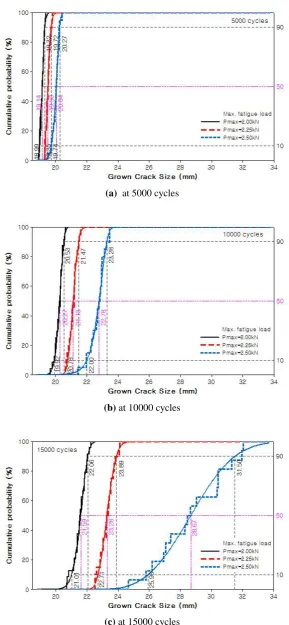
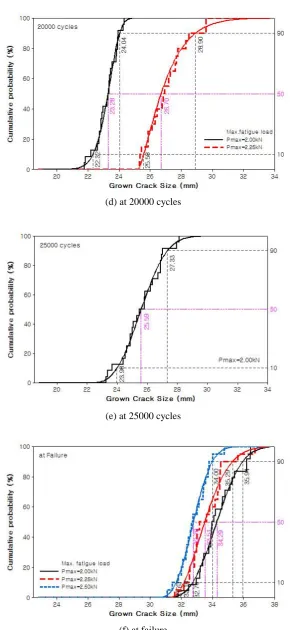
In order to investigate the characteristics of the eCDF of grown crack size, the estimation using the probability distribution is performed on the statistical fatigue data and the eCDFs of grown crack size at the specified FCP cycle in AZ31 magnesium alloy are plotted as shown in Fig.1. The eCDFs of grown crack size depending on three conditions of the MFL are also presented in Fig.1 to find the influence of the MFL on the characteristics of the eCDF. In Fig.1, the stepped graph is called the eCDF from experimental data of grown crack size and the curved graph is obtained from the statistical estimation using the probability distribution. The probability distribution used for the estimation is 3-parameter Weibull, because it shows a goodness-of-fit of probability distribution of grown crack size[13]. The values of the cumulative probabilities of 10 % and 90 % are marked on the eCDF graph. To analyze the influence of the MFL, the cumulative probability of 50 % is also indicated on the graph.
Fig.1(a) shows the eCDF of grown crack size depending on the MFL at FCP cycle of 5000. The median values of grown crack size for three cases of MFL are 19.14 mm, 19.50 mm and 20.04 mm, respectively. It signifies that the grown crack size becomes large as the MFL is large. This result is caused by large crack opening owing to large amplitude and loading effect.
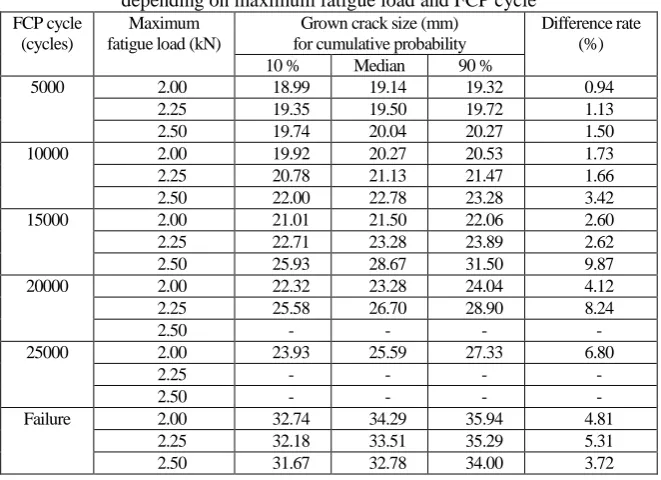
The eCDF of grown crack size at FCP cycle of 10000 is as shown in Fig.1(b) and those median values grown crack size are 20.27 mm, 21.13mm and 22.78 mm in three cases of MFL, respectively. As the MFL is large, the grown crack size becomes large. It represents similar tendency to Fig.1(a). But the FCP rate is faster than that of 5000 cycles. The values of the cumulative probabilities of 10 % ~ 90 % depending on three MFLs are 19.92~20.53 mm, 20.78~21.47 mm and 22.00~23.28 mm, respectively. The maximum difference between the cumulative probability 10 % and 90 % is 3.42 mm in case of the largest MFL of 2.50 kN. This means that the slope of the eCDF to the axis of grown crack size is affected by MFL. The maximum difference rate(DR) obtained from (1) occurs in the largest MFL of 2.50 kN as listed in Table 1.
100 Median Median CP DR
(1)
where, DR : Difference rate (%)
(a) at 5000 cycles
(b) at 10000 cycles
(c) at 15000 cycles
(d) at 20000 cycles
(e) at 25000 cycles
(f) at failure
Table 1 Grown crack size on empirical cumulative distribution function depending on maximum fatigue load and FCP cycle
FCP cycle (cycles)
Maximum fatigue load (kN)
Grown crack size (mm) for cumulative probability
Difference rate (%) 10 % Median 90 %
5000 2.00 18.99 19.14 19.32 0.94
2.25 19.35 19.50 19.72 1.13 2.50 19.74 20.04 20.27 1.50
10000 2.00 19.92 20.27 20.53 1.73
2.25 20.78 21.13 21.47 1.66 2.50 22.00 22.78 23.28 3.42
15000 2.00 21.01 21.50 22.06 2.60
2.25 22.71 23.28 23.89 2.62 2.50 25.93 28.67 31.50 9.87
20000 2.00 22.32 23.28 24.04 4.12
2.25 25.58 26.70 28.90 8.24
2.50 - - - -
25000 2.00 23.93 25.59 27.33 6.80
2.25 - - - -
2.50 - - - -
Failure 2.00 32.74 34.29 35.94 4.81 2.25 32.18 33.51 35.29 5.31 2.50 31.67 32.78 34.00 3.72
Fig.1(c) shows also similar tendency to Fig.1(a) and Fig.1(b) for grown crack size, the FCP rate, and the slop of the eCDF to the axis of grown crack size as the MFL is large. Especially, the eCDF in case of MFL of 2.50 kN inclines seriously to the axis of grown crack size. It is found that the tails of the eCDF in the range below 10 % and above 90 % are longer than those of Fig.1(a) and Fig.1(b). These results mean that the slope and the tails of the eCDF are affected by MFL and FCP cycle. The maximum DR occurs also in the largest MFL of 2.50 kN as shown in Fig.1(c) and Table 1. The large DR makes the data of grown crack size be scattered. In case of large DR, the probabilistic approach is to be required to judge the reliability. If the slope to the axis of grown crack size and the length of tails in the eCDF become seriously large, it can be considered to be close to failure. Actually, this comes true in Fig.1(d) and Fig.(e). In Fig.1(f) of failure stage, the median of MFL of 2.50 kN is inversely smaller than that of other MFL. It means that the rapid failure may easily occur in lager MFL.
IV. CONCLUSION
Through the FCP experiments under different MFL conditions and the statistical analyses of grown crack data in AZ31 magnesium alloy, the following conclusion can be suggested.
The MFL condition affects the probabilistic FCP behavior in magnesium alloy and the failure life can be short in lager MFL.
The slope of the eCDF to the axis of grown crack size and the tails in the range below 10 % and above 90 % of the eCDFare affected by MFL condition and FCP cycle. The slope of the eCDF and the length of the tail of the eCDF becomes large in condition of large MFL and in stage close to failure.
The probabilistic approach is to be considered in case of large DR to judge the reliability, for the large DR makes the FCP data be scattered.
V.
ACKNOWLEDGEMENTS
This paper is based on the abstract paper[12] presented in the 19th International Conference on Aerospace, Mechanical, Automotive and Materials Engineering(Venice, Aug., 2017).
REFERENCES
[1]. A. Bolchoun, J. Baumgartner, and H. Kaufmann, A new method for fatigue life evaluation under out-of-phase variable amplitude loadings and its application to thin-walled magnesium welds, International Journal of Fatigue 101, 2017, 159-168.
[2]. R.K. Singh Raman, Shervin Eslami Harandi, Resistance of Magnesium Alloys to Corrosion Fatigue for Biodegradable Implant Applications: Current Status and Challenges, Materials 10(11), 2017, 1316. [3]. W. Zhang, H. Liu, Q. Wang, J. He, A fatigue life prediction method based on strain intensity factor,
Materials 10(7), 2017, 689.
[5]. M. Klein, X. Lu, C. Blawert, K.U. Kainer, M.L. Zheludkevich, and F. Walther, Influence of plasma electrolytic oxidation coatings on fatigue performance of AZ31 Mg alloy, Materials and Corrosion 68(1),
2017, 50-57.
[6]. C. Cauthen, S.R. Daniewicz, N. Shamsaei, Modeling fatigue crack growth behavior in rolled AZ31 magnesium alloy using CTOD based strip yield modeling, International Journal of Fatigue 96(1), 2017, 196-207.
[7]. Z. Han, H. Luo, C. Sun, J. Li, M. Papaelias, and C. Davis, Acoustic emission study of fatigue crack propagation in extruded AZ31 magnesium alloy, Materials Science and Engineering A 597(12), 2014, 270-278.
[8]. S. Zheng, Q. Yu, Y. Jiang, An experimental study of fatigue crack propagation in extruded AZ31B magnesium alloy, International Journal of Fatigue 47, 2013, 174-183.
[9]. K. Tokaji, M. Nakajima, and Y. Uematsu, Fatigue crack propagation and fracture mechanisms of wrought magnesium alloys in different environments, International Journal of Fatigue 31(7), 2009, 1137-1143. [10]. S.S. Choi, Effect of Specimen Thickness on Probability Distribution of Fatigue Crack Propagation
Behavior in Magnesium Alloy AZ31, Journal of the Korean Society of Manufacturing Technology Engineers 18(4), 2009, 395-400.
[11]. M. Sivapragash, P.R. Lakshminarayanan, and R. Karthikeyan, Fatigue life prediction of ZE41A magnesium alloy using Weibull distribution, Materials and Design 29, 2008, 1549-1553.
[12]. S.S. Choi, Characteristics of Cumulative Distribution Function of Grown Crack Size at Specified Fatigue Crack Propagation Life under Different Maximum Fatigue Loads in AZ31, International Journal of Aerospace and Mechanical Engineering 11(8), 2017, 26. (Abstract paper)
[13]. S.S. Choi, Effect of Maximum Load on Probability Distribution of Fatigue Crack Propagation Behavior in Mg-Al-Zn Alloys, Proceedings of the KSME Spring Conference CAE & Applied Mechanics Div. Seoul, 2011, 97-98.