ISSN (e): 2250-3021, ISSN (p): 2278-8719
Vol. 07, Issue 10 (October. 2017), ||V2|| PP 79-89
Effect of Aggregate Gradation on Compressive Strength and
Elastic Modulus of Cement Treated Aggregate Base Material for
Highway Pavement
Ekwulo E. O
1. and Eme D. B
2.
1Department of Civil Engineering, Rivers State University, Nkpolu-Oroworukwo, Port Harcourt, Nigeria
Email: [email protected]
2
Department of Civil Engineering, University of Port Harcourt, Port Harcourt, Nigeria [email protected]
ABSTRACT:
Pavement failure is defined as the failure of the constructed layer of durable material of specified thickness, usually of concrete, asphalt, or any material designed to carry wheeled vehicles. The deflection on highway pavements can be as a result of excess wheel load, poor material properties or inadequate aggregate gradation of base material for construction. Aggregates used should have the proper particle size, shape, gradation and particle strength to contribute to a mechanically stable mixture. In this study, aggregates of 19.00mm, 2.00mm, 0. 425mm, 0.075mm and passing 200 sizes were combined to produce normal gradations that meets the specifications limits for Cement Treated Aggregate Base (CTAB) mixtures. Five other gradations were produced by removing each aggregate size from the normal gradation. CTAB mixtures were prepared using aggregates from the different gradations at 3%, 4.5% and 6%, cement content. The compressive Strength and elastic modulus of the mixtures were determined. Result showed that at all cement content, the normal gradation met the minimum strength requirement for base material but removing individual aggregate sizes relatively reduced or increased compressive strength and elastic modulus depending on the aggregate size removed. It was concluded that aggregate gradation affects compressive strength and elastic modulus of CTAB mixture. The study recommended that aggregates for CTAB mixtures should be combined to meet specification limits and further studies should be carried out for uniform aggregates in order to further investigate their effect on compressive strength and elastic modulus of CTAB mixtures.Keywords:
Aggregate Gradation, Compressive Strength, Elastic Modulus, CTAB--- --- Date of Submission: 04-11-2017 Date of acceptance: 16-11-2017 --- ---
I.
INTRODUCTION
Pavement failure is defined as the failure of the constructed layer of durable material of specified thickness, usually of concrete, asphalts, or any material designed to carry wheeled vehicles. Each time a load passes through a pavement structure, some deflection of the surface and underlying layer occurs. The deflection can be as a result of excess load, poor material properties or inadequate aggregate gradation of base material for construction.
Aggregates are granular mineral particles used either in combination with various type of cementing material to form concretes, or alone as road bases, backfill etc. Aggregates comprises the major portion of stabilized base, normally between 80 to 95 percent by weight of stabilized base mix may consist of Aggregates. Aggregate used should have the proper particle size, shape, gradation and particle strength to contribute to a mechanically stable mixture. In order to ensure an economical and practical solution, both fine and coarse aggregates are utilized to make up the bulk of the Aggregate mixtures. Sand, natural gravel and Crushed stone are mainly used for the purpose.
There are two different aggregate base materials used currently in practice for road base construction in many countries. One is the conventional crushed based material and the other is recycled concrete material. This study is based on the conventional crushed based materials which contain 1.5in (37.5mm), 3/4in (19.00mm),
No.10 (2.00mm), No.40 (0.425mm), No. 200(0.075mm), and passing 200 sieve size in accordance with the grading requirements of the American society of Testing Materials[1].
International organization of Scientific
Research
80 | P a g e
effects of handling, spreading and compacting. Fine aggregates passing the various sieve sizes shall normally consist of fines from the operation of crushing the coarse aggregate.Aggregate base materials (bound or unbound) are used as pavement materials. Unbound aggregate base material is a mixture of aggregate material and filler such as stone or cement dust. Bound aggregate base material such as Cement treated aggregate base (CTAB) is a mixture of aggregate material and measured amount of Portland cement and water that hardens after compaction and curing to form durable paving material [3]. As a structural layer of pavement, CTAB is widely used as a base course for either flexible or rigid pavements. CTAB also shows elastic, slab-like response to loading and its performance is influenced by the strength and modulus of the materials. These properties are also crucial for design procedures that consider the stress-strain relationship and fatigue characteristics of the CTAB layer [4, 5]. In CTAB construction, objectives are to obtain a thorough mixture of aggregate and granular material with the correct quantity of cement and water to permit maximum compaction which hardens the cement aggregates mixture during curing.
By virtue of the simplicity of the test method, the unconfined compressive strength is most commonly referred to as the mix design criteria for the construction of CTAB. Many previous studies proposed empirical relationships between the compressive strength and flexural or tensile strength of cement-treated materials that are useful for the structural design of the layer. The flexural and split tensile strength of cement-treated materials were found to be about 20-25% and 10-15% of the unconfined compressive strength, respectively (6). For the design and analysis purposes, 10% of the compressive strength is generally regarded as an acceptable estimate of the tensile strength of CTAB. It is noted that these relations are not significantly different from the relationships proposed for normal concrete.
Elastic modulus of CTAB is a necessary input for mechanistic design of highway pavements. CTAB material for use as pavement material must meet specifications in terms of gradation and compressive strength [1, 7]. The use of gap-graded aggregates for pavement base material results in unacceptable voids in the pavements and may affect pavement material properties such as elastic modulus. Test for elastic modulus for CTAB is relatively expensive. AASHTO design guide for mechanistic design of pavements recommends the use of correlation equations for the determination of elastic modulus of pavement materials. The ACI procedure adopted in this study is adequate in that it can determine the elastic modulus of CTAB materials from its compressive strength[7]. The ASTM [1] standards adopted also provide gradation specification for base materials in order to achieve adequate compressive strength and elastic modulus of CTAB that can withstand vehicular wheel loads. The research will go a long way in instilling caution in the selection of aggregates for road pavements.
Methods to determine an appropriate elastic modulus of CTAB material are complicated because of the difficulties associated with testing and interpreting the test results. Because of these difficulties, it was recommended for design purposes to use a relationship between the strength and modulus of elasticity of the material in lieu of testing. Many previous studies have proposed relationships between the unconfined compressive strength and modulus of elasticity of cement-treated materials [8-10]. These studies suggest that different relationships exist for different types of cement-treated materials depending on the quality of aggregates used. For lean concrete and CTAB materials, Thompson [6] recommended use of the relationship of normal concrete provided by the American Concrete Institute (ACI). The ACI committee 209 [7] proposed the estimation of compressive strength with time for normal concrete using the model in equation 1.
c b a t t fc . ) 28 ( f ) ( c (1) Where ) (t
fc = Compressive strength at time (t)
) 28 (
fc = references 28-days compressive strength
a,b = Experiment coefficient. Where a = 0.4 , b = 0.85
Calibration of the ACI model with the CTAB test data [11] resulted in a new set of coefficient as shown in equation 2 c b a t t fc . ) 28 ( f ) ( c (2) Where ) (t
fc = Compressive strength at time (t)
) 28 (
fc = references 28-days compressive strength
Where a = 2.5 , b = 0.9 .
This new set of coefficients is expected to be applicable to any CTAB mixture regardless of aggregate type and mixture proportioning.
The relationship between the compressive strength and elastic modulus or modulus of elasticity as proposed for CTAB materials [11] is as shown in equation 3
75 . 0 1.5
) ( . .3W 4 )
(t f t
E c (3]
Where,
E(t) = Elastic modulus at time t in psi w = mixture density in pcf
fc((t) = compressive strength in psi at time t
The relationships is expected to cover any type of CTAB materials having 7-day strength in the range of 200 to 2000psi (1.4 to 13.8 MPa) [11]. The water-cement ratio of CTAB also affects compressive strength an elastic modulus of CTAB material.
The use unbound aggregates base materials (commonly called stone base or 0/50) and CTAB materials as highway pavement material without considering the effect of aggregate gradation on the elastic modulus have contributed to the frequent road failures in Nigeria (Ajayi, 1987). Compressive strength and elastic modulus of CTAB may be affected if the mixed aggregate gradation of the material is altered or not properly mixed according to specification. This will also affect the particle size distribution (PSD) by forming a twist at that particular point where the aggregates is removed thereby causing a slight shift of the PSD curve from the envelop leading to an unsatisfactory gradation that will not meet specification. This study is aimed at investigating the effect of gap-graded aggregates on the compressive strength and elastic modulus of cement treated aggregate base material for highway pavement.
II.
MATERIALS AND METHODS
2.1 Material
The materials used in this study which are locally available pavement materials in Nigeria include: i. Ordinary Port Land Cement
ii. Portable water
iii. Coarse aggregate (crushed stone) iv. Stone dust
v. Fine sand
The crushed stone, stone dust and fine aggregates were sourced from a construction firm in Rivers State, Nigeria and well-graded to meet standard specification.
2.2 Apparatus
The equipment that were used in the study were: 100mm x 115mm cylindrical steel moulds, tags sieves, retainers, brush, weighing instrument, trowel, spanners, electric table vibrator, electric concrete mixer, slump test cone, curing tank and concrete load testing machine.
III.
METHODOLOGY
3.1 Experimental Design
International organization of Scientific
Research
82 | P a g e
Table 1a: Normal (Control) Aggregate Gradation Weight of Sample taken for sieving 1000g
Sieve No B.S.S
Sieve size (mm)
Weight Retained
(gm)
Percentage retained
(%)
Percent passing (%)
Graduation requirement
1.5in 37.5O 0 0 100 100
3/
4in 19.00 151.6 15.16 84.84 70-100
No. 10 2.00 354.6 35.46 49.38 45-70 No.40 0.425 190.6 19.06 30.32 10-40 No.200 0.075 239.6 23.96 6.36 0-20
Passing 200 - 63.6 6.36 0 -
Figure 1b: Gradation Envelop for Normal Gradation
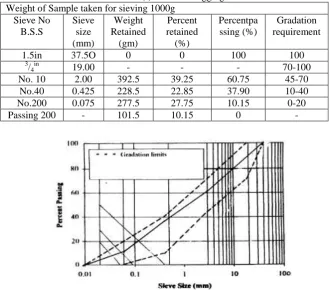
Table 2a: Minus(-) 19.00mm Aggregate Gradation Weight of Sample taken for sieving 1000g
Sieve No B.S.S
Sieve size (mm)
Weight Retained
(gm)
Percent retained (%)
Percentpa ssing (%)
Gradation requirement
1.5in 37.5O 0 0 100 100
3/
4in 19.00 - - - 70-100
No. 10 2.00 392.5 39.25 60.75 45-70 No.40 0.425 228.5 22.85 37.90 10-40 No.200 0.075 277.5 27.75 10.15 0-20
Passing 200 - 101.5 10.15 0 -
Figure 2b: Gradation Envelop for Minus 19.00mm Size Aggregates
Weight of Sample taken for sieving 1000g Sieve No
B.S.S
Sieve size (mm)
Weight Retained
(gm)
Percent retained (%)
Percent passing (%)
Gradation requirement
1.5in 37.5O 0 0 100 100
3/
4in 19.00 240.25 24.025 75.975 70-100
No. 10 2.00 - - - 45-70
No.40 0.425 279.25 27.925 28.050 10-40 No.200 0.075 328.25 32.825 15.225 0-20 Passing 200 - 152.25 15.225 0 -
Figure 3b: Gradation Envelop for Minus 2.00mm Size Aggregates
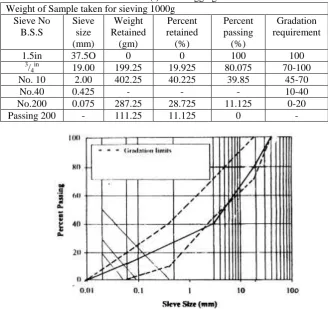
Table 4a: Minus(-) 0.425 Aggregate Gradation Weight of Sample taken for sieving 1000g
Sieve No B.S.S
Sieve size (mm)
Weight Retained
(gm)
Percent retained (%)
Percent passing (%)
Gradation requirement
1.5in 37.5O 0 0 100 100
3/
4in 19.00 199.25 19.925 80.075 70-100
No. 10 2.00 402.25 40.225 39.85 45-70
No.40 0.425 - - - 10-40
No.200 0.075 287.25 28.725 11.125 0-20 Passing 200 - 111.25 11.125 0 -
International organization of Scientific
Research
84 | P a g e
Table 5a: Minus(-) 0.075mm Aggregate Gradation Weight of Sample taken for sieving 1000g
Sieve No B.S.S
Sieve size (mm)
Weight Retained
(gm)
Percent retained (%)
Percent passing (%)
Gradation requiremen
t
1.5in 37.5O 0 0 100 100
3/
4in 19.00 211.5 21.15 78.85 70-100
No. 10 2.00 414.6 41.46 37.39 45-70 No.40 0.425 250.6 25.06 12.33 10-40
No.200 0.075 - - - 0-20
Passing 200 - 123.6 12.36 0 -
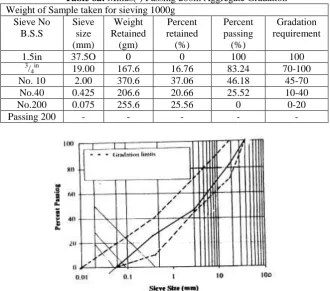
Table 6a: Minus(-) Passing 200m Aggregate Gradation Weight of Sample taken for sieving 1000g
Sieve No B.S.S
Sieve size (mm)
Weight Retained
(gm)
Percent retained (%)
Percent passing (%)
Gradation requirement
1.5in 37.5O 0 0 100 100
3/
4in 19.00 167.6 16.76 83.24 70-100
No. 10 2.00 370.6 37.06 46.18 45-70 No.40 0.425 206.6 20.66 25.52 10-40 No.200 0.075 255.6 25.56 0 0-20
Passing 200 - - - - -
Figure 5a: Gradation Envelop for Minus 0.075mm Size Aggregates
3.2 Specimen Preparation and Curing
Specimens were prepared in accordance with ASTM 39 [12] at different cement percentages of 3%, 4.5% and 6% by weight. The well-graded (normal) aggregate were used to prepare CTAB specimens to serve as a control to the out-of-specification aggregate gradations CTAB specimens. Three (3) sets of specimen samples were prepared for each cement percentage using aggregates of each gradation and cured for 28 days. A total of fifty four (54) specimens were prepared for the study.
3.3 Compressive Strength Test
The specimen were tested at 28 days for compressive strength using the universal testing machine in accordance with BS 1881, part 166 [13]. The value of the load at which the test specimen failed was recorded and used to calculate the compressive strength of each specimen for different cement percentages. The compressive strength at 7-days was predicted using the compressive strength at 28-days adopting the model in equation 4. c b a t t fc . ) 28 ( f ) ( c (4) Where ) (t
fc = Compressive strength at time (t)
) 28 (
fc = references 28-days compressive strength
a,b = Experiment coefficient. Where a = 2.5 , b = 0.9 .
3.4 Elastic Modulus
The elastic modulus of CTAB was determined using the relationship between the compressive strength and elastic modulus equation 5
75 . 0 1.5 ) ( . .3W 4 )
(t f t
E c (5]
Where,
E(t) = Elastic modulus at time tin psi w = mixture density in pcf
fc((t) = compressive strength in psi at time t
IV.
RESULTS AND ANALYSIS
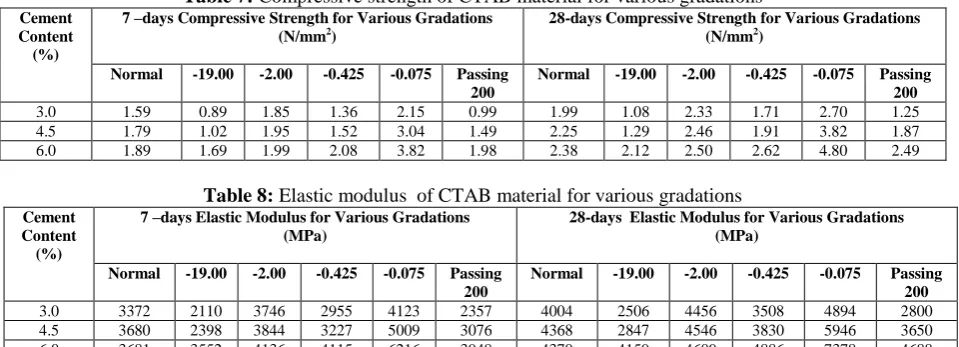
The result of the compressive strength and elastic modulus of CTAB for the different gradations and varying cement percentages are presented in Tables 7 and 8 respectively.
Table 7: Compressive strength of CTAB material for various gradations Cement
Content (%)
7 –days Compressive Strength for Various Gradations (N/mm2)
28-days Compressive Strength for Various Gradations (N/mm2)
Normal -19.00 -2.00 -0.425 -0.075 Passing
200
Normal -19.00 -2.00 -0.425 -0.075 Passing
200
3.0 1.59 0.89 1.85 1.36 2.15 0.99 1.99 1.08 2.33 1.71 2.70 1.25 4.5 1.79 1.02 1.95 1.52 3.04 1.49 2.25 1.29 2.46 1.91 3.82 1.87 6.0 1.89 1.69 1.99 2.08 3.82 1.98 2.38 2.12 2.50 2.62 4.80 2.49
Table 8: Elastic modulus of CTAB material for various gradations Cement
Content (%)
7 –days Elastic Modulus for Various Gradations (MPa)
28-days Elastic Modulus for Various Gradations (MPa)
Normal -19.00 -2.00 -0.425 -0.075 Passing
200
Normal -19.00 -2.00 -0.425 -0.075 Passing
200
International organization of Scientific
Research
86 | P a g e
4.1 Compressive Strength
The variation of compressive strength with of aggregate gradation of CTAB are shown in Figures 7a to 7c. From Figure 7a (3% cement content), the normal gradation resulted in compressive strength of 1.59N/mm2 and 1.99N/mm2 at 7 and 28days respectively. This implies that the normal gradation met the minimum strength requirement of 1.4PMa at 7-days for base materials [11]. Removing the 19mm aggregate (-19) resulted in a reduction of strength to 0.89N/mm2 and 1.08N/mm2 for 7 and 28days respectively. Also, removing the 2mm, 0.425mm, 0.075mm or passing 200 aggregates resulted in strengths of 1.85N/mm2 and 2.33N/mm2, 1.36N/mm2 and 1.71 N/mm2, 2.15N/mm2 and 2.7N/mm2, and 0.99N/mm2 and 1.25N/mm2 for 7 and 28days respectively. The relative reduction in strength (less than minimum strength requirement) on removal of the 19mm aggregate could be attributable to reduction in the load carrying capacity of the CTAB mixture when compared to that of the normal gradation. Also, the relative reduction in strength (less than minimum strength requirement) for -0.425 and passing 200 aggregates could be due to the absence of fine aggregates that would produce a good sand-cement mixture with less voids for the CTAB mixture. For 4.5% cement content, removing the 19mm (-19) aggregates resulted in compressive strength of 1.02N/mm2 and 1.29N/mm2 at 7 and 28 days respectively. These values are less than the7 days minimum compressive strength requirement for CTAB material.
4.2 Elastic Modulus
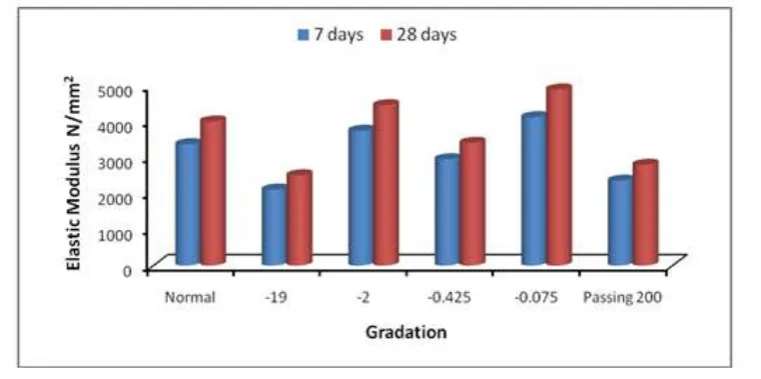
The variation of elastic modulus of CTAB mixture with gradation is shown in Figures 8a to 8c. From Figure 8a at 3% cement content, result shows that the elastic modulus of the CTAB mixture for the normal gradation were 3372MPa and 4004MPa at 7 and 28days respectively. On removal of the 19mm aggregates, the elastic modulus reduced to 2110MPa and 2506MPa at 7 and 28days respectively. Also, removing the 2mm, 0.425mm, 0.075mm or passing 200 aggregate sizes resulted in elastic modulus of 3746MPa and 4456MPa, 2955MPa and 3508MPa, 4123MPa and 4894MPa, and 2357MPa and 2800MPa at 7 and 28days respectively. Similarly, at 4.5% cement, result shows that the elastic modulus of the CTAB mixture for the normal gradation were 3680MPa and 4368MPa at 7 and 28days respectively. Removing the 19mm, 2mm, 0.425mm, 0.075mm or passing 200 aggregate sizes resulted in elastic modulus of 2398MPa and 2847MPa, 3844MPa and 4546MPa, 3227MPa and 3830MPa, 5009MPa and 5946MPa, and 3076MPa and 3650MPa at 7 and 28days respectively. Same trend occurred at 6% cement content as shown in Table 7 and Figure 8c.
International organization of Scientific
Research
88 | P a g e
V.
CONCLUSION AND RECOMMENDATION
5.1 Conclusion
From the results of the study, the following conclusions are hereby made:
1. Compressive strength of CTAB mixtures increases with increase in cement content. 2. Elastic modulus of CTAB increases with increase in compressive strength
3. Aggregate gradation affects compressive strength and elastic modulus of CTAB materials especially for gap-graded aggregates.
4. Absence of larger coarse aggregates and fines in CTAB mixtures reduces the compressive strength and elastic modulus, hence its load carrying capacity.
5.2 Recommendation
1. CTAB mixtures should be prepared from mixtures that meet the graduation requirement for base material 2. Gap-graded aggregates should be avoided in the use of CTAB for pavement bases materials because its
gradations does not meet minimum strength requirement for base materials
REFERENCE
[1]. ASTM D. 1241, Standard Specification for material for Soil-Aggregate sub base, Base and Surface Course, 1994.
[2]. Lilley, A.A, and R.I.T. Williams. Cement-Stabilized Materials in Great Britain, In Highway Research Record, HRB, National Research Council, Washington, D.C; 1973, pp.70-82.
[3]. PCA. Cement-Treated Aggregate Base. Report SR221.01S. Portland Cement Association, 1979. [4]. PCA. Thickness Design for Soil-Cement Pavements. Bulletin EB068.01S, Portland Cement Association,
1970.
[5]. George, K. P. Characterization and Structural Design of Cement Treated Base. In Transportation Research Record 1288, TRB, National Research Council, Washington, D.C., 1990, pp. 78-87.
[6]. Thompson, M.R. Mechanistic Design Concept for Stabilized Base Pavements. Civil Engineering Studies, Transportation Engineering Series No.46, University of Illinois, Urbana, IL, 1986.
[7]. ACI Committee 230. State of the Art Report on Soil Cement. Committee Report ACI 230. IR-90, ACL Manual of Concrete Practice, Part I, 1998.
[8]. Lilley, A. A., and R. I. T. Williams. Cement-Stabilized Materials in Great Britain. In Highway Research Record, HRB, National Research Council, Washington, D.C., 1973, pp. 70-82.
[9]. Larsen, T. J., and P. J. Nassbaum. Fatigue of Soil-Cement. Bulletin D119, Portland Cement Association, 1967.
[10]. Williams, R. I. T. Cement Treated Pavements: Materials, Design and Construction. Elsevier Publishers, London, UK, 1986.
[11]. Seungwook, L and Dan G. Z. Estimation of The Compressive Strength And Modulus of Elasticity Of Cement-Treated Aggregate Base Materials, Paper for Presentation and publication at the 2003 Meeting of Transportation Research Board Washington, D.C. 2003.
[12]. ASTM C 39 Test Method of Cylindrical Concrete Specimens.(1996-2010)