Page 44 www.ijiras.com | Email: [email protected]
Effect Of Eggshell Composite Material For The Replacement Of
Conventional Material
T Venkatamuni
Professor, Department of Mechanical Engineering, Jeppiaar Institute of Technology, Chennai, Tamilnadu, India
R Devanathan
D. Christopherselvam
Assistant professor, Department of Mechanical Engineering, Jeppiaar Institute of Technology, Chennai, Tamilnadu, India
I. INTRODUCTION
Composite materials were found to have wider applications in the fields of automobile, aerospace, marine and household which is obtained due to their unique properties such as low weight, high strength, toughness and specific stiffness [1]. N. Soltani et al has been reported that advanced materials like rice husk can be utilized to reduce greenhouse effect due to its observing capacity of CO2 unlike fossil fuels [2].
A. Bahrami et al experimented the consequence of rice-husk ash on properties of laminated and functionally graded Al/SiC composites by one-step pressure less infiltration process. He concluded that hardness and modulus of elasticity (E) of the bi layered functionally graded composite material shows significant improvement over rice husk [3].
Of late, a source of silicon and carbon based materials rice husk has been used for synthesis of high purity ceramic phases like silica, Mg2Si ,Si3N4, porous silicon ,carbon materials, SiC, and nano silica [4]. Surface associated
phenomena explains that surface tension and contact angles is based on wetting characteristics.[5].
From the Previous studies it has been found that Chicken eggshell (ES) is used as a byproduct in the field of agriculture, which is considered as one of the worst environmental problem as worldwide, In the U.S. 150,000 tons of ES material is disposed in landfills [6].
The egg shell structure is a protein lined with mineral crystals, usually of a calcium compound such as calcium carbonate which results in lightweight and low load-bearing composite applications in the fields of automotive industry, trucks, homes, offices, and factories.The average weight of one egg shell was found to be 7.2 to 7.8 gm. Egg shell was cleaned completely with a view to do away with organic properties and dried in sun light for 5 to 7 days and to make powder attained an average particle size of 45 μm.
Sudharsan et al, (2014) explained that the the tensile strength of composite depends on coconut coir fibre and compressive strength depends on eggshell quantity. It serves as a better application for Automotive & aircraft components, boat hulls. The mechanical properties of the composites such Abstract: Conventional materials have limitations in achieving good combination of strength, toughness and density. In order to overcome this limitation, composite materials are considered as the promising materials of recent development in automobile industries. In this paper epoxy resin is reinforced with the coconut coir and Egg shell (ES) powder to improve the mechanical properties such as Tensile strength, Compression strength and Hardnes. The tests were conducted on the prepared specimens as per ASTM standard. . The composite specimen was fabricated with various weight percentage of eggshell and coconut coir combined with epoxy resin. From the results it was found that coconut coir with egg shell (ES) powder exhibits Tensile strength of 16.49 MPa, Compression strength of 23.88MPa.This is due to increased surface area and the interfacial bonding of the particles in the matrix. The eggshell and coconut coir are considered as wastes, so producing a composite material from the waste would be useful and effective.
Page 45 www.ijiras.com | Email: [email protected] as Tensile strength, Flexural strength and Impact strength of
the composites are also greatly influenced by the fibre percentages. It is concluded that the tensile strength and impact strength of composites depend on coconut coir fibre and flexural strength of composites depend on chicken feather quantity [7].
Senthil, Madan Raj, (2015) derived that at two different percentage of (15%, 20%) addition of egg shell polymer composite results in significant results in tensile strength, flexural strength which is confirmed using SEM images. Egg shell powder is the renewable source for plastic industry.
Eggshell has been used as reinforcement in polymer composite. Generally 90 million tons of hen eggs are generated throughout the world every year. In India 77.7 billion eggs are produced in the year 2010-2011.Tamilnadu, amassing a share of around 20 per cent, is ranked second with 2000 core eggs are created in the Tamilnadu every year. Characteristics qualify ES as a good candidate for bulk quantity, low cost, less in weight.
Senthil J et al. explained that Epoxy resins have a number of useful properties. Both the liquid resin and curing agents form low viscosity easily processed systems. Epoxy resins are easily and quickly cured at any temperature from 5ºC to 150ºC, depending on the choice of curing agent. Epoxy has high mechanical properties and high adhesive strength. Epoxy can absorb both mechanical and thermal stresses also to assist with the accurate mixing of the resin and hardener[8].In this paper eggshell and coir act as a reinforcement and epoxy act as a matrix in polymer matrix composite in order to investigate the mechanical properties such as tensile streangth,hardnesss and compressive strength.
II. PREPARATION AND TESTING A. PREPARATION OF COMPOSITE MATERIAL
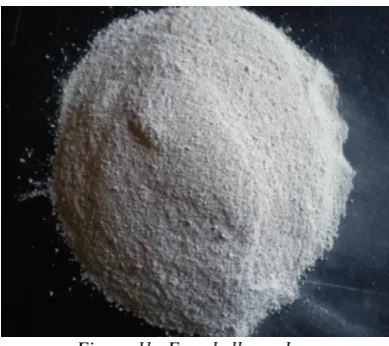
The eggshells were collected from the college mess and cleaned by removing the inside layer of the eggshell by washing it in a deionized water. The eggshells are immersed into boiling water for 15 minutes and pretreated with the base NaOH solution of 15 and 20% to hold at room temperature for four hours to remove the bacteria. Then the egg shell was chopped in order to obtain fine particle size with the help of blenders.
Figure 1a: Egg shell
Figure 1b: Egg shell powder
The coconut coir collected from the college and separated the coir. The coir is dried in sunlight for 12hours. The coconut coir is powered by using grinding machine.
Figure 2: Coconut coir powder
Next different size of dies are prepared for variable composites for different tests. For the tensile and compression test, PVC pipes of internal diameter of 1.6cm is considered and cut at middle through the length of pipe for composite material filled and removed. For hardness test circular dies are prepared by green sand.
Further the wet composite is prepared by taking the egg shell powder and coconut coir powder at different ratios and added with epoxy resin and hardener to prepare good mixture at room temperature.
The composite material is filled in the compression, tensile and Hardness dies at different ratios, then the dies are made to dry for 5days. The mechanical behaviour of composite is based on the ratio of eggshell and coconut fibre.
Figure 3: Prepared specimens
Page 46 www.ijiras.com | Email: [email protected]
Figure 4: Specimens as per ASTM standard
Table 1 shows the specimen specification used for the experimental study with percentage of composition.
SPECIMEN
EGG SHELL EG (%)
COCUNU T COIR CC (%)
EPOXY (%)
A 20 10 70
B 22 8 70
C 24 6 70
D 26 4 70
Table 1: Specimens used for the experiment
B. TESTING OF COMPOSITE MATERIAL TENSILE TEST
It is the ability of material to withstand a maximum stress. Also defined as the maximum stress to which the material can withstand without breakage. The specimens are tested in a universal testing machine (UTM) to determine the tensile strength. A load was connected to both sides of the composite specimens for the tensile testing. The testing is done to measure the load required to break the specimen and the length to which the specimen can stretch or elongates withstand without breakage.
COMPRESSIVE TEST
Compressive strength is the ability of the material to withstand loads tending to reduce size, it is opposite to tensile test which withstand loads tending to elongate or stretch. The specimens are tested in a universal testing machine (UTM) to determine the compressive strength. The testing is done to measure the load required to reduce the size or shape of the specimen.
HARDNESS TEST
Hardness is the internal resistance of the metal against cutting, wear, scratching or indentation. Hardness types available are Vickers, Brinell, Rockwell and Shore D hardness tests. In this method we are using Shore D hardness test to determine the hardness of the composite specimen. Generally there are three types of hardness measurement are scratch, indentation and rebound. Since it is a Shore D hardness test, the indentation type of hardness measurement is obtained.
III. RESULT AND DISCUSSION
The composite specimens are prepared with different ratios of coconut coir powder and eggshell powder with epoxy, then tested for different mechanical properties and they are illustrated below:
TENSILE TEST
The tensile strength of the composite specimen depends on the composition percentage of the eggshell powder and coir powder. The tensile strength varies with the percentage of the eggshell powder and coir powder. Increases in the coir due to eggshell composition, increases the tensile strength of the composite.
Figure 7: Tensile Performance
COMPRESSIVE TEST
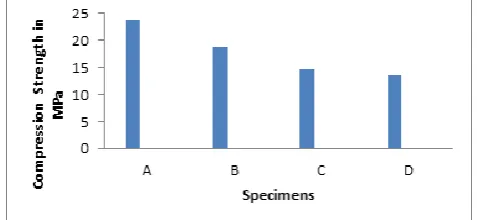
Compressive strength of the composite depends on the composition percentage of the eggshell powder and coir powder. The compressive strength varies with the percentage of the eggshell powder and coir powder. Increases in the weight % of eggshell composition, increases the compressive strength of the composite. Based on the eggshell proportions that means increase in eggshell powder, the compressive property are increase.
Figure 8: Compression Performance
HARDNESS TEST
Page 47 www.ijiras.com | Email: [email protected]
Figure 9: Hardness Performance
IV. DISCUSSION
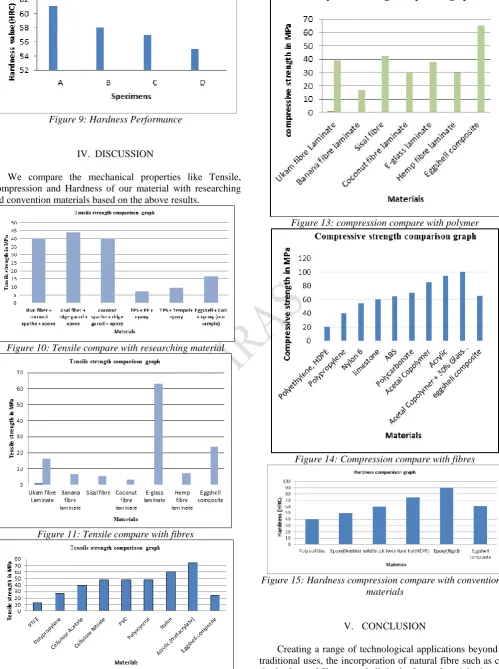
We compare the mechanical properties like Tensile, Compression and Hardness of our material with researching and convention materials based on the above results.
Figure 10: Tensile compare with researching material
Figure 11: Tensile compare with fibres
Figure 12: Tensile compare with conventional material
Figure 13: compression compare with polymer
Figure 14: Compression compare with fibres
Figure 15: Hardness compression compare with conventional materials
V. CONCLUSION
Page 48 www.ijiras.com | Email: [email protected] epoxy matrix shows the moderate improvement in the
mechanical properties of the composite.
Compare the mechanical properties such as Tensile, Compression and Hardness of our material with researching and convention materials based on experimental results, we conclude the following points in my Project work. From the graph, the composite can be regarded as light weight and good strength engineering material for the replacement of conventional material.
Developed materials shows good tensile strength of 16.49 MPa compare to few plastics polymer materials.
Our material exhibit good tensile strength over fibre materials that is eggshell composite material shows 23.88MPa than banana fibre, sisal fibre and hemp fibre composite materials.
Eggshell composite material exhibit reasonable tensile strength for replacing conventional polymer materials like PTFE and polypropylene.
The newly developed eggshell composite material exhibit excellent compressive strength than banana fibre, sisal fibre, hemp fibre and ukam fibre composite material.
As per fig.14 eggshell composite material shows good compressive strength than many polymers like polyethylene, polypropylene, nylon and limestone etc.
The developed eggshell composite material exhibit good hardness than conventional materials like polysulphide, epoxy, solid truck tyres, epoxy rigid, eggshell composite. Thus we conclude the developed eggshell, coconut coir composite material exhibit good mechanical properties for replacing existing conventional materials using in automotive industries.
REFERENCES
[1] Anon. Durafibre Inc. of Cargill Limited Processor of flax fiber. Ag Fiber Technology Showcase, available at: http://www.agrotechfiber.com/showcase/duraf ibre.htm, pp. 10-15, 1999.
[2] N. Soltani, A. Bahrami, MI Pech-Canul, LA Gonzalez.”Review on the physicochemical treatments of rice husk for production of advanced materials”, Chemical Engineering Journal, 2015, Vol. 264, 899-935 [3] A. Bahrami, N. Soltani, MI Pech-Canul, CA Gutierrez,
“Development of metal-matrix composites from industrial/agricultural waste materials and their derivatives”, Critical Reviews in Environmental science and Technology, 2016, Vol. 46(2), 143-207.
[4] A. Bahrami, MI Pech-Canul, CA Gutierrez, N. Soltani, “Effect of rice-husk ash on properties of laminated and functionally graded Al/SiC composites by one-step pressureless infiltration”, Alloys and Compounds, 2015, Vol. 644, 256-266.
[5] A. Bahrami, MI Pech-Canul, CA Gutierrez, N. Soltani, “Wetting and reaction characteristics of crystalline and amorphous SiO2 derived rice-husk ash and SiO2/SiC substrates with Al–Si–Mg alloys”, Applied Surface Science, 2015, Vol. 357, 1104-1113.
[6] S. Shuhadah, M. Supri and H. Kamaruddin: Thermal analysis, water absorption and morphology properties of eggshell powder filled low density polyethylene composites, in: Proceeding of MUCET 2008, UniMAP, Kangar, Perlis, 2008, pp. 15–16.
[7] Sudharsan B et al, International Journal of Engineering Trends and Technology, “The Mechanical Behaviour of Eggshell and Coconut Coir Reinforcing Composite”, Vol-18, pp. 9-13, Dec 2014.
[8] [8]Alagarsami S.V. et al, International journal of Science, Engineering and Technology Research, “Investigating the Mechanical Behaviour of Coconut Coir –Chicken Feather Reinforced Composite”, Vol-4, Issue 12, pp. 4215-4220, Dec 2015.
[9] Senthil J, Madan Raj P, “Preparation and Characterization of Reinforced Eggshell Polymer Composite”, Vol-3, Issue 3, pp. 7-1, 2015.
[10] Abdullah A et al, Journal of Basrah Research, “Water Absorption and Mechanical properties of High-Density Polyethylene Eggshell Composite”, Vol-37, pp. 36-42, 2011.
[11] Agunsoye J.O, S Bello et al, Journal of Metallurgical Engineering, “Potential of Recycled Al cans and 215 µm sized Eggshell powder for Low cost Metal Matrix Composite”, Vol-4, pp. 24-30, 2015.
[12] Alagarsami S.V. et al, International journal of Science, Engineering and Technology Research, “Investigating the Mechanical Behaviour of Coconut Coir –Chicken Feather Reinforced Composite”, Vol-4, Issue 12, pp. 4215-4220, Dec 2015.
[13] Asha A., V Chandra Sekhar, International Journal of Engineering Research and Technology, “Investigating on the Mechanical properties of Eggshell Powder Reinforced Polymeric Composite”, Vol-3, Issue 12, pp. 288-291, Dec 2014.
[14] Challah Ramesh, M Vamssi Krishna et al, The International Journal of Science and Technology, “Evaluation of Mechanical properties of Polyamide-Eggshell powder composite Materials”, Vol-2, Issue 11, pp. 90-95, 2014.
[15] Dolt SheeIng et al, “Eggshell powder potential filler in concrete”, 2014.
[16] Farahana R.N, A.G Supri et al, Journal of Advanced Research in Material Science, “Tensile and water absorption of Eggshell powder filled recycled High-Density Polyethylene/Ethylene Vinyl Acetate Composite”, Vol-5, pp. 1-9, 2015.
[17] Greta Gergely, Ference Weber et al, Ceramics International, “Preparation and Characterization of Hydroxyapatite from eggshell”, pp. 803-806, 2009. [18] Hassan S.B., V.S Aigbodian, Journal of King Saud
University-Engineering Science, “Effect of eggshell on the microstructure and properties of Al-Cu-Mg/eggshell particulate composites”, pp. 49-56, 2015.