Human Journals Vol.:2, Issue:2
Review Article
© All rights are reserved by Rev. Pinnawala Sangasumana
Methodological Issues Pertaining to the Application of
Qualitative Techniques in Forced Migration Studies
www.ijrm.humanournals.com
Keywords: Forced Migration, Methodological Issues, Qualitative techniques, Social Research
ABSTRACT
There is increasing attention been placed on qualitative methodology in collecting social data, it greatly contributes to collect more realistic and insightful information, ethnographic data etc. This had been realized by anthropologists but is now increasingly been realized by geographers as well. Such methodologies are important not only for their own sake but also to supplement quantitative data. This study has presently been initiated on the process of internal displacement in Sri Lanka- is a multidimensional process, which covers various social and spatial movements, delimited by single or multiple, day and night or other secular displacements. Therefore, the emphasis on qualitative research in the study. Though different qualitative methods are readily available to social scientists, it is found difficult and problematic to use such methods without subjecting them to a scanning process. Hence the need to pay special attention to methodological issues. In this paper, qualitative methods used by social scientists such as formal and informal discussions, in-depth interviews, structured or semi structured interviews, collective reflections, observations, innovation assessments, case studies and life histories etc. are first identified. This is followed by focusing on methods relevant to the study of internal displacement of people in Sri Lanka. The methodological issues confronted in this qualitative research such as the problems of representativeness, ethical considerations, verification of events and information relating to informants, validity and reliability, organization of the research (access, timing and neutrality) and objectivity of the researcher, are highlighted and discussed.
Rev. Pinnawala Sangasumana
Department of Geography
Citation: Rev. Pinnawala Sangasumana Ijrm.Human Vol. 2 (2): 1-19.
2
2
2
2
INTRODUCTION
Forced migration, or population movement by force, impacts to the society in many ways. It
is also a related to various facets of critical social changes such as urbanization,
industrialization, settlement policies, family structures etc. The recent history of Sri Lanka
reveals empirical evidence that forced migration—both local and international-has been a
dynamic force of social change derived from natural and anthropogenic reasons and need to
be more attention by researchers.
Forced migration is a multidimensional process which covers different social and spatial
movements, related to events such as evacuation, migration, refugee movement and internal
displacement, which have their particular characteristics and patterns. On the other hand, it
can be identified as a process or phenomenon that affects a steadily increasing number of
people across the world with variable implications at global, regional and local levels. One
dimension of the problem is when individuals, communities or ethnic groups have left their
home areas involuntarily forced by external circumstances and have been compelled to
settled down temporarily or permanently in new areas which may differ more or less in terms
of climate, natural resources, social and cultural organization and practices from their familiar
environment. The Internal displacement of people in Sri Lanka has become a highly
complicated national problem because its political, socio-economic and environmental
dimensions have been lost sight of in seeking solutions' The civil war that had dragged on
thirty years was the main factor contributing to the displacement of people and it had caused
as many as 800, 000 to become displaced from their homes by the end of 2010 (UNHCR
2010)' Even though the main cause of displacement – ethnic conflict- has no longer in the
country, several other reasons such as Tsunami, flood, drought, landslide etc. have been
producing thousands of displaced people over the country. However, a clear picture cannot be
drawn about the problem of forced migration in Sri Lanka from the quantitative perspective
based on the data provided by the Government or international agencies' Even though some
people do not physically leave their places of origin due to any risk, they are being subject to
severe social displacement' Therefore, it is important to make use of the qualitative
techniques in methodology to study this kind of problem'
Knowledge of qualitative methodology helps in collecting and analyzing the wide variety of
data that are used in social research' Although it is very difficult to give precise description of
Citation: Rev. Pinnawala Sangasumana Ijrm.Human Vol. 2 (2): 1-19.
3
3
3
3
collect data and analyze and interpret social phenomena or human behaviour by applying
concepts, techniques and qualitative research methods. The qualitative research aims at
explaining why human begins behave in a certain way and/or how the social phenomena are
related to their environments' If simply say, quantitative researcher mainly collects
quantitative data that are expressed in numbers, while quantitative researcher collects
qualitative data that are expressed in words, pictures, or objects. From the above meaning,
although qualitative studies differ from quantitative studies in terms of method of data
collection, modes of data analysis and data interpretation, both types are complementary' The
quantitative study determine the magnitude, direction, patterns and nature of social
phenomena correctly and reliably, but cannot explain why such phenomena happen, what
relationships exist among factors' These are best obtained and understood through qualitative
research' As shank (2002) states, qualitative research is a form of systematic empirical
inquiry into meaning. It is applied to gain insight into people's attitudes, behaviours, value
systems, concerns, motivations, aspirations, culture or lifestyles. Principally, qualitative
research enables scholars to study real people in real situations, notably interaction on
micro-level and thus mapping social worlds. This enables to produce an analytic description of a
complex social organization or process rather than a test of theory.
Qualitative research is concerned with no statistical methods of inquiry and analysis of social
phenomena. Creswell (2007) outlines eight characteristics of qualitative research: (1)
conducting the research in a natural setting; (b) using the researcher as a key instrument to the
study; (2) studying multiple sources of data; (3) analyzing data inductively; (4) focusing on
the participants’ meaning; (5) establishing an emergent design; (6) applying a theoretical
lens; (7) interpreting data subjectively; and (8) developing a holistic account. Qualitative
researchers are willing to interpret the meanings hidden between and within the lines. In
effect, qualitative researchers know what to expect; in other words, the researchers may only
know roughly in advance what they are looking for. Metaphorically, the researchers gather
data in order to plug them into the bigger picture (Tuner, 2013).
Qualitative research deeply rooted in social sciences that seek in-depth answers to human
behavioral patterns and systems of understanding and it is also concerned as an art form
which rests not only on the subjective insights of interviewees but also those of interviewers'
It has been explained a process of producing new knowledge about the social world, that uses
Citation: Rev. Pinnawala Sangasumana Ijrm.Human Vol. 2 (2): 1-19.
4
4
4
4
particular the study of people- their believes, behavior, interactions, institutions, and so forth'
Within the conceptual frame, qualitative researches can be the epistemology of quantitative
research is deeply rooted in empiricism. Nevertheless, "empiricism is an inherently limited
epistemology" (Slife & Melling, 2012). It deals with the observables and disregard non
observables. However, no one denies that to understand unobservable construct such as love,
it might be necessary to understand hugs, kisses, etc. Thus, the way of getting to the truth is
rigid and narrow. Truth is obtained in an absolute sense if phenomena can be observed. This
disadvantage in epistemology—ways of knowing— is "part of the reason that qualitative
methods were formulated—they deal better with the important nonobservables of our
experience" (Slife & Melling, 2012.). In addition, qualitative research has defined by several
scholars as an intensive research involvement of the researcher in the social setting being
studied, as observer and in varying degrees as a participant as well as the use of multiple
intensive research techniques, with emphasis on participant observation and key informant
interviewing etc.
RESEARCH PROBLEM
Forced migration research can be conducted from the position of a negative perception of
migration focusing on the costs of migration for social cohesion or welfare systems, or it can
be deducted from the position of a positive perception of migration, for example, by
emphasizing the economic and cultural benefits of migration Goubineau (1853) and Park
(1928). Franck Düvell (2012) says that qualitative migration research is often identified with
sociology, anthropology and ethnography, and with geography but also with market research.
Originating in anthropology, qualitative field research traditionally refers to a practice in
which researchers spend longer and sometimes repeated periods of time living within a
culture in order to study it. Emphasizing the significance of using qualitative techniques in
migration studies, Franck Düvell has further stated eight methodological considerations
which have consequences for the research design and the choice of the research methods.
Qualitative research in the field of forced migration depends mainly on fieldwork which is a
method by which researcher places himself into uncertain life of the displaced persons so that
he can mix with and understand the community. Such fieldwork attempts to collect first-hand
information on a qualitative basis, but it often does not totally overlook quantitative data' In
order to get a more holistic and comprehensive picture about the displaced persons,
Citation: Rev. Pinnawala Sangasumana Ijrm.Human Vol. 2 (2): 1-19.
5
5
5
5
insights into the magnitude and extent of a certain case, while a qualitative study lends insight
into the underlying processes and reasons for its existence' Consequently, any researcher can
do better in explaining certain phenomena if he or she commands good knowledge and skills
of in quantitative research' Contrary, researchers have emphasized several drawbacks with
qualitative approach, particularly in the field of forced migration since such studies require
thoughtful planning to ensure the obtained results accurate. On the other hand, as forced
migration studies are mostly open-ended, the participants have more control over the content
of the data collected. According to Bowen (2006), one of the potential problems with
qualitative research is that a particular problem could go unnoticed. Sometimes the personal
experience and knowledge influences the observations and conclusions related to the problem
need to be studied. In this context, Sri Lanka has set up an appropriate platform to test the
applicability of qualitative techniques in displacement studies on the one hand and limitations
pertaining to the application of qualitative techniques on the other. In the light of foregoing,
the present research has set few questions; which qualitative techniques are appropriate in the
field of forced migration and which level can be addressed by particular methods? What are
the advantages and limitations of depending on qualitative techniques particularly in forced
migration studies? Hence, the present research focusses to highlight the possibility of using
qualitative methods widely in forced migration field and to identify the methodological issues
pertaining to the application of such qualitative techniques.
MATERIALS AND METHODS
The present research was organized based on the qualitative approach, and supported by
empirical evidence or data, that has been carefully gathered using specific methods and
according to a set of rules or established procedures' In order to achieve the objective of the
research most popular qualitative technique conducting case studies was mainly asserted by
the researchers in the field such as Yin (1993) and Stake (1995)' In addition, different
methods were used such as focus group discussion, interviews, in-depth discussions, life
histories and direct and participant observation' Interviews took one of several forms:
open-ended, focused, or structured. In an open-ended interview, the researcher touched for the
informant's opinion on events or facts. In focused interviews, the respondent was interviewed
for only a short time, and the questions asked could have come from the case study protocol.
The structured interviews were particularly useful in studies of displacement experience. In
Citation: Rev. Pinnawala Sangasumana Ijrm.Human Vol. 2 (2): 1-19.
6
6
6
6
in other qualitative methods. Like in-depth interviewing, they allowed access to the attitudes
and experiences of informants. Direct observation in a case study occurred when the
investigator makes a site visit to gather data. Using multiple observers is one way to guard
against this problem. Participant observation is a unique mode of observation in which the
researcher may actually participate in the events being studied. While the information may
not be available in any other way, the drawbacks had to carefully consider by the researcher.
In addition to the above major techniques, rarely used techniques such as event recording, life
history recording, mental maps, documentary sources, archival records and physical artifacts
etc. were used in the research'
Figure No. 01: Location of Research Sites
Two villages; Morakewa and Dutuwewa located in the Horowpothana Divisional Secretariat Division belong to Anuradhapura District of North Central Sri Lanka are shown.
Dutuwewa
Morakewa
Figure No. 01: Location of Research Sites
Two villages; Morakewa and Dutuwewa located in the Horowpothana Divisional Secretariat Division belong to Anuradhapura District of North Central Sri Lanka are shown.
Dutuwewa and Morakewa Villages located in the D'S' division of Horowpothana belonging
to the Anuradhapura district were selected as the two research sites for understanding the
possibility of applying qualitative techniques in forced migration studies as well as their
methodological implications as shown in figure 01. Due to the brutal attack launched by the
LTTE against Dutuwewa village on 11th February 1989 people lost their lives, property and
the rights to their lands and the rest of the people moved by forced into the surrounded safer
Citation: Rev. Pinnawala Sangasumana Ijrm.Human Vol. 2 (2): 1-19.
7
7
7
7
various transformations that have taken place in the aftermath of the attack' Because many
Sinhala villages in the North and East and in bordering areas were systematically attacked by
the LTTE, many people left those areas as Internally Displaced Persons (IDPs) sought refuge
in other parts of the country' A large number of people who were displaced from Sinhala and
Muslim villages had come to the Horowpothana Division in Anuradhapura district by 1990s.
Many IDPs who had thus come since 1985 resided in the village of Morakewa' Even though
their numbers had declined over the time several issues were fueled by the uncertain
situation. This social conflict has been seen even after the 2009- the year of terrorism was
defeated.
Findings: Setting the Stage with Empirical Evidence
Despite the pre-defined definite quantitative methods, the above mentioned study has
attempted to use the appropriate qualitative research techniques and multiple sources of data
for obtaining the relevant data and information. The method of event recording which is still
rarely used in geographical research, in collecting data was extensively utilized in the study'
This method was very successful for obtaining correct information in respect of both the
situation and the time' Other important research methods such as in-depth interviews, life
histories, case studies and observation have been used in the study'
As one of the main techniques for qualitative data collection, In-depth discussions were used
in the study with different themes focusing female leaders of the welfare centres in
Morakewa village, Horowpothana DSD as well as with selected male and female elders,
youngsters and children, a few others representing the local community and with the
Gramaniladaries (village heads) in both research sites' This technique provided an
opportunity to understand in depth, how people have experienced the displacement process'
Group discussions allowed facts to be elicited on (a) how people settled in new areas after
leaving their original lands (sometimes displaced persons of a village or several villages got
together and shifted to new areas), (b) problems that the local community had to face because
of the arrival of IDPs and (c) identifying the efforts being made to protect their community
identity etc. Group discussions also helped to identify the manner in which the internal
displacement process contributed to the collective experience of the displaced and also
influenced them in adapting to a new environment' The IDP community informants as well as
local community informants were selected with reference to elders, youngsters and children,
Citation: Rev. Pinnawala Sangasumana Ijrm.Human Vol. 2 (2): 1-19.
8
8
8
8
effective means of evoking the collective memory of people who were subject to the trauma
of displacement' It was a relative means of collecting information as all information was
collectively reflected and agreed upon by the respondents'
Recording life histories is another technique that can be used to generate more information
relating to the central theme. This technique was so successful since some life histories
revealed quite a lot of information on the impact of the ethnic conflict from its early
beginnings up to displacement' Indeed some life histories provided a profile of the IDP
problem' The recordings were conducted in such a manner as to understand the way in which
the individuals responded to the traumatic situation created by the ethnic conflict' Even
though participant observation was not used in the study, much information was obtained
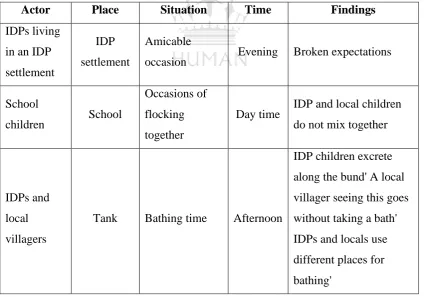
through observation' Table 01 shows the method used in the study for collecting data through
field observations' The objects of observation are shown in the first column and the facts
revealed through the experience appears in the last column'
Table No. 01 Method of collecting data through observation
Actor Place Situation Time Findings
IDPs living
in an IDP
settlement
IDP
settlement
Amicable
occasion Evening Broken expectations
School
children School
Occasions of
flocking
together
Day time IDP and local children do not mix together
IDPs and
local
villagers
Tank Bathing time Afternoon
IDP children excrete
along the bund' A local
villager seeing this goes
without taking a bath'
IDPs and locals use
different places for
Citation: Rev. Pinnawala Sangasumana Ijrm.Human Vol. 2 (2): 1-19.
9
9
9
9
Case Studies are another important technique of collecting qualitative data were carried out at
the community and individual level'
1' Case studies were conducted regarding a community living in a village and had been
displaced due to the unexpected attacks' Case studies were also recorded of communities, that
had completed the displacement circle and returned to the places of origin.
2' The experiences gained on displacement at individual level were also very important'
Therefore, persons with such experience in the displacement process were considered as
special cases' The different stages in their displacement history up to the present were
recorded'
Mental maps were also very useful in reconstructing the picture of the destroyed village' The
information was collected through the technique of developing a mental map by giving an
opportunity to the elderly males and females and also the youngsters to piece together spatial
information on the village that they had known' Finding evidence of the attack, date records,
visual evidence such as photographs and other related materials to the incident were very
useful for the study' Although some researchers perform data analysis as a one shot exercise
at the conclusion fieldwork, in the present study, data analysis had been undertaken as a two
stage exercise' One was while fieldwork was ongoing and the other on conclusion of
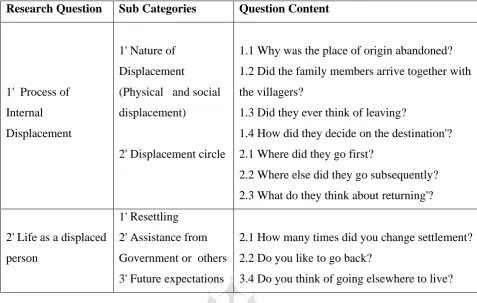
fieldwork' Table 02 shows the manner in which the main research questions were presented
to the respondents' The second column shows a breakdown of the main research question
while the last column indicates the question content' Field data analysis apart from dealing
with sorting, coding and organizing of data was also a strategy to check and remove errors
Citation: Rev. Pinnawala Sangasumana Ijrm.Human Vol. 2 (2): 1-19.
10
10
10
10
Table No. 02 Framework for asking the main research questions
Research Question Sub Categories Question Content
1' Process of
Internal
Displacement
1' Nature of
Displacement
(Physical and social
displacement)
2' Displacement circle
1.1 Why was the place of origin abandoned?
1.2 Did the family members arrive together with
the villagers?
1.3 Did they ever think of leaving?
1.4 How did they decide on the destination'?
2.1 Where did they go first?
2.2 Where else did they go subsequently?
2.3 What do they think about returning'?
2' Life as a displaced
person
1' Resettling
2' Assistance from
Government or others
3' Future expectations
2.1 How many times did you change settlement?
2.2 Do you like to go back?
3.4 Do you think of going elsewhere to live?
Field notes can be maintained during the period of field study in a systematic manner' It
would also be a good guidance for data analysis' The notes entered in the field book can be
indexed at various stages and it is helpful for sorting out important points as 1,2,3''' in the
Citation: Rev. Pinnawala Sangasumana Ijrm.Human Vol. 2 (2): 1-19.
11
11
11
11
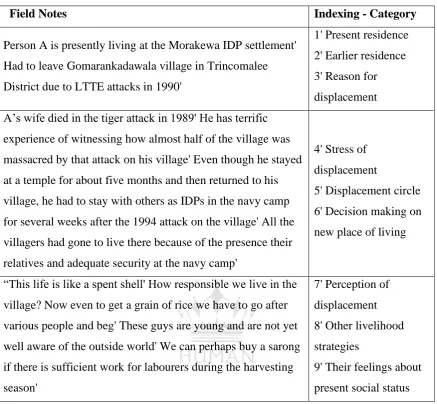
Table No. 03 Sorting field notes
Field Notes Indexing - Category
Person A is presently living at the Morakewa IDP settlement'
Had to leave Gomarankadawala village in Trincomalee
District due to LTTE attacks in 1990'
1' Present residence
2' Earlier residence
3' Reason for
displacement
A’s wife died in the tiger attack in 1989' He has terrific
experience of witnessing how almost half of the village was
massacred by that attack on his village' Even though he stayed
at a temple for about five months and then returned to his
village, he had to stay with others as IDPs in the navy camp
for several weeks after the 1994 attack on the village' All the
villagers had gone to live there because of the presence their
relatives and adequate security at the navy camp'
4' Stress of
displacement
5' Displacement circle
6' Decision making on
new place of living
“This life is like a spent shell' How responsible we live in the
village? Now even to get a grain of rice we have to go after
various people and beg' These guys are young and are not yet
well aware of the outside world' We can perhaps buy a sarong
if there is sufficient work for labourers during the harvesting
season'
7' Perception of
displacement
8' Other livelihood
strategies
9' Their feelings about
present social status
Field notes can be recorded in direct or indirect speech. Table 03 shows that only facts
directly associated with the objectives of the study were extracted from them' The second
column shows how data was categorized to help in the qualitative analysis' While conducting
the on field analysis of data, a very important procedure would be to encode them
systematically' Data encoding tables were prepared for Dutuwewa and Morakewa following
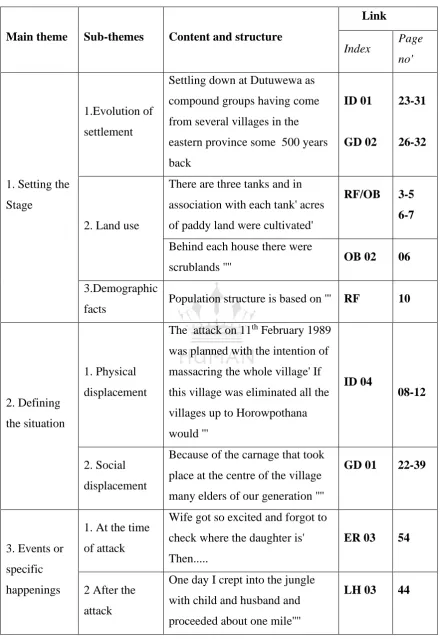
Miles and Huberman (1984)' As Table 04 indicates provision is made for the main themes,
content and structure and an index' Because all facts could not be shown in the content
column, an index is included in the notebook' The formation of a link between techniques
was used in the collection of data' The relevant number and the page number of the notebook
enabled quick access to information when analyzing data' (as an example Life History 01 on
pages 23-31 is shown as LH 01 23-31)' This was found to be a very useful method in
Citation: Rev. Pinnawala Sangasumana Ijrm.Human Vol. 2 (2): 1-19.
12
12
12
12
Table No. 04 Indexing table for systematic organization of data
Main theme Sub-themes Content and structure
Link
Index Page
no'
1. Setting the
Stage
1.Evolution of
settlement
Settling down at Dutuwewa as
compound groups having come
from several villages in the
eastern province some 500 years
back
ID 01
GD 02
23-31
26-32
2. Land use
There are three tanks and in
association with each tank' acres
of paddy land were cultivated'
RF/OB 3-5 6-7
Behind each house there were
scrublands '''' OB 02 06
3.Demographic
facts Population structure is based on ''' RF 10
2. Defining
the situation
1. Physical
displacement
The attack on 11th February 1989
was planned with the intention of
massacring the whole village' If
this village was eliminated all the
villages up to Horowpothana
would '''
ID 04
08-12
2. Social
displacement
Because of the carnage that took
place at the centre of the village
many elders of our generation ''''
GD 01 22-39
3. Events or
specific
happenings
1. At the time
of attack
Wife got so excited and forgot to
check where the daughter is'
Then...
ER 03 54
2 After the
attack
One day I crept into the jungle
with child and husband and
proceeded about one mile''''
Citation: Rev. Pinnawala Sangasumana Ijrm.Human Vol. 2 (2): 1-19.
13
13
13
13
(LH= Life history, ID= In-depth discussions, GD= Group discussions OB= Observation
RF= Resource Profile)
The method of cognitive mapping plays a very distinct role in forced displacement studies. A
cognitive map clearly presents the concept of place preference has played a vital role in
relation to displaced people perception of security related vulnerability at the
pre-displacement stage. As a collective reflection method, cognitive mapping techniques
explores subjective realities of the situation. As shown in Fig. 01, this cognitive map is a
spatial expression of individual respondents who considered being vulnerable to possible
terrorist attacks during the stage of at risk displacement. The respondents have expressed
their perceptions of safety and security by identifying the spatial points that would be of
serious concern to their well-being and peaceful cohabitation. Each respondent has identified
both the directions of possible attacks (Potential Danger Directions: PDD) as well as the
particular locations in their neighbourhood that are vulnerable for such incidents (Highly
Vulnerable Zones: HVZ). When analyzing the final Collective Cognitive Map of Fear, it was
revealed that the respondents of both the gender groups have identified their vulnerabilities
for possible attacks and atrocities including their directions and locations. However, there
was difference in demarcating the safer zone within the village. The women respondents have
marked the innermost centre but favoured the left side as the safest zone of their village while
the men have identified it with larger zone extending to the right side of the village centre.
The reason for this difference is obvious. The men, who normally associate with the society
outside of their own, have better access to information and the security situation in the area.
Hence, they consider an extended area as the safer zone when comparing to that of the
women. Before the conflict, a lot of places were bonded with their livelihood system in terms
of feeding cattle, chena cultivation, collecting firewood, bathing and laundering and religious
practices etc. For the women, the relationship between the Highly Vulnerable Zones (HVZ)
and the place preference is much stronger than the men. Every female respondent had
considered the higher part of the tank (HVZ 05) and bathing place of the tank nearby the
sluice gate (HVZ 06) where they collected firewood, having a bath and do the laundering
respectively. Male respondents who plotted HVZ 06 said that not the bathing place but the
sluice gate could be considered as the heart of the village because it drains the water into the
paddy fields. Since the whole village depends on paddy farming, this place was at risk of
terrorist attack. The mean in the HVZ 06 again proved that place preference of people
Citation: Rev. Pinnawala Sangasumana Ijrm.Human Vol. 2 (2): 1-19.
14
14
14
14
Methodological Issues
As internal displacement is a multidimensional process which can be studied from global to
local level as well as from macro to micro level using qualitative techniques, the study had to
face a few specific methodological problems normally not confronted in social research' They
are categorized and presented in brief as follows;
Ethical considerations
People gain various types of experience at the individual and community level in the process
of displacement' In inquiring about sensitive information the researcher as well as the
respondent found themselves on uneasy ground and the researcher had to arrive at judgmental
decisions on such occasions' Several examples of this can be pinpointed' While being
interviewed about her two children who were burnt to death (in front of her own eyes) and
the ordeal she had to subsequently undergo, the mother started to weep and lament over the
incident' Is it ethical to continue with the interview about the incident from a person who has
already been subject to psycho-traumatic stress? Even though there were occasions during
temporary displacement when young girls who had spent the night in the jungle had to suffer
Figure No. 02: Cognitive Map of Fear
Citation: Rev. Pinnawala Sangasumana Ijrm.Human Vol. 2 (2): 1-19.
15
15
15
15
sexual harassment, they were very reluctant to comment on them' Married couples had
sometimes satisfied their sexual needs by hiding themselves for privacy or by recourse to
deviant sexual behaviour' Because the opportunities for sexual contacts were limited, in some
cases it had also resulted in conflicts within the household' Even though these were the most
suitable occasions for studying the forms of mental stress undergone by people in
displacement, care had to be taken when questioning about such incidents' Judgmental
decisions had to be taken not only in collecting information but also in reporting them in
written form so that the self-respect of the respondents was not disturbed' Some incidents
were secrets, confined only to the village or to a few families and therefore while dealing
with them, a huge responsibility befalls on the researcher to safeguard confidentiality'
Verification of events
A main problem which occurred in case studies, in-depth discussions and event recording
was the verification of events or incidents reported by respondents' The respondents were at
sometimes in the habit of explaining some past events as if they themselves had experienced
them' Therefore time was wasted in verifying whether these events or specific happenings
took place in this context, for which specific methods had to be adopted' As they were
explaining incidents that had happened in the distant past as if they were recent, problems
surfaced in relating these facts to the real context' In this study, as in many other studies
dealing with social research, the interviewees mentioned about time in a manner that was
personal to them' (as during J'R'’s period, red crisis period, when the letter ‘Shri’ was
introduced etc') This meant that the researcher had to become familiar with the expressions
and usages of the respondents in undertaking the study'
Problem of representativeness
As social and spatial dimensions of internal displacement are of a complex nature,
representativeness is very important in the collection of data' Even though the challenges
faced by different people who were affected by the situation were meant to be the focus of
the study, it is not clear whether this goal had been achieved to the extent desirable in this
study' For example, in the Dutuwewa case study some officers and key informants who were
there at that time were not available nor were the LTTE Terrorists' Since the study was in part
conducted during the harvesting season, there were difficulties in spending time with some
Citation: Rev. Pinnawala Sangasumana Ijrm.Human Vol. 2 (2): 1-19.
16
16
16
16
Information relating to informants
IDPs have a good experience of dealing with officers and information seekers' Some
respondents while answering a question came up with an answer even before the full question
was put to them' However, they have so far being asked similar questions of a routine nature'
Since this study was conducted in-depth and on a different plan and since this required more
time on their part, the respondents were not really happy to collaborate' They expected the
researcher to leave after getting the necessary information' The fact that the researcher had no
‘aid’ to distribute also acted as a disincentive and this created many problems. At the initial
stage, it became a problem to access them, not only as an outsider but also as a Buddhist
priest' As a Buddhist priest has a revered position in Sri Lankan culture, at the beginning, the
respondents were not ready to accept the another (a Buddhist monk) as a researcher. The
IDPs were somewhat ashamed to explain certain experiences which they had gained because
of the reverence in which a monk is held' They also found it uncomfortable as they thought it
is against the culture to discuss such matters, while sitting face to face with a Buddhist priest'
But in course of time the researcher was able to win over their confidence and obtain more
information than even a lay researcher could have done, because of the advantages offered to
the respondents by way of confidentiality, leadership, ability to offer mental and spiritual
consolation and impartiality' As a result within a short time the respondents opened their
heart and soul to the researcher'
Organizational arrangements for research
There were difficulties to conduct the study according to a definite time table, as it was
highly time consuming to carry out intensive fieldwork using a qualitative methodology, on
an issue such as displacement' While answering questions about the LTTE attack that led to
displacement, the Dutuwewa villagers went to great lengths in their explanations providing
much supplementary information' Because the related incidents have been subject to
discussions for several years at various times and with different people, the respondents were
able to explain in detail even the experiences of others' The researcher had to face this
situation while recording the life histories of IDPs'
Another problem regarding the drawing up of the time table for the research programme was
the lack of time needed to gather information from the respondents' Rational information
Citation: Rev. Pinnawala Sangasumana Ijrm.Human Vol. 2 (2): 1-19.
17
17
17
17
long time, on related themes' The research got disturbed in many aspects because the
respondents were busy engaged in different types of work' Part of the fieldwork at Dutuwewa
was scheduled for the harvesting season and hence it became difficult to interview the
villagers as the researcher had wanted' It was not possible to conduct interviews by night as
villagers did not go out of their houses in fear of LTTE attacks' At times, the researcher had
to spend several days before meeting specific informants'
Difficulty in accessing interviewees as well as reaching particular areas were also problems
that constrained field research' For example, in Dutuwewa it was impossible to be at the right
place at appointed times not only due to lack of transport facilities but also because of the
possibility of facing attacks by the LTTE after the onset of darkness' Similarly it may not
possible to use the path used today, on the following day, because of the presence of wild
elephants' Because of the threat of LTTE attacks it was dangerous to visit certain areas of the
village located close to the border of Trincomalee district' However, these problems were
avoided by extending the time divided to fieldwork' Therefore, on some occasions it was not
rational to do any pre-planning for conducting qualitative studies on the IDPs'
Other problems
There were several other issues faced during the study in addition to the ones explained
earlier' First, the parents and elders did not allow the IDP children to be interviewed because
they (the parents) feared that they would be too outspoken' As many problems cropped up in
conducting group discussions with IDP children, it was necessary to interview them
individually' Secondly, as methods such as event recording, time budgets and cognitive maps
which were used in the study were not familiar to the respondents there was some difficulty
in extracting information by employing such techniques' Holding individual discussions with
the IDP community also proved difficult' When the researcher after having a discussion with
a father wanted to continue the discussion with his son, the father expected the son to
corroborate what he had said' When conducting in-depth discussions, several IDPs from
outside the camp disturbed interviews conducted within the camp by answering questions
directed at interviewees' An example of this was the interference of two elderly women, when
a young woman was being questioned about her attitudes to reproductive health' Similarly a
parent intervened in improvising the son’s rating scale used in the development of a
cognitive map' When such situations were unavoidable the results proved futile as the
Citation: Rev. Pinnawala Sangasumana Ijrm.Human Vol. 2 (2): 1-19.
18
18
18
18
attitude of the young female being interviewed, and the father’s cognitive map was drawn instead of the son’s' In addition to Morakewa where the in-depth study was carried out, basic
information on all other IDP settlements was also collected during the course of the study, but
a main problem faced here was the inability of most of Muslim IDPs to converse in Sinhala'
Even though the researcher adopted the strategy of making use of assistants fluent in both
Tamil and Sinhalese, there were instances when the Muslim respondents shied away claiming
poor knowledge of Sinhala, or ventured to suggest that the researcher go to somebody else (at
whom they even sometimes pointed out) who could converse in Sinhala' Therefore, this was
taking in time, effort and money' Finally data overloading could be shown as a special
problem which had to be faced in the study' As a result of the success of intensive field work
conducted through a qualitative approach, an unexpected amount of data and information
relating to the process of displacement was gathered'
CONCLUSION
As the validity acceptability, legitimacy, scope, breadth, depth of qualitative research
increasingly expands, qualitative research writing becomes more and more important in
research and academic areas' Qualitative research writing requires the qualitative researcher's
unique experiences in this area. There are some limitations inherent in both qualitative and
quantitative techniques' Each is good for studying certain kinds of problems which call for
certain kind of data, but not for others' Good command of both methodological domains is
desirable for it allows the researcher to choose methods appropriate to the research problem'
This paper highlighted the importance of using wide array of qualitative techniques in the
field of forced migration. Some techniques which have been hardly ever utilized by
qualitative researchers such as event recording and life histories are confirmed as more
reliable data collection methods. Finally, the research has identified specific methodological
problems normally not confronted in social research such as ethical considerations,
verification of events, problem of representativeness, information relating to informants,
organizational arrangements for research and objectivity of the researcher.
REFERENCES
1. Eyles, J and Smith, S (1998) Qualitative Methods in Human Geography, Blackwell Publishers, Cambridge. 2. Miles, M., & Huberman, M. (1984). Qualitative data analysis: A source book for new methods. Beverly
Hills, CA: Sage Publications
Citation: Rev. Pinnawala Sangasumana Ijrm.Human Vol. 2 (2): 1-19.
19
19
19
19
4. Yin, R. K. (1997).The abridged version of case study research, design and methods. In L. Bickman & D. G. Rog (Eds), Handbook of applied social research methods' Thousand Oaks, Sage.