Performance Evaluation of Concrete by Partly
Replacing Fine Aggregate with Copper Slag and
Cement with Micro Silica
Vikas. S. Koli V. G. Sayagavi
PG Student Assistant Professor
Department of Civil Engineering Department of Civil Engineering
MGM’s College of Engineering and Technology, India MGM’s College of Engineering and Technology, India
N. G. Gore P. J. Salunke
Assistant Professor Assistant Professor
Department of Civil Engineering Department of Civil Engineering
MGM’s College of Engineering and Technology, India MGM’s College of Engineering and Technology, India
Abstract
The replacement of natural resources in the manufacture of cement and sand is the present issue in the present construction scenario. Copper slag is industrial by-product materials produced from the process of manufacturing copper and Micro Silica is by product of the Ferro - silicon Metal industry. Use of Copper slag and micro silica does not only reduce the cost of construction but also helps to reduce the impact on environment by consuming the material generally considered as waste product. Hence in the current study an attempt has been made to minimize the cost of cement and crushed sand with concrete mix grade M40 by studying the mechanical behavior of this concrete mix by partial replacing with advanced mineral admixtures such as Copper slag and micro silica in concrete mix. In this study, partial replacement of Cement with micro silica and crushed Sand with Copper Slag considered. Experimental study is conducted to evaluate strength characteristics of hardened concrete, properties of concrete have been assessed by partially replacing cement with micro silica, and crushed sand with Copper Slag. The cement has been replaced by micro silica accordingly in the range of 0% (without micro silica), 4%, 12%, and 20% by weight of cement for M40 mix. The crushed sand has been replaced by Copper slag accordingly in the range of 0% (without Copper slag), 5%, 10%, 15%, and 20% by weight of cement for M40 mix. Concrete mixtures were produced, tested and compared in terms of compressive, flexural and split tensile strength with the conventional concrete.
Keywords: Copper Slag, Micro Silica, Compressive Strength, Split Tensile Strength, Flexural Strength
________________________________________________________________________________________________________
I. INTRODUCTION
In India, there is great demand of aggregates mainly from civil engineering industry for road and concrete constructions. But now days it is very difficult problem for available of fine aggregates. So researchers developed waste management strategies to apply for replacement of fine aggregates for specific need. Natural resources are depleting worldwide while at the same time the generated wastes from the industry are increasing substantially. The sustainable development for construction involves the use of nonconventional and innovative materials, and recycling of waste materials in order to compensate the lack of natural resources and to find alternative ways conserving the environment. Copper slag is one of the materials that is considered as a waste material which could have a promising future in construction industry as partial substitute of aggregates. It is a byproduct Obtained during the matte smelting and refining of copper. To produce every ton of copper, approximately 2.2–3.0 tons copper slag is generated as a by-product material. In Oman approximately 60,000 tons of copper slag is produced every year (Alnuaimi AS et al., 2012). Copper slag is a by-product material produced from the process of manufacturing copper.
The Use of copper slag in the concrete industry as a replacement for fine aggregates can have the benefit of reducing the costs of disposal and help in protecting the environment. Despite the fact that several studies have been reported on the effect of copper slag replacement on the properties of Concrete, further investigations are necessary in order to obtain a comprehensive understanding that would provide an engineering base to allow the use of copper slag in concrete.
II. MATERIALS USED
Cement
Fine Aggregate
Locally available crushed sand passing through 4.75 mm I.S. Sieve with a fineness modulus of 5.050, and water absorption of 4.71% in saturated surface dry (SSD) condition was used. The specific gravity of the crushed sand is found to be 2.80 and was confining to ZONE-II.
Coarse Aggregate
Crushed granite metal from local sources, passing through 20 mm and retained on 4.75 mm sieve was used as coarse aggregate. The fineness modulus of Coarse Aggregate is 3.237 for 20 mm aggregate and 2.96 for 10 mm aggregate and its water absorption is 1.42 % for 20 mm aggregate and 1.84 % for 10 mm aggregate in SSD condition. The specific gravity of coarse aggregate is found to be 2.86 for 20 mm aggregate and 2.84 for 10 mm aggregate.
Water
Potable fresh water available from local sources free from deleterious materials was used for mixing and curing of all the mixes tried in this investigation. W/C ratio is taken as 0.35 for M40 grade of concrete.
Copper Slag
Copper slag is an industrial by-product material produced from the process of manufacturing copper. Copper slag used in this work was brought from jayesh enterprises, Mumbai, India. And its specific gravity was found to be 3.91.
Micro Silica
Micro Silica is by product of the Ferro - silicon Metal industry. Micro silica used in this work was brought from gubbi enterprises, Mumbai, India and it is specific gravity was found to be 2.2.
Fiber & Admixture
RECRON 3s fiber and cac-hyperfluid plus admixture are used in this work.
III. MIX DESIGN
The mix proportion chosen for this study is M40grade with water-cement ratio of 0.35. In this test Cubes of standard size 150x150x150mm and Cylinders of standard diameter 150mm and height 300mm and beam mould of size 500x100x100mm were casted and cured for 3,7, and 28 days and tested as per code IS: 516-1959. The mix proportion chosen for this study is given in Table-1.
Table - 1
Concrete mix design Quantity required per 1 meter cube for Normal concrete. Mix grade Cement (kg) Water (kg) 20mm Aggregate (kg) 10mm Aggregate (kg) Crushed Sand (kg)
M40 450.66 167.012 670.30 448.76 793.84
IV. RESULTS AND DISCUSSION
The different tests conducted in laboratories are shown below. It consist mixing of concrete in the laboratory by replacing Copper Slag with fine aggregate with proportions (by weight) as follows: 0% (for the control mix), 5%, 10%, 15% & 20% and micro silica replaced with Cement by proportions (by weight) added to concrete mixtures were as follows: 0% (for the control mix), 4%, 12%, & 20% Concrete samples were prepared and cured in the laboratory, and are tested, to evaluate the concrete fresh and harden properties of concrete like compressive strength, Split tensile strength and flexural strength.
Compressive strength Test
For cube compression testing of concrete 150 X 150 X 150 mm cubes was used. All the cubes were tested in saturated condition after wiping out the surface moisture. Three cubes for each mix were tested at the age of 3 days, 7 days, &28 days curing using universal testing machine the average compressive strengths of concrete composites measured during this phase of the project are presented in Table 2 and fig.1.
Table -2
Compressive strength with different replacement percentage of copper slag and micro silica. Sr.
No.
Percentage of Micro Silica & Copper Slag Replacement
3Days (KN/M2)
7Days (KN/M2)
28Days (KN/M2)
1 Normal Concrete 20.44 31.85 41.63
2 4%MS & 5% CS 26.37 36.30 49.18
4 4%MS & 15% CS 21.48 29.92 44.74
5 4%MS & 20% CS 25.78 34.96 47.25
6 12%MS & 5 %CS 19.99 27.11 40.29
7 12%MS & 10% CS 25.18 31.11 46.66
8 12%MS & 15% CS 24.44 30.51 46.22
9 12%MS & 20% CS 20.15 26.96 43.85
10 20%MS & 5% CS 17.33 25.18 36.74
11 20%MS & 10% CS 17.78 23.26 37.03
12 20%MS & 15% CS 18.07 22.07 38.37
13 20%MS & 20 %CS 23.11 35.70 43.11
Fig. 1: compressive strength of concrete by partial replacing cement & crushed sand with micro silica & copper slag in %.
The compressive strength for partial replacement of fine aggregate (crushed sand ) with copper slag & cement with micro silica increased in the order of 22.49%,4.84%,20.71%,18.82%,16.37%and 11.55% for 4%MS &5%CS, 4%MS &15%CS, 4%MS &20%CS, 12%MS &10%CS, 12%MS &15%CS, 20%MS &20%CS, partial replacements respectively and decreased by 1.49%, 2.25% , 1.44% ,17.95% , 14.96% and 13.12% ,for 4%MS & 10%CS, 12%MS & 5%CS, 12%MS & 20%CS , 20%MS & 5%CS, 20%MS & 10%CS and 20%MS & 15%CS partial replacement with respect to control specimen at the age of 3 days.
The compressive strength for partial replacement of fine aggregate (crushed sand ) with copper slag & cement with micro silica increased in the order of 12.26%,8.89% and 10.78% for 4%MS &5%CS, 4%MS &20%CS and 20%MS &20%CS, partial replacements respectively and decreased by 16.88% , 6.45% , 17.48% ,2.38% , 4.39% , 18.14% ,26.49%,36.93% and 44.31% for 4%MS & 10%CS, 4%MS & 15%CS, 12%MS & 5%CS, 12%MS & 10%CS, 12%MS & 15%CS, 12%MS & 20%CS , 20%MS & 5%CS, 20%MS & 10%CS and 20%MS & 15%CS partial replacement with respect to control specimen at the age of 7 days.
The compressive strength for partial replacement of fine aggregate (crushed sand ) with copper slag & cement with micro silica increased in the order of 15.35%,6.95%,11.89%,10.78%,9.93%, 5.06% and 3.43% for 4%MS &5%CS, 4%MS &15%CS, 4%MS &20%CS, 12%MS &10%CS, 12%MS &15%CS, 12%MS &20%CS and 20%MS &20%CS partial replacements respectively and decreased by 0.36% , 3.33% , 13.31% ,12.42% , and 8.49% ,for 4%MS & 10%CS, 12%MS & 5%CS, 20%MS & 5%CS , 20%MS & 10%CS ,and 20%MS & 15%CS partial replacement with respect to control specimen at the age of 28 days.
Split Tensile Strength Test
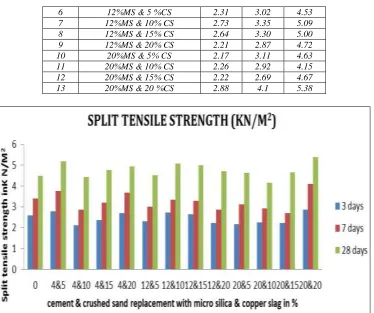
This is an indirect test to determine the tensile strength of cylindrical specimens. Splitting tensile strength tests were carried out on cylinder specimens of 150mm diameter with 300 mm of length at the age of 3 days,7 days & 28 days curing, using universal testing machine. The load was applied gradually till the specimens split and readings were noted. The average split tensile strengths of concrete composites measured during this phase of the project are presented in Table 3and fig 2.
Table-3
Split Tensile strength with different replacement percentage of copper slag and micro silica.
Sr. No. Percentage Of Micro Silica & Copper Slag replacement
3Days (KN/M2)
7Days (KN/M2)
28Days (KN/M2)
1 Normal Concrete 2.59 3.39 4.48
2 4%MS & 5% CS 2.78 3.77 5.19
3 4%MS & 10% CS 2.12 2.87 4.43
4 4%MS & 15% CS 2.36 3.21 4.76
6 12%MS & 5 %CS 2.31 3.02 4.53
7 12%MS & 10% CS 2.73 3.35 5.09
8 12%MS & 15% CS 2.64 3.30 5.00
9 12%MS & 20% CS 2.21 2.87 4.72
10 20%MS & 5% CS 2.17 3.11 4.63
11 20%MS & 10% CS 2.26 2.92 4.15
12 20%MS & 15% CS 2.22 2.69 4.67
13 20%MS & 20 %CS 2.88 4.1 5.38
Fig. 2: Split tensile strength of concrete by partial replacing cement & crushed sand with micro silica & copper slag in %.
The split tensile strength for partial replacement of fine aggregate (crushed sand ) with copper slag & cement with micro silica increased in the order of 6.83%, 3.72% ,5.13%,1.89% and 10.07% for 4%MS &5%CS, 4%MS &20%CS, 12%MS &10%CS, 12%MS &15%CS and 20%MS &20%CS, partial replacements respectively and decreased by 22.17%, 9.75%,12.12%,17.19%,19.35%,14.60% and 16.67% for 4%MS &10%CS, 4%MS &15%CS, 12%MS &5%CS, 12%MS &20%CS, 20%MS &5%CS, 20%MS &10%CS, and 20%MS &15%CS, partial replacement with respect to control specimen at the age of 3 days.
The split tensile strength for partial replacement of fine aggregate (crushed sand ) with copper slag &cement with micro silica increased in the order of 10.08%, 7.88% and 17.32%,for 4%MS &5%CS,4%MS &20%CS, and 20%MS &20%CS, partial replacements respectively and decreased by 18.19%, 5.61%,12.25%,1.19%,2.73%,18.19% , 9.003% 16.09% and 26.02% for 4%MS &10%CS, 4%MS &15%CS, 12%MS &5%CS, 12%MS &10%CS, 12%MS &15%CS, 12%MS &20%CS, 20%MS &5%CS, 20%MS &10%CS, and 20%MS &15%CS, partial Replacement with respect to control specimen at the age of 7 days.
The split tensile strength for partial replacement of fine aggregate (crushed sand ) with copper slag & cement with micro silica increased in the order of 13.68%, 5.88% ,9.49%,1.10% ,11.98% ,10.4%,5.08% ,3.24%,4.07%and 16.73%for 4%MS &5%CS,4%MS &15%CS, 4%MS &20%CS, 12%MS &5%CS , 12%MS &10%CS ,12%MS &15%CS , 12%MS &20%CS , 20%MS &5%CS , 20%MS &15%CS and 20%MS &20%CS, partial replacements respectively and decreased by 1.13%, and 7.95% for 4%MS &10%CS, and 20%MS &10%CS, partial replacement with respect to control specimen at the age of 28 days.
Flexural Strength Test
Beam specimens of size 500 X 100 X 100 mm were casted and tested at the age of 3 days,7 days & 28 days. The bearing surfaces of the supporting and loading rollers are wiped and clean and any loose sand or other material removed from the surfaces of the specimen where they are to make contact with the rollers. The specimen is then placed in the machine in such a manner that the load is applied to the uppermost surface as cast in the mould, along two lines spaced 13.3 cm apart. The axis of the specimen is carefully aligned with the axis of loading device. The average flexural strengths of concrete composites measured during this phase of the project are presented in Table 4 and fig.3.
Table - 4
Flexural strength with different replacement percentage of copper slag and micro silica.
Sr. No. Percentage of Micro Silica & Copper Slag replacement
3Days (KN/M2)
7Days (KN/M2)
28Days (KN/M2)
1 Normal Concrete 2.26 3.19 4.66
2 4%MS & 5% CS 3.33 5.26 7.25
4 4%MS & 15% CS 3.46 4.59 6.19
5 4%MS & 20% CS 4.06 4.73 6.38
6 12%MS & 5 %CS 2.33 2.92 4.72
7 12%MS & 10% CS 2.59 3.26 5.59
8 12%MS & 15% CS 2.72 3.52 5.45
9 12%MS & 20% CS 2.39 3.13 4.79
10 20%MS & 5% CS 2.66 3.12 4.39
11 20%MS & 10% CS 2.52 3.06 4.52
12 20%MS & 15% CS 2.86 2.99 4.59
13 20%MS & 20 %CS 3.12 4.46 5.79
Fig. 3: flexural strength of concrete by partial replacing cement & crushed sand with micro silica & copper slag in %.
The flexural strength for partial replacement of fine aggregate(crushed sand) with copper slag & cement with micro silica increased in the order of 32.13%,16.91%,34.68%,44.33%,3.004%,12.74%,16.91%,5.44%,15.04%,10.32%,20.98% and 27.56%,for 4%MS &5%CS, 4%MS &10%CS, 4%MS &15%CS, 4%MS &20%CS, 12%MS &5%CS, 12%MS &10%CS, 12%MS &15%CS, 12%MS &20%CS, 20%MS &5%CS, 20%MS &10%CS, 20%MS &15%CS, and 20%MS &20%CS, partial replacement with respect to control specimen at the age of 3 days.
The flexural strength for partial replacement of fine aggregate (crushed sand) with copper slag & cement with micro silica increased in the order of 39.35%, 12.84%, 30.50%, 32.56%, 2.15%, 9.38%, and 28.47% for 4%MS &5%CS, 4%MS &10%CS, 4%MS &15%CS, 4%MS &20%CS, 12%MS &10%CS, 12%MS &15%CS and 20%MS &20%CS, partial replacements respectively and decreased by 9.25% , 1.92% , 2.25% , 4.25% and 6.69% for12%MS &5%CS, 12%MS &20%CS, 20%MS &5%CS, 20%MS &10%CS and 20%MS &15%CS, Partial replacement with respect to control specimen at the age of 7 days.
The flexural strength for partial replacement of fine aggregate (crushed sand) with copper slag & cement with micro silica increased in the order of 35.72%, 13.54%, 24.72%, 26.96%, 1.27%, 16.64%, 14.49%,2.71%and 19.52% for 4%MS &5%CS, 4%MS &10%CS, 4%MS &15%CS, 4%MS &20%CS, 12%MS &5%CS, 12%MS &10%CS, 12%MS &15%CS, 12%MS &20%CS, and 20%MS &20%CS, partial replacements respectively and decreased by 6.15% , 3.10 % and 1.53% for 20%MS &5%CS, 20%MS &10%CS and 20%MS &15%CS Partial replacement with respect to control specimen at the age of 28 days.
V. CONCLUSION
The compressive strength of concrete cubes with 4 % replacement of cement with micro silica and 5% replacement of crushed sand with copper slag shows an increase of 15.35% when compared to the normal concrete cube at the age of 28 days and also In the similar manner, there was increased in the split tensile strength of concrete with 20 % replacement of cement with micro silica and 20% replacement of crushed sand with copper slag shows an increase of 16.73% when compared to the normal concrete at the age of 28 days. And in the flexural strength of concrete with 4% replacement of cement with micro silica and 5% replacement of crushed sand with copper slag shows an increase of 35.72% when compared to the normal concrete at the age of 28 days.
The main advantage of Use of copper slag and micro silica helps in waste management and dumping industrial waste and also help to reduce the impact on environment by consuming the material generally considered as a waste product. And also the Cost of concrete production reduces when copper slag is partly replaced as a fine aggregate in concrete and micro silica is partly replaced as cement.
REFERENCES
[1] Al-Jabri,K.S., Makoto Hisada,Salem k.Al oraimi and Abdullah H.Al-Saidy “performance of high strength concrete made with copper slag as a fine aggregate” Construction And Building Materials Vol23, Pages 2132-2140,2009.
[2] Al-Jabri,K.S., Makoto Hisada,Salem k.Al oraimi and Abdullah H.Al-Saidy “Copper Slag As Sand Replacement For High Performance Concrete” Cement And Concrete Composites Vol31, Pages 483-488,2009.
[3] Al-Jabri, K.S, Abdullah H.Al-Saidyand Ramzi Taha. ”Effect Of Copper Slag As A Fine Aggregate On The Properties Of Cement Mortars And Concrete” Construction And Building Materials Vol.25,Pages 933-938,2011.
[4] Bipra Gorai,R.K.Jana, Premchand (2002) “Characteristics andUtilizationof Copper Slag-A Review”. Resources Conservation And Recycling 39(2003) 299/313.
[5] Caijun Shi, Christian Meyer, And Ali Behnood, Utilization Of Copper Slag In Cement And Concrete” Resources Conservation And Recycling Vol.52 Pages 1115-1120, 2008.
[6] Najimi M, Sobhani J and Pourkhorshidi A R (2011) Durability of Copper Slag Contained Concreteexposed To Sulphate Attack ConstructionBuilding Material 25:1895-1905.
[7] Washington Almeida, Moura Jardal, PereiraGone, and Monica Batista Leite Lima, “Copper Slag Waste as a Supplementary Cementing Material To Concrete” J. Mater.Sci, Vol.42.Pp 2226-2230, 2007.