ISSN (e): 2250-3021, ISSN (p): 2278-8719
Vol. 05, Issue 07 (July. 2015), ||V1|| PP 43-49
Investigating the transitional state between square plates and
shallow shells
Mohamad Daoud
1, Moayyad Al-Nasra
21Department of Civil Engineering, Zarqa university, Zarqa, Jordan
2
Civil Engineering Department, Applied Science University, Amman, Jordan
ABSTRACT: The stiffness of square plates can be increased by inducing a rise at the center of these plates; this rise converts the plates from two-dimensional stiffness elements into three-dimensional stiffness elements. This slight change in the geometry shifts the state of stresses from mainly bending stresses to tensile-compressive stresses. The rise at the center of a rectangular plate is increased gradually to the point where a shell element is formed. This paper focuses on this particular transition between the plate elements to the shell element which is called the transitional rise. Several finite element models were used to identify the transitional rise given fixed parameters. Stresses and deflections are also studied for each case. An optimized approach was used to minimize the cost and improve the serviceability of the structural elements. In this present study, numerous analyses were conducted using the finite element methodology on shell model. Finite element mesh was established for each different rise value starting from zero (plate). The rise is increased gradually to the point where shell stiffness becomes insensitive to the increase in the rise. An empirical relationship was established relating the transition state between plate and shell elements, and relevant geometrical parameters. Parametric study is also conducted using several loading cases.
Keywords: square shells, square plates, transition state, optimization, rise
I.
INTRODUCTION
Plates and shells have several important civil engineering applications. They are used as structural elements, roofs, domes, and water tanks. Also for industrial purposes plates and shells are used extensively in many applications including machines, gas vessels and cans. Introducing a rise at the center of a plate will increase the stiffness of the plate. As the rise becomes large enough, the plate will change into a shallow shell, and consequently the strength of the plate increases substantially to a point where the rate of increase in strength becomes insignificant. This particular rise (apex) is referred to here as the Transitional Rise ɳ. This study also focused on the other parameters that may have any effect on the transitional rise ɳ.
Many researchers explored the difference between plates and shells, but most of their work produced solutions for stresses and deformations for symmetrically loaded plates and shells. The finite element method nowadays becomes widely used and much commercial software became available in the market. The new advances in computer hardware especially the processing power made it much easier to use the finite element method in engineering applications.
AlNasra conducted several experimental tests on reinforced concrete square plates loaded at the center. The central deflection is measured at each load level until failure. The plates showed concaved shapes before failure. The plates eventually failed by punching shear [1, 2]
In order to build a roof, there are two major choices; a plate or a shell in the shape of a dome or pyramid. Taking into consideration many factors one may go for a plate which might be characterized as an element of large thickness that uses more material, exhibiting large deflection under loads, and consequently generating cracks. The other available choice is to use a full-height shell which is characterized by relatively thin element covering large space. Nevertheless, the construction cost of a spherical roof or a roof of pyramid shape is higher than the plate. Developing a small rise in the center of the plate, one can take advantage of both plates and shells. A small rise at the middle of a plate can be induced making a concaved shape. This rise can change the state of stresses and the serviceability of the structural element. The finite element method can be used to determine the values of stresses and deflection at a given value of the rise and under given load case. A gradual increase in the rise makes the plate behaves like a shell. The value of the rise that makes the plate becomes a full blast shell is called the transitional rise based on the calculated values of stresses and deformations
Investigating the transitional state between square plates and shallow shells
Wmax= (Po a4 (5+ν )) / (64 D (1 + ν ) ) (1)
Where,
Po = uniformly distributed load
a= radius of plate 𝜈 = Poison‟s ratio
D = flexural rigidity of plate.
D= Et3 / ( 12 (1 – ν2) ) (2)
Where,
E = modulus of elasticity t = thickness of plate Then
Po= [ (64 D ( 1+ ν )) / ( a3 (5 + ν )) ] (w
max/a) (3)
Equation 3 relates the uniformly distributed load with the deflection at the center of a plate in what is known as small deflection theory. Several researchers also worked on the derivation of the large deflection theory of plates. The derivation is based on simply supported circular plates which in turns helped in understanding the post bucking behavior of circular plates. Equation (4) relates the uniformly distributed load on a simply supported circular plate with the total deflection at the center of the plate [8, 9, and 10].
(4)
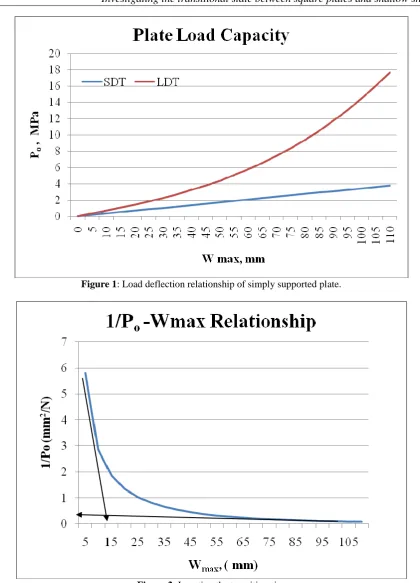
As a case study, a plot of the applied uniformly distributed load Po and the deflection equations is shown in Fig. 1 for the following constants:
E= 200,000 MPa ν = 0.3
a=1000 mm t=10.0mm
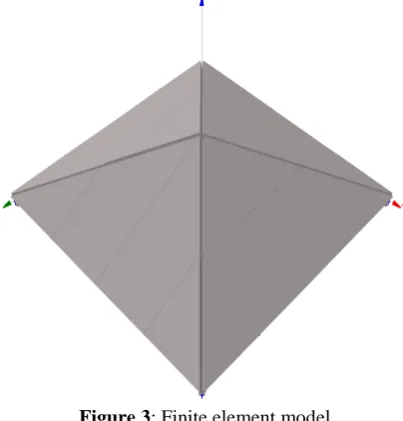
Figure 1 shows that the first portion of the curves can be used satisfactorily to calculate the central deflection by the small deflection theory (SDT). As the central deflection increases the small deflection theory becomes inappropriate while the large deflection theory (LDT) can give satisfactory results at any central deflection range. The early portion of this curve will be used to study the plate behavior. The remainder of the curve shows rapid divergence between the large deflection theory (LDT) and the small deflection theory (SDT). Another point that can be made out of these curves, that the stiffness of the plate increases at a higher rate as the maximum central deflection increases, a preparation for shell behavior. Figure 2 shows the relationship between 1/Po and the maximum central deflection Wmax. The first portion of the curve represents the plate behavior, and
Figure 1: Load deflection relationship of simply supported plate.
Figure 2: Locating the transition rise
II.
PLATE-SHELL THEORY
Investigating the transitional state between square plates and shallow shells
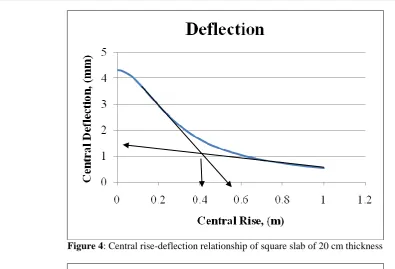
was selected proportionally to give meaningful outputs. The accuracy of the output depends on the number of segments used. Common rules that are widely acceptable among researchers when using this type of elements are; element aspect ratio should not be excessive, and each individual element should not be distorted. The preferable aspect ratio is 1:1 but it should not exceed 4:1. Also angles between any two adjacent sides within any element should be around 90 degrees but less than 180 degrees [11].
6 1 8 10 12 Z 2 17 20 13 22 3 18 25 14 23 4 5 X 7 19 9 21 11 15 16 24 Y
Figure 3: Finite element model
The types of supports used in this research are the ones that allow horizontal translation and rotation, while the vertical movement is restrained. This type of support suits the boundary condition of the membrane element, which is responsible of carrying the major part of the load in the large deflection theory. For analytical purposes, plates and shells used in this study are made of concrete, making the output easier to compare with experimental results [12, 13].
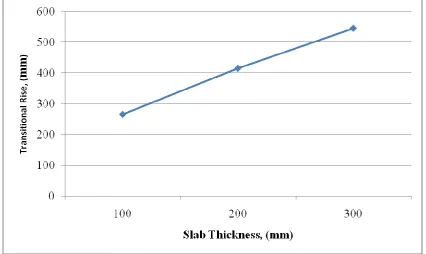
It was convenient to start the analysis with plate of zero height of apex. The height of apex is increased gradually by two and a half centimeter increment until the change in deflection due to applied load reached a well specified tolerance range.
For analytical purposes, the level of stress in the plate/shell element was controlled and bounded by the modulus of rupture of concrete. The concrete compressive strength is taken here to be 30 MPa, and the modulus of rupture for this type of concrete is taken as 4.3 MPa according to the local codes and confirmed by experimental data. In the case of the uniformly distributed load, the maximum stress can be calculated according to the following formula:-
Figure 4: Central rise-deflection relationship of square slab of 20 cm thickness
Figure 5: Maximum stress – rise relationship of the square 4X4 m slab with slab thickness of 20 cm.
III.
EFFECT OF THE PLATE/SHELL THICKNESS ON THE VALUE OF THE
TRANSITION RISE
Several hundreds of cases were studied and analyzed in order to draw a meaningful conclusion that relates the variation of the plate/shell thickness with the value of the transition rise. Table (1) shows a summary of these findings related to the slabs presented in this study. Table (1) shows only a sample of the data collected for a given plate/shell dimension of 4x4 m loaded by uniformly distributed load type.
Table 1: Effect of plate/shell thickness on the value of the transition rise Thickness-Length
ratio (t/L) X 10-3
Thickness (mm)
Transition Rise (mm)
Transition Rise – Length ratio (TR/D)
X 10-3
Transition Rise – Thickness ratio
(TR/t)
25.0 100 265 66 2.65
50.0 200 415 104 2.08
Investigating the transitional state between square plates and shallow shells
Figure 6 shows the plate/shell thickness and the value of the transition rise ɳ. The increase in plate/shell thickness decreases the value of the transition rise. These values are calculated only for the plate/shell of 4x4 m dimensions where the plate of aspect ratio of 1.
Figure 6: Transition rise-thickness relationship for shallow spherical shell
The relationship between the transitional rise, ɳ , and the slab thickness can be derived as follows.
ɳ = 1.40 t + 125 (6) Equation 6 shows the linear relationship between the transitional rise and the slab thickness.
IV.
CONCLUSIONS
Large number of cases was studied using the finite element method. The study focused on the shift between plate element behaviors to shallow shell element behavior. Rigorous parametric study was conducted to study the effect of several plate/shell parameters on the value of the transition rise. One of the main conclusions out of this study is that the value of the transition rise is linearly proportional with the slab thickness. This study is exclusive for slabs with aspect ratio of 1. The value of the transition rise is not sensitive to either the level of loading nor is it sensitive to the type of loading. The amount of material used to build the slab will be reduced substantially by adding a rise at the center of the slab. At the same time the stress level and the deflection will be reduced by introducing a relatively small value of rise at the center of the slab.
REFERENCES
[1] M. Al-Nasra, A. Najmi, I. Duweib, “ Effective Use of Space Swimmer Bars in Reinforced Concrete Flat Slabs”, International Journal of Engineering Sciences and Research Technology, Vol. 2 No. 2, February 2013, ISSN: 2277-9655, 2013
[2] M. AL-Nasra, I. Duweib, A. Najmi, “The Use of Pyramid Swimmer Bars as Punching Shear Reinforcement in Reinforced Concrete Flat Slabs”, Journal of Civil Engineering Research, Vol. 3, No.
2, 2013, PP 75-80, DOI: 10.5923/J.JCE.20130302.02, March, 2013.
[3] Eduard Ventsel and Theodor Krauthammer, Thin Plates and Shells Theory, Analysis, and Applications
(Marcel Dekker, Inc., ISBN: 0-8247-0575-0, 2001)
[4] Rudolph Sziland, Theory and Analysis of Plates, Classical and Numerical Methods (Prentice Hall 1974)
[5] SP Timoshenko and Woinowsky-Krieger K Theory of Plates and Shells (McGraw-Hill, 1959).
[6] M.L. Bucalem and K.J. Bathe, “Finite Element Analysis of Shell Structures,” Archives of
Computational Methods in Engineering, State of the art reviews, Vol. 4, 1, 3-61, 1997
[8] El-Sobky H., Singace A. A. and Petsios M., “Mode of Collapse and Energy Absorption Characteristics of Constrained Frusta under Axial Impact Loading”, International Journal of Mechanical Sciences.,
Vol. 43, No. 3, pp. 743-757, 2001.
[9] S. Ways, “Bending of Circular Plates with Large Deflections,” Trans. ASME, 56, No. 8, PP 627-636, 1934
[10] A.J. Sadowski and J.M. Rotter, “Solid or shell finite elements to model thick cylindrical tubes and shells under global bending,” International Journal of Mechanical Sciences, 74, 143-153. DOI: http://dx.doi.org/10.1016/j.ijmecsci.2013.05.008, 2008
[11] S. Reese, “A large deformation solid-shell concept based on reduced integration with hourglass stabilization,” International Journal of Numerical Methods in Engineering, vol. 69, no. 8, pp. 1671– 1716, 2007
[12] M. Schwarze and S. Reese, “A reduced integration solid-shell finite element based on the EAS and the ANS concept - geometrically linear problems,” International Journal for Numerical Methods in
Engineering, vol. 80, no. 10, pp. 1322–1355, 2009.
[13] R. Hauptmann, S. Doll, M. Harnau, and K. Schweizerhof, “„solid-shell‟ elements with linear and quadratic shape functions at large deformations with nearly incompressible materials,” Computers &