Page 431 www.ijiras.com | Email: [email protected]
Electricity Utilization Pattern And Demand Projection For Fct,
Abuja, Nigeria
H. A. Iortyer
I. E. Kucha
Mechanical Engineering Department, University of Agriculture, Makurdi, Benue state, Nigeria
Promise U. Chukwu
Energy Planning & Analysis Department, Energy Commission of Nigeria, Abuja, Nigeria
I. INTRODUCTION
As the population of the world increases, the demand for energy is increasing at a fast pace. Energy is needed for economic development and social welfare. This has necessitated the planning and implementing of more sustainable approaches to energy production, use and conservation. Electricity is one of the most dominant forms of energy in human society. It is a flexible energy carrier and its share in total energy consumed in many countries is constantly increasing. It plays a very important role in the socio-economic and technological development of a state and indeed every nation. Nigeria, like most developing countries, has been experiencing a widening gap between energy demand
and supply (especially electricity). Electricity demand in Nigeria far outstrips the supply that is very epileptic in nature. The country is faced with acute electricity supply problem which hinders economic development in spite of its vast natural resources. Some research has been carried out in the area of electricity generation, supply and demand. The research work carried out by Baek (2011) on the responsiveness of residential electricity demand to changes in price and policy probes how consumers respond to changes in energy price in the short run with individual household survey data and analyzes how the consumers’ behavioral attributes and energy policies affect future energy demand. More so, Baek (2011) empirically estimated a short-run price elasticity of demand with the energy consumption survey (RECS) data
Abstract: The objective of this research was to determine the electricity utilization pattern in the Federal Capital Territory (FCT) and to make projections of electricity demand in the FCT from 2009 to 2035. This was done using model for analysis of energy demand (MAED) which is a bottom-up model. Primary data were obtained through spot surveys and interviews using questionnaires while the secondary data were obtained from relevant agencies of government and other organizations and stakeholders in the energy sector. A total of 520 questionnaires (household =150, Services =150, Industry =50 and Transport =170) were administered with 507 valid responses representing a 97.5% response rate. Other data like the GDP, Demography, and socio-economic indices and utility bills were also obtained through secondary sources. These data were analyzed and imputed into the MAED model. The results of the research show that in the base year 2009, the total final electricity consumed in the FCT for all the economic sectors was 0.033398GWa, out of which 0.016596GWa was consumed in the services sector, 0.001759 GWa and 0.015043GWa were consumed in industry and household, representing 50% for services, 5% for industry and 45% for household sector respectively. The results also show that the total projected electricity demand of the FCT for all the sectors in 2035 will be 4.708478GWa, out of which 2.022528GWa is services, 1.769831GWa, 0.915834GWa and 0.000284GWa are household, industry and transport respectively. This shows how much electricity will be required to meet the projected GGP of the FCT in 2035. It is therefore recommended that funds for training of professionals and further research, and establishment of electricity expansion plan be made available for sustainable electricity supply in the FCT for the present and future demands.
Page 432 www.ijiras.com | Email: [email protected] collected in 2005. They forecasted how national energy
consumption of the residential sector would change as consumer behavioral patterns and residential energy policies change with the National Energy Modeling System (NEMS). In the study, econometric analysis with individual household survey data contributed to setting new assumptions on short-run demand functions of residential households in the NEMS, because it used the Residential Energy Consumption Survey data. It concluded that nowadays, energy consumers in the residential sector react to price changes more elastically than one or two decades before the research year. In 1950, a central body was established by the legislative council, which transferred electricity supply and development to the care of the central body known as the Electricity Corporation of Nigeria, now defunct. This paper investigates the patterns of electricity consumption, electricity intensity factors for FCT. It also presents electricity consumption projection. Adetunji et al. (2008) in their work examined the residential demand for electricity in Nigeria, employing annual data over the period 1970–2006. This was is one of the first studies of its kind to analyze the residential electricity demand for Nigeria and showed that increase in residential electricity price does not induce a significant increase in residential electricity demand.
The Federal Capital Territory (FCT) Abuja, Nigeria, occupies a strategic position, role and relevance to national development being the federal capital of the country and also adjudged the fastest growing city in Africa. It is a planned city and it was mainly built in the 1980s and officially became Nigeria's capital on 12 December 1991 replacing the role of the previous capital Lagos. The territory was formed in 1976 from parts of former Nasarawa, Niger, and Kogi States of Nigeria located in the central region of the country. It is currently made up of six local councils, comprising the City of Abuja and five Local Government Areas, namely: Abaji, Gwagwalada, Kuje, Bwari and Kwali. The trend of energy consumption in the FCT is different from the pattern of other states. This is because of some factors that are peculiar to FCT. These include the population growth rate of FCT, infrastructural development, income level and lifestyle of the residents. Because of its fast growing status, energy demand, especially electricity demand, has skyrocketed beyond the present supply level. In order to solve this problem, there is a need to undertake a study of the electricity demand profile of the FCT and project it over a specific period so as to be able to profer both immediate, medium and long term solutions that will enable its seamless development. The aim of this research was, therefore, to study the electricity utilization pattern of the FCT and project its demand using the consumption pattern of 2009 as the reference year.
II. MATERIALS AND METHOD
The materials used for this research were: Questionnaires, secondary data from relevant government agencies and departments (MDAs), and model for analysis of energy demand (MAED)- a software from the International Atomic Energy Agency (IAEA).
The method used for this study is the same as that used by Chukwu et al. (2016). It was designed according to the energy
demand modelling steps of Energy Commission of Nigeria for the national energy demand and supply projection. This method was designed with focus on the expected result, considering the input requirements of the model used to simulate the projection of the demand of the base year data which is the model for analysis of energy demand (MAED).
A. DATA COLLECTION
Sources of data for this research were grouped into two; primary and secondary data sources. The primary data sources were obtained through spot surveys and interviews while the secondary sources were obtained from relevant agencies of government and other organizations and stakeholders in the energy sector.
B. QUESTIONNAIRES
The design and administration of questionnaires was carried out in line with the Energy Commission of Nigeria’s methodology in their work on energy demand and supply projection for Nigeria 2005, as presented by Olayande (2008). The study made use of the percentage contributions of the various sectors as their respective weights for energy consumption and that was used as the sectors’ corresponding percentage number of questionnaires. Therefore, a total of 520 questionnaires (household =150, Services =150, Industry =50 and Transport =170) were administered with 507 valid responses representing a 97.5% response rate.
C. MODEL FOR ANALYSIS OF ENERGY DEMAND (MAED)
The data collected from the various sources was imputed into the model for analysis of energy demand (MAED) for simulation of the electricity demand projection from 2010 to 2035. MAED is a simulation, bottom-up model for evaluating the energy demand implications (in the medium and long term) of a scenario describing a hypothesized evolution of the economic activities and of the lifestyle of the population. This modelling tool was used to project the energy demand for the Federal Capital Territory from 2010 to 2035. In designing the questionnaires for the collection of data needed for the running of the model (MAED) and to establish the energy demand base year data of the Federal Capital Territory, the input data requirements were put into consideration.
a. INPUT DATA REQUIREMENTS FOR MAED
Page 433 www.ijiras.com | Email: [email protected] uses), motor fuels, electricity (thermal and non-thermal), metal
coke, solar-thermal, feedstock and non-commercial types. In Nigeria and specifically the FCT, economic and energy statistics are not in the level of disaggregation required for MAED. Rather, they are, when available, in highly aggregated forms, most especially the energy data.
Furthermore, there had been no previous study in the FCT in which the above disaggregated or comprehensive data had been presented. This constituted a major problem for the project.
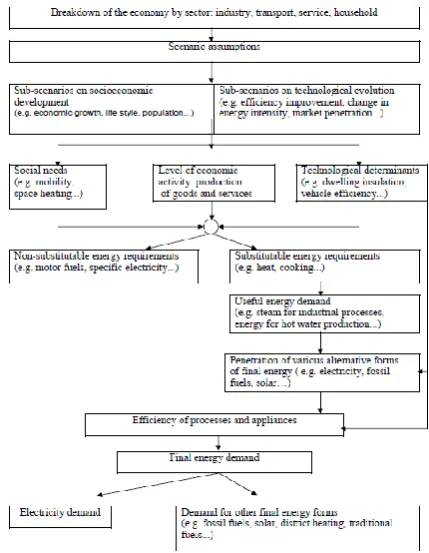
Given the constraints of time and funds, spot surveys were carried out in order to generate data and information to supplement and disaggregate available statistics. The model application requires detailed information on demography, economy, technological factors and energy consumption. Energy demand is disaggregated into a number of end-use categories, each corresponding to a given service or to the production of a certain goods, e.g., industrial, transport, household and services sectors. This information was first assembled for a base year, 2009, which is used as the reference year to look at the pattern of the evolution of the energy system in the medium to long–term future. The input data sheet for MAED is an excel sheet having exactly the same worksheets that is in the MAED model itself. This input preparation sheet is where the data to be used in running the model are first inputted before they are transferred to the model for simulation, then the results are obtained. The input data sheet has so many worksheets which cut across areas covered in MAED which include economy, demography, life style and technology. Figure 1 shows the categorization of input data requirements for MAED while figure 2 shows the scheme used to project useful and final energy demand in MAED.
Source: ECN Demand study using MAED model (2008) Figure 1: Categorization of Input Data requirements for
MAED
Source: IAEA MEAD model manual 2008
Figure 2: Scheme used to project useful and final energy demand in MAED
III. RESULTS AND DISCUSSION
A. ELECTRICITY PER SECTOR
From figure 3, it can be seen that the electricity consumption in the FCT in the base year was only in three economic sectors namely industry, services and household, with the services sector consuming the highest of the three. The transport sector (freight and passenger) had zero consumption in the base year (2009). It also shows that services sector had the highest consumption of 0.01659 GWa being 50% of the total electricity consumed in the FCT in the base year. The consumption for the base year is solely for grid electricity consumed in the FCT. The captive (self) generation in the given year was not accounted for and the projection was made based on the grid consumption.
Page 434 www.ijiras.com | Email: [email protected] This actually means that what was the actual demand for
electricity generation should be more than 0.0334 GWa for the base year (2009). The projection shows that from 2025, electricity will be consumed in the transport sector probably through the use of electric cars and trains or trams as could be seen from Figure 3. But this will only be for passenger transportation in the FCT. But in the far future, maybe around 2050, it is anticipated that electricity may be used for freight in the FCT. It showed a sharp increase in the projected demand by 2035; this means that by 2030, there should have been adequate and reliable electricity in the FCT. The determinants of electricity demand in the FCT include; population, level of economic activities, life-style of the residents, availability of infrastructure etc. This result is also in agreement with the work of Ekpo et al. (2011) which concludes that, in the long-run, electricity consumption in Nigeria is positively and significantly influenced by income, population and industrial sector’s output, while electricity price is insignificant though with the expected sign due to government regulation of prices.
B. SECTORAL ELECTRICITY DEMAND PROJECTIONS FOR FCT
Electricity consumption in the services sector was 0.33GWa in the FCT in the base year of 2009. Figure 4 shows that electricity consumed in the services sector will keep increasing from base year till 2035.
Figure 4: Projected Electricity for Services Sector in FCT 2009 to 2035
The implication is that by 2035, the energy requirements of the services sector will probably be fully met using electricity in the service sector especially as other sources of energy including the consumption of non-commercial (traditional) energy form will likely stop beyond 2035 because of their unsustainable nature and attendant environmental consequences.
More so, figure 5 shows that the electricity consumption in the house-hold sector in the FCT will increase till the last projected year. This is owing to the fact that the population of both residential houses and people will keep increasing, thereby increasing the demand for electricity in the FCT.
Figure 5: Projected Electricity for Household Sector in FCT 2009 to 2035
The industrial sector of the FCT will also witness a significant increase in its electricity demand in the projected years. This point is obvious considering that the city is having few industries at the present. However, considering the expected contribution of the industrial sector to the FCT economy, the electricity consumption in the industrial sector will keep increasing (figure 6).
Figure 6: Projected Electricity for Industrial Sector in FCT 2009 to 2035
IV. CONCLUSION AND RECOMMENDATIONS
Energy Planning is a process of establishing a conceptual framework of organizing the future development of energy systems based on past and present consumption trends and factors or parameters driving energy in that society.
This research work developed the scenarios for future electricity demand of the Federal Capital Territory, Abuja Nigeria, through the analysis of the historical data on the consumption of the base year which is 2009 and the projection of the future demand of electricity to 2035. The result of this research work is in agreement with Cape Town state of energy and energy future report (2011) but deviated from the ECN 2010 energy demand and supply study for Nigeria which has household as the highest consuming sector. The result is in agreement with most other works done within and outside Nigeria (Cape Town 2011; Ojosu et al, 2014; ECN 2014) which shows that as population and economic activities increase, electricity demand increases too. It also agrees with other works which showed in their findings that most modern and developing countries’ capitals are usually dominated by services sector energy demand showing that the economies of such cities are service sector-driven.
Therefore, the following recommendations are made, in order to achieve this sustainable energy planning in the FCT:
Page 435 www.ijiras.com | Email: [email protected] achievable targets and timeline for each task. This will foster
sustainable electricity supply for the FCT. This will help in meeting both the present and future electricity demand including the suppressed demand.
Establishing a mechanism for gathering electricity consumption data: The availability of reliable and timely data is the requirement for making sound and informed decisions and plans for sustainable energy. There is great need to have a unit under the utilities and infrastructure secretariat of the FCT which will be saddled with the responsibility of gathering electricity data in the FCT especially for household, services
and informal sector consumption. Introducing demand side management: Introducing and
intensifying demand side management in electricity utilization and applications to reduce wastages and improve the efficiencies of the end-use conversion devices. This could be done by carrying out sensitization workshops and seminars to residents and energy consumers in the FCT. Scaling up campaign on awareness on energy efficiency and conservation through resident associations, faith and community based organizations will be a good option.
Provision of funds for more research and training of professionals in energy planning: There is need to provide funds for collaboration, especially to fund research works and train professionals working in the area of energy (electricty) in the FCT. This will not only lead to regular surveys of electricity consuming sectors in the FCT, but will also help in solving most problems associated with electricity demand and supply in the FCT. This could also be done by providing funds for intensifying research and development in solar thermal devices to substitute electricity applications for thermal purposes, especially in the services and household sector which have the highest share of the total energy demand in the FCT.
REFERENCES
[1] Abubakar M. and Umar B. (2006) “Comparison of Energy Use Patterns in Maiduguri and Yobe Flour Mills, Nigeria”. Agricultural Engineering International: the CIGR Ejournal. Manuscript EE 06 004. Vol. VIII. [2] Adetunji M. B and Shuaibu M. I. (2008); The Demand for
Residential Electricity in Nigeria: A Bound Testing Approach.; http://www.africametrics.org/documents/ conference09/papers/Babatunde_Shuaibi.pdf; accessed on 20th October 2015.
[3] Akinlo, A. E. (2009). Electricity Consumption and Economic Growth in Nigeria: Evidence from Co integration and Co-feature Analysis. Journal of Policy Modelling, 31: 681-693.
[4] Auroville Municipal Energy Plan, (2001); Master Plan for the development of the city of Auroville, India; Ministry of Urban Development and Poverty Alleviation, Government of India, 2001.
[5] Baek Y. (2011), Responsiveness of residential electricity demand to changes in price, information, and policy; Phd dissertation presented to the academic Faculty Georgia
Institute of Technology, 2011.
(https://smartech.gatech.edu/bitstream/handle/1853/39581
/baek_youngsun_201105_phd.pdf?sequence=1); accessed on 5th June, 2014
[6] Babatunde M.A., Shuaibu I.M. (2011). The demand for residential electricity in Nigeria: A bound testing approach. http://www.africametrics.org/documents/ conference09/papers/Babatunde_Shuaibi.pdf; accessed on 20th October 2014.
[7] Cape Town (2011): State of Energy and Energy Futures Report; Energy use, carbon emissions inventory and scenarios for the future. City of Cape Town, Republic of South Africa, 2011.
[8] Central Bank of Nigeria (2009): Annual Statistical Bulletine; www.cenbank.org/OUT/PUBLICATIONS/ STATISTICALBULLETINE/STD/2009/STABULL%20-%20VOL.SEDI.PDF. Accessed 25th June 2016.
[9] Central Bank of Nigeria (2001). Annual Report and Statement of Accounts for Year Ended 31 Dec. 2001. Central Bank of Nigeria (CBN), Abuja, Nigeria. 2001. [10][10] Chukwu P.U., H.A. Iortyer and E.I. Kucha (2016);
Petroleum Products Utilization in the Federal Capital Territory (FCT) Abuja, Nigeria: Current Trends and Projected Demand, International Journal of Scientific & Engineering Research, Volume 7, Issue 3: 654-674 [11]Department of Petroleum Resources (DPR), 2013.
(http://dpr.gov.ng). Accessed 2nd of July 2016
[12]Ekpo U.N., Chuku A.C. and Effiong E.L. (2011). The Dynamics of Electricity Demand and Comsumption in Nigeria: Application of the Bounds Testing Approach; Current Research Journal of Economic Theory 2011, 3(2): 43-52.
[13]Energy Commission of Nigeria (2005). National Energy Policy, 1st edition 2005.
[14]Energy Commission of Nigeria (2005). National Energy Master Plan, 1st edition 2005.
[15]Energy Commission of Nigeria (2013). Energy Implications of Vision 20;2020 for Nigeria
[16]Energy Commission of Nigeria (2009), (2010). Energy demand and supply study for Nigeria.
[17]Enova (2008). Norwegian Guidebook for Municipalities. Enova, Norway. https://www.enova.no/upload_images/ A92D94DD6F144B23BD122C3FC6F78643.pdf,
accessed in June 2014.
[18]Federal Capital Territory Administration (2013). www.abuja-ng.com, accessed on 20th July 2016.
[19]FCT-MDG Baseline Data (2009)
(http://www.mdgfctabuja.net/Baseline/Electricity.aspx). [20]Guidebook for the Municipal Energy Profile Project
(MEPP) of Chicago, United States of America (February 2011), by the Center for Neighborhood Technology USA. [21]Hiremath R.B., Kumar B. and Balachandra P. (2011) Implications of decentralised energy planning for rural India. Journal of Sustainable Energy & Environment 2 (2011) 31-40.
[22]Iloeje O. C. Olayande J. S. and Yusuf A. O. (2004) Report on an Indicative Survey of Sectoral Energy Consumption in Nigeria. Energy Commission of Nigeria, Abuja
Page 436 www.ijiras.com | Email: [email protected] [24]International Energy Agency (IEA) (2007); Indicators for
industrial Energy Efficiency and CO2 Emissions: A Technology Perspective. International Energy Agency, Paris, France 2007.
[25]Mulder P. et al. (December 2006): Rural Electrification in Mozambique is it worth the Investment. Discussion papers No. 53E June 2007 National Directorate of Studies and Policy Analysis Ministry of Planning and Development, Mozambique
[26]National Bureau of Statistics, (2010, 2011, 2012); Annual Abstract of Statistics; www.nigerianstat.gov.ng/pages/ downlod/71
[27]Nigerian Electricity Regulatory Authority (NERC); www.nercng.org. accessed on 20th May 2016.
[28]National Planning Commission (2004). NIGERIA: National Economic Empowerment and Development Strategy (NEEDS). Office of the Economic Adviser to the President, National Planning Commission (NPC), Abuja.
[29]Ojosu J.O., Isa A.H., Chukwu P.U., Olayande J.S., (2014); A MAED Model Analysis of Biomass and Biofuels Demand in Nigeria, Journal of Alternate Energy Sources and Technologies, 5(2): 29-36.
[30]Olayande J.S. (2008). Determinants of energy demand; a paper delivered at the workshop on Sustainable Energy Development in Sub-Saharan Africa, organized by Biodiesel Nigeria Limited and Energy Commission of Nigeria, from 19th – 20th May 2009 at Chelsea Hotel, Abuja, Nigeria
[31]Rögnvaldur Hannesson, (2009). Energy and GDP growth", International Journal of Energy Sector Management, 3(2): 157 – 170.