ISSN (Online): 2320-9364, ISSN (Print): 2320-9356
www.ijres.org Volume 2 Issue 5
ǁ
May 2014
ǁ
PP.01-06
Control of Nonlinear Industrial Processes Using Fuzzy Wavelet
Neural Network Based on Genetic Algorithm
Navid Lotfizadeh
1,
Ahmad Reza Alaie
2, Ali Pedar Piralmani
31
Entekhab Elmi Karbordi University, Esfahan, Iran
2Department of Electrical Engineering, K.N.Toosi University of Technology, Tehran, Iran 3Department of Electrical Engineering, Islamic Azad University – Khomeinishahr Branch, Esfahan, Iran
ABSTRACT
:
Artificial intelligence control techniques, becomes one of the major control strategies and has received much attention as a powerful tool for the control of nonlinear systems. This paper presents a design of Fuzzy Wavelet Neural Network (FWNN) trained genetic algorithm (FWN-GA) for control of nonlinear industrial process. The FWNN is applied to approximate unknown dynamic of system and GA is used to train and optimize the FWNN parameters. In the proposed control scheme, neural control system synthesis is performed in the closed-loop control system to provide appropriate control input. For this, the error between desired system output and output of control object is directly utilized to tune the network parameters. The controller is applied to a highly nonlinear industrial process of continues stirred tank reactor (CSTR). Simulation results show that FWNN-GA controller has excellent dynamic response and adapt well to changes in reference trajectory and system parameters.Keywords
-
Fuzzy Wavelet neural network; genetic algorithm; nonlinear CSTR.I.
INTRODUCTION
Fuzzy technology is an effective tool for dealing with complex, nonlinear processes characterizing with ill-defined and uncertainty factors. Fuzzy rules are based on expert knowledge. The constructing of knowledge base for some complicated processes is difficult. Thus, there are some methods for constructing of fuzzy rules [1, 2]. On the other hand, some characteristics of neural networks such as learning ability, generalization, and nonlinear mapping are used to deal with signal processing, control system, decision making, and so on. However, the main problem of neural networks is that they require a large number of neurons to deal with the complex problems. Moreover, they also result in slow convergence and convergence to a local minimum. In order to overcome these disadvantages, wavelet technology is integrated into neural networks [3]. Recently, based on the combination of feed-forward neural networks and wavelet decompositions, wavelet neural network (WNN) has received a lot of attention and has become a popular tool for function learning [4]. The main characteristic of WNN is that some kinds of wavelet function are used as the nonlinear transformation in the hidden layer of neural network, so time–frequency property of wavelet is incorporated into the learning ability of neural networks.
However, the main problem of WNN with fixed wavelet bases is the selection of wavelet frames because the dilation and translation parameters of wavelet basis are fixed and only the weights are adjustable. The appropriate wavelet transform will result in the accuracy of approximation. Therefore, there are several different methods proposed to solve the problems [5, 6].
The complexity and uncertainty of the system can be also reduced and handled by the concepts of fuzzy logic. The local details of non stationary signals can be analyzed by wavelet transforms. The approximation accuracy of the plant can be improved by the self-learning capabilities of neural networks. Therefore, there are many papers that discuss the synthesis of a fuzzy wavelet neural inference system for signal processing, control problems, identification and pattern recognition [3, 7, 8].
In recent years, Fuzzy Wavelet Neural Networks (FWNN) have become very popular and have been applied in many scientific and engineering research areas such as system identification, function approximation and control of nonlinear systems. This is due to its information processing characteristics such as nonlinearity, high parallelism, fault tolerance as well as capability to generalize and handle imprecise information [4].
corresponding to a sub-WNN consists of single scaling wavelets. The difficulties of selecting wavelets are reduced and orthogonal least-square (OLS) algorithm is used to determine the number of fuzzy rules and to purify the wavelets for each rule. Also, GA is used to train and optimize the FWNN parameters. In the proposed control scheme the error between desired system output and output of control object is directly utilized to tune the network parameters. The capability and efficiency of the proposed method is illustrated by the temperature control of a nonlinear CSTR.
The paper is organized as follows. To make a proper background, the basic concepts of FWN and GA are briefly explained in section II. In section III, the proposed FWN-GA based controller and its learning algorithm are described. Section IV descried CSTR system. The results of the proposed approach on the simulation example are given in Section V and finally, some conclusions are dawn in Section VI.
II.
F
UZZYW
AVELETN
ETWORK ANDG
ENETICA
LGORITHM The basic concepts of FWN and GA are briefly described in this section.A. Fuzzy Wavelet Neural Network
A typical fuzzy wavelet neural network for approximating functionycan be described by a set of fuzzy rules such as follow [4]:
i R: If x1is
i
A1andx2is
i
A2and … and xqisAqi,
Then yˆi= ( ) ( )
1 , ,
x w k t M T k t M k i i k i
, Miz,tkRq
And wk R
i
t
M ,
q R
x (1)
WhereRiis the ith rule, c is the number of fuzzy rules.
x
jandy
ˆ
iare jth input variable of x and output of the local model for ruleRi, respectively. Also Miis dilation parameter andTi is the total number of wavelets for theith rule. tk [t1k,t2k,...,tqk], where
t
kj denotes the translation value of corresponding wavelet k. Finally,Aij is the fuzzy set characterized by the following Gaussian-type membership function.2 / 3 2 2 1 ) ) ) ( ((
)
(
i j p i j i j j p p x j ij
x
e
A
(2)i j
p 1, pij2Randpij32, where i
j
p 1represents the center of membership function, i
j p 2and i
j
p 3determine the width and the shape of membership function, respectively. Wavelets ( ) ( )
, x
k
t Mi k
are expressed by the tensor
product of 1-D wavelet functions:
) 2 ( 2 ) 2 ( 2 ) ( ( ) 1 2 ) ( 2 ) ( , k j j M k q j M k M k M k t
M x x t ix t
i i
i
i
(3)
By applying fuzzy inference mechanism and let
y
ˆ
ibe the output of each sub-WNN, the output of FWN for functiony(x)is as follow:
c i i iFWN x x y
y 1 ˆ ) ( ˆ ) (
ˆ (4)
Where
c i i ii x x x
1 ) ( / ) ( ) ( ˆ ,
q j j i ji x A x
1 ) ( ) ( ˆ
and for current input
x
and each function, satisfies 0ˆi 1and
c i i 1 1 ˆ
. Alsoˆi(x)determines the contribution degree of the output of the wavelet based model with
B. Genetic Algorithm
GA is an optimization techniques inspired by natural selection and natural genetics. Unlike many search algorithms, which perform a local, greedy search, GA is a stochastic general search method, capable of effectively exploring large search spaces. A genetic algorithm is mainly composed of three operators: reproduction, crossover, and mutation. As a first step of GA, an initial population of individuals is generated at random or heuristically. The individuals in the genetic space are called chromosome. The chromosome is a collection of genes where genes can generally be represented by different methods like binary encoding, value encoding, permutation encoding and tree encoding. Gene is the basic building block of the chromosome. Locus is the position of particular gene in the chromosome. In each generation, the population is evaluated using fitness function. Next comes the selection process, where in the high fitness chromosomes are used to eliminate low fitness chromosomes.
The commonly used methods for reproduction or selection are Roulette-wheel selection, Boltzmann selection, Tournament selection, Rank selection and Steady-state selection. But selection alone does not produce any new individuals into the population. Hence selection is followed by crossover and mutation operations. Crossover is the process by which two-selected chromosome with high fitness values exchange part of the genes to generate new pair of chromosomes. The crossover tends to facilitate the evolutionary process to progress toward potential regions of the solution space. Different types of crossover by and large used are one point crossover, two-point crossover, uniform crossover, multipoint crossover and average crossover. Mutation is the random change of the value of a gene, which is used to prevent.
III.
P
ROPOSEDC
ONTROLS
CHEMEThe FWNN and its learning algorithm are used for identification and control of nonlinear CSTR system. Following, the architecture of proposed control strategy and its optimization method based on GA are described in subsections A and B, respectively.
A. Architecture of Proposed FWNN-GA controller
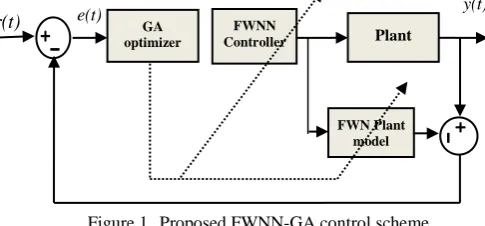
The structure of control system is given in Fig. 1. As can be seen, in this diagram FWNN is utilized as a controller and identifier.
Figure 1. Proposed FWNN-GA control scheme.
The control scheme consists of the FWNN plant model, FWNN controller and the optimization block. Where r(t)is desired output and y(t)is the output of control system. In the proposed control strategy, neural control system synthesis is performed in the closed-loop control system and
e
(
t
)
is used for tuning network weighs to provide appropriate control input. By minimizing a quadratic measure of the error between desired system output and the output of control object, i.e.e
(
t
)
, the design problem can be characterized by the GA formulation. On the other hand, the genetic algorithm is used to correct the network parameters for adjusting of FWNN controller and identifier in real time operation.B. FWNN Training.
In the learning step, the FWNN parameters are calculated by minimizing a fitness function that using the difference between the desired and real output as follow:
Hl
RNN
k
y
x
l
y
l
E
k
1
2
)
(
))
(
(
ˆ
(5)And, the Kth chromosome is represented as
N [ iNj1 iNj2 kN MN ]
i w t p p
F (6)
Plant FWNN
Controller
y(t)
r(t) e(t)
FWN Plant model GA
Which are all free design parameters that to be updated by GA in our FWNN model. H is number of network training data. According to Fig. 1, the output is measured in each iteration and will be given to the GA optimizer after being compared to the reference. Then the solution vector is obtained by GA by minimizing the fitness function which gives the FWNN parameters. By using the obtained parameters, the network output is calculated and applied to system followed by calculating the new output. The procedure continues until a termination criterion is met. The termination criterion could be the number of iterations, or when a solution of minimal fitness is found.
Equation (6) shows that the free parameters to be trained in FWNN are
[
iNj1 iNj2 kN MN]
i
w
t
p
p
.Our task is todesign the FWNN structure such that the error between output and reference is minimized. Therefore GA is applied for tuning parameters of FWNN by optimizing the (5) objective or cost function. Where EN is the fitness
of Nth chromosome. In the GA, each population is a solution to the problem which determines the parameters of FWNN, i.e.
[
iNj1 iNj2 kN MN]
i
w
t
p
p
.IV.
T
HEC
ONTINUOUSS
TIRREDT
ANKR
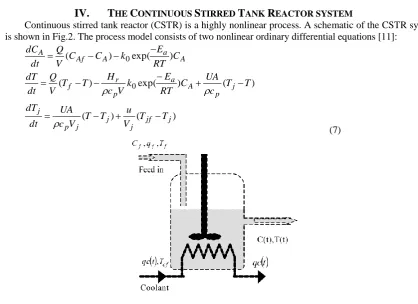
EACTOR SYSTEMContinuous stirred tank reactor (CSTR) is a highly nonlinear process. A schematic of the CSTR system is shown in Fig.2. The process model consists of two nonlinear ordinary differential equations [11]:
) (
) (
) ( )
exp( )
(
) exp( )
(
0 0
j jf j j j p j
j p A a
p r f
A a A
Af A
T T V
u T T V c UA dt
dT
T T c UA C RT
E k
V c H T T V Q dt dT
C RT
E k
C C V Q dt dC
(7)
Figure 2. CSTR plant model
where the x = [x1; x2; x3] state-variables of the model are the CA (mol/m3) concentration of the A
component in the reactor, the T (oC) reactor temperature, and the Tj (oC) temperature of the jackect of the reactor, while the input of the process is the u [m3/min] flow rate of the cooling material. The controlled output y of the process is the reactor temperature, y = x2. The parameters and its nominal values of the model are given in
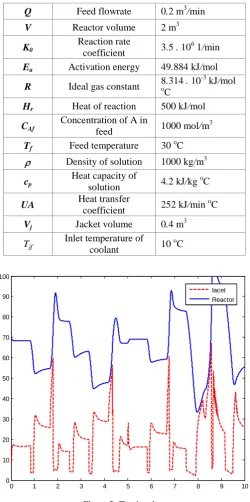
Table 1. Details of the system data and its properties are given in [12].
V.
Simulation Study
In the first stage, we should generate input-output data for obtaining the FWNN model of the process (Fig. 2). The training data was generated by closed-loop experiment and the proposed approach in section III is used to train the model. Fig. 3 shows the obtained training data set.
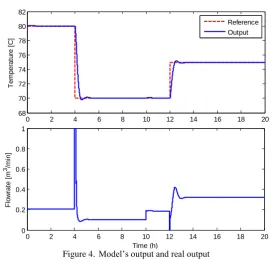
The combined servo and regulatory control problem was defined between two unstable operating points: 70 0C - 80 0C. The coolant feed temperature changed from 10 0C to 20 0C at t = 10 h what was the unmeasured disturbance. Fig. 4 shows the model's output and the real output. From Fig. 4 can see that performances of the controllers are good, and the FWNN controller based on GA achieved good dynamic performance.
Q Feed flowrate 0.2 m3/min
V Reactor volume 2 m3
K0
Reaction rate
coefficient 3.5 . 10
6 1/min
Ea Activation energy 49.884 kJ/mol
R Ideal gas constant 8.314 . 10
-3 kJ/mol oC
Hr Heat of reaction 500 kJ/mol
CAf
Concentration of A in
feed 1000 mol/m
3
Tf Feed temperature 30
o
C
Density of solution 1000 kg/m3
cp
Heat capacity of
solution 4.2 kJ/kg
o
C
UA Heat transfer
coefficient 252 kJ/min
o
C
Vj Jacket volume 0.4 m3
Tjf
Inlet temperature of
coolant 10
oC
Figure 3. Traningdate
0 1 2 3 4 5 6 7 8 9 10
0 10 20 30 40 50 60 70 80 90 100
Figure 4. Model’s output and real output
VI.
C
ONCLUSIONThis paper presented the development and evaluation of an FWNN based GA controller. The controller was designed to control the temperature of a CSTR. The nonlinear plant identification was done on-line using the genetic algorithm for quick learning. With this method any changes in the parameters of the system could be detected and remedial functions can be done. Simulation results show good dynamic performance of the proposed FWNN-GA controller.
R
EFERENCES[1] R. R. Yager and L. A. Zadeh, Eds., Fuzzy Sets, Neural Networks and Soft Computing. (New York: Van Nostrand Reinhold, 1994). [2] S. R. Jang, C. T. Sun, and E. Mizutani, Neuro-Fuzzy and Soft Computing.Englewood Cliffs, (NJ: Prentice-Hall, 1997, ch. 17). [3] S. Tang Tzeng, Design of fuzzy wavelet neural networks using the GA approach for function approximation and system identification,
Fuzzy Sets and Systems, 16(1), 2010, pp. 2585–2596.
[4] D.W.C. Ho, P.A. Zhang, J. Xu, Fuzzy wavelet networks for function learning, IEEE Transactions on Fuzzy Systems 9 (1), 2001, pp. 200–211.
[5] Q. Zhang, Using wavelet networks in nonparametric estimation, IEEE Transactions on Neural Networks, 8(4), 1997 pp. 227–236. [6] J. Chen, D.D. Bruns, WaveARX neural network development for system identification using s systematic design synthesis, Industrial
& Engineering Chemistry Research, 34(3), 1995, pp. 4420–4435.
[7] E. Bijami, M. Shahriari-kahkeshi, M. Zekri, Shuffled Frog Leaping Algorithm combined with Fuzzy Wavelet Neural Network for Function Learning , The 4th International Conference on Intelligent Information Technology Application (IITA 2010)
[8] R.H. Abiyev, O. Kaynak, Fuzzy wavelet neural networks for identification and control of dynamic plants—a novel structure and a comparative study, IEEE Transactions on Industrial Electronics, 55 (8), 2008, pp. 3133–3140.
[9] H. Khodadadi, H. Jazayeri-Rad, Applying a dual extended Kalman filter for the nonlinear state and parameter estimations of a continuous stirred tank reactor, Computers & Chemical Engineering, Computers & Chemical Engineering,35(11), 2426-2436 (2011). [10] S. Chen, C.F.N. Cowan, P.M. Grant, Orthogonal least squares learning algorithm for radial basis function networks, IEEE Trans.
Neural Networks, 2 ,1991.
[11] M. Nikravesh, A. E. Farell, T. G. Stanford, ―Control of nonisothermal CSTR with time varying parameters via dynamic neural network control (DNNC),‖ Chemical Engineering Journal, vol. 76, pp. 1-16, January 2000.
[12] J. Madar, J. Abonyi, F. Szeifert, ―Feedback Linearizing Control Using Hybrid Neural Networks Identified by Sensitivity Approach,‖
Engineering Applications of Artificial Intelligence, vol. 18, 2005.
0 2 4 6 8 10 12 14 16 18 20
68 70 72 74 76 78 80 82
T
e
m
p
e
ra
tu
re
[
C
]
0 2 4 6 8 10 12 14 16 18 20
0 0.2 0.4 0.6 0.8 1
Time (h)
F
lo
w
ra
te
[
m
3/m
in
]