COORDINATION BEHAVIOR OF 4-((3-CHLORO-2-METHYLPHENYL)
AMINO)BENZOIC ACID TOWARDS CR(III) AND CU(II) IONS: SYNTHESIS,
CHARACTERIZATION AND ANTIBACTERIAL ACTIVITY
Monika Chaudhary, Mradula Mittal*
Department of Chemistry, DAV PG College, Muzaffarnagar, Uttar Pradesh, India
INTRODUCTION
Inorganic compounds particularly transition metals have played a significant role in the development of new metal based drugs. During the past decades, much attention has been given to the synthesis of new metal complexes and the evaluation of these agents for antibacterial activity. This interest was generated by the discovery of the antimicrobial activity of several metal complexes. In
the last few years so many studies has been done on the structure and chemical behavior of several metal complexes to find out a substitute against the drugs. [1-3]. Many biologically active compounds used as drugs possess modified pharmacological and toxicological potentials when superintend in the form of metal based compounds [4-6]. Research has shown momentus growth in employment of transition metal complexes as drugs to treat several human diseases. Transition metals exhibit different oxidation states and can interact with a number of negatively charged molecules. This activity of transition metals has started the development of metal based drugs with promising pharmacological application and may offer unique therapeutic opportunities. In the last few years so many studies has been done on the structure and chemical behavior of several metal complexes to find out an alternative against the drugs. It has been reported that metal complexes show enhanced biological activity as compared to free ligands due to reduction in polarity of metal after complexation. Though many structure-activity correlation studies of transition metals have been reported [7-10].
Therefore, it is worthwhile to carry out the synthesis and study the spectral properties of the ligand derived from the condentation of p-chlorobenzoic acid and 3-chloro-2-methylaniline. The goal of the study presented here is to synthesize the Cr(III) and Cu(II) metal complexes of 4-((3-chloro-2-methylphenyl)amino)benzoic acid produced from condensation of p-chlorobenzoic acid and 3-chloro-2-methylaniline and to provide a baseline of structural data using various spectroscopic
International Journal of Therapeutic Applications
ISSN 2320-138X
ABSTRACT
Cr(III) and Cu(II) complexes (1–6) of general composition M(L1)X2 and M(L1)2 (M=Cr(III), Cu(II), X=Cl-1, NO3-1) with ligand 4-((3-chloro-2-methylphenyl)amino)benzoic acid (HL1) were synthesized. The characterization of newly synthesized ligand and complexes was done by 1H NMR, UV–VIS, IR, Mass spectrophotometry and molar conductivity studies. On the basis of the spectral study, octahedral geometry was assigned to Cr(III) metal complexes. Cu(II) complexes in metal:ligand (1:1) show square planar geometry and distorted octahedral geometry in metal:ligand (1:2) complexes. All the synthesized compounds were screened for antibacterial activity against the bacterial strains i.e. Escherichia coli and Pseudomonas striata. The antibacterial results reveal that metal complexes show enhance activity as compared to the free ligand.
Key words: Chromium(III), Copper(II), spectral studies, antibacterial screening
*Corresponding author:
techniques, and antibacterial activity.
MATERIALS AND METHODS
All the chemicals were used of Anala R grade and received from Sigma-Aldrich and Fluka. Metal salts were purchased from E. Merck and used as received.
Synthesis of Ligand
The Schiff base HL1 (Scheme 1) was prepared by mixing equimolar amount of p-chlorobenzoic acid (1 mmol) and 3-chloro-2methylanilne (1 mmol) in absolute ethanol. To this anhydrous potassium carbonate and copper oxide was added. The resulting solution was refluxed for 3–4 hours. The mixture tends to foam during the earlier part of heating due to evolution of carbon dioxide. The product separated out which was filtered off, washed, recrystallized with cold ethanol and dried under vacuum over P4O10.
Synthesis of metal complexes
Hot methanolic solution (15 mL) of CrCl3 (1
mmol) was added drop wise to a magnetically stirred solution of 4-(phenylamino)benzoic acid HL1 (1 mmol) in ethanol (20 mL) (scheme 1). The resultant mixture was refluxed for 12 h and the clear solution was allowed to cool at room temperature. The solid product precipitated out which was filtered, washed with ethanol, diethyl ether and dried under vacuum over P4O10. The same method was used for the
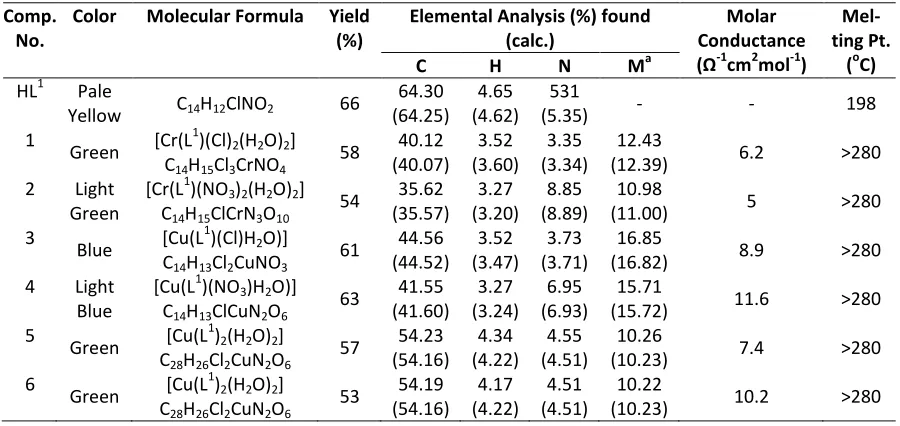
preparation of metal complexes 2–4 in metal : ligand (1:1). The metal complexes 5–6 were synthesized by using the above mentioned same procedure by taking metal : ligand in a 1:2 molar ratio. Physical, analytical and spectral data of ligands and metal complexes are given in Table 1.
Analysis
The carbon and hydrogen were analyzed on Carlo-Erba 1106 elemental analyzer. The nitrogen content of the complexes was determined using
Kjeldahl’s method. Molar conductance was
measured on the ELICO (CM82T) conductivity bridge. ESI-MS spectra were obtained using a VG Biotech Quattrro mass spectrometer equipped with an elctrospray ionisation source in the mass range of
m/z 100 to m/z 1000. IR spectra (CsBr) were recorded on FTIR spectrum BX-II spectrophotometer. NMR spectra were recorded with a model Bruker Advance DPX-300 spectrometer operating at 400 MHz using DMSO-d6 as a solvent and TMS as internal standard. The electronic spectra were recorded in DMSO on Shimadzu UV mini-1240 spectrophotometer. EPR spectra was recorded on
Scheme 1: Synthesis of ligand HL1
Table 1: Physical and Analytical data of ligand HL1 and metal complexes 1–6
Comp. No.
Color Molecular Formula Yield (%)
Elemental Analysis (%) found (calc.)
Molar Conductance (Ω-1cm2mol-1)
Mel-ting Pt.
(oC)
C H N Ma
HL1 Pale
Yellow C14H12ClNO2 66
64.30 (64.25)
4.65 (4.62)
531
(5.35) - - 198
1
Green [Cr(L
1
)(Cl)2(H2O)2]
C14H15Cl3CrNO4
58 40.12
(40.07) 3.52 (3.60) 3.35 (3.34) 12.43
(12.39) 6.2 >280
2 Light
Green
[Cr(L1)(NO3)2(H2O)2]
C14H15ClCrN3O10 54
35.62 (35.57) 3.27 (3.20) 8.85 (8.89) 10.98
(11.00) 5 >280
3
Blue [Cu(L
1)(Cl)H 2O)]
C14H13Cl2CuNO3 61
44.56 (44.52) 3.52 (3.47) 3.73 (3.71) 16.85
(16.82) 8.9 >280
4 Light
Blue
[Cu(L1)(NO3)H2O)]
C14H13ClCuN2O6 63
41.55 (41.60) 3.27 (3.24) 6.95 (6.93) 15.71
(15.72) 11.6 >280
5
Green [Cu(L
1
)2(H2O)2]
C28H26Cl2CuN2O6 57
54.23 (54.16) 4.34 (4.22) 4.55 (4.51) 10.26
(10.23) 7.4 >280
6
Green [Cu(L
1
)2(H2O)2]
C28H26Cl2CuN2O6
53 54.19
(54.16) 4.17 (4.22) 4.51 (4.51) 10.22
E4-EPR spectrometer at room temperature using DPPH as standard.
Antibacterial activity
The antibacterial activitity of the ligands(HL1-HL
-7) and their metal complexes were tested by using
Disc Diffusion Method [11]against Escherichia coli
and Pseudomonas striata . The test compounds in measured quantities were dissolved in DMF to get a
concentrations of 500 and 1000 ppm of compounds. 25 mL nutrient agar media (NA) was poured in each petriplate. After solidification 0.1 mL of test bacteria spreads over the medium using a spreader.The disc of Whatmann no 1 filter paper having the diameter
5.00 mm each containing (1.5 mg cm-1) of compounds were placed at 4 equidistant places at a
distance of 2 cm from the center in the inoculated petriplates. Filter paper disc treated with DMF served as control and Streptomycin used as a standard drug. All determinations were made in triplicate for each of the compounds. Average of three independent readings for each compound was
recorded. These petriplates were kept in refrigerator for 24 hrs for Pre-diffusion. Finally petriplates were incubated for 26-30 hours 28±20C. The zone of inhibition was calculated in mm carefully.
Table 2 : Magnetic Moment (B.M) and Electronic Spectral data (cm –1) and Ligand Field Parameter of the complexes
Complex µ eff B.M. Electronic data (cm-1) Ligand Field Parameter
υ1 υ2 υ3 Dq (cm-1) B (cm-1) Β LFSE (kJmol-1)
1 3.78 16240 21120 26840 1624 559 0.61 246
2 3.73 17740 20533 27300 1774 495 0.54 236
3 1.72 - - 18122 - - - -
4 1.77 - - 20267 - - - -
5 1.91 14723 19672 26545 - - - -
6 1.95 12912 18478 23456 - - - -
RESULTS AND DISCUSSION
The ligand HL1 (Scheme 1) was prepared reaction of p-chlorobenzoic acid (1 mmol) and 3-chloro-2-methylaniline (1 mmol) in absolute ethanol in presence of potassium carbonate and copper oxide. The separated product was filtered off, washed, recrystallized with cold ethanol and dried under vacuum over P4O10. The structure of ligand thus
formed was established by IR, 1H NMR and Mass spectrophotometry.
The synthesized ligand was further used for the complexation with Cr(II) and Cu(II) metal ions, using the following metal salt: CrCl3 for complex 1,
Cr(NO3)3 for complex 2, CuCl2 for complexes 3 & 5
and Cu(NO3)2 for complexes 4 & 6. The obtained
complexes are microcrystalline solids which are stable in air and decompose above 280 oC (Table 1). They are insoluble in common organic solvents such as acetone & chloroform, sparingly soluble in ethanol & methanol and completely soluble in DMF & DMSO. The molar conductance of the soluble complexes in DMF showed values indicating that complexes 1–6 (5-11.6 ohm-1 cm2 mol-1) [12] are non-electrolytes in nature. The elemental analysis data of the ligand are in agreement with the structure of the ligand. The physical and analytical data of the ligand (HL1) and metal complexes (1–6) are given in Table 1.
Mass Spectra
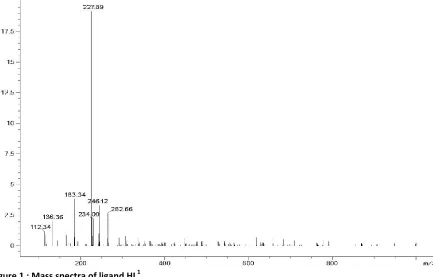
The ESI mass spectrum of ligand showed a molecular ion peak at m/z = 262.66 amu corresponding to [M + H]+, which confirms the proposed formula (Figure 1). It also shows a series of peaks at 246.12, 234.00, 227.89, 183.34, 136.36 and 112.34 corresponding to various fragments. The intensities of these peaks give the idea of the stability of the fragments.
1
H NMR Spectra
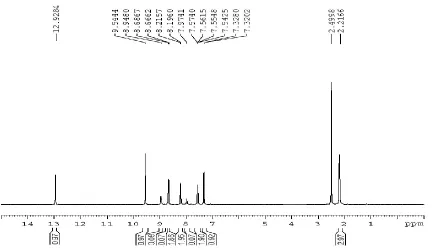
The 1H NMR spectra have been recorded for ligand HL1 (Figure 2). The characteristic signals, due
Figure 2: 1H NMR spectra of ligand HL1
Table 3 . EPR spectral data of the Cr(III) and Cu(II) complexes
Complex Data as polycrystalline sample
G
g׀׀ g giso
1 -- -- 1.7620 ----
2 ---- --- 1.9750 ---
3
2.2343 2.0706 2.1251 3.3186
4 2.1892 2.1156 2.1401 1.6366
5 2.2343 2.1220 2.1594 1.9204
to –NH and –COOH protons appear at 9.54 and 12.92 ppm, respectively. The aromatic region is a set of doublets and multiplets in the range 7.32–8.94 ppm for the ligand . All the proton peaks were found to be in the expected regions.
IR Spectra
The IR spectrum of the ligand was compared with those of the metal complexes in order to confirm the binding mode of the ligand to the corresponding metal ion. A very broad band at 3144 cm-1 corresponds to –COOH group in ligand HL1. However, in metal complexes 1–6 this band disappears, which indicates that the –COOH group deprotonate and coordinates to metal ion. In metal complex 1, The stretching bands corresponding to ʋasym(COO-) appeared at 1537 cm-1, while the band
corresponding to ʋsym(COO-) appeared at 1445 cm -1
.The separation value (Δʋ) of 92 cm-1 indicates bidentate binding of the carboxylato group [13]. Similarly, for metal complexes 2-6 the band for ʋasym(COO-) and ʋsym(COO-) appeared in the range of
1532-1557 and 1435-1455 cm-1 , respectively. This is also supported by the appearance of band in range of 522-537 cm-1, which corresponds to ʋ(M-O) bond [14].
The presence of bands at 1444-1423 (ν5), 1345
-1331 (ν1) and 1052-1028(ν2) cm-1, in the IR spectra
of the metal complexes 2, 4 and 6 suggest that both the nitrate groups are coordinated to the central metal ion in a unidentate fashion [15]. Furthermore, the presence of coordinated water molecules is evidenced by broad band's corresponding to O-H
stretching vibration [16] at 3370–3440 cm-1 in complexes 1–6. The chloro complexes show the IR bands in the region 322-367 cm-1 due to ν(M-Cl) [17]. The IR spectral data indicates that the ligand HL1 behaves uninegative bidentately.
Magnetic moments
Generally the magnetic moment of chromium(III) complexes at room temperature lies near 3.87 B.M. i.e. equal to spin-only value. For the Cr(III) compounds the magnetic moment is reduced below the spin-only value because of the (1-4 λ /10Dq) effect. The spin-orbit coupling constant for Cr(III) is rather small. The magnetic moment of complexes under study at room temperature lies in range of 3.73-3.78 B.M.(Table 2)[18] corresponding to three unpaired electrons. At room temperature Cu(II) complexes show magnetic moment in the range 1.72-1.95 B.M. corresponding to one unpaired electron [19].
For Cr(III) (d3, the spin quantum number S=3/2), the strong field ground configuration is t2g3eg0. The
excited configuration t2g2eg1 is six fold orbitaly
degenerate and the second excited configuration t2g1eg2 is three fold orbitaly degenerate. The ground
state can be written by considering a spin of 3/2 as it is an orbital singlet. The free ion split quartet term 4F and 4P. These terms in octahedral field split into 4A2g, 4
T1g, 4T2g and 4T1g (P), respectively. The electronic
spectra of the Cr(III) complexes 1–2 recorded in DMSO, display three bands in the range of 16240-17170, 20320-21120 and 26660-26840 cm-1 (Table2). These spin allowed bands shown by six coordinated complexes having Oh symmetry could be assigned to the transitions: 4 A2g (F) → 4T2g(F), ʋ1: 4A2g (F) → 4T1g
(F), ʋ2 : 4A2g(F) → 4T1g (P), ʋ3 [20].
Electronic absorption spectra of the copper complexes 3 and 5 display a transition in the region 18122-20267 cm-1, which can be assigned as the 2B1g
-2A1g transition, revealing that the Cu(II) complexes
exist in the square planar geometry [21]. Electronic spectra of Cu(II) complexes 4 and 6 show the d–d transition bands in the range 12,912–14,723, 18,478–19,672 and 23,456–26,545 cm-1. These bands correspond to 2B1g→2A1g (dx2–y2→dz2), 2
B1g→2B2g (dx2–y2→dxy) and 2B1g→2Eg (dx2–y2→dxz, dyz)
transitions, respectively [22]. On the basis of electronic transitions, a distorted octahedral geometry is suggested for complexes 4 and 6.
Various ligand field parameters are calculated for the complexes . The energy of the first spin allowed transition i.e. 4A2g (F) → 4T2g, directly gives the value
of 10 Dq (v1=10Dq). The Nephelauxetic parameter β
is calculated by the relation β = B complex / B free
ion. For Cr(III) the value of B free ion is 918 [20]. The value of β calculated for Cr(III) complexes lie in the range of 0.54-0.61 given in table . These values indicate that the complexes have appreciable covalent character.
EPR spectra
The X-band EPR spectra of all the Cr(III) complexes in solid state show a broad signal (Fig. ) in the vicinity of giso ≈2.0. Due to large line widths and dominance of giso ≈2.0 peaks, no hyperfine splitting is observed and the estimation of parameters D and E is not possible. The EPR results of Cr(III) complexes in the present study are consistent with the presence of hexacoordinated Cr(III) centers.
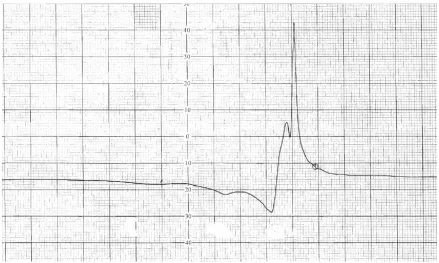
EPR spectra (Figure 3) of the Cu(II) complexes were recorded , at room temperature as polycrystalline samples, on the X-band at 9.1 GHz under the magnetic field range 3000 G. The trend g׀׀ > g׀ >2.0023, observed for the complexes, under study, indicate that the unpaired electron is localized in the dx2-y2 orbital of the Cu(II) ion and the spectral figures are characteristic for the axial symmetry. Tetragonally elongated geometry is thus confirmed for the afore-said complexes. G=( g׀׀ -2)/( g׀ -2), which measure the exchange interaction between the metal centers in a polycrystalline solid has been calculated. According to Hathaway and Billing [20] if G>4 the exchange interaction is negligible, but G<4 indicates considerable exchange interaction in the solid complexes. The complexes show the G values smaller than 4 which indicate exchange interaction in the solid complexes.
Based on above observations following
structures are proposed for metal complexes 1–6 (Figure 4).
Antibacterial Activity
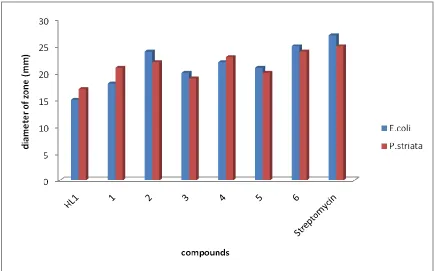
The antibacterial screening data shows that the compounds exhibit antibacterial properties and it is important to note that the metal chelates exhibit more inhibitory effects than the parents ligand (Figure 5). The increased activity of the metal chelates can be explained on the basis of chelation theory [23]. It is known that chelation tends to make the ligand act as more powerful and potent bactericidal agents, thus killing more of the bacteria than the ligand. It is observed that in complexes the positive charge of the metal is partially shared with the donor atoms present in the ligands and there may be π-electron delocalization over the whole
chelate [24]. This increases the lipophilic character of the metal chelate and favors its permeation through the lipoid layer of the bacterial membranes. There are other factors which also increased the activity these are solubility, conductivity and bond length between the metal and ligand.
The mode of action may involve the formation of a hydrogen bond through the azomethine nitrogen atom with the active centers of the cell constituents, resulting in interference with the normal cell process. The variation in the effectiveness of different compounds against different organisms depend either on the impermeability of the cells of the microbes or difference in ribosomes of microbial cells [25].
CONCLUSION
The analytical and physico-chemical analyses confirmed the composition and the structure of the newly obtained ligand and metal complexes. On the basis of the spectral studies Cr(III) complexes were found to have a octahedral geometry whereas Cu(II) complexes has a square planar geometry in 1:1 (metal:ligand) complexes and distorted octahedral in 1:2 complexes. In all complexes the ligand HL1 acts as uninegative bidentate around the metallic ion. Results of the antibacterial activity revealed that
metal complexes show enhanced activity in comparison to free ligand. The increase in activity after metal complexation can be explained on the basis of overtone concept.
REFERENCES
1. West DX, Bain GA, Butcher et al.
(1996).Synthesis, Characterization, and
Biological Activity of Some Transition Metal
Complexes of
N-Benzoyl-N′-2-thiophenethiocarbohydrazide. Polyhedron, 15, 665.
2. Pegfei X, Ximping Y, Shaozn W, Ziyl Z. (1998).
Synthesis of 5-Benzimidazolylbenzofuran
derivatives. Indian J Chem, 127, 3713.
3. Puratchikody A, Sivagothi V. (2001).Synthesis of benzimidazole derivatives of biological interest.
Indian J Heterocycl Chem , 241.
4. Kiran M, Singh RV, Tandon JP. 1H -Indole-3-carbaldehyde thiosemicarbazone. (1986). Inorg Met OrgChem, 16,1341.
5. Agarwal RK, Singh L. (2006). Synthesis, Spectral, and Biological Properties of Copper (II) Complexes of Thiosemicarbazones of Schiff Bases Derived from 4-Aminoantipyrine and Aromatic Aldehydes. Bioinorg Chem Appl, 2006, 1.
6. Ibrahim G, Khan MA, Bouet GM. (2002).
Complexes of 2-furaldehyde
4-phenylsemicarbazone. Trans Met Chem, 27, 34. 7. Ibrahim G, Khan MA. Bouet GM, Chebli E. (1999). Metallic complexes from 2-furaldehyde semicarbazone and 5-methyl-(2- furaldehyde) semicarbazone. Trans Met Chem, 24, 294. 8. Trinagaraju K, Prasad AVGS, Rao PV, Prasad
PSS. (2015). Synthesis, Characterization and Biological activity of 3- Indole Acetic acid.
International Journal of International Journal of Novel Trends in Pharmaceutical Sciences, 5, 21. 9. Trinagaraju K, Prasad AVGS, Rao PV, Prasad
PSS. (2015). Synthesis, physicochemical and
biological properties of
3,4,5-trimethoxybenzoates of Mn(II), Co(II), Ni(II) and Zn(II). International Journal of Medicinal Chemistry and Analysis, 5, 65.
10. Trinagaraju K, Prasad AVGS, Rao PV, Prasad PSS. (2015). Synthesis, characterization and biological properties of metal 1-(4-carboxy3-hydroxy phenyl aminomethyl)benzimidazole complexes. International Journal of Pharmacy,
5, 33.
11. Singh DP, Kumar K, Chopra RM .
(2011).Spectroscopic studies and antibacterial
activities of some new 16-membered
octaazamacrocyclic complexes derived from thiocarbohydrazide and pentane-2,4-dione.
Spectrochim Acta A, 78, 629.
12. Chandra S, Vandana, Kumar S. (2015).Synthesis, spectroscopic, anticancer, antibacterial and antifungal studies of Ni(II) and Cu(II) complexes with hydrazine carboxamide, 2-[3-methyl-2-thienyl methylene]. Spectrochim Acta A,135, 356.
13. Swamy SJ, Pola S. (2008). Spectroscopic Studies on Co(II), Ni(II) Cu(II) and Zn(II) Complexes witha N4-Macrocyclic Ligands. Spectrochim Acta A, 70, 929.
14. Swamy SJ, Veerapratap B, Nagaraju D, Suresh K, Someshwar P. (2003). Non-template Synthesis of ‘N4’ Di- and Tetra-amide Macrocyclic Ligands with Variable Ring Sizes.
Tetrahedron, 59, 10093.
15. Goeta AE, Howard JAK, Maffeo D, Puschmann H, Williams JAG, Yufit DS. (2000). Copper(II) complexes of the Isomeric tetraazamacrocyclic ligands 1,11- and 1,8-Bis-(2-pyridylmethyl)-1,4,8,11-tatraazacyclotetradecane and of the
1,4,8,11-tetraazacyclotetradecane-5-12-dione analogue at neutral and basic pH. J Chem Soc Dalton Trans, 1873.
16. Chandra S, Sharma AK.(2009). Applications of several spectral techniques to characterize coordination compounds derived from 2,6-diacetylpyridine derivative. Spectrochim Acta A,
74, 271.
17. Chandra S, Ruchi, Qanungo K, Sharma SK. (2011). Synthesis, molecular modeling and spectroscopic characterization of nickel(II), copper(II), complexes of new 16-membered mixed-donor macrocyclic schiff base ligand incorporating a pendant alcohol function. 79,1326.
18. Lever, ABP. Inorganic Electronic Spectroscopy, 1st ed. (Elsevier, Amsterdam) 1968.
19. Greenwood NN, Earnshaw A. Chemistry of the Elements, 1st edition. (Pergamon Press, UK) 1983, 1379.
20. Tyagi M, Chandra S, Tyagi P. (2014). Mn(II) and Cu(II) complexes of a bidentate Schiff’s base ligand: Spectral, thermal, molecular modelling and mycological studies. Spectrochim Acta A,
117, 1.
21. Bhaskar R, Salunkhe N, Yaul A, Aswar A.(2015).
Bivalent transition metal complexes
of ONO donor hydrazone ligand: Synthesis, structural characterization and antimicrobial activity. Spectrochim Acta A, 151, 621.
22. Sastry BA, Asadullah SMD, Ponticelli G, Massacesi M, Pinna R. (1981). Electron
paramagnetic resonance studies on
Cu(enEt2)(NCS)2. J Mol Struct, 73, 257.
23. Shankarwar SG, Nagolkar BB, Shelke VA, Chondhekar TK. (2015). Synthesis, spectral, thermal and antimicrobial studies of transition metal complexes of 14-membered tetraaza[N4]
macrocyclic ligand. Spectrochim Acta A, 145, 188.
24. Osowole AA, Balogun SA. (2012).Spectral, magnetic, thermal and antibacterial properties of some metal(II) complexes of Aminoindanyl Schiff Base. European Journal of Applied Sciences, 4 (1),6.