[Israr et al., 5(10): October, 2018]
ISSN 2349-0292
Impact Factor 3.802
GLOBAL JOURNAL OF ADVANCED ENGINEERING TECHNOLOGIES AND
SCIENCES
A REVIEW ON SECURITY ISSUES AND THEIR SOLUTION IN VANETS
A. Israr*, M. Ashraf
*
Department of Electrical & Electronics Engineering, University of Engineering & Technology
Peshawar, Pakistan
DOI: 10.5281/zenodo.1456385
ABSTRACT
Vehicular Adhoc Networks are of major interest of researchers nowadays. Despite of the huge attention of the researchers towards VANETs, there are still many issues regarding security of VANETs. Researchers are still going to secure the VANETS from different types of attacks and adversaries. There is a strong link between reliable network and security and privacy features. This paper provides a survey of problems in wireless networks like jamming attacks and their impact on the network. Many security issues are analyzed and have been discussed. Many researches about the solutions of the security attacks to the wireless networks have also been sum up in this paper.
KEYWORDS: Vehicular Adhoc Networks, Security issues, jamming attacks.
INTRODUCTION
Because of increase in the number of vehicles on the roads, the traffic accidents are also increasing. According to a report by National Highway Traffic Safety Administration more than 30 thousand of accidents happened in 2012 in which drivers, passengers and other road users were affected. This number is increasing as there is direct relationship between the traffic and the fatalities. To avoid the fatalities, the vehicles and the roads should be made safer.
To achieve this goal, the very first step which is taken is to make the vehicles safer by embedding and installing computers in the vehicles. These computers help the drivers to diagnose the problems occurring in the internal systems of the cars. Chevrolet was the first company to install computers in the cars in 1975. After that many other cars started adopting the same technique. Computers which are being installed in the cars are composed of Electronic Control Units (ECU). It has different modules which controls the electrical systems of the cars. Modules are like engine control module, transmission control module, and brake control module [1] [2]. Quality of driving’s safety is increased as a result of installing ECU in cars. But these ECUs address only the internal problems occurring to the car. The external problems like road scenarios, hazards, weather behavior and traffic blocks on the roads are some of the factors that also need to be addressed for the safety of the drivers.
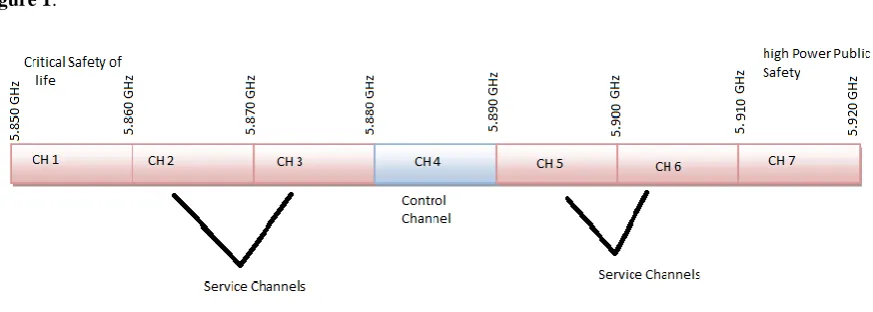
To make the cars able to gain information about the external hazards the Intelligent Transport System (ITS) is the first step. ITS is the national program which uses modern computers for the purpose of communication so that vehicles are communicated about the external hazards or scenarios of the road. Automatic Toll Collection, Traveler Information System, Intelligent Traffic Control are some of the examples of the ITS [3]. The main purpose of ITS is to embed such hardware in very car so that each car is capable of communicating to other cars (Vehicle to Vehicle “V2V”) and to the fixed infrastructure units installed on the road sides which are termed as Road Side Units (RSUs) which is called Vehicle to Infrastructure (V2I) communication. V2V and V2I is collectively called as VANETs. For the purpose of communication VANETs a bandwidth of 75MHz is allocated in the spectrum of 5.9GHz which is called as Dedicated Short Range Communication (DSRC) [4]. DSRC is based upon two points:
1. Safety of the connected vehicles is of top priority.
2. DSRC is the only available technology that offers latency, accuracy, and reliability required for the safety of the connected vehicles of the network [3].
[Israr et al., 5(10): October, 2018]
ISSN 2349-0292
Impact Factor 3.802
Figure 1:DSRC Spectrum Band & Its Channels
As VANETs are wireless in nature, these networks also faces many issues regarding their security because of which safety of drivers come at stack. If safety is kept at priority by the researchers then the Quality of Service (QoS) is compromised because both the security and QoS are inversely related to each other. So the main goal of the researchers is to balance between the security of the network and QoS.
There are different types of attacks which can affect the security of the network which can be categorized in terms of authentication, availability and non-repudiation [5]. Authenticity and Non-repudiation are also important but the availability of the network is most important to assure the security of the network. One of the main threats to availability is jamming attack. This type of attack is easy to launch but hard to detect.
Jamming attack targets the availability of the network in VANETs, because jamming blocks the regulation of informative messages between the nodes of the network. Imagine for a second that an accident is happended on the road and a vehicle broadcast a message to the cars heading towards that direction about the mishap, if that message is blocked, what will be the devastating results of that? So jamming is a major problem in VANETs.
This paper addresses the security issues of the VANETs and also summarizes the solutions which are proposed by different researchers.
SECURITY CHALLENGES IN VANETS
Although security is of great importance in VANETs but it is not taken in consideration to that level by the researchers. Vehicles in VANETs broadcast the informative packets which contains important information. Now these packets need to be delivered to their destination without any alteration. For this delivery of the packets from the source to the destination, the security of the VANETs must be kept in consideration while designing the architecture of the VANETs [5]. This section gives the security requirements that need to be satisfied before the deployment of such networks.
1. Availability: availability means that the network should always be available to the nodes whenever the nodes want to access the network for the transmission of some important messages. Denial of Services (DoS) attack is the main threat to the availability.
2. Confidentiality: Confidentiality means that the privacy of the nodes constituting the network should be kept secret so that the un-authorized nodes cannot effect the information shared by the authorized nodes of the network. Eavesdropping is an attack which can effect the confidentiality.
3. Identification & Authentication: The purpose of this requirement is to ensure that the nodes and the messages of the network are legitimate. This requirement can be effected by the Impersonation and Sybil Attack.
[Israr et al., 5(10): October, 2018]
ISSN 2349-0292
Impact Factor 3.802
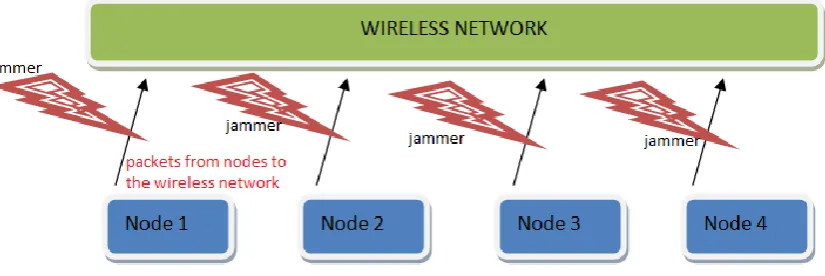
JAMMING PROBLEMIn jamming attacks the adversary launches the noise signals upon the frequency on which the nodes of the network are communicating. These noise signals get interfered with the original signals and thus decreases there Signal to Noise Ratio (SNR). So the receiver of the signal will not be able to extract the useful information from the signal. Jamming attacks are classified into 4 different types depending upon their nature.
Constant Jamming: In this type of jamming continuous jamming signals are transmitted by the jammer without analyzing the state of the channel. Deceptive Jamming: in this a stream of random bits is injected to the channel without having any gap between the packets. Random Jamming: In this time of jamming the adversary alters itself between sleeping and jamming mode for the purpose of saving energy. Reactive Jamming: This is the most difficult attack to be detected. In this attack the attacker only launches the jamming signals when it senses any activity upon the network. Figure 2 gives the pictorial view to understand the concept of jamming.
Figure 2:
Interfering with the Data Packets sent by the Nodes to the Wireless Networks
SOLUTIONS OF THE JAMMINNG PROBLEM
Author of [6] explained the need of network’s availability for the purpose of assuring security. The author addressed the Denial of Services attack and also proposed a solution for that. DoS attack is divided into 3 categories by the author. 1). Basic Level 2) Extended Level 3) Distributed Denial of Services DDoS attack. Author proposed a solution that vehicles and drivers should depend upon On Board Units (OBUs) which are installed in each vehicle. OBU is made capable of decision making to avoid DoS attack. Techniques like Channel Switching, technology switching and frequency hopping are proposed for that. In [7] the author proposed a technique for the detection of jamming inn wireless networks. Detection technique uses the Correlation Coefficient (CC). CC is the statistical measure between the 2 variables whose values lies in between -1 and 1. Each node of the network compares 2 values CC and Error Probability (EP). If the value of EP is less than that of CC then it is considered as jamming. The author of [8] the issues related to security of VANETs and proposed a technique for avoiding jamming. Author proposed a technique called Hideaway technique which depends upon Packet Send Ration (PSR) for the determination of the network that whether it is jammed or not.
[Israr et al., 5(10): October, 2018]
ISSN 2349-0292
Impact Factor 3.802
Road Based Routing Vehicles in VANETs (RBVT) for the better routing of the vehicles in VANETs. The protocol uses real time traffic information for the creation of road based paths. Two sub protocols are also proposed by the author named as RBVT-R and RBVT-P to work as reactive or proactive protocols. Network on Wheels (NoW) project is the German research project which is described by the [13]. The project was done in collaboration with the car manufacturers, suppliers, researchers and educational institutes. A system was developed in this project which unifies safety and infotainment. The main contribution of that project was the development of CAR-X communication where X can be another car or the RSU. Provision of safety, networking, radio, privacy and security is the main goal of this project. The author of [14] describes the advantages and disadvantages of different routing protocols which are being used for VANETs. Author divided the routing protocols into 5 different categories:1. Topology Based 2. Position Based 3. Cluster Based 4. Broadcast Based
5. Geocast Routing Protocol
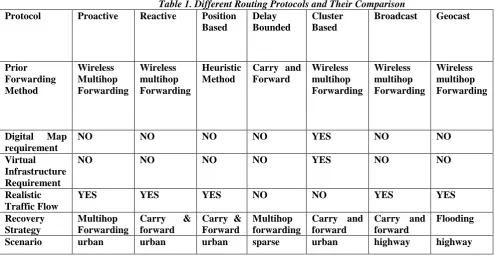
The following table is taken from the paper for the purpose of illustration.
Table 1. Different Routing Protocols and Their Comparison Protocol Proactive Reactive Position
Based
Delay Bounded
Cluster Based
Broadcast Geocast
Prior Forwarding Method Wireless Multihop Forwarding Wireless multihop Forwarding Heuristic Method
Carry and Forward Wireless multihop Forwarding Wireless multihop Forwarding Wireless multihop Forwarding
Digital Map requirement
NO NO NO NO YES NO NO
Virtual Infrastructure Requirement
NO NO NO NO YES NO NO
Realistic Traffic Flow
YES YES YES NO NO YES YES
Recovery Strategy
Multihop Forwarding
Carry & forward
Carry & Forward
Multihop forwarding
Carry and forward
Carry and forward
Flooding
Scenario urban urban urban sparse urban highway highway
The paper of [14] presented a technique for encountering the jamming attack. According to the author the effects of jamming upon the source and receiver are not isotropic. Author suggested that when jamming attack is detected the transmission power of the original signal should be adjusted so that SNR could be improved.
CONCLUSION
Jamming attack is considered as serious threat to the wireless networks by the Federal Communication Commission and is termed as criminal offense. Hence jamming is an illegal thing to do. Our paper studies different jamming attacks which are addressed by the authors in the previous years and also gives a detailed survey about the proposed solutions of that. This paper is the base of the study for our future work which will be in the field of Detection and Minimization of jamming attacks in Vehicular Adhoc Networks.
ACKNOWLEDGEMENTS
[Israr et al., 5(10): October, 2018]
ISSN 2349-0292
Impact Factor 3.802
REFERENCES
[1] Engine Control Unit, Working of ECU, http://en.wikipedia.org/wiki/Engine_control_unit.
[2] “Electronic control unit”, Wikipedia: The Free Encyclopedia. Wikipedia Foundation, Inc. September 2014. Web, http://en.wikipedia.org/wiki/Electronic_control_unit.
[3] U.S. Department of Transportation, Intelligent Transportation Systems (ITS) Home, http://www.its.dot.gov/index.htm.
[4] Y Qian, K Lu, and N Moayeri, “A Secure VANET MAC Protocol for DSRC Applications”, IEEE Globecom, 2008.
[5] R Raw, M Kumar, and N Singh, “Security Challenges, Issues and Their Solutions for VANET”, Vol.5, pp95-105, IJNSA 2013.
[6] H. Hasbullah, I. Soomro, and J. Manan, “Denial of Service (DOS) Attack and Its Possible Solutions in VANET”, World Academy of Science, Engineering and Technology, 2010
[7] A. Hamieh, J. Othman, and L. Mokdad, “Detection of Radio Interference Attacks in VANET”, IEEE, 2009.
[8] I. Azogu, M. Ferreira, J. Larcom, and H. Liu, “A New Anti-Jamming Strategy for VANET”, Globecom 2013 Workshop, IEEE, 2013.
[9] R Raw, M Kumar, and N Singh, “Security Challenges, Issues and Their Solutions for VANET”, Vol.5, pp95-105, IJNSA 2013.
[10] S. Babar, N. Prasad, and R. Prasad, “Jamming Attack: Behavioral Modeling and Analysis”, IEEE, 2013. [11] S. Bhoi, and P. Khilar, “A Secure Routing Protocol for Vehicular Ad Hoc Network to Provide ITS
Services”, International conference on Communication and Signal Processing 2013, IEEE, 2013. [12]J Nzouonta, N Rajgure, G Wang, and C Borcea, “VANET Routing on City Roads Using Real-Time
Vehicular Traffic Information”, Vol. 58, pp3609-3626, IEEE, September 2009.
[13] A. Festag, G. Noecker, M. Strassberger, A. Lübke, B. Bochow, M. Torrent-Moreno, S. Schnaufer, R. Eigner, C. Catrinescu, and J. Kunisch,”NoW – Network on Wheels’: Project Objectives, Technology and Achievements”, International Workshop on Intelligent Transportation (WIT), 2008.