1535-9778/09/$08.00⫹0 doi:10.1128/EC.00069-09
Copyright © 2009, American Society for Microbiology. All Rights Reserved.
Functional Analysis of
cis
- and
trans
-Acting Elements of the
Candida albicans CDR2
Promoter with a Novel Promoter
Reporter System
䌤
†
Alix T. Coste,
1Je
´ro
ˆme Crittin,
1Christopher Bauser,
2Bettina Rohde,
2and Dominique Sanglard
1*
Institute of Microbiology, University of Lausanne and University Hospital Center, CH-1011 Lausanne, Switzerland,1and
GATC Biotech, Konstanz, Germany2
Received 1 March 2009/Accepted 17 June 2009
Azole resistance in Candida albicans can be mediated by the upregulation of the ATP binding cassette
transporter genesCDR1andCDR2. Both genes are regulated by acis-acting element called the drug-responsive
element (DRE), with the consensus sequence 5ⴕ-CGGAWATCGGATATTTTTTT-3ⴕ, and the transcription
factor Tac1p. In order to analyze in detail the DRE sequence necessary for the regulation ofCDR1andCDR2
and properties ofTAC1alleles, a one-hybrid system was designed. This system is based on aP(CDR2)-HIS3
reporter system in which complementation of histidine auxotrophy can be monitored by activation of the
reporter system byCDR2-inducing drugs such as estradiol. Our results show that most of the modifications
within the DRE, but especially at the level of CGG triplets, strongly reduceCDR2expression. TheCDR2DRE
was replaced by putative DREs deduced from promoters of coregulated genes (CDR1, RTA3, and IFU5).
Surprisingly, even if Tac1p was able to bind these putative DREs, as shown by chromatin immunoprecipitation,
those fromRTA3andIFU5did not functionally replace theCDR2DRE. The one-hybrid system was also used
for the identification of gain-of-function (GOF) mutations either inTAC1 alleles from clinical C. albicans
isolates or inserted in TAC1 wild-type alleles by random mutagenesis. In all, 17 different GOF mutations were identified at 13 distinct positions. Five of them (G980E, N972D, A736V, T225A, and N977D) have already been described in clinical isolates, and four others (G980W, A736T, N972S, and N972I) occurred at already-described positions, thus suggesting that GOF mutations can occur in a limited number of positions in Tac1p. In conclusion, the one-hybrid system developed here is rapid and powerful and can be used for characterization
ofcis- andtrans-acting elements inC. albicans.
Candida albicans is an opportunistic pathogen causing su-perficial to deep systemic infection in immunocompromised patients. Due to the increase in the number of people with immunodeficiencies (essentially due to AIDS, transplantation, or chemotherapy), the use of antifungal drugs is now more frequent and has led to development of drug resistance in several fungal species, especially inCandida albicans. Several resistance mechanisms have been described up to now (22). One of the more frequent is the upregulation of multidrug transporters, encoded byCDR1 andCDR2, belonging to the ATP-binding cassette transporter family (1, 2). In azole-resis-tant isolates, the expression of these pumps is constitutively high. The resulting drug efflux diminishes antifungal efficacy and thus protects the fungus from drug toxic effects. We dem-onstrated that the expression of pump-encoding genes can also be transiently upregulated by treating azole-susceptible iso-lates with drugs such as estradiol or fluphenazine, thus mim-icking azole-resistant isolates (8). In our laboratory we are particularly interested in the regulation of the expression of multidrug transporter genes.
Previous studies showed that CDR1 and CDR2 promoters contain regulatory sequences crucial for their regulation. The existence of two basal response elements localized between nucleotides⫺860 and⫺810 and between⫺243 and⫺234 and one negative regulatory element localized within the ⫺289 region was reported (12, 20). Finally, Karnani et al. (14) have identified a steroid response region between⫺696 and⫺521 containing two elements (steroid response elements 1 and 2), but none of these elements were shown to be crucial for azole resistance. In contrast, the drug-responsive element (DRE) sequence (5⬘-CGGAWATCGGATA-3⬘) in both CDR1 and CDR2promoters has been characterized and was crucial not only for the upregulation of these genes in azole-resistant strains but also for the transient upregulation of both genes in the presence of different drugs (8).
CDR1andCDR2are coregulated with other genes, such as RTA3, IFU5, PDR16, and TAC1, that all contain putative DREs in their promoters (6–8, 24). The expression of these genes was shown to be controlled by the Zn(2)-Cys(6) tran-scription factor Tac1p (trantran-scriptional activator of CDR genes). Tac1p was shown to be responsible for transient up-regulation of CDR genes in azole-susceptible strains in the presence of inducers (6). We previously identifiedTAC1 hy-peractive alleles from clinical azole-resistant strains, which, in contrast to wild-type alleles, conferred constitutive highCDR1 andCDR2expression on atac1⌬/tac1⌬mutant (6). Hyperac-tivity ofTAC1was due to a gain-of-function (GOF) mutation. Seven distinct GOF mutations have been found in 11 analyzed * Corresponding author. Mailing address: Institute of
Microbiol-ogy, University Hospital Lausanne and University Hospital Center (CHUV), rue du Bugnon 48, CH-1011 Lausanne, Switzerland. Phone: 00 41 21 314 40 83. Fax: 00 41 21 314 40 60. E-mail: Dominique.Sanglard @chuv.ch.
† Supplemental material for this article may be found at http://ec .asm.org/.
䌤Published ahead of print on 26 June 2009.
1250
on September 8, 2020 by guest
http://ec.asm.org/
hyperactive alleles (4, 5, 24). In previous studies, Tac1p was shown to bind in vitro and in vivo to the DRE (6, 17). Our in vitro analysis demonstrated the crucial role of the CGG triplets for the binding of Tac1p. Liu et al. (17) performed a genome-wide location analysis of Tac1p in an azole-susceptible strain and demonstrated that 37 promoters including those ofCDR1 and CDR2 and of TAC1 itself were bound to Tac1p in an azole-susceptible strain. They deduced a consensus sequence for the Tac1p binding site: 5⬘-CGGN(4)CGG-3⬘, which over-lapped with the DRE identified by de Micheli et al. (8).
Both elements, the DRE and Tac1p, are crucial for the constitutive and induced upregulation ofCDRgenes. Further analyses of both elements are, however, needed to better un-derstand the regulation ofCDR1and CDR2. The one-hybrid system provides an interesting tool to study transcriptional regulation of genes. Recently two one-hybrid systems were developed inC. albicansbased on a transcription factor cou-pled with theStaphylococcus aureus lexADNA binding domain and quantification of the transcriptional activity by -galacto-sidase assays (19, 21). Even if these two systems are efficient for measuring the activity of transcription factors, these tech-niques are time- and material consuming. Moreover, these techniques allow only analysis oftrans-acting factors, not cis-acting elements. Therefore an alternative method was needed to rapidly analyze several derivatives of the DRE and several Tac1p variants.
In this study we analyzed more precisely the cisandtrans regulators involved in the regulation ofCDR2inC. albicans. A one-hybrid reporter system using a fusion of the CDR2 pro-moter [P(CDR2)] withHIS3was designed, enabling bothcisand transelements regulatingCDR2to be tested. We demonstrated that mutations in the DRE, especially at the position of CGG triplets, perturb its function.trans-acting elements regulating CDR2were tested by reintroducing differentTAC1alleles into the reporter strain lackingTAC1. A library of randomly mu-tatedTAC1alleles and ofTAC1alleles recovered from clinical isolates was screened in the reporter strain. Seventeen GOF mutations and 5 loss-of-function (LOF) mutations either in the C-terminal part of the protein or between the previously de-scribed DNA-binding domain and middle homology region (MHR) were thus identified.
MATERIALS AND METHODS
Strains and media.TheC. albicansstrains used in this study are listed in Table 1. Isolates were grown in YEPD (1% Bacto peptone [Difco Laboratories, Basel, Switzerland], 0.5% yeast extract [Difco], and 2% glucose [Fluka]) or in minimal medium (MM):yeast nitrogen base (Difco) and 2% glucose (Fluka, Buchs, Swit-zerland). When isolates were grown on solid media, 2% agar (Difco) was added.
Escherichia coliDH5␣was used as a host for plasmid constructions and
propa-gation. DH5␣was grown in Luria-Bertani broth (LB) or LB plates supplemented
with ampicillin (0.1 mg/ml) (LB-amp) when required.
Yeast transformation.C. albicanscells from a 0.2-ml stationary-phase culture were resuspended in 0.1 ml of a solution containing 200 mM lithium acetate (pH 7.5), 40% (wt/vol) polyethylene glycol 8000, 15 mg/ml dithiothreitol, and 250
g/ml denatured salmon sperm DNA. Transforming DNA (1 to 5g) was added
to the yeast suspension, which was incubated for 60 min at 44°C. Transformation mixtures were plated directly onto selective plates.
Immunoblots.C. albicanscell extracts for immunoblotting were prepared by an alkaline extraction procedure from cells grown to mid-log phase. Briefly, cells (optical density at 540 nm, 5) were resuspended in an Eppendorf tube with 500
l water and 150l of a solution containing 1.85 M NaOH and 7.5%
-mer-captoethanol. This mixture was incubated on ice for 10 min. Proteins were then
precipitated with 150l of a 50% trichloroacetic acid solution, and the
suspen-sion was left on ice for another 10 min. Precipitated proteins were centrifuged at maximal speed in a microcentrifuge for 15 min. The sediment was resuspended
in 50l of loading buffer (40 mM Tris-HCl [pH 6.8], 8 M urea, 5% sodium
dodecyl sulfate [SDS], 0.1 M EDTA, 1%-mercaptoethanol, and 0.1 mg/ml
bromophenol blue) and incubated at 37°C for 10 min. Nonsolubilized material was eliminated by a centrifugation step for 10 min. Ten microliters of solubilized yeast proteins was separated by 10% SDS-polyacrylamide gel electrophoresis and transferred by Western blotting onto a nitrocellulose membrane. Immunodetec-tions of Cdr1p and Cdr2p were performed with rabbit polyclonal anti-Cdr1p and anti-Cdr2p antibodies as described previously (8).
Construction of gene disruption cassettes.For the disruption ofHIS3, a region containing the entire open reading frame (ORF) was amplified from genomic DNA using the cloning primers HIS3-XHO and HIS3-XBA (Table 2). PCR
fragments were cloned into pBluescript KS(⫹) to yield pDS970. Deletions within
cloned regions were carried out by PCR with deletion primers CAHIS-PST and CAHIS-BGL and with cloning constructs as templates. The 3.7-kb PstI-BglII
fragment comprising theURA3-blaster cassette from pMB7 was cloned into the
PCR fragment previously digested with PstI and BglII to obtain deletion
con-struct pAC1. For transformation inC. albicans, linear fragments were obtained
by digestion of deletion constructs with ApaI and SacI. The deletion ofTAC1in
DSY2627 was performed as previously described, yielding strain ACY29 (6).
Construction of the one-hybrid P(CDR2)-HIS3system and its modification.
Fusion ofCDR2promoter region withHIS3was performed by two consecutive
PCRs. First, theCDR2promoter and HIS3were amplified separately from
genomic DNA of strain SC5314 using the primers CDR2prom-Nsi with CDR2-anti and HIS3-ATG with HIS3-KPN (Table 2). The HIS3-ATG primer allowed
introduction of the last 30 bp of the 3⬘-end sequence of theCDR2promoter
before theHIS3ATG start codon. Then, a second PCR was performed using the
two previous PCR products as templates, which can hybridize via the 3⬘end of
theCDR2promoter sequence present in both PCR products. This second PCR
was performed using the external primers CDR2prom-Nsi and HIS3-KPN.
This PCR product consisting of the fusion of theCDR2promoter with the
HIS3ORF was inserted between the XhoI and KpnI restriction sites of pDS961,
which is pBluescript KS(⫹) carryingADE2between the XhoI and PstI sites. This
ligation resulted in the plasmid pAC3.
Other constructs were obtained by amplifying theCDR2promoter-HIS3
fu-sion from pAC3 using differentCDR2promoter-modifying primers listed in
Table 2. The PCR products were then cloned in pDS961 using XhoI and KpnI
restriction sites. These modifications were made within aCDR2minimal
pro-moter [⫺224 relative to the start codon;P(CDR2mini)] that was adapted from
pAC3 to yield pAC4.
In the case of theCDR2promoter lacking the DRE, a fusion between the 5⬘
and 3⬘regions of theP(CDR2)-HIS3fusion flanking the DRE was performed. For
this purpose, two PCRs using the primers CDR2prom-Nsi with CDR2-DEL3 and CDR2-DEL5 with HIS3-KPN were first performed. A second PCR using the two previous PCR products as templates was performed. This second PCR was performed using the external primers CDR2prom-Nsi and HIS3-KPN.
Construction of one-hybrid reporter strains.Reporter strains were obtained
by transformation ofC. albicansDSY2627 with the differentCDR2- orCDR2
-modified promoter-HIS3constructs. These plasmids were linearized by NsiI and
transformed intoC. albicans, thus allowing integration into the genomicADE2
locus.
Strain ACY29 was transformed with pDS178-derived plasmids (8) containing
differentTAC1alleles cloned between XhoI and BamHI restriction sites. These
plasmids were linearized by SalI and transformed intoC. albicans, thus allowing
integration into the genomicLEU2locus.
One-hybrid screening.C. albicansstrains analyzed for recovery of histidine auxo-trophy were grown overnight in MM-yeast nitrogen base containing uridine and adenine with or without histidine under constant agitation at 30°C and diluted from
a starting culture containing 1.5⫻107
cells/ml with serial 10-fold dilutions. Five microliters of each dilution was spotted onto MM and in some cases onto MM with
CDR2inducers such as estradiol, terbinafine, benomyl, diamide (10g/ml), and
fluphenazine (100g/ml). Cells were also spotted onto MM containing histidine as
a growth control. Plates were incubated for 48 h at 34°C.
Chromatin immunoprecipitations (ChIP).TAC1was cloned by using SalI and SphI into CIP-ACT-C-ZZ (3), which introduced protein A at the C terminus of
Tac1p. Our construct (pAC9) was introduced into theRPS1locus of a strain
lackingTAC1(DSY2906). To verify the functionality of the fusion protein, the
expression ofCDR2andCDR1was controlled in the absence and presence of
fluphenazine by immunoblotting as described above.
For ChIP assays, 200 ml of YEPD was inoculated with 2 ml of an overnight culture of strains to be tested and strains were grown at 30°C under agitation
until the culture reach a density of 1.5⫻107
cells/ml. This culture was then
on September 8, 2020 by guest
http://ec.asm.org/
Strain Parental strain Genotype Reference or source
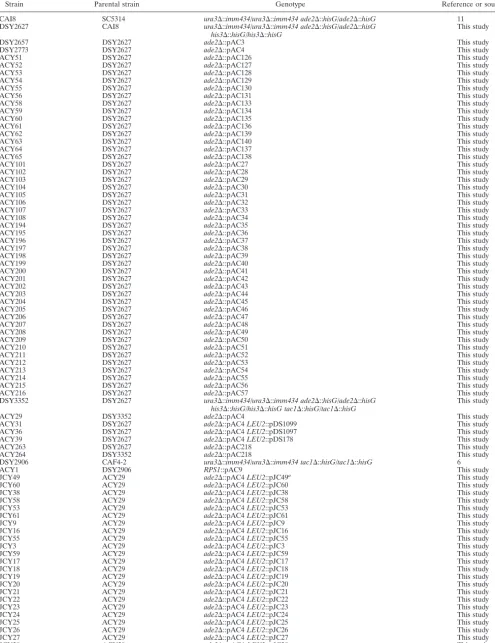
CAI8 SC5314 ura3⌬::imm434/ura3⌬::imm434 ade2⌬::hisG/ade2⌬::hisG 11
DSY2627 CAI8 ura3⌬::imm434/ura3⌬::imm434 ade2⌬::hisG/ade2⌬::hisG
his3⌬::hisG/his3⌬::hisG
This study
DSY2657 DSY2627 ade2⌬::pAC3 This study
DSY2773 DSY2627 ade2⌬::pAC4 This study
ACY51 DSY2627 ade2⌬::pAC126 This study
ACY52 DSY2627 ade2⌬::pAC127 This study
ACY53 DSY2627 ade2⌬::pAC128 This study
ACY54 DSY2627 ade2⌬::pAC129 This study
ACY55 DSY2627 ade2⌬::pAC130 This study
ACY56 DSY2627 ade2⌬::pAC131 This study
ACY58 DSY2627 ade2⌬::pAC133 This study
ACY59 DSY2627 ade2⌬::pAC134 This study
ACY60 DSY2627 ade2⌬::pAC135 This study
ACY61 DSY2627 ade2⌬::pAC136 This study
ACY62 DSY2627 ade2⌬::pAC139 This study
ACY63 DSY2627 ade2⌬::pAC140 This study
ACY64 DSY2627 ade2⌬::pAC137 This study
ACY65 DSY2627 ade2⌬::pAC138 This study
ACY101 DSY2627 ade2⌬::pAC27 This study
ACY102 DSY2627 ade2⌬::pAC28 This study
ACY103 DSY2627 ade2⌬::pAC29 This study
ACY104 DSY2627 ade2⌬::pAC30 This study
ACY105 DSY2627 ade2⌬::pAC31 This study
ACY106 DSY2627 ade2⌬::pAC32 This study
ACY107 DSY2627 ade2⌬::pAC33 This study
ACY108 DSY2627 ade2⌬::pAC34 This study
ACY194 DSY2627 ade2⌬::pAC35 This study
ACY195 DSY2627 ade2⌬::pAC36 This study
ACY196 DSY2627 ade2⌬::pAC37 This study
ACY197 DSY2627 ade2⌬::pAC38 This study
ACY198 DSY2627 ade2⌬::pAC39 This study
ACY199 DSY2627 ade2⌬::pAC40 This study
ACY200 DSY2627 ade2⌬::pAC41 This study
ACY201 DSY2627 ade2⌬::pAC42 This study
ACY202 DSY2627 ade2⌬::pAC43 This study
ACY203 DSY2627 ade2⌬::pAC44 This study
ACY204 DSY2627 ade2⌬::pAC45 This study
ACY205 DSY2627 ade2⌬::pAC46 This study
ACY206 DSY2627 ade2⌬::pAC47 This study
ACY207 DSY2627 ade2⌬::pAC48 This study
ACY208 DSY2627 ade2⌬::pAC49 This study
ACY209 DSY2627 ade2⌬::pAC50 This study
ACY210 DSY2627 ade2⌬::pAC51 This study
ACY211 DSY2627 ade2⌬::pAC52 This study
ACY212 DSY2627 ade2⌬::pAC53 This study
ACY213 DSY2627 ade2⌬::pAC54 This study
ACY214 DSY2627 ade2⌬::pAC55 This study
ACY215 DSY2627 ade2⌬::pAC56 This study
ACY216 DSY2627 ade2⌬::pAC57 This study
DSY3352 DSY2627 ura3⌬::imm434/ura3⌬::imm434 ade2⌬::hisG/ade2⌬::hisG
his3⌬::hisG/his3⌬::hisG tac1⌬::hisG/tac1⌬::hisG
This study
ACY29 DSY3352 ade2⌬::pAC4 This study
ACY31 DSY2627 ade2⌬::pAC4LEU2::pDS1099 This study
ACY36 DSY2627 ade2⌬::pAC4LEU2::pDS1097 This study
ACY39 DSY2627 ade2⌬::pAC4LEU2::pDS178 This study
ACY263 DSY2627 ade2⌬::pAC218 This study
ACY264 DSY3352 ade2⌬::pAC218 This study
DSY2906 CAF4-2 ura3⌬::imm434/ura3⌬::imm434 tac1⌬::hisG/tac1⌬::hisG 6
ACY1 DSY2906 RPS1::pAC9 This study
JCY49 ACY29 ade2⌬::pAC4LEU2::pJC49a This study
JCY60 ACY29 ade2⌬::pAC4LEU2::pJC60 This study
JCY38 ACY29 ade2⌬::pAC4LEU2::pJC38 This study
JCY58 ACY29 ade2⌬::pAC4LEU2::pJC58 This study
JCY53 ACY29 ade2⌬::pAC4LEU2::pJC53 This study
JCY61 ACY29 ade2⌬::pAC4LEU2::pJC61 This study
JCY9 ACY29 ade2⌬::pAC4LEU2::pJC9 This study
JCY16 ACY29 ade2⌬::pAC4LEU2::pJC16 This study
JCY55 ACY29 ade2⌬::pAC4LEU2::pJC55 This study
JCY3 ACY29 ade2⌬::pAC4LEU2::pJC3 This study
JCY59 ACY29 ade2⌬::pAC4LEU2::pJC59 This study
JCY17 ACY29 ade2⌬::pAC4LEU2::pJC17 This study
JCY18 ACY29 ade2⌬::pAC4LEU2::pJC18 This study
JCY19 ACY29 ade2⌬::pAC4LEU2::pJC19 This study
JCY20 ACY29 ade2⌬::pAC4LEU2::pJC20 This study
JCY21 ACY29 ade2⌬::pAC4LEU2::pJC21 This study
JCY22 ACY29 ade2⌬::pAC4LEU2::pJC22 This study
JCY23 ACY29 ade2⌬::pAC4LEU2::pJC23 This study
JCY24 ACY29 ade2⌬::pAC4LEU2::pJC24 This study
JCY25 ACY29 ade2⌬::pAC4LEU2::pJC25 This study
JCY26 ACY29 ade2⌬::pAC4LEU2::pJC26 This study
JCY27 ACY29 ade2⌬::pAC4LEU2::pJC27 This study
JCY28 ACY29 ade2⌬::pAC4LEU2::pJC28 This study
aPlasmids with the pJC prefix were obtained after rescue fromC. albicansstrains transformed with random-mutagenized pDS1097.
1252
on September 8, 2020 by guest
http://ec.asm.org/
TABLE 2. Primers used in this study
Primer Sequence
Amplification ofADE2
ADE-xho...GCGCAAACTCGAGAATGATTAATCAATGATCACCATAAACTTG ADE2-pst...GCGCAAACTGCAGAAGAAAAAGACACTTAAGTTTTAATTATAAG
HIS3inactivation
HIS3-XHO ...GCGCAAACTCGAGCCAAGGTTTTAATTCAATTTTGGGTTGAGG HIS3-XBA ...GCGCAAATCTAGACAGAGGTTCAATTATTCGAAATCCAGCAAT CAHIS-PST...GCGCAAACTGCAGGTAGAGAATTTATTTATTTATTTATTTATT CAHIS- BGL ...ACACAGAAAGATCTAATAGTAAAAAAACGCCTGCTTAC
AmplificationTAC1
Zinc2-5-BamB ...GCAAGGATCCAAGAAGAAGTGGATAATTTTGATTAC Zinc2-3-Xho ...GCAACTCGAGAGTATATTCTGTTGGGAAAGGGGTGAG
Construction of pAC9, pAC3 and pAC44
SPHI-ZINC2C ...GCGCAAAGCATGCAAATCCCCAAATTATTGTCAAAGAAAAA SALI-ZINC2C ...GCGCAAAGTCGACATAATGGACACTTCACTGTCACTGGGA HIS3-KPN ...GCGCAAAGGTACCAAGGTTTTAATTCAATTTTGGGTTGAGG
HIS3-ATG ...TTCACTAATTAACACATACAATAAAAACATATGTCACGAGAAGCTTTAATCAATAGAATA CDR2-ANTI ...ATGTTTTTATTGTATGTGTTAATTAGTGAA
CDR2prom Nsi-...GCGCAAACTCGAGGTATGTGCAAAAACTGATAATATACCTCTG CDR2-DEL3 ...AGTATTCATAATAGAGGCTTTGAAAACAA
CDR2-DEL5 ...GTATTAATTTTTACGTATTTTCTTTGTGTTATTCAATTCTTGTTTTCAAAGCCT
Construction of pAC218
IFU5promF1000xho ...GCGCAAACTCGAGCCAGTATTATGAGAGCAAAGATCATGCGCG IFU5promR-his...CTAGAAGTCTCCGCCGCCAAAGTCACC
IFU5-HIS...GGTGACTTTGGCGGCGGAGACTTCTAGATGTCACGAGAAGCTTTAATCAATAGAATA
CDR2promoter mutations
CDR2 DREmini ...GCGCAAACTCGAGTTCACGGAAATCGGATATTTTTTTTTGTTTTCAAAGCC DREIIdegpolyT ...GCGCAAACTCGAGTTCACGGAAATCGGATAGTTTTCAAAGCCTCTAT DREIIdegw/oTc...GCGCAAACTCGAGTTCACGGAAACGGATATTTTTTTTTGTTTTCAAAGCC DREdeg-CGG1 ...GCGCAAACTCGAGTTCAATTAAATCGGATATTTTTTTTTGTTTTCAAAGCC DREdeg-AAA ...GCGCAAACTCGAGTTCACGGCCCTCGGATATTTTTTTTTGTTTTCAAAGCC DREdeg-CGG2 ...GCGCAAACTCGAGTTCACGGAAATATTATATTTTTTTTTGTTTTCAAAGCC DREdeg-ATA ...GCGCAAACTCGAGTTCACGGAAATCGGCGCTTTTTTTTTGTTTTCAAAGCC DREdeg-part1...GCGCAAACTCGAGTTCAATTCCCTCGGATATTTTTTTTTGTTTTCAAAGCC DREdeg-part2...GCGCAAACTCGAGTTCACGGAAATATTCGCTTTTTTTTTGTTTTCAAAGCC DREdeg delete ...GCGCAAACTCGAGTTCACGGAAATTTTTTTTTGTTTTCAAAGCC
DREdeg1T ...CGCAAACTCGAGAATTCACGGAAATCGGATATGTTTTCAAAGCCTCTAT DREdeg2T ...CGCAAACTCGAGAATTCACGGAAATCGGATATTGTTTTCAAAGCCTCTAT DREdeg3T ...CGCAAACTCGAGAATTCACGGAAATCGGATATTTGTTTTCAAAGCCTCTAT DREdeg4T ...CGCAAACTCGAGAATTCACGGAAATCGGATATTTTGTTTTCAAAGCCTCTAT DREdeg5T ...CGCAAACTCGAGAATTCACGGAAATCGGATATTTTTGTTTTCAAAGCCTCTAT DREdeg6T ...CGCAAACTCGAGAATTCACGGAAATCGGATATTTTTTGTTTTCAAAGCCTCTAT DREdeg7T ...CGCAAACTCGAGAATTCACGGAAATCGGATATTTTTTTGTTTTCAAAGCCTCTAT DREdeg8T ...CGCAAACTCGAGAATTCACGGAAATCGGATATTTTTTTTGTTTTCAAAGCCTCTAT DRE-degV1...GCGCAAACTCGAGTTCACGGAAATCGGATAGGGGGTTTTGTTTTCAAAGCC DRE-degV2...GCGCAAACTCGAGTTCACGGAAATCGGATATTTTTGGGGGTTTTCAAAGCC DRE-degTT ...GCGCAAACTCGAGTTCACGGAAATCGGATAGGGGGGGGGGTTTTCAAAGCC DREdegPoly T1...GCGCAAACTCGAGTTCACGGAAATCGGATATCCCCTTTTGTTTTCAAAGCC DREdegPoly T2...GCGCAAACTCGAGTTCACGGAAATCGGATATTCCCTTTTGTTTTCAAAGCC DREdegPoly T3...GCGCAAACTCGAGTTCACGGAAATCGGATATTTCCTTTTGTTTTCAAAGCC DREdegPoly T4...GCGCAAACTCGAGTTCACGGAAATCGGATATTTTCTTTTGTTTTCAAAGCC DREIIdegC1 ...GCGCAAACTCGAGTTCANGGAAATCGGATATTTTTTTTTGTTTTCAAAGCC DREIIdegG1...GCGCAAACTCGAGTTCACNGAAATCGGATATTTTTTTTTGTTTTCAAAGCC DREIIdegG2...GCGCAAACTCGAGTTCACGNAAATCGGATATTTTTTTTTGTTTTCAAAGCC DREIIdegA1 ...GCGCAAACTCGAGTTCACGGNAATCGGATATTTTTTTTTGTTTTCAAAGCC DREIIdegA2 ...GCGCAAACTCGAGTTCACGGANATCGGATATTTTTTTTTGTTTTCAAAGCC DREIIdegA3 ...GCGCAAACTCGAGTTCACGGAANTCGGATATTTTTTTTTGTTTTCAAAGCC DREIIdegTc...GCGCAAACTCGAGTTCACGGAAANCGGATATTTTTTTTTGTTTTCAAAGCC DREIIdegC2 ...GCGCAAACTCGAGTTCACGGAAATNGGATATTTTTTTTTGTTTTCAAAGCC DREIIdegG3...GCGCAAACTCGAGTTCACGGAAATCNGATATTTTTTTTTGTTTTCAAAGCC DREIIdegG4...GCGCAAACTCGAGTTCACGGAAATCGNATATTTTTTTTTGTTTTCAAAGCC DREIIdegA4 ...GCGCAAACTCGAGTTCACGGAAATCGGNTATTTTTTTTTGTTTTCAAAGCC DREIIdegT1 ...GCGCAAACTCGAGTTCACGGAAATCGGANATTTTTTTTTGTTTTCAAAGCC
Continued on following page
on September 8, 2020 by guest
http://ec.asm.org/
treated for 15 min with 1% formaldehyde with occasional agitation. The reaction was stopped by addition of glycine at 125 mM and incubation for 5 min at room temperature. The culture was washed twice in cold TBS (20 mM Tris-HCl [pH
7.6], 150 mM NaCl). The pellet was resuspended in 500l ice-cold lysis buffer
(50 mM HEPES-KOH [pH 7.5], 1% Triton X-100, 140 mM NaCl, 0.1% Na deoxycholate, 1 mM EDTA, and Roche protease inhibitor mixture). The solution was transferred in a 2-ml tube, and glass beads were added. The mixture was agitated at 4°C and 1,400 rpm in an Eppendorf Thermomixer block for 45 min. Lysates were recovered by puncturing the bottoms of tubes with a 23-gauge needle and by centrifugation at 1,000 rpm for 2 min. The recovered lysates were next sonicated four times (10 s) at full power with a sonicator (Soniprep 150; MSE Ltd., London, United Kingdom). The sonicated lysates were centrifuged
for 20 min at 4°C and 10,000⫻g. The supernatants were recovered, and 25l
of this crude extract was conserved at⫺80°C as the input control of the
exper-iment. In parallel, 40l of protein G-Dynabeads (corresponding to the quantity
needed for one sample) was incubated for 2 h at room temperature with 5 ml of rabbit anti-protein A antibody (Sigma), washed twice with phosphate-buffered saline–bovine serum albumin (5 mg/ml) using a magnetic device, and
resus-pended in 40l of phosphate-buffered saline-bovine serum albumin. Beads were
added to 250l of the crude extracts, and the solution was incubated overnight
with tilt rotation at 4°C. Beads were next washed twice for 5 min with 600l lysis
buffer on a rotator, with wash buffer (10 mM Tris-HCl [pH 8.0], 0.5% Na
deoxycholate, 0.25 M LiCl, 1 mM EDTA, 0.5% NP-40), and for 5 min in 600l
Tris-EDTA (TE). Beads were resuspended in 60l TE–1% SDS and incubated
for 10 min at 65°C with shaking. Supernatants were recovered using a magnetic device, and beads were retreated for 10 min at 65°C with TE–1% SDS. Both
supernatants were pooled and supplemented with 130l of TE–1% SDS. Only
100l of TE–1% SDS was added to 25l of the crude input.
Immunoprecipi-tated samples and input samples were incubated overnight at 65°C. After
addi-tion of 240l TE, 40g of glycogen, and 200g of proteinase K, tubes were
incubated for 2 h at 37°C. After addition of 50 ml LiCl (5 M), samples were treated twice with phenol-chloroform. Recovered DNA was then precipitated with Na acetate and absolute ethanol. Pellets were then washed in 70% ethanol
and resuspended in 60l TE (30l for input samples).
Quantitative real-time PCR and normalization.Real-time PCRs were per-formed using the QuantiTect SYBR green PCR kit (Qiagen) in a final volume of
25l according to the manufacturer’s recommendations. PCRs were performed
in duplicate for the standard curve and in triplicate for the samples to be quantified. DNA of the input samples was diluted 100-fold, and immunoprecipi-tated samples were diluted 10-fold to be in the range of the standard curve.
TABLE 2—Continued
Primer Sequence
DREIIdegA5 ...GCGCAAACTCGAGTTCACGGAAATCGGATNTTTTTTTTTGTTTTCAAAGCC
DRE-IFU5...CGCAAACTCGAGTTGTATATATCCGATTTCCGATTTCCCTGTTTTCAAAGCCTCTATTATG AATAC
DRE-RTA3 ...CGCAAACTCGAGTCCACACGGAACTCGGAAATTATGCGTTTTCAAAGCCTCTATTATGA ATAC
DRE-CDR1...CGCAAACTCGAGTTGAGACGGATATCGGATATTTTTTTTGTTTTCAAAGCCTCTATTATG AATAC
DRE-TAC1-457 ...CGCAAACTCGAGTGGAAATAGTGGCGAAGGCAAATTGAAAATTCCGGATAGTTTTCAAA GCCTCTATTATGAATAC
DRE-TAC1-501 ...CGCAAACTCGAGCTTTTTATTTTCCGTTGCTTCTTCCGTGCTCCGCGTTTTCAAAGCCTCT ATTTGAATAC
DRE-PDR16-ZCB-1 ...CGCAAACTCGAGCCTAAAATCGGATTCGGAATTAACAAATGGTTTTCAAAGCCTCTATTA TGAATAC
qPCR
CDR1-CHIP2-F ...TTTCAACATATTAGAATCGAATCATTACG CDR1-CHIP2-R ...GCGGCTGTGTGTTTGTGTG
CDR2-CHIP2-F ...AATTCAAACACAAACAATAAGGCTGT CDR2-CHIP2-R ...GCAATCATTGTGGTATACATCGGA RTA3-CHIP2-F ...AGATCCACACGGAACTCGGA
RTA3-CHIP2-R...TGATAACACACATGGGTTGTAAGATATTT IFU5-CHIP-R ...AATACATGCCAGTATTATGAGA
IFU5-CHIP-F...TGCTTACATTAGCAAATATGAG ACT1-RTPCR-F...GTTCCCAGGTATTGCTGAAC ACT1-RTPCR-R ...CAATGGATGGACCAGATTCG ControlChIP-Ch3F ...AGGAGCTGGACATAGTTG ControlChIP-Ch3R...CCAGCAGTGAATGATACG
TAC1sequencing
Zinc2-604 ...ATAAGAGTGGCATGTGATA Zinc2-1123 ...GATGCCAACGAATTATTGA Zinc2-1708 ...CAGAATTCGTTGGAGAATA Zinc2-2242 ...GCCTTGTTACAATCAAGAA Zinc2-2683 ...GCAGCATATCTTGTATTAG Zinc2-3224 ...ATGCTCAGTCACCAAGTTA Zinc2-3087c ...GGTGTTCCTGCTACCACAA Zinc2-3078c ...GGTGTTCCTGCTACCACAA Zinc2-1798c ...ACATCAACAATGCTTCTAC Zinc2-1247c ...TCTTCACCGTATGAACCTA Zinc2-778c ...CGTTGCTATTGGCGGTTGA Zinc2-1169 ...TGTTGGTACTCATTCAATT Zinc2-1722 ...TTGGAGAATAGTGCCATTT Zinc2-1510 ...GCTACCAAGCGAAGGAGAT Zinc2-2465c ...TCTCTCGCCTAATTGACGT
TAC1truncated allele
JC-TAC...GCGCAAACTCGAGTTATGGGGTCAAATATTCTTC
on September 8, 2020 by guest
http://ec.asm.org/
Quantitative real-time PCRs were performed on an ABI Prism 7000 sequence detection system with the following program: 2 min at 55°C, 10 min at 95°C, and 45 cycles of 15 s at 95°C and 1 min at 60°C.
To normalize data, quantitative PCR (qPCR) signals derived from the ChIP samples were divided by the qPCR signals derived from the input samples. Background signals were next removed. For this purpose the ratio obtained
previously for CAF2-1, which did not carry theTAC1-protein A fusion, was
subtracted from the ratio obtained for ACY1 containing theTAC1-protein A
construct. Finally the enrichment of the gene of interest was compared to that of control genes by dividing the normalized values obtained for our sequences of
interest (DREs ofCDR1,CDR2,RTA3, andIFU5) by the normalized value
obtained for the control sequence. The control sequence is located in the
pro-moter of orf19.5970, situated on chromosome 3 betweenCDR1andCDR2. This
gene was chosen because of its location between two Tac1p target genes (CDR1
TABLE 3. Plasmids used in this study
Vector Backbone Description Source or
reference
pBluescript KS(⫹)
Cloning vector Stratagene, La
Jolla, CA
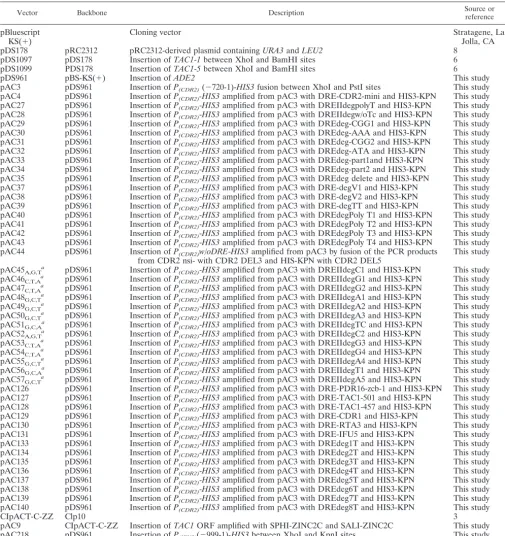
pDS178 pRC2312 pRC2312-derived plasmid containingURA3andLEU2 8
pDS1097 pDS178 Insertion ofTAC1-1between XhoI and BamHI sites 6
pDS1099 PDS178 Insertion ofTAC1-5between XhoI and BamHI sites 6
pDS961 pBS-KS(⫹) Insertion ofADE2 This study
pAC3 pDS961 Insertion ofP(CDR2)(⫺720-1)-HIS3fusion between XhoI and PstI sites This study
pAC4 pDS961 Insertion ofP(CDR2)-HIS3amplified from pAC3 with DRE-CDR2-mini and HIS3-KPN This study
pAC27 pDS961 Insertion ofP(CDR2)-HIS3amplified from pAC3 with DREIIdegpolyT and HIS3-KPN This study
pAC28 pDS961 Insertion ofP(CDR2)-HIS3amplified from pAC3 with DREIIdegw/oTc and HIS3-KPN This study
pAC29 pDS961 Insertion ofP(CDR2)-HIS3amplified from pAC3 with DREdeg-CGG1 and HIS3-KPN This study
pAC30 pDS961 Insertion ofP(CDR2)-HIS3amplified from pAC3 with DREdeg-AAA and HIS3-KPN This study
pAC31 pDS961 Insertion ofP(CDR2)-HIS3amplified from pAC3 with DREdeg-CGG2 and HIS3-KPN This study
pAC32 pDS961 Insertion ofP(CDR2)-HIS3amplified from pAC3 with DREdeg-ATA and HIS3-KPN This study
pAC33 pDS961 Insertion ofP(CDR2)-HIS3amplified from pAC3 with DREdeg-part1and HIS3-KPN This study
pAC34 pDS961 Insertion ofP(CDR2)-HIS3amplified from pAC3 with DREdeg-part2 and HIS3-KPN This study
pAC35 pDS961 Insertion ofP(CDR2)-HIS3amplified from pAC3 with DREdeg delete and HIS3-KPN This study
pAC37 pDS961 Insertion ofP(CDR2)-HIS3amplified from pAC3 with DRE-degV1 and HIS3-KPN This study
pAC38 pDS961 Insertion ofP(CDR2)-HIS3amplified from pAC3 with DRE-degV2 and HIS3-KPN This study
pAC39 pDS961 Insertion ofP(CDR2)-HIS3amplified from pAC3 with DRE-degTT and HIS3-KPN This study
pAC40 pDS961 Insertion ofP(CDR2)-HIS3amplified from pAC3 with DREdegPoly T1 and HIS3-KPN This study
pAC41 pDS961 Insertion ofP(CDR2)-HIS3amplified from pAC3 with DREdegPoly T2 and HIS3-KPN This study
pAC42 pDS961 Insertion ofP(CDR2)-HIS3amplified from pAC3 with DREdegPoly T3 and HIS3-KPN This study
pAC43 pDS961 Insertion ofP(CDR2)-HIS3amplified from pAC3 with DREdegPoly T4 and HIS3-KPN This study
pAC44 pDS961 Insertion ofP(CDR2)w/oDRE-HIS3amplified from pAC3 by fusion of the PCR products
from CDR2 nsi- with CDR2 DEL3 and HIS-KPN with CDR2 DEL5
This study
pAC45A,G,Ta pDS961 Insertion ofP(CDR2)-HIS3amplified from pAC3 with DREIIdegC1 and HIS3-KPN This study
pAC46C,T,A
a pDS961 Insertion ofP
(CDR2)-HIS3amplified from pAC3 with DREIIdegG1 and HIS3-KPN This study
pAC47C,T,Aa pDS961 Insertion ofP(CDR2)-HIS3amplified from pAC3 with DREIIdegG2 and HIS3-KPN This study
pAC48G,C,T
a pDS961 Insertion ofP
(CDR2)-HIS3amplified from pAC3 with DREIIdegA1 and HIS3-KPN This study
pAC49G,C,Ta pDS961 Insertion ofP(CDR2)-HIS3amplified from pAC3 with DREIIdegA2 and HIS3-KPN This study
pAC50G,C,T
a pDS961 Insertion ofP
(CDR2)-HIS3amplified from pAC3 with DREIIdegA3 and HIS3-KPN This study
pAC51G,C,Aa pDS961 Insertion ofP(CDR2)-HIS3amplified from pAC3 with DREIIdegTC and HIS3-KPN This study
pAC52A,G,T
a pDS961 Insertion ofP
(CDR2)-HIS3amplified from pAC3 with DREIIdegC2 and HIS3-KPN This study
pAC53C,T,Aa pDS961 Insertion ofP(CDR2)-HIS3amplified from pAC3 with DREIIdegG3 and HIS3-KPN This study
pAC54C,T,A
a pDS961 Insertion ofP
(CDR2)-HIS3amplified from pAC3 with DREIIdegG4 and HIS3-KPN This study
pAC55G,C,Ta pDS961 Insertion ofP(CDR2)-HIS3amplified from pAC3 with DREIIdegA4 and HIS3-KPN This study
pAC56G,C,A
a pDS961 Insertion ofP
(CDR2)-HIS3amplified from pAC3 with DREIIdegT1 and HIS3-KPN This study
pAC57G,C,Ta pDS961 Insertion ofP(CDR2)-HIS3amplified from pAC3 with DREIIdegA5 and HIS3-KPN This study
pAC126 pDS961 Insertion ofP(CDR2)-HIS3amplified from pAC3 with DRE-PDR16-zcb-1 and HIS3-KPN This study
pAC127 pDS961 Insertion ofP(CDR2)-HIS3amplified from pAC3 with DRE-TAC1-501 and HIS3-KPN This study
pAC128 pDS961 Insertion ofP(CDR2)-HIS3amplified from pAC3 with DRE-TAC1-457 and HIS3-KPN This study
pAC129 pDS961 Insertion ofP(CDR2)-HIS3amplified from pAC3 with DRE-CDR1 and HIS3-KPN This study
pAC130 pDS961 Insertion ofP(CDR2)-HIS3amplified from pAC3 with DRE-RTA3 and HIS3-KPN This study
pAC131 pDS961 Insertion ofP(CDR2)-HIS3amplified from pAC3 with DRE-IFU5 and HIS3-KPN This study
pAC133 pDS961 Insertion ofP(CDR2)-HIS3amplified from pAC3 with DREdeg1T and HIS3-KPN This study
pAC134 pDS961 Insertion ofP(CDR2)-HIS3amplified from pAC3 with DREdeg2T and HIS3-KPN This study
pAC135 pDS961 Insertion ofP(CDR2)-HIS3amplified from pAC3 with DREdeg3T and HIS3-KPN This study
pAC136 pDS961 Insertion ofP(CDR2)-HIS3amplified from pAC3 with DREdeg4T and HIS3-KPN This study
pAC137 pDS961 Insertion ofP(CDR2)-HIS3amplified from pAC3 with DREdeg5T and HIS3-KPN This study
pAC138 pDS961 Insertion ofP(CDR2)-HIS3amplified from pAC3 with DREdeg6T and HIS3-KPN This study
pAC139 pDS961 Insertion ofP(CDR2)-HIS3amplified from pAC3 with DREdeg7T and HIS3-KPN This study
pAC140 pDS961 Insertion ofP(CDR2)-HIS3amplified from pAC3 with DREdeg8T and HIS3-KPN This study
CIpACT-C-ZZ Clp10 3
pAC9 CIpACT-C-ZZ Insertion ofTAC1ORF amplified with SPHI-ZINC2C and SALI-ZINC2C This study pAC218 pDS961 Insertion ofP(IFU5)(⫺999-1)-HIS3between XhoI and KpnI sites This study
aThese plasmids have three versions, each containing one of the bases indicated.
on September 8, 2020 by guest
http://ec.asm.org/
andCDR2) and because it was not regulated by Tac1p either in the presence of
fluphenazine or in azole-resistant strains in whichCDRgenes were upregulated,
as shown by microarray experiments (6).
Analysis ofTAC1alleles from clinical isolates.TAC1was amplified from the genomic DNA of the clinical strains and cloned into pDS178 (Table 3). In order
to distinguish the two putativeTAC1alleles present in a strain, at least three
plasmids were analyzed by restriction fragment length polymorphism (RFLP) using the restriction enzyme EcoRI or AciI or both (see Table 4). For strains heterozygous for the mating type-like (MTL) locus, from 3 to 20 plasmids could
be analyzed. For each distinctTAC1allele, at least two differentTAC1
-contain-ing plasmids carry-contain-ing the same RFLP profile were sequenced and introduced at
theLEU2locus of the one-hybrid reporter strain after SalI digestion. When
isolates were heterozygous for the MTL but had no distinctTAC1RFLP profiles,
from 3 to 20 distinctTAC1-containing plasmids from a given strain were
se-quenced in order to discriminate distinct sequences.
Next, two distinct transformants for each allele were tested on the different
media in order to determine the property of the introducedTAC1allele.
Random mutagenesis.Random mutagenesis of theTAC1-1allele cloned in
pDS178, yielding pDS1097 (Table 3), was performed usingE. coliXL1-Red
(Stratagene, La Jolla, CA) by following the instructions of the manufacturer.
Briefly, 100-l aliquots of competent XL1-Red were transformed with 50 ng of
pDS1097 carryingTAC1-1. Three independent transformations were performed,
and products were plated onto LB-amp plates for 16 h. Plates were divided in quarters, and colonies of each quarter were recovered and incubated in 5 ml LB-amp and agitated overnight at 37°C. Minipreparations of DNA were
pro-duced, and 1l of extracted DNA was retransformed in DH5␣. All DH5␣
colonies were recovered and pooled into 10 ml LB-amp. Seven milliliters was used to inoculate 500 ml LB-amp. Cultures were grown for 4 to 5 h at 37°C, and
plasmid DNA was extracted. Sixty independentC. albicanstransformations were
performed using 10g of randomly mutagenized plasmid DNA linearized by
SalI.
Rescue of mutatedTAC1alleles.MutatedTAC1alleles were amplified from
genomic DNA of theC. albicans strains transformed with a randomly
mu-tagenized plasmid library using the M13-forward and M13-reverse primers. DNA amplicons were digested by XhoI and BamHI, ligated into pDS178, and
trans-formed in DH5␣. Rescued plasmids were then sequenced and introduced into
ACY29 to verify phenotypes initially observed inC. albicans.
Sequencing of theTAC1alleles.The rescuedTAC1alleles were sequenced in a 3130XL genetic analyzer (Applied Biosystem). Sequences analysis was per-formed using ContigExpress and VectorNTI software (Infomax; Invitrogen Life Sciences, Basel, Switzerland).
TAC1alleles from clinical strains of our collections were cloned in pDS178
and sequenced with a 96-capillary 3730XL DNA analyzer (Applied Biosys-tems). The resulting data were analyzed using the Mutation Surveyor soft-ware (SoftGenetics).
RESULTS
Construction of theC. albicansone-hybrid system.In order
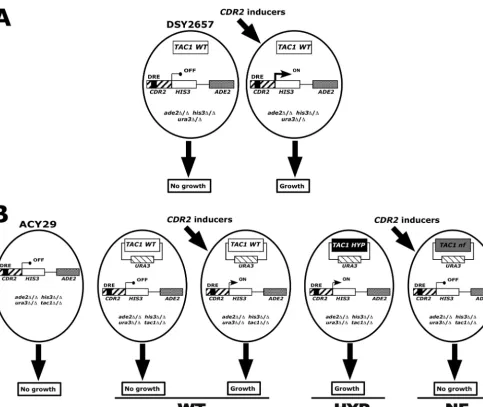
to study the activity of theCDR2promoter and the importance of the DRE for its activity, we designed a one-hybrid system based on the restoration of histidine prototrophy in aC. albi-cansreporter strain. Briefly,HIS3was introduced under the control of theCDR2promoter (⫺506 to⫺1) in a strain auxo-trophic for histidine. SinceCDR2expression is almost absent in normal growth conditions, we expected that aP(CDR2)-HIS3 chimeric fusion would not be transcribed. In contrast, in the presence of CDR2 inducers like estradiol, we expected that HIS3would be transcribed (Fig. 1A). The P(CDR2)-HIS3 re-porter activities can thus be determined in a strain lacking HIS3by monitoring the restoration of growth in the absence of histidine. To enable the monitoring ofP(CDR2)-HIS3reporter activities, strain CAI8, which is already auxotrophic for uridine and adenine, was made auxotrophic for histidine by targeted deletion ofHIS3, leading to strain DSY2627. In parallel, the P(CDR2)-HIS3chimeric construct was introduced into a plasmid carryingADE2. This construct was introduced into DSY2627 at theADE2locus, yielding DSY2657.
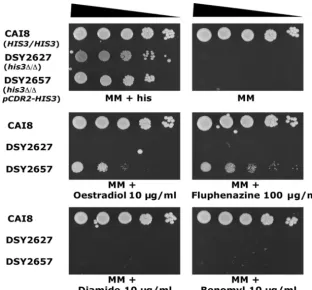
The functionality of this system was verified by the following experiments. CAI8, DSY2627, and DSY2657 were spotted onto MM supplemented with uridine and adenine in the pres-ence or abspres-ence of histidine. All strains were able to grow in the presence of histidine. However, only CAI8 could grow as expected in the absence of this amino acid (Fig. 2). To verify that histidine auxotrophy could be complemented by treatment withCDR2-inducing agents in DSY2657 that carries the one-hybrid system, strains were also spotted onto MM containing either estradiol, fluphenazine, or terbinafine. As shown in Fig. 2, DSY2657 was able to grow in the absence of histidine but only in the presence of CDR2 promoter-inducing drugs, in contrast to DSY2627, which did not contain the reporter sys-tem. To verify the inducer specificity of the system, the strains were also spotted onto MM containing drugs unable to induce CDR2 such as diamide or benomyl. Neither DSY2657 nor DSY2627 was able to grow on these drug-supplemented media, thus confirming the specificity of the one-hybrid system (Fig. 2). The dosage of estradiol permitting growth of DSY2627 ranged between 10 and 20g/ml (see Fig. S1 in the supplemental mate-rial). These experiments demonstrated the functionality and spec-ificity of the one-hybrid screening system based onCDR2 pro-moter activity controllingHIS3. The system was therefore used to probecisandtrans CDR2promoter regulatory elements inC. albicans.
Identification of the minimal DRE sequence required for
drug responsiveness of the CDR2 promoter. The DRE was
previously demonstrated to be crucial for the regulation of CDR1 and CDR2 in azole-susceptible strains treated with CDR-inducing drugs or in azole-resistant strains in whichCDR genes are upregulated (8). Nevertheless, the minimal require-ments of this sequence are still not precisely described, and it is difficult to determine putative DREs in the promoters of other genes. The DRE consensus derived from previous stud-ies performed with theCDR1andCDR2promoters is a 20-bp sequence (5⬘-CGGAWATCGGATATTTTTTT-3⬘) (8). The DRE was therefore systematically mutated in the context of theP(CDR2)-HIS3reporter system in order to identify the min-imal sequence requirement of theCDR2promoter. We used a minimalCDR2promoter [⫺224 from start codon; P(CDR2mini)]
as the starting promoter context. This minimal promoter con-tained the full DRE and was inducible by estradiol (see Fig. S1 in the supplemental material). Growth of reporter strains con-taining each DRE variant in histidine-free medium in the pres-ence ofCDR2inducers was monitored (Fig. 3B). Two domains could be distinguished in theCDR2 DRE: (i) a 13-bp region (CGGAAATCGGATA) forming two hexamers (CGGAA/TA) separated by a central thymidine (the “core” domain) and (ii) a poly(T) sequence of nine thymidines downstream of the core domain in the CDR2 DRE but of seven thymidines in the CDR1 DRE. The two hexamers of the core could be them-selves divided into two triplets, one being a CGG triplet and the other an AWA triplet. All these different DRE segments were transversed or deleted, and the resulting constructs were inserted into DSY2773, which contained a portion of the CDR2promoter (⫺224 to⫺1).
A total of 24 strains containing individualP(CDR2)-HIS3 mu-tated constructs were spotted onto selective media (data not shown). In contrast to what was found for DSY2773, which carried theCDR2DRE wild-type sequence, the majority of the
on September 8, 2020 by guest
http://ec.asm.org/
modifications performed in the DRE abolished the activity of the promoter, as the strains were unable to grow on MM even in the presence of estradiol (Fig. 3A). Constructs 10 and 11, containing a DRE with a poly(T) stretch of six and seven thymidines, still allowed the induction ofCDR2 by estradiol, but to a reduced extent compared to DSY2773 (Fig. 3). This result is consistent with the fact that the poly(T) of theCDR1 DRE contains only seven thymidines and is still fully functional (Fig. 3).
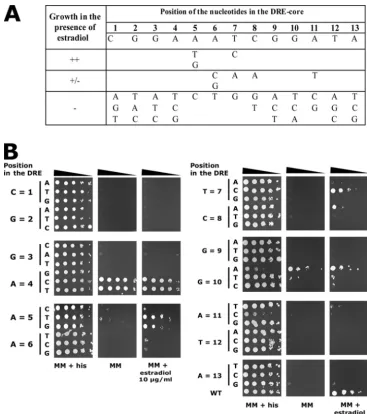
Since nucleotide changes in the DRE were performed within the 13-bp core of the DRE (5⬘-CGGAAATCGGATA-3⬘) (Fig. 3), we decided to replace each base of the core DRE with the three other possible bases. Results are presented in Fig. 4B and summarized in Fig. 4A. We observed that the DRE
se-quence cannot tolerate base substitutions, especially at the position of the first CGG triplet. We observed that the AATC bases from positions 5 to 8 and the A at position 11 with respect to the core sequence accept base substitutions since reporter strains carrying theP(CDR2)-HIS3reporter constructs were still able to grow on selective medium in the presence of aCDR2inducer (Fig. 4). Permissive mutations to T or G at position 5 and to C at position 7 were also found in the DRE ofCDR1 and in the putative DRE ofRTA3, which is a gene coregulated withCDR1andCDR2. Unexpectedly, changes to C or T at position 4 and A or T at position 10 resulted in a constitutive activation of the P(CDR2)-HIS3 reporter system (Fig. 4).
Sequence analysis of the promoters of CDR1 and CDR2 FIG. 1. Schematic view of the promoter-reporter system. (A) Testing ofcis-acting elements of theCDR2promoter. The promoter-reporter system is based on a reporter construct consisting of theCDR2promoter regulatingHIS3introduced at theADE2locus in a strain lackingHIS3. The reporter strain is unable to grow in the absence of histidine unless theCDR2promoter is activated by inducers such as fluphenazine or estradiol. (B) Testing oftrans-acting elements of theCDR2promoter. Properties of theTAC1alleles can be assayed in the reporter strain lacking TAC1, encoding theCDR2regulator. The parental strain is unable to grow in the absence of histidine even in the presence of aCDR2inducer, sinceTAC1is absent. Introduction of a wild-typeTAC1allele should restore histidine prototrophy, but only in the presence of an inducer. A hyperactiveTAC1allele can confer constitutive activation on theCDR2promoter and thus growth in the absence of histidine. In contrast, a nonfunctionalTAC1allele cannot confer the ability to grow in the absence of histidine even in the presence of aCDR2inducer.
on September 8, 2020 by guest
http://ec.asm.org/
coregulated genes identified the presence of a DRE-like se-quence (5⬘-CGGWWWTCGGWWW-3⬘) with the possibility of one mismatch (Fig. 3A). In order to test the functionality of these DRE-like sequences, they were substituted into the CDR2DRE in the one-hybrid system designed here. Attempts to use full-length promoters (for example, theIFU5promoter) in our reporter system failed due to intrinsic TAC1-indepen-dentHIS3reporter activity (see Fig. S2 in the supplemental material). Except for theCDR1DRE, none of these putative regulatory sequences could restore growth in the absence of histidine in the context of the CDR2 promoter (Fig. 3). In conclusion, the DRE sequence of CDR2 accepts only a few modifications such as base substitution from positions 5 to 8 (AATC) and required a poly(T) stretch of at least four Ts at the 3⬘end.
Determination of binding of Tac1p on the DRE by ChIP
assays.It was previously shown that the DNA-binding motif of
Tac1p was able to bind in vitro to the DREs of theCDR1and CDR2promoters (6). We then asked if this binding could occur in vivo. For this purpose, we tagged a wild-type form of Tac1p in the C terminus with protein A. After verification that the chimeric protein was functional (data not shown), we per-formed ChIP experiments. We confirmed that Tac1p was able to bind to regions of 123 and 150 bp flanking the DREs of CDR1and CDR2(Fig. 5). The enrichments were 439-fold⫾ 44-fold and 173-fold⫾32-fold, respectively, compared to that for a control sequence located in the orf19.5970 promoter situated on chromosome 3 between theCDR1andCDR2loci. Surprisingly, even if the putative DREs of RTA3 and IFU5
were not functional in our one-hybrid reporter system, Tac1p could bind their promoters in a region covering the DRE-like sequence with enrichments of 162-fold⫾16-fold and 147-fold⫾ 31-fold compared to that for the control sequence, respectively (Fig. 5). This binding did not require treatments with fluphen-azine or estradiol, and these drugs did not modify the enrich-ment of DRE sequences (data not shown). Moreover, parallel ChIP experiments performed with aTAC1hyperactive allele fused to protein A gave results identical to those with a wild-type TAC1 allele (data not shown) and thus confirmed the constitutive binding of Tac1p to its targets independently of any activation.
Screening of different TAC1 alleles by the one-hybrid
P(CDR2)-HIS3system. The CDR2 one-hybrid system was
de-signed to study elements regulating the activity of theCDR2 promoter either incisor intrans. In this part of the study, we focused on the CDR2 promoter activity driven by different TAC1 alleles. For this purpose, the two TAC1 alleles were deleted in DSY2627, yielding DSY3352. The P(CDR2)-HIS3 reporter system carried by pAC3 was next introduced into the latter strain, giving ACY29, which was used as the recipient strain for different TAC1 alleles from azole-susceptible or azole-resistant clinical strains. We expected to be able to rapidly discriminate between wild-type, hyperactive, and nonfunc-tionalTAC1alleles, as represented in Fig. 1B. For example, a wild-typeTAC1allele should confer on ACY29 the ability to grow on a medium lacking histidine only in the presence of CDR2inducers such as estradiol and fluphenazine. In contrast, TAC1hyperactive alleles should confer on the strain the ability FIG. 2. Functionality of theP(CDR2)-HIS3reporter system. Serial dilutions of overnight cultures were plated onto MM supplemented with
histidine or containing different drugs as indicated. Plates were incubated for 48 h at 34°C.
on September 8, 2020 by guest
http://ec.asm.org/
to grow in the absence of histidine or of CDR2 inducers. Finally, a strain lackingTAC1 or carrying a nonfunctional allele ofTAC1should not be able to grow in the absence of histidine even if aCDR2inducer is added, since the activity
of theCDR2 promoter was shown to be Tac1p dependent (6).
To verify the functionality of the system,TAC1-1andTAC1-5, which are wild-type and hyperactive alleles, respectively, were FIG. 3. Activity of theCDR2promoter carrying a degenerate DRE. (A) Summary of reporter activities of all tested constructs. Growth of the strains carrying theP(CDR2)-HIS3constructs was evaluated on MM in the absence or presence of 10g/ml estradiol.⫺, the reporter system is
nonfunctional, meaning that the strain containing it is unable to grow in the presence of estradiol or shows constitutive growth even in the absence of estradiol;⫹, the reporter system is functional, meaning that the growth of the associated strain is identical to that of the positive control carrying wild-type DRE (DSY2673);⫹/⫺, reduced growth compared to the positive control. Underlined nucleotides indicate the localization of the DRE core or the putative DRE sequences. Letters in lowercase correspond to theCDR2promoter sequence flanking the degenerate DRE or the putative DREs ofCDR1andCDR2coregulated genes; letters in uppercase correspond to the putative DRE sequence; and letters in boldface correspond to transversed nucleotides. (B) Growth of reporter strains carrying degenerate DREs in theP(CDR2)-HIS3reporter system. Serial
dilutions of overnight cultures were plated onto MM supplemented with histidine (his) or with estradiol. (Top) Numbers 9 to 16 indicate the types of constructs (detailed in panel A) carrying degenerate DREs. (Bottom)P(CDR2)-HIS3constructs contained DREs from other gene promoters as
indicated in panel A. Plates were incubated for 48 h at 34°C.
on September 8, 2020 by guest
http://ec.asm.org/
introduced into ACY29, giving ACY36 and ACY31. ACY31 grew in the absence of histidine regardless of the presence of inducers. ACY36 grew in the absence of histidine only if an inducer was present (Fig. 6A, left). A control strain (ACY29) lackingTAC1was unable to grow in the absence of histidine, even if an inducer was added. These experiments therefore validated the one-hybrid system for discriminating between wild-type, hy-peractive, and absent or nonfunctionalTAC1alleles.
Detection of TAC1hyperactive andTAC1 wild-type alleles
from a collection of clinical isolates.We previously showed
that GOF mutations such as single nucleotide substitutions or codon deletions led to the conversion of a TAC1 wild-type allele into a hyperactive allele. Up to now, seven distinct GOF
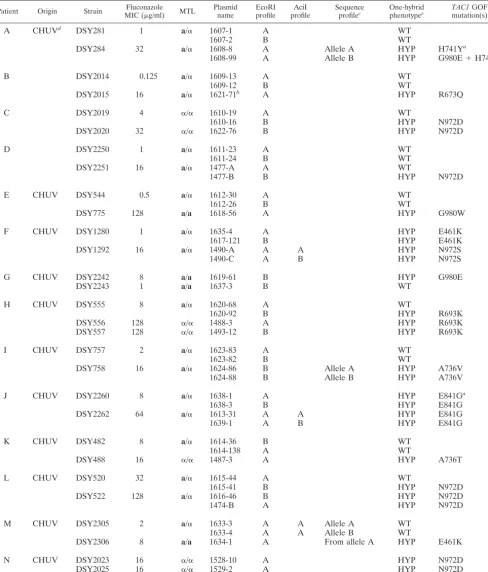
mutations have been identified among 26 analyzedTAC1 al-leles (4, 5); however, this number of GOF mutations is prob-ably not exhaustive. In this part of the study, we addressed the occurrence of GOF mutations using the one-hybrid reported system designed here. We selected 29 clinical strains, grouped in 13 pairs, and one triplet of related strains from 14 different patients. Each group of isolates originating from the same patient contained at least one susceptible and one azole-resistant strain (Table 4). The azole MICs for each strain were determined as well as their mating status (Table 4). Among the 29 strains, 18 were MTLa/␣, 4 were MTLa/a, and 7 were MTL
␣/␣. SinceTAC1is located close to the MTL, heterozygosity of the MTL often correlates withTAC1heterozygosity (4, 5). We FIG. 4. Nucleotide replacements in theCDR2DRE. (A) Possibility of base replacement in the DRE core sequence. For each position, the growth conferred in MM supplemented with estradiol (10g/ml) by the base(s) replacing the wild-type nucleotide is indicated.⫺, the reporter system is nonfunctional, meaning that the strain containing it is unable to grow in the presence of estradiol or shows constitutive growth even in the absence of estradiol;⫹, the reporter system is functional, meaning that the growth of the associated strain is identical to that of the positive control carrying wild-type DRE (DSY2673);⫹/⫺, reduced growth compared to the positive control. (B) Growth of reporter strains carrying DREs with systematic nucleotide replacement in the P(CDR2)-HIS3 reporter system. Serial dilutions of overnight cultures were plated onto MM
supplemented with histidine (his) or with estradiol. Nucleotide positions in the DRE and replacements are indicated. Plates were incubated for 48 h at 34°C. Each strain spotted is representative of three transformants. WT, wild type.
on September 8, 2020 by guest
http://ec.asm.org/
therefore, attempted to discriminate two distinctTAC1alleles in these strains.
Among 12 MTL heterozygous strains out of a total of 18, two distinctTAC1alleles could be discriminated. A summary of the results is presented in Table 4. We can observe that, except for DSY2015 and DSY2019, we were able to clone two distinct TAC1alleles in strains heterozygous for the MTL and only one TAC1 allele in strains homozygous for the MTL. In isolate DSY2015 (a/␣), only oneTAC1allele was cloned even after the analysis by RFLP and by sequencing at least 30 distinct plasmids. In contrast to DSY2019, which is homozygous for the MTL, two distinctTAC1alleles were cloned.
In all the 29 remaining isolates we identified 47 distinctTAC1 alleles. The 47 plasmids containing distinct TAC1 alleles were introduced into theP(CDR2)-HIS3reporter system. Among these 47TAC1alleles we could distinguish 19 wild-type and 28 hyper-activeTAC1alleles. Alignments of the obtainedTAC1sequences allowed us to deduce putative GOF mutations in the hyperactive TAC1 alleles. Out of 11 deduced distinct GOF mutations (G980E, G980W, N972D, N972S, R693K, R673Q, A736V, A736T, E461K, E841G, H741Y), 3 were already described (G980E, N972D, and A736V) (4, 24) and 8 were new GOF mutations (N972S, A736T, R693K, R673Q, G980W, E461K, E841G, and H741Y), including three occurring at already-described positions (N972S, A736T, and G980W) (4, 24). In-troduction of six out of eight newly identified GOF mutations by site-directed mutagenesis converted theTAC1-1wild-type allele into a hyperactive allele using the one-hybrid screening system (data not shown).
Detection of GOF and LOF mutations inTAC1by random
mutagenesis.To increase the number of potential GOF
mu-tations that can be obtained inTAC1, random mutagenesis was performed on aTAC1 wild-type allele. Importantly, random mutagenesis could also result in LOF alleles. A collection of TAC1mutant alleles obtained in XL1-Red E. coli (approxi-mately 2,200 plasmids) was screened using the one-hybrid re-porter system in order to detect hyperactive or nonfunctional TAC1alleles. From this library, approximately 3,000C.
albi-cans strains were generated in the ACY29 background for screening onto MM as shown in Fig. 1B.
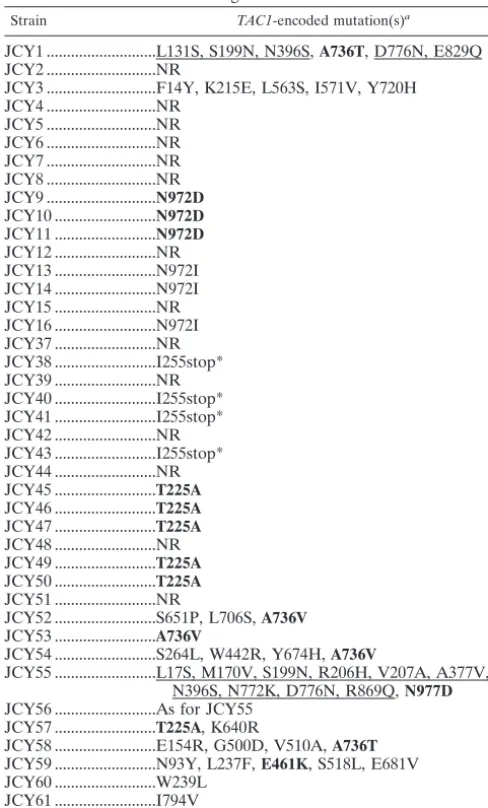
From the 3,000C. albicanstransformants, pools of 70 strains were spotted onto a medium lacking histidine in order to select His⫹strains potentially carrying theTAC1hyperactive alleles. This first selection allowed the recovery of 42 clones on the His medium. TheTAC1alleles of 28 isolates out of 42 His⫹ colo-nies were successfully recovered and sequenced. Detected polymorphisms compared to theTAC1-1initial allele are pre-sented in Table 5 and Fig. 6A. In 19 out of the 28 recovered alleles, seven single nonsilent point mutations (N972D, N972I, I255stop [introduction of a stop codon in place of codon 255], W239L, I794V, A736V, and T225A) were detected and desig-nated GOF mutations. Five other strains (JCY52, JCY54, JCY55, and JCY57) carryTAC1alleles with several mutations, but in each strain one of them was already defined as a GOF mutation (A736V for JCY52 and JCY54, N977D for JCY55, T225A for JCY57, and E641K for JCY59). TAC1 alleles in JCY1 and JCY58 contained several mutations but shared one of them (A736T). We therefore considered that this mutation was responsible for the hyperactivity of TAC1 in these two strains. Finally, theTAC1allele recovered from the last strain (JCY3) carried several TAC1 mutations, but none of them have already been described. We were thus unable to deduce those responsible forTAC1 hyperactivity. To verify that the phenotypes so far observed were due to the identified muta-tions, each rescuedTAC1hyperactive allele was reintroduced into the reporter strain ACY29. All strains except JCY3 were able to grow in the absence of histidine (Fig. 6A). This phe-notype correlated with a high expression ofCDR1andCDR2 in all strains except the one carrying TAC1 from JCY3, as shown by Western blot analysis (Fig. 6B).
These analyses allowed us to detect 10 GOF mutations located at eight distinct positions. Four of them (N972I, I255stop, W239L, and I794V) were new GOF mutations, in-cluding one new substitution (N972I) but at a position (N972) already described in clinical isolates with another substitution. Six of them (N972D, A736V, N977D, T225A, E461K, and A736T) have already been described in clinical isolates.
TAC1random mutagenesis coupled with one-hybrid system analysis could also detect LOF mutations in TAC1. For this purpose, all of the 3,000 previously obtainedC. albicans trans-formants of the library were replica plated onto complete me-dium and MM supplemented with estradiol. Nonfunctional alleles should grow on complete medium but not onto MM supplemented with estradiol. Forty-six strains had this phe-notype. As previously performed for hyperactive alleles, the TAC1alleles of 12 strains out of the 46 were successfully recovered and sequenced. Results are presented in Table 6. Four strains carriedTAC1alleles with single point mutations (K215stop, F368S, N871D, and L392F). They were considered LOF mutations. Two strains (JCY18 and JCY23) each carried two mutations but with one in common (K763stop). This mu-tation was probably responsible for the nonfunctionality of the allele. For the last four alleles recovered from JCY17, JCY22, JCY26, and JCY27,TAC1alleles carried too many mutations to deduce those responsible for nonfunctionality. Surprisingly, two strains (JCY24 and JCY25) carriedTAC1alleles with no mutations either in the ORF or in the 500-bp promoter com-pared toTAC1-1. The phenotypes were verified as previously FIG. 5. Tac1p binds to DRE-containing promoters. After
cross-linking to the DNA, the Tac1p-protein A fusion was immunoprecipi-tated using anti-protein A antibody. Specific sequences flanking the DREs ofCDR1andCDR2or putative DREs ofRTA3andIFU5were amplified by real-time PCR on the precipitated DNA. A sequence located on chromosome 3 in the promoter of orf19.5970, which is situated betweenCDR1andCDR2, was also amplified and used as an unspecific sequence. Results were expressed as increases in enrich-ment relative to that for unspecific sequence amplification and are representative of three independent experiments.
on September 8, 2020 by guest
http://ec.asm.org/
explained by reintroducing each rescuedTAC1allele into the reporter strain. Transformants were plated onto complete me-dium and onto MM in the presence or absence of estradiol. All the strains except JCY25 (no mutation) and JCY27 (T158A, N218S, L949S) (indication of growth for JCY25 and JCY27 was considered a false-positive result) were unable to grow in the absence of histidine and when estradiol was added, in contrast to ACY36, carryingTAC1-1(Fig. 7 [CTRwt]). This phenotype correlated with the inability of strains, except for JCY25 and JCY27, to overexpress transientlyCDR1andCDR2 in the presence of fluphenazine as the inducer (Fig. 7B). This analysis therefore allowed us to determine five LOF mutations, among which two introduced early stop codons (TAA). The nonfunctionality of the TAC1 allele from the JCY24 strain
cannot be attributed to any mutations either in the ORF or in a 500-bp promoter.
Results reported in Fig. 8 showed that the GOF and LOF mutations in Tac1p identified so far were essentially located in the C-terminal part of the protein and in a region located between the DNA-binding domain and the MHR of the tein. Although these mutations do not converge to small pro-tein domains, they probably delimit functional domains of the protein.
DISCUSSION
In this work, we developed a screening system allowing the analysis of cis- and trans-acting factors of a given gene by FIG. 6. Verification of growth phenotypes obtained in the promoter-reporter strains receiving randomly mutatedTAC1alleles selected for their potential hyperactivity. (A) Each strain was plated onto MM in the presence or absence of histidine. A hyperactiveTAC1allele should confer growth in the absence of histidine. (B) Immunodetection of Cdr1p and Cdr2p inC. albicansstrains carrying randomly mutatedTAC1alleles.C. albicansstrains were grown in YEPD to mid-log phase and exposed (⫹) or not (⫺) to fluphenazine (10g/ml) for 20 min. ACY29,tac1⌬/tac1⌬ reporter strain; CTRhyp, hyperactive control strain (ACY29 carryingTAC1-5[hyperactive]); CTRwt, control wild-type strain (ACY29 carrying wild-typeTAC1-1); CTRnf, nonfunctional control strain (ACY29 carrying an empty plasmid). For each tested strain, except for JCY3, the GOF mutation responsible for Tac1p hyperactivity is indicated.
on September 8, 2020 by guest
http://ec.asm.org/
TABLE 4. Summary of the analysis ofTAC1alleles cloned from clinical isolates and screened by theP(CDR2)-HIS3reporter system
Patient Origin Strain Fluconazole
MIC (g/ml) MTL
Plasmid name
EcoRI profile
AciI profile
Sequence
profilec One-hybrid
phenotypee TAC1GOF
mutation(s)
A CHUVd DSY281 1
a/␣ 1607-1 A WT
1607-2 B WT
DSY284 32 a/␣ 1608-8 A Allele A HYP H741Ya
1608-99 A Allele B HYP G980E⫹H741Y
B DSY2014 0.125 a/␣ 1609-13 A WT
1609-12 B WT
DSY2015 16 a/␣ 1621-71b A HYP R673Q
C DSY2019 4 ␣/␣ 1610-19 A WT
1610-16 B HYP N972D
DSY2020 32 ␣/␣ 1622-76 B HYP N972D
D DSY2250 1 a/␣ 1611-23 A WT
1611-24 B WT
DSY2251 16 a/␣ 1477-A A WT
1477-B B HYP N972D
E CHUV DSY544 0.5 a/␣ 1612-30 A WT
1612-26 B WT
DSY775 128 a/a 1618-56 A HYP G980W
F CHUV DSY1280 1 a/␣ 1635-4 A HYP E461K
1617-121 B HYP E461K
DSY1292 16 a/␣ 1490-A A A HYP N972S
1490-C A B HYP N972S
G CHUV DSY2242 8 a/a 1619-61 B HYP G980E
DSY2243 1 a/a 1637-3 B WT
H CHUV DSY555 8 a/␣ 1620-68 A WT
1620-92 B HYP R693K
DSY556 128 ␣/␣ 1488-3 A HYP R693K
DSY557 128 ␣/␣ 1493-12 B HYP R693K
I CHUV DSY757 2 a/␣ 1623-83 A WT
1623-82 B WT
DSY758 16 a/␣ 1624-86 B Allele A HYP A736V
1624-88 B Allele B HYP A736V
J CHUV DSY2260 8 a/␣ 1638-1 A HYP E841Ga
1638-3 B HYP E841G
DSY2262 64 a/␣ 1613-31 A A HYP E841G
1639-1 A B HYP E841G
K CHUV DSY482 8 a/␣ 1614-36 B WT
1614-138 A WT
DSY488 16 ␣/␣ 1487-3 A HYP A736T
L CHUV DSY520 32 a/␣ 1615-44 A WT
1615-41 B HYP N972D
DSY522 128 a/␣ 1616-46 B HYP N972D
1474-B A HYP N972D
M CHUV DSY2305 2 a/␣ 1633-3 A A Allele A WT
1633-4 A A Allele B WT
DSY2306 8 a/a 1634-1 A From allele A HYP E461K
N CHUV DSY2023 16 ␣/␣ 1528-10 A HYP N972D
DSY2025 16 ␣/␣ 1529-2 A HYP N972D
aThis putative GOF mutation was not verified by site-directed mutagenesis.
bOnly oneTAC1allele was cloned even if the sequence of the genomic DNA indicated a polymorphism at the MTL.
cTAC1sequence analysis was performed after failure ofTAC1allele discrimination by RFLP in MTL heterozygous strains.
dCHUV, University Hospital Lausanne and University Hospital Center.
eWT, wild type; HYP, hyperactive.