ORIGINAL ARTICLE
Margot Sehlstedt-Persson · Thomas Wamming
Wood drying process: impact on Scots pine lumber durability
Abstract There are indications that the drying process may have negative effects on the natural durability of wood. The impact of various drying processes on the durability of Scots pine lumber has been evaluated with mass loss in a decay test with brown rot fungus, Coniophora puteana, as measure of the decay resistance of sapwood and inner and outer heartwood. Drying with or without steam conditioning was performed in six different series: air drying, kiln drying at temperature ranges commonly used in Swedish sawmills at 70°C and 90°C with two different regulation principles, and one high-temperature drying at 110°C. Durability varied considerably both between and within boards. Sapwood showed considerable less durability than heartwood. No difference in durability was found between inner heartwood and outer heartwood. Air-dried heartwood showed the highest durability compared to other drying series. The lowest durability in sapwood and heartwood was found for series dried at the 90°C temperature level with high mate-rial temperature early in drying. The interpretation is that the duration of high material temperature at high moisture content (MC) is the critical combination for decay resis-tance in heartwood. Steam conditioning after drying decreased durability in sapwood.
Key words Drying · Conditioning · Durability · Scots pine
Introduction
Durability of wooden products for outdoor applications above ground is an urgent issue for the future utilization of wood as a competitive construction material. During recent
M. Sehlstedt-Persson (*)
Division of Wood Physics, Luleå University of Technology, LTU Skellefteå, SE-931 87 Skellefteå, Sweden
Tel. +46-910-58-5305; Fax +46-910-58-5399 e-mail: [email protected]
T. Wamming
SP Trätek Technical Research Institute of Sweden, SE-93177 Skellefteå, Sweden
years there has been some indication that the durability of pine heartwood products has declined, such as, for example, high-temperature-dried pine poles in playgrounds that have become seriously decomposed after just a few years usage.1 One hypothesis is that the drying process might negatively affect the natural durability of wood. In this study, the main issue is to clarify the impact of the drying process on the durability of Scots pine lumber in above-ground applications.
According to the European Standard,2 pine heartwood is classifi ed into class 3–4 (moderately to slightly durable) and pine sapwood into class 5 (not durable) in terms of natural durability in resistance to wood-destroying brown rot fungus. Mass loss, expressed as a percentage of the original dry weight, is commonly used in laboratory tests to assess the natural durability of wood.3
However, the varia-tion in durability between pine trees from growing stands has been shown to be large in decay tests with the brown rot fungus Coniophora puteana.4
A large proportion of this variation is the result of genetic differences.5
The variation in durability within a single tree in the radial direction is also shown to be large, with higher durability in outer heart-wood, compared to inner heartheart-wood, while tree height, crown limit, wood density, heartwood radius, and propor-tion of latewood do not explain the variapropor-tion.4
The amount of extractives in heartwood generally increases with dis-tance from pith. The pattern of lower extractive content near the pith may refl ect the degradation of extractives over time or an increase in extractive deposits with age. Thus, the age of the tree affects heartwood extractive content.6
Various heartwood extractives are known to contribute to decay resistance. The chemical characteristics that sepa-rate decay-resistant trees from decay-susceptible trees are resin acids, pinosylvins, acetone-soluble extractives, and total phenolics measured according to the Folin–Ciocalteau (FC) assay.4
The spatial distribution of pinosylvin in pine heartwood was found to decline in inner heartwood, while the concentrations were highest in outer heartwood at the transition between sapwood and heartwood.7
No seasonal trend in the distribution pattern or concentration of pinosylvins was found in pine heartwood.8
Compared to heartwood, the extractive content in sapwood is considerably lower in Scots pine. According to different studies the extractive content in pine sapwood was found to be 2.2% of dry weight (petroleum ether soluble),9 4.5% (acetone soluble),10
and 2.3%–3.0% (cyclohexane-acetone soluble)11
and that in heartwood was 8.6% (ether soluble)9
and 9.3% (acetone soluble).10
Sapwood, with its low natural durability, contains high amounts of carbohydrates as free sugars that play an impor-tant role as nutrients for, primarily, mold fungi. The concentration of soluble carbohydrates such as glucose, fructose, and sucrose in pine sapwood is greatest in the outer sapwood and decreases gradually toward the inner-most sapwood.12
The seasonal fl uctuation of low molecular weight sugars is great, with the highest concentrations during autumn and winter months in pine sapwood13
as well as in spruce sapwood.14
The surfaces of dried, winter-felled pine sapwood were shown to be more susceptible to mold growth than spring-felled timber.15
In the early stage of the drying process when free water in sapwood moves toward the evaporation front beneath the surface, an enrichment of carbohydrates and nitrogen compounds takes place at the surface.16
The drying rate has a signifi cant effect on this redistribution, with a higher accu-mulation if the drying rate is high.17
Thus, the nitrogen and carbohydrate gradients near the lumber surface in dried sapwood depend on the drying process. Air-dried sapwood surfaces were shown to have smaller gradients than kiln-dried lumber.18
In mold growth testing on dried sapwood surfaces, planing was shown to reduce mold growth on kiln-dried lumber whereas mold growth on planed, air-dried surfaces increased compared to unplaned surfaces.19
For kiln-dried sapwood, the reduction of mold growth on planed surfaces was higher in fast drying schedules compared to slow drying schedules. Planing of kiln-dried sapwood removes the most enriched zone, while in air-dried sapwood, planing might expose wood with a higher nutrient concentration.
The natural durability of wood has been evaluated by a multitude of methods for many species.6
In general, there are diffi culties in transforming and comparing results from tests on one species to another. Furthermore, even if the same standardized decay test is performed at fi ve European test institutes on the same species in a round-robin test, the mass loss varies considerably.20
Studies of the impact of different drying methods on the durability of pine and spruce have been done with various short- and long-term decay methods with varying results. No difference between different drying methods was found concerning mass loss in a 10-week rot test when comparing air-dried pine lumber with artifi cially dried pine lumber at temperature levels not exceeding 54°C,21
temperature levels considered moderate by today’s standards. In a long-term outdoor test above ground, air-dried pine and spruce lumber were compared with kiln-dried lumber of the same species.22,23
Air-dried spruce showed higher mass loss after 9 years exposure compared to kiln-dried spruce,22
but also signifi cantly higher average moisture content (MC) during exposure time, which probably explains the higher mass loss
because of more favorable conditions for wood-destroying fungi. However, the drying process in the study22
is poorly described, merely stated as “kiln dried.” For pine sapwood,23 no difference in mass loss after 9 years exposure was found between air-dried and kiln-dried material dried at a maximum of 65°C.
Mold growth with Cladosporium cladosporioides and Penicillium commune has been studied on spruce sapwood and heartwood dried at temperatures between 20° and 170°C, together with spruce commercially heat treated at 190° and 210°C.24
Mold growth was more pronounced on the original surfaces than on resawn surfaces, and heavier on sapwood than on heartwood. All kiln-dried material exhibited higher mold growth than air-dried material after 20 weeks of exposure, whereas heat-treated spruce showed very low mold growth levels. An inhibiting effect of higher drying temperatures on mold growth after 8 weeks of expo-sure with Penicillium brevicompactum was found for pine sapwood.25
In an 8-week rot test with the brown-rot fungus Fomitopsis palustris on high-temperature-treated Japanese cedar blocks, results show that durability was improved at treatment temperatures higher than 135°C and that longer treatment time resulted in stronger decay resistance.26
The drying process can in fact be seen as a hygrothermal treatment of wood, and the performance of the drying process can be varied infi nitely. The main issue with this study is to investigate if and how the drying processes com-monly used at Swedish sawmills affect the durability of pine sapwood and heartwood. The focus is on the performance of the drying process with regard to temperature levels, material temperatures at different stages of drying, and the impact of conditioning at the end of the drying process. A short-term in vitro test with the brown rot fungus Coniophora puteana was chosen as a measure of the durability of sapwood and inner and outer heartwood from winter-felled lumber with a high concentration of nutrients in the sapwood.
Materials and methods
Lumber
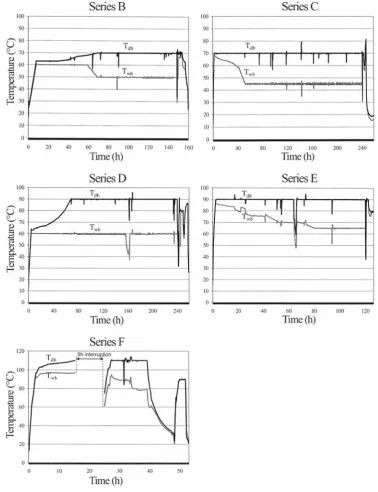
Fig. 1. Drying schedules with
two regulation principles at maximum dry-bulb temperature 70°C (series B and C), 90°C (series D and E), and 110°C (series F). In series F, a 9-h interruption occurred because of activation of an alarm.
Tdb, dry-bulb temperature;
Twb, wet-bulb temperature
Drying and conditioning
Drying was performed in six different series. Series A, considered similar to outdoor air-drying, was, due to the time of year, done indoors at the laboratory on stickers at 20°–25°C, 38%–45% RH for slightly less than 9 weeks. Series B–F were dried in a small-scale laboratory air-circulation kiln at maximum temperature levels of 70°, 90°, and 110°C. For the 70°C and 90°C series B–E, two dif-ferent regulation principles were used after the initial preheating:
I. Dry-bulb temperature (Tdb) gradually rising to maximum temperature level and wet-bulb temperature (Twb) at one or two constant levels.
II. Constant Tdb at maximum level with initial Twb dropping to a constant level.
Both these principles correspond to kiln-drying schedules used at Swedish sawmills.
Series F was dried with a high-temperature schedule at a maximum temperature of 110°C. During series F, kiln regulation was unfortunately interrupted for 9 h because of activation of an alarm, which resulted in a temporary tem-perature drop. The appraisal is, however, that this distur-bance had a fi nite infl uence on the results in the decay test. The drying series are summarized in Table 1 and Fig. 1. Schedules for series B–F are presented in detail.
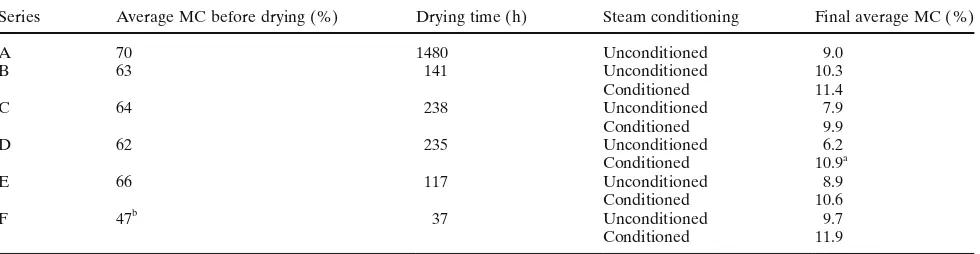
Table 2. Moisture content (MC) before and after drying and conditioning in series A–F
Series Average MC before drying (%) Drying time (h) Steam conditioning Final average MC (%)
A 70 1480 Unconditioned 9.0
B 63 141 Unconditioned 10.3
Conditioned 11.4
C 64 238 Unconditioned 7.9
Conditioned 9.9
D 62 235 Unconditioned 6.2
Conditioned 10.9a
E 66 117 Unconditioned 8.9
Conditioned 10.6
F 47b 37 Unconditioned 9.7
Conditioned 11.9
a Low MC after drying was adjusted with an extended conditioning
b The low average MC before drying in series F is explained by a high fraction of heartwood content
Fig. 2. Sampling of specimen for decay test from dried and planed
samples in positions of inner heartwood, outer heartwood, and sapwood. For inner heartwood, the pith was avoided. Left: Position of outer heartwood specimen in lumber with low heartwood content.
Right: With high heartwood content Table 1. Description of drying series A–F
Series Maximum temperature Preheating Regulation principle Number of samples Steam conditioning
A 25°C – – 10 –
B 70°C Water spray I 10 Half batch, 4 h
C 70°C Steam II 10 Half batch, 5.5 h
D 90°C Water spray I 10 Half batch, 9.7 ha
E 90°C Steam II 10 Half batch, 3.7 h
F 110°C Steam – 19 Half batch, 3.5 h
a Extended conditioning to adjust the low fi nal moisture content (MC) after drying
and D. Conditioning after drying was done on half of each batch in series B, C, D, E, and F, whereas the other half was removed from the kiln at the end of drying. Conditioning was performed with saturated steam at 100°C injected from an external steam boiler for a range of hours according to Table 1. No conditioning was done on series A.
Wood temperature during drying
The wood temperature in one chosen sample per drying series B–F was registered using a PT100 sensor inserted in a hole drilled from the board edge to half board width at a depth of 5 mm below sapwood surface. No temperature measurements were done in the lumber dried indoors in series A.
Decay test
The decay test with the brown rot fungus Coniophora puteana (BAM Ebw.15) was performed according to the standardized EN113 decay test, but modifi ed with respect to sample size and incubation time in the same way as described by Harju and Venäläinen.27 The mass loss of the samples after an incubation time of 7 weeks, expressed as percent of dry mass of wood before decay test, was used as a measure of durability.
Sampling for decay test
Specimens cut into 5 × 15 × 30 mm blocks were sawn from dried and planed samples in all six series at three positions:
inner heartwood, outer heartwood, and sapwood (Fig. 2). Thus, only planed surfaces were used in the study, with a planing depth of 2–3 mm. For outer heartwood specimens, the distance from pith side was measured. In total, 194 specimens were made: 2 × 66 heartwood specimens and 62 sapwood specimens.
Results and discussion
MC and density
The average density, ρ0,raw, of all dried boards before dryingwas 418 kg/m3
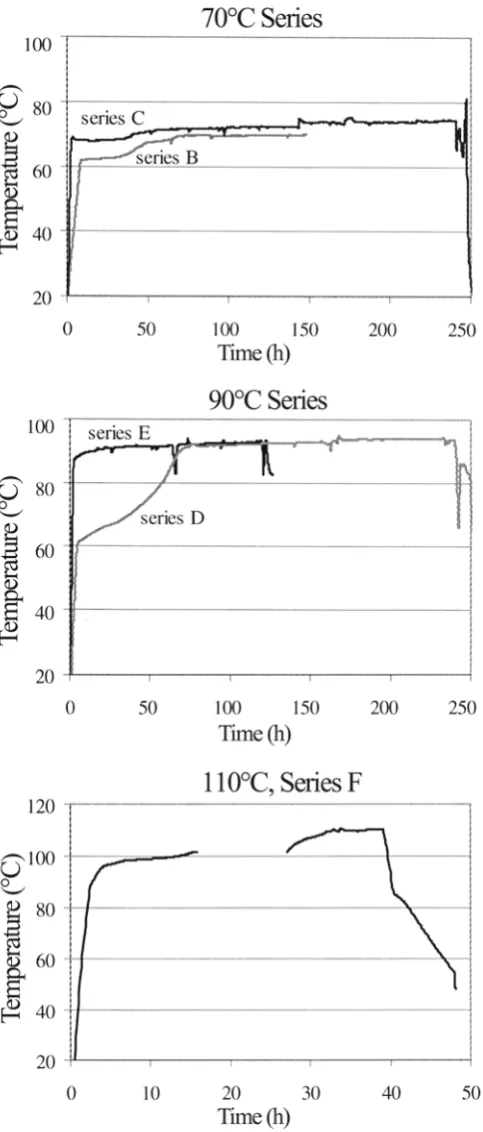
principles, I and II, is found in the early stages of drying after the preheating phase. In series C and E with regulation principle II, the wood temperature reaches close to maximum temperature 70°C or 90°C early in drying when the MC is high with free capillary water present in sapwood and with MC in heartwood close to fi ber saturation point. In series B and D with regulation principle I, however, maximum temperature is reached considerably later in the drying process when the MC is substantially lower. Less temperature difference early in drying between regulation principles I and II can be seen in the 70°C series compared to the 90°C series.
Mass loss in decay test
The mass losses after 7 weeks incubation time in each series are shown in Fig. 4 for the three wood type positions: inner heartwood, outer heartwood, and sapwood. A large varia-tion in mass loss is seen for all posivaria-tions in all series, judging from the confi dence intervals. As expected, the mass loss in sapwood in all series is signifi cantly higher (at 5% signifi cance level) than in inner heartwood and outer heartwood.
Series E shows, on average, the largest mass loss com-pared to all other series for all three wood types. In sapwood, the mass loss in series E is signifi cantly higher only in com-parison to sapwood in series D at 10% signifi cance level.
In heartwood, the mass loss, on average, is lowest in series A and highest in series E. Mass loss in outer heartwood in series A is signifi cantly lower than in outer heartwood in all other series (at signifi cance levels between 1% and 10%). Mass loss in inner heartwood in series A is signifi cantly lower compared to series E and F at 10% signifi cance levels.
In contradiction to other studies, no signifi cant differ-ence between mass loss in inner heartwood and mass loss Fig. 3. Material temperature during drying in series B and C (top), in
series D and E (middle), and in series F (bottom)
Fig. 4. Mass losses after 7 weeks incubation with brown-rot fungus Coniophora puteana for pine lumber dried in series A–F. Data are
given as average values with 95% confi dence intervals (n = from 10 to 16 in each bar). Average values comprise conditioned and uncondi-tioned specimens
Wood temperature during drying
in outer heartwood was found, either in any series or in overall average values. Also, the mass loss in outer heart-wood specimens did not show any dependence on measured distance from pith side.
Among the various drying strategies, series A, consid-ered equivalent to outdoor air-drying, shows the best decay resistance in heartwood. The average mass loss for heart-wood (inner and outer grouped together) in series A is signifi cantly lower compared to all other series (at 5% sig-nifi cance level compared to series B, C, D, and F and at 1% compared to series E). Drying with high wood material temperature early in the drying process, such as in series E at 90°C maximum temperature, shows the lowest decay resistance in sapwood and heartwood. The difference for heartwood (inner and outer grouped together) is, however, signifi cantly higher only in comparison to series A.
High material temperature when MC is high, such as in series E, is an unsuitable combination for decay resistance in pine heartwood. In fact, these are also the conditions in the high-temperature drying in series F, but because the drying time is short, this combination of high material tem-perature and high MC does not lead to any pronounced decrease in decay resistance compared to the other series.
When comparing the drying time for the two series with maximum temperature 90°C, the total time for material temperature at maximum level is much longer in series D than in series E. Even though this is the case, mass loss is higher in series E. The interpretation of these results is that the duration of high material temperature early in drying when MC is high with presence of free, liquid water seems to be the critical combination for decay resistance in heart-wood. At higher temperatures reactivity and solubility of compounds are normally increased, and it is possible that more of fungicides such as resin acids or pinosylvins in heartwood are inactivated when drying at higher tempera-tures and high MC. Duration of high material temperature later in drying when MC is lower, such as in series D, does not show any deterioration of decay resistance compared to series at 70°C.
Effect of conditioning on mass loss
At the end of each drying series, except series A, steam conditioning was performed on half of each batch. A comparison between mass loss in unconditioned and conditioned sapwood and heartwood is shown in Fig. 5. No signifi cant effect of conditioning in heartwood is found, but in sapwood, steam-conditioning increases mass loss. The increase is signifi cant at the 10% signifi cance level.
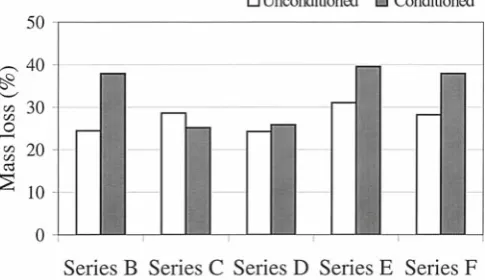
In Fig. 6, the mass loss in conditioned/unconditioned planed sapwood in series B–F is shown. Conditioning has increased mass loss in all series apart from series C.
A hypothesis is that this increase of mass loss in condi-tioned sapwood depends on redistribution of nutrition during moistening of the dry lumber surface with free con-densation water during injection of saturated steam. During this substantial moistening of the outermost thin dry layer, which forms early during drying28,29
down to a depth of
seven to ten cell rows beneath the surface,28
a redistribution toward the surface of migrating nutrients through this thin dry layer is conceivable. These nutrients have been accu-mulated just beneath the thin dry layer early during drying and has a typically position of 0.5 mm below the surface down to a depth of 1.5–5 mm.30
Such redistribution of nutri-ents at the surface might facilitate and initiate a more rapid decay of conditioned sapwood. In heartwood, it is likely that no such accumulation of soluble nutrients takes place during drying.
Effect of raw material properties on mass loss
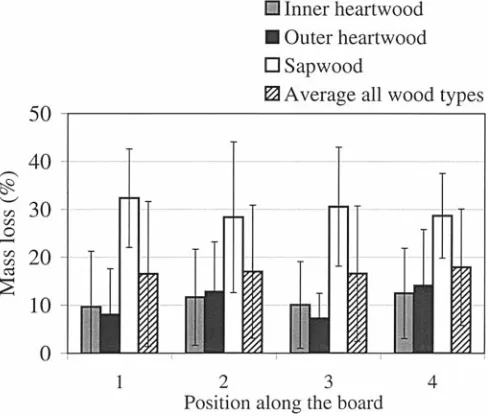
The variation in decay resistance is large among different boards, as revealed in Figs. 4, 5, and 6, but also within single boards. Investigation of the impact of position along the board shown in Fig. 7 showed no dependence on positions 1–4.
One probable explanation to the large variation in mass loss is the natural variability of extractive content between and within individual boards. However, extractive content was not measured in this study.
Fig. 5. Mass losses in pine sapwood and heartwood after 7 weeks
incubation with brown-rot fungus Coniophora puteana for uncondi-tioned and condiuncondi-tioned pine lumber in all series except series A. Data are given as average values with 95% confi dence intervals (n = 112 for heartwood; n = 52 for sapwood)
Fig. 6. Effect of conditioning on mass loss in pine sapwood in series
Conclusions
The impact of different drying processes on the durability of Scots pine lumber has been evaluated with mass loss in a 7-week decay test with the brown rot fungus Coniophora puteana as a measure of decay resistance. The results are summarized as follows:
• The variation in decay resistance is large between different boards, but also within single boards.
• Sapwood shows considerably lower durability than heartwood. Mass loss after the 7 weeks rot test as average values for all drying series was 30% in sapwood compared to 11% in heartwood.
• In contrast to other studies, no difference was found between the durability of inner heartwood and that of outer heartwood.
• Air-dried heartwood shows the highest durability compared to the other drying series. Mass loss after the 7 weeks rot test as average values for inner and outer heartwood was 4.2% in air-dried lumber compared to 14.9% in the kiln-dried series, which showed the highest mass loss.
• Steam conditioning after drying lessens the durability of sapwood. Mass loss after the 7 weeks rot test as average values of all kiln-dried series was 27.3% in unconditioned sapwood compared to 33.8% in conditioned sapwood. The difference is signifi cant at the 10% signifi cance level.
• Steam conditioning after drying did not affect the durability of heartwood.
• Drying at 90°C maximum temperature with high material temperature early in drying when MC is high shows the lowest durability for both sapwood and heartwood. The interpretation is that the duration of high material
temperature at high MC is the critical combination for decay resistance in heartwood.
Acknowledgments The authors thank Styrbjörn Johansson, SP Wood
Technology, for his assistance in conducting the laboratory drying series and Linda Eriksson, SP Technical Research Institute of Sweden, Department of Chemistry and Materials Technology, for performing the decay experimental work.
References
1. Wamming T (2005) Besiktning av nedmonterat klättertorn (in Swedish). SP Trätek Uppdragsrapport, P504194
2. European Commitee for Standardizaiton Central Secretariat (1994) European Standard EN 350-2. Durability of wood and wood-based products. Natural durability of solid wood. Part 2: Guide to natural durability and treatability of selected wood species of importance in Europe. European Commitee for Stan-dardization Central Secretariat, Brussels
3. Råberg U, Edlund M-L, Terziev N (2005) Testing and evaluation of natural durability of wood in above ground conditions in Europe: an overview. J Wood Sci 51:429–440
4. Harju A, Venäläinen M (2006) Variation in natural durability of Scots pine heartwood. In: ECOWOOD, 2nd International
Conference on Environmentally-Compatible Forest Products, Fernando Pessoa University, O Porto, Portugal, 20–22 September
5. Harju AM, Venäläinen M (2002) Genetic parameters regarding the resistance of Pinus sylvestris heartwood to decay caused by
Coniophora puteana. Scand J For Res 17:199–205
6. Taylor AM, Gartner BL, Morrell JJ (2002) Heartwood formation and natural durability: a review. Wood Fiber Sci 34:587–611 7. Bergström B (2003) Chemical and structural changes during
heart-wood formation in Pinus sylvestris. Forestry 76:45–53
8. Bergström B, Gustafsson G, Gref R (1999) Seasonal changes of pinosylvin distribution in the sapwood/heartwood boundary of
Pinus sylvestris. Trees 14:65–71
9. Lange W, Kubel H, Weißmann G (1989) Die Verteilung der Extraktstoffe im Stammholz von Pinus sylvestris L. Holz als Roh- Werkstoff 47:487–489
10. Sehlstedt-Persson M (2001) The effect of extractive content on moisture diffusion properties for Scots pine and Norway spruce. COST Action E15. Advances in the drying of wood (1999– 2003). In: Proceedings, 3rd Workshop on Softwood Drying to
Specifi c End-Uses, 11–13 June, Helsinki
11. Fernando D, Hafrén J, Gustafsson, J, Daniel G (2008) Micromor-phology and topochemistry of extractives in Scots pine and Norway spruce thermomechanical pulps: a cytochemical approach. J Wood Sci 54:134–142
12. Saranpää P, Höll W (1989) Soluble carbohydrates of Pinus
sylves-tris L. sapwood and heartwood. Trees 3:138–143
13. Terziev N, Boutelje J, Larsson K (1997) Seasonal fl uctuations of low-molecular-weight sugars, starch and nitrogen in sapwood of
Pinus sylvestris L. Scand J For Res 12:216–224
14. Höll W (1985) Seasonal fl uctuation of reserve materials in the trunkwood of spruce (Picea abies (L.) Karst.) J Plant Physiol 117:355–362
15. Terziev N, Boutelje J (1998) Effect of felling time and kiln-drying on color and susceptibility of wood to mould and fungal stain during an above-ground fi eld test. Wood Fiber Sci 30:360–367 16. Theander O, Bjurman J, Boutelje JB (1993) Increase in the content
of low-molecular carbohydrates at lumber surfaces during drying and correlations with nitrogen content, yellowing and mould growth. Wood Sci Technol 27:381–389
17. Terziev N, Boutelje J, Söderström O (1993) The infl uence of drying schedules on the redistribution of low-molecular sugars in
Pinus sylvestris L. Holzforschung 47:3–8
18. Terziev N (1995) Migration of low-molecular sugars and nitroge-nous compounds in Pinus sylvestris L. during kiln and air drying. Holzforschung 49:565–574
Fig. 7. Mass loss in different wood types at positions 1 through 4 along
19. Terziev N, Bjurman J, Boutelje JB (1996) Effect of planing on mould susceptibility of kiln-and air-dried Scots pine (Pinus
sylves-tris L.) lumber. Material Organism 30:95–103
20. Van Acker J, Stevens M, Carey J, Sierra-Alvarez R, Militz H, Le Bayon I, Kleist G, Peek RD (2003) Biological durability of wood in relation to end-use. Part 1. Towards a European standard for laboratory testing of the biological durability of wood. Holz als Roh- Werkstoff 61:35–45
21. Rydell R (1981) Inverkan av torkmetod på långtidsbeständigheten för fönstervirke (in Swedish). STFI meddelande serie A731 22. Bergström M, Rydell Å, Elowson T (2004) Durability of untreated
Norway spruce (Picea abies) exposed outdoors above ground for nine years. Holzforschung 58:167–172
23. Rydell Å, Bergström M, Elowson T (2005) Mass loss and moisture dynamics of Scots pine (Pinus sylvestris L.) exposed outdoors above ground in Sweden. Holzforschung 59:183–189
24. Frühwald E, Li Y, Wadsö L (2007) Mould susceptibility of spruce and larch wood dried or heat-treated at different temperatures. (Submitted to Holzforschung.) Paper V in doctoral thesis TVBK-1034: Effect of high-temperature drying on spruce and larch. Lund University, Sweden
25. Sehlstedt-Persson SMB (1995) High-temperature drying of Scots pine. A comparison between HT- and LT-drying. Holz als Roh-Werkstoff 53:95–99
26. Momohara I, Ohmura W, Kato H, Kubojima Y (2003) Effect of high-temperature treatment on wood durability against the brown-rot fungus Fomitopsis palustris and the termite, Coptotermes
for-mosanus. In: Proceedings of 8th International IUFRO Wood,
Drying Conference, Brasov, Romania, 24–29 August
27. Harju AM, Venäläinen M (2006) Measuring the decay resistance of Scots pine heartwood indirectly by the Folin-Ciocalteau assay. Can J For Res 36:1797–1804
28. Wiberg P, Sehlstedt-Persson SMB, Morén TJ (2000) Heat and mass transfer during sapwood drying above the fi bre saturation point. Drying Technol 18:1647–1664
29. B McCurdy M, Pang S, Keey R (2005)Experimental determination of the effect of temperature and humidity on the development of colour in Pinus radiata. Braz J Chem Eng 22:173–179