J Wood Sci (2001) 47:58-62 9 The Japan Wood Research Society 2001
A t s u s h i K o d a n 9 H i r o y u k i K u r o d a 9 F u k u m i S a k a i
Simultaneous expression of stilbene synthase genes in Japanese red pine
( Pinus densiflora)
seedlings
Received: October 25, 1999 / Accepted: February 18, 2000
A b s t r a c t We analyzed sequences of the stilbene synthase (STS) c D N A in Pinus densiflora. Three novel STS c D N A clones (pdstsl, pdsts2, pdsts3) that carry full coding se- quences were isolated from a c D N A library constructed from the roots. The homologies in their coding regions were about 95%, and they have a conserved STS motif. Their phylogenetic relation was also discussed. The 3' end of the STS c D N A fragments was amplified by the polymerase chain reaction and subcloned. The 3' untranslated region ( 3 ' U T R ) of the fragments highlighted the structure diver- sity. Twelve STS c D N A clones were categorized into seven distinct subclasses according to 3 ' U T R sequences. We dis- cussed the stability of the transcripts and their gene organi- zation. The simultaneous expression of the STS members is one of the mechanisms for adaptation that pine trees have developed over time.
K e y w o r d s P i n o s y l v i n 9 P h y t o a l e x i n 9 Multigene family -
Stilbene synthase 9 Chalcone synthase
Introduction
Pinosylvin, the stilbenoid phytoalexin, is an effective fungi- cide; and its monomethyl ether is a strong nematicide. 1 It is usually formed in pine heartwood but is inducible under biotic and abiotic stress. 2-6 Stilbenoids are distributed in higher plants without any direct phylogenic correlation, 7 whereas flavonoids are widely distributed in the plant king- dom. Stilbene synthase (STS) and chalcone synthase (CHS)
A. Kodan 9 H. Kuroda ( ~ ) . F. Sakai
Laboratory of Gene Expression, Wood Research Institute, Kyoto University, Uji, Kyoto 611-0011, Japan
Tel. +81-774-38-3619; Fax +81-774-38-3619 e-mail: [email protected]
This paper was presented at the 48th Annual Meeting of the Japan Wood Research Society, Shizuoka, April 1998
are key enzymes in stilbenoid and flavonoid biosynthesis, respectively. Both enzymes catalyze the addition of three molecules of malonyl-coenzyme A (CoA) to a starter C o A ester, producing either a stilbenoid or a flavonoid, respec- tively. They are highly homologous (60%-70%) in amino acid sequence and STS genes are probably derived from CHS genes during plant evolution. 8 Some STS genes have been cloned and sequenced in Arachis hypogaea, 9 Vitis
vinifera, ~~ Pinus sylvestris, 12 and Pinus s t r o b u s . 13
The pine genome is 10 times the size of the human ge- nome. 14 During its evolution it might have been promi- nently amplified and dispersed to form complex families. ~5 Southern analysis has revealed several STS genes in Pinus
densiflora, 16 and 10 genomic STS genes from Pinus sylvestris
were grouped into five subclasses according to the size of their introns. ~7 However, diverse STS transcripts are not yet reported in the conifer. To clarify the STS members ex- pressed in pine trees, we analyzed the 3' untranslated region (3'UTRs). U T R s are rich in sequence diversity, whereas t h e
coding sequences are generally well conserved. We took advantage of this diversity for identifying family members. In this study, we have isolated diverse STS genes expressed in pine seedlings and discuss their relation with the multi- gene family.
Materials and methods
Construction of a c D N A library
pSPORT1 (Life Technologies), respectively. The library containing the cDNA smaller than 1.0 kb was used to isolate 3' end fragments (ca. 0.4kb) of STS cDNA clones, and that containing the cDNA larger than 1.0kb was used to isolate full-length STS cDNA (ca. 1.4kb) clones.
Amplification of 3'-end STS cDNA
The cDNA library (smaller than 1.0kb) was used as a tem- plate for the amplification of STS cDNA 3' ends. The for- ward primer was based on the plasmid vector pSPORT1, and the reverse primer was based on the nucleotide se- quence of a highly conserved block in STS. The vector specific primer sequence was 5 ' - A C G A G G A A G G C G T C T C T A C A A - Y (2liner). The STS cDNA specific primer sequence was: 5 ' - C C A G T G A A T T G A A T T T A G G T G A C - 3' (23mer). D N A fragments with sequences corresponding to STS were amplified using these primers. Thermal cycling consisted of preincubation at 94~ for 6rain and 35 cycles of denaturation at 94~ for l min followed by annealing/ extension at 55~ for 2min. The polymerase chain reaction (PCR) products were observed as a smear band (200- 400bp) on 1% agarose gel after electrophoresis. The bands were rescued from the gel using a Whatmann GF/C glass filter. The purified PCR products were subcloned into a plasmid p G E M - T Easy vector (Promega). The ligated D N A was transformed into Escherichia coli DH10B cells by electroporation. After the subcloning, 50 white colonies were arbitrarily checked for insertional DNA, and their nucleotides were sequenced.
Screening of full-length STS cDNA clones by colony hybridization
From the cDNA library (larger than 1.0kb), 3 • 10 4 colo- nies were screened using the PCR-amplified probe for STS, 900bp long. The colonies were transferred to a nylon mem- brane (Hybond N+; Amersham). The colony hybridization was carried out using E C L direct nucleic acid labeling and detection systems (Amersham). Single colonies were ob- tained from positive spots by repeating the hybridization twice.
Nucleotide sequencing
The nucleotides of the cloned STS were sequenced for both strands by the dideoxy chain termination method 19 using the Big Dye Terminator Cycle Sequencing FS Ready Reaction Kit (PE Applied Biosystems, Japan).
Analysis of STS cDNA clones
The B L A S T algorithm 2~ was used to search the GenBank database for similarity of the STS cDNA nucleotide se- quence with other reported sequences. Phylogenetic analy- sis was performed using P H Y L I P Version 3.57c. 2~
Results and discussion
Analysis of 3' ends in STS cDNA
Some 12 cDNA clones were assigned as STS for the follow- ing reasons. First, they showed higher homology to Pinus
sylvestris STS than CHS. They had a highly conserved block
for the STS coding sequence, followed by 3' UTRs, which are similar to STS but not to CHS. Second, the three novel STS cDNA clones that carry full coding sequence were also isolated from the library and were identified as one of the 12 cDNA clones, respectively. Third, the recombinant STS expressed in Escherichia coli cells were confirmed by West- ern blotting analysis, and enzyme activity was successfully detected (A. Kodan, et al., unpublished results).
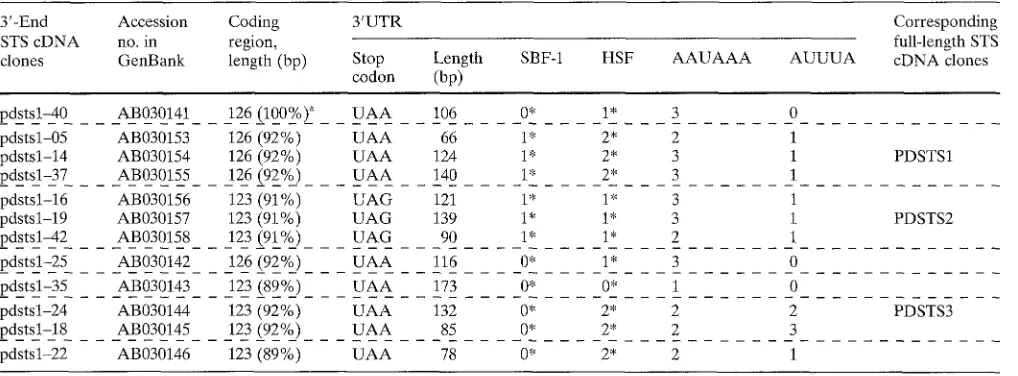
Three prime UTRs of the m R N A transcripts highlighted the sequence diversity. The mRNA transcripts with puta- tive multiple polyadenylation sites, often observed in other plant mRNAs, 22 were present. We analyzed the phyloge- netic relations among the diverse transcripts, but the sequence lengths were not enough to create a reliable phy- logenetic tree. Thus we classified them by some characteris- tic sequences, for example the number of translation factors such as SBF-1, 23 HSF, A A U A A A , and A U U U A a4 motifs present in the 3'UTRs. Table 1 shows that 12 STS mRNA transcripts are organized by seven subclasses. Most of the STS are novel molecular species, except for pdstsl-40 (AB030141) and pdsts1-35 (AB030143). The former was identical to that isolated from Pinus sylvestris, ~ and the latter corresponded to that isolated from Pinus strobus. 13
Each STS cDNA clone had one or two putative polyadenylation signals composed of A A U A A A or AAUAAA-like sequences, which are responsible for stabi- lizing the mRNA, preceding a polyadenylation tail. Some of the STS cDNA clones had multiple reiterations of the A U U U A motifs and adjacent AU-rich domain, which were identified as selective mRNA destabilizersY Both the stability and instability sequences suggest that long- and short-lived mRNA transcripts are present and may control stilbenoid metabolism via the mRNA level. Examples of long-lived mRNA transcripts are pdstsl-40 (AB030141), pdsts1-25 (AB030142), and pdstsl-35 (AB030143), none of which had a destabilizing factor in the 3'UTR. Such mRNA transcripts may have the potential to increase STS produc- tion levels and upregulate pinosylvin biosynthesis.
Isolation of three STS cDNA clones with full coding sequences
60
Table 1. Characteristics of 3'-end STS c D N A fragments in Pinus densiflora
3 ' - E n d Accession Coding 3 ' U T R Corresponding
STS c D N A no. in region, full-length STS
clones G e n B a n k length (bp) Stop Length SBF-1 HSF A A U A A A A U U U A c D N A clones
codon (bp)
p d _ s t s _ _ ~ - _ 4 0 _ _
p d s t s l - 0 5 pdsts1-14 pd_stsl-_37 _ _
p d s t s l - 1 6 pdsts1-19
AB0_3014_1_ _ _12_6 (_10_0 ~ )_ ~ _ _ U A A _ _ 10_6 . . . . 0* . . . . 1_* _ _ _ 3 . . . O . . .
AB030153 126 (92%) U A A 66 1 ' 2* 2 1
AB030154 126 (92%) U A A 124 1 ' 2* 3 1 PDSTS1
A_B0_30155_ _ _12_6 (92%_)_ _ _ UAA_ _ _ 1_40 . . . . 12 . . . . 2* _ _ _ 3_ . . . _1 . . .
AB030156 123 (91%) U A G 121 1 ' 1 ' 3 1
AB030157 123 (91%) U A G 139 1 ' 1" 3 1 PDSTS2
pdsts.1--4_ 2 _ _ A_B 03 015_8 _ _ _12_3 (91%.)_ _ _ U A G _ _ _90 . . . . 1" . . . . 1" _ _ _ 2 . . . __1_
pdsts_l-25 _ _ AB03014_2_ _ _12_6 (_92_%_)_ _ _ _UA_A _ _ 11_6 _ _ _ 0 * . . . . 1" _ _ _ 3_ . . . _0 . . .
pdsts_1-.35 _ _ AB0_3014_3_ _ _12_3 (89%_)_ _ _ _UAA _ _ 173 . . . . 02 . . . . 01 _ _ _ 1_ . . . _0 . . .
pdsts1-24 AB030144 123 (92%) U A A 132 0* 2* 2 2 PDSTS3
_pasts_1-18 _ _ _A_B 03 0145 _ _ 123 (_92_%_)_ _ _ UAA_ _ _ _85 . . . . 0* . . . . 2_* _ _ _ 2_ . . . 3 . . .
p d s t s l - 2 2 AB030146 123 (89%) U A A 78 0* 2* 2 1
The n u m b e r of SBF-1, HFS, A A U A A A , and A U U U A motifs were examined for the classification of 12 STS cDNAs
SBF-1, silencer binding factor of chalcone synthase from bean; HSF, heat shock factor from Drosophila; A A U A A A and A U U U A , numbers of
possible polyadenylation signals and selective m R N A destabilizing signals, respectively; broken lines, borders among seven subclasses; PDSTS1
(AB015489), PDSTS2 (AB030139), and PDSTS3 (AB030140), full-length STS c D N A clones isolated from Pinus densiflora; * Numbers of motifs
present in the sequences aligned to p d s t s l - 0 5 whose 3 ' U T R was shortest (no asterisk represent numbers of motifs in the full sequence) a Identities with p d s t s l - 4 0
P D S T S I
P D S T S 2
P D S T S 3
X 6 0 5 7 3
P D C H S X
P D S T S I
P D S T S 2
P D S T S 3
X 6 0 5 7 3
P D C H S X
P D S T S I
P D S T S 2
P D S T S 3
X 6 0 5 7 3
P D C H S X
1 3 . . 100
M G G V D F E G F R K L Q R A D G F A S 7 L A I G T A N P P N A V D Q S T Y P D Y Y F R I T G N E H N T E L K D K F K R I C E R S A I K Q R Y M Y L T E E I L K K N P D V C A F V E V P S L D A G
~ e o ~ o ~ e e t ~ e ~ o ~ e e ~ e e o ~ o o ~ e o e I o e e ~ o e o e ~ e Q o ~ e o o o t m e a e ~ e o ~ o ~ o e o o o ' I e ~ Q e o o ~ j e o o I ~ R
9 e e e e o e e o 9 o o 9 9 o 9 e e e e 9 o e 9 9 9 9 9 * 9 9 o o e e 9 e o o 9 * e * e e 9 9 * * e o 9 o * 9 o ~ e 9 e ~ 9 e e e * ~ 9 9 e e ~ 9 e o * e o 9 o * ~ 9 e ~ * ~ e o ~ e ~ 9 9 R
M P . . E T L * L ~ 9 o A " 9 " * , p o T o o 9 " " 9 - T - 9 9 9 9 o * , S 9 9 9 9 9 o K o , N S - . M . - , , E o o R o M o D K o , - o K o 9 * , 9 * * 9 9 9 - E * - N . o E ~ I A - , 9 o 9 o R
9 200
Q A M L A M E V P R L A K E A A E K A I K E W G Q S K S R I T H L I F C S T T T P D L P G A D F E V A K L L G L H P S V ~ V G V F Q H G C F A G G T V L R ~ . K D L A E N N R G A R V L V I C S E T T
. . . ~ . . . ~ . . . " ' I " . . . ~ " . . .
I I
. ~ . ~ , v . . . G . . . . ~ . . . ~ - - ~ . - . V - . - , - ~ G V - ~ . . . . ~ , , . . . R . . . . t ' ' ~ ' ~ ' ~ . . . V . . . V - - - ~ -
3OO
A V T F R G P S E T H L D S L V G Q A L F G D G A S A L I V G A D P I P Q V E K A C F E I V W T A Q T V V P D S E G A X G G K V R E V G L T F Q L K G A V P D L I S A N I E N C L V E A F S Q F K I S D
9 9 9 . . , . , D . . . 9 . M . . . 9 9 9 c A . . . . 9 o . . V . . 9 9 . p , o . L M . . . . , I L , . . D . . , * D , H L . , . . . H . L K D , , , G , , . K , . , . K S . E . . . Q , L G . . .
P D S T S I
P D S T S 2
P D S T S 3
X 6 0 5 7 3
P D C H S X
W N K L F W V V ~ P G G R A I L D R V ~ D P T K L i P T R H V M S E Y G N M S S A C V H F i L D Q T R K A S L Q N G C S T S G E G L E M G V L F G F G P G L T i E T V V L K S V P L Q * 3 9 3
. . . o * o ~ . . . o . o o . . . . - o ' o , - E o o . o * o R * | . . . o o . . . . , o - o * * * 3 9 3
E Q V V L G C S S R R T C H P * 3 1 2
. . . . 9 . . . . . . . * - - . . . . 9 . . . . . . . . 9 . . . 9 . . . T - - . . . . . . - . . . . . - . - Z o * 3 9 3 9 * Q - * - Z A - . . o P - - . . Q - . . . . . - . . K , - R A - - Q - L - D . . . . . . - E M - - S - Q - - - . . - T . . . . D V . . . . - . . . . . . V . . . . - . - . - Q * 3 9 6
Fig. 1. Alignment of deduced amino acid sequence for three PDSTS and P D C H S X . A m i n o acid sequences of PDSTS1, PDSTS2, PDSTS3, X60573, and P D C H S X are shown from the start (M) to stop codons
(*). X60573 represents P. syIvestris pinosylvin synthase. Points show
identical amino acids, and hyphen positioned at V-94 shows inserted
deletion. Conserved cysteine residues (C), which are essential for
activity, are indicated by an inverted triangle. A motif around the cysteine (Cys-f67), which is probably the binding site for cinnamoyl-
coenzyme A, is indicated by a box. The three amino acid residues,
which is the most remarkable property of a pinosylvin synthase, are shown by large solid circles
b a s e ) . T h i s f i n d i n g i n d i c a t e s t h a t t h e g e n e h a s m u l t i p l e c o p - ies. T h e o t h e r c l o n e w a s a b o u t 1.7 k b l o n g w i t h a n o p e n r e a d i n g f r a m e c o d i n g f o r C H S , d e s i g n a t e d P D C H S X ( A B 0 1 5 4 9 0 i n t h e G e n B a n k d a t a b a s e ) . T h e C H S c l o n e w a s s c r e e n e d a t t h e s a m e t i m e b e c a u s e o f its h i g h h o m o l o g y ( a b o u t 6 0 % ) w i t h t h e t h r e e S T S s . T h e C H S p r o b a b l y p l a y s a n i m p o r t a n t r o l e i n p i n o c e m b r i n b i o s y n t h e s i s i n t h e s e e d - l i n g s .
T h e t h r e e S T S c D N A s w e r e d e d u c e d t o e n c o d e
p i n o s y l v i n s y n t h a s e f o r t h e f o l l o w i n g r e a s o n s . F i r s t , t h e a m i n o a c i d s e q u e n c e d e d u c e d f r o m t h e c D N A s e x h i b i t e d s i g n i f i c a n t h o m o l o g y ( 9 2 - 9 8 % ) w i t h t h a t f o r t h e P i n u s
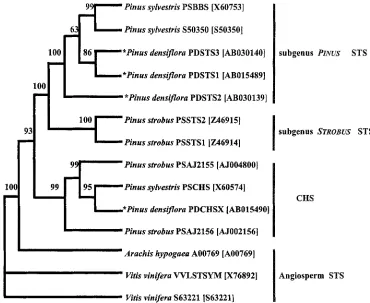
Fig. 2. Strict consensus tree of STS and CHS inferred by the neighbor-joining method. The tree was created from the amino acid sequences using PHYLIP. The numbers at the forks indicate percent bootstrap values for 1000 bootstraps. Brackets represent ac- cession numbers in the GenBank database. Our cDNAs cloned are shown by asterisks. The sequence of PDSTS3, which lacks 82 amino acid residues in the C-terminal area due to a frame shift, is used in a gap-filling mode to align
l
I
99 95
Pinus sylvestris PSBBS [3[60753]
Pinus sylvestris $50350 [S50350]
*Pinus densiflora PDSTS3 [AB030140]
*Pinus densiflora PDSTS1 [AB015489]
*Pinus densiflora PDSTS2 [AB030139]
Pinus strobus PSSTS2 [Z46915]
Pinus strobus PSSTS1 [Z46914]
Pinus strobus PSAJ2155 [A J004800]
Pinus sylvestris PSCHS [X60574]
*Pinus densiflora PDCHSX [AB015490]
Pinus strobus PSAJ2156 [AJ002156]
Arachis hypogaea A00769 [A00769]
Vitis vinifera VVLSTSYM [X76892]
Vitis vinifera $63221 [$63221]
61
subgenus PINUS STS
subgenus STROBUS STS
CHS
Angiosperm STS
162). P D S T S 3 h a d a t w o - b a s e d e l e t i o n ( n u c l e o t i d e positions 8 7 9 - 8 8 0 : A B 0 3 0 1 4 0 in the G e n B a n k d a t a b a s e ) c o m p a r e d to the others, resulting in a shift in the r e a d i n g frame, which lacks 82 a m i n o acid residues in the C - t e r m i n a l area.
P h y l o g e n e t i c analysis of STS c D N A clones
To u n d e r s t a n d the s e q u e n c e r e l a t i o n s a m o n g the t h r e e STSs, we c o n s t r u c t e d a m o l e c u l a r p h y l o g e n e t i c t r e e by the n e i g h b o r - j o i n i n g m e t h o d with b o o t s t r a p p i n g . T h e t r e e clearly shows four p r i m a r y lineages c o r r e s p o n d i n g to sub- genus PINuS STS, subgenus S t R o B e , s STS, C H S , a n d an- g i o s p e r m STS (Fig. 2). A c c o r d i n g to the classification of genus P i n u s , 2s the t h r e e STSs fell into a group of subgenus P m u s STS gene r a t h e r t h a n subgenus SrROBUS STS gene. This is in consistent with the classical p h y l o g e n y b e c a u s e our s a m p l e belongs to the subgenus P m u s .
T h e STS genes h a d higher o r d e r s of r e g u l a t o r y c o m p l e x - ity, p e r h a p s to e n s u r e n o r m a l c o n t r o l by s i m u l t a n e o u s ex- p r e s s i o n of the family m e m b e r s r a t h e r t h a n a single copy. T h e c o m p l e x i t y of the gene f a m i l y is p r o b a b l y d u e to the large g e n o m e size of pine, a l t h o u g h a n o t h e r e x p l a n a t i o n for the s i m u l t a n e o u s e x p r e s s i o n of the family m e m b e r s is also possible. C o n i f e r species are n o t fully c o n v e r g e d into a p u r e line, u n l i k e v e g e t a t i v e crops, a n d are e x p e c t e d to contain genetic v a r i a t i o n within a species. T h e STS g e n e family might b e caused to s o m e e x t e n t by v a r i a t i o n in the p i n e p o p u l a t i o n b e c a u s e t h e m a t e r i a l u s e d in this s t u d y was n o t a single t r e e b u t seedlings. A t any rate, we d e m o n s t r a t e d s i m u l t a n e o u s STS m R N A t r a n s c r i p t expression, with as
m a n y as 12 STS m R N A transcripts g r o u p e d into seven sub- classes, in the conifer species.
Acknowledgments We thank Prof. Takashi Miyata, Laboratory of Molecular Physics, Kyoto University, for his kind suggestions for our phylogenetic analyses. This work was supported by a Grant-in-Aid for Science Research (09556037) from the Ministry of Education, Science, and Culture of Japan for H.K.
References
1. Suga T, Ohta S, Munesada K, Ide N, Kurokawa M, Shimizu M, Ohta E (1993) Endogenous pine wood nematocidal substances in pines, Pinus massoniana, P. strobus and P. palustris. Phytochemis- try 33:1395-1401
2. Shain L (1967) Resistance of sapwood in stems of loblotly pine to infection by Fomes annosus. Phytopathology 57:1034-1045 3. Hillis WE, Inoue T (1968) The formation of polypheno~s in trees.
IV. The polyphenols formed in Pinus radiata after Sirex noctilio attack. Phytochemistry 7:13-22
4. Kemp MS, Burden RS (1968) Phytoalexins and stress metabolites in the sapwood of trees. Phytochemistry 25:1261-1269
5. Rosemann D, Heller W, Sandermann H Jr (1991) Biochemical plant response to ozone. II. Induction of stilbene biosynthesis in Scot pine (Pinus sylvestris L.) seedlings. Plant Physiol 97:1280- 1286
6. Fritzemeier KH, Kindl H (1981) Coordinate induction by UV light of stilbene synthase, phenylalanine ammonia-lyase and dnnamate- 4-hydroxylase in leaves of Vitaceae. Planta 151:48-52
7. Gorham J (1995) The biochemistry of the stilbenoids. Chapman & Hall, London
62
9. Schr6der G, Brown JW, Schr6der J (1988) Molecular analy- sis of resveratrol synthase: cDNA, genomic clones and rela- tionship with chalcone synthase. Eur J Biochem 172:160- 169
10. Melchior F, Kindl H (1990) Grapevine stilbene synthase cDNA only slightly differing from chalcone synthase cDNA is expressed
in Escherichia coli into a catalytically active enzyme. FEBS Lett
268:17-20
11. Wiese W, Vornam B, Krause E, Kindl H (1994) Structural organi- zation and differential expression of three stilbene synthase genes located on a 13kb grapes D N A fragment. Plant Mol Biol 26:667- 677
12. Fliegmann J, Schr6der G, Schanz S, Britsch L, Schr6der G (1992) Molecular analysis of chalcone and dihydropinosylvin synthase from Scots pine (Pinus sylvestris), and differential regulation of these and related enzyme activities in stressed plants. Plant Mol Biol 18:489-503
13. Raiber S, Schr6der G, Schr6der J (1995) Molecular and enzymatic characterization of two stilbene synthases from eastern white pine (Pinus strobus): a single Arg/His difference determines the activity and pH dependence of the enzymes. FEBS Lett 361:299- 302
14. Wakamiya I, Newton RJ, Johnston JS, Price HJ (1993) Genome size and environmental factors in the genus Pinus. Am J Bot 80: 1235-1241
15. Kinlaw CS, Harry DE, Sederoff RR (1990) Isolation and charac- terization of alcohol dehydrogenase cDNAs from Pinus radiata.
Can J For Res 20:1343-1350
16. Yamauchi Y, Kuroda H, Sakai F (1997) Two stilbene synthase genes from Japanese red pine (Pinus densiflora). Wood Res 84:15- 18
17. Preisig-Mfiller R, Schwekendiek A, Brehm I, Reif HJ, Kindl H (1999) Characterization of pine multigene family containing elicitor-responsive stilbene synthase genes. Plant Mol Bio139:221- 229
18. Kubota K, Kuroda H, Sakai F (1996) Expression of stilbene syn- thase gene in Japanese red pine (Pinus dense[Iota) seedlings. Wood Res 83:17-20
19. Sanger F, Nicklen S, Coulson A R (1977) D N A sequencing with chain-terminating inhibitors. Proc Natl Acad Sci USA 74:5463- 5467
20. Altschul SF, Gish W, Miller W, Myers EW, Lipman DJ (1990) Basic local alignment search tool. J Mol Biol 215:403-410 21. Felsenstein J (1995) PHYLIP: phylogeny Inference Package, ver-
sion 3.57c. Distributed by the author, Department of Genetics, University of Washington, Seattle
22. Dean C, Dunsmuir P, Favreau M, Katayama C, Dooner H, Bedbrook J (1986) mRNA transcripts of several plant genes are polyadenylated at multiple sites in vivo. Nucleic Acids Res 14: 2229-2240
23. Lawton MA, Dean SM, Dron M, Kooter JM, Kragh KM, Harrison MJ, Yu L, Tanguay L, Dixon RA, Lamb CJ (1991) Silencer region of a chalcone synthase promoter contains multiple binding sites for a factor, SBF-1, closely related to GT-1. Plant Mol Biol 16:235-249 24. Shaw G, Kamen R (1986) A conserved A U sequence from the 3' untranslated region of GM-CSF mRNA mediates selective mRNA degradation. Cell 46:659-667
25. Lanz T, Tropf S, Marner F-J, Schr6der J, Schr6der G (1991) The role of cysteines in polyketide synthase. J Biol Chem 266:9971- 9976
26. Tr6pf S, Karcher B, Schr6der G, Schr6der J (1995) Reaction mechanisms of homodimeric plant polyketide synthases (stilbene and chalcone synthase). J Biol Chem 270:7922-7928
27. Preisig-Mt~ller R, Gehlert R, Melchior F, Stietz U, Kindl H (1997) Plant polyketide synthases leading to stilbenoids have a domain catalyzing malonyl-CoA: COz exchange, malonyl-CoA decarboxy- lation, and covalent enzyme modification and a site for chain lengthening. Biochemistry 36:8349-8358