
Volume 2007, Article ID 81813,11pages doi:10.1155/2007/81813
Research Article
Scalable Multiple-Description Image Coding Based on
Embedded Quantization
Augustin I. Gavrilescu,1Fabio Verdicchio,1Adrian Munteanu,1Ingrid Moerman,2
Jan Cornelis,1and Peter Schelkens1
1Department of Electronics and Informatics (ETRO), Vrije Universiteit Brussel (VUB) and Interdisciplinary Institute for Broadband Technology (IBBT), Pleinlaan 2, 1050 Brussels, Belgium
2Department of Information Technology (INTEC), Universiteit Gent (UGent) and Interdisciplinary Institute for Broadband Technology (IBBT), St.-Pietersnieuwstraat 41, 9000 Ghent, Belgium
Received 14 August 2006; Revised 14 December 2006; Accepted 5 January 2007
Recommended by B´eatrice Pesquet-Popescu
Scalable multiple-description (MD) coding allows for fine-grain rate adaptation as well as robust coding of the input source. In this paper, we present a new approach for scalable MD coding of images, which couples the multiresolution nature of the wavelet transform with the robustness and scalability features provided by embedded multiple-description scalar quantization (EMDSQ). Two coding systems are proposed that rely on quadtree coding to compress the side descriptions produced by EMDSQ. The proposed systems are capable of dynamically adapting the bitrate to the available bandwidth while providing robustness to data losses. Experiments performed under different simulated network conditions demonstrate the effectiveness of the proposed scalable MD approach for image streaming over error-prone channels.
Copyright © 2007 Augustin I. Gavrilescu et al. This is an open access article distributed under the Creative Commons Attribution License, which permits unrestricted use, distribution, and reproduction in any medium, provided the original work is properly cited.
1. INTRODUCTION
Performing compression is of paramount importance in modern multimedia systems in order to improve the band-width usage and to reduce the costs associated with the signal transport. Sending image and video data in an efficient way over an ideal (error-free) channel basically consists in remov-ing the redundancy from the input signal. Additionally, in the context of browsing through large data sets and fast access to large images transmitted over low-bandwidth channels, em-ploying a compression scheme with progressive transmission capabilities is of critical importance. Scalable image coding technologies [1] enable the media providers to generate, in a single compression step, a unique bitstream from which ap-propriate subsets, producing different visual qualities, frame rates, and resolutions can be extracted to meet the prefer-ences and the bitrate requirements of a broad range of clients. Moreover, at the decoder side it is possible to refine the image quality as more data is received.
On the other hand, in data communications over un-reliable channels (e.g., mobile wireless or best-effort net-works), achieving overall performance optimization is not
always similar to minimizing the redundancy within the in-put stream. Hence, streaming data over networks involves much more than taking the output of a standard coder and writing it to the socket, justifying entirely the need for a new paradigm called robust source coding. In this context, sev-eral multiple-description (MD) coding techniques (e.g., [2– 6]) have been introduced to efficiently overcome the chan-nel impairments over diversity-based systems, allowing the decoders to extract meaningful information from a subset of the transmitted data. MD coding systems are able to generate more than one description of the source, such that (i) each description independently describes the source with certain fidelity, and (ii) when more than one description is available at the decoder, these descriptions can be combined to en-hance the quality of the decoded signal.
addresses this combined problem, and proposes a class of scalable MD image coding systems as a solution to this prob-lem. The key component in these systems is given by em-bedded multiple-description scalar quantization (EMDSQ) [7–11]. EMDSQ belongs to the broad family of multiple-description coding approaches based on scalar quantization. The basic principle of MD based on scalar quantization (MDSQ) was firstly proposed by Vaishampayan in [3], while the optimal design of central and side quantizers has been extensively studied for the fixed-rate case in [12,13]. The classical MDSQs are fixed-rate quantizers. This will lead to the impossibility to design embedded coding schemes having the ability to refine the image quality at the decoder side as more information is received. This problem has been solved in [14], where multiple-description uniform scalar quantiz-ers (MDUSQ) have been proposed, simultaneously enabling multiple-description coding and a scalable encoding of the input source.
More recently, we proposed generic EMDSQ [7–11] pro-ducing double-deadzone central quantizers, known to be op-timal and very nearly opop-timal at high and low rates, re-spectively, [1]. This will allow the coding systems employ-ing EMDSQ to provide state-of-the-art codemploy-ing results in data communications under realistic network conditions, and due to the embedded nature of EMDSQ, also to support progres-sive transmission and fine-grain rate adaptation of the out-put stream.
In contrast to MDUSQ, the design of EMDSQ treats the generic case of an arbitrary number of descriptions. Another important feature of EMDSQ consists in their unique abil-ity to control not only the overall redundancy but also the redundancy, at each distinct quantization level between the descriptions.
In this paper, we propose a new scalable MD coding ap-proach for images that couple EMDSQ and a customized ver-sion of our wavelet-based quadtree (QT) coding algorithm, originally proposed in [15,16]. The system will be referred to as MD-QT.
In the proposed MD-QT approach, EMDSQ is used in order to produce a scalable MD representation of the wavelet coefficients, while QT coding is employed in order to en-code for each description the localization information, in-dicating the positions of the coefficients that are found to be significant at each quantization level. However, simply coupling EMDSQ with QT coding only provides a multiple-description representations of the quantization indices. A critical design aspect is to extend the MD paradigm and to produce multiple representations of the localization infor-mation as well. This idea is followed in our design of an enhanced MD-QT image coding system. The experimental results show that in the context of transmission over error-prone packet networks, the enhanced MD-QT system pro-vides a substantial performance increase in comparison to a simple MD-QT approach.
The rest of the paper is structured as follows.Section 2 presents the EMDSQ focusing on two main issues: Section 2.1describes the way EMDSQs are constructed by recursive splitting of an index assignment (IA) matrix, while
Section 2.2describes the mechanism that allows for a flexible redundancy allocation for each distinct quantization level. The proposed MD-QT algorithm is detailed inSection 3.1. It is followed withSection 3.2where an enhanced version of the algorithm extending the MD coding paradigm to all types of encoded information is presented. The experimental results are presented in Section 4, illustrating the rate-distortion performances of the proposed still-image codecs in data transmission over error-prone networks. Finally, Section 5 summarizes the conclusions of our work.
2. EMBEDDED MULTIPLE-DESCRIPTION SCALAR QUANTIZATION
2.1. Embedded index assignment
An EMDSQ is an embedded scalar quantizer designed to work in a diversity-based communication system. We can de-fine EMDSQ as a set of embedded side quantizers generating two descriptions denoted byQ0
m,Q1m,. . .,QPm, wherem
rep-resents the description index (m=1, 2) andprepresents the quantization level (0 ≤ p ≤ P). The corresponding set of embedded central quantizers is denoted by Q0,Q1,. . .,QP.
For any p, p < P, the partition cells of any quantizersQmp
andQp are embedded in the partition cells of the quantiz-ersQPm,QP−1
m ,. . .,Qmp+1 andQP,QP−1,. . .,Qp+1, respectively.
The embedded side quantizer indexqmp =(qPm,qP−1
m ,. . .,q0m)
is the output ofQmp for a source samplex∈R[1].
Consider an IA matrixM. The matrixMis recursively split along each dimensionm=1, 2 for a number ofPlevels. Then, for every levelp, with 0≤p≤P,Mcan be considered as a block matrix of the form
M=Bpj1,j2
1≤jm≤Jmp, ∀p, 0≤p≤P, (1)
and it is represented as follows:
M= ⎛ ⎜ ⎜ ⎜ ⎝
B11p B12p · · · B1pJp
2 ..
. ... ... BJpp
11 B
p
J1p2 · · · B
p J1pJ2p
⎞ ⎟ ⎟ ⎟
⎠. (2)
The corresponding side quantizers for the dimensionmat levelpwill beQmp, containing a number ofJmp cells. In order to obtain balanced descriptions at each distinct quantization level p, the conditionJ1p =J2p = Jp for any p, 0 ≤ p < P,
has to be satisfied. Further, we consider an arbitrary block Bijp+1withinMand the corresponding cellsCqp+1
m within the
side quantizersQmp+1. The blockBijp+1 at levelp is split into L1p×L2p blocks at the lower level p, and thus it can be
de-fined by its component blocks asBpj1+1j2 = [Bip1i2]1≤im≤Lp m for
any 1≤ jm ≤Jp+1. It is noticeable that in order to have
bal-anced descriptions at each quantization levelp, 0≤p≤P, the conditionL1p = Lp2 =Lphas to be satisfied. The
result-ing blocksBip1i2correspond to cells of the formCqp+1
m qpmwithin
the side quantizersQmp. To any source samplex ∈ Cqmp+1qmp
M
B11p B1pLp .
. . BLpp1
. . .
. . . BpLpLp . .
. Bp
−1 1Lp−1 . . .
. . . BLp−p−11Lp−1 BLp−p−111 . . .
B01L0 . . .
. . . B011
B0
L01 . . . B
0
L0L0
Figure1: Recursive block-matrix decomposition.
to obtain the indices of lower-rate quantizers by discarding the components of higher-rate quantizers, similar to embed-ded scalar quantization [1]. Hence,Cqp
m=Cqpm+1qmpare
embed-ded inCqp+1
m for any pandm, and the side-quantizer indices
are embedded. This shows that the recursive splitting ofM generates embedded side quantizers. Consequently, the cen-tral quantizers are embedded as well. The relation between the numbers of cells contained in anyQmp andLpis
Jp= P
i=pLi.
(3)
One can conclude that by splittingBpj1+1j2, a numberLp×Lp
of blocksBip1i2 will result at the lower levelp. The recursive splitting ofMalong each dimension is illustrated inFigure 1. Furthermore, following the recursive splitting of a bal-anced embedded IAMas described above, we define a strictly increasing sequence of natural numbersbpas follows:
bp=
⎧ ⎪ ⎪ ⎪ ⎪ ⎨ ⎪ ⎪ ⎪ ⎪ ⎩
1, p=0,
p−1
i=0
Li, p >0.
(4)
Givenbp, any output indexnmofQ0
mfor a source samplex∈
Rcan be uniquely represented in the Smarandache general numeration base [17] as follows:
nm−1=
qPm,qP−1
m ,. . .,q0m
(SG)=
P
p=0
qmpbp, (5)
where 0≤qmp ≤Lp−1. It is noticeable, as described above,
thatqmp =(qPm,qP−1
m ,. . .,qmp) is an embedded quantizer index representing the output of the embedded side quantizerQmp. As previously indicated in the literature on scalar quan-tization, an entropy-constrained uniform quantizer is very nearly optimal for input sources with smooth PDFs (prob-ability density functions) [18, 19]. For embedded quanti-zation, a notable example where all embedded quantizers can be optimal is the uniform case [1]. The conditions that need to be satisfied by an embedded IA defined as M =
[Bpj1,j2]1≤jm≤Jpto yield embedded uniform central quantizers are as follows:
(1) the corresponding central quantizer for the highest rate (Q0) has to be uniform;
(2) for allp, 0≤p≤P, in eachBpj1j2=[0] (1≤jm≤Jp),
a constant number of consecutive nonzero indices are mapped (by [0] we denote the zero matrix).
The proof of the theorem from which the above conditions are derived is given in [8].
We define the operator nnz(M) determining the num-ber of nonzero elements contained in a matrixM. The num-ber of blocksBpj1j2 =[0] contained inMis determined via the nonzero-blocks operatornzb(M,p). It is noticeable that nzb(M, 0)=nnz(M). Pursuant to this definition and based on the conditions above, for any of the block matricesBpj1+1j2 =
[Bip1i2]1≤im≤Lp, the number of blocksB
p
j1j2 = [0] is constant and is given byNp = nzb(Bjp1+1j2,p). Additionally, at levelP, NP=nzb(M,P) represents the number of blocksBPj1j2=[0] withinM. The total number of indices mapped in each block Bpj1j2 at levelp is thennnz(Bpj1j2) = ip=0Np. It results that
the number of cells contained inQpisN=Pi=pNp.
2.2. Redundancy control
Denote byRm the rates and by Dm(Rm) the corresponding side-description distortions. Also, denote byD0 the central
distortion. In single-description (SD) coding, one minimizes D0for a given rateR0. The redundancy is the bitrate sacrificed
by MD coding compared to SD coding in order to achieve the same centralD0distortion:
ρ=R1+R2−R0. (6)
In the embedded case, the overall rate is the cumulated value of rates corresponding to each distinct quantization level, and it can be written analytically asR0 =
P
p=0Rp0, where
R0prepresents the rate at level p. In the same way for the case
of embedded MD coding, we can write for each of the side descriptionsRm = Pp=0R
p
m, where Rpm represents the side rate at level p. This will result in the expression of the re-dundancy per quantization level:ρp=Pp=0(R1p+Rp2−R0p).
From this, the overall redundancy between the descriptions can be interpreted as the sum of the redundancies at each distinct quantization level:ρ =Pp=0ρp. In our case,Rm =
log2(Pi=pLi) and R0 = log2( P
i=pNi). This leads toρp =
2 log2(Pi=pLp)−log2(Pi=pNp) which can be written as
ρp= P
p=0
Lp2
Np . (7)
This simple formulation shows that for any EMDSQ instan-tiation, the redundancy is directly dependent on the levelp. In addition, the redundancy can be controlled at each dis-tinct quantization level by changing the ratioNp/Lp(via the NpandLpparameters).
analytical expression of redundancy (which is more appro-priate for measurement purposes), we rely on the normalized redundancy, lying in the range [0, 1]:
ρp=R p
1+R2p
Rp0
−1. (8)
In progressive coding relying on embedded quantization, the information within the stream is prioritized according to its impact on the overall rate-distortion performance. Hence, in order to improve the protection provided by an MD coding system, the redundancy in the layers corresponding to the coarser quantization levels should be higher than the redun-dancy corresponding to the finer levels. In other words, the redundancy has to increase with levelpas
ρ0≤ρ1≤ · · · ≤ρP. (9)
3. MULTIPLE-DESCRIPTION IMAGE CODING
3.1. Multiple-description quadtree
image codec
In this section, we present a still-image MD coding sys-tem, enabling progressive transmission over unreliable chan-nels. The proposed MD quadtree (MD-QT) coding ap-proach is a wavelet-based system derived from our single-description square-partitioning (SQP) codec proposed in [15,16]. SQP employs successive approximation quantiza-tion (SAQ) of the wavelet coefficients, followed by quadtree coding of the significance maps and adaptive arithmetic en-tropy coding. Other quadtree-based embedded image cod-ing techniques have been proposed in the past, includcod-ing for instance the nested quadtree splitting (NQS) algorithm of [20], the wavelet-based quadtree (WQT) codec of [15], and the set-partitioned embedded block coding (SPECK) ap-proach of [21]. A later improvement of SQP is the QT-L codec of [22,23], providing comparative compression per-formance against state-of-the-art codecs, such as JPEG2000 [1] or SPIHT [24]. The choice of the underlying single-description (SD) coding system is thus justified by the proven fact [22,23] that intraband coding based on quadtree coding of the significance maps provides competitive compression performance against the state of the art.
In the proposed MD-QT approach, the classical SAQ is replaced by EMDSQ. This allows for producing more than one description of the input data. Additionally, EMDSQ re-tains the capability to provide fine-grain rate adaptation and progressive transmission of each description. Finally, the em-ployed EMDSQ provides embedded deadzone quantization not only for the central quantizer, but for the side quantiz-ers as well. Due to this feature, the proposed codec provides competitive rate-distortion characteristics for both central and side decoders.
At each quantization level p, 0 ≤ p ≤ P, the proposed MD-QT coding algorithm performs the same coding passes as our SQP codec of [15]: thesignificance pass, in which the significant wavelet coefficientsw,Tp ≤ |w|< Tp+1,
exceed-ing a certain significance threshold of the current levelTp
are localized and quantized, and therefinement pass, during which the quantization accuracy of the already significant co-efficients (i.e.,w:Tp+1≤ |w|) is refined. With the exception
of the full-redundancy case, a different side quantizer is em-ployed for each side description. Hence, it is natural to al-locate for each distinct description a different set of signif-icance thresholds, denoted asTmp, with mrepresenting the description index (m=1, 2 in the following). Once the po-sitions and the corresponding symbols of the significant co-efficients are encoded,pis set toP−1 and the significance pass is restarted to identify the new significant coefficients. At every quantization levelp, p < P, only the significance of the previously nonsignificant coefficients is encoded, and the corresponding quantization step is applied.
In order to detail the algorithm, we begin by defining the QT partition rule used in the significance pass and introduce the related notations. Consider the wavelet-transformed im-ageWas a matrix of dimensionV1×V2and denote byw(l) a
wavelet coefficient contained inWat coordinatesl=[l1l2], with 0≤ l1 < V1and 0 ≤l2 < V2. We denote by QT(k,v)
a quadrant with top-left coordinates k = [k1k2] and size v =[v1v2], wherev1andv2represent the quadrant’s width and height, respectively. In view of simplification, we assume identical power-of-two quadrant dimensionsv1andv2, that
is, v1 = v2 = 2r for some r ∈ N. Hence, the quadrant
QT(k,v) can be considered as a square matrix containing the wavelet coefficientsw(l) and it is defined as follows:
QT(k,v)=w(l)ki≤li<ki+vi withi=1, 2. (10) According to the above notations, the wavelet-transformed image can be considered as a quadrant denoted as W =
QT(0,V), where0=[0 0], andV=[V1V2] denotes the im-age size.
The significance of any quadrant QT(k,v) ∈ W,v =
[1 1], with respect to the applied thresholdTmp is determined via the significance operator defined as follows:
σpQT(k,v)
v=[ 1 1 ]
= ⎧ ⎪ ⎨ ⎪ ⎩
1 if∃w(l)∈QT(k,v) :w(l)≥Tmp,
0 if∀w(l)∈QT(k,v):w(l)< Tmp.
(11)
The binary matrix QTmp(k,v), which indicates the signifi-canceσp(w(l)) of each coefficientw(l)∈QT(k,v) with re-spect to the applied thresholdTmp, is defined as
QTpm(k,v)=σpw(l)
ki≤li<ki+vi withi=1, 2. (12)
Finally, we define a partitioning rule that divides a signifi-cant quadrant and the relative matrix QTmp(k,v) into four adjacent minors, as follows:
QTmp(k,v)=
QTmp
k+v 2α,
v 2
, ifσpQT(k,v)=1. (13)
whereα=[α1 0
Next we describe, for a number of two description, the
significance and refinement passesperformed by the encoder. Starting with the coarsest quantization levelp =P, the sig-nificance pass is activated first and the sigsig-nificance of the wavelet imageWis determined with respect to the thresh-old TmP as in (11). If σP(W) = 1, a significance symbol is emitted and the significance map QTmp(0,V) is split into four quadrants QTmp(Vα/2,V/2) according to the partition-ing rule (13). Then, following a depth-first technique [25], the descendent quadrants are further tested for significance and only the significant ones are iteratively spliced as in (13). The recursive process ends when all the 4×4 leaf nodes, con-taining at least one significant coefficient, are isolated and quantized, applying the proper EMDSQ side quantizer and the output symbols are added to the stream.
Conversely (σP(W) = 0), all coefficients belonging to nonsignificant quadrants need not be explicitly quantized and a single nonsignificance symbol suffices to map all ele-ments in a quadrant to the side quantizer deadzone.
Thus, the significance pass (i) records the positionslof all the leaf nodes newly identified as significant, using a recur-sive tree-structure of quadrants, and (ii) quantizes the val-ues of the coefficients contained in the significant leaf nodes. The tree structure of matrices, produced by the partition-ing rule, can be represented by the correspondpartition-ing tree struc-ture of significant or nonsignificant symbols. The employed depth-first scanning procedure allows the encoder to map the tree structure to a one-dimensional stream of symbols. Sim-ilarly, by inverting such mapping, the decoder reconstructs, at each quantization level, the significance matrices from the received stream.
It is noticeable that for an individual wavelet coefficient, we no longer apply the significant operatorσp, and instead we use the quantizer-index allocation operator, which we denote by δ(w(l)), determining in which partition cell the wavelet coefficient is contained. To do so, the wavelet coeffi -cients have to be compared with the partition-cell boundary points. Consider that an arbitrary partition cell at level pis divided into a maximum numberLp−1of partition cells at
levelp−1. In the index allocation process, the operatorδ de-termines the symbol associated to each quantized coefficient as follows:
δw(l)=
⎧ ⎪ ⎪ ⎪ ⎪ ⎪ ⎪ ⎪ ⎪ ⎪ ⎨ ⎪ ⎪ ⎪ ⎪ ⎪ ⎪ ⎪ ⎪ ⎪ ⎩
SLp−1, w(l)∈C
p−1
Lp−1, ..
.
S2, w(l)∈C2p−1,
S1, w(l)∈Cp− 1
1 ,
(14)
whereCnp−1with 1≤n≤Lp−1denote the partition cells of
Qp−1
m in which a given partition cellCkpofQmp is divided. All the coefficients contained in significant leaf nodes are stored in asignificance list; we denote bywp(l) the coefficients con-tained in thesignificance listat levelp.
Subsequently, the significance pass is followed by the re-finement pass. This pass is activated at every levelp,p < P, in order to refine the quantization accuracy for the coefficients
recorded in thesignificance list, which were already coded as significant at a previous quantization levelq, p < q≤P. The coefficients stored in thesignificance list are refined by ap-plying the quantizer index allocation operatorδthat corre-sponds to the current coding pass. Before applying the opera-torδ, all the coefficients contained in thesignificance listmust be rescaled according to a refinement thresholdTr=Tmp. The rescaling is performed by subtracting the value of the signif-icance threshold from the coefficient magnitude till the re-sulting value is smaller than the refinement threshold. This can be expressed analytically aswp(l) = wp+1(l)−n·Tp
m, wherewp(l) is the rescaled value obtained fromwp+1(l), and
nis the minimum integer for whichwp+1(l)−n·Tmp ≤Tmp.
Last, p is decremented and the described procedure is repeated, until the finest quantization accuracy is achieved, that is,p=0, or the target bitrate is met.
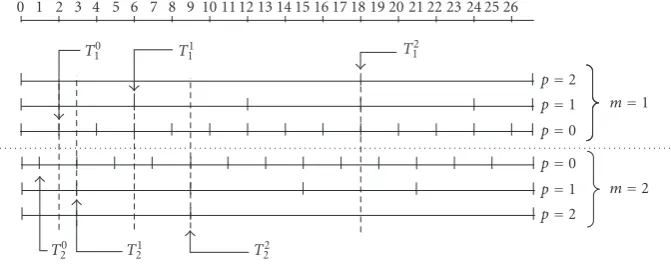
Finally, we illustrate the manner in which the significance thresholds are computed, in the particular case of an EMDSQ instantiation [10] with M = 2, as depicted in Figure 2. For the coarsest quantization accuracy, p = P, the starting thresholds corresponding to each channel areT1P =2T and
TP
2 =T, respectively. Since it is not desirable that the
quan-tizer is characterized by an overload region, theTvalue is re-lated to the highest absolute magnitudewmaxof the wavelet
coefficients as
T=3log3(wmax/3)+1. (15)
Hence, the maximum number of quantization levels isP = log3(wmax/3) + 1. In general, for p < P, the significance
thresholds used for each channelm=1, 2 are given by
Tmp = T P m
3P−p. (16)
3.2. Enhanced MD-QT image codec
This section introduces an improved version of the MD-QT approach presented inSection 3.1. To start with, it is impor-tant to observe that the MD-QT coder described above ap-plies the MD coding paradigm only at the level of produc-ing multiple quantized (and coded) representations of the wavelet coefficients. However, the output bitstreams are not composed solely of this type of information, but also of ad-ditional localization (or QT) information. Practically, the QT information is the data stored in the output stream generated by encoding the locations of the significant leaf nodes, as ob-tained by (11) for each applied threshold. Motivated by this observation, we extend in this section the MD paradigm to all types of information generated by the coder, thus provid-ing an enhanced version of MD-QT codprovid-ing. As demonstrated experimentally, in case of erasures, this will lead to a system-atically better rate-distortion performance in comparison to the MD-QT coder presented inSection 3.1.
0 1 2 3 4 5 6 7 8 9 10 11 12 13 14 15 16 17 18 19 20 21 22 23 24 25 26 T0
1 T11 T21
T0
2 T21 T22
p=2 p=1 p=0 p=0 p=1 p=2
m=1
m=2
Figure2: Example of a three-level representation ofQmp for two-description EMDSQ (M=2, 0≤p≤2) with granular region ranging from 0 to 26. The significance-map coding is performed with respect to the set of thresholdsTmp, as defined by (16).
EMDSQ. The level of redundancy between the side quantiz-ers’ output can be adjusted via theindex allocation(IA) of the EMDSQ [26] and is related to the channel probability of failure.
At every quantization level, each MD output stream is composed of the following encoded symbols: the quantized information, the sign information, and the QT information. The quantized and sign information are generated during the significance and refinement passes. For each quantiza-tion symbol resulting from the significance pass, we have a corresponding QT piece of information that serves to local-ize the position of the corresponding sample in the wavelet-transformed image.
The distribution of the symbols generated for a single coding step, corresponding to one quantization levelpis il-lustrated inFigure 3. Additionally,Table 1gives the relative percentage magnitude of each symbol type within the total number of symbols for each of the first five coding steps, cor-responding to the quantization levelsp,P−4≤p≤P.
The numbers are calculated by averaging, for each cod-ing step, the number of symbols obtained by encodcod-ing a set of ten images. Notice that for the first coding step, there are no refinement symbols and that the number of sign symbols equals the number of quantization symbols. This experiment reveals that at least half of the amount of information con-tained in the output stream at each coding pass consists of QT symbols.
Now, let us consider that each of the descriptions is sepa-rately packetized and transmitted over the network. It is ob-vious that in the case of an erasure at the level of the quan-tization symbols (both the significance and refinement sym-bols), these symbols can be recovered with a certain fidelity from the received description at the decoder side. In the case of lost sign data for one description, the second description will provide complete recovery since the sign information is completely redundant in each description. However, the QT information needs to be protected against potential errors as well. In fact, if compared to the impact of errors occurring on quantization information, the errors that occur at the level of QT information will have a greater impact on the decoded
Levelp
QT symbols Refinement symbols
Quantization symbols
Sign symbols
Figure3: Distribution of the symbols generated in a coding pass of a MD-QT coding system.
Table1: Distribution of the coding symbols in a bitstream gener-ated in the first five coding passes of a wavelet-based MD-QT coding system.
Quantization level P P−1 P−2 P−3 P−4
Sign symbols (%) 13 23 21 19 16
Quantization symbols (%) 13 23 21 19 16
Refinement symbols (%) 0 5 8 10 12
QT symbols (%) 74 49 50 52 54
data. Indeed, if there is no mechanism that correlates the QT information among the different descriptions, then there is no way to enable QT data recovery from a received descrip-tion.
From the above discussion, the following conclusions can be drawn.
(i) Despite the fact that multiple descriptions are pro-vided by the system ofSection 3.1, the MD principles are limited only to the quantization and sign informa-tion. The information represented by the QT symbols is nevertheless present in all descriptions, but is not correlated, thus leading to the impossibility of recov-ering such data in case of erasures.
0 1 2 3 4 5 6 7 8 9 10 11 12 13 14 15 16 17 18 19 20 21 22 23 24 25 26 T0
1 T11 T21
T0
2 T21 T22
p=2 p=1 p=0 p=0 p=1 p=2
m=1
m=2
Figure4: Three-level representation ofQmp for a two-channel EMDSQ (M =P =2, 0≤ p ≤2) for an example with granular region ranging from 0 to 26. The significance-map coding is performed for each of the two descriptions with respect to the set of thresholds (T1P,T2P),. . ., (T10,T20).
In the following, we present a new QT encoding approach that will lead to redundant QT information among the re-sulting descriptions. The starting point in this design is the coding scheme described in Section 3.1. Similar to this scheme, each coding step is composed ofsignificanceand re-finement passes, with the exception of the first step, corre-sponding to the coarsest quantization level, in which only the significance pass is performed.
It is important to observe that in order to produce sim-ilar QT (i.e., localization) information for all descriptions, we need to apply a common set of significance thresholds when we construct the descriptions. A simple solution to obtain such a set is to combine the different sets of sig-nificance thresholds used to generate each distinct descrip-tion in the MD-QT scheme ofSection 3.1. Consider for ex-ample the EMDSQ instantiation depicted in Figure 2. In this case, the first set of thresholds isT1P,T1P−1,. . .,T10 and
the second set of thresholds is T2P,T2P−1,. . .,T20, where Tmp
is given by (16). The common set of thresholds will be of the form (T1P,T2P), (TP−1
1 ,T2P−1),. . ., (T10,T20).Figure 4
de-picts the same EMDSQ instantiations as given in Figure 2. It is noticeable that in the case of enhanced MD-QT, two thresholds correspond to each quantization level. This results into two significance passes and one refinement pass for each coding step. In general, by following this approach of merg-ing the sets of significance thresholds, the algorithm will per-formMsignificance passes and one refinement pass for every coding stagep, p < P.
4. EXPERIMENTAL RESULTS
In this section, we present experimental results testing dif-ferent aspects of our proposed approach. For all the experi-ments presented in this section, the MDC system is providing a number of two descriptions.
The first set of experiments focuses on (i) the redundancy control mechanism and (ii) the comparative performance as-sessment between instantiations of EMDSQ and the state-of– the-art MDUSQ of [14]. In order to demonstrate the redun-dancy control mechanism, three instantiations of EMDSQ at
different overall redundancy levelsare employed in the MD-QT coding system. The MD-MD-QT yieldingρ = 0.9 employs an EMDSQ instantiation that corresponds to a two-diagonal embedded IA [26,27]. It is noticeable that the EMDSQ cells are not disconnected in this case. The MD-QT yielding a total redundancy ofρ=0.4 employs an EMDSQ instantiation that corresponds to a two-diagonal embedded IA for all quantiza-tion levels except the finest one (p=0) [8,11]. For the finest quantization level, we allocate no redundancy in between the two descriptions. Following the notations fromSection 2.2, this can be written asN0=(L0)2. It is noticeable that for the
last quantization level, EMDSQ employs disconnected cells [8,11]. Finally, for the last employed EMDSQ instantiation we allocate no redundancy at all for the final two quantiza-tion levels, that is,N0=(L0)2andN1=(L1)2. This case will
result in a total redundancy value ofρ=0.3. [8,11]. Figure 5 depicts the rate distortion behavior of the MD-QT central decoder employing the above-mentioned EMDSQ instantiations. The experiments demonstrate that both the overall redundancy and redundancy per each quan-tization level can be controlled. Additionally, (9) suggests that one can adapt the EMDSQ in order to provide an un-equal error protection scheme where we can tune the re-dundancy according to the importance of the layer being encoded—for example, more redundancy can be allocated to the base layer (corresponding to the coarser quantization levels) and less to the enhancement layers, corresponding to the finer quantization levels.
Additionally, Figure 5 shows the rate-distortion results obtained with MD-QT incorporating MDUSQ at an over-all redundancy ρ = 0.9. It is important to notice that for EMDSQ, it is possible to control the redundancy at each dis-tinct quantization level, while the MDUSQ do not feature this important control mechanism. These results show also that at the same redundancy level, EMDSQ outperforms the state of the art on the whole range of rates.
25 30 35 40 45 50
0 0.5 1 1.5 2 2.5 3 3.5
Rate (bpp)
Cent
ra
l
P
SNR
(dB)
EMDSQρ=0.3 EMDSQρ=0.4 EMDSQρ=0.9
MDUSQρ=0.9 SDC
(a)
25 30 35 40 45 50
0 0.5 1 1.5 2 2.5 3 3.5 4 4.5 Rate (bpp)
Cent
ra
l
P
SNR
(dB)
EMDSQρ=0.9 EMDSQρ=0.4 EMDSQρ=0.3
MDUSQρ=0.9 SDC
(b)
Figure5: Comparative central rate-distortion performance for SDC and MD-QT incorporating the EMDSQ at different overall redundan-cies and MDUSQ of [7] applied on the (a) Lena and (b) Goldhill images.
lesser protection level (which will be reflected in less redun-dancy between the two descriptions), the rate-distortion gap between the SD and MD coders can be narrowed.
The goal of the second sets of experiments from this sec-tion is to evaluate the performance of the proposed MD-QT codecs operating in a realistic data communication sce-nario. Transmission systems are increasingly using packeti-zation techniques. Therefore, we will asses how our error-resilient MD-QT systems are able to cope with packet losses in comparison to the equivalent single-description coding (SDC) system based on QT coding.
For this purpose, the output stream is divided into pack-ets and is transmitted via the channel. We assume that the employed packetization method provides packets with a number of payload bytes representing the coded data plus sufficient header information. The header information will allow detecting the lost packets at the decoder side, and thus the correct sequencing of the remaining packets could be maintained. In the following experiments, we chose a packet payload of 640 bytes. For each probability of loss, all the pos-sible erasure patterns are explored and the resulting PSNR values are averaged, as described next.
Let us consider a certain number of packetsNthat are to be transmitted, and letpLbe the average packet-loss proba-bility. The average number of packets being lost isk=pL·N, and there will beNkcombinations to losekpackets out of N. The average distortion is then calculated by measuring and averaging the MSE over all possible combinations.
Three sets of experiments are performed on two standard images, that is, 512×512 gray-scaleLena, andBarbara im-ages, which have been compressed using (i) the simple and (ii) enhanced MD-QT codecs employing EMDSQ, and (iii) the equivalent single-description SQP coder, employing suc-cessive approximation quantization.
In a first round of experiments, we transmit N = 14 packets, corresponding to a coding rate of 0.27 bit per pixel (bpp). For this test, we use a channel model with a loss rate varying between 0% and 35%. Although 35% may seem high for current networks, such high loss rates commonly occur with wireless networks and on the Internet at peak times. The results given in Figure 6 show that in case of no error, the SDC system (i.e., SQP) provides better per-formance. On the other hand, in the presence of errors, even with a small probability of failure, the SDC system experiences a large drop in performance. This justifies the need for MD coding and demonstrates the robustness of the proposed approach over a broad range of packet-loss rates.
These results also demonstrate that generating common QT information for both descriptions by using a common significance threshold set comes at practically no cost in the error-free case, and significantly improves the performance in the error-prone case. Finally, it is important to point out that these results are systematically observed on a broad set of test images [26].
The results for the second experiment are presented in Figure 7 and demonstrate comparative progressive trans-mission capability (or quality scalability) in the context of communication over error-prone channels for the MD-QT versus SQP. The vertical axis represents the average PSNR obtained for all the possible loss patterns, while the horizontal axis represents the number of received pack-ets.
18 20 22 24 26 28 30 32 34
0 5 10 15 20 25 30 35
Loss (%)
A
ver
age
P
SNR
(dB)
SDC MDC MDC-enh
(a)
18 20 22 24 26 28
0 5 10 15 20 25 30 35
Loss (%)
A
ver
age
P
SNR
(dB)
SDC MDC MDC-enh
(b)
Figure6: Effect of packet loss on average PSNR for all loss patterns for a number of 14 transmitted packets and probability of loss varying between 0% and 35% for (a) Lena and (b) Barbara. The employed coders are the simple MD-QT (MDC) and enhanced MD-QT (MDC-enh) and the corresponding SDC version, SQP.
23 25 27 29 31 33 35
2 4 6 8 10 12 14 16 18 20 22 24 26 Number of packets
A
ver
age
P
SNR
(dB)
SDC MDC
(a)
21 23 25 27
2 4 6 8 10 12 14 16 18 20 22 24 26 28 30 32 34 36 38 40 Number of packets
A
ver
age
P
SNR
(dB)
SDC MDC
(b)
Figure7: Effect of 4% packet loss on average PSNR for progressive transmission of (a) Lena and (b) Barbara. The employed coders are the MD-QT (MDC) and the corresponding SDC version, SQP.
Several conclusions can be drawn from this experiment. First, we can notice that an MD-QT coding system is a ro-bust progressive transmission system since it allows for an increase in image quality with each packet received at the decoder side, in the context of erasures. Second, it is no-ticeable that even for a small error rate and a small num-ber of received packets, the MD-QT coder outperforms the SQP coder by a large margin. Finally, it is noticeable that for MD-QT, the distortion is monotonically decreasing with the number of received packets, while the one of SQP is charac-terized by a plateau effect. This effect indicates that the av-erage SDC performance can no longer be improved as the
probability of correctly receiving an increasing number of packets diminishes drastically.
5. DISCUSSION AND CONCLUSIONS
common localization information across descriptions comes at practically no cost in the error-free case, and significantly improves the performance in the error-prone case.
The advantages of both MD coding systems are demon-strated in the context of image transmission over packet-lossy networks. The experimental results demonstrate that both the overall redundancy and redundancy per quantiza-tion level can be controlled. A comparative performance as-sessment between instantiations of EMDSQ and the state-of-the-art MDUSQ of [14], both incorporated in a common MD-QT coding system, is performed. The experimental re-sults demonstrate that at the same redundancy level, EMDSQ outperforms the state of the art on the whole range of rates.
Finally, we notice that even for a small error rate and a small number of transmitted packets, the MD-QT codec out-performs the single-description coding equivalent (SQP) by a large margin. Moreover, for the MD-QT codec, the distor-tion is monotonically decreasing with the number of received packets, while the SQP codec is characterized by a plateau ef-fect. This justifies the need for MD coding and demonstrates the robustness of the proposed approach over a broad range of packet-loss rates.
These results show that while transmitting over reliable links, the coding penalty associated with the proposed MD approaches versus single-description coding is controllable and can be reduced by reducing the overall redundancy. In other words, the “cost” of MDC can become negligible, while preserving significant benefits when transmitting over error-prone channels.
ACKNOWLEDGMENTS
This work was supported by the Federal Office for Scientific, Technical, and Cultural Affairs (IAP Phase V - MOTION), EU (IST SUIT), and the Fund for Scientific Research - Flan-ders (FWO) (Project G.0053.03 and Postdoctoral Fellowships P. Schelkens and A. Munteanu).
REFERENCES
[1] D. Taubman and M. W. Marcelin,JPEG2000: Image Compres-sion Fundamentals, Standards, and Practice, Kluwer Academic, Norwell, Mass, USA, 2002.
[2] L. Ozarow, “On a source-coding problem with two channels and three receivers,”The Bell System Technical Journal, vol. 59, no. 10, pp. 1909–1921, 1980.
[3] V. A. Vaishampayan, “Design of multiple description scalar quantizers,”IEEE Transactions on Information Theory, vol. 39, no. 3, pp. 821–834, 1993.
[4] Y. Wang, M. T. Orchard, V. Vaishampayan, and A. R. Reibman, “Multiple description coding using pairwise correlating trans-forms,”IEEE Transactions on Image Processing, vol. 10, no. 3, pp. 351–366, 2001.
[5] V. K. Goyal and J. Kovaˇcevi´c, “Generalized multiple descrip-tion coding with correlating transforms,”IEEE Transactions on Information Theory, vol. 47, no. 6, pp. 2199–2224, 2001. [6] R. Puri and K. Ramchandran, “Multiple description source
coding using forward error correction codes,” inProceedings of 33rd the Asilomar Conference on Signals, Systems, and Com-puters, vol. 1, pp. 342–346, Pacific Grove, Calif, USA, October 1999.
[7] A. I. Gavrilescu, A. Munteanu, P. Schelkens, and J. Cornelis, “Embedded multiple description scalar quantizers,”IEE Elec-tronics Letters, vol. 39, no. 13, pp. 979–980, 2003.
[8] A. I. Gavrilescu, A. Munteanu, J. Cornelis, and P. Schelkens, “Generalization of embedded multiple description scalar quantizers,”IEE Electronics Letters, vol. 41, no. 2, pp. 63–65, 2005.
[9] A. I. Gavrilescu, A. Munteanu, P. Schelkens, and J. Cornelis, “Embedded multiple description scalar quantizers for pro-gressive image transmission,” in Proceedings of IEEE Inter-national Conference on Acoustics, Speech, and Signal Process-ing (ICASSP ’03), vol. 5, pp. 736–739, Hong Kong, April 2003.
[10] A. I. Gavrilescu, A. Munteanu, J. Cornelis, and P. Schelkens, “High-redundancy embedded multiple-description scalar quantizers for robust communication over unreliable chan-nels,” inProceedings of 5th International Workshop on Image Analysis for Multimedia Interactive Services (WIAMIS ’04), Lis-boa, Portugal, April 2004.
[11] A. I. Gavrilescu, A. Munteanu, J. Cornelis, and P. Schelkens, “A new family of embedded multiple description scalar quantiz-ers,” inProceedings of IEEE International Conference on Image Processing (ICIP ’ 04), vol. 1, pp. 159–162, Singapore, October 2004.
[12] V. A. Vaishampayan and J. Domaszewicz, “Design of entropy-constrained multiple-description scalar quantizers,” IEEE Transactions on Information Theory, vol. 40, no. 1, pp. 245– 250, 1994.
[13] V. A. Vaishampayan and J.-C. Batllo, “Asymptotic analysis of multiple description quantizers,”IEEE Transactions on Infor-mation Theory, vol. 44, no. 1, pp. 278–284, 1998.
[14] T. Guionnet, C. Guillemot, and S. Pateux, “Embedded multi-ple description coding for progressive image transmission over unreliable channels,” inProceedings of IEEE International Con-ference on Image Processing (ICIP ’01), vol. 1, pp. 94–97, Thes-saloniki, Greece, October 2001.
[15] A. Munteanu, J. Cornelis, G. Van der Auwera, and P. Cristea, “Wavelet-based lossless compression scheme with progres-sive transmission capability,” International Journal of Imag-ing Systems and Technology, vol. 10, no. 1, pp. 76–85, 1999.
[16] A. Munteanu, J. Cornelis, G. Van der Auwera, and P. Cristea, “Wavelet image compression—the quadtree coding approach,” IEEE Transactions on Information Technology in Biomedicine, vol. 3, no. 3, pp. 176–185, 1999.
[17] C. Dumitrescu and V. Seleacu, Some Notions and Questions in Number Theory, American Research Press, Rehoboth, NM, USA, 1998.
[18] N. Farvardin and J. W. Modestino, “Optimum quantizer per-formance for a class of non-Gaussian memoryless sources,” IEEE Transactions on Information Theory, vol. 30, no. 3, pp. 485–497, 1984.
[19] H. Gish and J. Pierce, “Asymptotically efficient quantizing,” IEEE Transactions on Information Theory, vol. 14, no. 5, pp. 676–683, 1968.
[20] C. K. Chui and R. Yi, “System and method for nested split coding of sparse data sets,” US patent no. 5748116, Teralogic, Menlo Park, Calif, USA, 1998.
[22] A. Munteanu, Wavelet image coding and multiscale edge detection—algorithms and applications, Ph.D. thesis, Depart-ment of Electronics and Information Processing (ETRO), Brussels, Belgium, 2003.
[23] P. Schelkens, A. Munteanu, J. Barbarien, M. Galca, X. Giro-Nieto, and J. Cornelis, “Wavelet coding of volumetric medical datasets,”IEEE Transactions on Medical Imaging, vol. 22, no. 3, pp. 441–458, 2003.
[24] A. Said and W. A. Pearlman, “A new, fast, and efficient im-age codec based on set partitioning in hierarchical trees,” IEEE Transactions on Circuits and Systems for Video Technol-ogy, vol. 6, no. 3, pp. 243–250, 1996.
[25] K. Parsaye and M. Chignell,Expert Systems for Experts, John Wiley & Sons, New York, NY, USA, 1988.
[26] A. I. Gavrilescu,Multiple descriptions scalar quantizers—theory and applications, Ph.D. thesis, Department of Electronics and Information Processing (ETRO), Brussels, Belgium, 2006. [27] A. I. Gavrilescu, A. Munteanu, J. Cornelis, and P. Schelkens,
![Figure 5: Comparative central rate-distortion performance for SDC and MD-QT incorporating the EMDSQ at different overall redundan-cies and MDUSQ of [7] applied on the (a) Lena and (b) Goldhill images.](https://thumb-us.123doks.com/thumbv2/123dok_us/890982.1586531/8.600.66.541.72.287/comparative-distortion-performance-incorporating-dierent-redundan-applied-goldhill.webp)