
R E S E A R C H
Open Access
The application of image analysis
technology in the extraction of human
body feature parameters
Pengcheng Wei
1*, Jiao Jiang
2and Li Li
1Abstract
With the improvement of living standards, personalized clothing customization has become a trend of people’s apparel demand. The key factor in personalized clothing customization is a three-dimensional human modeling. With the development of image analysis technology, it is possible to use image analysis technology to extract human characteristics. In this paper, two-dimensional human feature regions and characteristic parameter extraction methods of images are used. The backpropagation neural network (BP neural network) is used to curve the three-dimensional human characteristics, and the neck, chest, waist, and buttocks of 22 subjects are verified. The results show that the use of this method can well achieve the extraction of human characteristic parameters.
Keywords:Image analysis, Human characteristics, BP neural network, Feature extraction, Computer-aided design (CAD)
1 Introduction
As an integral part of computer human simulation, a three-dimensional (3D) human modeling has always been one of the hot topics in computer graphic research. Com-puter human body modeling can construct a highly realis-tic virtual human body, which has been widely used in various fields, such as garment computer-aided design (CAD), animation production, and scene simulation, and has attracted the attention and research of many scholars. With the development of a three-dimensional scanning reconstruction technology and a three-dimensional hu-man body modeling technology, the computer-aided three-dimensional garment design system is an integration and synthesis of three-dimensional human body measure-ments, dimension information extraction, apparel design, virtual fitting, animation simulation, and customization, sales, and display of the Internet. The computer-aided three-dimensional garment design system can realize the virtual review and inspection of garments before the for-mal forfor-malization of garments, identify problems, and im-prove them in a timely manner. At the same time, it
enhances user participation, reduces risks, shortens the design production cycle, and reduces cost.
3D human modeling has always been a challenging problem. The human body is an extremely complex geo-metric body. Since the middle of the twentieth century, 3D human modeling technology has been widely studied and applied. During this period, many different implemen-tations have emerged. The main human modeling methods can be summarized as follows: three-dimensional wireframe model [1], three-dimensional solid model [2,3], three-dimensional surface model [4], and physics-based three-dimensional modeling [5]. The 3D wireframe model was first used to represent virtual 3D human model. The three-dimensional wireframe model simulates a three-dimensional human body shape from a combin-ation of points, lines, arcs, and various parametric curves. Although the structure is simple and the oper-ation is convenient, it conforms to the habit of people proofing. The three-dimensional solid modeling in-cludes two parts: one part is the definition and descrip-tion of voxels (cuboids, spheres, cylinders, cones, etc.), and the other part is the set of operations between vox-els (combination, difference, intersection, etc.). Surface modeling mainly studies the mathematical description of a surface profile with a certain degree of smoothness. Surface modeling, also known as surface modeling, is * Correspondence:[email protected]
1School of Mathematics and Information Engineering, Chongqing University
of Education, Chongqing, China
Full list of author information is available at the end of the article
one of the most commonly used human modeling methods. Surface modeling is used to fit partially discrete data points on a surface to get a smooth transi-tion of the surface, so as to achieve the reconstructransi-tion of the original surface. It can provide three-dimensional body surface information, making hidden line elimin-ation and realistic 3D human model display. The mod-eling based on physical characteristics is to add physical characteristics of human body to its geometric model and simulate it through numerical calculation, and then, human behavior is determined automatically in the process of simulation.
In anthropometry, the human body feature point refers to the demarcation point used to represent the measure-ment position, and it is usually located at the prominent part of the muscle under the human body and at the ar-ticular junction. In the 3D garment design, feature points such as the head vertex, acromion point, nipple point, osteotome point, metatarsal point, and perineal point of the human body need to be extracted. For the extraction of human feature points, domestic and for-eign scholars have conducted a lot of relevant research [6–10]. In image-based 3D human model reconstruction technology, the extraction of feature points is the basis of image analysis and image matching, and it is also one of the important tasks of single-photo processing. The features in the digital image include point features, line features, and surface features in the image. The location of point features is accurate, and it can provide more ef-fective 3D information. Therefore, there are many re-searches on point feature extraction algorithms [11–14].
The BP neural network analysis is a non-parametric es-timation method that constitutes the interpretation scheme that can best simulate and analyze the target his-torical data. The BP neural network is mainly rooted in a technique such as neuroscience, mathematics, statistics, physics, computer science, and engineering [15–19]. In the aspects of human modeling and surface modeling, BP neural network as a powerful tool for modeling nonlinear systems can not only simplify the calculation of modeling but also consider the influencing factors between systems. Therefore, some scholars apply neural network technology to human body modeling, human motion modeling, and surface modeling.
The three-dimensional personalized human modeling method proposed in this paper, through the user’s photo image processing to mention the human body contour and key feature areas and feature points to identify, gets the user’s key parts of the feature parameter information. Then, the network is trained by scanning enough human body scan data in the human body database to obtain a neural network model that can reflect human body characteristics (human body feature cross-section rings). According to the parameter information of the key parts
such as height, chest circumference, waist circumfer-ence, and hip circumference obtained from the previous input, the neural network model obtained by training is directly generated to generate the human body charac-teristic curve that matches the real human body shape. Starting from the user’s photo information, a similar hu-man body matching the user’s human body is searched in the 3D scanning human body database.
The main contributions of this article are as follows:
1) Construct a human body model using BP neural network
2) Establish a human body feature parameter model 3) Establish a personalized human body 3D model
method
2 Proposed method
2.1 Image binarization processing method
When the image is captured in this article, the camera is at rest and the focal length of the lens is fixed. The back-ground area in the image is fixed. The basic principle of differential image processing is to differentiate the gra-dated image in the detection area from the background image in the image space domain, which can be expressed as follows:
Dfi;fiðx;yÞ ¼ f xð ;y;tiÞ−f x ;y;tj ð1Þ
In the formula, f(x,y,ti) and f(x,y,tj) are the brightness values of a pixel at location (x,y) intiandtj, and its size is between 0 and 255. The significant difference of f(x,y,ti) andf(x,y,tj) in pixel brightness at location (x,y) is as follows:
siþsj
2 þ
mi−mj
2
2
h i2
sisj >t ð2Þ
In the formula,mkandsk(k=i,j) are the mean and vari-ance of (x,y,tk), which are in neighborhood (x,y) of (x,y). The letter“t” is the threshold. If formula (3.2) holds, the brightness off(x,y,ti) and f(x,y,tj) are significantly differ-ent at the position (x,y), chooseDfi, fj(x,y) = 1; If formula (2) is not established and then chooseDfi,f(x,y) = 0.
value of the difference between the pixel values in the two images is smaller than the threshold, the two pic-tures are considered to be the same for the correspond-ing two points, and the default is the background pixel, which is set to 0, that is, black. If it is larger than the threshold, it is considered that the pixel values of the corresponding pixel in the two pictures are different, which means that the point in the person picture is a person, not a background, and the pixel value of the point is retained. If you want to perform binarization directly, set this point directly to 255, which is white. After traversing all the pixels, new image data can be ob-tained. In this data, the pixel value of the background pixel has been set to 0, and the pixel value of the human pixel is the pixel value of the corresponding point in the human picture or is set to 255 (binarization).
2.2 Human character calculation method
The size of the cross-section of some feature points on the human body model plays an extremely important role in clothing. For example, the circumference of the cross-section of the chest feature point is the bust, and the circumference of the cross-section of the waist fea-ture point is the waist circumference. In addition, some dimensions between feature points and some reference planes, feature points, and feature points also play an important role in apparel, and these dimensions are col-lectively referred to as feature sizes. We need to recognize the feature region of the human body before we get the feature size of the human body. The recogni-tion of the human body region is mainly achieved by the method of projecting pixel values on they-axis.
Taking the head as an example, only the human body area is a white point in the picture, and the rest are black spots. Scan from top to bottom, when a white point ap-pears for the first time in a row, it indicates that the head area starts. After the start, scanning is continued and the number of white pixels in each row is recorded. In gen-eral, the head structure is changed from small to large, and then from large to small, into the neck region. So you can identify the head by judging the number of pixels in each row. When the pixel point changes from big to small, the number of white pixels in the top row of the recording head is the largest. This row corresponds to the widest part of the head. It is not possible to increase the size of the head until it enters the chest. A threshold can be set in the program. When the head becomes smaller from the second time, it reaches 1.2 times the maximum position, and it can be judged that it has entered the chest area. The number of pixels of each part is obtained after the area is determined. The calculation method for calculating the body height, the length of the upper arm, the length of the leg, the length of the trunk, and the width of the body such as the body width is as follows:
Suppose the camera has a CCD target size of H(c) ×W(c)(mm), where H(c) is the height of the tar-get surface CCD and W(c) is the target width. As-suming that the item distance is u(mm), CCD image size is H(i) ×W(i)(pixel), and the circumscribed rect-angle of the detected body is H(r) ×W(r)(pixel), then the height, Sg(mm), of the human body is as follows:
Sg¼kuf H rH ið Þ
ð ÞH cð ÞðmmÞ ð3Þ
In the formula, f(mm) is the focal length; k is the model correction coefficient, and it is determined by ex-periment. We take 1.07 in this program. With a known height, the actual size of other parts of the body can be derived from the ratio of the number of pixels in other parts of the body and the number of height pixels. For example, when the leg length is L(pixel), the actual length of the leg Tc(mm) is as follows:
Tc¼H rL
ð ÞSgðmmÞ ð4Þ
2.3 BP neural network
The basic BP neural network algorithm is as follows: (1) The initialization of the network is mainly to give the initial input vector and set the target output.
Assumed sample set (xk,yk), where k= 1,2,3…., N, and Oiis the output of any node i. When the kth sample is input, the input of thejth cell in a certain layer is shown in formula (2.12):
Netjk ¼ X
iWijOik ð5Þ
Among them, Oik is the output of the previous layer ith unit. So the output of node j is Oik=f(netjk), using square error functions:
Ek ¼1 2
X
i
yik−yik
2
ð6Þ
In the formula,yikis the actual output of uniti. (2) Output of hidden layer and output layer. If nodejis an output node, thenOjk=yjk, then
δjk ¼ ∂Ek ∂netjk ¼
∂Ek ∂yjk
∂yjk
∂netjk ¼− yk−yk
f0 net
jk
ð7Þ
If nodejis a hidden node, then
δjk ¼ ∂Ek ∂netjk ¼
∂Ek ∂Ojk
∂Ojk ∂netjk ¼
∂Ek ∂Ojk f
0 net
jk
ð8Þ
calculation ∂Ek
∂Ojk should be counted back from the next
layer of nodej.
(3) The BP algorithm is as follows:
wijðtþ1Þ ¼wijð Þt −η ∂E
∂wij ð9Þ
In the formula,ηis the learning parameter.
The photos of each subject are binarized, then each part is extracted, and the features of each part are com-posed into feature vectors, which are used as input vec-tors of BP neural network, and the characteristics of other subjects are used as background vectors. The tar-get subject’s characteristic output value is defined as 1; the background feature output value is defined as 0.
3 Experiments and results 3.1 Participants in the experiment
The participants in this article are from college students in a university. Among them, there are 11 males and 11 females. The male weight is 55 ± 15 kg, the male height is 1.6 ± 0.3 m, the female weight is 50 ± 10 kg, and the height is 1.5 ± 0.2 m.
3.2 Picture acquisition
There are 200 images of life taken by the mobile MI 4, and the image size is 92 × 112. The image is converted into a BMP (Bitmap) format by a JPEG (Joint Photo-graphic Experts Group). In order to avoid specific fea-tures, we divided the subjects’samples into 10-cross fold methods and divided 200 samples into 10 samples. One sample was used as a test sample, and 9 samples were used as training samples.
3.3 Training parameters
In this paper, neural networks are used as the three hid-den neurons in the three layers, and the convergence limit of neural network approximation is 0.001.
3.4 Lab environment
The data processing in this paper is performed in MATLAB R2014b 8.4 software environment. The main parameters of the hardware environment are Intel Core i7-4710HQ quad-core processor, Kingston DDR3L 4G memory, and operating system is Windows 7 Ultimate 64-bit SP1.
4 Discussion
4.1 Human body fitting results
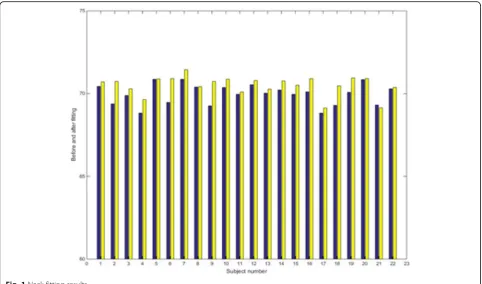
Using the neural network in the second part of this art-icle, 22 individuals were trained on the neck, chest, waist, and buttocks, and the human curve characteristics were trained, as shown in Fig. 1 for neck fitting results. As can be seen from the results in Fig.1, the average of
the first 22 subjects was 69.96. After fitting, the neck feature was 70.50. The variance before fitting was 0.62, and the variance after fitting was 0.57. This method can fit the neck curve well.
Figure 2 shows the comparison of hips before and after fitting. From the results of Fig. 2, we can see that the average before hip fitting was 72.59, the mean after fitting was 72.69, and the standard deviations before and after fitting were 4.67 and 4.2, respectively. From a nu-merical point of view, the hip curve fitting results are good. From the standard deviation point of view, the standard deviations before and after the fitting are large. The reason for this result is that there is a large differ-ence in hip circumferdiffer-ence between the subjects. How-ever, the difference between the standard deviation before and after the fitting is only 0.47, which further shows that the fitting result is also ideal when the input hip circumference is relatively different.
Figure 3 shows the fitting results of the chest. Before fitting, the average of 22 subjects was 70.02, the mean after fitting was 70.56, the mean before fitting was 0.61, and the mean after fitting was 0.57. Chest fitting results are better.
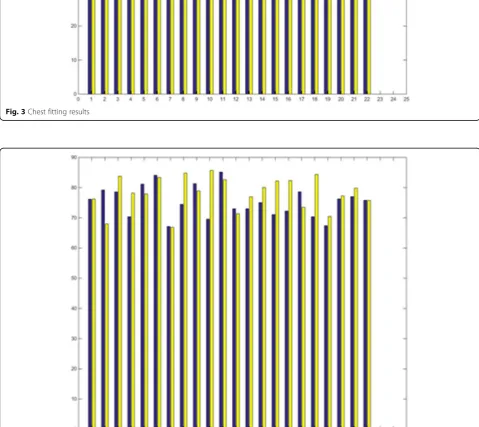
Figure4shows the waist fitting results. From the results, the average value of the subjects’waist input parameters is 75.33, the output fitting result is 78.20, the standard devi-ation of the input parameters is 5.04, and the standard de-viation of the output parameters is 5.47, although the comparison of the neck, chest, and buttocks has poor re-sults, they still show better fitting results.
Table1shows the input parameters and output param-eter differences of the 22 samples in Figs.1,2, 3, and4. From the difference results, the four sample parameters obtain better fitting results.
Fig. 1Neck fitting results
Fig. 3Chest fitting results
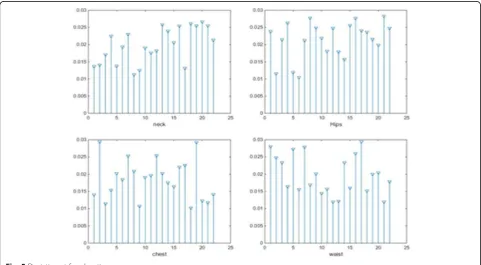
characteristic points on the waist characteristic curve to take the chest characteristic curve as an example were taken; the coordinates of the characteristic points on the standard human breast curve to the corresponding user’s chest and the coordinates of the point on the characteris-tic curve were changed; the standard human chest curve, according to the spline curve and the mesh of the manikin to obtain the polygon fold line closest to the spline curve, was adjusted as well as its shape to make it close to the initial grid-edge shape; and all feature line and dimension information iterative deformation steps until the devia-tions meet the deformation accuracy requirements are up-dated. Figure 5 shows the absolute deviations of human body model design using the above method.
The results in Fig. 5 show that the errors in the four parts of the 22 individuals are 0.019, 0.021, 0.018, and 0.019, respectively, which show that the reconstructed hu-man model and the user have a small difference, thereby providing the possibility to generate a three-dimensional personalized costume design system. The results in Fig.5 show that the fit deviations are different for different subjects, but the deviations are not large.
4.2 Simulation example
The results of the above method can be seen, and using this method can be a good fit to the characteristics of the human body. One of the important applications of human body modeling is personalized clothing design. In the design of clothing, the human body under consid-eration indicates that the requirements of the
Table 1Result of different input parameters
Sample number Neck Hips Chest Waist
1 0.26 0.3 0.28 0.02
2 1.35 1.34 1.34 −11.25
3 0.4 −2.58 0.4 5.15
4 0.81 0.84 0.86 7.81
5 0.01 0.06 −0.04 −3.24
6 1.43 1.42 1.45 −0.71
7 0.57 0.59 0.57 −0.29
8 0.01 0.04 0.07 10.31
9 1.47 1.52 1.42 −2.37
10 0.5 0.51 0.48 16.12
11 0.14 −6.83 0.12 −2.51
12 0.25 0.27 0.29 −1.66
13 0.23 0.29 0.21 3.93
14 0.54 0.54 0.59 5.01
15 0.55 0.57 0.59 11.12
16 0.79 0.84 0.85 10.05
17 0.29 0.34 0.29 −5.15
18 1.17 1.19 1.19 13.98
19 0.87 0.93 0.85 3.07
20 0.06 0.05 0.11 1.01
21 −0.18 −0.15 −0.21 2.81
22 0.08 0.11 0.08 −0.04
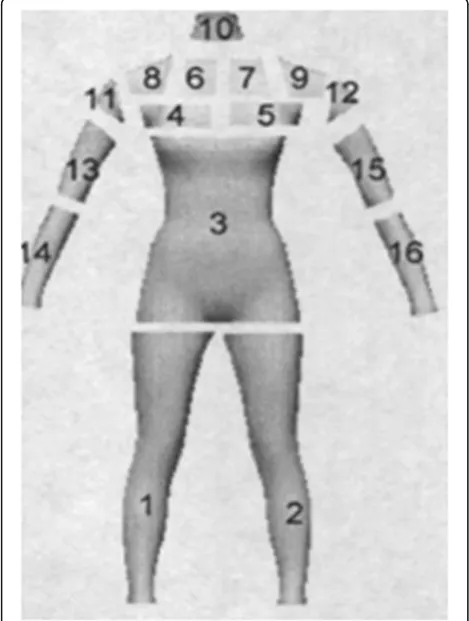
appearance are relatively simple, and the characteristics of the human body can be described by the characteristic curves of several individuals. As shown in the figure, the body features are divided into 16 areas: 1 and 2 represent the leg area; 3 represents the trunk area; 4, 5, 6, and 7 rep-resent the chest area; 8 and 9 reprep-resent the shoulder area; 10 represents the neck area; 11, 12, 13, and 15 represent the upper arm area; and 14 and 15 represent the forearm area. Each area can be seen as a surface patch, and the apex of the grid of the human model is distributed on dif-ferent surface patches. We put these vertex connections to form a mesh surface patch (Fig.6).
After the segmentation is obtained, for tangential rings and characteristic curves, equidistant discrete tangent rings generate mesh vertices, and then, the vertices of the mesh are connected to generate a mesh topology structure. After obtaining all the facial patches, the body surface is sutured; merging the information of the mesh vertices and triangle patches on the sub-surface patch, deleting the common vertex at the junction of adjacent sub-pieces, and regenerating the body mesh. After the adjustment, a surface reconstruction mesh model is finally established, as shown in Fig.7.
After the human body feature grid is acquired, the human body feature fitting curve can be obtained by
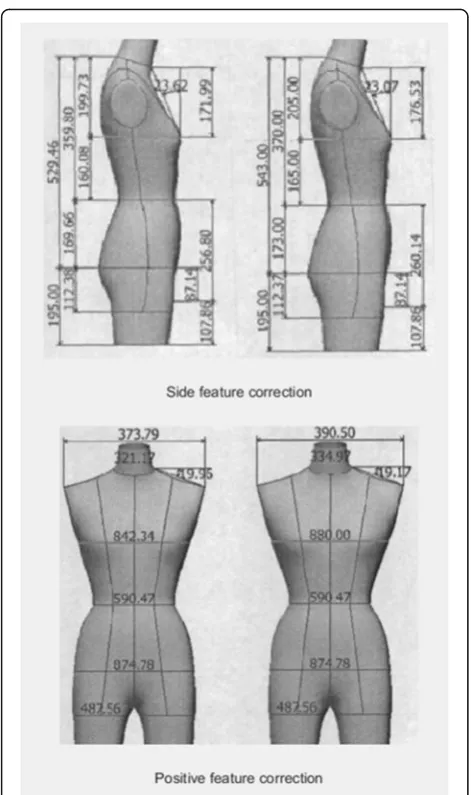
using the above method, then the human body feature curve is corrected. The adjustment step is to firstly find the target feature curve corresponding to the size of the circumference and the target feature line is adjacent. The shape of the surface determines the size of its cir-cumference, and then, the center point of the ring of the body section is determined. Finally, all surfaces are ad-justed and smoothed. The result is shown in Fig.8.
Through practice, it has been proved that the method can fit the human body characteristic curve well and meet the demand of costume design for the human body model.
5 Conclusions
Personalized clothing customization has become one of the important research directions in apparel design and manufacturing. Whether the human body model obtained by the 3D human model can truly reflect the actual human body size and shape depends on the mod-eling principle and the implementation method. This paper presents a three-dimensional personalized human modeling method based on user photos and neural net-works for costume design. The human body size infor-mation (size, outline points, and contour lines) is extracted based on the human body feature region and feature parameters based on the image; the human body three-dimensional cross-section information is generated by the three-dimensional human body
Fig. 6Whole body feature segmentation
feature curve based on the neural network. The similar three-dimensional human body that is searched in the three-dimensional human body database is a body shape information carrier, and the similar three-dimensional hu-man body deformation is driven by the feature size and curve. The obtained information is merged and divided to quickly generate a three-dimensional personal body.
Abbreviations
BP neural network:Backpropagation neural network; CAD: Computer-aided design
Acknowledgements
This work was supported by the Chongqing Big Data Engineering Laboratory for Children, Chongqing Electronics Engineering Technology Research Center for Interactive Learning, the Science and Technology Research Project of Chongqing Municipal Education Commission of China (no. KJ1601401), the Science and Technology Research Project of Chongqing University of Education (no. KY201725C), Basic research and frontier exploration of Chongqing science and Technology Commission (cstc2014jcyjA40019), supported by the project of science and technology research program of Chongqing Education Commission of China. (KJZD-K201801601).
Availability of data and materials We can provide the data.
Authors’contributions
All authors take part in the discussion of the work described in this paper. PW wrote the first version of the paper. JJ and Li Li did the part of the experiments of the paper, and JJ revised the different versions of the paper, respectively. All authors read and approved the final manuscript.
Ethics approval and consent to participate Approved.
Consent for publication Approved.
Competing interests
The authors declare that they have no competing interests.
Publisher’s Note
Springer Nature remains neutral with regard to jurisdictional claims in published maps and institutional affiliations.
Author details
1
School of Mathematics and Information Engineering, Chongqing University of Education, Chongqing, China.2School of Automation, Chongqing
University of Posts and Telecommunications, Chongqing, China.
Received: 1 July 2018 Accepted: 17 September 2018
References
1. J. Mihalik, M. Kasar,Shaping of Geometry of 3D Human Head Model[C]//
Radioelektronika, 2007. International Conference. IEEE(2007), pp. 1–4
2. D. Parker, C.A. Taylor, K. Wang, Imaged based 3D solid model construction
of human arteries for blood flow simulations[C]//Engineering in Medicine and Biology Society, 1998. Proceedings of the International Conference of the IEEE. IEEE2, 998–1001 (1998)
3. M.J. Leo, D. Manimegalai,3D modeling of human faces - a survey[J](2011),
pp. 40–45
4. C. Huang, A. Luximon, K. Yeung, Functional 3D human model design: a
pilot study based on surface anthropometry and infrared thermography[J].
Computer-Aided Design and Applications12(4), 475–484 (2015)
5. E. Promayon, P. Baconnier, C. Puech, Physically-based model for simulating the
human trunk respiration movements[J]. CVRMed-MRCAS’971205, 379–388 (1997)
6. P. Jin, Y.U. Bian, W. Da, et al., Multi-scale symmetry transform with
application to location of feature points on human face image[J]. Acta Electron. Sin.30(3), 363–366 (2002)
7. G.U. Hua, S.U. Guang-Da, D.U. Cheng, Automatic localization of the vital
feature points on human faces[J]. Journal of Optoelectronics Laser15(8),
975–979 (2004)
8. J. Tang, X. Liu, H. Cheng, et al.,Gender recognition with limited feature points from 3-D human body shapes[J](2012), pp. 2481–2484
9. M.A. Yan-Ni, G.H. Geng, M.Q. Zhou, Localization and extraction for feature
points of human faces[J]. Computer Engineering & Applications45(18),
167–170 (2009)
10. S. Sakamoto, Extracting feature points on human eye photographs[J]. Proc
Miru76, 461-464 (1993)
11. S. Sakamoto, Y. Miyao, J. Tajima,Extracting Feature Points on Human Eye
Photographs.[C]//Iapr Workshop on Machine Vision Applications, Mva 1992, December December 7–9, 1992(DBLP, Tokyo, Japan, 1993), pp. 461–464
12. X.J. Zhu, X.Y. Xiong, Human body shapes modeling and feature points
location based on ASM for virtual fitting[C]//Sixth International Conference
on Information Science and Technology. IEEE, 476–481 (2016)
13. T. Kim, K.H. Jo, S.E. Kim, et al., Recognition of free gymnastics using human
body feature points from silhouette and skin region[C]//The, Russian-Korean International Symposium on Science and Technology, 2002. Korus-2002.
Proceedings. IEEE, 150–154 (2002)
14. M.D. Dudley, Recognition of human interactions using limb-level feature
points[J]. Dissertations & Theses - Gradworks, Rochester Institute of Technology, RIT Scholar Works (2009)
15. L. Jiang, J. Zhang, X. Ping, et al., BP neural network could help improve pre-miRNA identification in various species[J]. Biomed. Res. Int.2016, 11 (2016). Article ID 9565689. Hindawi Publishing Corporation. BioMed Research
International.https://doi.org/10.1155/2016/9565689
16. L.I. Ru-Ping, L. Zhu, W.U. Fang-Shen, et al., BP neural network algorithm
improvement and application research[J]. Journal of Heze University (2016) 17. S.U. Xin, H. Pei, W.U. Yingya, et al., Predicting coke yield of FCC unit using
genetic algorithm optimized BP neural network[J]. Chem. Industry Eng. Prog.35(2), 389-396 (2016)
18. C. Liu, W. Ding, Z. Li, et al., Prediction of high-speed grinding temperature
of titanium matrix composites using BP neural network based on PSO algorithm[J]. Int. J. Adv. Manuf. Technol.89(5–8), 1–9 (2016)
19. B. Wang, X. Gu, L. Ma, et al., Temperature error correction based on BP
neural network in meteorological wireless sensor network[J]. International
![Bis[hydrotris(4 chloro 3,5 dimethylpyrazolyl)borato]nickel(II)](data:image/gif;base64,R0lGODlhAQABAIAAAP///wAAACH5BAEAAAAALAAAAAABAAEAAAICRAEAOw==)