a Walter Eucken Institut, Goethestrasse 10, 79100 Freiburg, Germany, Phone +49.761.79097-0, Fax +49.761.79097-97, [email protected].
b Walter Eucken Institut and Albert-Ludwigs-University Freiburg, Goethestrasse 10, 79100 Freiburg, Germany, Phone +49.761.79097-0, Fax +49.761.79097-97, [email protected].
Heiko T. Burreta and Lars P. Feldb
JEL-Classification: H30, H60, H72
Keywords: Fiscal Federalism, German Debt Brake, Fiscal Compact
It is very tempting to a minister to employ such an expedient [public debt], as enables him to make a great figure during his administration, without overburthening the people with taxes, or exciting any immediate clamours against himself. The practice, therefore, of contracting debt will almost infallibly be abused, in every government.
David Hume (1741).
1. Introduction
In 2009, Germany revised its constitutional provisions for restricting public debt. This reform was the first revision since 1969 and it aimed at curing the shortcom-ings of the previous rules. German constitutions had restricted public debt since the foundation of the German Empire, the Kaiserreich, in 1871. Article 73 RV of the German Empire had stipulated that only in extraordinary circumstances, government bonds could be issued. Regularly, revenue and surpluses from previ-ous years had to cover spending (Article 69 et sequ. RV). The German Laender in these earlier times had been fully autonomous and responsible for their gov-ernment finances. In Article 87 the Weimar Constitution allowed for govern-ment debt only extraordinarily and only in order to finance expenditures that generated returns. In 1933, these constitutional debt restrictions were suspended, but the German Basic Law (Grundgesetz) adopted the same provisions after the Second World War. The Laender had similar provisions.
occurs – government debt could be higher. Only much later, on April 18, 1989 and on July 9, 2007, the German Constitutional Court specified this clause fur-ther by demanding that the government must spell out clearly the existence of a macro-economic disequilibrium and must show that the additional government debt is suitable for correcting the disequilibrium (BVerfGE 79, 311; 119, 96). The possibility to incur higher debt for deficit spending in recessions was introduced at a time when the belief in the effectiveness of Keynesian countercyclical poli-cies was at its peak in Germany. Policymakers were not concerned at all about possibly increasing public debt.
This has changed since, as public debt in Germany has increased markedly during the past four decades. It has meanwhile arrived at levels that are unsus-tainable in the long-run (Burret, Feld and Köhler, 2013). In Section 2 of this paper, we illustrate this situation of public finances in Germany. The reasons that have led to the continuing trend in increasing indebtedness not only in Germany, but also in other countries are outlined in Section 3. The shortcomings of the aforementioned old debt restrictions of the German Grundgesetz introduced in 1969 are discussed in Section 4. The new debt brake that passed in 2009 is ana-lyzed in Section 5 and the necessary changes of this new rule that are induced by the Fiscal Compact of the Eurozone member countries are discussed in Sec-tion 6. Section 7concludes.
2. Public Debt in Germany
Fi g u re 1 : P u bl ic D eb t i n G er m an y i n
% of G
D P , 1 850 –2 01 0 0 20 40 60 80 100 120 140 1850 1853 1856 1859 1862 1865 1868 1871 1874 1877 1880 1883 1886 1889 1892 1895 1898 1901 1904 1907 1910 1913 1916 1919 1922 1925 1928 1931 1934 1937 1940 1943 1946 1949 1952 1955 1958 1961 1964 1967 1970 1973 1976 1979 1982 1985 1988 1991 1994 1997 2000 2003 2006 2009 G eneral go vernment N
ational or F
ederal states
F
ederal lev
el (R
eich or B
und)
240
Collapse of Lehman Brothers – financial
and debt crisis
Softening of the
Stability and
G
ro
wth Pact
R
eunification
Collapse of the
B
retton W
oods
System
D
eutsche Bundes- bank
C urr ency R eform D eutsche M ar k
and in 1949: Federal R
epublic
of G
ermany
Allied Occupation 1945–1949
W orld W ar II 1939–1945 G reat D epr ession 1929–1933 C urr ency R eform “R entenmar k” H yperinflation ~1918–1923 W orld W ar I 1914–1918 Social Legislation of B ismar ck G ründer krach W
ar compen- sation fr
om F rance F ranco-G erman W ar Softening of Ar
t. 115 GG
E
conomic crisis of 1857
Constitutional F
oundation
of the N
or th G erman Confeder-ation Eu ro intr
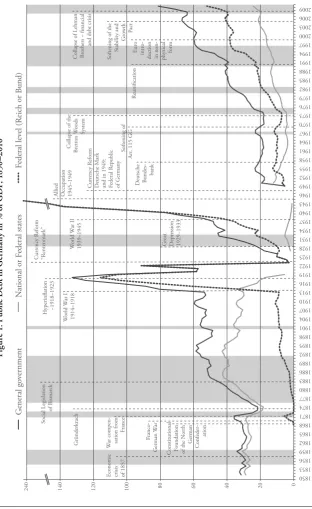
afterwards. (V) The annual accumulation of fiscal deficits led to (ever) increasing debt levels. In 2010 the German debt-to-GDP ratio set a peacetime record. (VI) The development of public debt is surprising since fiscal rules restricting debt and deficits, respectively, have been in place since the formation of the German Empire. Hence, flaws in the fiscal rules are likely to have existed.
The accumulation of government debt was, however, not restricted to a cer-tain government level. In 2011 over two thirds of general public debt was federal, while local public debt only played a minor role (6%). Back in 1973 the munici-pal and federal layers were responsible each for about 40% of total public debt. While the share of general public debt of the Laender (states) was about 20% during the 1960s, it rose to 30% in the following decade and remained around this level until today. Thus, the federal government and the Laender have mainly contributed to the increase in public debt in Germany.
The current situation of sub-federal public finances is worth a closer look: While public debt is not much of an issue in some jurisdictions, public finances are hardly sustainable in others. In 2011 Saarland and Bremen showed the largest per capita deficits, which amounted to 15% and 17% of their total expenditures, respectively. Rhineland-Palatinate and Hesse experienced a similar deteriora-tion in their public finances (9% and 11%). This development seems particu-larly remarkable since public revenues arrived at historical highs in 2011. The deficit accumulation led to increasing debt levels in most states. Only Saxony and Bavaria showed debt-to-GDP ratios (including municipal debt) below 20% in 2011 (Figure 2). While Baden-Wuerttemberg was still part of this “group” back in 2006, it experienced a sharp increase in its debt ratio since then – simi-lar to the fiscal development of most other states. In terms of debt-to-GDP the city states, Saarland, North Rhine-Westphalia, Schleswig-Holstein, Rhineland-Palatinate and Saxony-Anhalt are currently most troubled. A crucial part of the Laender budgets is, thus, captured by interest payments. These costs add up to 600 Euros per inhabitant in Saarland and to almost 1000 Euros in Bremen (Deutsche Bundesbank, 2012a).
Note to Figure 1: Periods of low real GDP growth are indicated by shaded areas (except for war times). Missing data: 1945–1948; for 1920–1926 and 1944–1949 no data for states; for 1915–1926 and 1940–1945 no data for municipalities. Before 1949 fiscal year ends 31st March/1st April. The reference date for 1923 is 15th November. In 1945 debt refers to the level at the end of World War II. General government data includes federal, state and local tiers; since 1954, it includes Federal Special Funds; since 2006, it includes most, and since 2010, all public funds, institutions and companies. Federal level data includes the Mefo bills for 1932–1944.
Figure 2: State (Grey) and Municipal Debt (Black) Including Cash Advances in % of Imputed GDP
0% 10% 20% 30% 40% 50% 60% 70% 80% 90%
2006 2011 2006 2011 2006 2011 2006 2011 2006 2011 2006 2011 2006 2011 2006 2011 2006 2011 2006 2011 2006 2011 2006 2011 2006 2011 2006 2011 2006 2011 2006 2011 2006 2011 BW
BY
BB
HE
MV
NI
NW
RP
SL
SN
ST
SH
TH
BE
HB
HH
Avg.
Note: The imputed GDP is calculated by multiplication of the GDP per capita in Germany with the population in the respective state. Abbreviations of the German federal states accord-ing to ISO 3166: BW = Baden-Wuerttemberg, BY = Bavaria, BB = Brandenburg, HE = Hesse, MV = Mecklenburg-West Pomerania, NI = Lower Saxony, RP = Rhineland-Palatinate, SL = Saar-land, SN = Saxony, ST = Saxony Anhalt, SH = Schleswig-Holstein, TH = Thuringia, BE = Berlin, HB = Free Hanseatic City of Bremen, HB = Free and Hanseatic City of Hamburg.
1 This can be illustrated formally: dt+ (1 +it ) / (1 +yt ) ∗bt−1=bt, where d is the primary budget
to GDP ratio, b is the debt to GDP ratio, i indicates the nominal interest rate, y denotes the nominal growth rate and t the time.
While local public debt is not much of an issue in the aggregate, the fiscal situa-tion varies considerably across local jurisdicsitua-tions. In several Laender, the munic-ipalities increasingly rely on cash advances (Figure 3). Technically the commu-nities are only allowed for borrowing for investment related expenditures. Short term loans for current consumption are merely permitted to temporarily bridge liquidity gaps between financial outflows and the corresponding revenue inflows during a single year. Yet, many municipalities face structural deficits and are, thus, using cash advances in order to finance consumptive spending in the long run. The heavy use of short term borrowing places an additional burden on local finances since interest rates on those loans are mostly less favourable as compared to long-term lending (Heinemann et al., 2009). In 2011 the amount of munici-pal cash advances arrived at an all-time high of 44 billion Euros. The indebted-ness of the municipalities in Saarland, Rhineland-Palatinate and North Rhine-Westphalia roughly doubled in 2011 when adding cash advances (Figure 3). The amount of outstanding cash advances in Hesse has increased by almost 100% since 2008. The heavy use of short term loans is at least partly shaped by the lack of local tax autonomy and an inability to reduce social spending, which is mainly determined by the federal level. In light of the deterioration in local finances, many federal states, e.g. Saxony-Anhalt, Lower Saxony, North Rhine-Westphalia, Hesse, Schleswig-Holstein and Rhineland-Palatinate, have set up (partial) bail-out funds for their communities and cities (Enderlein et al., 2012; Deutsche Bank Research, 2010).
Given the almost steady increase in public debt levels, the sustainability of public finances in Germany seems at least questionable. According to Domar (1944) public finances remain “within manageable limits” as long as the debt-to-GDP ratio is not increasing across time. By assuming that maturing debts and interests are covered by issuing new government bonds, the public debt ratio is sustainable in the long run if primary budgets are balanced and the growth rate of nominal GDP exceeds or equals the nominal interest rate on government bonds.1
Figure 3: Share of Cash Advances on Total Municipal Debt in %
0 10 20 30 40 50 60 70
1995 1997 1999 2001 2003 2005 2007 2009 2011
Brandenburg
North Rhine-Westphalia Saxony
Thuringia Total 0
10 20 30 40 50 60 70
1995 1997 1999 2001 2003 2005 2007 2009 2011
Bavaria Lower Saxony Saarland
Schleswig-Holstein Hesse
0 10 20 30 40 50 60 70
1995 1997 1999 2001 2003 2005 2007 2009 2011
Baden-Wuerttemberg Mecklenburg-West Pomerania Rhineland-Palatinate Saxony-Anhalt
Note: In 2010 the definition of total municipal debt has changed subtly.
(2013) provide time series evidence rejecting the hypothesis of fiscal sustainabil-ity in Germany after the Second World War. Although the annual growth rate of GDP exceeded the annual interest rate in the years 2010–2012, a permanent move towards fiscal sustainability is not in sight. Instead this process primarily results from temporarily low interest rates due to the European debt crisis and dynamic economic growth in the aftermath of the financial crisis.
Figure 4: (Un)sustainability of German Fiscal Policy, 1970–2010 in %
1970 1972 1974 1976 1978 1980 1982 1984 1986 1988 1990 1992 1994 1996 1998 2000 2002 2004 2006 2008 2010
primary budget balance in % of GDP (right hand scale) nominal GDP growth average nominal GDP growth
nominal interest rate average nominal interest rate
20
15
10
5
0
–5
5
4
3
2
1
0
–1
–2
–3
–4
–5
Note: Interest rate on ten-year government bonds.
Sources: Statistisches Bundesamt and IMF.
2 Empirical evidence for Germany suggests rather small effects (Roos, 2007), but there is a continuing debate (see, e.g., Cwik and Wieland, 2011).
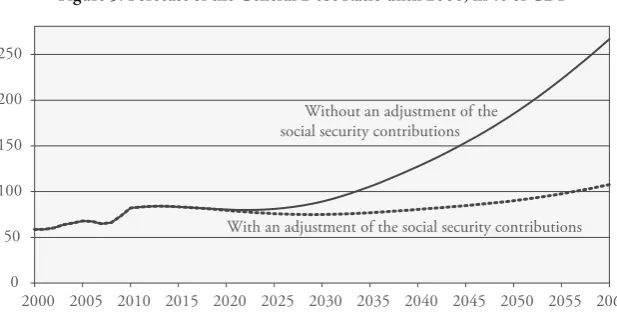
twenty years later (Figure 5). Because an adjustment of social security contri-butions may curb public debt to only 107.7% by 2060, it is not prevented from increasing. In addition to social security reforms further consolidation measures are thus inevitable for sustainable public finances in Germany.
Figure 5: Forecast of the General Debt Ratio until 2060, in % of GDP
0 50 100 150 200 250
2000 2005 2010 2015 2020 2025 2030 2035 2040 2045 2050 2055 2060 Without an adjustment of the
social security contributions
With an adjustment of the social security contributions
Note: A consolidation of 3.2% is assumed for the period 2011–2015.
Source: Sachverständigenrat (2011a).
3. Determinants of Public Debt
In order to successfully restrain a further rise in public debt, the driving forces of fiscal deficits need to be considered. The impact of economic and socio-demo-graphic determinants on public debt is widely accepted. Economic downturns put a burden on public finances as automatic stabilizers imply a reduction of tax revenue and an increase in social spending. While most economists acknowledge that automatic stabilizers should be allowed to work, the effectiveness of further discretionary fiscal policy is controversial since the multiplier effect of such meas-ures is not unambiguous.2 Yet, the fiscal effects of automatic stabilizers should
Supplementary determinants of public debt are constituted by exogenous large-scale events like natural disasters, wars or other extraordinary situations. Imme-diate tax adjustments in order to cover the necessary expenditures implied by such events are hardly appropriate. Instead, welfare gains might be realized by smoothing distortionary taxation over time through public borrowing (Barro 1979). Yet, as it is the case with automatic stabilizers, tax smoothing implies debt to be eventually paid. Hence, tax smoothing can hardly be held accountable for increasing debt levels.
The effects of economic turmoil (shaded areas) and large-scale events, like the two World Wars and Reunification, on public finances in Germany are illustrated by Figure 1. Obviously, these temporary influences explain the development of German public debt only insufficiently. This holds in particular with respect to the missing consolidation in economic upturns. A similar lack of explanation is observed by Mikosch and Übelmesser (2007) regarding the variation of public debt ratios in OECD countries.
The missing link explaining a continuing debt growth (even in cyclical upturns) is provided by political economics. According to this theory, politi-cians act as self-interested, rational individuals restricted by formal and informal rules. The best way for a politician to gain an increase in income, political power and prestige or to serve their constituencies or to realize their individual ideologi-cal goals is to get (re)elected. Politicians thus face incentives to increase spend-ing and decrease taxes, resultspend-ing in deficits. The rationale behind this strategy was stated by Buchanan (1986/2000: 454): “Constituents enjoy the benefits of public spending; they do not enjoy taxes.“
(1974) – citizens’ perceptions are systematically biased towards an underestima-tion of the necessary future rise in taxes due to fiscal deficits today. Analogously, the problem of the fiscal commons may also reduce the prospects of a successful consolidation. Since each interest group, politician and bureaucrat tries to pre-vent spending cuts and tax hikes in the area of interest, a broad consolidation is rather difficult to achieve (Alesina and Drazen, 1991).
Related to the problem of the fiscal commons is the issue of strategic debt use (Persson and Svensson, 1989; Tabellini and Alesina, 1990; Alesina and Tabellini, 1990). If a running party faces low chances of winning the next election, it has incentives to lower the fiscal and political leeway of subsequent governments by running high deficits. As borrowing burdens the next govern-ment, the currently ruling party hopes to increase its chances for the next but one election. A review of empirical and theoretical literature on the various politi-cal mechanisms leading to a growth in public expenditures, deficits and debt is provided by Feld (2011).
The problem of the fiscal commons might be particularly severe in federal states, depending on their fiscal framework. Notably three institutions could curb incentives for sound fiscal policies on the sub-federal level: First, a low level of sub-federal tax autonomy increases the likelihood of fiscal deficits as it implies a dependency on revenues from fiscal transfers and joint taxes. Since rev-enues from those sources can hardly be increased autonomously, the capability of sub-federal governments to react to unforeseen revenue shortfalls is limited to borrowing and spending cuts. Public deficits more likely accrue if the fed-eral level mandates the provision of certain public services and, thus, requires a minimum spending at the sub-federal levels. In addition, a low political and fiscal autonomy reduces fiscal competition between the jurisdictions. Such a framework decreases citizens’ capabilities to evaluate the benefits and costs of local policy measures through a comparison of tax-service-packages in different jurisdictions. Hence, the political incentives to service special interest groups, which are central to the problem of fiscal commons, are enhanced and taxpay-ers’ sovereignty is mitigated.
the funding through transfers and debt is politically more attractive. In addi-tion, high public debt probably enhances the bargaining position of a jurisdiction regarding reforms of the transfer mechanism such that highly indebted jurisdic-tions obtain higher transfers from the equalization scheme. While the benefits of incurring debt are then locally concentrated the costs might be spread across all taxpayers through the fiscal equalization system.
A third federal institution further erodes the incentives for fiscal prudence: The implementation of joint liability for government debt enables jurisdictions to spread their debt burden across all entities, while keeping the benefits of sub-national borrowing mostly within the jurisdiction. In addition, creditors are less worrisome, knowing that a financial bailout is likely to prevent a sub-federal default. Subsequently, excessive borrowing is less restricted by market forces through higher risk premiums. While the problem of the fiscal commons might generally be limited through fiscal rules, the federal institutions of limited tax autonomy on the sub-national level, a bailout rule and an egalitarian equaliza-tion scheme do not provide incentives for sound public finances in federaequaliza-tions.
4. Fiscal Rules: The Case of Germany
The increase in German public debt, despite national and international deficit restrictions might, at least partly, be explained by the insufficient design of those rules and a lack of sub-national fiscal responsibility and autonomy. While the restriction of public borrowing to extraordinary needs and to public investment according to the first version of Article 115 of the German Basic Law (Grundge-setz) in 1949 seemed to work relatively well (see Figure 1), anecdotal evidence on nominal public debt suggests otherwise. Rather the extraordinarily high rates of economic growth during the 1950s and 1960s, known as the “economic miracle”, kept the debt-to-GDP ratio relatively low. Nominal public debt instead increased by over 500% until 1970. By taking nominal debt growth into account, it seems likely that the exception for investment related spending was interpreted loosely. A missing definition of public investments made this possibility political feasi-ble (Burret, 2013).
3 A detailed description of the German debt brake is provided by, e.g., Feld (2010), Feld and Baskaran (2010), Deutsche Bundesbank (2011), Federal Ministry of Finance (2012). 4 The amount is calculated with help of nominal GDP as estimated by the IMF.
other. The SGP could, thus, not prevent the excessive indebtedness of European member states. In December 2011 a reform came into force, introducing a restric-tion of the structural deficit, the duty to reduce the debt-to-GDP ratios below 60% and quasi-automatic sanctions in case of contraventions (see Section 6).
5. The German Debt Brake in Light of German Fiscal Federalism
The increase in public debt, the insufficient fiscal rules and the insight that not merely economic factors, but also political economics determine public deficits have led to the revision of Article 115 of the German Grundgesetz and the intro-duction of a (close-to) balanced budget rule, the German debt brake, in 2009. The Swiss debt brake served as a role model for its German counterpart despite the fact that its success has not been fully demonstrated. Empirical evidence suggests a deficit reducing effect of the Swiss cantonal debt brakes (Feld and Kirchgässner, 2008), while the Swiss federal debt brake is still too young to be properly assessed. In addition, the success of the Swiss debt brakes should not be extrapolated to Germany since the design of the rule must be adapted to the quite different federal framework.
5.1 Design3
The debt brake, as set out in Articles 115 and 109 of the German Grundgesetz and in the implementation law (Article 115-law), requires a structurally close-to-balanced budget. Starting in 2016 the federal deficit must not exceed 0.35% of GDP after cyclical adjustments. Hence, a structural deficit of about 10.4 bil-lion Euros will still be allowed beyond 2015.4 The cyclical component
Public expenditures and revenues are further adjusted for financial transactions, which relate to financial assets and do not affect capital formation, e.g. privati-zation or loans. Credit authoriprivati-zation for special funds created after 2010 are not excluded anymore from the deficit restriction.
Besides cyclical borrowing an additional credit line may be provided by the majority of the members of the Bundestag in the case of natural disasters or other extraordinary situations that are beyond the government’s control and sig-nificantly affect government finances. The use of these escape clauses requires an amortization plan which is designed to reduce the extra borrowing within a reasonable timeframe.
Unexpected deviations from the annual deficit threshold of 0.35% are recorded in a control account and are, thus, “kept in mind”. Hence, the debt brake is bind-ing when preparbind-ing and executbind-ing the budget (Federal Ministry of Finances, 2012). If the accumulated deficits in the control account surpass 1% of nominal GDP the allowed deficit of the next year is cut by the exceeding amount. Yet, the annual reduction is limited to at most 0.35% of GDP and takes only place in years with a positive change in the output gap, i.e. during economic upturns.
In line with Article 109 of the German Grundgesetz the states face similar rules starting in 2020. While the German Grundgesetz entirely prohibits structural deficits on the sub-national level, the precise drafting of the debt brake is in the responsibility of the states. For instance, the escape clauses are already given by the German Basic Law, however the states may lay down own rules regarding the required approval in the parliament and the amortization plan. Similarly, the legal form of the control account and the adjustments for financial transactions is left to the states. Cyclical adjustments of the fiscal deficit are only allowed in case of a symmetric treatment of the cyclical influences. If a state fails to legally implement the requirements of the debt brake until 2020, its constitutional rules will be overruled by Article 109 Grundgesetz which immediately bans public borrowing without any exception.
A transition period is currently in place until the debt brakes come into force in 2016 and 2020, respectively. Starting in 2011 the federal government has had to steadily reduce its structural deficit of the year 2010 to around 10 billion Euros, i.e., 0.35% of GDP, in 2016. So far the federal level has complied with these requirements; yet, this achievement rests on an overestimation of the start-ing value in 2010, unexpectedly strongly increasstart-ing public revenues in 2011 and 2012, and extremely low interest rates resulting from the Eurozone crisis.
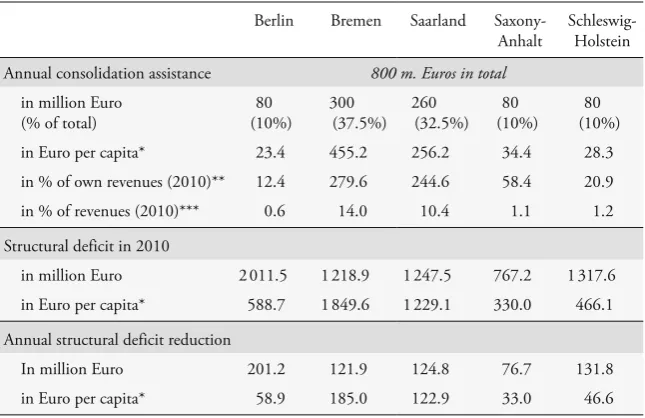
of finance and economics and the state finance ministers, may be able to unveil unsustainable developments in sub-federal and federal finances. In order to enable the five particularly highly indebted states, namely Berlin, Bremen, Saarland, Saxony-Anhalt and Schleswig-Holstein, to comply with the debt brake by 2019, consolidation assistances are paid. The annual volume of those transfers amounts to 800 million and is equally financed by the states and the federal level. These transfers can be ceased and reclaimed if the Stability Council states a violation of a state restructuring program. According to legal agreements the five states have to reduce their structural deficit of 2010 by a tenth each year starting in 2011. Although this is a challenging undertaking, it is not unlikely that the con-solidation paths are satisfied, since the transitional assistance contributes a cru-cial amount to the states’ revenues (Table 1). In 2011 all five states succeeded in reducing their structural deficits in line with their consolidation agreements. Yet, as with the federal level, the starting values, i.e. structural deficits of 2010, were overestimated since an increase in structural tax revenues was not taken into account, although this was already predictable.
Table 1: Consolidation Assistance and Structural Deficits in the Five Program States
Berlin Bremen Saarland Saxony- Anhalt
Schleswig- Holstein Annual consolidation assistance 800 m. Euros in total
in million Euro (% of total)
80 (10%)
300 (37.5%)
260 (32.5%)
80 (10%)
80 (10%)
in Euro per capita* 23.4 455.2 256.2 34.4 28.3
in % of own revenues (2010)** 12.4 279.6 244.6 58.4 20.9 in % of revenues (2010)*** 0.6 14.0 10.4 1.1 1.2 Structural deficit in 2010
in million Euro 2 011.5 1 218.9 1 247.5 767.2 1 317.6 in Euro per capita* 588.7 1 849.6 1 229.1 330.0 466.1 Annual structural deficit reduction
In million Euro 201.2 121.9 124.8 76.7 131.8
in Euro per capita* 58.9 185.0 122.9 33.0 46.6
Note: *Population in 2010. **Local state revenues without municipalities before revenue-sharing. ***Local state revenues without municipalities after revenue-sharing.
5 The Swiss debt brake in comparison offers hardly any of those loopholes: The control account has to be balanced within six years if the accumulated deficit exceeds six percent of previous years’ spending. Exceptions from the deficit rule must be approved by both chambers, the
Ständerat and the Nationalrat. Deficits due to escape clauses enter on the amortization account and are tied to repayment schedules.
5.2 Legal Loopholes
The provisions of the German debt brake show crucial improvements compared to former deficit restrictions. Namely a (close-to) balanced budget amendment instead of the previous investment oriented restraint, the inclusion of newly cre-ated special funds, a more clearly defined cyclical adjustment of deficits, the ex ante and ex post application of the deficit limit and the narrowly defined excep-tions. Yet, several flaws remain:5
1. The cyclical deficits are likely to be systematically overestimated (Kempkes, 2012). Since neither an ex post test of potential biases nor a corrective mech-anism is installed, the calculated surpluses and deficits need not neutralize over time, but public debt might build up. Further, revisions of the estimated output gap are often immense: The OECD estimate for the German output gap in 2009 was revised from 0.5% (spring 2008) of the potential output to –5.4% (spring 2009) to –3.5% (autumn 2009) and finally to –4.5% (autumn 2011). For 2007 the estimates varied between 0.0% and 2.6% of the poten-tial output (ibid.). Since (unforeseen) deficits due to differences between the estimated and the actual output gap enter the control account, it might be overburdened across time (Sachverständigenrat, 2010).
2. A high public debt in the control account is even more likely to accrue since no precise time frame is set, in which debt must be amortized.
6 On the contrary, Swiss cantons had debt brakes in place long before it was introduced on the federal level.
4. The consent requirement for the entitlement to use an exception from the deficit limit is relatively low. In fact, a simple majority of all members of par-liament is already sufficient. This is called a qualified majority because all parliamentarians must be present, but it is far from two thirds majorities or the like. An approval of the second chamber of parliament is not necessary. In addition, a precise definition of an extraordinary situation and a specific time limit for an amortization is not provided.
5. The Stability Council has hardly the ability to impose sanctions or to inter-vene in case of unsustainable budget developments. Only the consolidation assistance payments to five Laender can be ceased and reclaimed in the year the state violates its consolidation agreement. However, this procedure does not apply automatically: The members of the Council, i.e., the national and Laender finance ministers, have to vote on a fine or the presence of excep-tional circumstances. This framework of the Council corresponds to the flaws of the SGP. Further, the assessment criteria might not be successful in their aim to unveil unsustainable developments of public finances in time (Deutsche Bundesbank, 2011).
6. Since the balanced budget amendment of Article 109 III Grundgesetz refers only to the federal and Laender budgets, new off-budget activities do not seem to be completely out of question (Deutsche Bundesbank, 2012a). Depending on the interpretation of the wording of Article 143 Id GG it could be argued that new public funds are merely prohibited on the federal level, offering the states a wide loophole.
7. The transition period and the structure of German fiscal federalism place incentives on sub-national governments to delay a necessary consolidation and accrue further deficits (Section 5.3 and 5.4).
5.3 Implementation into Sub-National Law
The implementation of the debt brake (as of January 2013) is far less advanced in the Laender as compared to the federal level.6 The Laender were granted a
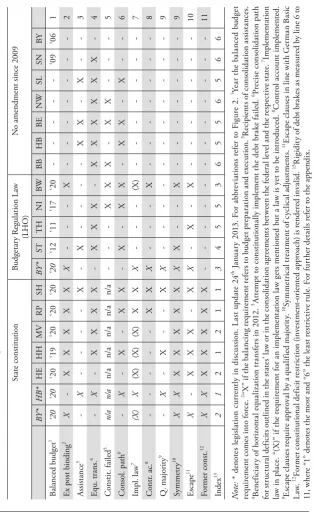
2012a). Not only the relatively highly indebted states, but most of all states seem to take full advantage of the transition period. In fact, precise amortization steps in terms of a structural deficit reduction until 2020 are only statutory in the five states receiving consolidation assistance and in Baden-Wuerttemberg, Hamburg, Lower Saxony and Rhineland-Palatinate. However, escape clauses enacted in these consolidation paths might delay a deficit reduction. In addition, a balanced budget is not mandatory before 2020 in most states (Table 2).
Besides postponing the necessary reduction of structural deficits, seven states have not even succeeded in implementing the new requirements of the debt brake into their ordinary or constitutional law. In these states the former debt restric-tion following the investment-oriented approach with the loosely specified escape clauses still applies. In fact, only five states have implemented the debt brake into their constitution and four states have reformed their Budgetary Regulation Law, i.e. Landeshaushaltsordnung (LHO).
Implementation of the Debt Brake into Budgetary Regulation Laws (Table 2)
T able 2 : I mple me n tat
ion of t
h e D eb t Br ak e i n t h e G er m an L ae nd er si nc e 2 0 0 9 State constitution B udgetar y R egulation Law (LHO) N
o amendment since 2009
BY* HB* HE HH MV RP SH BY* ST TH NI B W BB HB BE NW SL SN BY B alanced budget 1 ‘20 ‘20 ‘20 ‘19 ‘20 ‘20 ‘20 ‘20 ‘1 2 ‘1 1 ‘1 7 ‘2 0 ---‘0 9 ‘0 6 1 E
x post binding
2 X-XXXXX X ---X ---2 Assistance 3 -X ----X -X ----X X -X --3 E qu. trans. 4 -X -XXXX -XXX -XXXXXX -4 Constit. failed 5 n/a n/a n/a n/a n/a n/a n/a - --X X X -X X ---5 Consol. path 6 -X -X-X X -X-X X-X XX -6 Impl. law 7 (X) X (X) (X) (X) X X X ---(X ) ---7 Contr . ac. 8 -- ---X X X ---X ---8 Q. majority 9 -X -X--X X ---9 Symmetr y 10 XX XXXXX X X --X ---9 Escape 11 X-XXX -X X -X -X ---1 0 F ormer const. 12 XX XXXXX - ---1 1 Index 13 21 21211 3 45536556566 No te : * d enot es le gi sl at ion c u rr en tl y i n d is cu ss ion . L as t up d at e 2 4
th Ja
n u ar y 2 01 3
. For a
b br ev ia ti on s r ef
er to F
ig u re 2 . 1 Y ea r t h e b ala n ced b u d get re qu ir eme n t c ome s i n to f orc e. 2“X ” i f t he b al anc in g r equ ir em en t r ef er
s to bu
d ge t pr ep ar at ion a nd e xe cut ion . 3R ec ip ie n ts of c on sol id at io n a ssi st an ce s. 4 B ene fi ci ar
y of hor
iz on ta l e q u al iz at ion t ra n sf er s i n 2 01 2 . 5 A tt
empt to c
on st it u ti on al ly i m ple me n t t he d ebt br ak e f ai le d . 6 Pr ec is e c on sol id at ion p at h fo r s tr u ct u ra l d ef ic it s out li ne d i n t h e s ta te s’ l
aw or i
n t h e c on sol id at ion a gr ee m en ts b et w ee n t h e f ed er al le ve l a nd t h e r es p ec ti ve s ta te . 7 Im p le m en ta ti on la w i n pl ac e. “ (X )” i f t he r equ ir em en t f or a n i m ple me n ta tion l aw g et s me n tione
d but a l
aw i
s y
et to b
e i n tr o d u ce d . 8C on tr ol a cc ou n t i m ple me n te d . 9 E sc ap e c la u se s r equ ir e a ppr ov al
by a qu
al if ie d m ajor it y. 10 Sy m m et ric al t re at m en
t of c
yc lic al a d ju st me n ts . 11 E sc ap e c la u se s i n l ine w it h G er m an B as ic La w . 12 For me r c on st it u ti on al d ef ic it r es tr ic tion ( inve st me n t-or ie n te d a ppr o ac h ) i s r end er ed i n va li d . 13 R ig id it y o f d eb t b ra k es a s m ea su re d b y l in e 6 t o 11 , w h er e “ 1” d enot es t h e mo st a nd “ 6 ” t h e le as t r es tr ic ti ve r u le
. For f
u rt he r d et ai ls r ef
er to t
In general, the debt brakes of the four states are less rigid compared to the debt brake of the federal level. For instance, the use of escape clauses requires no qualified majority in any of these states. Further, the need of an additional law governing the precise design and implementation of the sub-national debt brake, e.g., the control account, adjustments for the financial transactions and for the cyclical component, gets not even mentioned in any LHO but one. In the case of Lower Saxony fiscal deficits up to the amount of expenditures on investments and deviations in the case of macroeconomic disequilibrium are still allowed. Essential parts of the debt brake are, thus, not implemented. While the cyclical adjustment process can be manipulated easily in Thuringia, the debt brake of Saxony-Anhalt does not even specify any adjustment method. In fact, the sym-metry requirement of the German Basic Law is only met by the debt brake of Baden-Wuerttemberg. Further, off-budget funds are not explicitly encompassed in any of the states’ law. In all but one state the debt brake refers solely to budg-etary preparation, but not to implementation. A new draft for an implementa-tion of the debt brake into the Bavarian LHO is currently discussed in parlia-ment. Since Bavaria has not amended its LHO or constitution yet, and the bill meets mostly all requirements of the German Basic Law, it is highly welcome.
Implementation of the Debt Brake into the Constitutions (Table 2)
The constitutional anchoring of debt brakes increases their effectiveness since an amendment requires a qualified majority. Invoking on escape clauses of the former fiscal rule is rendered impossible. So far, only five states have successfully enshrined the debt brake into their constitutions: Hamburg, Hesse, Mecklenburg-West Pomerania, Rhineland-Palatinate and Schleswig-Holstein. In addition a constitutional implementation is currently discussed in Bremen and Bavaria. While the draft in Bavaria is supported by all parties in parliament but one, a referendum is mandatory. It is scheduled to take place in autumn 2013 (Bay-erischer Landtag, 2012). Since the motion in Bremen is only put forward by the Social Democrats and the Green Party, the necessary two-thirds majority is questionable. Although introduced after 2009, the constitutional debt brakes are not necessarily in line with the requirements of the German Basic Law.
7 These encompass Baden-Wuerttemberg, Hesse, Lower Saxony, North Rhine-Westphalia, Rhineland-Palatinate, Saarland, Saxony-Anhalt, Schleswig-Holstein, Thuringia, Berlin and Bremen.
8 In 2011 the combined own tax revenues of the German states were below 2.3% of the total tax revenues before revenues-sharing (Statistisches Bundesamt, 2012).
agreements, these legislations are only valid until 2020. In fact, consolidation steps and off-budget funds are solely incorporated into the constitution of Rhine-land-Palatinate. An implementation law and a control account, securing com-pliance during budget execution, have yet only been enshrined in the legislation of Rhineland-Palatinate and Schleswig-Holstein. Their laws define the cyclical component basically as the difference between the “normal tax revenues” and the estimated tax revenues. While the exact calculation method is still to be specified in a legal decree (Rechtsverordnung), there might be enough leeway for governments to work towards an overestimation of the “normal tax revenues”. In short, compared to the federal level the states’ debt brakes seem less rigid. This holds if implemented into the LHO and, to a lesser extent, if enshrined into the constitutions. Hence, most loopholes mentioned in Section 5.2 are also valid for the sub-national level.
5.4 Incentives on the Sub-national Level: Feast before the Fast
States which have notable consolidation requirements, a missing consolidation path and a delay in the implementation of the debt brake (Table 2) risk an unbal-anced budget in structural terms by 2020. Particularly, Brandenburg, Meck-lenburg-West Pomerania, North Rhine-Westphalia, Rhineland-Palatinate and Thuringia might be on unsustainable paths. In fact, nominal public debt of most states increased in 2011 – despite historically strong revenues.7 In a nutshell,
sub-national governments might be tempted to “Feast before the Fast”. Indeed, the framework of German fiscal federalism and the expiration of the Fiscal Equali-zation Scheme (FES) place incentives on sub-federal governments to accumulate public deficits, delay fiscal consolidation and take full advantage of the transi-tion period until 2020.
Incentives Arising from the Limited Tax Autonomy and the Implicit Joint Liability
9 On the contrary, a lawsuit of Berlin was rejected by the Constitutional Court in 2006 point-ing to Berlin bepoint-ing capable to solve its financial distress on its own.
finances by 2020 will demand higher fiscal transfers in order to comply with the debt brake. Hence, a delay in necessary consolidation measures might seem attractive to politicians.
This holds in particular since the risk that a state is forced to consolidate through spending cuts (or a default) is negligible: Back in the 1980s the highly indebted governments of Saarland and Bremen turned to the German Consti-tutional Court asking for a bailout. The two states claimed that coping with the fiscal burden themselves would imply large spending cuts which are hardly possible since most expenditures are determined by federal mandates and, if cut, it would threaten the constitutional requirement of equivalent living con-ditions throughout Germany (“Einheitlichkeit der Lebensverhältnisse im Bun-desgebiet”). In 1992 the Constitutional Court finally ruled in favour of the two states. According to the judgment a bailout is required due to the principle of cooperation and support (Bündisches Prinzip) which the Court saw primarily materialized in the FES (BVerfGE 86, 148; Seitz, 1999).9 The ruling of the
Constitutional Court exacerbated the common pool problem of German fiscal federalism: While the states are responsible for the accumulation of fiscal deficits, the costs of excessive indebtedness can be spread across all jurisdictions through the implicit joint liability.
The German Fiscal Equalization System
10 The population weight of the sparsely populated states of Brandenburg, Mecklenburg-West Pomerania and Saxony-Anhalt is slightly increased and the population of the city-states is weighted by 135%.
11 The numbers include municipal debt and cash advances.
revenues per inhabitant, receive transfers from the relatively wealthier states.10
The more the financial capacity per capita exceeds the average value the higher are the transfer contributions of a state, and visa versa. After this stage the aver-age fiscal strength of the financially weak new Laender rose to 94% of the total average in 2011 (Table 3). In a fourth step the federal government provides gen-eral vertical grants to states whose financial strength still remained below 99.5% of the average. A last stage distributes transfers to the East German states and Berlin in line with the provisions of the Solidarity Pact II.
This extensive transfer scheme almost levels out initial differences in the financial capacity of the 16 states. While the new Laender had a financial capac-ity per capita of around 53% of the average after the first step of the revenue-sharing (excluding VAT) in 2011, the share increased to 111% after all steps of the FES were conducted. The financial strength of the fiscally strong states decreased accordingly (Table 3). In fact, the per capita financial strength of the “poor” states as percentage of the average exceeded the strength of the former “rich” western non-city states when taking the full equalization process into account.
Incentives Arising from the German FES
Despite almost equalizing transfer payments, public debt was not less of an issue in the beneficiary states than in the contributors. In fact, the eastern states (including Berlin) received about 84.4 million Euros between 1995 and 2011 from the western states, especially due to contributions of Bavaria, Hesse, Baden-Wuerttemberg and Hamburg. However, nominal public debt increased during this period by 110% in the western states and by 95% in eastern states (includ-ing Berlin).11 Indeed, the fiscal equalization system provides incentives on gov-ernments to refrain from an increase in local revenues and incur debt instead.
in local revenues reduces (raises) the receipts (contributions) by more than one Euro (Feld und Schnellenbach, 2013). The common pool problem becomes apparent: Politicians face hardly any incentives to increase their tax revenues, but to reap large transfer payments and to incur debts. Since public borrowing has
Table 3: Financial Strength per capita in Federal States, in 2011*
in % of the national average After r
ev
enue
sharing (not
V
A
T
)
After V
A
T
-sharing
After horiz
ontal
equalization After general suppl. central go
v’
t grants
After special suppl. central go
v’
t grants
Bavaria 127.9 112.0 102.6 101.5 97.8
Hesse 124.5 112.2 102.6 101.6 97.9
Baden-Wuerttemberg 118.3 106.3 101.0 99.9 96.3
North Rhine-Westphalia 101.5 96.6 97.0 96.0 92.5
Rhineland-Palatinate 96.6 93.8 95.7 95.7 92.6
Schleswig-Holstein 95.5 94.8 96.2 95.8 93.0
Lower Saxony 83.9 95.7 96.6 95.9 92.4
Saarland 81.6 90.7 94.5 95.4 93.9
Western non-city states 108.7 102.4 99.1 98.3 94.8
Hamburg 155.6 133.9 132.8 131.5 126.7
Bremen 96.5 95.0 120.3 127.2 125.4
Berlin 85.5 91.0 119.4 127.0 136.4
City states 107.9 104.4 123.5 128.4 132.2
Brandenburg 62.4 88.7 94.4 95.9 109.7
Saxony-Anhalt 51.6 85.9 93.5 95.5 112.0
Saxony 51.4 86.0 93.2 95.1 109.9
Mecklenburg-West Pomerania 50.9 85.1 93.6 96.0 112.0
Thuringia 50.7 85.4 93.0 95.1 110.8
Eastern states 53.4 86.3 93.5 95.4 110.7
Note: *Provisional figures only. For further details refer to source.
12 In fact, Galmarini et al. (2007) provide empirical evidence for the US states suggesting that fiscal transfers do not merely lead to increased spending and decreased taxes (flypaper effect) but to a rise in public deficits.
hardly any effect on a state’s fiscal equalization transfers, it is much more attrac-tive to sub-national governments to generate revenues by means of debt than by increasing local revenues, which would get redistributed.12
Incentives Arising from the Expiration of the German Fiscal Equalization System
The German fiscal equalization system expires at the end of 2019. However, a restatement is deemed necessary due to the Bündisches Prinzip and the inter-jurisdictional differences in the financial power. The required reform of the fiscal equalization system might enhance sub-national incentives to accumulate fiscal deficits, particularly owing to three mechanisms:
1. As the realization of extensive sub-national tax autonomy is politically dif-ficult, the inter-jurisdictional differences in financial power are likely to be met by fiscal transfers. In fact, the history of the fiscal equalization system teaches that the financially weaker a state by the time the negotiations take place, the better are the chances to receive a larger proportion of the transfer volume. Hence, sub-federal governments have incentives to postpone a nec-essary consolidation.
2. The bargaining power of the central government might weaken because it has to follow the legally fixed consolidation path and structural deficits are prohibited beyond 2016. On the contrary, the combined bargaining power of the states increases with the number of highly indebted states. This con-stellation could enable the states to reap a larger share of the joint taxes and place, thus, incentives to refrain from fiscal consolidation within the next years. Despite the sub-national debt brakes coming into force in 2020, sound public finances are still questionable. Since the fiscal rules allow for circum-ventions and have yet not been tested in the field, the highly indebted states might form a coalition and interpret the provisions of the debt brake loosely (Heinemann, 2012).
13 Germany and all other states subject to an excessive deficit procedure in November 2011 do not have to comply with this requirement before 2015.
Hence, the five states receiving consolidation aid might also risk an unbal-anced budget by 2020.
6. The European Fiscal Compact
In 2012 mostly all Euro zone countries had ratified the Fiscal Compact (“Treaty on Stability, Coordination and Governance in the Economic and Monetary Union”) and, thus, agreed to reduce their public deficits. This agreement is deemed to be respected if the structural deficit of the general government sector equals or is below the Medium Term Objective (MTO) of a country, which is limited to 0.5% of GDP. In case the debt-to-GDP ratio is significantly below 60%, the upper limit of the MTO increases to 1% of GDP. Yet, the MTO’s might be set closer to the upper boundary than actually necessary since they are autonomously determined by the national governments.
While the Fiscal Compact and the German debt brake specify similar escape clauses, five crucial differences can be stressed: First, the Fiscal Compact encom-passes almost the whole government sector, e.g., special public funds, the social security systems, and special purpose associations. In a first benchmark paper on the inner-German implementation of the Compact, the states agreed to be held accountable for their communities, while the social security system is assigned to the federal level. Second, an implementation into national legislation has to be conducted by the end of 2013, thereby shortening the transition period granted by the German debt brake. Third, the contracting states have to reduce their debt-to-GDP ratios on average by 1/20 per annum to 60% of GDP.13 Fourth,
financial sanctions might be imposed if an implementation of the provisions of the Fiscal Compact is not successfully conducted by 2014. However, a priori a contracting state has to bring the case before the European Court of Justice. Fifth, an independent institution, set up at the national level, should monitor the compliance with the rules. In case of a significant deviation from the MTO a corrective mechanism is required to be triggered automatically.
only be blocked by a qualified majority in the Council. In the case a country does not conduct any corrective measures the deposit can be translated into a non-interest bearing fine in the amount 0.2%–0.5% of GDP later on. For Ger-many this could add up to 13.67 billion Euros in 2013 and 15.28 billion Euros in 2017, using nominal GDP estimates by the IMF.
In light of the earlier and broader consolidation requirements, the Laender approved the Fiscal Compact in the Bundesrat only after the central govern-ment provided fiscal concessions, e.g., funds for childcare places, to the states and municipalities (Deutsche Bundesbank, 2012a). However, a first draft of an implementation law was rejected by the states at the end of 2012 (BT-Drs. 17/10976). A new one was proposed in mid-January 2013 (BT-(BT-Drs. 17/12058) and is still pending. Besides bringing the Budgetary Principles Act (Haushaltsgr-undsätzegesetz) in line with the requirements of the Fiscal Compact and provid-ing the committed funds to the sub-national governments through amendments in the Fiscal Equalization Law the current draft touches on several other issues: First the control account of the federal debt brake is to be set back to zero by the end of 2015. According to the government this should ensure that the account is not positive when the debt brake becomes effective in 2016. Since a negative balance of the control account is also to be deleted, a wider use of this account might appear tempting to politicians. Second, the responsibilities of the Stabil-ity Council are enhanced and an independent advisory board is supplemented. Despite monitoring the structural deficit of the general government and provid-ing recommendations in case of contraventions against the MTO, neither the Council nor the advisory board has any possibility to impose sanctions. Third, the draft amends the distribution of potential EU-sanctions between the federal and sub-federal level. While the share of the central government amounts to 65%, the states have to bear 35%. The sub-federal share is further divided among the states according to the state’s population (35%) and to the state’s share of total deficit (65%). Yet, sanctions due to deviations from the MTO are solely paid by the federal level until 2020.
7. Conclusions
Public debt in Germany has become unsustainable in recent decades such that a consolidation of government finances is necessary. This development cannot be explained by (macro-) economic shocks or singular events like reunification though the initial impulse to incur public debt may stem from that. The con-tinuing trend in increasing indebtedness rather reflects the inability of govern-ments to consolidate budgets in good times. This lack of fiscal responsibility is due to political forces that induce a fiscal commons problem.
The new fiscal rules in Germany, i.e., the German debt brake, aim at correct-ing the resultcorrect-ing bias towards public debt. While the debt brake is an improve-ment as compared to the old version of Article 115 Grundgesetz, mainly because the investment orientation of public debt is dropped, new special funds are pro-hibited and the general allowance to incur debt in a macroeconomic disequi-librium has become specific, many loopholes remain that pose a danger for the effectiveness of the debt brake. Nevertheless, the federal government appears to be able to comply with the debt brake even earlier than the required year 2016.
A
p
pen
d
ix
: S
u
b
-F
eder
al Im
p
lem
en
ta
ti
on
o
f t
h
e Deb
t B
ra
ke
Legal status D ebt Brake included in Constitution
State
B
av
aria – D
raft only
Ar
t. 82 state constitution
B
remen – D
raft only
Ar
t. 131a state constitution
H
esse
Ar
t. 141 state constitution
D
raft bill for the constitutional
intr
oduction of the debt brake
failed
No
No
No
T
ranslation into law
Joint draft bill of all par
ties, but one. I n parliamentar y discussion. Constitutional r efer
endum in fall
2013. In parliamentar y discussion 27.03.2011 (r efer endum) B
alanced budget amendment; Entr
y into for
ce
B
inding when pr
eparing and
ex
ecuting budget; planned for
1.1.2020
B
inding when pr
eparing budget;
planned for 1.1.2020
B
inding when pr
eparing and
ex
ecuting budget; 1.1.2020
P
recise consolidation path for deficits (deviations in emergency situations ar
e most often allo
w
ed)
N
o
Clearly defined annual ceilings for structural deficits, decr
easing to
zer
o in 2020 (constitution r
elates to
§4 K
onsoVV*).
N
o (a r
eduction should be
conducted star
ting in 2011 in
or
der to comply with the balanced
budget amendment in 2020).
Escape clauses 1. C yclical adjustments 2. N atural disasters 3. E
mergency situations with significant financial impact and beyond go
vernment contr ol 1. C yclical adjustments 2. N atural disasters 3. E
mergency situations bey
ond
go
vernment contr
ol
4. A
djustment to str
uctural changes
in r
ev
enues or spending not
attributable to the state. (max. 4 y
ears) 1. C yclical adjustments 2. N atural disasters 3. E
Legal status
D
ebt B
rake included in Constitution
State
B
av
aria – D
raft only
Ar
t. 82 state constitution
B
remen – D
raft only
Ar
t. 131a state constitution
H
esse
Ar
t. 141 state constitution
–
F
ormal r
equir
ement for escape
clauses
N
o
In case of escape clause 2 , 3 or 4: 2/3 M
ajority; J
ustification
No
–
Amor
tisation of ne
wly issued
debt
In case of escape clause 2 or 3: Within a r
easonable timeframe
follo
wing an amor
tisation plan
In case of escape clause 2, 3 or 4: Amor
tisation considering cy
clical
dev
elopments
In case of escape clause 2 or 3: Reduction within r
easonable timeframe follo wing an amor tisation plan. C
yclical adjustments specified
Symmetrical adjustment for cyclical fluctuations. M
andator
y
amor
tisation plan.
Symmetrical adjustment for cy
clical
fluctuations.
Symmetrical adjustment for cy
clical
fluctuations.
Implementation law in place
N
o, but r
equir
ed b
y state law
N
o, but r
equir
ed b
y state law
N
o, but r
equir
ed b
y state law
Contr
ol account specified
N o N o N o A
djustments for financial
transactions specified No No No B eneficiar
y of consolidation
assistance (2012) No Ye s No B eneficiar
y of S
olidarpakt II transfers (2012) No No No B eneficiar
y of horiz
ontal
equalization transfers (2012)
No Ye s No * A s r equ ir ed by t he K on sol id ie ru n gs h il fe n ge se tz ( con so li d at ion a ss is ta nc e l aw ), s ta te s t h at r ec ei ve c on sol id at ion a ss is ta nc e h
ave to s
p ec if y t h ei r re sp ec ti ve c on sol id at ion p at h s f or s tr u ct u ra l d ef ic it s i n a n a d m in is tr at ive a gr ee m en t ( V er w al tu n gs ve re in b ar u n g z u m G es et z z u r G ew äh run g v on K on sol id ie ru n gs h il fe n, K on so V V ), s u p er vi se
d by t
Legal status
D
ebt B
rake included in Constitution
State
H
amburg
Ar
t. 72 state constitution
M ecklenburg-W est P ommerania Ar
t. 65 state constitution
Rhineland-P
alatinate
Ar
t. 117 state constitution
D
raft bill for the constitutional
intr
oduction of the debt brake
failed
No
No
No
T
ranslation into law
19.06.2012
28.6.2011
23.12.2010
B
alanced budget amendment; Entr
y into for
ce
B
inding when pr
eparing and
ex
ecuting budget; 1.1.2020
B
inding when pr
eparing and
ex
ecuting budget; 1.1.2020
B
inding when pr
eparing budget;
1.1.2020
P
recise consolidation path for deficits (deviations in emergency situations ar
e most often allo
w
ed)
B
udget plans must incorporate a steady and continuous r
eduction of
str
uctural deficits; net borr
owing
is scheduled to cease in fiscal y
ear
2019 (Ar
t 72a state constitution).
N
o (follo
wing 2011, budget plans
must be pr
epar
ed in or
der to
comply with the balanced budget amendment in 2020).
Str
uctural deficits must be r
educed
steadily until 2020
Escape clauses 1. C yclical adjustments 2. N atural disasters 3. E
mergency situations with significant financial impact and beyond go
vernment contr ol 1. C yclical adjustments 2. N atural disasters 3. E
mergency situations with significant financial impact and beyond go
vernment contr
ol.
1. C
yclical adjustments
2. N
atural disasters
3. E
mergency situations
4. A
djustment to str
uctural
changes in r
ev
enues or spending
not attributable to the state. (max. 4 y
ears)
–
F
ormal r
equir
ement for escape
clauses
In case of escape clause 2 or 3: 2/3 parliamentar
y majority
N
o
In case of escape clause 2, 3 or 4: Simple majority; J
Legal status
D
ebt B
rake included in Constitution
State
H
amburg
Ar
t. 72 state constitution
M
ecklenburg-W
est P
ommerania
Ar
t. 65 state constitution
Rhineland-P
alatinate
Ar
t. 117 state constitution
–
Amor
tisation of ne
wly issued
debt
In case of escape clause 2 or 3: Within r
easonable timeframe
follo
wing an amor
tisation plan.
In case of escape clause 2 or 3: Within specific timeframe
–
In case of escape clause 2 or 3: Reduction allo
wing for cy
clical
fluctuations
–
In case of escape clause 4: Steady r
eduction b
y at most 1/10
C
yclical adjustments specified
Symmetrical adjustment for cy
clical
fluctuations.
Symmetrical adjustment for cy
clical
fluctuations.
Symmetrical adjustment for cy
clical
fluctuations.
Implementation law in place
N
o, but r
equir
ed b
y state law
N
o, but r
equir
ed b
y state law
Yes, adapted 3.7.2012, enter
ed into
for
ce as of 14.7.2012
Contr
ol account specified
N
o
N
o
Yes, see implementation law
A
djustments for financial
transactions specified
N
o
N
o
Yes, see implementation law
B
eneficiar
y of consolidation
assistance (2012)
No
No
No
B
eneficiar
y of S
olidarpakt II
transfers (2012)
No
Ye
s
No
B
eneficiar
y of horiz
ontal
equalization transfers (2012)
Ye
s
Ye
s
Ye
Legal status
D
ebt B
rake included in
Constitution
D
ebt B
rake included in F
inancial r egulation State Schleswig-H olstein Ar
t. 53 state constitution
B
av
aria – D
raft only §18 B ayHO Sax ony-Anhalt §18 LHO D
raft bill for the constitutional
intr
oduction of the debt brake
failed
No
No
No
T
ranslation into law
19.05.2010
In parliamentar
y discussion,
Suggestion of budgetar
y committee
to r
eject.
17.12.2010
B
alanced budget amendment; Entr
y into for
ce
B
inding when pr
eparing and
ex
ecuting budget; 01.01.2020
B
inding when pr
eparing and
ex
ecuting budget; planned for
1.1.2020
B
inding when pr
eparing budget;
1.1.2012
P
recise consolidation path for deficits (deviations in emergency situations ar
e most often allo
w
ed)
The annual ceiling for str
uctural
deficits is r
educed b
y 1/10 of the
2010 str
uctural deficit (Ar
t 59a
state constitution). §4 K
onsoVV
clearly states annual ceilings for structural deficits, decr
easing to
zer
o in 2020.
N
o (budget plans must be pr
epar
ed
in or
der to comply with the
balanced budget amendment in 2020). Clearly defined annual ceilings for structural deficits, decr
easing to
zer
o in 2020 (§4 K
onsoVV
, not
mentioned in LHO).
Escape clauses 1. C yclical adjustments 2. N atural disasters 3. E
mergency situations with significant financial impact and beyond go
vernment contr ol 1. C yclical adjustments 2. N atural disasters 3. E
mergency situations with significant financial impact and beyond go
vernment contr ol 1. C yclically adjustments 2. N atural disasters 3. E
mergency situations with significant financial impact
–
F
ormal r
equir
ement for escape
clauses
In case of escape clause 2 or 3: 2/3 majority In case of escape clause 2 or 3: 2/3 majority; J
ustification
Legal status
D
ebt B
rake included in
Constitution
D
ebt B
rake included in F
inancial r
egulation
State
Schleswig-H
olstein
Ar
t. 53 state constitution
B
av
aria – D
raft only
§18 B
ayHO
Sax
ony-Anhalt
§18 LHO
–
Amor
tisation of ne
wly issued
debt
F
or all debt:
W
ithin r
easonable
timeframe
In case of escape clause 2 or 3: Within r
easonable timeframe
In case of escape clause 2 or 3: Within r
easonable timeframe,
star
ting with the first y
ear of
balanced budget, latest 4 y
ears after
borr
owing. D
eviations ar
e allo
w
ed
in ex
ceptional situation.
C
yclical adjustments specified
Symmetrical adjustment for cy
clical
fluctuations.
Symmetrical adjustment for cy
clical
fluctuations.
C
yclical tax incr
eases to be used for
debt amor
tisation
Implementation law in place
Yes
Yes (draft)
N
o
Contr
ol account specified
Yes, see implementation law
Yes, see implementation law
N
o
A
djustments for financial
transactions specified
Yes, see implementation law
Yes, see implementation law
N
o
B
eneficiar
y of consolidation
assistance (2012)
Ye
s
N
o
Ye
s
B
eneficiar
y of S
olidarpakt II
transfers (2012)
No
No
Ye
s
B
eneficiar
y of horiz
ontal
equalization transfers (2012)
Ye
s
N
o
Ye
Legal status
D
ebt B
rake included in F
inancial r
egulation
State
Thuringia §18 LHO
Lo w er S ax ony §18a LHO B aden-W uer ttemberg §18 LHO D
raft bill for the constitutional
intr
oduction of the debt brake
failed
D
raft for constitutional
implementation r
ejected
17.01.2012
D
raft for constitutional
implementation r
ejected 26.9.2012
P
revious draft for constitutional and or
dinar
y legal implementation
rejected
T
ranslation into law
8.7.2009
26.9.2012
14.12.2012
B
alanced budget amendment; Entr
y into for
ce
B
inding when pr
eparing budget;
1.1.2011
B
inding when pr
eparing budget;
1.1.2017
B
inding when pr
eparing and
ex
ecuting budget; 1.1.2020
P
recise consolidation path for deficits (deviations in emergency situations ar
e most often allo
w
ed)
N
o
D
eficits ceilings in the budget
plans: 2014:
720 million E
ur
o
2015:
470 million E
ur
o
2016:
220 million E
ur
o
Steady r
eduction steps for fiscal
deficits Escape clauses 1. S ubstantial r ev enue losses compar
ed to pr
evious y
ears
2. N
atural disasters
3. E
mergency situations with significant financial impact and beyond go
vernment contr
ol
1. M
acr
oeconomic disequilibrium
2.
Thr
eats to natural liv
elihood 1. C yclically adjustments 2. N atural disasters 3. E
mergency situations with significant financial impact and beyond go
vernment contr ol – F ormal r equir
ement for escape
clauses
In case of escape clause 2 or 3: Justification in budget plan
N
o
In case of escape clause 2 or 3: simple majority
–
Amor
tisation of ne
wly issued
debt
In case of escape clause 1, 2 or 3: Within 5 y
ears, star
ting with the
first y
ear of a balanced budget plan
ex
cept for emergencies
In case of all escape clauses: Reduction follo
wing an
amor
tisation plan
In case of escape clause 2 or 3: Within a r
Legal status
D
ebt B
rake included in F
inancial r
egulation
State
Thuringia §18 LHO
Lo
w
er S
ax
ony
§18a LHO
B
aden-W
uer
ttemberg
§18 LHO
C
yclical adjustments specified
N
o
N
o
Symmetrical adjustment for cy
clical
fluctuations.
Implementation law in place
N
o
N
o
N
o, but r
equir
ed b
y state law
Contr
ol account specified
N
o
N
o
Yes, specified in §18
V
A
djustments for financial
transactions specified
N
o
N
o
N
o, only basically specified in §18
IV
B
eneficiar
y of consolidation
assistance (2012)
No
No
No
B
eneficiar
y of S
olidarpakt II
transfers (2012)
Ye
s
N
o
N
o
B
eneficiar
y of horiz
ontal
equalization transfers (2012)
Ye
s
Ye
s
N