Can m- and e-learning support pathways for meaningful vocation
in remote communities?
John Guenther, Flinders University/CRC-Remote Economic Participation
Eva McRae-Williams, Batchelor Institute of Indigenous Tertiary Education/CRC-Remote Economic Participation
Philip Townsend, Flinders University
The work reported in this paper is supported by funding from the Australian Government Cooperative Research Centres Program through the CRC for Remote Economic Participation. The views expressed herein do not necessarily represent the views of the CRC for remote Economic Participation or its Participants.
Abstract
This paper, based on an upcoming CRC for Remote Economic Participation (CRC-REP) research project—‘Pathways to Employment’—will canvas the proposition that mobile technology can be used as an effective vehicle for vocational learning in remote communities. This proposition in itself is not new and indeed there are a number of examples in the literature that demonstrate the possibilities of mobile and emerging digital technologies in remote Aboriginal and Torres Strait Islander communities in Australia and indigenous communities elsewhere in the world. However, the application of technologies in vocational learning is often applied to the delivery of mainstream training packages for mainstream employment outcomes. The ‘Pathways to Employment’ research project will consider pathways from a different starting point than many other research projects, which take as a given, the traditional notion of pathways to employment—typically linear, mainstream oriented and driven—with all the mainstream assumptions that go along with this notion of ‘pathway’. This paper foregrounds the research with a consideration of the literature on effective application of digital technologies in vocational learning and the intersection between these technologies, vocational learning and their fit within a pathway. The philosophical underpinnings behind the pathways construct are examined and questioned as to their fit within a remote Aboriginal and Torres Strait Islander context. The paper suggests that the reason the apparently successful applications of digital technologies in remote VET programs work is because of their fit with Aboriginal and Torres Strait Islander ontologies, epistemologies and axiologies.
Introduction
The Cooperative Research Centre for Remote Economic Participation (CRC-REP) is focused on delivering solutions to the economic disadvantage that affects remote Australia. While much of the country’s wealth is generated from remote Australia, the inequitable distribution of that wealth is most visible in the contrast between the ‘capital’ of remote Aboriginal and Torres Strait Islander communities, and that of the large mining developments and their stakeholders, which dominate the economies of mineral rich states.
The CRC-REP has three goals:
1. To develop new ways to build resilience and strengthen regional communities
and economies across remote Australia;
2. To build new enterprises and strengthen existing industries that provide jobs,
livelihoods and incomes in remote areas; and
3. To improve the education and training pathways in remote areas so that
people have better opportunities to participate in the range of economies that exist.
The CRC’s research agenda reflects these goals. The focus of this paper relates particularly to the third goal. To be consistent with these goals, the research approach of the CRC-REP must also be sensitive to the need for equitable distribution of capital—in particular human capital. Therefore, the research will not simply gather data for the sake of academic reporting. Rather it will attempt to work collaboratively with Aboriginal and Torres Strait Islander researchers to co-produce knowledge that is on the one hand supportive of remote community aspirations, and on the other, supportive of a need to bring about systemic, practice and policy change.
What do we mean by digital technologies or ICTs?
In this paper the terms ICTs and digital technologies are used interchangeably. The authors acknowledge though that ‘ICT’ is perhaps becoming dated. It does still however have some currency in much of the education literature. According to the Australian Bureau of Statistics (ABS 2008), ICT ‘…refers to the technologies and services that enable information to be accessed, stored, processed, transformed, manipulated and disseminated, including the transmission or communication of voice, image and/or data over a variety of transmission media’. ICTs (or digital technologies) include technologies such as radio, telephone, film, television, photocopying, fax, computers, video, CDs, DVDs, satellites, the Internet, mobile phones, Voice over Internet Protocol (VoIP), laptops, notebooks, MP3s, iPads, tablets, and smart phones.
The uptake of mobile technologies is increasing globally. About 90 per cent of the world’s population is covered by 2G networks. About 45 per cent of the population is covered by 3G networks. There are 1.2 billion active mobile-broadband subscriptions in the world—17 per cent of the global population. Australia is the fourth highest ranked nation in terms of mobile-broadband penetration, with a rate of 82 active mobile broadband subscriptions per 100 inhabitants (mobiThinking 2012).
Global trends reported in A World Bank Blog on ICT use in Education in early 2010 show a number of emerging technologies, which in 2012 are now almost commonplace. The list points to the following innovations in learning including mobile learning, cloud computing, one-to-one computing, ubiquitous learning, gaming, personalised learning, redefinition of learning spaces, teacher-generated open content and smart portfolio assessment (Hawkins 2010). The rapid change in these technologies means that for those working in education, what was considered innovative five years ago may well now be redundant.
The challenges and potential of ICT in remote communities
The problem of access
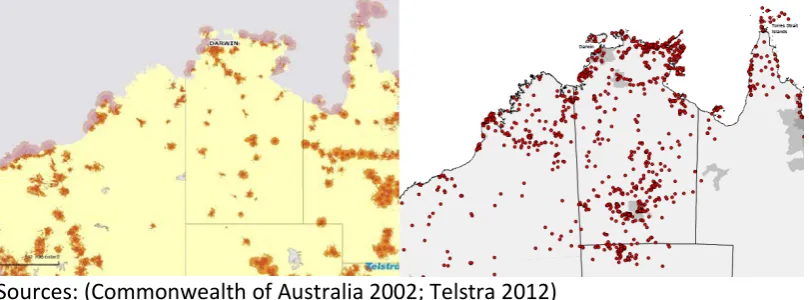
Figure 1. 3G Mobile phone coverage in 2012, compared with discrete remote community locations
Sources: (Commonwealth of Australia 2002; Telstra 2012)
While access to ICT infrastructure is a significant issue in many remote areas where Aboriginal and Torres Strait Islanders live, Kral (2010: 4) has shown that in communities where there is mobile phone coverage, ‘young people are quickly acquiring the practice of SMS text messaging, ‘bluetoothing’ converted video files, and uploading instant action videos and photos’. She also highlights that even when people move through areas of no coverage, phones have ‘become requisite accessories for style-aware remote youth and are popular as private mobile storage spaces for personal digital photos, songs and short films’ (Kral 2010: 4). When available, internet use or online engagement is also not alien to the experiences of young Aboriginal people in remote communities and there is evidence of rapid uptake of mobile technologies even when access to the network is limited (Taylor 2012). Kral (2010) has described this interaction as not dissimilar to that of other youth populations, consisting of visiting music video sites, sport and game sites, utilising Google earth, Internet banking, and purchasing things such as second hand cars and musical instruments online. She suggests that while young people rarely use email for text-based interaction, social networking sites are increasingly being accessed.
Opportunities arising with emerging trends for learning and ICT
Notwithstanding the problem of access, as discussed above, there are numerous opportunities for applying digital technologies to VET in remote Aboriginal and Torres Strait Islander contexts. These include, but are not limited to:
• Using e-portfolios as a way of storing assessable material (Wallace 2009);
• Using multimedia recording tools for capturing evidence ready for assessment (Boyle and Wallace 2008);
• Addressing access and equity issues for English as another language and low literacy learners (Guenther and Tayler 2008);
• Supporting cultural and language maintenance activities (Verran and Christie 2007; Rea et al. 2008);
• Story-telling from community perspectives (Indigenous Communications and Events 2011);
• Documenting and protecting aspects of traditional knowledge (Christie 2005);
• Engaging and empowering participants (Corbett et al. 2009; Singleton et al. 2009). Wallace (2009), concluding from the findings of a major project involving remote Indigenous participants using e-portfolios for evidence gathering, suggests that:
The use of multimedia has the potential to improve learning by making better connections to learners’ workplaces, homes and community contexts. What was more important than the technology was the ways it was used to engage and support Indigenous learners’ participation in formal education. (p. 120)
Wallace and Appo (2011), in their analysis of learning projects designed to support Aboriginal and Torres Strait Islander workforce development and engagement, conclude that it is about more than the technologies themselves. Rather, it is the ‘co-production of knowledge, the development of the skills to participate in workforces and the ability to share and represent concepts in many different ways’ (p. 109). Beyond the specifics of applying digital technologies to remote contexts there are several reasons why e-learning or m-learning strategies can be applied to tertiary education (VET included) more generically. One of the key reasons that students choose to use e-learning as a means of formal study is because of the flexibility it offers: students can use online resources when they want, where they want and at times that they choose (Misko et al. 2005). Learners who enjoy the flexibility of the online learning environment may also have a predisposition to being self-directed and self-managed. Learners must be ‘comfortable with e-learning’ in the sense that they must be ready to access materials on the Internet and be prepared to collaborate online (Smith et al. 2003).
The VET ‘pathway to employment’ construct
Despite the common view that ‘there are no real jobs in remote communities’ there are arguably many—if not abundant—opportunities for meaningful livelihoods to be made out of remote communities, particularly in a policy environment which targets remote service delivery. Census data shows that the greatest paid work opportunities exist in mining, local government services, health care services, education, land and sea management, tourism and accommodation services, and retail services. Aboriginal and Torres Strait Islanders are under-represented in most industry groups. The notable exceptions are ‘inadequately described’, ‘health care and social assistance’ and ‘public administration and safety’ (ABS 2007).
Another way to look at employment data is to consider who does what kinds of jobs. In remote parts of Australia Aboriginal and Torres Strait Islanders are over-represented in categories of ‘Community and personal service workers’, ‘labourers’ and ‘Inadequately described/Not stated’ (ABS 2007). They are notably
under-represented in the jobs that require higher level qualifications such as ‘managers’, ‘professionals’ and ‘technicians and trades workers’ which is where half of the non-Indigenous workforce finds itself.
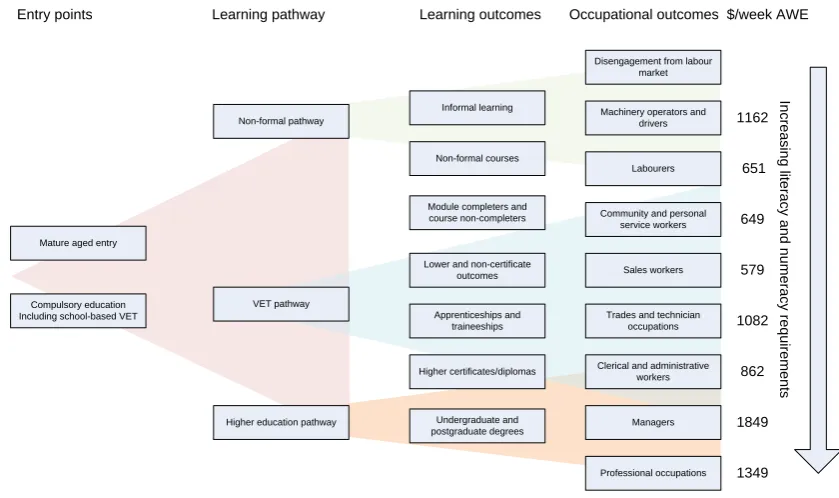
various pathways together with learning and occupational outcomes is shown in Figure 2, below. The occupational outcomes are sorted in ascending order of literacy and numeracy levels required by employees (see Shomos 2010: 32) and by implication, the levels of ICT demands and opportunities required. Learning outcomes are sorted into order based on Australian Qualifications Framework levels (Australian Qualifications Framework Council 2011). Not surprisingly, the order of learning outcomes and occupational outcomes is fairly closely associated with income levels. The three lowest paid occupational categories correspond directly with the categories that are over-represented by Aboriginal and Torres Strait Islander people.
Figure 2. Pathways to employment schema
Compulsory education Including school-based VET
VET pathway
Apprenticeships and traineeships Non-formal pathway
Lower and non-certificate outcomes
Higher certificates/diplomas Module completers and course non-completers
Undergraduate and postgraduate degrees Non-formal courses
Informal learning
Disengagement from labour market
Professional occupations Trades and technician
occupations
Clerical and administrative workers
Managers Machinery operators and
drivers
Sales workers Labourers
Community and personal service workers
Higher education pathway Mature aged entry
Increasing literacy and numeracy requirements
Increasing ICT demands and opportunities
Entry points Learning pathway Learning outcomes Occupational outcomes $/week AWE
1162 651 649 579 1082 862 1849 1349
AWE=Average Weekly Cash Earnings. Source: (ABS 2011a)
experienced as a source of pride, fulfilment and social identity formation (Miller et al. 2002).
Nevertheless, the learning pathways described by Figure 2 are rooted in enculturated ontological, epistemological and axiological frameworks—which by definition as ‘enculturated’, must be accepted as ‘normal’ in mainstream society. For those operating ‘successfully’ in the mainstream environment, at the core of their being, or ontologies, is the importance placed on ‘occupation’. In terms of the ways of knowing, or epistemologies, that support this existence, knowledge is acquired through an institutional learning system via expert, professional teachers and is recognised through a formal qualification structure (described as the Australian Qualifications Framework). In terms of axiologies, the values that shape this being and knowing, are frameworks represented to a large extent by dollars and social status. Yet these ‘mainstream’ ontologies, epistemologies and axiologies are rarely discussed or acknowledged openly. While these concepts are frequently used to inform research methodology literature (see for example Lincoln et al. 2011), they are seldom included in educational or employment literature—except as we shall see, in the literature that relates to Aboriginal and Torres Strait Islander being and learning. Problems with the construct in remote Aboriginal and Torres Strait Islander communities
Given the above, there is something of a disjuncture between the mainstream pathways and frameworks that are built around Aboriginal and Torres Strait Islander ontologies, epistemologies, axiologies and cosmologies. The latter concept is largely ignored (if not denied) in the mainstream framework, but is arguably central to conceptions of learning and livelihoods (see for example Arbon 2008; Christie et al. 2010; Ford 2010). Both Arbon and Ford speak of the importance of identities, ways of being, ways of doing and ways of constructing knowledge for ‘education’ and its outcomes for Aboriginal and Torres Strait Islander people.
ICT as a pathway enabler or something else?
Jamaican research and both Kral’s and Taylor’s studies in Australia should caution us not to assume that digital technologies will be primarily used for learning purposes— and indeed there are risks associated with uptake of digital technologies.
However, we now return to the point of this paper, which is about the role of digital technologies in remote community vocational education. In the Introduction we posed a number of questions about ICT and its role: Is it a pathway enabler? Is it an end in itself? How can it be effectively integrated into vocational learning for Aboriginal and Torres Strait Islanders in remote communities?
We noted earlier (page 4) some of the successful approaches where ICTs have been used in remote Aboriginal and Torres Strait Islander contexts. These included approaches for assessment, evidence collection, engagement, empowering, story-telling, documenting and protecting traditional knowledge. What role then, does ICT play in these approaches? In some cases (such as evidence collection and assessment) it is an educational tool not dissimilar from e-learning tools used in mainstream contexts. In other cases (such as digital story-telling) it is a vehicle for engaging people in culturally and locally relevant learning. In yet other cases (such as documenting and protecting traditional knowledge), it is effectively an end in itself. What is clear from the range of applications, is that there is no single right way of using digital technologies in learning—it is highly context dependent.
What makes it work though? Drawing on our understanding of Aboriginal and Torres Strait Islander philosophical foundations, it is possible to see a match between the ICT approaches (and teaching and learning processes more generally) used and elements of ontologies, epistemologies, axiologies and cosmologies. For example, if ICTs support what it means to be an Aboriginal or Torres Strait Islander in a remote community then it would appear that results are viewed positively by educators and community members alike. Arbon (2008: 100-101), discussing ‘Indigenous approaches to knowledge creation’, asserts that ‘knowledge, if it is to be taken on locally, has to be experienced, engaged, interpreted, dialogued and mentored before being accepted and transformed into an embodiment of one’s own ontology or as cultural knowledge in a holistic cosmology’. Similarly, if ICTs support learners’ ways of knowing and creating knowledge, (for example supporting language and cultural maintenance activities) then they may be likely to succeed. Kral (2010), commenting on remote youth engagement in digital literacies concludes that:
…when young people have access to resources and activities are tied to meaningful community projects they are engaging as the mediators and facilitators of digital literacy in collaborative, participatory, intergenerational activities. These activities positively affirm their contemporary Indigenous identity as well as their ‘belongingness’ to globalised youth culture. (p. 14)
Further, if ICTs support learners’ values (what is important and morally or ethically right), then they will engage remote learners in meaningful ways. For example, the process of recording and preserving aspects of traditional knowledge provide a reason for engagement in what Christie et al. (2005) call the ‘digital environment’.
the content of their knowledge, but the shared background which makes truth claims and performances possible and assessable, the practices of intuition which derive axioms from theorems, the modes of performance through which truth claims and performances can be made, and the complex ethical and aesthetic work which is done in validating and privileging some particular performances rather than others. This is largely an intuitive process rather than a logical one. It is also a social process interacting with a sentient environment… These are the contexts and processes which an Aboriginal digital environment must enter and support. (p. 66)
For the trainer, Christie at al’s comments probably raise more questions about applying ICTs to VET in remote contexts than they answer. One thing is for sure though. If ICTs were more accessible, the range of possibilities for applications in learning would increase significantly. As long as mobile data access is limited to larger communities (at the moment the threshold seems to be about 500 with some exceptions), opportunities for uptake of technologies for education and training purposes will continue to be limited. Further, if ICTs are used as they would be to support the so called ‘pathways’ (as represented and discussed at Figure 2), then they will inevitably fail in remote Aboriginal and Torres Strait Islander contexts. They will fail, not because of the technology itself, but because the teaching and learning that goes along with the technology does not take account of the local ontologies, epistemologies and axiologies.
In conclusion: questions we’d like an answer to
In this paper the notion of a ‘pathway’ to employment is contested, not because it is an invalid construct, but because it is not an acultural or culture-free construct. It works well in mainstream Australia because it matches the ontologies, epistemologies and axiologies of the mainstream. It does not work well in remote Aboriginal and Torres Strait Islander contexts because it fails to match the ontologies, epistemologies, axiologies and cosmologies of local people. We assert that ICTs used to support the progression along the mainstream pathway will fail for the same reasons.
As we in the CRC-REP embark on a research agenda for ‘remote employment pathways’ we are conscious of the many unanswered questions that surround the associated constructs. In this paper we have perhaps given more attention to the philosophical foundations of the ‘pathways’ construct than we have to the place of digital technologies in remote vocational learning. We have done so because we recognise the significance of the philosophical foundation as the basis for application of ICTs in learning. One of our tasks in the research will be to test these theoretical perspectives with empirical data. As we prepare for the research the following are some of the questions we will be asking, firstly in relation to the ‘pathway’, and secondly in relation to the place of ICTs within the ‘pathway’.
• Can we reconceptualise a pathways framework that takes account of Aboriginal and Torres Strait Islander cosmologies, ontologies, epistemologies and axiologies?
• How can e-learning and m-learning be embedded in teaching and learning practices and content in ways that support these frames of reference?
• Given that mobile technologies are not always accessible, where does ICT fit in communities with limited access and infrastructure?
• How can ICT be used as a research tool for exploring pathways? And what could such an approach teach us about the value, uses and issues involved in ICT facilitation of learning?
• What future possibilities do newer forms of digital technologies offer in remote contexts?
The answers to these questions are not straightforward. As researchers, we do not underestimate the complexity of the cross-cultural environment in which we will be working. However, the issues raised and the implications for VET policy and practice are important, particularly for those living in remote communities.
References
ABS (2007). 2006 Census DataPacks Indigenous Profile Release 2. Canberra, Australian Bureau of Statistics.
ABS (2008), 3 October 2008. "8126.0 - Information and Communication Technology, Australia, 2006-07." Retrieved February 2012, from
http://www.abs.gov.au/ausstats/[email protected]/Products/8126.0~2006-07~Glossary~Glossary. ABS (2011a), Employee Earnings and Hours, Australian Bureau of Statistics. Canberra, Retrieved
January 2012 from
http://www.ausstats.abs.gov.au/Ausstats/subscriber.nsf/0/B3494FC716887B12CA257823001 546DC/$File/63060_may%202010.pdf.
ABS (2011b), 28 July 2011. "Remoteness Structure." Retrieved October 2011, from
http://www.abs.gov.au/websitedbs/D3310114.nsf/home/remoteness+structure. Anderson, J. (2010), ICT Transforming Education, UNESCO Bangkok, Retrieved January 2012 from
http://miyaichi.up.seesaa.net/image/ICT.pdf.
Arbon, V. (2008). Arlathirnda Ngurkarnda Ityirnda: Being-Knowing-Doing, De-colonising Indigenous Tertiary Education, Teneriffe, QLD, Post Press.
Australian Qualifications Framework Council (2011), Australian Qualifications Framework, Retrieved January 2012 from
http://www.aqf.edu.au/Portals/0/Documents/Handbook/AustQuals%20FrmwrkFirstEditionJul y2011_FINAL.pdf.
Boyle, A. and Wallace, R. (2008). The role of e-learning in ‘holistic’ approaches to VET in remote Australian Indigenous contexts. AVETRA 2008, 'VET in Context', 11th Annual Conference, Adelaide Holiday Inn, Adelaide, South Australia, Retrieved June 2008 from
http://www.avetra.org.au/AVETRA%20WORK%2011.04.08/CS1.1%20-%20Ruth%20Wallace%20&%20Alicia%20Boyle.pdf.
Christie, M. (2005). "Aboriginal knowledge traditions in digital environments." Australian Journal of Indigenous Education 34: 61-66.
Christie, M., Gotha, K., Gurruwiwi, D. and Guyula, Y. (2010). "The ethics of teaching from country." Australian Aboriginal Studies 2010(2): 69-80.
Commonwealth of Australia (2002), Discrete Indigenous Communities by Remoteness, Retrieved March 2012 from
http://www.abs.gov.au/AUSSTATS/[email protected]/95553f4ed9b60a374a2568030012e707/ae34db 3435ef319eca2572bf00195de7/$FILE/Map2_1.pdf.
Corbett, J., Singleton, G. and Muir, K. (2009). "Web 2.0 for Aboriginal cultural survival: a new Australian outback movement." Participatory Learning and Action 59(1): 71-78.
Ford, P. L. (2010). Aboriginal Knowledge Narratives and Country: Marri kunkimba putj putj marrideyan, Brisbane, Post Pressed.
GISCA (2010), 25 August 2010. "ARIA Plus " Retrieved January 2011, from
Guenther, J. and Tayler, C. (2008). Indigenous Training And Development Project: Using technology innovatively for low literacy learners. 17th NCVER No Frills Conference, University of Tasmania, Newnham Campus, Launceston
Hawkins, R. (2010). 10 Global Trends in ICT and Education. EduTech: A World Bank Blog on ICT use in Education, The World Bank Group. 2012.
Horst, H. and Miller, D. (2005). "From Kinship to Link up: Cell phones and social networking in Jamaica."
46(5).
Indigenous Communications and Events (2011). "NT MOJOs: Northern Territory Mobile Journalists." Retrieved January 2012, from http://ntmojos.indigenous.gov.au/.
Kral, I. (2010), Plugged in: Remote Australian Indigenous Youth and Digital Culture, Centre for Aboriginal Economic Policy Research, Retrieved January 2012 from
http://caepr.anu.edu.au/sites/default/files/Publications/WP/WP69_0.pdf.
Lincoln, S., Lynham, S. and Guba, E. (2011). Paradigmatic controversies, contradictions, and emerging confluences, revisited. The SAGE Handbook of Qualitative Research. N. Denzin and Y. Lincoln. Thousand Oaks, Sage Publications Inc. 4th Edition: 97-128.
Miller, M. J., Woehr, D. J. and Hudspeth, N. (2002). "The meaning and Measurement of Work Ethic: Construction and Initial Validation of a Multidimensional Inventory." Journal of Vocational Behaviour 60(3): 451-489.
Misko, J., Choi, J., Yee Hong, S. and Sook Lee, I. (2005). E-learning in Australia and Korea: Learning from practice, Korea Research Institute for Vocational Education & Training, National Centre for Vocational Education Research.
mobiThinking (2012). "Global mobile statistics 2012: all quality mobile marketing research, mobile Web stats, subscribers, ad revenue, usage, trends…." Retrieved February 2012, from
http://mobithinking.com/mobile-marketing-tools/latest-mobile-stats.
Rawlinson, C. (2011, 22 December 2011). "Divas Chat shape communication in remote communities." PM, Retreived March 2012, from
http://mpegmedia.abc.net.au/news/audio/pm/201112/20111222-pm3-divas-chat.mp3. Rea, N., Messner, J. and Gipey, C. (2008), The character of Aboriginal training pathways: A local
perspective, Desert Knowledge CRC, Research Report 34. Alice Springs, Retrieved December 2008 from http://www.desertknowledgecrc.com.au/resource/DKCRC-Report-34-Character-Aboriginal-Training-Pathways.pdf.
Shomos, A. (2010), Links Between Literacy and Numeracy Skills and Labour Market Outcomes, Productivity Commission, Retrieved January 2012 from http://www.pc.gov.au/research/staff-working/literacy-numeracy-labour-outcomes.
Singleton, G., Rola-Rubzen, M., Muir, K., Muir, D. and McGregor, M. (2009). "Youth empowerment and information and communication technologies: a case study of a remote Australian Aboriginal community." GeoJournal 74(5): 403-413.
Smith, P., Murphy, K. and Mahoney, S. (2003). "Towards Identifying Factors Underlying Readiness for Online Learning: An Exploratory Study." Distance Education 24(1): 57-67.
Taylor, A. (2012). "Information Communication Technologies and New Indigenous Mobilities? Insights from Remote Northern Territory Communities." Journal of Rural and Community Development
7(1).
Telstra (2012). "State Coverage Maps." Retrieved January 2012, from
http://telstra.com.au/mobile/networks/coverage/state.html.
Verran, H. and Christie, M. (2007). "Digital Technologies and Aboriginal Knowledge Practices." Retrieved June 2008, from
http://www.cdu.edu.au/centres/ik/pdf/DigTech_IndigPlaceAust.pdf.
Wallace, R. (2009). "Empowering Disenfranchised Learner Identities through EPortfolios." Learning Communities: International Journal of Learning in Social Contexts December 2009(Issue 2: E-portfolio edition): 104-123.