Mech. Sci., 6, 119–125, 2015 www.mech-sci.net/6/119/2015/ doi:10.5194/ms-6-119-2015
© Author(s) 2015. CC Attribution 3.0 License.
Hybrid Position-Force Control of a Cable-Driven Parallel
Robot with Experimental Evaluation
W. Kraus, P. Miermeister, V. Schmidt, and A. Pott
Fraunhofer Institute for Manufacturing Engineering and Automation IPA in Stuttgart, Germany Correspondence to: W. Kraus ([email protected])
Received: 1 December 2014 – Revised: 25 May 2015 – Accepted: 8 July 2015 – Published: 4 August 2015
Abstract. For cable-driven parallel robots elastic cables are used to manipulate a mobile platform in the workspace. In this paper, we present a hybrid position-force control, which allows for applying defined forces on the environment and simultaneous movement along the surface. We propose a synchronous control of the cable forces to ensure the stability of the platform during movement. The performance of the controller is exper-imentally investigated regarding contact establishment and dynamic behavior during a motion on the cable robot IPAnema 3.
1 Introduction
Due to their huge workspace, high dynamics and lightweight structure, cable-driven parallel robots, in the following re-ferred to as cable robots, received high interest in the past.
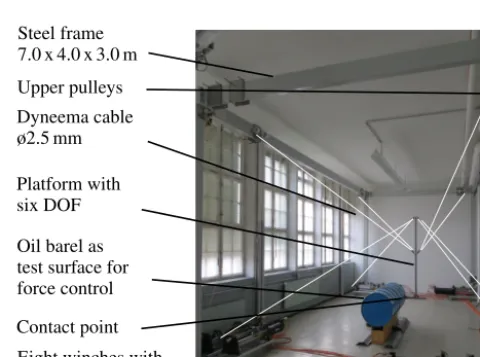
Processes like grinding and polishing demand an accu-rately controlled contact force to give reliable results. One application example is the surface grinding in the airplane maintenance, which is exemplary setup using oil barrels shown in Fig. 1. Force control also allows compensating for deviations in the work piece geometry by keeping the tool constantly in contact with the surface. There exist solutions like air controlled cylinders or stiffness actuators, which can be installed at the robot’s platform to enable for the control of process forces. Osypiuk and Kröger (2011) The drawback is that the system adds additional weight to the platform and the direction of the force is typically fixed w.r.t. the platform frame. Furthermore, these systems make a power and signal supply on the platform necessary.
The aim of the hybrid position-force control is to apply process forces in a programmable direction to a surface while the movement perpendicular to the force vector is position controlled.
The basic approach for the hybrid position-force control was already presented in the early eighties by Raibert and Craig (1981) and its basic structure is shown in Fig. 3. The control problem is divided into parallel control loops for po-sition and force control with their set-points xset andFset,
Manuscript prepared for Mech. Sci.
with version 2014/09/16 7.15 Copernicus papers of the LATEX class
coperni-cus.cls.
Date: 28 July 2015
Hybrid Position-Force Control of a Cable-Driven Parallel
Robot with Experimental Evaluation
W. Kraus, P. Miermeister, V. Schmidt, and A. Pott
Fraunhofer Institute for Manufacturing Engineering and Automation IPA in Stuttgart, Germany
Correspondence to:W. Kraus ([email protected])
Abstract. For cable-driven parallel robots elastic cables are used to manipulate a mobile platform in the workspace. In this paper, we present a hybrid position-force control, which allows for applying defined forces on the environment and simultaneous movement along the surface. We propose a synchronous control of the cable forces to ensure the stability of the platform during movement. The performance of the controller is exper-imentally investigated regarding contact establishment and dynamic behavior during a motion on the cable robot IPAnema 3.
Dyneema cable ø2.5 mm Steel frame 7.0 x 4.0 x 3.0 m
Platform with six DOF
Oil barel as test surface for force control
Eight winches with cable force sensors Contact point Upper pulleys
Figure 1.Cable-driven parallel robot IPAnema 3: Robot test set-up
1 Introduction
Acknowledgements. This work was supported by the FhG Internal Programs under Grant no. WISA 823 244.
Edited by: J. Schmiedeler
Reviewed by: S. Y. Ko and one anonymous referee
Table 1.Experimental evaluation of the contact establishment at different positions and resulting overshoot and settling time
position overshoot settling time mean [%] σ[%] mean [s] σ[s]
1 9.357 1.171 0.781 0.191
2 8.698 0.840 1.378 0.242
3 5.692 0.351 0.981 0.093
4 4.299 0.927 0.866 0.138
5 8.573 0.486 0.977 0.081
6 8.329 0.461 1.035 0.019
7 18.106 2.227 0.804 0.156
8 15.024 2.857 0.742 0.209
9 5.100 0.353 0.889 0.010
10 3.910 0.067 3.517 0.413
average 8.709 - 1.197
-Table 2.Control parameters of hybrid position-force control (con-troller is experimentally tuned)
parameter definition value unit
TMA time constant of moving average for wrench filtering
2.0 s
Ti,OFC integrator reset time 2.6 s
Td,OFC derivative time constant 0.03 s−1
Kp,OFC proportional gain (compliance) 22000−1 m/N
fmin minimum cable force 100 N
fmax maximum cable force 1000 N
Fth threshold force 25 N
vmax maximum approaching velocity 0.05 m/s
Figure 1.Cable-driven parallel robot IPAnema 3: Robot test set-up.
respectively. With the selection matrix S, the degrees-of-freedom (DOF) are assigned to be either force or position controlled. The hybrid control law was implemented already on parallel manipulators in Madani and Moallem (2011) and Deng et al. (2010). For the cable robot, several adaptions are made. The major difference to the classic hybrid control law is the additional cable force control loop to control the inter-nal cable tensions. For a serial robot, the concept of an ad-ditional null-space control loop is described in Park (2006).
1202 W. Kraus et al.: Hybrid Position/Force Control of a Cable RobotW. Kraus et al.: Hybrid Position/Force Control of a Cable Robot
Kp
K0
r,R
ai
bi
τp
fp
Ai
Bi
ui
li
Figure 2.General kinematic parameters
+ Forward
kinematics
Position control law
Force control law
Force transformation
Robot +
xset xe
Fe
Fset Fe,s +
S J−1 −
+ −
I−S JT
τPC
τFC
xis lis
Fis fis
xe,s
Figure 3.Hybrid position and force control proposed by Raibert and Craig Raibert and Craig (1981)
References
Albu-Schaeffer, A., Ott, C., Frese, U., and Hirzinger, G.: Cartesian Impedance Control of Redundant Robots: Recent Results with the DLR-Light-Weight-Arms, IEEE International Conference on Robotics and Automation, 2003.
Almeida, F., Lopes, A., and Abreu, P.: Force-Impedance Control a new control strategy of robotic manipulators, Recent Advances in Mechatronics, 1999.
Assuncao, V. and Schumacher, W.: Hybrid Force Control for Paral-lel Manipulators, 11th Mediterranean Conference on Control and Automation (MED), Rhodos, Griechenland, 2003.
Deng, W., Lee, H. J., and Jeh-Won, L.: Dynamic Hybrid Position-Force Control for Parallel Robot Manipulators, ROMANSY 18 Robot Design, Dynamics and Control, 2010.
Kraus, W., Schmidt, V., Rajendra, P., and Pott, A.: System Iden-tification and Cable Force Control for a Cable-Driven Parallel
time [s]
0 1 2 3 4 5
force [N]
-40 -20 0 20 40 60 80
F
is
Fset d(F
is)/dt
Fset is reached (± 2%)
settling time state
A
platform comes in contact
B D
overshoot
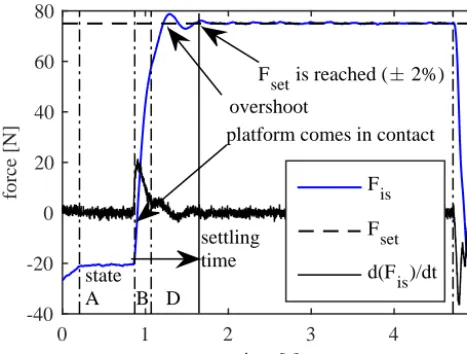
Figure 4.Progression of the force during contact establishment, force control and release
time [s]
0 20 40 60 80
contact force [N]
-20 0 20 40 60 80
Fis Fset oscillations due to
stick slip effect
release contact establishment
robot moves along the surface
Figure 5.Progression of the force normal to the surface on the oil barrel
x
y
Top view:
2 m
2 m 1
2 3
4 5
6 7
8
9 10
Figure 6.Investigated points for contact establishment
Figure 2.General kinematic parameters.
Another difference is the use of joint space force measure-ment and transformation into operational space instead of a force-torque sensor at the platform. The cable force sensors are already integrated for cable force control. By using them for wrench measurement, additional costs for sensors can be avoided and no additional sensor has to be added to the plat-form. We assume a cable robot using closed-loop position control in the joint space, instead of closed-loop position con-trol in operational space. Therefore, no forward kinematics is used which is computationally expensive for a cable robot. The position control is encapsulated in the motion genera-tor. Therefore, the selection matrix S cannot be realized for position control and the decoupling is realized in the force control implementation.
Beside the hybrid position-force control, the contact es-tablishment is challenging. The major concern regarding sta-bility are the transient system properties when the platform comes in contact with the environment. The contact prob-lem was investigated for both serial (Albu-Schaeffer et al., 2003; Raibert and Craig, 1981), and classical parallel robots Tang et al. (2012). In Assuncao and Schumacher (2003) this problem is solved by a state machine based approach using acceleration and brake controllers for bringing the robot into contact. An alternative approach for eliminating the switch-ing strategy is presented in Almeida et al. (1999) usswitch-ing an adaptive gain of the impedance controller. In Reisinger et al. (2011) Moreau’s sweeping process is applied for the transi-tion during contact establishment.
In this paper, we present the design and experimental eval-uation of a operational space force control for a cable robot.
In addition to the known contact problem, we have to en-sure that the cables remain under tension.
Kp
K0
r,R
ai
bi
τp
fp
Ai
Bi
ui
li
Figure 2.General kinematic parameters
+ Forward
kinematics
Position control law
Force control law
Force transformation
Robot +
xset xe
Fe
Fset Fe,s +
S J−1 −
+
− I−S J
T
τPC
τFC
xis lis
Fis fis
xe,s
Figure 3.Hybrid position and force control proposed by Raibert and Craig Raibert and Craig (1981)
References
Albu-Schaeffer, A., Ott, C., Frese, U., and Hirzinger, G.: Cartesian Impedance Control of Redundant Robots: Recent Results with the DLR-Light-Weight-Arms, IEEE International Conference on Robotics and Automation, 2003.
Almeida, F., Lopes, A., and Abreu, P.: Force-Impedance Control a new control strategy of robotic manipulators, Recent Advances in Mechatronics, 1999.
Assuncao, V. and Schumacher, W.: Hybrid Force Control for Paral-lel Manipulators, 11th Mediterranean Conference on Control and Automation (MED), Rhodos, Griechenland, 2003.
Deng, W., Lee, H. J., and Jeh-Won, L.: Dynamic Hybrid Position-Force Control for Parallel Robot Manipulators, ROMANSY 18 Robot Design, Dynamics and Control, 2010.
Kraus, W., Schmidt, V., Rajendra, P., and Pott, A.: System Iden-tification and Cable Force Control for a Cable-Driven Parallel
time [s]
0 1 2 3 4 5
force [N]
-40 -20 0 20 40 60 80
Fis Fset d(F
is)/dt
Fset is reached (± 2%)
settling time state
A
platform comes in contact
B D
overshoot
Figure 4.Progression of the force during contact establishment, force control and release
time [s]
0 20 40 60 80
contact force [N]
-20 0 20 40 60 80
F
is
F
set
oscillations due to stick slip effect
release contact establishment
robot moves along the surface
Figure 5.Progression of the force normal to the surface on the oil barrel
x
y
Top view:
2 m
2 m 1
2 3
4 5
6 7
8
9 10
Figure 6.Investigated points for contact establishment
Figure 3.Hybrid position and force control proposed by Raibert and Craig (1981).
The state machine based approach presented in Assuncao and Schumacher (2003) is adapted for the cable robot. To keep the cables under tension, we introduce a decoupled ca-ble force controller to tension the caca-bles during the contact force control. For this, the cable force control presented in Kraus et al. (2014) is modified regarding the set-point de-termination. A task coordinate system is established to real-ize the hybrid position-force control. For motion control, the trajectory planning and interpolation is done in operational space and transformed with the inverse kinematics to position set-points in joint space. This structure is typically used in commercial CNC controllers. We chose position-controlled drives and not a torque-based approach to make use of state-of-the art industrial servo drives and the robustness of the decentralized position control. To program the desired force vector with standard industrial machine interfaces, new com-mands based on standardized G-Code are established.
This paper is organized as follows: The robot model in-cluding kinematic and the determination of cable force dis-tributions are summarized in Sect. 2. The design and im-plementation of the operational space force controller is de-scribed in Sect. 3. Experimental results are presented and dis-cussed in Sect. 4. Finally, conclusions and an outlook on fu-ture work are given in Sect. 5.
2 Kinematic and static model
For completeness, we briefly review the kinematic model for a spatial robot withn=6 DOF. Verhoeven (2004) The geom-etry of the robot is described by the proximal anchor points on the robot baseai and the distal anchor points on the plat-formbi as shown in Fig. 2. The index i denotes the cable number andmis the absolute number of cables. By applying a vector loop, the cable vectorlifollows as
li =ai−r−Rbi, (1)
W. Kraus et al.: Hybrid Position/Force Control of a Cable Robot 121 while r is the platform position vector and rotation matrix
R describes the orientation of the mobile platform frameKp w.r.t. the base coordinate frameK0.
The structure equation with K0 the structure matrix AT describes the force and torque equilibrium at the platform for a given cable force distributionf and can be written as
u1 ··· um
b1×u1 ··· bm×um
| {z }
AT(r,R)
f1 .. . fm
| {z }
f
= −
fp
τp | {z }
w
, (2)
withui= li
klik being the unit vector of the cables directing from the mobile platform to the base. The applied wrench wconsists of external forcesfpand torquesτpand also in-cludes the weightmpof the platform.
For the cable force control, a force distributionf has to be calculated, which solves the structure Eq. (2) and is con-tinuous along a trajectory. There exist several approaches which fulfill these requirements like Lamaury and Goutte-farde (2012) or Mikelsons et al. (2008). In this paper, the advanced closed-form solution presented in Pott (2013) is applied. It is based on the closed-form solution for the struc-ture matrix presented in Pott et al. (2009). In this approach, a reference cable force fref=(fmin+fmax)/2 is intro-duced which is based on the minimum cable forcefminand maximum cable force fmax, respectively. With the Moore-Penrose matrix inverse A+T, the least square optimal force distribution is obtained by
f =fref−A+T(w+ATfref). (3)
The redundancyr=m−ndefines the rank of the null-space of the structure matrix. For the IPAnema cable robot with r=2, the workspace derived with the closed-form solution amounts only 57.5 % of the possible workspace. This moti-vated for the further development and ended in the advanced closed-form method. The algorithm and its application to workspace analysis of cable robots was firstly presented in Pott (2013).
The advanced closed-form algorithm consists of the eval-uation of the closed-form solution and an order reduction of the linear equation system in the case, the cable bounds are violated. The largest violation of the cable bounds is detected and the cable force is set to the corresponding limit value. Next, this cable is excluded from structure matrix and the ex-erted force and torque of this cable is added to the wrench. This procedure is repeated until a feasible solution is reached or the structure matrix is quadratic and no further reduction is possible. The computational effort is strictly bounded. In the worst case, r iterations have to be performed. The de-scription of the robot model is hereby completed and next the controller design for hybrid position-force control is pre-sented.
W. Kraus et al.: Hybrid Position/Force Control of a Cable Robot 3
for a given cable force distributionf and can be written as
u1 ··· um
b1×u1 ··· bm×um
| {z }
AT(r,R)
f1 .. . fm
| {z }
f
= −
fp τp
| {z } w
, (2)
withui= li
klik being the unit vector of the cables directing from the mobile platform to the base. The applied wrench wconsists of external forcesfpand torquesτpand also in-cludes the weightmpof the platform.
For the cable force control, a force distribution f has to be calculated, which solves the structure Eq. (2) and is con-tinuous along a trajectory. There exist several approaches which fulfill these requirements like Lamaury and Goutte-farde (2012) or Mikelsons et al. (2008). In this paper, the advanced closed-form solution presented in Pott (2013) is applied. It is based on the closed-form solution for the struc-ture matrix presented in Pott et al. (2009). In this approach, a reference cable force fref=(fmin+fmax)/2 is intro-duced which is based on the minimum cable forcefminand maximum cable forcefmax, respectively. With the Moore-Penrose matrix inverse A+T, the least square optimal force distribution is obtained by
f =fref−A+T(w+ATfref). (3) The redundancyr=m−ndefines the rank of the null-space of the structure matrix. For the IPAnema cable robot with r=2, the workspace derived with the closed-form solution amounts only 57.5 % of the possible workspace. This moti-vated for the further development and ended in the advanced closed-form method. The algorithm and its application to workspace analysis of cable robots was firstly presented in Pott (2013).
The advanced closed-form algorithm consists of the eval-uation of the closed-form solution and an order reduction of the linear equation system in the case, the cable bounds are violated. The largest violation of the cable bounds is detected and the cable force is set to the corresponding limit value. Next, this cable is excluded from structure matrix and the ex-erted force and torque of this cable is added to the wrench. This procedure is repeated until a feasible solution is reached or the structure matrix is quadratic and no further reduction is possible. The computational effort is strictly bounded. In the worst case, r iterations have to be performed. The de-scription of the robot model is hereby completed and next the controller design for hybrid position-force control is pre-sented.
3 Controller design and implementation
3.1 Controller design
The operational space force control aims at the control of the wrench win a given direction e.g. perpendicular to the
Kp
K0
Desired contact
forceFd
Surface
Robot platform
Rt Path
Kt
Cables
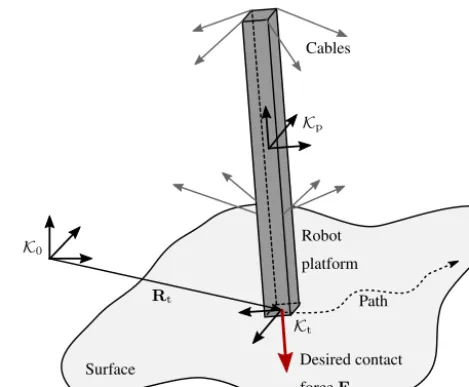
Figure 4.Principle set-up at the mobile platform and coordinate systems for hybrid position-force control.
surface of the environment. While using a cable robot for applying the contact force, additionally the cables have to be kept under tension. Especially for the simultaneous position controlled movement in the tangential plane this is important, as friction forces have to be overcome. To realize the hybrid position-force control for a cable robot, the control problem is divided into three parts:
– The operational space position control gives a desired position in operational space xset,PCTS2 to move the platform along a path.
– The operational space force control generates an offset in the operational space position xset,OFC allowing to control the external platform wrench i.e. contact force using joint space position control.
– The cable force control for keeping the cables under ten-sion. For this, a feasible force distribution is calculated for the measured wrench. The controller output is the modificationlCFCof the cable length set-point. With the inverse kinematics (IK) the output of the three con-trollers are summed up by
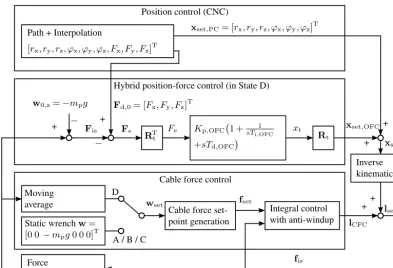
lset=IK{xset,PC+xset,OFC} +lCFC, (4) to the cable length set-pointlsetwhich is commanded to the servo drives. The control structure is visualized in Fig. 5. In the following, the operational space and cable force control are described in detail.
3.2 Operational Space Force Control
The main challenge of the operational space force control is the contact establishment. When the platform comes in
Please
note
the
remarks
at
the
end
of
the
manuscript.
www.mech-sci.net/6/1/2015/ Mech. Sci., 6, 1–7, 2015
Figure 4.Principle set-up at the mobile platform and coordinate systems for hybrid position-force control.
3 Controller design and implementation
3.1 Controller design
The operational space force control aims at the control of the wrenchwin a given direction e.g. perpendicular to the surface of the environment. While using a cable robot for applying the contact force, additionally the cables have to be kept under tension. Especially for the simultaneous position controlled movement in the tangential plane this is important, as friction forces have to be overcome. To realize the hybrid position-force control for a cable robot, the control problem is divided into three parts:
– The operational space position control gives a desired position in operational spacexset,PC to move the plat-form along a path.
– The operational space force control generates an offset in the operational space position xset,OFC allowing to control the external platform wrench i.e. contact force using joint space position control.
– The cable force control for keeping the cables under ten-sion. For this, a feasible force distribution is calculated for the measured wrench. The controller output is the modificationlCFCof the cable length set-point.
With the inverse kinematics (IK) the output of the three con-trollers are summed up by
lset=IK{xset,PC+xset,OFC} +lCFC, (4) to the cable length set-pointlsetwhich is commanded to the servo drives. The control structure is visualized in Fig. 5. In the following, the operational space and cable force control are described in detail.
fis Integral control with anti-windup Cable force
set-point generation Static wrenchw=
[0 0 −mpg0 0 0]T
Force transformation wis
wset fset
lCFC
xset,OFC Position control (CNC)
Hybrid position-force control (in State D)
Cable force control Moving
average
Kp,OFC 1 +sTi1
,OFC +sTd,OFC
RT
t Rt
Path + Interpolation
[rx, ry, rz, ϕx, ϕy, ϕz, Fx, Fy, Fz]T
xset,PC= [rx, ry, rz, ϕx, ϕy, ϕz]T
Fe
Fe xt
Inverse kinematics
lset
Fis
w0,z=−mpg
− +
+
++ +
+ xset −
Fd,0= [Fx, Fy, Fz]T
D
A / B / C
Figure 5.Proposed implementation of the hybrid position-force control with cable force control.
Fis
Fe
xt
Fis≥Fth v= 0 Fis< Fth
Fis< Fth Fis≥Fth
Fis≥Fth
A
Initial state
Position controller
B
Brake controller
D
Final state
Force controller
C
Position controller
Figure 6.State machine with transition conditions for the contact establishment.
contact, the system properties change abruptly. We adapt the
approach presented by Assuncao and Schumacher (2003)
which uses a state machine. Basically, the contact is
estab-lished in position control (States A–C) and closed-loop force
control is performed when the platform is in contact. The
contact establishment is structured into four states, as
illus-trated in Fig. 6. The inputs of the state machine are the actual
contact force
F
isand the deviation from the desired contact
force
F
e=
F
set−
F
is. The output is the position offset
x
tin
the direction of the desired force vector.
In state A, the platform is moved in the direction of the
surface with a maximal velocity
v
max. During the movement,
the wrench is observed. The contact between the platform
and the surface is detected when the threshold force
F
this
exceeded. As the measured wrench is disturbed by
measure-ment errors, we also observe the derivative of the force to
identify the contact. When the contact is detected, the
plat-form is slowed down till stand still in state B. Next in state D,
the closed-loop force control is activated as shown in Fig. 5.
A PID controller with the transfer function
G
c(
s
)
=
L
{
x
t(
t
)
}
L
{
F
e(
t
)
}
=
K
p,OFC1
+
1
sT
i,OFC+
sT
d,OFC,
(5)
is applied, where
K
p,OFCdenotes the gain,
T
i,OFCthe
inte-grator reset time and
T
d,OFCthe derivative time. The control
parameters are determined experimentally and presented in
Table 1. When the robot loses the contact to the surface, this
means the force is less than the threshold force, the state
ma-chine switches to state C and a position controller brings the
platform again in contact.
The operational space force control is based on an
indi-rect force measurement using the cable force sensors. For the
transformation from joint to operational space, the structure
matrix A
T, describing the actual cable directions, is used.
The estimated wrench
w
isis derived by
w
is= −
A
Tf
is,
(6)
where
f
isdenotes the measured cable forces. The actual
force vector w.r.t. the world frame
F
isis derived from the
Mech. Sci., 6, 1–7, 2015 www.mech-sci.net/6/1/2015/
Figure 5.Proposed implementation of the hybrid position-force control with cable force control.
fis Integral control with anti-windup Cable force
set-point generation Static wrenchw=
[0 0−mpg0 0 0]T
Force transformation wis
wset fset
lCFC
xset,OFC Position control (CNC)
Hybrid position-force control (in State D)
Cable force control Moving
average
Kp,OFC 1 +sTi1
,OFC +sTd,OFC
RT
t Rt
Path + Interpolation
[rx, ry, rz, ϕx, ϕy, ϕz, Fx, Fy, Fz]T
xset,PC= [rx, ry, rz, ϕx, ϕy, ϕz]T
Fe
Fe xt
Inverse kinematics
lset
Fis
w0,z=−mpg
− +
+
++ +
+ xset −
Fd,0= [Fx, Fy, Fz]T
D
A / B / C
Figure 5.Proposed implementation of the hybrid position-force control with cable force control.
Fis
Fe
xt
Fis≥Fth v= 0 Fis< Fth
Fis< Fth Fis≥Fth
Fis≥Fth
A
Initial state
Position controller
B
Brake controller
D
Final state
Force controller
C
Position controller
Figure 6.State machine with transition conditions for the contact establishment.
contact, the system properties change abruptly. We adapt the approach presented by Assuncao and Schumacher (2003) which uses a state machine. Basically, the contact is estab-lished in position control (States A–C) and closed-loop force control is performed when the platform is in contact. The contact establishment is structured into four states, as illus-trated in Fig. 6. The inputs of the state machine are the actual contact forceFis and the deviation from the desired contact
forceFe=Fset−Fis. The output is the position offsetxt in
the direction of the desired force vector.
In state A, the platform is moved in the direction of the surface with a maximal velocityvmax. During the movement,
the wrench is observed. The contact between the platform and the surface is detected when the threshold force Fth is
exceeded. As the measured wrench is disturbed by measure-ment errors, we also observe the derivative of the force to identify the contact. When the contact is detected, the plat-form is slowed down till stand still in state B. Next in state D, the closed-loop force control is activated as shown in Fig. 5.
A PID controller with the transfer function
Gc(s)=
L{xt(t)}
L{Fe(t)}=
Kp,OFC
1+ 1
sTi,OFC+
sTd,OFC
, (5)
is applied, whereKp,OFC denotes the gain,Ti,OFC the
inte-grator reset time andTd,OFCthe derivative time. The control
parameters are determined experimentally and presented in Table 1. When the robot loses the contact to the surface, this means the force is less than the threshold force, the state ma-chine switches to state C and a position controller brings the platform again in contact.
The operational space force control is based on an indi-rect force measurement using the cable force sensors. For the transformation from joint to operational space, the structure matrix AT, describing the actual cable directions, is used. The estimated wrenchwisis derived by
wis= −ATfis, (6)
where fis denotes the measured cable forces. The actual force vector w.r.t. the world frameFis is derived from the
Mech. Sci., 6, 1–7, 2015 www.mech-sci.net/6/1/2015/
Figure 6.State machine with transition conditions for the contact establishment.
3.2 Operational Space Force Control
The main challenge of the operational space force control is the contact establishment. When the platform comes in contact, the system properties change abruptly. We adapt the approach presented by Assuncao and Schumacher (2003) which uses a state machine. Basically, the contact is estab-lished in position control (States A–C) and closed-loop force control is performed when the platform is in contact. The contact establishment is structured into four states, as illus-trated in Fig. 6. The inputs of the state machine are the actual contact forceFisand the deviation from the desired contact forceFe=Fset−Fis. The output is the position offsetxtin the direction of the desired force vector.
In state A, the platform is moved in the direction of the surface with a maximal velocityvmax. During the movement, the wrench is observed. The contact between the platform and the surface is detected when the threshold force Fth is exceeded. As the measured wrench is disturbed by
measure-ment errors, we also observe the derivative of the force to identify the contact. When the contact is detected, the plat-form is slowed down till stand still in state B. Next in state D, the closed-loop force control is activated as shown in Fig. 5. A PID controller with the transfer function
Gc(s)= L{ xt(t)} L{Fe(t)}=
Kp,OFC
1+ 1
sTi,OFC+ sTd,OFC
, (5) is applied, whereKp,OFC denotes the gain,Ti,OFC the inte-grator reset time andTd,OFCthe derivative time. The control parameters are determined experimentally and presented in Table 1. When the robot loses the contact to the surface, this means the force is less than the threshold force, the state ma-chine switches to state C and a position controller brings the platform again in contact.
The operational space force control is based on an indi-rect force measurement using the cable force sensors. For the transformation from joint to operational space, the structure
W. Kraus et al.: Hybrid Position/Force Control of a Cable Robot 123
2 W. Kraus et al.: Hybrid Position/Force Control of a Cable Robot
Kp
K0
r,R
ai
bi
τp
fp
Ai
Bi
ui
li
Figure 2.General kinematic parameters
+ Forward
kinematics
Position control law
Force control law
Force transformation
Robot +
xset xe
Fe
Fset Fe,s +
S J−1 −
+ −
I−S JT
τPC
τFC
xis lis
Fis fis
xe,s
Figure 3.Hybrid position and force control proposed by Raibert and Craig Raibert and Craig (1981)
References
Albu-Schaeffer, A., Ott, C., Frese, U., and Hirzinger, G.: Cartesian Impedance Control of Redundant Robots: Recent Results with the DLR-Light-Weight-Arms, IEEE International Conference on Robotics and Automation, 2003.
Almeida, F., Lopes, A., and Abreu, P.: Force-Impedance Control a new control strategy of robotic manipulators, Recent Advances in Mechatronics, 1999.
Assuncao, V. and Schumacher, W.: Hybrid Force Control for Paral-lel Manipulators, 11th Mediterranean Conference on Control and Automation (MED), Rhodos, Griechenland, 2003.
Deng, W., Lee, H. J., and Jeh-Won, L.: Dynamic Hybrid Position-Force Control for Parallel Robot Manipulators, ROMANSY 18 Robot Design, Dynamics and Control, 2010.
Kraus, W., Schmidt, V., Rajendra, P., and Pott, A.: System Iden-tification and Cable Force Control for a Cable-Driven Parallel
time [s]
0 1 2 3 4 5
force [N]
-40 -20 0 20 40 60 80
Fis Fset d(Fis)/dt Fset is reached (± 2%)
settling time state
A
platform comes in contact
B D
overshoot
Figure 4.Progression of the force during contact establishment, force control and release
time [s]
0 20 40 60 80
contact force [N]
-20 0 20 40 60 80
Fis Fset oscillations due to
stick slip effect
release contact establishment
robot moves along the surface
Figure 5.Progression of the force normal to the surface on the oil barrel
x
y
Top view:
2 m
2 m 1
2 3
4 5
6 7
8
9 10
Figure 6.Investigated points for contact establishment
Figure 7. Progression of the force during contact establishment, force control and release.
matrix AT, describing the actual cable directions, is used. The estimated wrenchwisis derived by
wis= −ATfis, (6)
where fis denotes the measured cable forces. The actual force vector w.r.t. the world frame Fis is derived from the actual wrench under consideration of the own-weight of the platformmpg.
We introduce a task coordinate system Kt as visualized in Fig. 4, which lies in the contact point and thezaxis co-incides with the desired force direction. The transformation from world K0 to task coordinate system Kt is described by the rotation matrix Rt. The desired force vectorFset,0is transformed by
Fset,t=RTtFset,0,withFset,0= [0 0Fset]T, (7) to the task coordinate system, where thezcomponent repre-sents the scalar desired forceFset. With the coordinate trans-formation, the force control can be designed as a single input single output controller.
3.3 Cable force control
Redundant cable robots have the property that the cables can be tensed against each other without exerting an external force. In the present control architecture, the external forces are controlled by the operational space force control. There-fore, the cable force control aims at the control of the internal tensions and has to be decoupled from the operational space force control. As the wrench is controlled by the operational space force control, we propose to use the measured wrench wisfor the determination of the set-point of the cable forces fsetaccording to (Eq. 3). This ensures that the controlled ca-ble force is compatica-ble to the actual external forces and does
Table 1.Control parameters of hybrid position-force control (con-troller is experimentally tuned).
parameter definition value unit
TMA time constant of moving average for wrench filtering
2.0 s
Ti,OFC integrator reset time 2.6 s Td,OFC derivative time constant 0.03 s−1 Kp,OFC proportional gain
(compliance)
22 000−1 m N−1
fmin minimum cable force 100 N fmax maximum cable force 1000 N
Fth threshold force 25 N
vmax maximum approaching velocity
0.05 m s−1
not influence the motion of the platform. To avoid instabil-ities due to the synchronous control of the external wrench and the internal cable forces, a moving average is applied on the wrench to smooth the measurement signal (low pass fil-ter) and, thus, increase the stability margins of the control loop. The control error in cable forcefeis established by
fe=fset−fis. (8)
The integral control with anti-windup is realized according to Kraus et al. (2014).
During the contact establishment, the system properties and also the wrench change abruptly. This leads to the desta-bilization of the contact controller. In this transient phase, the cable force controller also influences the external forces and additionally disturbs the contact controller. To avoid this problem, the cable force control assumes the gravitational forcempgas wrench during contact establishment which cor-responds to the states A to C of the state machine. With this approach, we can eliminate additional sources of instabilities due to the internal cable force control. After contact estab-lishment, the cable force control is enabled again.
3.4 Implementation
The CNC executes the position control for a path pro-grammed in G-code. Three additional axes were added to the CNC, which are interpreted as desired force vector. These axes were handled as movement axes and were interpo-lated in the interpolation cycle. In this way, the force vec-tor changes smoothly and is consistent with the movement commands along the surface.
4 Experimental evaluation
4.1 Test platform
For the experimental evaluation the control algorithms are implemented on the cable robot IPAnema 3 using eight
124 W. Kraus et al.: Hybrid Position/Force Control of a Cable Robot
Table 2. Experimental evaluation of the contact establishment at different positions and resulting overshoot and settling time.
position overshoot settling time mean [%] σ [%] mean [s] σ [s]
1 9.357 1.171 0.781 0.191
2 8.698 0.840 1.378 0.242
3 5.692 0.351 0.981 0.093
4 4.299 0.927 0.866 0.138
5 8.573 0.486 0.977 0.081
6 8.329 0.461 1.035 0.019
7 18.106 2.227 0.804 0.156
8 15.024 2.857 0.742 0.209
9 5.100 0.353 0.889 0.010
10 3.910 0.067 3.517 0.413
average 8.709 – 1.197 –
bles and a straight line platform as shown in Fig. 1. The robot frame measures 7 m by 4 m and is 3 m high.
The robot control is realized on an industrial PC with Beckhoff TwinCAT 3.1 CNC at a cycle time of 1 ms. The field bus protocol is EtherCAT. For the force measurement each winch is equipped with a cable force sensor of type Tecsis F2301 with a measurement range up to 4000 N. The analog output signal of the force sensors is digitized in A/D-converters and sent via the field bus to the control. The cable type is LIROS D-Pro 01505-0250 based on Dyneema SK 75 fiber (Polyethylene) with a diameter of 2.50 mm.
4.2 Contact establishment
For the investigation of the contact establishment, a vertical force on the floor is applied. The resulting progression of the force during force control is shown in Fig. 7. The time deriva-tive of the contact force d(Fis)/dt is noisy but clearly signals when the platform comes in contact.
One interesting point is the contact establishment under the condition of changing robot stiffness in the contact. For this, the operational space force control was applied on the floor at ten different positions which are visualized in Fig. 8. Position 1 lies in the center of the workspace, whereas 7 and 9 are on the edge of robot’s footprint.
The evaluation criteria for the contact establishment are the overshoot and settling time. For the experiment the approaching velocity is 50 mm s−1 and the desired force amounts to 75 N. The experimental results are presented in Table 2. We can observe a maximum overshoot of 18.2 % whereas the average lies at 8.7 %. The settling time is de-fined as the time from the first contact to the surface until the control error is smaller than 2 %. The mean settling time is in average 1.2 s.
The results show a compromise between an acceptable overshoot and a settling time. By changing the approaching
Kp
K0
r,R
ai
bi
τp
fp
Ai
Bi
ui
li
Figure 2.General kinematic parameters
+ Forward
kinematics
Position control law
Force control law
Force transformation
Robot +
xset xe
Fe
Fset Fe,s +
S J−1 −
+ −
I−S JT
τPC
τFC
xis lis
Fis fis
xe,s
Figure 3.Hybrid position and force control proposed by Raibert and Craig Raibert and Craig (1981)
References
Albu-Schaeffer, A., Ott, C., Frese, U., and Hirzinger, G.: Cartesian Impedance Control of Redundant Robots: Recent Results with the DLR-Light-Weight-Arms, IEEE International Conference on Robotics and Automation, 2003.
Almeida, F., Lopes, A., and Abreu, P.: Force-Impedance Control a new control strategy of robotic manipulators, Recent Advances in Mechatronics, 1999.
Assuncao, V. and Schumacher, W.: Hybrid Force Control for Paral-lel Manipulators, 11th Mediterranean Conference on Control and Automation (MED), Rhodos, Griechenland, 2003.
Deng, W., Lee, H. J., and Jeh-Won, L.: Dynamic Hybrid Position-Force Control for Parallel Robot Manipulators, ROMANSY 18 Robot Design, Dynamics and Control, 2010.
Kraus, W., Schmidt, V., Rajendra, P., and Pott, A.: System Iden-tification and Cable Force Control for a Cable-Driven Parallel
time [s]
0 1 2 3 4 5
force [N]
-40 -20 0 20 40 60 80
Fis Fset d(Fis)/dt Fset is reached (± 2%)
settling time state
A
platform comes in contact
B D
overshoot
Figure 4.Progression of the force during contact establishment, force control and release
time [s]
0 20 40 60 80
contact force [N]
-20 0 20 40 60 80
F
is
Fset oscillations due to
stick slip effect
release contact establishment
robot moves along the surface
Figure 5.Progression of the force normal to the surface on the oil barrel
x
y
Top view:
2 m
2 m 1
2 3
4 5
6 7
8
9 10
Figure 6.Investigated points for contact establishment
Figure 8.Experimental evaluation of the contact establishment at different positions.
2 W. Kraus et al.: Hybrid Position/Force Control of a Cable Robot
Kp
K0
r,R
ai
bi
τp
fp
Ai
Bi
ui
li
Figure 2.General kinematic parameters
+ Forward
kinematics
Position control law
Force control law
Force transformation
Robot +
xset xe
Fe
Fset Fe,s +
S J−1 −
+ −
I−S JT
τPC
τFC
xis lis
Fis fis
xe,s
Figure 3.Hybrid position and force control proposed by Raibert and Craig Raibert and Craig (1981)
References
Albu-Schaeffer, A., Ott, C., Frese, U., and Hirzinger, G.: Cartesian Impedance Control of Redundant Robots: Recent Results with the DLR-Light-Weight-Arms, IEEE International Conference on Robotics and Automation, 2003.
Almeida, F., Lopes, A., and Abreu, P.: Force-Impedance Control a new control strategy of robotic manipulators, Recent Advances in Mechatronics, 1999.
Assuncao, V. and Schumacher, W.: Hybrid Force Control for Paral-lel Manipulators, 11th Mediterranean Conference on Control and Automation (MED), Rhodos, Griechenland, 2003.
Deng, W., Lee, H. J., and Jeh-Won, L.: Dynamic Hybrid Position-Force Control for Parallel Robot Manipulators, ROMANSY 18 Robot Design, Dynamics and Control, 2010.
Kraus, W., Schmidt, V., Rajendra, P., and Pott, A.: System Iden-tification and Cable Force Control for a Cable-Driven Parallel
time [s]
0 1 2 3 4 5
force [N]
-40 -20 0 20 40 60 80
F
is
F
set
d(F
is)/dt
F
set is reached (± 2%)
settling time state
A
platform comes in contact
B D
overshoot
Figure 4.Progression of the force during contact establishment, force control and release
time [s]
0 20 40 60 80
contact force [N]
-20 0 20 40 60 80
F
is
F
set
oscillations due to stick slip effect
release
contact establishment
robot moves along the surface
Figure 5.Progression of the force normal to the surface on the oil barrel
x
y
Top view:
2 m
2 m 1
2 3
4 5
6 7
8
9 10
Figure 6.Investigated points for contact establishment
Figure 9.Progression of the force normal to the surface on the oil barrel.
velocity, this compromise can be influenced in favor of one evaluation criteria.
The settling time lies in a range of experimental results which can be found in literature. In Kroeger et al. (2004) the settling time for a serial industrial manipulator lies be-tween 0.6 and 1.7 s. In another scenario shown in Lange et al. (2013) a settling time of 0.8 s for an industrial robot was achieved.
4.3 Following behavior
The following behavior of the force control during a simulta-neous motion of the platform was investigated on oil barrels. The test set-up is shown in Fig. 1. The test scenario is ex-emplary for a spherical surface which can be found at wings of airplanes or blades of wind turbines. The path along the
W. Kraus et al.: Hybrid Position/Force Control of a Cable Robot 125 oil barrel is programmed offline. In addition, we also
pro-grammed the desired force vector which is aligned to the normal vector of the surface.
The quantitative behavior of the contact force along the surface is shown in Fig. 9. The desired force is 50 N. As the contact point of the platform to the oil barrel is eccentric, the stiffness is low and stick slip effects in the contact generate oscillations. The oscillation is relatively high, when the robot moves position controlled into a direction where it is not very stiff. Since the cables are tensed, these critical positions were overcome. For the position and orientation measurement dur-ing the trajectory no measurement equipment was available. Qualitatively, the platform followed well the trajectory. 5 Conclusions
In this paper, we proposed an adaption of the well-known hybrid position-force control for a cable robot. By using the measured wrench as input for the set-point determination of cable forces we were able to tense the cables during the con-tact control. The experimental evaluations on the IPAnema 3 are promising. Further investigation could analyze a specific process by attaching a tool and running the process and an-alyzing how the controller performs when including addi-tional noise associated with running the process. Another in-teresting point is the online identification of the stiffness in the contact and how such knowledge can improve the control quality.
Acknowledgements. This work was supported by the FhG Internal Programs under Grant no. WISA 823 244.
Edited by: J. Schmiedeler
Reviewed by: S. Y. Ko and one anonymous referee
References
Albu-Schaeffer, A., Ott, C., Frese, U., and Hirzinger, G.: Cartesian Impedance Control of Redundant Robots: Recent Results with the DLR-Light-Weight-Arms, IEEE International Conference on Robotics and Automation, 2003.
Almeida, F., Lopes, A., and Abreu, P.: Force-Impedance Control a new control strategy of robotic manipulators, Recent Advances in Mechatronics, 1999.
Assuncao, V. and Schumacher, W.: Hybrid Force Control for Paral-lel Manipulators, 11th Mediterranean Conference on Control and Automation (MED), Rhodos, Griechenland, 2003.
Deng, W., Lee, H. J., and Jeh-Won, L.: Dynamic Hybrid Position-Force Control for Parallel Robot Manipulators, ROMANSY 18 Robot Design, Dynamics and Control, 2010.
Kraus, W., Schmidt, V., Rajendra, P., and Pott, A.: System Identifi-cation and Cable Force Control for a Cable-Driven Parallel Robot with Industrial Servo Drives, IEEE International Conference on Robotics and Automation, 2014.
Kroeger, T., Finkemeyer, B., Heuck, M., and Wahl, F. M.: Adap-tive implicit hybrid force/pose control of industrial manipulators: compliant motion experiments, IEEE/RSJ International Confer-ence on Intelligent Robots and Systems (IROS), 2004.
Lamaury, J. and Gouttefarde, M.: A Tension Distribution Method with Improved Computational Efficiency, in: Cable-Driven Par-allel Robots, Springer, 71–85, 2012.
Lange, F., Bertleff, W., and Suppa, M.: Force and trajectory control of industrial robots in stiff contact, IEEE International Confer-ence on Robotics and Automation, 2013.
Madani, M. and Moallem, M.: Hybrid position/force control of a flexible parallel manipulator, Journal of the Franklin Institute, 999–1012, 2011.
Mikelsons, L., Bruckmann, T., Schramm, D., and Hiller, M.: A Real-Time Capable Force Calculation Algorithm for Redundant Tendon-Based Parallel Manipulators, in: ICRA, Pasadena, 2008. Osypiuk, R. and Kröger, T.: Parallel Stiffness Actuators with Six Degrees of Freedom for Efficient Force/Torque Control Applica-tions, in: Robotic Systems for Handling and Assembly, Springer, vol. 67, 2011.
Park, J.: Control strategies for robots in contact, Ph.D. thesis, Stan-ford University, 2006.
Pott, A.: An improved Force Distribution Algorithm for Over-Constrained Cable-Driven Parallel Robots, in: Computational Kinematics, Springer, 2013.
Pott, A., Bruckmann, T., and Mikelsons, L.: Closed-form Force Dis-tribution for Parallel Wire Robots, in: Computational Kinemat-ics, Springer, 25–34, 2009.
Raibert, M. H. and Craig, J. J.: Hybrid Position/Force Control of Manipulators, in: Journal of Dynamic Systems, Measurement, and Control, vol. 103, 1981.
Reisinger, T., Wobbe, F., Kolbus, M., and Schumacher, W.: Inte-grated Force and Motion Control of Parallel Robots – Part 2: Constrained Space, in: Robotic Systems for Handling and As-sembly, Springer, 2011.
Tang, H., Yao, J., Chengz, L., and Zhao, Y.: Hybrid Position Force Control Investigation of parallel machine tool with redundant ac-tion, Applied Mechanics and Materials, 2012.
Verhoeven, R.: Analysis of the Workspace of Tendon-based Stewart Platforms, Ph.D. thesis, University of Duisburg-Essen, Duisburg, 2004.