https://doi.org/10.5194/ascmo-5-1-2019
© Author(s) 2019. This work is distributed under the Creative Commons Attribution 4.0 License.
NWP-based lightning prediction using flexible
count data regression
Thorsten Simon1,2, Georg J. Mayr1, Nikolaus Umlauf2, and Achim Zeileis2
1Department of Atmospheric and Cryospheric Sciences, University of Innsbruck, Innsbruck, Austria 2Department of Statistics, University of Innsbruck, Innsbruck, Austria
Correspondence:Thorsten Simon ([email protected])
Received: 4 July 2018 – Revised: 2 January 2019 – Accepted: 8 January 2019 – Published: 4 February 2019
Abstract. A method to predict lightning by postprocessing numerical weather prediction (NWP) output is de-veloped for the region of the European Eastern Alps. Cloud-to-ground (CG) flashes – detected by the ground-based Austrian Lightning Detection & Information System (ALDIS) network – are counted on the 18×18 km2 grid of the 51-member NWP ensemble of the European Centre for Medium-Range Weather Forecasts (ECMWF). These counts serve as the target quantity in count data regression models for the occurrence of lightning events and flash counts of CG. The probability of lightning occurrence is modelled by a Bernoulli distribution. The flash counts are modelled with a hurdle approach where the Bernoulli distribution is combined with a zero-truncated negative binomial. In the statistical models the parameters of the distributions are described by additive pre-dictors, which are assembled using potentially nonlinear functions of NWP covariates. Measures of location and spread of 100 direct and derived NWP covariates provide a pool of candidates for the nonlinear terms. A combination of stability selection and gradient boosting identifies the nine (three) most influential terms for the parameters of the Bernoulli (zero-truncated negative binomial) distribution, most of which turn out to be associ-ated with either convective available potential energy (CAPE) or convective precipitation. Markov chain Monte Carlo (MCMC) sampling estimates the final model to provide credible inference of effects, scores, and predic-tions. The selection of terms and MCMC sampling are applied for data of the year 2016, and out-of-sample performance is evaluated for 2017. The occurrence model outperforms a reference climatology – based on 7 years of data – up to a forecast horizon of 5 days. The flash count model is calibrated and also outperforms climatology for exceedance probabilities, quantiles, and full predictive distributions.
1 Introduction
Lightning in Alpine regions is associated with events such as convection, thunderstorms, extreme precipitation, high wind gusts, flash floods, and debris flows. In order to predict the probability of lightning events (i.e. thunderstorms), numeri-cal weather prediction (NWP) output is often postprocessed by logistic regression (Schmeits et al., 2008; Gijben et al., 2017; Bates et al., 2018; Simon et al., 2018) in which light-ning detection data serve as a proxy for the occurrence of thunderstorms. However, these studies present methods to predict only whether a thunderstorm might take place or not. The objective of the present work is to extend this ap-proach by modelling the intensity of thunderstorms with a model for the time and space variations of lightning counts.
From a statistical perspective this means that not a Bernoulli distribution, which is determined only by the occurrence probability, has to be employed, but a parametric count data distribution. Classically, count data are modelled by a Pois-son distribution (Cameron and Trivedi, 2013). However, in practical work data often have excess zeros and/or have a variance larger than their mean, which is called overdis-persion1 in the count data literature (Cameron and Trivedi, 2013).
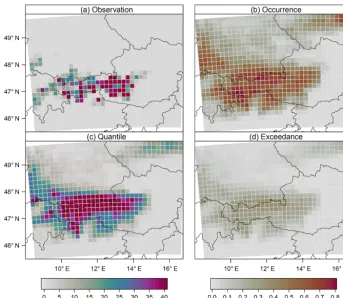
Figure 1 illustrates such excess zeros and overdispersion. The synoptic weak pressure gradient situation on 18 July
2017 allowed local heating to trigger a number of single-cell storms. Very high lightning flash rate intensities exceeding 40 cloud-to-ground (CG) flashes were observed in 29 boxes (3.2 % of the whole domain) along the main Alpine ridge between 12:00 and 18:00 UTC. However, a large number of boxes (82.2 %) remained devoid of CG lightning.
Overdispersed data can be handled by applying a nega-tive binomial distribution (Cameron and Trivedi, 2013). Ex-cess zeros can be accounted for by splitting the distribution into a binary hurdle and a part for positive counts (Mullahy, 1986). The hurdle can be modelled e.g. by logistic regression and the positive counts by a zero-truncated version of the Poisson or negative binomial distribution. Another benefit of the hurdle approach is that the binary hurdle part can serve as a stand-alone model for the occurrence of thunderstorms. Thus, the predictions resulting from the binary hurdle part can be compared directly to the outcome of previous studies that focus on binary response variables (e.g. Schmeits et al., 2008; Simon et al., 2018). The combined model predicts a full probability distribution of lightning counts, which allows one to derive various quantities such as probabilities for the occurrence of thunderstorms and also quantiles and the ex-ceedance of predefined lightning count thresholds (Fig. 1).
Input variables for the statistical models come from a physically based NWP model and capture convection only incompletely. Convection permitting or resolving models with horizontal meshes of 1–3 km are capable of reproduc-ing bulk properties of heat and water vapour (Langhans et al., 2012). In contrast, global NWP systems with a coarser resolution simulate convection with parametric submodels, which may be perturbed stochastically (Buizza et al., 1999). By generating ensembles of a numerical forecast one aims at accounting for uncertainties of small-scale events such as convection.
In this study a set of direct and derived NWP variables from the (global) ECMWF ensemble is employed as covari-ates for a statistical lightning prediction model. Many differ-ent output variables of an NWP ensemble system are poten-tiallygoodcandidates for lightning prediction, e.g. convec-tive available potential energy (CAPE) or convecconvec-tive precip-itation. However, next to these potentialgoodcandidates any additional variable could improve the prediction even by a small contribution. Moreover, the effect of individual vari-ables might act nonlinearly on the target quantity (lightning counts).
In order to account for nonlinear dependencies we employ additive predictors linked to the parameters of the hurdle model. Each additive predictor potentially consists of sev-eral nonlinear terms which are summed up. This statistical framework is often referred to as distributional regression (Fahrmeir et al., 2013; Klein et al., 2015; Wood, 2017) or generalized additive models for location, scale and shape (Rigby and Stasinopoulos, 2005; Umlauf et al., 2018). The selection of a sparse sufficient set of nonlinear terms from the numerous covariates provided by the NWP ensemble is
performed using gradient boosting with stability selection. This concept has been used successfully in several studies (e.g. Simon et al., 2018; Thomas et al., 2018).
The final model resulting from the selection procedure is still complex. Different approaches for identifying the non-linear terms have been proposed, such as penalized max-imum likelihood (Wood, 2017), gradient boosting (Mayr et al., 2012), or Markov chain Monte Carlo (MCMC) sam-pling based on a Bayesian formulation of the problem (Brezger and Lang, 2006). In this study we follow the Bayesian approach, which ensures stable estimation and valid credible intervals for the regression coefficients of our complex model of the present count data distribution (Klein et al., 2015). The MCMC samples allow inferential conclu-sions to be drawn about the effects and the predictive perfor-mance.
Our statistical approach to modelling flash counts (Sect. 2.1) by postprocessing numerical weather prediction output (Sect. 2.2) can be summarized as follows: a paramet-ric distribution for the count data is specified, in which the parameters are linked to additive predictors that contain po-tentially nonlinear functions of the covariates (Sect. 3.1). Sta-bility selection combined with gradient boosting selects the most influential terms (Sect. 3.2). The selected model is esti-mated using MCMC sampling (Sect. 3.3), which allows one to draw inferential conclusions about nonlinear terms and out-of-sample predictions (Sect. 4). Finally, in Sect. 5, we build a connection to previous studies, discuss the transfer-ability of the method, and summarize the study.
2 Data
This section describes the lightning detection data (Sect. 2.1) and the numerical weather prediction ensemble data (Sect. 2.2). The data are collected for the region of the Eu-ropean Eastern Alps (Fig. 2), which is exposed to thunder-storms and severe lightning events during summer (Schulz et al., 2005; Simon et al., 2017).
2.1 Lightning detection data
Lighting data are from the Austrian Lightning Detection & Information System (ALDIS) network (Schulz et al., 2005), for the summer months May–August of the period 2010– 2017. The raw ALDIS data are aggregated on a 18×18 km2 grid for afternoons (12:00–18:00 UTC). One count refers to one cloud-to-ground flash, which might contain several strokes. We focus on CG flashes, as clustering of CG strokes to an associated flash is more robust than for IC strokes.
Figure 1.A sample prediction case (18 July 2017) for the lightning count model with a lead time of 1 day.(a)Number of observed flashes from 12:00 to 18:00 UTC in a 18×18 km2grid box.(b)Predicted probabilities for the occurrence of lightning events (no. of flashes>0). (c)Predicted 90 % quantiles.(d)Predicted probabilities for exceeding a threshold of 10 flashes in a grid box.
Figure 2.Topography of the European Eastern Alps (from SRTM, Farr et al., 2007). Lightning flashes are counted in white grid boxes of 18×18 km2.
136.3, respectively – and 15.05 and 941.06 when calculated over the positive counts, i.e. boxes in which lightning oc-curred. Thus, the data are heavily skewed with the variance much larger than the mean, which is calledoverdispersionin the count data literature (Cameron and Trivedi, 2013).
For the given aggregation scale the region (Fig. 2) is de-scribed by 910 grid boxes. The season from May to Au-gust consists of 123 days, which leads to a sample size of 910×123=111 930 for each year.
2.2 Numerical weather prediction data
Covariates are derived from the ensemble prediction system of the European Centre for Medium-Range Weather Fore-casts (ECMWF ENS). Since March 2016 the ECMWF ENS has had a horizontal grid size of approximately 18 km. The temporal resolution of the data is 3-hourly. The summers of 2016 and 2017 serve as the training and evaluation periods, respectively. Moreover, five forecast horizons are considered, where day 1 refers to lead times of 12–18 h of the ensemble initialized at 00:00 UTC. Analogously, day 2, day 3, day 4, and day 5 refer to lead times of 36–42, 60–66, 84–90, and 108–114 h, respectively. All model variables are interpolated bilinearly to the same grid as the lightning data (Fig. 2).
convec-Table 1.Unconditional and conditional (given positive counts) probabilities (%) of 18×18 km2grid boxes for the counts of lightning flashes y=0, . . .,9.
y 0 1 2 3 4 5 6 7 8 9 >9
Pr(y) 88.05 2.90 1.36 0.92 0.68 0.54 0.44 0.38 0.33 0.29 4.11
Pr(y|y >0) 24.27 11.37 7.68 5.65 4.48 3.71 3.21 2.78 2.44 34.41
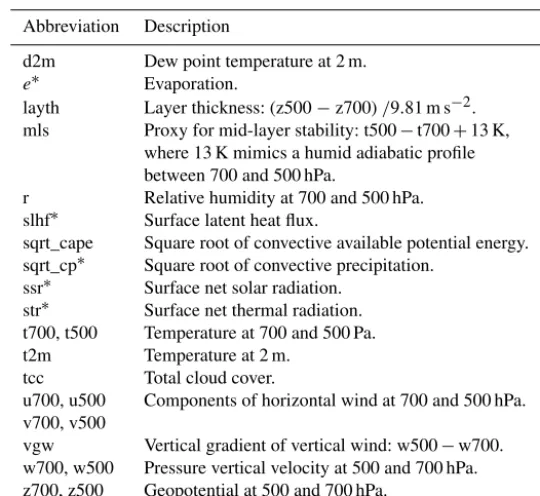
tive precipitation and convective available potential energy (CAPE) in order to reduce skewness before employing the statistical model. A full list of direct and derived variables is given in Table 2. Although these variables already cover a wide range of atmospheric processes, the list could still be extended, which will be discussed at the end of this paper.
For all variables, except for the accumulated fields, the temporal mean over the afternoon, the difference between the values for 18:00 and 12:00 UTC, and anomalies of the three afternoon values from the temporal mean are computed.
Finally, two statistics are computed over the ensemble space, namely the median and the interquartile range (IQR) as measures for location and spread, respectively, of the co-variates over the ensemble.
Hereafter the notation of the covariates is as follows. For accumulated fields the name of the variable as listed in Ta-ble 2 and its applied statistic over the ensemTa-ble are sepa-rated by a period. For all other variables the computation ap-plied over the time dimension (mean, difference, or anomaly) is placed in the middle and separated by periods. For in-stance, to derive t2m.12.median the 2 m temperature is av-eraged over 12:00, 15:00, and 18:00 UTC for each member of the ECMWF ensemble. This average is subtracted for the value at 12:00 UTC to compute the anomaly. Finally, the me-dian over all 12:00 UTC anomalies is computed over the en-semble space.
3 Methods
This section establishes a statistical count data model for lightning prediction based on NWP outputs from the ECMWF ensemble. The building blocks of this distributional regression model (Fahrmeir et al., 2013; Klein et al., 2015; Wood, 2017; Umlauf et al., 2018) are as follows.
– Covariates: direct and derived variables from the NWP data (Sect. 2.2).
– Terms: linear or smooth nonlinear functions or interac-tion surfaces based on the covariates.
– Additive predictors: sum of one or more terms to be used for prediction of a distribution parameter.
– Probability distribution: a parametric distribution for the lightning counts whose parameters are linked to the additive predictors above.
As the resulting model can become quite complex, espe-cially if all available covariates were considered simultane-ously, it is vital to use some form of regularized estimation of the model along with a selection of the relevant terms or covariates. Here, gradient boosting in combination with sta-bility selection is employed for objectively selecting the most influential terms of the additive predictors (Sect. 3.2). The functional forms of the terms selected for the final model are estimated using Markov chain Monte Carlo sampling (Sect. 3.3), which also allows one to draw inferential con-clusions about the nonlinear terms and verification scores.
A similar synthesis of methods has been applied previ-ously in Simon et al. (2018) to predict the occurrence proba-bility of thunderstorms, i.e. using only a single additive pre-dictor. Here, a novel extension is presented to a count data distribution with three model parameters and thus three addi-tive predictors. Specifically, a two-part hurdle model is con-sidered (Sect. 3.1) that combines the following components.
– Binary hurdlefor the occurrence probability, thus ad-dressing the large amount of zeros in the data (i.e. boxes without lightning).
– Truncated countsfor the distribution of lightning counts (given that lightning occurs) comprising a location pa-rameter and a dispersion papa-rameter to account for the strong overdisperion in the lightning data.
3.1 Count data regression
To account for the large amount of zeros and the strong overdispersion present in the lightning counts y∈ {0,1,2, . . .}, a hurdle model (Mullahy, 1986) is employed. The hurdle model consists of two parts: one part explicitly models the probability of the occurrence of lightning events; i.e. at least one lightning flash is observed with a grid box. The second part models the number of flashes given that a lightning event takes place.
Table 2.An overview of the base covariates from the ECMWF-EPS forecast. The asterisk (∗) indicates accumulated variables. Covariates derived from this base set are discussed in the data section (Sect. 2).
Abbreviation Description
d2m Dew point temperature at 2 m.
e∗ Evaporation.
layth Layer thickness: (z500−z700)/9.81 m s−2. mls Proxy for mid-layer stability: t500−t700+13 K,
where 13 K mimics a humid adiabatic profile between 700 and 500 hPa.
r Relative humidity at 700 and 500 hPa.
slhf∗ Surface latent heat flux.
sqrt_cape Square root of convective available potential energy. sqrt_cp∗ Square root of convective precipitation.
ssr∗ Surface net solar radiation. str∗ Surface net thermal radiation. t700, t500 Temperature at 700 and 500 Pa.
t2m Temperature at 2 m.
tcc Total cloud cover.
u700, u500 Components of horizontal wind at 700 and 500 hPa. v700, v500
vgw Vertical gradient of vertical wind: w500−w700. w700, w500 Pressure vertical velocity at 500 and 700 hPa. z700, z500 Geopotential at 500 and 700 hPa.
with the probability mass at zero redistributed towards posi-tive counts (cf. Appendix A).
The hurdle model has the density
f(y|π, µ, θ)=
1−π y=0
π·fZTNB(y|µ, θ) y∈ {1,2, . . .}, (1)
wherefZTNBis the density of the zero-truncated negative bi-nomial.
When taking the logarithm of Eq. (1) to obtain the associ-ated log-likelihood, a sum emerges where the first summand depends solely onπ, i.e. thebinary hurdle part, and the sec-ond summand depends onµandθ, i.e. thetruncated count part (cf. Appendix A). As a consequence the two parts of the hurdle model can be maximized independently, i.e. with separate estimation, term selection, and prediction.
For thebinary hurdle partthe probabilityπ for non-zero events is conditioned on (NWP) covariates by an additive predictorηπ,
logit(π)=ηπ=β0,π+f1,π(doy)+f2,π(lon,lat)
| {z }
baseline climatology
+f3,π(x3)+ · · · +fp,π(xp), (2)
where the logit function maps the probability π to the real line. Within the additive predictor, on the right-hand side of Eq. (2),f?(·) are functions that are modelled by P-splines in order to account for potentially nonlinear relationships be-tween the response and the covariates doy, lon, lat, and xj (Wood, 2017).f1(doy) accounts for an annual cycle, where
the day of the year doy serves as a covariate.f2(lon, lat) is a spatial effect depending on geographical location, i.e. lon-gitude lon and latitude lat. The covariatesx3, . . ., xpare the direct and derived parameters from the ECMWF ensemble (Sect. 2.2).
Not all functions f1, . . ., fp are included in the final model, but the relevant terms are selected using gradient boosting combined with stability selection (Sect. 3.2). The resulting final model is estimated using Markov chain Monte Carlo sampling (Sect. 3.3).
For thetruncated count part the parametersµandθ are linked to covariates by additive predictors analogously to the right-hand side of Eq. (2). To ensure positive values forµ andθ, the logarithm serves as a link function:
log(µ)=ηµ=β0,µ+f1, µ(doy)+f2, µ(lon, lat)
| {z }
baseline climatology
+f3, µ(x3)+. . .+fp, µ(xp), (3) log(θ)=ηθ=β0,θ+f1, θ(doy)+f2,θ(lon, lat)
| {z }
baseline climatology
+f3, θ(x3)+. . .+fp, θ(xp). (4)
3.2 Stability selection with gradient boosting
The selection of the most important nonlinear terms within the predictors associated with the parametersπ,µ, andθ is performed using gradient boosting combined with stability selection. Gradient boosting is an iterative gradient descent algorithm, where the term which minimizes the residual sum of squares when fitted to the gradient of the log-likelihood is slightly updated in each iteration. The estimates converge to the maximum likelihood estimates when the number of iterations approaches infinity. Early stopping of the iterations ends in regularized estimates of the terms, and also serves as a selection procedure when individual terms are equal to 0 at the final iteration.
The selection of terms for logit(π) (binary hurdle part), and for log(µ) and log(θ) (truncated count part), is performed separately. Hence the binary hurdle part is determined by ex-actly one parameter (π); the additive predictor for logit(π) is updated in each iteration. Within the truncated count part, which is determined by two parameters (µandθ), either the additive predictor of log(µ)orlog(θ) is updated in each it-eration, depending on which update contributes more to the log-likelihood. This updating scheme, callednoncyclicin the boosting literature (Mayr et al., 2012), is presented in Ap-pendix B.
If gradient boosting is applied as a stand-alone method the number of iterations – and thus the degree of regularization – can be determined by means of information criteria or cross-validation. Here the main purpose of gradient boosting is to select important termsfj. It is desirable to avoid the selec-tion of numerous non-informative terms. Stability selecselec-tion is a convenient resampling method for controlling the num-ber of selected non-informative terms by gradient boosting (Meinshausen and Bühlmann, 2010; Hofner et al., 2015).
Rather than applying the boosting algorithm to all obser-vations, stability selection is based on drawing a subsample half the size of the training data, running the boosting al-gorithm until a predefined number of terms – 12 and 8 for the binary hurdle and the truncated counts, respectively – is selected. This procedure is repeated many times. After-wards the relative selection frequencies per nonlinear term are computed. Finally, the terms which were selected in more than, say, 90 % of such subsamples are included in the final model (cf. the algorithm in Hofner et al., 2015). The number of terms being selected before stopping the boosting algo-rithm and the cut-off selection frequency are chosen in order to establish an upper bound of unity for falsely selected terms (Hofner et al., 2015; Simon et al., 2018).
3.3 Markov chain Monte Carlo sampling
The final model is of a complex form as it contains several nonlinear terms, and thus determining confidence intervals based on asymptotic assumptions might fail. Markov chain
Monte Carlo (MCMC) sampling offers an attractive tool to provide valid credible intervals.
To be able to apply this technique to models with addi-tive predictors, the posterior distribution has to be formulated (Brezger and Lang, 2006). The potentially nonlinear func-tionsf∗(·) in Eqs. (2), (3) and (4) are modelled by P-spline basis functions (Wood, 2017), which transfers the nonlinear function to a linear regression problem. A multivariate nor-mal distribution serves as prior for the coefficients associated with one function, where the variances of the multivariate normal distributions account for the degree of regularization, which is equivalent to the inverse smoothing parameter in the frequentist approach. Inverse gamma distributions serve as prior densities for these variances. Thus, within the Bayesian framework the degree of regularization is estimated simulta-neously during MCMC sampling (Umlauf et al., 2018).
MCMC samples of the posterior distribution can be ef-ficiently generated by approximating a full-conditional dis-tribution using a second order Taylor series expansion of the log-posterior centred at the last state (Gamerman, 1997; Fahrmeir et al., 2013; Umlauf et al., 2018). Moreover, in most situations the structure of the sampling scheme reduces to an iteratively weighted least squares (IWLS) updating step for which highly efficient algorithms are available (Lang et al., 2014).
The statistical models encompassing ECMWF covariates, selected by gradient boosting with stability selection, and the climatological baseline models are estimated by MCMC sampling; 1000 independent realizations of the regression coefficients are drawn from the Markov chains, which en-ables inference of the effects, predictions, and out-of-sample scores.
4 Results
In this section we present the results of the selection proce-dure of nonlinear terms for both the binary hurdle part and the truncated count part. Afterwards, we evaluate the per-formance of the binary hurdle part as an separate model for the occurrence of lightning events, and the combined hurdle model (Eq. 1) as a model for the intensity of lightning events.
4.1 Model selection 4.1.1 Binary hurdle part
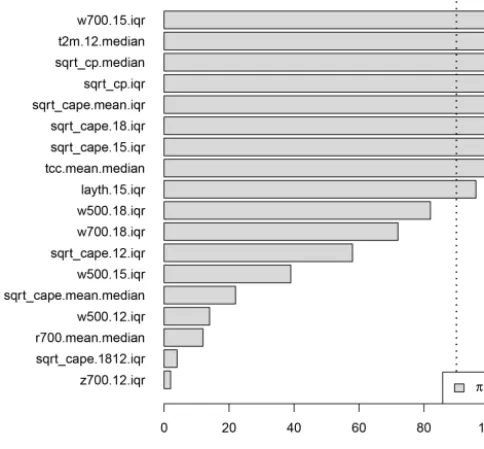
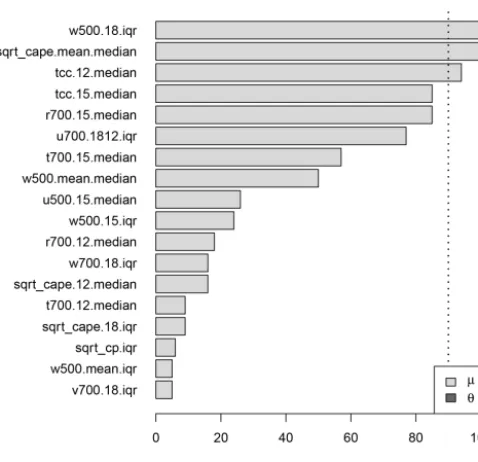
The selection of nonlinear terms for the binary hurdle part, i.e. the additive predictor forπ, for a lead time of 1 day is visualized in Fig. 3. The gradient boosting algorithm is ap-plied to 100 distinct random subsamples, each half the size of the whole training data until 12 terms are selected. The bars in Fig. 3 indicate the relative frequencies for the terms being selected in the 100 boosting runs.
con-Figure 3.Results of the stability selection procedure for the binary hurdle part of the hurdle model for day 1. The variable names on theyaxis serve as a placeholder for the associated nonlinear effect. The vertical dotted line marks the threshold of 90 % above which terms are added to the final model.
vective available potential energy (cape). Neither the sea-sonal term f1(doy) nor the spatial term f2(lon,lat) is se-lected, which indicates that temporal and spatial variability is well explained by effects depending only on the ECMWF ensemble covariates.
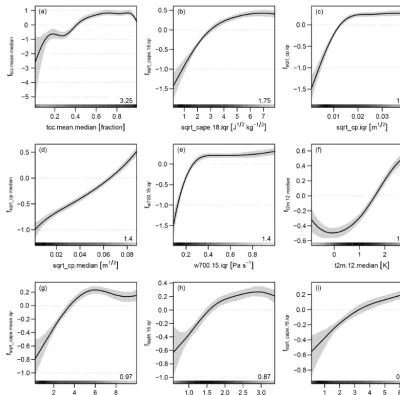
The selected effects build the (reduced) additive predic-tor in Eq. (2); 1000 samples of the coefficients for this fi-nal model are drawn using MCMC sampling (Sect. 3.3). The mean effects and associated credible intervals (Fig. 4) are computed from these samples. All effects show a smooth and most a monotonic behaviour. The effect of the median of the square root of convective precipitation (sqrt_cp.median) is close to linearity (Fig. 4d).
The IQR ensemble statistic appears more often than the median statistic. All the terms associated with the IQR first increase and flatten after some point (Fig. 4b, c, e, g, h, i). Thus, a larger spread of variables such as convective pre-cipitation, CAPE, vertical velocity and layer thickness in the ensemble favours the occurrence of lightning. One meteoro-logical interpretation of this result is that when the synop-tic situation does not preclude convection, thunderstorms oc-cur in some of the NWP ensemble members but at different times during the 12:00–18:00 UTC period, which increases the spread of variables in the ensemble.
4.1.2 Truncated count part
The count data part of the hurdle model takes only grid boxes with values greater than zero. Thus the sample size of the
training data decreases from 111 930 to 14 099. On this sub-set of the data the stability selection with gradient boosting is applied in order to find the most relevant effects for the ad-ditive predictors of the parametersµandθ(Eqs. 3 and 4) of the zero-truncated negative binomial. The gradient boosting was run 100 times, each time until eight terms were selected. The result of this procedure is shown in Fig. 5 for the trun-cated count part with a forecast horizon of 1 day. Three terms are selected for the parameterµ, which is the expectation of the underlying negative binomial distribution, and none for the dispersion parameterθ. Thus, only an interceptβ0is es-timated within the final model of log(θ).
The estimated effects from the MCMC sampling are pre-sented in Fig. 6 on the log scale. The effect with the largest range is the median (over the ensemble) of the mean (over the afternoon) of the square root of cape, which increases monotonically but nonlinearly. The spread (IQR over the en-semble) of the 18:00 UTC anomaly of the vertical veloc-ity at 500 hPa (w500) is associated with a nearly linear ef-fect and its larger spread leads to a larger µ. The median of the 12:00 UTC anomaly of total cloud cover (tcc) reveals a nearly linear effect with a negative slope. The estimated value forθis 0.199 (0.179, 0.220), which reflects the strong overdispersion of the data.
4.2 Performance
4.2.1 Occurrence of lightning events
For the evaluation of the predictive performance for the oc-currence of lightning events only the probabilityπis consid-ered. The models with ECMWF ensemble covariates have been estimated on data from 2016 and the data from 2017 are used for an out-of-sample assessment of the performance of the models. The predictions are compared against a clima-tology, which accounts for seasonal and spatial variations by nonlinear terms (Eq. 2) and is estimated with data from 2010 to 2016. First we present the global scores – averaged over all grid boxes – and afterwards the spatial distribution of skill is analysed.
The Brier score (BS) andarea under curve(AUC) derived from the receiver operating characteristics (ROC) theory are applied as verification measures. Both scores and their asso-ciated skill scores reveal that the postprocessed ECMWF pre-dictions outperform the climatologies up to a forecast hori-zon of 5 days (Table 3). Inference is based on the samples from the MCMC sampling.
indi-Figure 4.Effects and 95 % credible intervals of the occurrence model for day 1 fitted using MCMC sampling. The effects are displayed on the logit scale. The number in the bottom right corner of each panel gives the absolute range of the effect, i.e. the difference between the maximum and the minimum. The shading at the bottom of each panel indicates the density distribution of the corresponding covariate. The xaxes are cropped at the 1 % and 99 % percentiles of the respective covariate to enhance graphical representation.
vidual box, we apply the correction for controlling thefalse discovery rate(Benjamini and Hochberg, 1995) which is ro-bust to spatial dependence within the field of the test (Wilks, 2016). A control level of 5 % was chosen, which leads to a threshold of 3.4 % for rejecting a local null hypothesis (see Eq. 3 in Wilks, 2016).
4.2.2 Intensity of lightning events
The evaluation of the predictive performance with respect to the intensity of lightning events takes the hurdle model (Eq. 1) into account. We investigate the global performance of the forecasts, firstly, by averaging scores over all grid boxes, secondly, by visualizing rootograms for a graphical
portrayal of calibration, and, thirdly, by looking at the spatial distribution of skill scores.
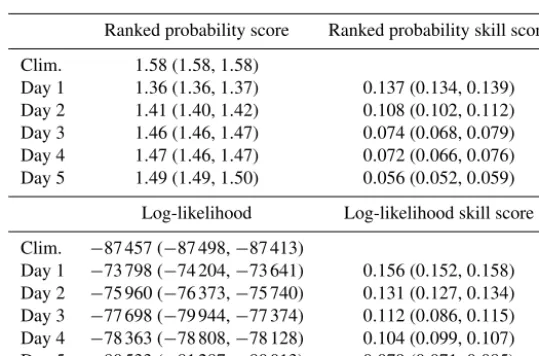
For every day a probability mass is predicted for every possible outcomey∈ {0,1,2, . . .}, which are evaluated (Ta-ble 4) with theranked probability score(RPS, Epstein, 1969) and log-likelihood of the hurdle negative binomial distribu-tion, i.e. the combination of the Bernoulli and zero-truncated negative binomial distribution. The predictions are compared against a reference climatology in which each parameter – π,µ, andθ– is modelled by a seasonal effect and a spatial effect. The models based on the ECMWF covariates outper-form the climatology up to a forecast horizon of 5 days.
Table 3.Out-of-sample performance of the occurrence model; 95 % credible intervals based on MCMC samples are given in parentheses.
Brier score Brier skill score
Clim. 0.106 (0.106, 0.106)
Day 1 0.079 (0.079, 0.080) 0.26 (0.25, 0.26) Day 2 0.084 (0.083, 0.085) 0.21 (0.20, 0.22) Day 3 0.089 (0.089, 0.089) 0.16 (0.16, 0.17) Day 4 0.089 (0.089, 0.090) 0.16 (0.15, 0.16) Day 5 0.093 (0.092, 0.094) 0.12 (0.11, 0.13)
Area under curve Area under curve skill score
Clim. 0.622 (0.620, 0.624)
Day 1 0.893 (0.892, 0.894) 0.72 (0.71, 0.72) Day 2 0.872 (0.871, 0.873) 0.66 (0.66, 0.66) Day 3 0.853 (0.852, 0.854) 0.61 (0.61, 0.62) Day 4 0.845 (0.843, 0.847) 0.59 (0.58, 0.60) Day 5 0.815 (0.813, 0.817) 0.51 (0.51, 0.52)
Table 4.Out-of-sample performance of the intensity model; 95 % credible intervals based on MCMC samples are given in parentheses.
Ranked probability score Ranked probability skill score
Clim. 1.58 (1.58, 1.58)
Day 1 1.36 (1.36, 1.37) 0.137 (0.134, 0.139)
Day 2 1.41 (1.40, 1.42) 0.108 (0.102, 0.112)
Day 3 1.46 (1.46, 1.47) 0.074 (0.068, 0.079)
Day 4 1.47 (1.46, 1.47) 0.072 (0.066, 0.076)
Day 5 1.49 (1.49, 1.50) 0.056 (0.052, 0.059)
Log-likelihood Log-likelihood skill score
Clim. −87 457 (−87 498,−87 413)
Day 1 −73 798 (−74 204,−73 641) 0.156 (0.152, 0.158) Day 2 −75 960 (−76 373,−75 740) 0.131 (0.127, 0.134) Day 3 −77 698 (−79 944,−77 374) 0.112 (0.086, 0.115) Day 4 −78 363 (−78 808,−78 128) 0.104 (0.099, 0.107) Day 5 −80 533 (−81 287,−80 013) 0.079 (0.071, 0.085)
{0,1,2, . . .}with the expected frequencies – the sum of the predicted densities over all samples – on the square root scale (Kleiber and Zeileis, 2016). In ahangingrootogram bars in-dicating the square root of the observed frequencies hang from a curve showing the square root of expected frequen-cies.
The rootogram for day 1 reveals that the amount of zero counts is underestimated and that counts in the range from 1 to approx. 10 are overestimated. For higher counts the rootogram reveals good calibration of the model. The rootogram for the model with a forecast horizon of 5 days shows slightly better calibration for counts in the lower range. Although the bottom end of the bar for zero counts is closer to thex axis, the 95 % credible intervals from the MCMC sampling reveal that the model also underestimates the amount of zeros.
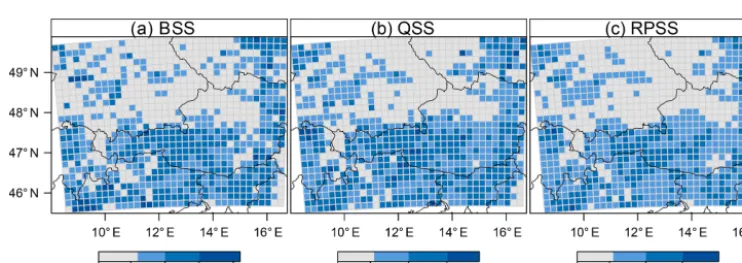
Finally, we investigate the spatial distribution of different skill scores for a lead time of 5 days (Fig. 9). From the hurdle
Figure 5.As Fig. 3 but for the truncated count part of the hurdle model for day 1. The grey value indicates whether the term is as-signed to the predictor ofµorθ. (Note: in this case no terms are selected for the predictor ofθ.)
5 Discussion
This section connects the present work to previous stud-ies (Sect. 5.1) and discusses how the proposed methods can be transferred to further applications (Sect. 5.2), for which increasing the number of input variables can be cru-cial (Sect. 5.3). At the end of this section we summarize and conclude the study (Sect. 5.4).
5.1 Connection to other studies
We discuss the relation of the present work to two other stud-ies: firstly, a work with meteorological background on the prediction of thunderstorm occurrence in the Eastern Alps (Simon et al., 2018). Secondly, a work from the statistical lit-erature which focuses on gradient boosting for distributional regression and which presents a case study with a count data variable as response (Thomas et al., 2018).
Simon et al. (2018) postprocess the deterministic high-resolution (HRES) ECMWF forecast from 2010 to 2015 to predict the probability of the occurrence of thunderstorms. The methodology – stability selection with gradient boost-ing, and MCMC sampling – is similar to the methods ap-plied in this study. However, the binomial model used by Simon et al. (2018) is less complex, and less computation-ally expensive. As counts are not considered by Simon et al. (2018), only the results of the binary hurdle are compared with their results: during 2010–2015 the native resolution of the ECMWF HRES was 16×16 km2and thus comparable to
the resolution of the target variable in this study. Although the framework was different – a longer training period of 4 years andonlydeterministic NWP forecasts – the resulting out-of-sample scores are comparable: Brier skill score ranges from approx. 0.25 to approx. 0.12 throughout the forecast horizons of 1 to 5 days. The AUC ranges from 0.88 to 0.79. Also, the spatial patterns of the skill match with patterns pre-sented by Simon et al. (2018). This finding suggests than the short training period of the present study covers a sufficient variety of atmospheric processes leading to lightning, which enables the statistical model to learn these processes.
Thomas et al. (2018) apply a hurdle model with a zero-truncated negative binomial in their study about abundance of wintering sea ducks. The abundance of sea ducks is quan-tified on a grid which leads to a response quantity with simi-lar properties to the present lightning counts: 75 % zeros and overdispersion. They also separate the hurdle model for the selection of terms by gradient boosting with stability selec-tion. However, in Thomas et al. (2018)’s study, terms for the dispersion parameterθhave also been selected, which could also be a consequence of less regularization within the indi-vidual boosting runs.
There is one more important difference between the present study and the work by Thomas et al. (2018), namely the way in which the final model is estimated. After the selection procedure, their final model is fitted by gradient boosting. The optimal amount of regularization – tuning the number of iterations – is found by maximizing the out-of-bootstrap log-likelihood. In the present study the final model is estimated using MCMC sampling. Thus regularization is performed for each individual term by a prior distribution. A major advantage of this Bayesian approach is that inferential conclusions for effects, scores, and predictions can be drawn from the MCMC samples.
5.2 Transfer of method
The postprocessing method presented in this study can be easily transferred to other types of lightning, e.g. total light-ning, or other regions of the world. The key to this trans-ferability is the objective selection scheme, i.e. stability se-lection combined with gradient boosting, which enables us to adapt the predictors to the new application. Further, im-plementations of the selection and MCMC sampling scheme proposed in this study are made available in thebamlss flex-ible regression toolbox (Bayesian additive models for loca-tion, scale, and shape (and beyond), Umlauf et al., 2018), which is an add-on package for the R software environment (R Core Team, 2018). Thus, users can easily test the pro-posed method on the data of their application.
pre-Figure 6.As Fig. 4 but for the intensity model for day 1. All effects are assigned to the predictor ofµand are displayed on the log scale.
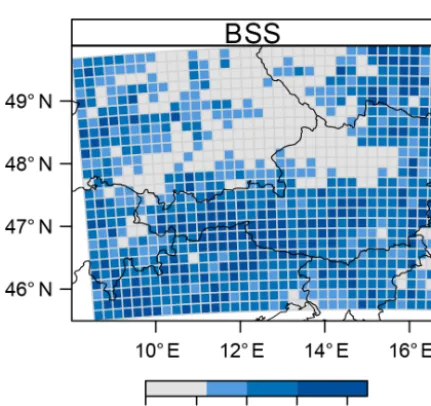
Figure 7.Spatial distribution of Brier skill scores for a lead time of 5 days evaluating the occurrence of lightning events (no. of flashes>0). Blueish colours indicate significantly positive values.
dictors is extended. Thus, transferring the method to a larger domain is likely to offer some challenges in data handling and efficiency of the optimization schemes.
5.3 Increasing the number of input variables
The variables that initially enter the selection procedure al-ready cover a wide range of atmospheric processes. However, there are many variables that are promising for further im-proving the predictive performance of the final model. Most interesting would be to investigate the influence of param-eterized lightning variables in the ECMWF output (Lopez, 2016) introduced in mid-2018 (Lopez, 2018). Further can-didates are cloud properties (graupel, supercooled water, ice crystals) related to charge separation (e.g. Saunders, 2008).
In addition to variables from a NWP, observations from previous time steps could also add predictive skill. From an operational perspective, adding the lagged response increases the technical effort, as not only do data from a NWP have to
be gathered, but the supply of the lightning observation for forecast production also has to be guaranteed.
The candidate pool can be further extended by variables that describe the orography in more detail, such as altitude, slope, and the orientation of the slope. This extension would especially give deeper insights into the climatological effects. At the scale of 18×18 km2we found no benefit of including orography-related covariates. However, at finer spatial scales orography-related covariates might have more influence (Si-mon et al., 2017).
5.4 Summary
To conclude, we summarize the methods and the key findings of this study. We propose a framework to predict the proba-bility of occurrence and the intensity of lightning events (or thunderstorms) in the European Eastern Alps. A hurdle ap-proach – with a Bernoulli hurdle and a zero-truncated neg-ative binomial as count part – is chosen to account for ex-cess zeros and overdispersion in the lightning count data. Covariates for nonlinear terms in additive predictors are de-rived from the ECMWF ensemble prediction system. An ob-jective selection procedure – gradient boosting with stability selection – reduces the set of numerous terms. The final mod-els are estimated using MCMC sampling in order to provide valid credible intervals for effects, predictions, and out-of-sample scores.
Both the occurrence and intensity models outperform a cli-matology up to a forecast horizon of 5 days. The predictive skill is greater over complex terrain of the Eastern Alps than over regions with fewer orographic features. This pattern can be associated with persistent forcing in regions with complex terrain such as orographic lifting, thermally induced circula-tions (plains–mountains, slope winds, valley winds), and lee effects (Houze, 2012).
boost-Figure 8.Hanging rootograms for the intensity models with a forecast horizon of 1 and 5 days. The curve shows the expected frequencies and bars the observed frequencies on the square root scale. The small vertical lines bisecting the bottom ends of the bars show the 95 % credible intervals from MCMC sampling of the difference between expected and observed frequencies.
Figure 9.Spatial distribution of skill scores for a lead time of 5 days. Blueish colours indicate significantly positive values.(a)Brier skill score for exceeding 10 flashes per grid box.(b)Quantile skill score for the 90 % quantile.(c)Ranked probability skill score for the full predictive distribution.
ing via the boost() model fitting engine function and to simulate MCMC samples of the posterior distribution with the GMCMC() engine function. Thecountregpackage (Zeileis et al., 2008) pro-vides score functions and the hessian of the zero-truncated negative binomial distribution and the high-level rootogram() plotting func-tion.
Appendix A: The negative binomial hurdle distribution
In this Appendix we derive the density and the log-likelihood of the hurdle model (Eq. 1). Hurdle models consist of two parts: abinary hurdle part– modelling the probability of zero vs. non-zero events – and atruncated count part– modelling the distribution of positive counts.
Hurdle models for counts were introduced by Mullahy (1986). A comprehensive overview of modelling count data is given by Cameron and Trivedi (2013). Zeileis et al. (2008) present an implementation of regression models for count data in the R software environment.
In the present study a Bernoulli distribution serves as the binary hurdle, and a zero-truncated negative binomial distri-bution as the truncated count part. The Bernoulli distridistri-bution has the density
fBE(z|π)=(1−π)1−z·πz, z∈ {0,1}, (A1)
which is determined by the probabilityπ.
To derive the truncated count part, we start with the neg-ative binomial (type 2) distribution (Cameron and Trivedi, 2013), with the density
fNB(z|µ, θ)=0(θ+z)
0(θ)·z! ·
µz·θθ
(µ+θ)θ+z, z∈ {0,1,2, . . .}, (A2)
whereµ >0 is the expectation of the distribution,E(z)=µ, andθ >0 modifies the variance, VAR(z)=µ+µ2/θ, in or-der to account for the overdispersion in the gridded lightning observations. Small values of θ refer to strong overdisper-sion. Whenθapproaches infinity the negative binomial dis-tribution converges towards the Poisson disdis-tribution, and the variance converges toµwhich equals the expectation.
For truncating the negative binomial the probability mass at zero is redistributed towards positive values leading to the density of the zero-truncated negative binomial,
fZTNB(y|µ, θ)=
fNB(y|µ, θ)
1−fNB(0|µ, θ), y∈ {1,2, . . .}. (A3)
The Bernoulli distribution (Eq. A1) and the zero-truncated negative binomial (Eq. A3) are combined to obtain the hurdle model (Eq. 1). From the density of the hurdle model we can derive the log-likelihood function (which serves as objective function during optimization),
`(π, µ, θ|y)=I{0}(y)·log(1−π)+(1−I{0}(y))·logπ
| {z }
e
`BHP(π|y)
+(1−I{0}(y))·log(fZTNB(y|µ, θ)),
| {z }
e`TCP(µ,θ|y)
(A4)
whereI{0}(y) is an indicator function which takes the value one ifyequals zero, and zero otherwise. The log-likelihood is a function of the parametersπ,µ, andθ. However, it can
be separated additively into a function ofπ,e`BHP(π|y), and
a function ofµandθ,e`TCP(µ, θ|y). Thus, during
optimiza-tion the optima for the two funcoptimiza-tions can be obtained inde-pendently from each other.
In particular,e`BHP and e`TCP are equivalent to the log-likelihood of the Bernoulli distribution (Eq. A1) and the zero-truncated negative binomial (Eq. A3), respectively.
The gradients of`w.r.t. the parametersπ,µ, andθare as follows:
∂`
∂π = 1−I{0}(y)
· 1
π −I{0}(y)· 1
1−π, (A5)
∂`
∂µ = 1−I{0}(y)
· y µ−
y+θ µ+θ−
θ µ+θ
θ+1
· 1−
θ µ+θ
θ!−1
, (A6)
∂`
∂θ = 1−I{0}(y)
·
ψ0(y+θ)−ψ0(θ)+log(θ)
+1−log(µ+θ)−y+θ
µ+θ+
θ
µ+θ
θ
· 1−
θ µ+θ
θ!−1
·
log θ
µ+θ+1− θ
µ+θ , (A7)
whereψ0(·) is the digamma function.
Appendix B: Noncyclic gradient boosting
In this Appendix we illustrate the algorithm implemented for noncyclic gradient boosting tailored to the zero-truncated negative binomial distribution, i.e. the truncated count part of the hurdle model. The log-likelihood of the truncated count parte`TCP is a function of two parametersµandθ with two
associated additive predictorsηµ andηθ, respectively. The additive predictors consist of termsf∗(x∗), which are nonlin-ear functionsf(·) of the covariatesx(Eqs. 3 and 4).
The selection of influential terms is performed using non-cyclic gradient boosting which is an iterative procedure, where in each iteration only the best fitting term is slightly updated. Generic versions of the algorithm can be found in Mayr et al. (2012) and Thomas et al. (2018). Here we illus-trate the noncyclical gradient boosting algorithm tailored to the zero-truncated negative binomial:
2. Evaluate the negative gradients of the log-likelihood
e
`TCPw.r.t. the predictors by employing the chain rule,
−∂e`TCP
∂ηµ
= −∂e`TCP
∂µ · ∂µ ∂ηµ
with ∂µ ∂ηµ
=∂exp(ηµ)
∂ηµ
=exp(ηµ)=µ, (B1)
−∂e`TCP
∂ηθ
= −∂e`TCP
∂θ · ∂θ ∂ηθ
with ∂θ ∂ηθ
=∂exp(ηθ)
∂ηθ
=exp(ηθ)=θ, (B2)
for every observation, leading to a vectors of gradi-ents. The derivations w.r.t. the parameters are given in Eqs. (A6) and (A7).
3. Fit low-degree-of-freedom splines for each termf∗(x∗) to the gradient vectors using penalized least squares es-timation (Wood, 2017).
4. For each predictor the coefficients of the best fitting term – w.r.t. the residual sum of squares – are updated by a proportionν, e.g.ν=0.1, leading to an auxiliary predictor,
eηµ=ηµ+ν·fj(xj) and eηθ=ηθ+ν·fk(xk), (B3)
and the intercepts within the auxiliary predictors are up-dated.
5. Every iteration is concluded by replacing the predictor whose auxiliary predictor leads to the largest improve-ment of the log-likelihood,
ife`TCP exp(eηµ),exp(ηθ)>e`TCP exp(ηµ),exp(eηθ)
setηµ=eηµelse setηθ =eηθ. (B4)
Author contributions. TS, GJM, and AZ defined the scientific scope of this study. TS performed the statistical modelling, eval-uated the results, and wrote the paper. GJM supported the meteoro-logical analysis. NU and AZ contributed to the development of the statistical methods. All the authors discussed the results and com-mented on the manuscript.
Competing interests. The authors declare that they have no con-flict of interest.
Acknowledgements. We acknowledge the funding of this work by the Austrian Research Promotion Agency (FFG) project LightningPredict(contract no. 846620). The computational results presented have been achieved using HPC infrastructure LEO of the University of Innsbruck. Furthermore, we are grateful to the editor and two anonymous reviewers for their valuable comments. Finally, we thank Gerhard Diendorfer and Wolfgang Schulz from ALDIS for data support.
Edited by: William Kleiber
Reviewed by: two anonymous referees
References
Bates, B. C., Dowdy, A. J., and Chandler, R. E.: Lightning Predic-tion for Australia Using Multivariate Analyses of Large-Scale Atmospheric Variables, J. Appl. Meteor. Climatol., 57, 525–534, https://doi.org/10.1175/JAMC-D-17-0214.1, 2018.
Benjamini, Y. and Hochberg, Y.: Controlling the False Discovery Rate: A Practical and Powerful Approach to Multiple Testing, J. Roy. Stat. Soc. B-Met., 57, 289–300, 1995.
Brezger, A. and Lang, S.: Generalized Structured Additive Regres-sion Based on Bayesian P-Splines, Comput. Stat. Data An., 50, 967–991, https://doi.org/10.1016/j.csda.2004.10.011, 2006. Buizza, R., Milleer, M., and Palmer, T. N.: Stochastic
Repre-sentation of Model Uncertainties in the ECMWF Ensemble Prediction System, Q. J. Roy. Meteor. Soc., 125, 2887–2908, https://doi.org/10.1002/qj.49712556006, 1999.
Cameron, A. C. and Trivedi, P. K.: Regression Analysis of Count Data, Econometric Society Monographs, Cambridge University Press, Cambridge, 2nd edn., 2013.
Epstein, E. S.: A Scoring System for
Probabil-ity Forecasts of Ranked Categories, J. Appl.
Me-teorol., 8, 985–987, https://doi.org/10.1175/1520-0450(1969)008<0985:ASSFPF>2.0.CO;2, 1969.
Fahrmeir, L., Kneib, T., Lang, S., and Marx, B.: Regres-sion: Models, Methods and Applications, Springer, Berlin, https://doi.org/10.1007/978-3-642-34333-9, 2013.
Farr, T. G., Rosen, P. A., Caro, E., Crippen, R., Duren, R., Hensley, S., Kobrick, M., Paller, M., Rodriguez, E., Roth, L., Seal, D., Shaffer, S., Shimada, J., Umland, J., Werner, M., Oskin, M., Burbank, D., and Alsdorf, D.: The Shut-tle Radar Topography Mission, Rev. Geophys., 45, 1–33, https://doi.org/10.1029/2005RG000183, 2007.
Gamerman, D.: Sampling from the Posterior Distribution in Generalized Linear Mixed Models, Stat. Comput., 7, 57–68, https://doi.org/10.1023/a:1018509429360, 1997.
Gijben, M., Dyson, L. L., and Loots, M. T.: A Statistical Scheme to Forecast the Daily Lightning Threat over South-ern Africa Using the Unified Model, Atmos. Res., 194, 78–88, https://doi.org/10.1016/j.atmosres.2017.04.022, 2017.
Gneiting, T., Balabdaoui, F., and Raftery, A. E.: Probabilistic Fore-casts, Calibration and Sharpness, J. Roy. Stat. Soc. B., 69, 243– 268, https://doi.org/10.1111/j.1467-9868.2007.00587.x, 2007. Hofner, B., Boccuto, L., and Göker, M.: Controlling False
Discoveries in High-Dimensional Situations: Boosting with Stability Selection, BMC Bioinformatics, 16, 144, https://doi.org/10.1186/s12859-015-0575-3, 2015.
Houze, R. A.: Orographic Effects on Precipitating Clouds, Rev. Geophys., 50, 1–47, https://doi.org/10.1029/2011RG000365, 2012.
Kleiber, C. and Zeileis, A.: Visualizing Count Data Re-gressions Using Rootograms, Am. Stat., 70, 296–303, https://doi.org/10.1080/00031305.2016.1173590, 2016. Klein, N., Kneib, T., and Lang, S.: Bayesian Generalized
Addi-tive Models for Location, Scale, and Shape for Zero-Inflated and Overdispersed Count Data, J. Am. Stat. Assoc., 110, 405–419, https://doi.org/10.1080/01621459.2014.912955, 2015.
Lang, S., Umlauf, N., Wechselberger, P., Harttgen, K., and Kneib, T.: Multilevel Structured Additive Regression, Stat. Comput., 24, 223–238, https://doi.org/10.1007/s11222-012-9366-0, 2014. Langhans, W., Schmidli, J., and Schär, C.: Bulk
Conver-gence of Cloud-Resolving Simulations of Moist Convec-tion over Complex Terrain, J. Atmos. Sci., 69, 2207–2228, https://doi.org/10.1175/JAS-D-11-0252.1, 2012.
Lopez, P.: A Lightning Parameterization for the ECMWF Inte-grated Forecasting System, Mon. Weather Rev., 144, 3057–3075, https://doi.org/10.1175/MWR-D-16-0026.1, 2016.
Lopez, P.: Promising results for lightning predictions, ECMWF Newsletter, 14–19, https://doi.org/10.21957/plz731tyg2, 2018. Mayr, A., Fenske, N., Hofner, B., Kneib, T., and Schmid,
M.: Generalized Additive Models for Location, Scale and Shape for High Dimensional Data – A Flexible Approach based on Boosting, J. Roy. Stat. Soc. C App., 61, 403–427, https://doi.org/10.1111/j.1467-9876.2011.01033.x, 2012. Meinshausen, N. and Bühlmann, P.: Stability Selection, J. Roy.
Stat. Soc. B, 72, 417–473, https://doi.org/10.1111/j.1467-9868.2010.00740.x, 2010.
Mullahy, J.: Specification and Testing of some Modi-fied Count Data Models, J. Econometrics, 33, 341–365, https://doi.org/10.1016/0304-4076(86)90002-3, 1986.
R Core Team: R: A language and environment for statistical com-puting, R Foundation for Statistical Comcom-puting, Vienna, Austria, available at: https://www.R-project.org/, last access: 26 Novem-ber 2018.
Rigby, R. A. and Stasinopoulos, D. M.: Generalized Additive Mod-els for Location, Scale and Shape, J. Roy. Stat. Soc. C-App., 54, 507–554, https://doi.org/10.1111/j.1467-9876.2005.00510.x, 2005.
Schmeits, M. J., Kok, K. J., Vogelezang, D. H. P., and van Westrhenen, R. M.: Probabilistic Forecasts of (Se-vere) Thunderstorms for the Purpose of Issuing a Weather Alarm in the Netherlands, Weather Forecast., 23, 1253–1267, https://doi.org/10.1175/2008WAF2007102.1, 2008.
Schulz, W., Cummins, K., Diendorfer, G., and Dorninger, M.: Cloud-to-Ground Lightning in Austria: A 10-Year Study Using Data from a Lightning Location System, J. Geophys. Res., 110, D09101, https://doi.org/10.1029/2004JD005332, 2005. Simon, T., Umlauf, N., Zeileis, A., Mayr, G. J., Schulz, W., and
Diendorfer, G.: Spatio-temporal modelling of lightning clima-tologies for complex terrain, Nat. Hazards Earth Syst. Sci., 17, 305–314, https://doi.org/10.5194/nhess-17-305-2017, 2017. Simon, T., Fabsic, P., Mayr, G. J., Umlauf, N., and Zeileis, A.:
Prob-abilistic Forecasting of Thunderstorms in the Eastern Alps, Mon. Weather Rev., 146, 2999–3009, https://doi.org/10.1175/MWR-D-17-0366.1, 2018.
Thomas, J., Mayr, A., Bischl, B., Schmid, M., Smith, A., and Hofner, B.: Gradient Boosting for Distributional Re-gression: Faster Tuning and Improved Variable Selection via Noncyclical Updates, Stat. Comput., 28, 673–687, https://doi.org/10.1007/s11222-017-9754-6, 2018.
Umlauf, N., Klein, N., and Zeileis, A.: BAMLSS: Bayesian Additive Models for Location, Scale and Shape (and
Beyond), J. Comput. Graph. Stat., 27, 612–627,
https://doi.org/10.1080/10618600.2017.1407325, 2018. Wilks, D. S.: “The Stippling Shows Statistically Significant Grid
Points”: How Research Results are Routinely Overstated and Overinterpreted, and What to Do about It, B. Am. Meteo-rol. Soc., 97, 2263–2273, https://doi.org/10.1175/BAMS-D-15-00267.1, 2016.
Wood, S. N.: Generalized Additive Models: An Introduction with R, Texts in Statistical Science, Chapman & Hall/CRC, Boca Raton, 2nd edn., 2017.