ORIGINAL ARTICLE DOI 10.1007/s10086-002-0485-7
Jianying Xu · Guangping Han · E.D. Wong Shuichi Kawai
Development of binderless particleboard from kenaf core using
steam-injection pressing
Received: April 15, 2002 / Accepted: September 17, 2002
J. Xu (*) · G. Han · S. Kawai
Wood Research Institute, Kyoto University, Gokasho, Uji, Kyoto 611-0011, Japan
Tel. ⫹81-774-38-3670; Fax ⫹81-774-38-3678 e-mail: [email protected]
E.D. Wong
Faculty of Foresty, University Putra Malaysia, 43400 Serdang, Salangor, Malaysia
Part of this report was presented at the 19th Annual Meeting of the Japan Wood Technological Association, Tokyo, October 2001 Abstract Binderless particleboards were successfully
de-veloped from kenaf core using the steam-injection press. The effects of board density, steam pressure, and treatment time on the properties of the board were evaluated. The target board densities were relatively low, ranging from 0.40 to 0.70 g/cm3
. The properties [i.e., moduli of rupture (MOR) and elasticity (MOE) in both dry and wet conditions, inter-nal bonding strength (IB), and water absorption (WA)] of the boards increased linearly with increasing board density. Steam pressure and treatment time also affected the board properties. The bending strength and IB were improved with increased steam pressure. A long steam treatment time contributed to low thickness swelling (TS) values and thus better dimensional stability. The appropriate steam pres-sure was 1.0 MPa, and the treatment time was 10–15 min. The properties for 0.55 g/cm3
density boards under optimum conditions were MOR 12.6 MPa, MOE 2.5 GPa, IB 0.49 MPa, TS 7.5%, and wet MOR 2.4 MPa. Compared with the requirement of JIS 5908, 1994 for particleboard, kenaf binderless boards showed excellent IB strength but rela-tively poor durability.
Key words Particleboard · Kenaf core · Binderless board ·
Steam-injection press
Introduction
In recent years, effective utilization of fast-growing nonwood lignocellulosic materials and agro-wastes has
been of great interest owing to a drastic fall in forest resources. Among the nonwood lignocellulosic materials, kenaf (Hibiscus cannabinus L.) has attracted special inter-est because of its rapid growing speed.
Much research has been done on the effective utilization of kenaf.1–5
Kenaf has been demonstrated to be not only a suitable material for pulping but also a good raw material for making board. The bast fiber provides high strength and can be converted to a high performance oriented
medium-density fiberboard (MDF),2,3
and the kenaf core is ex-tremely light in weight with a density of 0.1–0.2 g/cm3
, which is a good material for low-density board.4,5
Synthetic binders are usually used for wood-based panel production. They are not only expensive but are also derived from nonrenewable petro resources. The search for alternative adhesive has been widespread since the mid-1970s. A great deal of work has been done to explore the use of lignin, tannin, and carbohydrates, among other substances; even no-binder technology has been evaluated.
Wet-process hardboard is one type of binderless board. An adhesive of less than 2% is added during the production of wet-process hardboard. Lignin and hydrogen bonding of cellulose play major roles in fiber-to-fiber bonding. During the mid-1980s Shen developed and patented a steam-explosion process for lignocellulosic materials directly converted to panel products without the use of synthetic resin binders. Binderless boards from steam-exploded fibers of oil palm frond have also been developed in recent years.6,7
Matsumoto et al.8
developed binderless board from kenaf core using conventional hot pressing. The pressing temperature and moisture content of particles used were relatively high: 220°–240°C and 20%–30%, respectively.
Okamoto et al.9
reported binderlesss MDF made from mixed softwood and hardwood fibers as a reference using steam-injection pressing to improve the dimensional stabil-ity of the fiberboard. Unfortunately, the bonding strength of the binderless MDF was poor.
The effect of board density, steam pressure, and treatment time on the properties of the boards was explored.
Materials and methods
Raw material preparation
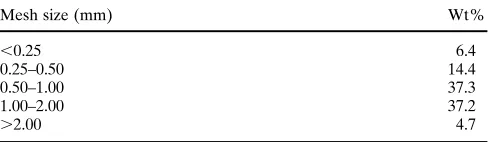
Kenaf (Hibiscus cannabinus L.) core about 1.2 m long and 10–20 mm in diameter was used as raw material. First, the kenaf core was cut into chips about 5 cm in length and adjusted to a moisture content of about 60%. The kenaf chips were further processed into particles with a target thickness of 0.5 mm using a knife-ring flaker; the particles were then air-dried to about 11% moisture content. The size composition of kenaf particles is shown in Table 1.
Binderless board manufacture
The dimensions of the boards were 300 ⫻ 300 ⫻ 12 mm. The
weight of the kenaf core particles was measured according to their target densities, after which the particles were hand-formed (using a forming box) into homogeneous single-layer mats. The mats were prepressed and then pressed again with a steam-injection press. The press was sealed with a 12 mm thick stainless steel frame. Steam was intro-duced into the press after it closed and the pressing pressure reached the desired level (set at 6 MPa). The mats were pressed under various steam gauge pressures (0.6–1.0 MPa) and treatment times (7–25 min). The steam was then re-leased. It took about 30 s to release the steam from the press and to open the press. During pressing, the temperatures of both the upper and lower platens were kept 5°–7°C higher than the steam temperature to avoid steam condensation.
The target densities, steam pressures, and steam treat-ment times used in this experitreat-ment are shown in Table 2. The target board densities were set at six levels, ranging from 0.40 to 0.70 g/cm3
. The steam gauge pressures were set at 0.6 MPa (164°C), 0.8 MPa (175°C), and 1.0 MPa (183°C). The steam treatment times ranged from 7 to 25 min. A total of 30 boards were manufactured. In addition, a binderless kenaf particle mat was pressed with a conventional platen press at a temperature of 190°C for 20 min. The moisture content of the particles was 11%, and the target board density was 0.55 g/cm3
.
As shown in Table 2, some of the high-density boards were delaminated. The boards that were entirely
delami-nated were not evaluated further. Thus, the number of test specimens decreased.
Evaluation of physical properties of binderless board
Prior to evaluation of the mechanical properties and dimen-sional stability, the binderless boards were conditioned at room temperature for about 2 weeks. They reached a mois-ture content of 5%–7%. The properties of the binderless boards were then evaluated in accordance with the Japanese Industrial Standard (JIS) for Particleboards (JIS A 5908, 1994).
Four 12 ⫻ 25 ⫻ 230 mm specimens (or two 12 ⫻ 50 ⫻ 230 mm specimens) were prepared from each board for the static bending test in the dry condition. The static bending test was conducted using three-point bending over an effec-tive span of 180 mm at a loading speed of 10 mm/min. One
to five 50 ⫻ 50 mm test specimens were prepared from each
sample board for internal bond (IB) tests, and four speci-mens of the same size from each board were prepared for thickness swelling (TS) and water absorption (WA) tests after 24-h water immersion at 20°C.
Considering the wet bending property of the low-density
boards might be relatively low, only the 0.65 g/cm3
density boards were tested in accordance with wet bending strength test A of JIS A 5908. That is, test specimens were soaked in hot water (70°C) for 2 h followed by further soaking in 20°C water for 1 h. For the boards with densities ranging from 0.40 to 0.60 g/cm3
, a mild wet bending test was carried out by soaking the specimens in 20°C water for 3 h. In both cases there were two specimens for each sample board with
di-mensions of 12 ⫻ 50 ⫻ 230 mm. Prior to the bending test,
the length of the specimens before and after water soaking were measured, and the linear expansion (LE) of the board was calculated.
Results and discussion
Some of the high-density (⬎0.60 g/cm3
) binderless boards were delaminated when they were downloaded during these manufacturing conditions, as shown in Table 2. The
Table 1. Particle composition based on mesh analysis
Mesh size (mm) Wt%
⬍0.25 6.4
0.25–0.50 14.4
0.50–1.00 37.3
1.00–2.00 37.2
⬎2.00 4.7
Wt%, Weight percentage
Table 2. Manufacturing conditions for kenaf binderless particleboard
Target board density Steam pressure Steam treatment time
(g/cm3) (MPa) (min)
0.40 1.0 (183°C) 7 10 15
0.50 1.0 7 10
0.55 0.8 (175°C) 7 10 15 20
0.60 0.6 (164°C) 10a 20 25
0.8 10a 15b 20
1.0 7 10b 15 20b
0.65 0.6 20a 25
0.8 7a 10b 15b 20b
1.0 7 10b 15b
0.70 0.6 15a 20a
boards with a target density of 0.40–0.55 g/cm3
were not
delaminated, whereas 50% of the 0.60 g/cm3 density boards
and most of the 0.65–0.70 g/cm3
density boards were delami-nated to various degrees. The reason may be as follows: Boards with high densities have high compaction ratios (i.e., 4.3 for a 0.60 g/cm3
density board), making it difficult for the steam inside the board to escape, thereby producing high steam pressure inside the board. When the steam pressure is higher than the internal bonding strength of the board at downloading, delamination occurs. Thus, a vacuum system to release the steam from the particle mat after treatment is recommended. The properties of the delaminated speci-mens were excluded from the results.
Bending strength
The effect of board density on the modulus of rupture (MOR) of boards manufactured with a steam pressure of 1.0 MPa during various steam treatment times is shown in Fig. 1. As the board density increased, the MOR increased almost linearly. The MOR was 4 MPa for the board with a density of 0.35 g/cm3
, whereas it was 17.3 MPa for a board density of 0.65 g/cm3
, a significant increase. Similarly, the MOR was increased with increasing steam pressure, as shown in Fig. 2. The real densities of the specimens were
about 0.02–0.08 g/cm3
lower than the target board density. The values in Fig. 2 were adjusted to a board density of 0.55 g/cm3
based on the linear regression between board
density and MOR. At a density of 0.55 g/cm3
, when the steam pressure was 0.6 MPa the highest MOR value was 9.3 MPa, whereas the value increased to 12.9 MPa under a steam pressure of 1.0 MPa. To acquire high MOR, high steam pressure is needed. Compared to the density and steam pressure, the steam treatment time has less effect on MOR at 1.0 MPa steam pressure.
Figure 3 shows the relation between the board density and the modulus of elasticity (MOE). Similar trends were observed for the MOE and the MOR. An MOE of 0.95 GPa
was observed at a density of 0.35 g/cm3
, and it increased to
3.3 GPa as the board density increased to 0.65 g/cm3
. Similar to the trend for dry MOR, wet MOR increased linearly with increasing board density (Fig. 4). The wet
MOR value at 0.55 g/cm3
board density was 2.4 MPa. The residual strength was calculated to be 19%, and the boards in wet bending test A showed lower residual strength (12%). Compared with the requirement of the JIS 5908 for
Fig. 1. Effect of board density and steam treatment time on the modu-lus of rupture (MOR) of kenaf binderless particleboard. Steam pres-sure was 1.0 MPa
Fig. 2. Effect of steam pressure and steam treatment time on the MOR of kenaf binderless particleboard. The board density was a corrected value of 0.55 g/cm3. Vertical lines through the bars represent the stan-dard deviation from the mean
particleboard, the kenaf binderless particleboards showed low performance for wet MOR.
Internal bond strength
Excellent results were obtained for IB strength, as shown in Fig. 5. Similar to MOR, the IB increased with increasing
board density. At a density of 0.65 g/cm3
, the IB was
0.61 MPa, and at a density of 0.35 g/cm3
it was 0.23 MPa. Figure 6 shows the relation between steam pressure and IB. The figure shows the corrected IB values for a board density of 0.55 g/cm3
. The IB tended to increase with increasing steam pressure.
The kenaf binderless particleboards showed high per-formance for IB compared with other binderless boards reported previously. The steam-exploded fibers of oil palm frond binderless board had an extremely low IB value (⬍0.1 MPa) at densities ⬍0.70 g/cm3
.7
The binderless board from kenaf core using conventional hot pressing recorded IB values of 0.05–0.20 MPa with board densities of 0.60– 0.75 g/cm3
.8
The binderless MDF made from wood fibers using steam-injection pressing had an IB of 0.1 MPa at 0.65 g/cm3 density.9
Figure 7 shows the properties of kenaf binderless particleboards made by the steam-injection pressing and hot pressing methods in this study. The values were ad-justed to a board density of 0.50 g/cm3
. The binderless kenaf particleboards made by the conventional hot press had an extremely low IB (0.09 MPa), whereas the value was 0.43 MPa for the steam-pressed board. This value is even higher than those of the boards using adhesive during board manufacturing: Kenaf core hot-pressed particleboards using melamine urea resin as an adhesive with a resin
con-tent of 10% had IB values of ⬍0.3 MPa at a board density
of 0.5 g/cm3.8 Thus, it can be concluded that the kenaf
binderless particleboards made by steam injection pressing in this study had high bondability.
The surface of the boards made by steam injection press-ing were dark brown, indicatpress-ing changes in the chemical
composition of the lignocellulosic materials. Hsu et al.10
reported that steam pretreatment can cause partial hydroly-sis of hemicellulose in both hardwood and softwood. The amount of water-soluble materials extracted from aspen and lodgepole pine increased with increasing steam treat-ment durations of 1–4 min. Time-dependent degradation of carbohydrate polymers was observed as a result of the steam treatment. However, under the steam pretreatment condition of 3–4 min at 1.55 MPa, the contents of total lignin and cellulose based on the oven-dried weight of the original
Fig. 4. Effect of board density and steam treatment time on the wet MOR of kenaf binderless particleboard. Steam pressure was 1.0 MPa. The specimens were soaked in 20°C water for 3 h before testing
Fig. 5. Effect of board density and steam treatment time on the inter-nal bonding strength (IB) of kenaf binderless particleboard. Steam pressure was 1.0 MPa
wood did not decrease significantly with increasing treat-ment times, within the limit of the treattreat-ment times used. It
was also reported that Okamoto et al.9
produced dimen-sionally stable MDF using steam pressing with a pressure range of 0.6–1.6 MPa for 5 min. Analyses of the changes of chemical components showed trends of decreasing
hemicel-lulose and α-cellulose with higher steam pressures and
longer treatment durations, but the lignin component did not change much.
This study used steam pressures of 0.6–1.0 MPa. It is believed that the kenaf core subjected to steam treat-ment causes thermodecomposition and hydrolyzation of the hemicellulose portion; the steam then converts and transforms the hydrolyzed hemicellulose to low-molecular-weight water-soluble carbohydrates and other decom-position products, which can be used as adhesive for bonding. Further research is needed to clarify the bonding mechanism.
Research11,12
has shown that the steam-pressed board has a flat density profile because of the uniform plasticization of the entire mat. The IB value may thus increase with increas-ing core density of the board. The excellent IB values of kenaf binderless board may also be attributed to a low-density gradient in the thickness direction.
Dimensional stability
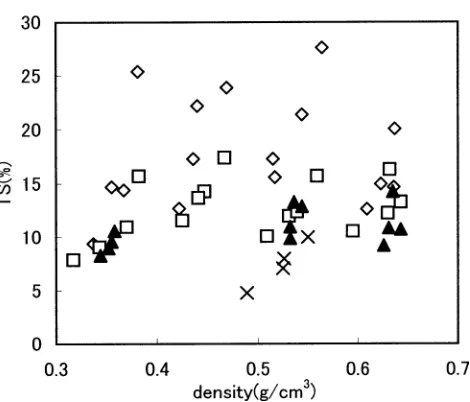
Figure 8 shows the effect of board density and steam treat-ment time on TS of kenaf binderless particleboard. No sig-nificant change was observed between the TS and board density, as shown in Fig. 8, but the TS values were affected
Fig. 7. Comparison of the properties of kenaf binderless particleboard made by the steam-injection pressing method (SIP) and the hot press-ing method (HP). The board density was a corrected value of 0.5 g/cm3. Hot pressing condition: temperature 190°C, pressing time 20 min. Steam injection pressing condition: steam pressure 1.0 MPa (183°C), treatment time 15 min. TS, thickness swelling
Fig. 8. Effect of board density and steam treatment time on the TS of kenaf binderless particleboard. Steam pressure was 1.0 MPa
by the steam treatment time. A short treatment time results in a high mean TS value and scattered values. With a
press-ing pressure of 1.0 MPa, a mean TS of 0.35 g/cm3
density board was 16.0% (range 9%–25%) for a 7-min treatment time, whereas the mean TS decreased to 9.4% (range 8%– 10%) for a 15-min treatment time. This indicated that the board with the longer steam treatment duration had a lower TS, as found in previous studies.9,13
Compared with the boards manufactured by conven-tional hot pressing, the TS values of the boards made by steam injection pressing were much lower, as shown in Fig. 7. At a density of 0.50 g/cm3
the average TS value for the hot pressing board was 169%, whereas it was 11% for steam injection boards. The low TS may be attributed to the steam-injection pressing method, which has proved to im-prove the bondability and dimensional stability of wood-based boards.
No significant change was observed between linear ex-pansion (LE) and board density. As shown in Fig. 9, when the steam pressure was 1.0 MPa the LE was 0.3%–0.5% at all board densities. The LE values of boards exposed to long treatment times were somewhat lower than those seen with short treatment times.
Board density had a significant effect on water absorp-tion (WA) (Fig. 10). WA decreased with increasing board
density. The WA of the board at 0.35 g/cm3
density was
176%, whereas it decreased to 66% at 0.65 g/cm3
Fig. 9. Effect of board density and steam treatment time on the linear expansion (LE) of kenaf binderless particleboard. Steam pressure was 1.0 MPa
Fig. 10. Effect of board density and steam treatment time on water absorption (WA) of kenaf binderless particleboard. Steam pressure was 1.0 MPa
Conclusions
Kenaf binderless particleboard was manufactured using steam-injection pressing. The effects of board density,
steam pressure, and steam treatment time on the board properties were examined. The results can be summarized as follows.
High-performance binderless board can be manufac-tured under proper manufacturing conditions using kenaf core as the raw material. The mechanical properties im-proved significantly with increasing board density, although delamination sometimes occurred when the target board density was ⬎0.60 g/cm3
. The steam treatment time and steam pressure also affected the properties of the binderless board. A long treatment time contributes to less TS and better dimensional stability. The appropriate treatment time was found to be 10–15 min at a steam pressure of 1.0 MPa. Based on JIS requirements, kenaf binderless boards showed high IB and relatively low wet bending strength.
Acknowledgment The authors thank Matsushita Electric Works for supplying the kenaf core.
References
1. Cheng Z (2000) Studies on production management indicators of kenaf (Hibiscus cannabinus L.) whole stalk for papermaking. Bull Kochi Univ For 27:53–126
2. Ohnishi K, Okudaira Y, Zhang M, Kawai S (2000) Manufacture and properties of oriented medium density fiberboard from non-wood lignocellulosic fibers. I. Mokuzai Gakkaishi 46:114–123 3. Kawai S (1999) International conference on effective utilization of
plantation timber. Chi-Tou, Taiwan, pp 109–114
4. Kajita H, Kawasaki T, Kawai S (1998) Proceedings of the 4th Pacific Rim Bio-Based Composites Symposium, Bogor, Indonesia, pp 479
5. Sellers T Jr, Miller GD, Fuller MJ (1993) Kenaf core as a board raw material. For Prod J 43(7/8):69–71
6. Laemsak N, Okuma M (2000) Development of boards made from oil palm frond. II. Properties of binderless boards from steam-exploded fibers of oil palm frond. J Wood Sci 46:322–326 7. Suzuki S, Shintani H, Park S, Saito K, Laemsak N, Okuma M
(1998) Preparation of binderless boards from steam exploded pulps of oil palm (Elaeis guneensis Jaxq.): fronds and structural characteristics of lignin and wall polysaccharides in steam exploded pulps to be discussed for self-binding. Holzforschung 52:417–426 8. Matsumoto J, Harada S, Kajita H (1999) Proceedings of the techno
trend. The Adhesion Society of Japan, Osaka, pp 30–37
9. Okamoto H, Sano S, Kawai S, Okamoto T, Sasaki H (1994) Pro-duction of dimensionally stable medium density fiberboard by use of high-pressure steam pressing. Mokuzai Gakkaishi 40:380–389 10. Hsu HE, Schwald W, Shields JA (1988) Chemical and physical
changes required for producing dimensionally stable wood-based composites. Wood Sci Technol 22:281–289
11. Geimer R (1982) Steam injection pressing. In: Proceedings of the 16th international particleboard symposium, Washington State University, Pullman, WA, pp 115–134
12. Kwon JH, Geimer R (1998) Impact of steam pressing variables on the dimensional stabilization of flakeboard. For Prod J 48(4):55–61 13. Thoman B, Pearson RG (1976) Properties of steam-pressed