R E S E A R C H
Open Access
A new blockchain-based trusted DRM
scheme for built-in content protection
Ma Zhaofeng
1*, Huang Weihua
2and Gao Hongmin
1Abstract
With the development of Internet technology, transmitting, editing and misusing the digital multimedia bring great challenges in misusing detection for multimedia content protection. In this paper we proposed an artwork image digital rights management scheme for Internet misusing detection based on watermark and blockchain with robustness and high-level security. We embed artwork right information such as author, RightHolder, Date and Location information into the artwork image data. In the scheme, we use image Arnold transform to enhance the security and use image DCT coefficients of middle frequency to embed watermark for robustness. In the transparence of watermark, HVS and Watson models are used to control the watermark strength, which can enhance the invisibility. Once the suspicious image data from Internet are misused and spreading the image data on Internet without authorization, especially the high value artwork image data, we can trace the misuse responsibility by extracting the watermark. And according to the above algorithm, we implemented the scheme as DRMChain based on the consortium blockchain which stored the artwork and DRM information in an un-tampered ledger for decentralized rights confirmation. Large amount of experiments indicate the proposed watermark-based trusted blockchain DRM scheme is secure, robust, and for the protection and misuse detection of image data.
Keywords:Digital rights management (DRM), Watermark, Blockchain, Misusing detection
1 Introduction
The snaking of piracy has brought incalculable losses to the image creators, which is particularly prominent in areas such as news, design, photography, and e-com-merce. However, due to the fact that the image itself is difficult to identify with embezzlement, and it takes a long time to legal proceedings, the actual cost of the in-fringement is often chosen by the victim, which also contributes to the proliferation of piracy.
In recent years, with the ever-increasing awareness of copyright protection at the national, social, and in-dividual levels, the protection of copyrights such as videos, music, and literature has taken a big step for-ward. However, due to some characteristics of the pic-ture itself, the copyright protection process has progressed slowly. Whether online or offline, the con-tent of the picture is indispensable, the value of the
picture is increasingly prominent, and the protection of the copyright of the picture becomes inevitable. The report of 2017 China Network Copyright Industry Development Report shows the industry scale of
China’s core network copyright industry exceeded 500
billion yuan, with a high growth rate of 31.3% year-on-year. Compared with the protection of copy-rights such as videos and music, the protection of copyright of picture is currently less concerned, and people’s awareness of copyright is also relatively weak. In order to solve the current market infringement of such image infringement, researchers hope to solve the current situation of difficulty in defending rights through the technical, so that the original author can be traced by labelling their own work and engraving imprinted. Blind watermark is a kind of image water-mark technology, which can hide digital info in the picture. The processed image does not seem to change, but in fact, the image already has its unique identifier. No matter whether it is cropped, pasted, ro-tated, zoomed, or added with text or filters, the
* Correspondence:[email protected]
1School of Cyberspace Security, Beijing University of Posts and Telecommunications, Beijing 100876, China
Full list of author information is available at the end of the article
content of the watermark will be affected in some degree. This enables copyright protection and tracking without damaging the original work and being unnoticed.
Digital watermarking [1, 2] is a technique of using multimedia digital information such as images as a data carrier to embed copyright information, which can be visible or invisible. When a digital product copyright dispute occurs, the information in the data carrier can be extracted and verify the ownership of the copyright. Digital watermarking system generally
includes two stages: watermark embedding and
extracting. The indicators of evaluating the quality of the watermark system mainly include concealment, watermark capacity, robustness, and security [3].
From the perspective of the robustness of watermark resisting attacks, digital watermarking techniques can be divided into three types: robust, fragile, and
semi-fragile [4–7]. Robust watermarks can be used
against most image processing operations and be suit-able for copyright and ownership verification, while fragile watermarks are sensitive to subtle modifica-tions and are best suitable for authentication and in-tegrity. According to the different fields of the hidden watermark, there are mainly two types: spatial domain
watermarks and transform domain watermarks.
Among them, the spatial domain-watermarking algo-rithm hides the watermark information by directly modifying the original signal. Although the watermark hiding and extraction process is simple, the robustness is not as good as the transform domain watermark. Therefore, in recent years, transform domain water-marking has attracted more attention. The watermark-ing algorithm based on discrete cosine transfer (DCT) has been widely used, and various watermarking algo-rithms based on discrete wavelet transfer (DWT) are the focus of current research, but these transform domain-watermarking algorithms are also facing the following challenges in research: (1) the watermarking
algorithm based on DCT [8] has good compatibility
with the commonly used image international compres-sion standard. Therefore, this kind of algorithm can make full use of the characteristics of the compressed domain to hide the watermark information. However, such algorithms often choose the intermediate fre-quency coefficient to compromise the concealment and robustness of the watermark information, so it is difficult to resist the image processing attacks such as filtering and adding noise. (2) The watermarking
algo-rithm based on DWT [9] can balance the
characteris-tic of the watermark signal in the time domain and the frequency domain and can realize the fine analysis of different scales through the translation and zoom op-erations, so the characteristics of the signal can be
extracted more effectively. The coefficients of the high-frequency sub-band obtained after wavelet ana-lysis are mostly zero. If the watermark information is hidden in the high frequency, the high-frequency coefficient needs to be strictly selected. Compared with hidden low-frequency watermarks, hidden high-frequency watermarks have better resistance to geo-metric attacks, but they are not effective against low-pass filtering and JPEG lossy compression.
In [10], genetic algorithm optimization principles
are employed and the strength of the watermark is controlled locally and according to the visual proper-ties. The scheme is invisible to the human eyes and robust to a wide variety of common attacks. The dis-advantage of this algorithm is that it is slow and not suited for real-time applications. A blind and highly robust watermarking scheme method for ownership verification and copyright protection has been
pre-sented in [11]. Watermarking is performed using
prin-cipal component analysis (PCA) and Laplacian
pyramid in contourlet transform. Wherever, it offers low payload. In [12], a novel blind watermarking algo-rithm is proposed. The algoalgo-rithm is performed in DCT domain, using the correlation between two DCT coefficients of adjacent blocks in the same position. The watermarking algorithm is tested for some at-tacks, including JPEG compression, cropping, rotation, contrast enhancement, brightening, and sharpening. The disadvantage of this algorithm is that it is unable to embed a watermark bit in all the blocks, resulting in low capacity. In order to improve the payload cap-acity, all the blocks are used for the embedding
pur-pose in [13]. The robustness of the proposed scheme
has been examined for various singular and hybrid at-tacks, and a watermark of good quality is extracted even after various simultaneous attacks on the system.
Considering for copyright protection, DRM misusing detection, data authentication, and digital content tracking for illegal distribution, the watermarks should be secure. And then numerous encryption methods have been used to improve security and confidentiality of watermarks.
A chaotic encryption-based blind digital image watermarking technique applicable to both grayscale
and color images has been presented in [14]. The
watermark bit is embedded by modifying the differ-ence between DCT coefficients of adjacent blocks. Arnold transform is used in addition to chaotic en-cryption to add double-layer security to the water-mark. A new digital image watermarking model based on scrambling algorithm logistic and RSA asymmetric
encryption algorithm has been presented in [15]. The
embedded into the low-frequency sub-band of the
host. In [16], a novel chaos-based image encryption
scheme using nonlinear inter-pixel computing and swapping-based permutation approach is presented. Simulation results demonstrate the high level of secur-ity for practical secret applications, but payload and imperceptivity have not been discussed in the paper. In [17], the watermarking image is encrypted by logis-tic map to enhance its confidentiality. The authors choose the region of interest of host image, and the experimental results show that the scheme does well against common attacks and geometric attacks. Al-though the scheme is secure to some degree, the imperceptivity and payload are not very good. In [18], the authors provide a promising solution to the secur-ity of watermarking. The watermark algorithm is per-formed in the encrypted domain, which means that the algorithm protects the original images from the third party embedders. The hybrid DCT and DWT methods are used to improve the robust performance of the scheme. Experiments demonstrate that the en-tire performance is satisfactory.
Recently, the improvement of DRM based on water-marking basically focused on algorithms. A new design scheme of DRM based on watermarking and blockchain is proposed in [19]. Blockchain is used to store water-mark securely and provides timestamp authentication for multiple watermarks. Multiple watermarks and com-bine blockchain can prove the scheme which could im-prove copyright protection of multiple creations.
To address the abovementioned issues, we attempted to improve the security of watermarks based on ensur-ing high robustness. So we proposed a new image watermarking and blockchain scheme for DRM based on Arnold, human vision system (HVS), and DCT. The rest of this paper is organized as follows. In Section 2, we discuss the principle of Arnold, HVS, and DCT. In
Section 3, the components of this DRM scheme based
on digital watermarking are introduced, including watermark embedding and extracting processes. In
Section 4, the simulation of this scheme is presented.
In Section 5, we implemented the artwork DRM
scheme and gave the blockchain data instance.
2 Preliminaries
In order to solve the problem of digital rights manage-ment misusing detection for multimedia content pro-tection, we proposed a new watermarking scheme based on DCT transform domain. In the DCT water-marking algorithm, we embed watermark information into the low- and intermediate-frequency coefficients of the original digital image DCT transform domain. Firstly, after quantization process, watermark algorithm
can enhance the ability of watermark information to resist compression attacks. Secondly, the coefficients in the DCT transform domain have the characteristics of the statistical distribution mathematical model. In theory, we can estimate the amount of the embedded watermark in-formation. Thirdly, digital image watermarking through DCT transform will be dispersed into the whole image when doing the inverse DCT, so the embedded watermark information will not affect the compression, cutting, modification, and other attacks of the image. Therefore, the watermark based on DCT domain has high robustness and invisibility.
2.1 Security encryption
In order to enhance the robustness and security of the watermark, before embedding the watermark into the digital image, we first use the Arnold scrambling encryption algorithm to preprocess the watermark. Arnold transform is an encryption technique based on the combination of pixel displacement and matrix transformation, which can be encrypted by changing the position or gray value of pixels, so that even if the attacker extracts the watermark, the original watermark image cannot be obtained if the en-cryption method or enen-cryption key is not known.
2.1.1 Two-dimensional Arnold transform
Two-dimensional Arnold transform is a commonly used transformation method. The Arnold transform formula of two-dimensional signalN×Nis defined as follows:
x2 y2
¼ 1 1
1 2
x1 y1
modð ÞN ð1Þ
where y∈(0, 1, 2,…,N−1), (x1,y1) indicates the
coordi-nates of a pixel point in the original matrix. (x2,y2)
indi-cates the coordinates of the pixel after transforming. Inverse Arnold transform is used to decrypt the Arnold encryption message by using Eq. (2).
x1 y1
¼ −2 −1
1 1
x2 y2
modð ÞN ð2Þ
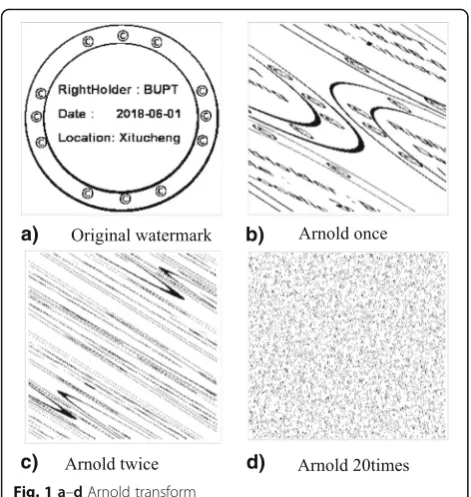
2.1.2 Arnold transform effect
The original two-value watermark image is shown in
Fig. 1a. The image is carried out using Arnold
2.2 Logistic map
Logistic map is a chaotic mapping method for one-di-mensional, which is digital content security and other fields. The formula of logistic map is featured with a simple form, which is defined as follows:
X kð þ1Þ ¼uX kð Þ ½1−X kð Þ;k¼0;1;…;n; X kð Þ∈ −ð 1;1Þ;u∈ð0;4Þ
0<Xð Þ0 <1 3:5699456<u<4
ð3Þ
where X(k) is the mapping variable and u is the system
mapping parameter. The function of logistic works in a dis-order and unpredictable way, and the function is sensitive to the system mapping parameteru. [X(0),u] is used as the encrypted secret key.
2.3 Human visual system and Watson model 2.3.1 Human visual system
Background brightness masking, texture masking, and frequency masking effects of human vision system (HVS) are often applied to digital watermarking tech-nology, which has a great relationship with the embed-ding strength and the value of the visible threshold value. In the visual system, brightness and frequency are much more important to image or video than color or direction. The higher the background brightness is, the less sensitive to the human eye. That is, background brightness can very well mask the change of image. In the transform domain algorithm, the human eye changes the
image by the high-frequency coefficient or the diagonal coefficient, which does not reflect the change of the image, that is to say, the frequency coefficient can mask the change of the image. The more complex the image back-ground texture is, the more difficult the human eye can judge the change of the image, the image texture can be changed by masking, so the embedding strength of the watermark can be increase moderately in the relatively complex background image.
2.3.2 Illuminance masking model
The illuminance model proposed in [20] is one of the
hu-man visual models (Fig. 2), the background brightness
masking effect and the pattern. The masking effect and the frequency masking effect are also applicable to the Watson model. In this paper, we use the formula in this model to calculate the embedding strength.
From the background brightness masking properties, according to the Weber-Fechner law, the visual bright-ness masking properties can be expressed as follows:
where L shows the background brightness and L+ΔL
shows the brightness of the object that the human eye
can observe.ΔLis the threshold that human visual
or-gans can detect when brightness changes. Recent
stud-ies have shown that the mapping equation betweenΔL
andLis as follows:
ΔL¼0:05941:219þL0:42:5 ð4Þ About frequency concealment characteristics, divide the image into 8 × 8 sub-blocks; the study of the frequency of 8 × 8 sub-blocks indicates that the sensitivity of the human eye decreases with the increase of frequency.
2.3.3 Texture masking model
Texture masking characteristics are also called contrast-masking characteristics. For the identification of contrast, there is no specific model at present. Usually, edge detec-tion is used. Even in the case of high texture complexity,
a) b)
c) d)
Fig. 1a–dArnold transform
the human eye is still insensitive to image modification traces even if the watermark intensity is increased. Sup-posing two-dimensional image is f(x1,x2)∈L2 (R2), the
two-dimensional wavelet decomposition image is:
A2f xð 1;x2Þ ¼< f xð 1;x2Þ;∅2k1ð Þx1 ∅2k2ð Þx2 > Dð Þ1
2 f xð 1;x2Þ ¼< f xð 1;x2Þ;∅2k1ð Þx1 ψ2k2ð Þx2 > Dð Þ2
2 f xð 1;x2Þ ¼< f xð 1;x2Þ;ψ2k1ð Þx1 ∅2k2ð Þx2 > Dð Þ3
2 f xð 1;x2Þ ¼< f xð 1;x2Þ;ψ2k1ð Þx1 ψ2k2ð Þx2 >
ð5Þ
Q xð 1;x2Þ ¼
X3
i¼1
σ Dð Þ2i f xð 1;x2Þ
þΔL xð 1;x2Þ ð6Þ
where∅(∙) andψ(∙) are the horizontal filter function and vertical filter function respectively. σ (∙) indicates the standard deviation function.
2.4 JPEG image compression and Watson DCT model 2.4.1 JPEG compression and DCT transform
Considering the image storage, the image data is com-monly stored in a compressed way. JPEG is widely used in picture compression form, so we choose JPEG as an example of image data in our proposed multi-media content protection solution. In this scheme, ro-bust watermark for DRM misusing detection is a binary image, which indicates some owner identifica-tion. We choose to embed watermarks based on the DCT coefficients in this scheme.
JPEG compression usually divides the complete digital image into 8 × 8 blocks, DCT, and quantifies the luma samples of each block. The DCT of the two-dimensional signal f(x,y), x= 0, 1, …M−1; y= 0, 1,…N−1) is defined as follows:
F uð ;vÞ ¼c uð Þc vð ÞXM− 1
x¼0 X
N−1
y¼0
f xð ;yÞcosð2xþ1Þuπ 2M cos
2yþ1
ð Þvπ
2N u¼0;1;…;M−1;v¼0;1;…;N−1:
ð7Þ The inverse IDCT is defined as follows:
f xð ;yÞ ¼XM−1
u¼0
X
N−1
v¼0
c uð Þc vð ÞF uð ;vÞcosð2xþ1Þuπ
2M cos 2yþ1
ð Þvπ
2N
x¼0;1;…;M−1;y¼0;1;…;N−1:
c uð Þ ¼ 1
ffiffiffiffiffi M
p u¼0
2ffiffiffiffiffi M
p u≠0
8 > > < > > : 9 > > = > >
; c v
ð Þ ¼ 1
ffiffiffiffi N
p v¼0
2ffiffiffiffi N
p v≠0
8 > > < > > : 9 > > = > > ;
ð8Þ
2.4.2 Watson DCT domain model
For the JPEG compression standard, we can use the visual model to calculate the quantization step size.
The quantization error of the quantized DCT coeffi-cient is within JND. Watson have presented optimal JPEG quantization step size.
For brightness-adaptive phenomenon,TLu;v;k is defined as follows:
TL
u;v;k ¼Tu;v cc0;0;k 0;0
a
ð9Þ
where c0, 0,k represents the DC coefficients of block k,
which means the brightness value of block image. c0, 0
reflects the mean brightness of the whole image, which can be assignedc0, 0= 1024 when calculating. Tu,vis the quantization step size matrix, independent on concrete images. Taking into account the contrast-masking effect, quantization step size can be obtained from the follow-ing formula,wu,v= 0.7:
TC
u;v;b¼ Max TLu;v;b; Xu;v;b wu;v TLu;v;b 1−wu;v
ð10Þ
3 Method: The proposed DRM misusing detection scheme based on watermark
3.1 Watermark scheme architecture for DRM misusing detection
The whole scheme includes two import parts. The first part is the watermarking embedding process. In the pre-processing of the input JPEG image, we convert
the RGB image into YCbCr image, in which Y is the
luminance signal, Cb is chrominance blue signal, and Cr is chrominance red signal of the image. The redun-dancy of luminance signal is more than that of the Cb
signal and Cr signal, and the luminance Y signal is
insensitive to watermark, so we select the luminance to embed the watermarks. After pre-processing the
input image, the Y matrix could be divided into 8 × 8
blocks. And with each 8 × 8 DCT block, the water-mark could be embedded in the DCT domain with HVS characteristics. The brightness equation is as follows:
Y ¼0:299Rþ0:587Gþ0:114B Cb¼−0:299R−0:587Gþ0:886B Cr¼0:701R−0:587G−0:114B
ð11Þ
3.2 Watermark embedding algorithm for DRM misusing detection
In the watermark embedding algorithm, we select one
M×N binary image as watermark W. W= {W(i,j)| 0≤
i<M, 0≤j<N}, and W(i,j)∈{0, 1}. We scramble the binary image using Arnold transform for security and then convert the encrypted image into one-dimensional image sequence and then use logistic mapping to encrypt the one-dimensional sequence to encrypted watermark se-quence, namely W= {wi},i= 1, 2, …,C;C=M×N,wi= 0 or 1. The RGB of the host JPEG image is converted into
YUV signals. And the Y luminance is divided into 8 × 8
blocks. The sequence of DCT coefficients of one block is recorded as Di(k), (k= 0, 1, 2,…63) in a zigzag scan
form.iis the number of blocks. We choose a continuum
of mid-frequency coefficients to embed watermark, such asDi(L),L= 3,4,…18.
The processing of coefficient Di(k) balances the ro-bustness and transparency of watermark. The specific methods are as follows:
Dið Þk0¼
Q Dð ið Þk Þ TLu;v;kþ
TL u;v;k
2 & ’
þ modðQ Dð ið Þk Þ;2Þ TLu;v;k !
S Dð ið Þk Þ
if wð i¼0Þ
Q Dð ið Þk Þ TLu;v;kþ
TL u;v;k
2 & ’
þ modðQ Dð ið Þk Þ þ1;2Þ TLu;v;k !
S Dð ið Þk Þ
if wð i¼1Þ 8
> > > > > > > > > > > > > < > > > > > > > > > > > > > :
ð12Þ
Q Dð ið Þk Þ ¼
Dið Þk −QiS Dð ið Þk Þ
TL u;v;k
" #
Dið Þk >0
Dið Þk −QiS Dð ið Þk Þ
TL u;v;k
" #
Dið Þk <0 8
> > > > < > > > > :
S Dð ið Þk Þ ¼ signðDið Þk Þ
Dið Þk ϵfDið ÞL ;DiðLþ1Þ;DiðLþ2Þ;DiðLþ3Þ;DiðLþ4Þg
ð13Þ
where mod(.) indicates modular operation, sig(.) returns the symbol variable of the parameter, Di(k) is the DCT coefficient, i is the 8 × 8 block image number, and k is the coefficient number. In order to control the excessive increase of bit rate of the image data after watermark embedding, the watermark embedding algorithm only considers non-zero coefficients.
Mid-frequency coefficients are selected to embed watermarks. The choice of the mid-frequency coefficients directly affects the robustness and transparency of water-marks. Different modifications of DCT coefficients may bring different visual perception and different robustness
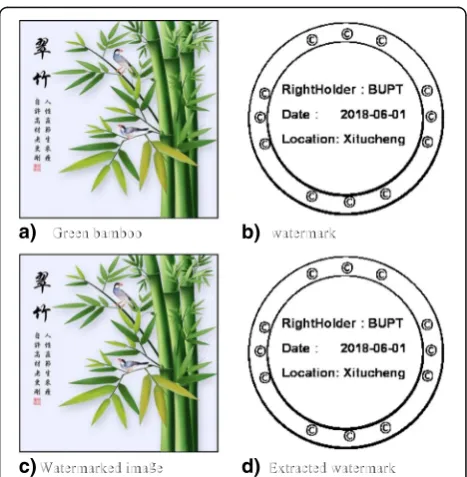
of watermark. Figure 3 describes the relationship of,
namely, different Di(k) and transparency and robustness. Peak signal to noise ratio (PSNR) is used to measure the transparency, and bit error is used to measure the robust-ness. The image Green bamboo is used as the host image, and watermark is random sequence.
In Fig. 4, the horizontal ordinate indicates the choice of Di(L)~Di(L+ 4) to be embedded watermark. The left vertical ordinate is the PSNR between the host image
and the watermarked JPEG image. For different L, the
watermark is embedded in different coefficients; whenL
is small, the watermark is embedded in low-frequency coefficients, which may bring low PSNR but low bit
Fig. 3a–dHost image and watermark
a) b)
c) d)
error robustness, and when L is big, the watermark is embedded in mid-frequency coefficients, which may bring high PSNR but also high bit error.
In Fig.4, we find whenL=10, the PSNR is near 39 dB, one maximum value in around the curve, and also the bit error is less than 2%. The main reasons may be as follows:
(1) We can find whenL=10, the coefficients to be
em-bedded is Di(10)~Di(14), which are in the same layer in the zigzag scanning line and impact the 8 × 8 block image evenly.
(2) In JPEG compression table, the quantization step is
not very big in the layer responding to L=10, which
bring small quantization errors and some good balance between PSNR and bit error of the block image.
From the above analysis, we selectDi(10)~Di(14) (L=10) as the watermark embedding coefficients.
From Formula 5, we can get Qi is related to the
tex-ture of the image. The much biggerQimeans the higher
texture in the blocks of the image and the easier to embed watermarks.
For the host image is JPEG image, when the water-mark is embedded, the waterwater-marked image is often saved in JPEG format. The lossy compression of JPEG may attack the watermark in the saved JPEG image and bring some bit error in the extracted watermark process, so the choice of JPEG compression quality is very important. Meantime, the high quality may cause the storage volume to be very big, which is not very suitable for practical application. So in order to deter-mine the bit error of the watermark and the storage volume of the watermarked image, some treatment measures will be used before the watermark embed-ding process is quite over.
Store watermarked JPEG image with compression
quality factor Q = 100. And then extract the watermark
from the stored image; if there is no bit error in the ex-tracted watermark, store the watermarked JPEG image
with the new compression quality factor Q=Q−1, and
so on. Until bit error happens, save the watermarked JPEG image with the final compression quality factor
Q = Q + 1, then the watermark embedding process is
complete.
3.3 Watermark extracting algorithm for DRM misusing detection
In the watermark extracting algorithm, we get one suspicious JPEG image for digital rights management. Convert the RGB signals of JPEG image into YUV
sig-nals and divide theYluminance into 8 × 8 blocks, and
then perform DCT transform on each block image. The sequence of DCT coefficients of one block is also recorded as Di(k), (k= 0, 1, 2,…63) in a zigzag scan
form the same as the watermark embedding process,
where i is the number of blocks. We choose a
con-tinuum of mid-frequency coefficients to extract water-mark, such asDi(L), L= 10,11,…14. The watermark to
be extracted is recorded asWn, where nis the number
of watermark bit extracted. The watermark extracting methods are on the basis of the characteristics of DCT coefficients, and the specific methods are as follows:
wi¼ −1; mod Q Dið Þk 0
;2
¼0
þ1; otherwise
ð14Þ
Q Dið Þk
0
¼
Dið Þk
0
−QiS Dið Þk 0
TL
u;v;k
2 4
3
5 Dið Þk 0 >0
Dið Þk
0
−QiS Dið Þk 0
TL
u;v;k
2 4
3
5 Dið Þk 0<0
8 > > > > > > < > > > > > > :
S Dið Þk
0
¼ signDið Þk 0
ð15Þ And then
Wn¼
0; X
i
wi<0
1; otherwise
( )
ð16Þ
whereithe number of block coefficient isDi(k) and nis the number of watermark bit.
After all watermark bits are extracted, the watermark bits should be changed into a two-dimensional image signal, and then retrieve watermark image by reverse Ar-nold transform and reverse logistic mapping transform.
4 Results and discussions
4.1 Experiments and evaluations of the watermark algorithm for DRM misusing detection
In this scheme, we designed a watermark-based effect-ive DRM algorithm for misusing detection by embed-ding watermarks based on DCT, in which the robust watermark is for misusing detection process. In our scheme, we constructed the watermark in an image format with some copyright text information; thus, even if the image data is being attacked, the copyright text information can still be recognized in the image watermark and can parse the user-related information and then can be taken as an evidence by the image watermark.
PSNR¼10 log10 ðO−1Þ 2
MSE
!
dB ð17Þ
where O−1 reflects the maximum value of the original
image pixels. MSE is the mean squared errors, given by
MSE¼ 1
MN
XM−1 i¼0
XN−1
j¼0 W ið Þ;j−W i^ð Þ;j
2
ð18Þ Structural similarity index (SSIM) values can also be used to evaluate the quality of the watermarked image. The maximum value is 1 when both images are structur-ally similar.
L Xð ;YÞ ¼ 2uXuY þC1 uX2þuY2þC1
ð19Þ
C Xð ;YÞ ¼ 2σXσYþC2
σX2þσY2þC2
ð20Þ
S Xð ;YÞ ¼ σXYþC3
σXσY þC3
ð21Þ
C3¼C2=2 ð22Þ
SSIMðX;YÞ ¼ ð2uXuY þC1Þð2σXYþC2Þ uX2þuY2þC1
ð ÞðσX2þσY2þC2Þ
ð23Þ
whereuX and uYreflect the mean value of imageX and
image Y. σX and σY reflect the standard deviation of
image X and image Y. σXY reflects the covariance of
imageXand imageY.
Normalized cross correlation (NC) is a standard method for evaluating the degree of similarity between the original watermark image and the extracted water-mark image, which is defined as:
NC¼
PM−1
i¼0PNj¼0−1W ið Þ ;j W i^ð Þ;j
PM−1 i¼0
PN−1 j¼0W ið Þ;j 2
ð24Þ Bit error rate (BER) is defined as the ratio of water-mark bit errors. BER is defined as follows:
BERð Þ ¼% 1 n
Xn
j¼1W ið Þ;j ⨁W i^ð Þ;j
h i
100 ð25Þ
where n is total number of watermark bits, which are
embedded.
In the experiment, some pictures taken on the Internet with the size of 2560 × 2560 are used. A binary logo of
size 250 × 250 is used as watermark, which describes some info for misusing detection, such as right holder,
date, and location information. Figure 5 shows the
ori-ginal image, binary watermark, and the corresponding watermarked image. The PSNR of watermarked image is 39.32 dB while quality factor is 100. The bit- error of the watermark extracted is 0.
After the host JPEG image is embedding the water-mark for misusing, storage capacity of the waterwater-marked JPEG file may be increased. To constraint the storage capacity, the watermarked JPEG image should be com-pressed with low quality factor and storage in a limit capacity. The index CIR (capacity increase ratio) will be used in this paper, which can be used as the percentage
a) b)
c) d)
e) f)
g) h)
of image capacity increase ratio between the host image and the watermarked image.
CIR¼Capacity Watermarkedð Þ−Capacity Originalð Þ Capacity Originalð Þ
100%
ð26Þ
where Capacity (Original) and Capacity (Watermarked) are the file capacity of the original image and the water-marked image capacity.
We can analyze the following conclusions from Table1. When the quality factor decreases, the CIR of JPEG image decreases. CIR is lower than 0 when quality factor is below 90. When compression factor is reduced to 90, bit error may be happened.
4.2 Attacks and analysis of DRM watermark algorithm
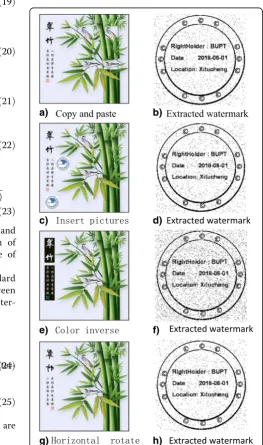
In this experiment (see Fig.5), we attack the watermarked image firstly and then verify whether we can extract the watermark from the attacked images. In the experiment, we gave the detailed experiments according to the six kinds of attacks: (1) copy and paste attack, (2) insert picture at-tack, (3) color inverse atat-tack, and (4) horizontal rotate.
From the results in Fig.6, in which the watermark can be easily recognized, it describes the information, such as right holder, date, and location information after the attacks.
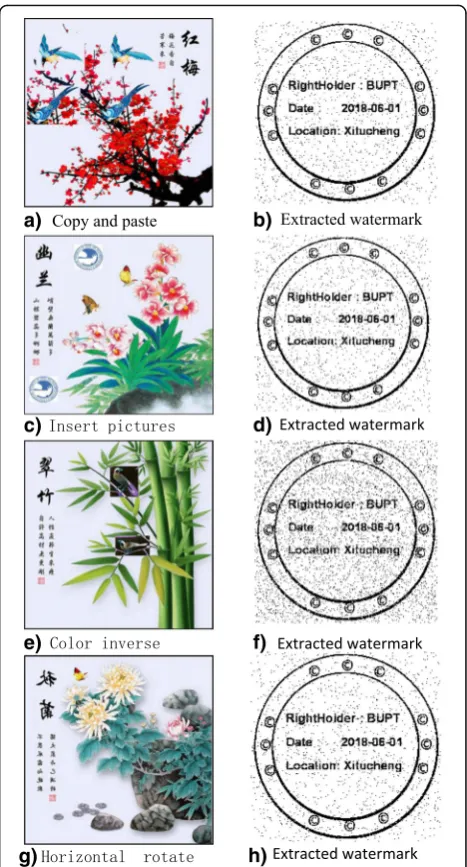
For further experimental verification, we use different benchmark images as experimental object images (see Figs.6and7). The watermark describes info for misusing detection, such as right holder, date, and location
infor-mation. Table 2 shows the experiment results, and the
a) b)
c) d)
Fig. 6a–dExperiment images
Table 1Different quality factors for the Green bamboo image
Quality factor CIR (%) PSNR (dB) SSIM Bit error
100 163.24 39.32 0.9750 0
95 32.89 39.34 0.9762 0
90 2.91 39.03 0.9723 0
85 −18.23 39.23 0.9736 0.001 80 −26.33 38.82 0.9715 0.004 75 −31.88 38.33 0.9687 0.016 70 −36.65 37.99 0.9660 0.037 65 −47.67 38.00 0.9657 0.075
a) b)
c) d)
e) f)
g) h)
experiments show the validation and performance of the proposed algorithm.
According to the experimental results from Table2, we draw the conclusion as follows: The CIR for different images are generally less than 0 when compression quality is 90, which means the file storage size of watermarked images cannot be increased very much after watermark embedding, even decreased for JPEG compression. Espe-cially, CIR for image of high texture are commonly below zero, such as red plum and chrysanthemum. CIR for image of low texture are commonly above zero, such as orchid and green bamboo. The PSNR of the images are general above 38 dB, and the bit error of the identifi-cation watermarks is near 0.
The related methods are compared with the proposed schemes in terms of functionalities and performance.
Comparing with the current related schemes, our pro-posed scheme has the following three advantages and innovations:
Obviously, in addition to the abovementioned analysis, the present schemes have another three advantages.
(1)Automatic watermark generation: Compared with some other watermark schemes, the watermark scheme is efficient. The security of watermark is very well for Arnold transform and logistic mapping transform.
(2)Parameter control for watermark performance: Different quality of JPEG compression can control the quality of watermarked images, so as to balance the capacity of the image storage file and watermark performance, the watermark scheme can use quality of JPEG to compact the algorithm. (3)Scheme proposed misuse detection method based
on robust watermark in post-usage stage: The
proposed watermark scheme supports robust watermark, which can certificate the Internet image source authentication and misusing detection, even if the watermarked image was attacked by variant tamping.
Through experiments, we can see that the proposed watermark scheme is practical and effective, which can recognize the device-related information to trace and find the one who misuse or violate the confiden-tial Internet pictures.
In Table3, we can get that the watermark algorithm
is embedded randomly and securely in the host im-ages. So the robustness of watermark is very good against the attack of parts of (Table4). The bit error is 0 even when the tampering ratio is up to 1%. The al-gorithm is effective especially when parts of image ro-tate and color inverse attack happen, and the bit error is also very slow in the experiments.
5 Artwork DRM blockchain platform implementation and its blockchain data management
5.1 Artwork DRM blockchain platform implementation
Based on the above availability and security analysis of the digital rights management and its misusing de-tection technology, we implemented the artwork DRM platform (named DRMChain) based on
Hyperl-edger Fabric 1.0 [21–24] consortium blockchain for
authorized membership user service (see Figs. 8 and 9),
Table 2Experiments for Green bamboo
Image number
Attack type Tampering ratio (%)
Bit error
NC
1 Copy and paste 7.3 0.048 0.9771 2 Insert pictures 5.5 0.051 0.9722 3 Color inverse 7.8 0.072 0.9310 6 Horizontal
rotate
8 0.044 0.9763
Table 3Experiments for different images when quality is 90
Image number Image CIR (%) PSNR (dB) SSIM Bit error 1 Red plum −9.38 39.17 0.9729 0.003 2 Orchid 1.0 38.98 0.9721 0 3 Green bamboo 3.53 39.03 0.9723 0 4 Chrysanthemum −2.96 38.85 0.9713 0
Table 4Experiments for tampering
Image number
Image Attack type Tampering ratio (%)
Bit error
NC
1 Red plum Copy and paste
11.6 0.066 0.9771
2 Orchid Insert pictures
5.9 0.036 0.9722
3 Green bamboo Color inverse
6.3 0.057 0.9310
4 Chrysanthemum Horizontal rotate
8.1 0.042 0.9763
upon which authorized consortium users can find and confirm their interested artwork and can track the art-work’s copyright information such as artwork’s author, right holder, and date.
5.2 Artwork DRM blockchain data management 5.2.1 Artwork raw data management
When the user is using the DRMChain platform, he/ she firstly needs to register as user-level account, then
he/she can commit his/her artwork, and the
DRMChain will create the raw artwork and its corre-sponding blockchain data, which includes block data (block header) and the block transaction (block body).
5.2.2 Artwork DRM blockchain data creation
Upon the implementation of the consortium block-chain, the DRMChain first creates the blockchain channel and chain code and builds up the blockchain in the Docker system. When the raw artwork data is committed as a proposal in the DRMChain blockchain
platform, the DRMChain creates the block-related discrete data and then commit the unconfirmed discrete data to the order peer; the order peer then confirmed and ordered the data in Kafka or Solo mode; once the data is confirmed in the blockchain system, the artwork data is formally stored in all the related peers and created its corresponding blockchain
data structure. Table 5 shows an instance of a raw
artwork data and its corresponding blockchain data (block header and body):
5.3 Artwork DRM blockchain data management
As for the blockchain, data is created and confirmed by cryptography-based digital signature with unique timestamp, and each block (except for the genesis block) is linked with the previous block which is
en-sured by un-tampered hash algorithm, and the
consortium-based DRMChain platform can provide authorization access, isolation of different level user data, privacy protection, and high-level TPS (transaction per second). Thus, the DRMChain can provide a technique-based, fair, and trusted artwork content protection solu-tion, in which the artwork is protected by the content provider with watermark (the unauthorized fake art-work can NOT provide the authorized watermark); the DRMChain is useful for artwork content exhib-ition and exchange.
6 Conclusions
A new watermarked-based image data security scheme for digital rights management misusing detection was proposed in this paper. We embedded the information,
Fig. 9DRMChain block data instance
Table 5Artwork DRM blockchain data instance
Name Data
Creation name Chinese bamboo painting
Creation author Mr. Li Qing
Copyright owner BUPT Library
Creation time 2008-08-08
BlockNumber 36
CurrentHash 2c8c4881b34e13bce7d4ed4869f890fbbd5754ab7f02b4c229cfc0495419ca77 PreviousHash 3dc7555ead146a41302865873e941767e7126064da73e343e282654ace5103ff Datahash 469f57098a297611c450f2d138fe7a4851cd383825c10fef9e0b3bbd9ae23587
Number of tx 1
tx_id 1c50bc264ee12588711e8a77c3ea8ebf81651079a260ebebc95d9c7de12984d7 ProposalHash e5b66ffa37aaa8c8ea9ffd21cd042051b943a28d518b9cecf121a601cd9b380b
such as right holder, date, and location information into the confidential image data. In the scheme, we use image Arnold transform to enhance the security and use image DCT coefficients of middle frequency to embed water-mark for robustness. In the transparence of waterwater-mark, HVS and Watson models are used to control the water-mark strength, which can enhance the invisibility. Once the image data was spreading and misused in the Internet and for some commerce purposes without authorization, we can extract the watermark even after some attacks happen on the images. Finally, we evalu-ated the proposed watermark scheme for DRM misusing detection by groups of variant style image data for secur-ity and efficiency, and a large amount of groups of ex-periments indicate the proposed scheme was secure, robust, pervasive, and efficient for confidential image data protection and misusing detection.
Abbreviations
DCT:Discrete cosine transfer; DRM: Digital rights management; DWT: Discrete wavelet transfer
Funding
This work is supported by the National Natural Science Fundamental of China (Nos. 61272519, 61170297, 61572080, and 61472258).
Availability of data and materials
Please contact the author for data requests.
Authors’contributions
The work is mainly finished by the author MZ, who proposed the whole architecture and complemented main work of the paper. The other authors made part of the experiments and help in formatting the references. All authors read and approved the final manuscript.
Competing interests
The authors declare that they have no competing interests.
Publisher’s Note
Springer Nature remains neutral with regard to jurisdictional claims in published maps and institutional affiliations.
Author details
1
School of Cyberspace Security, Beijing University of Posts and
Telecommunications, Beijing 100876, China.2Shenzhen Datong Industrial Co. Ltd, Shenzhen 518000, China.
Received: 13 July 2018 Accepted: 28 August 2018
References
1. D. Bouslimi, G. Coatrieux, M. Cozic, C. Roux, A joint encryption/watermarking system for verifying the reliability of medical images. IEEE Trans. Inf. Technol. Biomed.16(5), 891–899 (2012)
2. I. Cox, M. Miller, J. Bloom, J. Fridrich, T. Kalker,Digital Watermarking and Steganography, 2nd edn. (Morgan Kaufmann, San Francisco, 2007) 3. C.I. Podilchuk, E.J. Delp, Digital watermarking: algorithms and applications.
IEEE Signal Process. Mag.18(4), 33–46 (2001)
4. C.C. Chang, P.Y. Lin, J.S. Yeh, Preserving robustness and removability for digital watermarks using subsampling and difference correlation. Inf. Sci.
179(13), 2283–2293 (2009)
5. S. Bravo-Solorio, A.K. Nandi, Secure fragile watermarking method for image authentication with improved tampering localisation and selfrecovery capabilities. Signal Process.91(4), 728–739 (2011)
6. X. Wu, Reversible semi-fragile watermarking based on histogram shifting of integer wavelet coefficients, in Proc. DEST, Cairns, 2007, pp. 501–505 7. Z. Ni, Y.Q. Shi, N. Ansari, W. Su, Q. Sun, X. Lin, Robust lossless image data
hiding designed for semi-fragile image authentication. IEEE Trans Circuits Syst Video Technol18(4), 497–509 (2008)
8. C.-C. Lai, C.-C. Tsai, Digital image watermarking using discrete wavelet transform and singular value decomposition. IEEE Trans. Instrum. Meas.
59(11), 3060–3063 (2010)
9. A. Benoraira, K.B. Mahammed, N. Boucenna, Blind image watermarking technique based on differential embedding in DWT and DCT domains. EURASIP J Adv Signal Process, 55 (2015).https://doi.org/10.1186/s13634-015-0239-5
10. E. Vahedi, R.A. Zoroofi, M. Shiva, Toward a new wavelet-based watermarking approach for color images using bio-inspired optimization principles. Digit Signal Process22(1), 153–162 (2012)
11. I. Prathap, V. Natarajan, R. Anitha, Hybrid robust watermarking for color images. Comput. Electr. Eng.40(3), 920–930 (2014)
12. C. Das, S. Panigrahi, V.K. Sharma, K.K. Mahapatra, A novel blind robust image watermarking in DCT domain using inter-block coefficient correlation. Int. J. Electron. Commun.68(3), 244–253 (2014)
13. S.A. Parah, J.A. Sheikh, N.A. Loan, G.M. Bhat, Robust and blind watermarking technique in DCT domain using inter-block coefficient differencing. Digit. Signal Process.53, 11–24 (2016)
14. Loan N A, Hurrah N N, Parah S A, et al. Secure and robust digital image watermarking using coefficient differencing and chaotic encryption [J]. IEEE Access, vol.6, no.99, pp. 19876–19897, 2018
15. Y. Liu, S. Tang, R. Liu, et al., Secure and robust digital image watermarking scheme using logistic and RSA encryption. Expert Syst. Appl.97, 95–105 (2018) 16. J.-X. Chen, Z.-L. Zhu, C. Fu, L.-B. Zhang, Y. Zhang, An image encryption scheme
using nonlinear inter-pixel computing and swapping based permutation approach. Commun. Nonlinear Sci. Numer Simul23(1–3), 294–310 (2015) 17. C. Dong, L. Jingbing, M. Haung, and Y. Bai, The medical image
watermarking algorithm with encryption by DCT and logistic, in Proc. WISA, Haikou, 2012, pp. 119–124
18. J. Guo, P. Zheng, J. Huang, Secure watermarking scheme against watermark attacks in the encrypted domain. J. Vis. Commun. Image Represent.30, 125–135 (Jul. 2015)
19. MENG Zhaoxiong, Morizumi Tetsuya, Miyata Sumiko, Kinoshita Hirotsugu, Design scheme of copyright management system based on digital watermarking and blockchain, 42nd IEEE International Conference on Computer Software & Applications,2018, pp. 359–364
20. A.B. Watson, J. Hu, J.F. Mcgowan, DVQ, a digital video quality metric based on human vision. J. Electron. Imaging10, 20–29 (2001)
21. The Hyperledger Project.https://www.hyperledger.org
22. M. Vukolić, The quest for scalable blockchain fabric: proof-of-work vs. BFT replication, International Workshop on Open Problems in Network Security, pp. 112–125, 2015
23. A. Dorri, M. Steger, S.S. Kanhere, R. Jurdak, BlockChain: a distributed solution to automotive security and privacy. IEEE Commun. Mag.55(12), 119–125 (2017) 24. R. M. Frey, P. Buhler, A. Gerdes, T. Hardjono, K. L. Fuchs, and A. Ilic, The effect