42 | P a g e
AUTONOMOUS VEHICLE
Vishal K. Sapkal
1, Punam A. Bhamare
2, Aishwarya V. Shinde
3 1.2.3U. G. Student, Department of Mechanical Engineering,
Sandip Foundation’s- Sandip Institute of Technology and Research Centre, Mahiravani,
Nashik, Maharashtra, (India)
ABSTRACT
Autonomous vehicle is also called as driverless car or robotic car. Autonomous vehicle have five important
working fundamentals viz; Radar, GPS, LIDAR, Optics and Processor. It is basically working of car without
driver, the car which itself take control and decision to move, to run and to operate. Use of automobiles is
indispensable in modern era. This mobility is usually taken for granted by most people and they hardly realize
that transportation forms the basis of our civilization. Use of technology makes vehicle smart. As the cities grow
and the population increases, more traffic is generated which has many adverse effects. Not having a proper
transportation system costs people their safety, time and money. The need for a more efficient, balanced and
safer transportation system is obvious. This need can be best met by the implementation of autonomous
transportation systems. Autonomous means having the ability of self-governance. The car that is capable of
sensing its environment and navigating without human input. Autonomous vehicles sense their surroundings
with techniques such as radar, LIDAR, GPS, and computer vision. Advanced control systems interpret sensory
information to identify appropriate navigation paths, as well as obstacles and relevant signage. Autonomous
vehicles are capable of updating their maps based on sensory input, allowing the vehicles to keep track of their
position even when conditions change or when they enter uncharted environments.
This paper focuses on working and future scope of Autonomous Vehicle. The use of technological advancement
has shown the promising future.
Keywords: Autonomous vehicle, Driverless car, Radar, LIDAR, Processor, Smart, Promising
Future
.
I. INTRODUCTION
Autonomous means having the ability of self-governance. An autonomous car, also known as a driverless car,
self-driving car or robotic car. Autonomous vehicles sense their surroundings withsuch techniques as radar,
LIDAR, GPS, and computer vision. Advanced control systems interpret sensory information to identify
appropriate navigation paths, as well as obstacles and relevant signage [1, 2]. Autonomous vehicles are capable
of updating their maps based on sensory input, allowing the vehicles to keep track of their position even when
conditions change or when they enter uncharted environments.
II. LITERATURE REVIEW
43 | P a g e
Table 1:
Development of Autonomous Vehicles
SR. NO YEAR AUTHOR/ AUTHORITY FINDINGS
1 1930 Norman Bel Geddes's Futurama Automated Guided Car
2 1950 Leland M. Hancock Miniature Car
3 1960 Dr. Robert L. Cosgriff Driverless Car
4 1990 United States Congress Automated Vehicle and Highway System
5 2000 US Government Unmanned Ground Vehicle
6 2010 major automotive manufacturers Testing Driverless Car Systems
III. WORKING
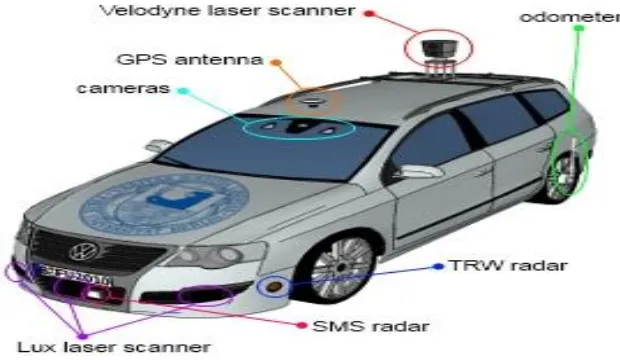
Working of the autonomous vehicles is consisting of mainly 5 components such as- Radar, GPS, LIDAR and
Optics & Processors. The RADAR is used in the vehicles for the used to detect the dangerous objects in the path
of vehicles. The LIDAR is component of the autonomous vehicle which scans the car surrounding in the 100
meters radius. The GPS (GLOBAL POSITIONING SYSTEM) gives the global positioning of the car. OPTICS
uses the video cameras to identify road marking & traffic signals [3]. The above 4 components give their
information to PROCESSOR& it will give this information to the car.
Fig. 1
Detail Working of Autonomous Vehicles
During the actual working of autonomous vehicles there are 2 RADARS i.e. one on the roof & 2ndon the front of
the vehicle. The radar is actually used to judge the distance between the autonomous vehicle and the vehicle in
front. This emits thousands of beams of light per seconds in all direction to identify within 100 meter radius of
the car.They are not harmful to the human health. When the vehicle is running on the road all the components of
autonomous vehicle are in the working, in which radar plays an vital role to identify the road condition. The
mainly radar is identifies the road conditions at least 100 meters from the vehicle. At the running condition radar
also works and it sends the beams , when any obstacles is come in this beams it reduces the speed of vehicle and
44 | P a g e
Fig. 2 Detail Working of RADAR
At that same time the OPTICS that is CAMERA which is equipped with 2 lenses that measure the depth in 3D.
This lenses measures brightness & identify the shapes of people and animals. And also this identifies the road
marking and traffic signals. The OPTICS & CAMARAS are senses the signals like signal of lane changing,
signal of stopping, turning signals of front vehicle.
Fig. 3 Detail Working of OPTICS and CAMARA
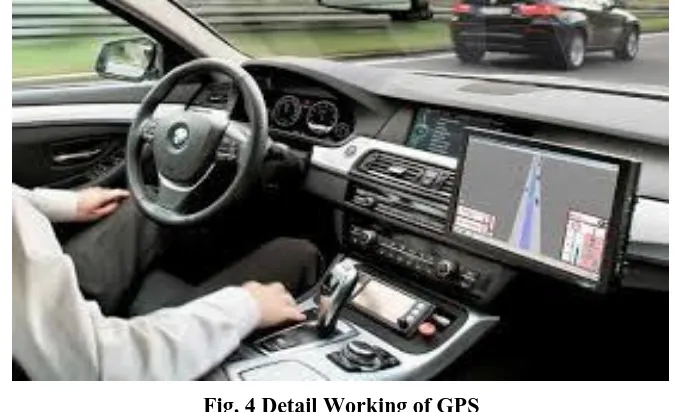
The GPS it captures satellite signals to the pinpoint of vehicles location and transfers them to processing system
that determines the rout to be followed by that car and also the global position of vehicle in road with an
accuracy of 30 centimeters.
45 | P a g e
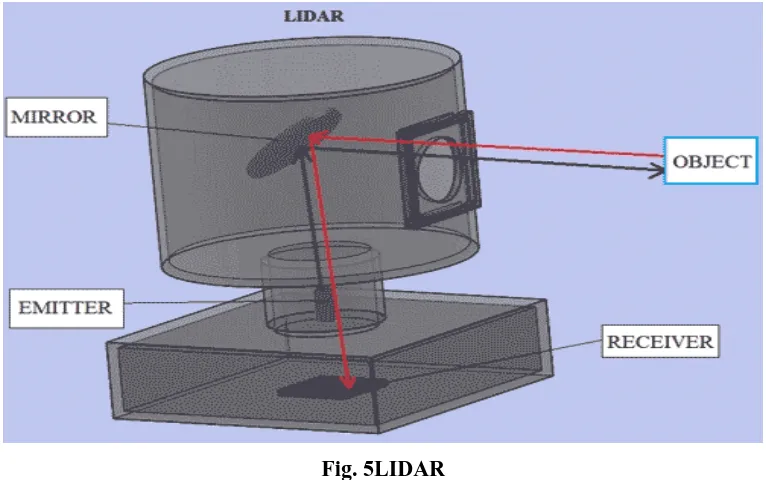
The LIDAR consist of emitter, mirror, receiver & display. The working of LIDAR consist of emitter which
sends the laser beam, then this laser beam are bounces on the mirror that is rotating with 10 revolution per
second.
Fig. 5LIDAR
Then this laser beams are bouncing on the objects in front of the car then this is getting reflected back to the
mirror and get downward. Then this light is focused onto the receiver. From this information the processer is
generating the map of surrounding and use to avoid the obstacles. The autonomous vehicles consist of 2
computers. Computer 1 is located at the bottom of the car. It has high processing capacity, receives information
from the external sensors and tells the car what it should do for purposes of computer 2 (which operate the
hardware) [3]. Computer 2 is smaller and fits in the gloves compartment. Its function is to operate all the
vehicles hardware e.g. telling the steering wheel to turn to the right. While vehicles is running on the road the
magnetic electric motor in the steering column turns the wheel based on commands from the computers. The
brakes and accelerators are operated by using mechanism i.e. linear actuator. Automatic gear shifting &
controlling, this information is seen on the screen, and the buttons on the dashboard which is operated by using
command which is given by computer 2.
IV. FUTURE SCOPE
Future scope of the autonomous vehicles is Now comes the next step. Mercedes-Benz and Audi recently
demonstrated Traffic Jam Assist, which uses adaptive cruise control and automatic steering. Volkswagen Passat
and General Motors Firebird II are some of the autonomous vehicle projects under research.
V. CONCLUSION
Working of a typical autonomous vehicle is discussed, which is intelligent vehicle by virtue of smart technology
used in it. Most of the leading automobile industry have put forward with Research and Development for
betterment of society. It not only serves the purpose of smart vehicle but also shows the overall betterment in
46 | P a g e
REFERENCES
[1] Lassa, Todd "The Beginning of the End of Driving". Motor Trend. (January 2013). Retrieved 1 September
2014.
[2] European Roadmap Smart Systems for Automated Driving, European Technology Platform on Smart
Systems Integration (EPoSS), 2015.