8 |
P a g e
A STUDY ON HIGH RATE SHREW DDOS ATTACK
Kanika Minhas
1, Amanpreet Kaur
2, Dheerendera Singh,Phd
31
Research Scholar, Chandigarh Engineering College (India)
2Assistant Professor, MTech IT, Chandigarh Engineering College (India)
3Professor and Head (CSE) SUSCET, Tangori, Mohali (India)
ABSTRACT
Denial of Service attacks is frequently presenting an increasing threat to the global inter-networking
infrastructure in networking area and scenario. The algorithm for TCP congestion control is highly efficient for
the various networking areas and operations as well its internal assumption of end-system cooperation results
are well prone to attack by high-rate flows. A Shrew attack uses the concept of a low-rate burst which is
carefully designed to use the TCP’s retransmission timeout mechanism in an unfair way and can affect the
bandwidth of a TCP flow in a smooth manner without coming into appearance as an intruder. A Shrew attack
has further classifications such as a low rate shrew attack or an high rate shrew attack. A high rated shrew
attack uses the concept of timely sending high rate packet stream in low frequency. Such attack can affect the
performance of a network to a large extent.
Keywords: WSN- Wireless Sensor Network , DDOS-Distributed Denial Of Service Attack,
TCP-Transfer Control Protocol, DNS-Domain Name Services, RTO-Retransmission Time Out.
I. INTRODUCTION
DDoS attacks will first of all try to stop the user from receiving required message at correct time. This type of
attack may be improved to give a new form of two sorts of knowledge resource one is on the large volume of
information sent over the network for the business process, therefore clean up the server for a few particular
quantity of your time another one on the sensitive knowledge like military application i.e. mainly for purpose
where more security is required. So this paper focuses a lot of on sensitive knowledge transmission instead of
the attack that makes the business server closedown for a few amount of time and leads to large amount of loss.
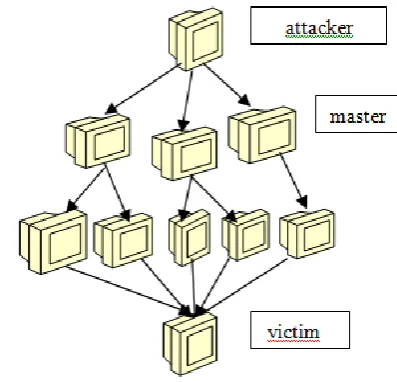
In DDoS attacks, maliciously attackers inject bulk of different packets into the network or forward a similar
9 |
P a g e
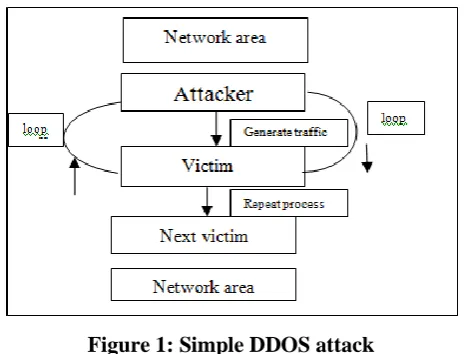
Figure 1: Simple DDOS attack
These attacks are mainly classified into two varieties one is packet flood attack and another is DDoS attack.
These types of attacks can consume the information and buffer and prevent all the required packets from
reaching the target and therefore affect the network performance and services. Here, aim is to divide and send
the important information and retrieve that knowledge by network writing method. Network writing method is
used to retrieve, divide and send original knowledge across the network. There are two key techniques random
writing and linear writing. The random writing makes network writing practical and also the linear writing is
economical for network writing. Attacks may also occur against the root name servers. The infrastructure of the
root name server is highly distributed, using the inherent features of DNS like catching, retries, and multiple
servers for the same network area with follow-up if one or more fail). The potential throughput is improved by
increasing security, decrease in energy transmission, and decrease in delay. Network writing is employed to
retrieve the info sent over completely different nodes. During the study for this paper the information has been
split and sent over completely different router, then DDOS attacks area unit is known by matching with the edge
router information already set. Once attack has been identified, the router performs packet marking and data
flow marking over the routing table. It provides and shows an alternate path to forward the remaining
knowledge to the next neighbor router. As a future work we are able to concentrate in retrieving lost knowledge
by exploring the knowledge mining techniques.
One common method of DOS attack involves affecting the target mechanism with external communications
requests such that it gives no response to legitimate traffic, or response is very slow. Such attacks will lead to
a server overload.
Denial-of-service attack is considered as violations of the Internet Architecture Board's Internet proper use
policy, and also violate the rules of the internet services provider. These also commonly lead to constitute
violations of the laws of individual nations. Altogether, DOS attack denies the server from providing the
information and services required by the legitimate user in a network. Basically attacks are of two types one is
an active attack and the other one is a passive attack. Active attack is one which attacks the network area when
the network is under process i.e. traffic is being generated and packets are flowing. The passive attack is one in
10 |
P a g e
A. Impact of Denial of Service attack on multihop
“Impact of Denial of Service Attacks on Ad Hoc Networks” studied a novel DoS attack experimented by
Jellyfish [1]. The relay nodes are or may be in a disorder, a delay, or there may be a periodic drop in packets that
they are expected to forward in a way that leads to end-to-end congestion control protocols. Such attacks results
in increase in the capacity of ad hoc networks as they will stop them from continuing to a particular destination
of all multihop flows and provide all resources to one-hop flows that cannot be detected by Jellyfish or Black
Holes. It considers the fairness measures and the mean number of hops for a received packet, as an performance
measures for a system under attack
B. Router request flooding attack technique
“A Secure on Demand Routing protocol” brought out Secure adhoc destination vector routing protocol that
makes use of Hash chains and merkle hash tree[2]. It checked the distance to target and sequence numbers. It
uses concept of path weight to find sensible place.
It implements a method referred to as Route-request flooding attack. During this each node features a rate limit
to route request even it's asked to relay. But it posses drawbacks like rate limiting may delay a victim’s ability to
associate attack, and consequently scale back the output of victims.
C. Mitigating technique for nodes in mobile Adhoc Network
“Mitigating technique DDoS attacks exploitation protection nodes in Mobile Adhoc Networks” makes use of
two types of nodes in two completely different levels like local protection node and remote protection node[3].
It makes use of messages like anm & amp. It aim to communicate between two completely different levels of
nodes, If correct acknowledgement is received then transfer of messages takes place. It has few drawbacks like
False positive rate, Different setting of LPN change amount, Assignment of
LPN in multi-level network.
D. Evasion Technique
This technique proposed two different but complementary approaches [4]. In the first approach, simply retreat
from the attacker, which may be done by either spectral evasion (channel surfing) or spatial evasion (spatial
retreats)[4]. The spatial evasion aims to compete more actively with the intruder by adjusting resources, such as
power and communication coding in order to achieve communication in the presence of the jammer.
E. classification of IP tarcebacking scheme
“A framework for classifying denial of service attacks,” [5] shows a hybrid trace back approach in which packet
marking and packet logging are combined and used together in a very novel manner to achieve the simplest of
each worlds. It achieved small range of attack packets to conduct the trace back method and small quantity of
resources to be allotted at intermediate routers for packet logging .
F. Tracbacking technique using data packet marking and logging
“A more sensible approach for single-packet information processing trace back exploitation packet work and
marking,” studied the importance of log-based information process trace back in tracing out one packet below
the setting where not each AS (Autonomous Systems ) supports log-based information processing trace back[6].
It has a drawback as previously existing trace back techniques start from the router to the victim and check its
11 |
P a g e
After studying the different techniques mentioned above it is clear that each technique has its own different
advantage and few drawbacks. In “Impact of Denial of Service Attacks on Ad Hoc Networks” the capacity of
the ad Hoc networks can be increased which sometimes also leads to congestion in one hop flow. The router
request flooding attack technique may sometimes delay the victims ability to associate attack by limiting the rate
and results into lowering the output of the victims. The mitigating techniques for nodes in mobile Adhoc
network is technique in which nodes communicate with each other using wireless medium and communicate
with each other using network model. On the other hand the Evasion technique works on the two approaches
spectral evasion and spatial evasion. These both provide a way of reducing the effect of the attack but do not
give the exact directions about the main attacker node. The technique using data packet marking and packet
logging was also formed but it had no record about the flow that has been marked previously.
2.1 Low Rate DOS
Unlike the Distributed Denial of Service, low-rate TCP targeted attacks doesn't build use of the many packets to
flood the network. It affects the operating mechanism of TCP Timers therefore transfer the output of a system
near to zero. These low-rate attacks generate packets in terribly large amount into the network. Therefore the
packets send by the attacker will simply stay hidden with the legitimate packets and escape the Anti-Dos traffic
watching systems. It’s importantly necessary to know the TCP operating procedure before studying this attack.
Throughout congestion in TCP, the congestion window is step by step reduced till the network is obvious.
Therefore because of congestion the senders rate is reduced that reduces the output. The TCP waits for the
Retransmission day trip (RTO) to expire when that the info is distributed once more. Once the congestion is
additional, the RTO timer is doubled when that the packets are retransmitted. Therefore throughout an
occasional rate attack, once packets are lost, TCP enters RTO. once assaulter is ready to calculate this RTO time
and sends assaultive packets to form packet collision and loss, the assaulter will push the TCP into waiting state.
Hence, there's no want for flooding the network with packets, however solely send packets once the timer is
close to expire and push it once more into the RTO waiting time.
In such type of attack the intruder or the attacker is not known or hidden source. The server will slow down and
a point it will be unable to provide the services to the user this wil be the effect of low rate shrew attack.
12 |
P a g e
In the congestion control mechanism of TCP, congestion window instantly reduces its size till the network is
free from congestion. Therefore congestion in network makes sender’s rate low and also lowers the throughput.
When network due to traffic is congested, there may be chance to drop packets in the network. When the
packets are dropped, the data is resent after the RTO expires. As the congestion exceeds in the network area, the
value for RTO timer is doubled after that the packets are retransmitted. Therefore during a low rate attack, an
attacker calculates the RTO time and sends low rate attacking packets traffic that creates packet collision at
router and this may result of packet loss. Thus the attacker leads the TCP into the waiting state. There is no need
for flooding the network with packets, but only send low rate packets traffic when the RTO timer is about to
expire and push it again into waiting. This type of attack can escape the traffic monitors due to its low traffic
rate and is a serious challenge for the security experts.
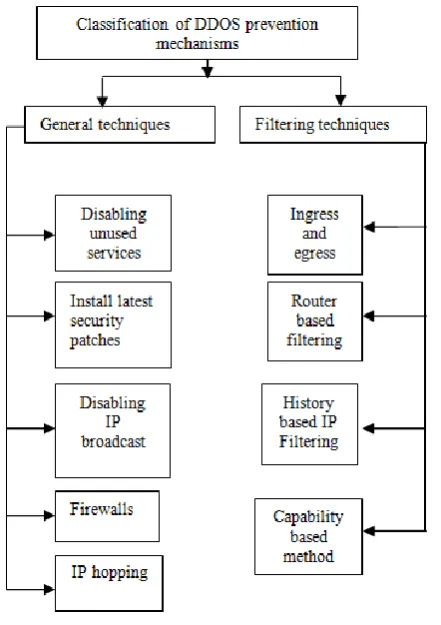
2.2 Classification of Ddos Prevention Mechanism
Various methods of attack prevention many times try to:
Stop all well known DDoS attacks from being launched in the first place or edge routers.
It keeps the track of all the machines over Internet up to date with patches and fix security holes. The techniques are classified as follows:
1. General techniques:
I. Disabling unused services II. Install latest security patches III. Disabling IP broadcast IV. Firewalls
V. IP hopping 2. Filtering technique:
I. Ingress and egress II. Router based filtering III. History based IP Filtering IV. Capability based method
Attack prevention methods are not enough to stop DDoS attacks because they are always prone to simple and mixed attack types for which signatures and patches do not exist in the database. Prevention technique can be classified into following categories:
(i) General Techniques:
These are some common measures for prevention i.e. protection of system, duplication of resources and many other that must be followed by the individual servers and ISPs in order to stop them from becoming the part of DDoS attack process.
(ii) Filtering Techniques:
13 |
P a g e
Figure 3. Classifying Prevention Mechanisms DDOS
Attack prevention methods are not enough to stop DDoS attacks because they are always prone to simple and
mixed attack types for which signatures and patches do not exist in the database. Prevention technique can be
classified into following categories:
(iii) General Techniques:
These are some common measures for prevention i.e. protection of system, duplication of resources
and many other that must be followed by the individual servers and ISPs in order to stop them from
becoming the part of DDoS attack process.
(iv) Filtering Techniques:
These techniques include the ingress filtering, the egress filtering, the router based packet filtering, etc
A. General Techniques
I) Disabling unused services: if there are less applications and open ports in hosts then there will be less
probability to exploit chances of attack by attackers. In case if the network services are not needed or are not
used, then the services should be disabled to prevent or stop attacks.
II) Install latest security patches: DDoS attacks exploit chances in the target system. So the known security holes
must be removed by installing all the relevant latest security patches that prevents attack in the target system.
III) Disabling IP broadcast: If the host computers and all the neighboring networks disables the IP broadcast
only then the defense against attacks that make use of the intermediate broadcast nodes e.g. various flood attacks
and Smurf attacks will be successful.
. IV) Firewalls: It prevents users from launching simple flood attacks from machines behind the firewall.
14 |
P a g e
e.g. in case if there is an attack on port number 80 (web service) then firewalls cannot prevent such attack
because they cannot differentiate good traffic and DOS attack traffic.
V) Global defense infrastructure: It prevents the network from many DDoS attacks by introducing filtering
rules in the most important routers of the Internet. As Internet is checked and accessed by various autonomous
individual systems according to their own local security policies or rules. such type of global defense
architecture is possible only theoretically.
VI) IP hopping: The change in location or IP address of the active server can prevent the DOS attack proactively
within a group of homogeneous servers or with a previously defined set of IP address range. The IP address of
the victim computer is invalidated by changing it with a new one. After the IP addresses change is completed all
internet routers will be informed and edge routers will drop the attacking packets.
B. Filtering Techniques
I) Ingress and Egress filtering:
Ingress Filtering is a mechanism that drops the traffic with IP addresses those which do not match a domain
connected to the ingress router. On other hand, Egress filtering is one which ensures that only assigned or
allocated IP address space leaves the network.
II) Router based packet filtering:
Route based filtering uses the route information to filter the spoofed IP packets. Its functioning principle is that
for each link in the Internet, there is a limited set of source addresses which could lead to traffic generation.
III) History based IP filtering: More often the set of source IP addresses seen during normal operation tends to
remain unchanged or stable. On the other hand, in DoS attacks, most of the source IP addresses are unknown .
IV) Capability based method: This method gives destination a way to control the traffic coming towards itself.
In this technique, source first sends request packets to its destination. Router marks previously marked
capabilities that are added to request packet while passing through the network. The destination may or may not
grant permission to the source to send the packets. If permission is granted then destination returns the
capabilities, if permission is not granted then it does not supply the capabilities in the returned packet.
III. PROPOSED SIMULATION PROCEDURE
The simulation model works on the functioning of MAC and physical layer according to the IEEE standard. The
simulation requires to be precise and easy to understand therefore OPNET simulation tool has been chosen.
Here, the zigbee model has been used that is provided in the OPNET 14.2 model. It is the most easy model to be
studied and evaluate the results of the performance in an network.
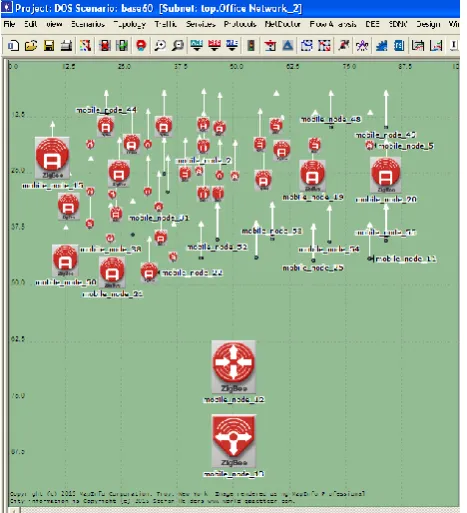
The following figure shows the normal or base scenario with 60 nodes taken in an network. This network
mainly consists of :
1. Zigbee Router
2. Zigbee End to end devices
3. Zigbee coordinator
15 |
P a g e
Figure 4.1 Zigbee Base Scenario with 60 Nodes
Main points of the above scenario with 60 nodes:
1. The scenario consists of 60 zigbee nodes with a router and a coordinator. All the zigbee devices have there
own working and functions.
2. Zigbee router: it functions as a simple router does its work. It keeps the record of data allocated and
deallocated and also routes the data from node to node.
3. Zigbee coordinator: it may be considered as the main part of the network as it coordinates the whole
network and has also a record of the security keys.
4. Zigbee end devices: it can only communicate with the another node. We can say it is the end-user that
requires the services form the server.
IV. EVALUATION WITH PROPOSED WORK
Here we need to study how the different metrics are being affected when the base scenario is compared with
the result of the proposed scenario. Its main task is to show the difference in the performance of the base and
proposed scenarios of ddos attack.
16 |
P a g e
Figure 4.1 Data Dropped(as is Graph Representation)
Clearly from the above graph the data dropped in case of base scenario is more than the data dropped in case of
proposed scenario..
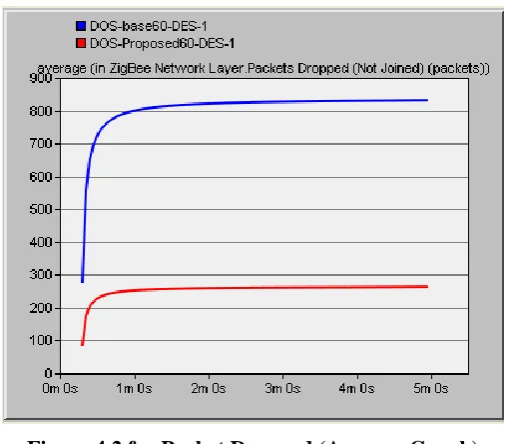
Figure 4.2 for Packet Dropped (Average Graph)
Clearly from the above graph the packet dropped in case of base in more than the packet dropped in case of
17 |
P a g e
Figure 4.3 Delay in Case of Both Scenarios
Clearly from the above graph the delay in case of base scenario in more than the delay in case of proposed
scenario.
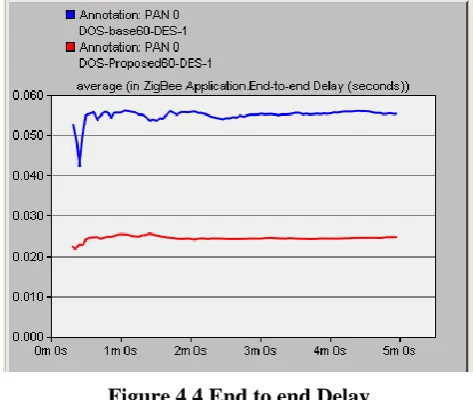
Figure 4.4 End to end Delay
Below are the results for the base 40 and proposed 40:
18 |
P a g e
Clearly from the above graph the data dropped in case of base scenario is more than the data dropped in case of
proposed scenario..
Figure 4.5 throughput
Clearly from the above graph throughput in case of proposed scenario is more than the throughput in case of
basic scenario.
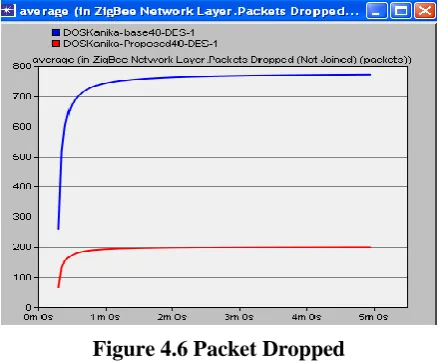
Figure 4.6 Packet Dropped
Clearly packet drop is more for base than the propoed scenario.
19 |
P a g e
Clearly from the above graph the delay in case of base scenario is more than the delay in case of proposed
scenario.
V. COMPARITIVE ANALYSIS OF DIFFERENT SCENARIOS
In this practical approach, we have studied the different scenarios by taking the variation in nodes. The network
scenarios are taken in two categories one is the base network scenario and the other is the proposed scenario.
The base scenario shows the result for the dos attack without implementation of any mitigating technique. The
proposed scenario shows the network with implementation of the proposed technique in which we have used the
concept of counter number which is set to 3.
The counter number may also be the sequence number. The nodes are taken as base 40, base 60, proposed 40
and proposed 60 respectively. The following results will clearly show the difference in results obtained through
these networks.
The main parameters studied in this case study of comparison between different scenarios are:
1. Data dropped
2. Delay
3. Packet dropped
4. Throughput
5. Traffic received
6. Load
The result is shown through the graph representation as follows:
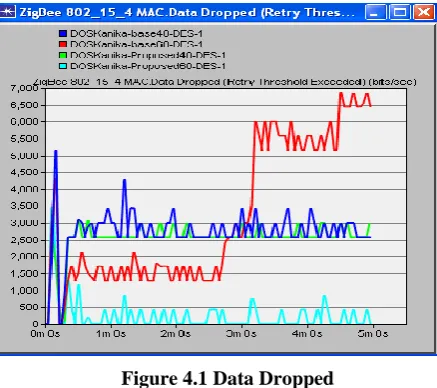
Figure 4.1 Data Dropped
The graph clearly shows that the data dropped in case of the proposed scenario with 60 nodes is minimum as
compared to the basic scenario with 40 and 60 nodes. This shows that the data is dropped less in the formulated
20 |
P a g e
Figure 4.2 Delay
The graph clearly shows that the delay in case of the proposed scenario with 60 nodes is minimum as compared
to the basic scenario with 40 and 60 nodes. This shows that the delay less in the formulated scenario.
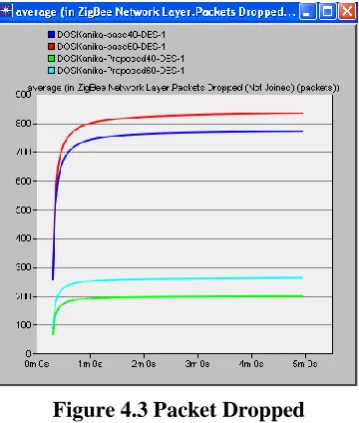
Figure 4.3 Packet Dropped
Above graph clearly shows the result for packet dropped that the packet drop in case of the proposed scenario
with 60 nodes is minimum as compared to the basic scenario with 40 and 60 nodes. This shows that the packets
are dropped less in the formulated scenario.
21 |
P a g e
The above graph shows that the throughput for the proposed scenario with 40 nodes is more then the rest
scenarios. This is due to the variation in the number of nodes of the different scenarios.
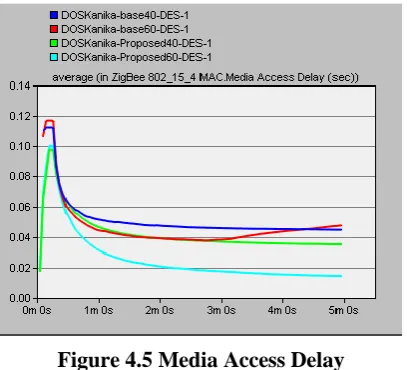
Figure 4.5 Media Access Delay
The graph clearly shows that the media access delay in case of the proposed scenario with 60 nodes is minimum
as compared to the basic scenario with 40 and 60 nodes. This shows that the delay less in the formulated
scenario.
VI. CONCLUSION
The denial of service attack has various techniques for prevention and detection of the attack. Different types of
prevention techniques are discussed here but there is no specific solution for the preventing the attack
completely. The low rate shrew attack is the most prone and difficult one to detect as it works in a hidden
manner without coming under the eye of the attack preventers. The high rate shrew attack is a type of shrew
attaches which work on the principle of high rate packets stream transmitted over an network. There is no such
technique yet discovered that can completely remove the attack or prevent the attack.
Here, the main metrics that have been studies and performance evaluated are the data dropped, delay, end to end
delay and packet dropped. Clearly, the results for the above mentioned parameters are seen to be better in case
of the proposed scenario as compared to the base scenario. The further work is being done to work on the
parameters like the throughput and the load and their comparison.
The comparison between the different scenarios clearly shows the variation due to the increase in number of
nodes. The further study can be dine to show the improved results in case of throughput and load and any other
parameter.
Therefore, mitigation techniques with some improvement and modification can be formulated based on the
concept of counters which can have the record of flow in table form which further can at least reduce the effect
of dos attack to some extent and also help to discover the attacker node.
REFERENCES
[1] Imad Aad etal, “Transactions on Networking”, “Impact of denial of service attacks on Adhoc networks”,.
[2] Y-C. Hu et al, “A Secure on Demend Routing protocol”, Mobile Communication 2002,pp:12-33.
[3] Minda Xiang et al, “Mitigating DDoS attacks using protection nodes in Mobile Adhoc Networks”,IEEE
22 |
P a g e
[4] Wenyuan Xu “Jamming Sensor Networks: Attack and Defens Strategies. IEEE Network May/June 2006
[5] A. Hussain, J. Heidemann, and C. Papadopoulos, “A framework for classifying denial of service attacks,”
in Proc. ACM SIGCOMM ’03, Karlsruhe, Germany, Aug. 2003, pp. 99–110.
[6] C. Gong and K. Sarac, “A more practical approach for single-packet IP traceback using packet logging and
marking,” IEEE Trans. Parallel Distributed Syst., vol. 19, no. 10, pp. 1310–1324, Oct. 2008.
[7] Wei-Shen Lai et al, “Using Adaptive bandwidth a location approach to defend DDoS attacks”,ACM 2008.
[8] A. Hussain, J. Heidemann, and C. Papadopoulos, “A framework for classifying denial of service attacks,”
in Proc. ACM SIGCOMM ’03, Karlsruhe, Germany, Aug. 2003, pp. 99–110.
[9] B.Al-Duwari andM. Govindarasu, “Novel hybrid schemes employing packet marking and logging for IP
traceback,” IEEE Trans. Parallel Distributed Syst., vol. 17, no. 5, pp. 403–418, May 2006.
[10] C. Gong and K. Sarac, “A more practical approach for single-packet IP traceback using packet logging and marking,” IEEE Trans. Parallel Distributed Syst., vol. 19, no. 10, pp. 1310–1324, Oct. 2008.
[11] H. Burch and B. Cheswick, “Tracing anonymous packets to their approximate source,” in Proc. USENIX
LISA 2000, New Orleans, LA, Dec. 2000, pp. 319–327.
[12] S. Acedanski, S. Deb, M. Medard, and R. Koetter, “How Good Is Random Linear Coding Based
Distributed Networked Storage,” Proc. Workshop Network Coding, Theory and Applications, Apr. 2005.
[13] P.A. Chou, Y. Wu, and K. Jain, “Practical Network Coding,” Proc. Allerton Conf. Comm., Control, and
Computing, Oct. 2003.
[14] C. Gkantsidis and P.R. Rodriguez, “Network Coding for Large Scale Content Distribution,” Proc. IEEE
INFOCOM, pp. 2235-2245, 2005.
[15] S.Vincent and J.I.Raja, “A Survey of IP Traceback to overcome Denial of service attacks” in Proc. Recent
Advances in Networking,VLSI and Signal Processing.
[16] M.Hour Yang and M.Chein Yang, “RIHT- A Novel Hybrid IP Traceback scheme” in Proc. IEEE Trans on
Information Forensics and Security, April 2012, vol. 7,no. 2, pg. 789- 797
[17] S. Savage, D. Wetherall, A. Karlin, and T. Anderson, “Practical network support for IP traceback,” in Proc.
ACM SIGCOMM2000, Stockholm, Sweden, Aug. 2000, pp. 295– 306.
[18] A. C. Snoeren, C. Partridge, L. A. Sanchez, C. E. Jones, F. Tchakountio, B. Schwartz, S. T. Kent, and W. T. Strayer, “Single-packet IP traceback,” IEEE/ACM Trans. Networking, vol. 10, no. 6, pp. 721–734, Dec.