Page | 37
FACE DETECTION BASED TWO LEVEL SECURITY SYSTEM
Rohit Kumar
1, Shivam Singh
2, Aditya Sharma
3, S.K. Dubey
41,2
UG, Student of Electronics and Communication Department, AIMT,Greater Noida, INDIA
3
Assistant Professor, Electronics and Communication Department, AIMT,Greater Noida, INDIA
4
Director, AIMT, Greater Noida, INDIA
ABSTRACT
Security is generally a state or feeling of being saved and protected, an assurance that something of value will not be
taken. This paper employs two of the emerging artificial intelligence technologies: Facial Recognition and Artificial
Neural Networks for developing a secure keyless door where authentication of authorized faces are the only
guarantee for entry. This mechanically built door, with a camera, has an interface with the PC for capturing and
processing images.
Keywords:
Microcontroller, LM7805 IC(Voltage Regulator), MATLAB Commands ,Crystal Oscillator
I. INTRODUCTION
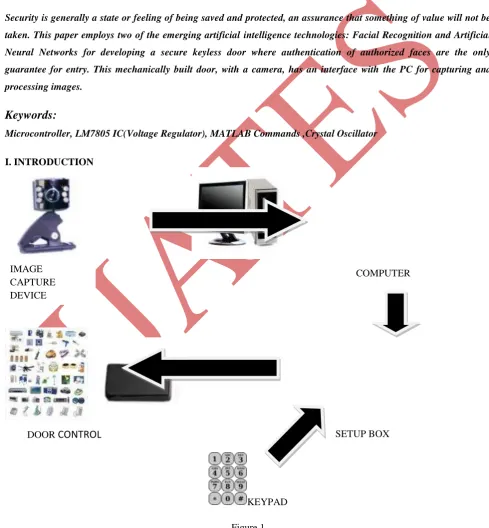
KEYPAD
Figure 1 IMAGE
CAPTURE DEVICE
COMPUTER
SETUP BOX
Page | 38
The future of computing is not limited to controlling the computers by our conventional door control like keyboards, mouse, joystick etc. The technologies are changing very rapidly and very soon it will be our conventional method to automate the system Different software companies as working on face recognition software including Math-Works. We will use MATLAB here for face detection. Humans often use faces to recognize individuals and over the past few decades advancement in computing has led to the recognitions automatically using the image acquiring hardware and computing algorithms. The algorithms had been developed through sophisticated mathematical computing and matching process to recognize the face of the individual. The development has propelled various face recognition technologies which add on to the security of the system. This technology can be used for the verification as well as identification (open set & close set operations). Automatic face recognition system is new concept emerged. This system requires the various features matching of the face by the administrator with a pre defined data. Facial recognition technology (FRT) has emerged as an attractive solution to address many contemporary needs for identification and the verification of identity claims. It brings together the promise attempt to tie identity to individually distinctive features of the body, and the more familiar functionality of visual surveillance systems. The whole project can be divided into two parts. Part one includes hardware and second includes software. In Hardware we are using the USB port of the computer, usb to uart interface, keypad unit and controller and of interface the door control. In software section we shall use MATLAB 2007/2011 to interact with the computer and USB port for communication for a recognition and notification sending and receiving from the real time hardware. In this project there are two levels of security that is first user has to enter the correct password (embedded) and then face is matched(MATLAB) then the door will open else in all cases alarm will activate.II.OPERATION AND HARDWARE DESIGN
In hardware the components are USB port, USB to UART voltage level converter controller to take input and generate output. To drive the motor we have used L293D IC capable of provide larger amount of current to drive the motor. We also have a keypad unit for user to enter the password.
In order to appreciate the complexity (and susceptibilities) of FRS, we need to get a sense of all the complex tasks that make up a system and how small variations in the system or environment can impact on these tasks. We will endeavor to keep the discussion on a conceptual level. However, from time to time, we will need to dig into some of the technical detail to highlight a relevant point.
(A) Facial recognition algorithms
Steps in the facial recognition process .Let us for the moment assume that we have a probe image with which to work. The facial recognition process normally has four interrelated phases or steps. The first step is face detection, the second is normalization, the third is feature extraction, and the final cumulative step is face recognition. These steps depend on each other and often use similar techniques. They may also be described as separate components of a typical FRS. Nevertheless, it is useful to keep them conceptually separate for the purposes of clarity. Each of these steps poses very significant challenges to the successful operation of a FRS.
(B) Detecting a face
Page | 39
(C) Normalization
Once the face has been detected (separated from its background), the face needs to be normalized. This means that the image must be standardized in terms of size, pose, illumination, etc., relative to the images in the gallery or reference database. To normalize a probe image, the key facial landmarks must be located accurately.
(D) Feature extraction and recognition
Once the face image has been normalized, the feature extraction and recognition of the face can take place. In feature extraction, a mathematical representation called a biometric template or biometric reference is generated, which is stored in the database and will form the basis of any recognition task. Facial recognition algorithms differ in the way they translate or transfer m a face image (represented at this point as grayscale pixels) into a simplified mathematical representation (the ―features‖) in order to perform the recognition task (algorithms will be discussed below). It is important for successful recognition that maximal information is retained in this transformation process so that the biometric template is sufficiently distinctive.
III. SOFTWARE- MATLAB
Mainly two Tool Boxes are used –
A. Image Acquisition
B. Image Processing
(A) Image Acquisition
It enables to acquire images from camera. (B) Image Processing
It processes the acquired image according to the specified algorithm (Principle Component Analysis) and displays the desired output.
IV. FACE RECOGNITION ALGORITHMS
The early work in face recognition was based on the geometrical relationships between facial landmarks as a means to capture and extract facial features. This method is obviously highly dependent on the detection of these landmarks (which may be very difficult is variations in illumination, especially shadows) as well as the stability of these relationships across pose variation. These problems were and still remain significant stumbling blocks for face detection and recognition. This work was followed by a different approach in which the face was treated as a general pattern with the application of more general patter n recognition approaches, which are based on photometric characteristics of the image. These two starting points: geometry and the photometric approach are still the basic starting points for developers of facial recognition algorithms. To implement these approaches a huge variety of algorithms have been developed:
A.
Principal Components Analysis (PCA)Page | 40
amount of data is discarded as not containing significant information since 90% of the total variance in the face is contained in 5-10% of the components. This means that the data needed to identify an individual is a fraction of the data presented in the image. Each face image is represented as a weighted sum (feature vector) of the principle components (or eigen faces), which are stored in a one dimensional array. Each component (Eigen face) represents only a certain feature of the face, which may or may not be present in the original image. A probe image is compared against a gallery image by measuring the distance between their respective feature vectors. For PCA to work well the probe image must be similar to the gallery image in terms of size (or scale), pose, and illumination. It is generally true that PCA is reasonably sensitive to scale variation.B. Linear Discriminate Analysis(LDA)
LDA is a statistical approach based on the same statistical principles as PCA. LDA classifies faces of unknown individuals based on a set of training images of known individuals. The technique finds the underlying vectors in the facial feature space (vectors) that would maximize the variance between individuals (or classes) and minimize the variance within a number of samples of the same person (i.e., within a class).
NOTE:The system has two level of security: First the user enters the password using keypad. If the password is correct the face recognition interface is opened. The user then checked for its face recognition and if it also matches then the system/door is opened. The alarm will be activated if the user is wrong at any stage.
V. RESULTS AND DISCUSSIONS
The developed face recognition based security system gives good response when some face is placed in front of camera. First we enter correct password, if password is correct then it detect the face and match it with database. If the face matches, door is opened otherwise alarm is ringed.
A. ADVANTAGES
1. It is a very user friendly.
2. Modernizes the entire tracking system.
3. Simple to operate and can be installed in a short time.
4. Easier to manage with very less demand on man-power.
5. It has a variable range of operation and hence it can be used at almost all places.
B. LIMITATIONS
1. Environmental effect & depends on camera resolution.
2. The face should not be more than 30 cm away from camera.
3. It is not fully-automatic.
Page | 41
VI. CONCLUSION
The face recognition based security system has been and tested with some particular users. The user can get alert when some unknown person try to enter the door. For this MATLAB toolboxes are used. The system has tested on the model of smart home and further it will be tested in actual home the complexity of the algorithm of the system can be increased by introducing more numbers of user. This paper provides a new concept in implementation of an effect face recognition based security system and also provide advantage of the technological advancement in daily life.
REFERENCES
[1] E. Hjelmås, and B. K. Low, ―Face detection: A survey‖, Computer Vision and Image Understanding, Vol. 83, No. 3, Sept. 2001, pp. 236-274.
[2] A. Abdallah, M. Abou El-Nasr, and A. Lynn Abbott, ―A New Face Detection Technique using 2D DCT and Self Organizing Feature Map‖ in Proc. of World Academy of Science, Engineering and Technology, Vol. 21, May 2007, pp. 15-19.
[3] J. Nagi, ―Design of an Efficient High-speed Face Recognition System‖, Department of Electrical and Electronics . Engineering, College of Engineering, UniversitiTenagaNasional, March 2007.
[4] D. Kumar, C.S. Rai, and S. Kumar, ―Face Recognition using Self- Organizing Map and Principal Component Analysis‖ in Proc. on Neural Networks and Brain, ICNNB 2005, Vol. 3, Oct 2005, pp. 1469-1473.
[5] E. Ifeachor and B. Jervis, Digital Signal Processing: A Practical Approach. Prentice Hall, 2001.
[6] L. Ma, Y. Xiao, and K. Khorasani, ―A new facial expression recognition technique using 2D DCT and k-means algorithm‖, in Proc. International Conference on Image Processing, Oct. 2004, pp. 1269-1272.
[7] K. Khorasani, ―Facial expression recognition using constructive feedforward neural networks‖, IEEE Transactions on Systems, Man and Cybernetics, Part B, Vol. 34, No. 3, June 2004, pp. 1588-1595.